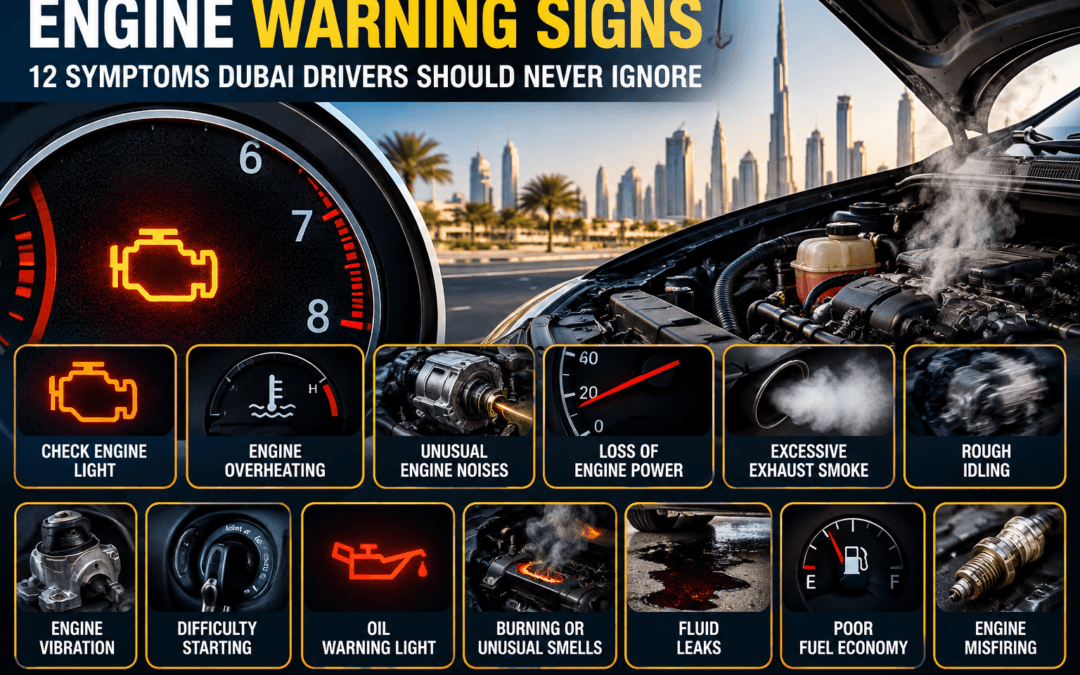
12 Symptoms Dubai Drivers Should Never Ignore
Your car’s engine usually gives warning signs before a serious mechanical problem develops. Strange noises, dashboard warning lights, overheating, smoke, vibration, loss of power or unusual smells can all indicate that something needs attention.
For drivers in Dubai, recognizing engine warning signs early is especially important. High temperatures, heavy traffic, long-distance driving and dusty conditions can place additional stress on the engine, cooling system, filters, fluids and electrical components.
Ignoring an early symptom may allow a relatively manageable problem to develop into a more complicated and expensive repair.
This guide explains the most common engine warning signs, what they may indicate, when you should stop driving and when professional engine diagnostics may be necessary.
Table of Contents
Why Engine Warning Signs Matter
Check Engine Light
Engine Overheating
Unusual Engine Noises
Loss of Engine Power
Excessive Exhaust Smoke
Rough Idling
Engine Vibration
Difficulty Starting
Oil Warning Light
Burning or Unusual Smells
Fluid Leaks
Poor Fuel Economy
Engine Misfiring
What to Do When an Engine Warning Sign Appears
How Professional Engine Diagnosis Works
How to Reduce Engine Problems in Dubai
Frequently Asked Questions
Conclusion
1. Why Engine Warning Signs Matter
An engine contains many components working together under heat, pressure and constant movement.
These include:
Pistons
Cylinders
Spark plugs
Fuel injectors
Sensors
Engine oil
Cooling system
Belts
Timing components
Air-intake system
Fuel-delivery system
Electrical components
A problem in one area can sometimes affect several others.
For example, an ignition problem may cause poor acceleration and increased fuel consumption. A cooling-system problem may lead to overheating. Low engine oil can reduce lubrication and potentially damage internal components.
Recognizing symptoms early gives you a better opportunity to investigate the actual cause before additional damage occurs.
2. Check Engine Light
One of the most common engine warning signs is the check engine light.
Modern vehicles use an engine control unit and multiple sensors to monitor engine operation. When the system detects a fault outside the expected range, it may store a diagnostic trouble code and illuminate the warning light.
Possible causes can include:
Faulty engine sensors
Ignition problems
Misfires
Fuel-system problems
Air-intake problems
Emission-system faults
Electrical issues
Loose or faulty components
A check engine light does not automatically mean that the engine itself has suffered major mechanical damage.
The correct approach is to perform a diagnostic scan and investigate the stored fault code.
Flashing Check Engine Light
A flashing check engine light can indicate a more urgent problem, such as a severe misfire on some vehicles.
If the light is flashing and the vehicle is running poorly, avoid unnecessary driving and arrange professional inspection.
3. Engine Overheating
Engine overheating is a warning sign that should never be ignored.
Common symptoms include:
Temperature gauge moving above normal
Temperature warning light
Steam from the engine area
Coolant smell
Reduced engine performance
Coolant leaking underneath the vehicle
Possible causes include:
Low coolant
Coolant leaks
Faulty thermostat
Cooling fan failure
Radiator problems
Water-pump problems
Damaged hoses
Electrical faults
More serious internal engine problems
Dubai’s hot climate can make cooling-system weaknesses more noticeable, particularly during traffic or long periods of driving.
If your engine temperature rises significantly, find a safe place to stop.
Never open a hot radiator cap. The cooling system may be pressurized and hot coolant or steam can cause serious burns.
For a detailed explanation, see our complete guide to Car Overheating in Dubai.
4. Unusual Engine Noises
A healthy engine should normally operate with a reasonably consistent sound.
New or unusual noises deserve attention.
Knocking Sound
A knocking sound may have several possible causes depending on when and where it occurs.
It can sometimes be related to combustion, lubrication or internal engine problems.
Ticking Noise
Ticking may be associated with:
Low oil level
Valve-train components
Injectors
Lubrication problems
Other moving engine parts
Some engines naturally produce a certain amount of ticking, so professional inspection is useful when the sound is new or becoming louder.
Squealing Sound
Squealing can sometimes indicate:
Belt wear
Tensioner problems
Pulley problems
Accessory-component issues
Grinding Noise
Grinding should be investigated promptly, particularly if it occurs while starting, shifting gears or operating accessories.
The important point is not to diagnose the vehicle from sound alone.
A technician should determine the source before parts are replaced.
5. Loss of Engine Power
A noticeable decrease in acceleration or engine performance can indicate several different problems.
Possible causes include:
Restricted air filter
Fuel-delivery problem
Ignition fault
Sensor malfunction
Turbocharger problem
Exhaust restriction
Engine overheating
Transmission-related issue
You may notice that:
Acceleration feels slower
The vehicle struggles uphill
Engine response is delayed
The vehicle enters reduced-power or limp mode
If the power loss appears suddenly, particularly together with warning lights or abnormal sounds, have the vehicle inspected.
6. Excessive Exhaust Smoke
The appearance of exhaust smoke can provide useful clues about engine operation.
However, exhaust appearance can vary with vehicle type, temperature and operating conditions.
Blue Smoke
Persistent blue-colored smoke can sometimes indicate that engine oil is entering the combustion process.
Possible causes may involve:
Worn internal components
Valve-related issues
Turbocharger problems
Other oil-consumption faults
White Smoke
Some light vapour when starting a cold engine can be normal.
Persistent heavy white smoke, especially combined with coolant loss or overheating, deserves professional investigation.
Black Smoke
Black exhaust smoke can indicate excessive fuel in the combustion mixture.
Possible causes include:
Fuel-system issues
Air-intake restriction
Injector problems
Sensor faults
Persistent smoke should not simply be ignored.
7. Rough Idling
When a vehicle is stationary and the engine is running, it should normally maintain a relatively stable idle.
Signs of rough idling may include:
Engine shaking
RPM moving up and down
Uneven engine sound
Vehicle vibration
Engine almost stalling
Possible causes include:
Spark-plug problems
Ignition coil issues
Fuel injector problems
Vacuum leaks
Air-intake problems
Sensor faults
Fuel-delivery issues
Because many problems can cause similar symptoms, proper diagnostic testing is important.
8. Engine Vibration
Some vibration is normal in any running vehicle.
However, excessive or new vibration may indicate a problem.
Possible causes can include:
Engine misfire
Worn engine mounts
Ignition problems
Fuel-delivery problems
Internal mechanical issues
Drivetrain problems
Pay particular attention if vibration occurs together with:
Check engine light
Reduced acceleration
Rough idle
Unusual noises
These combinations can provide useful diagnostic clues.
9. Difficulty Starting
An engine that takes longer than usual to start may have a problem in the starting, fuel, ignition or electrical system.
Possible causes include:
Weak battery
Faulty starter motor
Fuel-pressure problem
Ignition problem
Sensor fault
Electrical connection issue
If the engine does not crank at all, the issue may be electrical rather than an internal engine problem.
This is why battery, starter and alternator testing may be needed before assuming that engine repair is required.
10. Oil Warning Light
The engine oil warning light requires immediate attention.
It may indicate low oil pressure or another lubrication-related issue.
Possible causes include:
Low engine oil
Oil leak
Oil-pump problem
Blocked oil passage
Faulty pressure sensor
Internal engine wear
If the oil-pressure warning light remains illuminated while driving, continuing to operate the engine could cause serious damage.
Stop safely and follow your vehicle manufacturer’s instructions.
Do not assume that simply adding oil will always solve the problem.
11. Burning or Unusual Smells
Unusual smells can indicate several different vehicle problems.
Burning Oil Smell
May be caused by oil leaking onto hot engine components.
Sweet Smell
Can sometimes indicate coolant leakage.
Burning Rubber Smell
May be associated with:
Belt problems
Hoses touching hot components
Electrical issues
Other overheating components
Fuel Smell
A strong fuel smell should be investigated promptly.
Fuel leaks can present a safety risk.
If you smell fuel strongly around the vehicle, avoid unnecessary driving and arrange inspection.
12. Fluid Leaks
Fluid underneath your vehicle should not automatically be ignored.
Different fluids can include:
Engine oil
Coolant
Transmission fluid
Brake fluid
AC condensation water
Power-steering fluid on vehicles using hydraulic systems
Not every fluid under a vehicle represents an emergency.
For example, clear water under the vehicle after using the air conditioner may simply be AC condensation.
However, dark oil, coloured coolant or other unusual fluids should be investigated.
13. Poor Fuel Economy
If your fuel consumption suddenly becomes significantly worse without an obvious change in driving conditions, an engine-related issue may be contributing.
Possible causes include:
Dirty air filter
Incorrect tyre pressure
Faulty sensors
Ignition problems
Fuel injector issues
Engine misfires
Fuel-system problems
Air-conditioning use, traffic and driving style also affect fuel economy, so fuel consumption alone cannot diagnose a mechanical problem.
Look for changes compared with your vehicle’s normal performance.
14. Engine Misfiring
A misfire occurs when combustion does not occur correctly in one or more cylinders.
Symptoms may include:
Rough engine operation
Shaking
Poor acceleration
Check engine light
Increased fuel consumption
Unusual exhaust behaviour
Possible causes include:
Spark Plugs
Worn or damaged spark plugs may affect combustion.
Ignition Coils
A faulty ignition coil can prevent a cylinder from firing correctly.
Fuel Injectors
Dirty, blocked or malfunctioning injectors may affect fuel delivery.
Air or Vacuum Problems
Unmetered air entering the engine can interfere with the fuel-air mixture.
Compression Problems
Internal engine problems may also cause misfires.
A diagnostic scan can help identify which cylinder or system requires further investigation.
15. What to Do When an Engine Warning Sign Appears
The correct response depends on the severity of the symptom.
Step 1: Check the Dashboard
Look for:
Check engine light
Temperature warning
Oil-pressure warning
Battery/charging warning
Other vehicle-specific alerts
Step 2: Pay Attention to Vehicle Behaviour
Notice whether the vehicle has:
Lost power
Started vibrating
Developed unusual noises
Begun overheating
Started producing smoke
Step 3: Reduce Unnecessary Load
If the engine appears to be struggling, avoid aggressive acceleration or unnecessary high engine speeds.
Step 4: Stop if the Problem Appears Serious
Stop safely if you experience:
Severe overheating
Oil-pressure warning
Heavy smoke
Strong fuel smell
Major loss of power
Severe knocking or grinding
Significant fluid loss
Step 5: Arrange Professional Diagnosis
Do not replace parts simply based on one symptom.
Different mechanical and electrical problems can produce similar warning signs.
16. How Professional Engine Diagnosis Works
Professional engine diagnosis should identify the actual cause before major parts are replaced.
A typical process may include:
Computer Diagnostic Scan
The vehicle is scanned for stored fault codes and relevant live data.
Visual Inspection
The technician may inspect:
Wiring
Connectors
Hoses
Belts
Fluid levels
Air intake
Visible leaks
Battery and Charging Test
Low system voltage can sometimes create symptoms or fault codes that appear unrelated.
Ignition Testing
Spark plugs, ignition coils and related components may be checked.
Fuel-System Inspection
Depending on symptoms, fuel pressure or injector operation may require inspection.
Cooling-System Check
If overheating is involved, the radiator, coolant, fans, thermostat, hoses and water pump may need evaluation.
Mechanical Testing
When necessary, additional tests may be performed to assess internal engine condition.
The exact diagnostic process depends on the vehicle and symptoms.
17. How to Reduce Engine Problems in Dubai
Preventive maintenance is usually easier than dealing with a major breakdown.
Check Engine Oil Regularly
Engine oil lubricates and protects moving internal components.
Follow the oil type and replacement interval specified by the vehicle manufacturer.
Maintain the Cooling System
Check:
Coolant level
Hoses
Radiator condition
Cooling fans
Signs of leakage
Dubai’s high temperatures make cooling-system condition particularly important.
Replace Filters When Required
Dirty air or fuel filters can affect engine performance.
Follow manufacturer recommendations rather than waiting until symptoms appear.
Do Not Ignore Dashboard Lights
Warning lights are designed to alert you to potential problems.
Investigate recurring or persistent warnings.
Address Leaks Early
Small fluid leaks can sometimes become larger over time.
Pay Attention to Changes
You know how your vehicle normally feels and sounds.
A new:
Noise
Smell
Vibration
Warning light
Temperature change
Performance drop
is worth investigating.
18. Frequently Asked Questions
What is the most serious engine warning sign?
There is no single warning sign that is always the most serious. However, severe overheating, an oil-pressure warning, heavy smoke, significant knocking, major fluid loss or sudden loss of power can require immediate attention.
Can I drive with the check engine light on?
It depends on why the light is illuminated and how the vehicle is behaving. A steady light with otherwise normal operation may be less urgent than a flashing light accompanied by rough running. A diagnostic scan is the safest way to identify the issue.
Why is my engine shaking?
Engine shaking can be caused by misfires, ignition problems, fuel-delivery issues, worn engine mounts or other mechanical problems. Proper diagnosis is required.
Why does my car lose power when accelerating?
Possible causes include fuel-system problems, ignition faults, airflow restrictions, sensor problems, overheating or transmission issues.
Why does my engine overheat in Dubai traffic?
Low-speed traffic reduces natural airflow through the radiator. If the cooling fan, radiator, coolant level, thermostat or another cooling component has a problem, overheating may become more noticeable in traffic.
Is an engine warning light always expensive to repair?
No. Warning lights can be triggered by problems ranging from relatively simple sensor or electrical issues to more significant mechanical faults. Diagnosis should come before estimating repair cost.
Should I replace parts immediately after getting a fault code?
Not necessarily. A fault code identifies the system where a problem was detected but does not always prove that a particular component is defective. Further testing may be required.
19. When Should You Get Professional Help?
Arrange professional inspection if your vehicle shows repeated or serious engine symptoms such as:
Check engine light
Engine overheating
Excessive smoke
Rough idle
Misfiring
Loss of power
Strong vibration
Oil warning light
Fluid leaks
Unusual engine noises
Difficult starting
Burning or fuel smells
Early diagnosis can help identify the problem before additional components are affected.
Conclusion
Engine problems rarely improve simply by being ignored.
Modern vehicles use mechanical, electrical and computerized systems that work together, so a single symptom can have several possible causes.
The safest approach is to recognize engine warning signs early, avoid continuing to drive when a serious warning appears and have the vehicle properly diagnosed before replacing parts.
For Dubai drivers, regular maintenance becomes even more important because extreme temperatures, traffic and demanding driving conditions can expose weaknesses in the engine and cooling system.
If your vehicle has developed a warning light, unusual noise, overheating problem, vibration, loss of power or another engine symptom, professional diagnosis can help identify the actual cause and determine the appropriate repair.