
In Dubai, a car's air conditioning is not a comfort feature — it is the difference between a bearable drive and a dangerous one. Cabin temperatures in a parked car climb fast, and a failing AC system turns every trip into an endurance test. Yet AC faults are among the most misunderstood repairs: drivers pay for gas refills that leak away within days, compressors replaced when the fault was electrical, and "repairs" that cool the car for a week and then fail again.
This complete guide explains how car air conditioning works, the faults that stop it cooling, what gas refilling actually involves and when it is the wrong answer, how proper diagnosis finds the real fault, and what a mobile AC service visit looks like — so the driver knows what should happen before anyone opens the bonnet.
How Car Air Conditioning Works
Car AC does not create cold air; it removes heat from the cabin and dumps it outside, using refrigerant circulating through a sealed loop. The cycle has four main stages. The compressor, driven by the engine, pressurises the refrigerant gas. The condenser, mounted at the front of the car, cools that pressurised gas until it condenses into a liquid, releasing heat to the outside air. The expansion valve or orifice tube meters the liquid refrigerant into the evaporator inside the dashboard, where it expands, evaporates, and absorbs heat from the cabin air blown across it. The blower fan pushes that cooled, dehumidified air through the vents. The refrigerant returns to the compressor, and the cycle repeats.
Every component in that loop must work for the system to cool. A weak compressor cannot pressurise the gas. A blocked condenser cannot release heat. A clogged expansion valve starves the evaporator. A failed blower moves no air. And any leak anywhere in the loop lets the refrigerant escape, which is why a system that cools weakly usually has a cause that a simple refill cannot fix permanently. Understanding the loop is what makes the diagnosis section below make sense — and what separates a technician who finds the fault from one who just adds gas.
The Common Faults: What Stops a Car AC Cooling
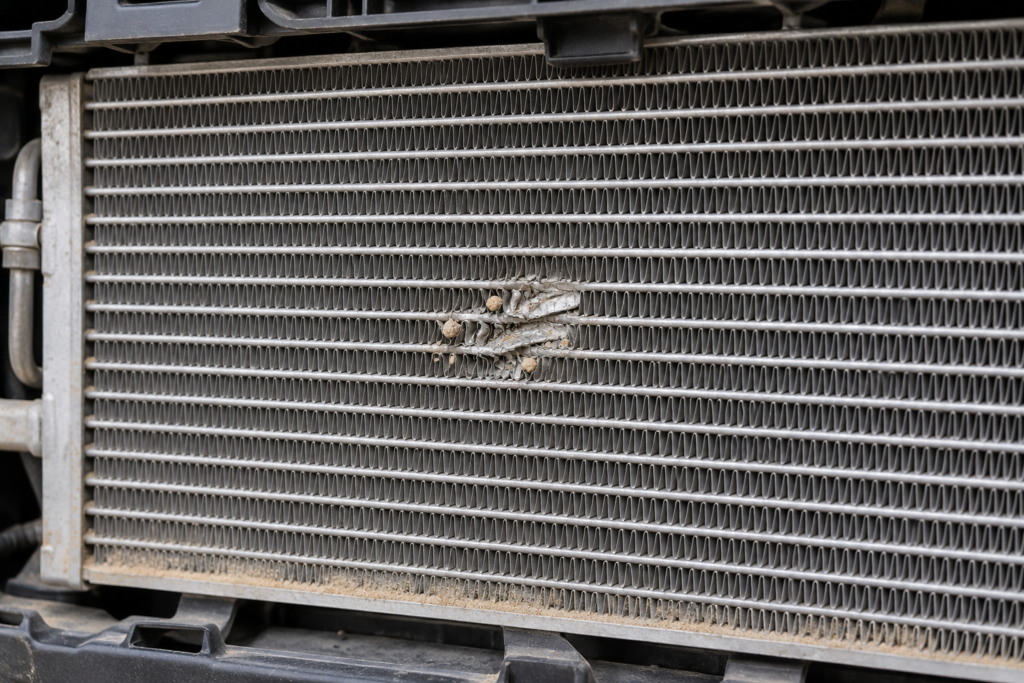
Weak or warm airflow has a short list of usual causes, and each feels different. Low refrigerant from a leak is the most common: cooling fades gradually, works better at speed than at idle, and eventually stops altogether. A failing compressor shows as no cooling at all, unusual noises when the AC is switched on, or the compressor clutch not engaging. A blocked or damaged condenser — often from road debris or bent fins — causes poor cooling especially in traffic, when airflow is low. A faulty expansion valve causes erratic cooling, freezing evaporator coils, or warm air that comes and goes.
Electrical faults are the quiet mimics: a blown fuse, a failed relay, a faulty pressure switch, or a broken wire can disable the whole system while every mechanical part is healthy. The blower motor and its resistor fail too, producing no airflow or only one fan speed. And the cabin filter, when clogged with dust, strangles airflow so badly that drivers assume the AC itself has failed — a cheap fix that is easy to miss. Each cause needs its own test; guessing between them is how drivers pay for a compressor when the fault was a relay.
Gas Refilling: What It Is, and Why "Just Top It Up" Usually Fails
Refrigerant gas does not get "used up" the way fuel does. In a sealed, healthy system, the charge lasts for years. When the gas level is low, it is low because it leaked out — through a worn seal, a corroded line, a damaged condenser, or a loose fitting. Refilling a leaking system without finding the leak is pouring water into a bucket with a hole: the car cools for days or weeks, the gas escapes again, and the driver pays twice — once for the refill, once for the repair that should have come first.
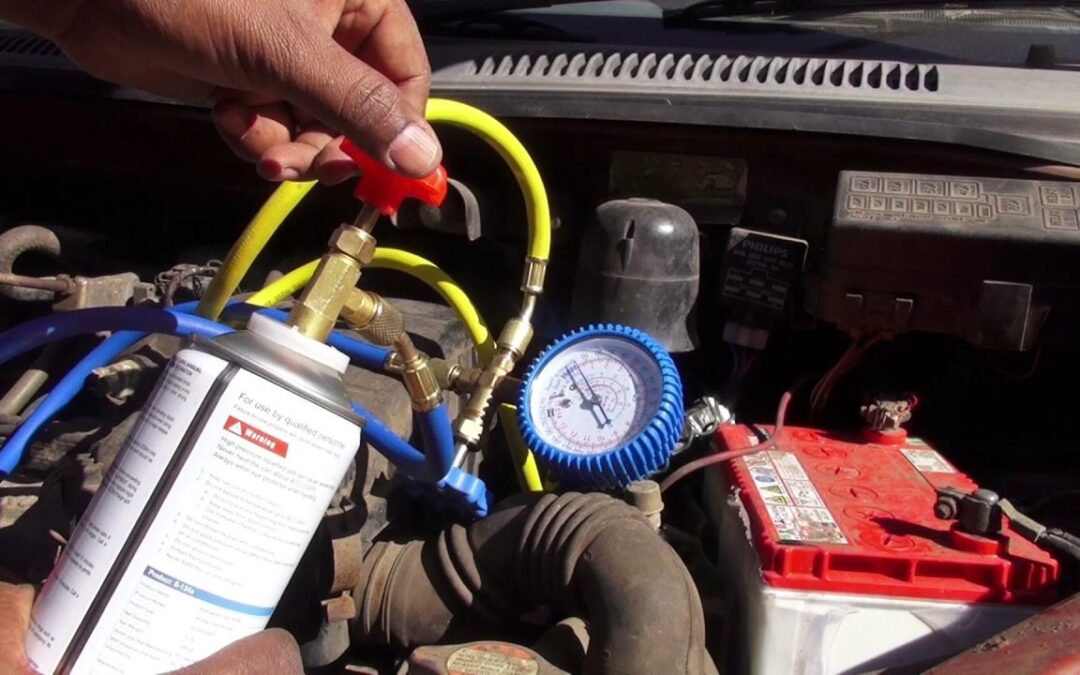
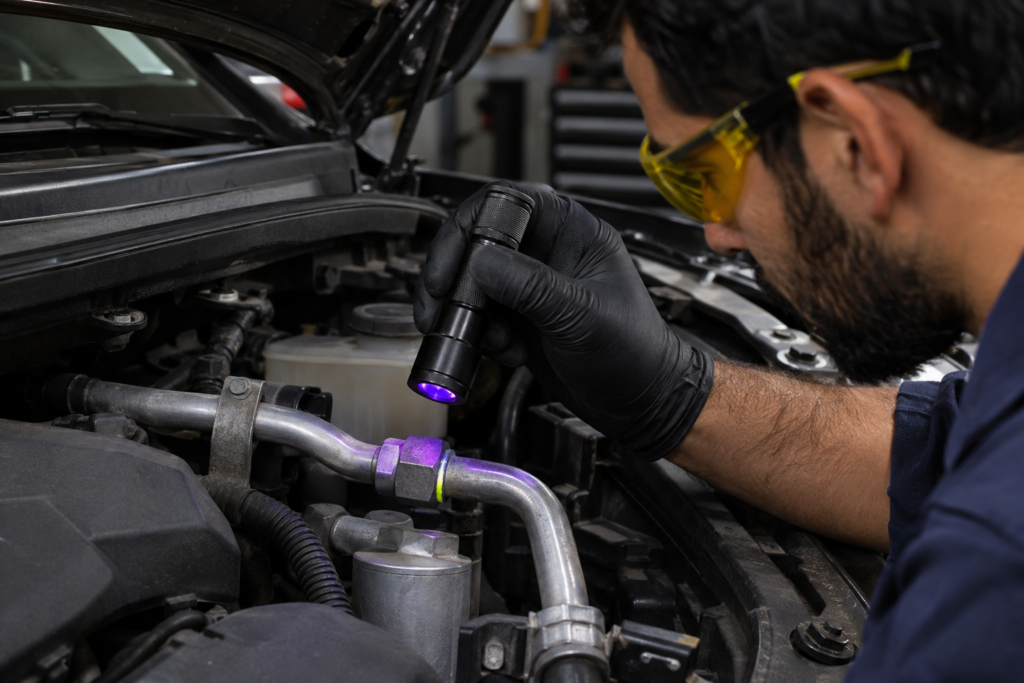
A proper gas service therefore starts with leak detection, not with the refill machine. The system is pressure-tested, and leaks are found with electronic detectors, UV dye, or nitrogen testing depending on the situation. Only when the system holds pressure is it evacuated — the old gas and moisture removed under vacuum — and recharged with the correct refrigerant type and exact quantity for the vehicle. Too little gas under-cools; too much gas over-pressurises the system and can damage the compressor. The specification is checked, not estimated. And if a previous refill has already failed, the reason is almost always an unfixed leak: the guide to car AC not cooling after a gas refill explains that specific problem in detail.
Refrigerant Types & Why the Right One Matters
Not all refrigerant is the same, and using the wrong type damages the system. Older vehicles use R134a; newer models increasingly use R1234yf, a lower-global-warming-potential gas with different handling requirements and different service fittings, deliberately designed so the two cannot be mixed by accident. The correct type is printed on a label under the bonnet and specified in the owner's manual, and it is checked before any service begins. Mixing refrigerants, or charging a system with the wrong gas, causes poor cooling, incorrect pressures, and potential compressor damage — and it contaminates the system so that a proper recovery and recharge becomes more involved. The quantity matters as much as the type: the manufacturer's charge weight, in grams, is the specification, and it is weighed in with a scale, not estimated from gauge pressure alone. A service that cannot say which refrigerant the car takes and how much it holds has not done the homework the job requires.
Diagnosis First: Finding the Real Fault
Proper AC diagnosis follows evidence through the loop. It starts with the symptoms and a visual inspection: condenser condition, belt and clutch operation, visible oil stains at joints (refrigerant leaks leave an oily trace), and cabin filter state. Then pressures are read with manifold gauges: high-side and low-side readings together reveal whether the system is undercharged, overcharged, blocked, or suffering a weak compressor — each fault has a characteristic pressure pattern. Electrical checks follow: fuses, relays, pressure switches, clutch engagement, and blower operation. Temperature readings at the vents confirm how much cooling the system actually delivers, and leak detection confirms whether the sealed loop is intact.
Only with those results does the conversation turn to repair. The driver is told what was found, what the repair involves, and what it costs — confirmed before work begins. A compressor is not replaced on a hunch, a refill is not sold to a leaking system, and a relay fault is not dressed up as a compressor failure. That discipline is what makes the repair last: the cause is fixed, not the symptom masked.
Compressor, Condenser & Evaporator: The Big Three Explained
The compressor is the heart of the system and the most expensive component — which is why it is the most over-replaced. A genuinely failed compressor shows specific signs: seizure, internal noise, clutch failure, or metal debris in the system. When a compressor fails internally, debris can contaminate the whole loop, and a proper repair includes flushing the system and replacing the receiver-drier — skipping that step is how a new compressor dies young. But a compressor that simply does not engage may have an electrical fault, a pressure-switch fault, or a low charge cutting it out for protection. Testing separates the two.
The condenser sits exposed at the front of the car, collecting debris, dust, and stone damage. Bent fins reduce heat rejection; a punctured condenser leaks gas fast. Cleaning and fin-straightening restore some condensers; damaged ones are replaced. The evaporator, hidden inside the dashboard, is the hardest to reach — which is why evaporator leaks and blockages are among the most labour-intensive AC repairs, and why accurate diagnosis before dashboard removal matters so much. All three components are repaired or replaced based on test results, never on assumption.
Smells, Mould & Cabin Air Quality
A musty smell when the AC starts is usually microbial growth on the evaporator and in the ducting — warm, damp, and dark, the evaporator is ideal habitat for mould and bacteria. The smell is unpleasant, and for drivers with allergies or asthma it is more than that. The fix combines cleaning the evaporator and ducts with an antibacterial treatment, and replacing a clogged cabin filter that is holding dust and moisture. Prevention is simple: running the fan for a few minutes with the AC off before switching the car off dries the evaporator, and replacing the cabin filter on schedule keeps the air path clean. If the smell returns quickly after cleaning, the drain may be blocked — the evaporator's condensate drain, when clogged, leaves standing water that feeds regrowth and can soak the cabin floor. A damp passenger footwell with the AC running points straight at that drain.
Maintaining Car AC in Dubai: Habits That Keep It Cold
AC maintenance is mostly prevention. Run the system regularly, even in cooler months: the refrigerant carries oil that lubricates the compressor seals, and long disuse lets seals dry and leak. Replace the cabin filter on schedule — in Dubai's dusty air, sooner than the manual's headline interval is often wise. Keep the condenser clear: a gentle rinse of the front grille area removes the dust and debris that insulate it. Listen for changes: new noises on engagement, cooling that fades at idle, or a smell that was not there last month are all early warnings worth investigating while they are cheap. And have the system checked before summer, not during the first heatwave — a pressure check and inspection in the cooler months finds the leak that would otherwise fail the car in July.
AC & Engine Performance: The Load Question
Drivers sometimes notice the engine working harder with the AC on — a slight drop in acceleration, a small rise in fuel consumption, a fan running more often. That is normal: the compressor draws engine power, and the cooling fans work harder to reject the extra heat. What is not normal is a dramatic loss of power, stalling at idle when the AC engages, or overheating in traffic. Those point to faults elsewhere — a weak idle-control system, a failing cooling fan, a partially blocked radiator, or a compressor drawing excessive load because it is failing internally. The AC exposes weaknesses in the cooling and idle systems that hide when it is off, which is why a thorough AC visit includes a glance at engine temperature behaviour and fan operation. Fixing the underlying weakness restores both the cooling and the engine's composure; blaming the AC alone misses the cause.
What AC Repair Costs — and How Quotes Work
Service prices at 95 Services are kept very low as a matter of policy, and AC work follows the same rule as every other job: diagnosis first, then the scope and price discussed and confirmed before repair work begins. No component is replaced on a guess, and no surprise appears on the bill afterwards. The quote reflects what testing found — whether the fault is a leak, a component, an electrical issue, or a combination — plus the correct refrigerant and parts for the vehicle and the labour the repair requires.
What affects the cost is straightforward: the fault found, the part the vehicle needs, the refrigerant type and quantity, and the access the repair requires — a relay or a filter costs far less than a compressor or an evaporator, which is exactly why diagnosis comes first. The driver pays for the fault found, not for the most expensive guess. If inspection reveals more than expected, the driver hears about it first and approves the next step.
Mobile AC Service or Workshop Visit?
Diagnosis, pressure testing, leak detection, gas service, filter replacement, and many component repairs are realistic mobile jobs, done where the car stands. The equipment travels: gauges, leak detectors, vacuum pump, and charging equipment all work at the location. Dashboard-removal work, evaporator replacement, and jobs needing extended workshop access are honestly directed to the workshop — and where the car cannot be driven comfortably, car recovery brings it there. The choice is made after diagnosis, case by case, not assumed in advance. Either way, the response time, the low prices, and the confirmed quote stay the same.

How It Works: From Your Call to Cold Air
Every AC job follows the same five steps. First, the call: phone or WhatsApp with the location, vehicle details, and symptoms. Second, the response: help dispatched within the 15–20 minute standard, anywhere in the complete UAE. Third, diagnosis: inspection, pressure readings, electrical checks, and leak detection to find the real cause. Fourth, the quote: scope, parts, and price confirmed before any repair work begins. Fifth, repair and verification: the agreed work completed, pressures and vent temperatures re-checked, and the system run to confirm cooling holds — not just at idle, where a weak system can hide. That sequence never changes, because speed without diagnosis is guessing, and a repair without testing is a promise unverified.
Frequently Asked Questions
Why does my car AC blow warm air?
The usual causes are low refrigerant from a leak, a compressor or electrical fault, a blocked condenser, or a failed blower or cabin filter. Pressure readings and electrical checks identify which — guessing between them wastes money.
How often does car AC gas need refilling?
In a healthy sealed system, refrigerant lasts for years. If gas is low, it leaked. A proper service finds and fixes the leak before recharging, so the refill lasts.
Is a gas refill enough to fix weak cooling?
Only if the system is leak-free and the charge is genuinely low. If a previous refill faded quickly, an unfixed leak is the likely cause, and refilling again without repair repeats the failure.
Why does my car AC smell bad?
Mould and bacteria on the damp evaporator and in the ducts, often with a clogged cabin filter. Cleaning, antibacterial treatment, and a new filter fix it; a blocked condensate drain causes it to return.
How fast can help reach me?
The response time is 15–20 minutes. Call or WhatsApp +971 54 344 3513 with a live location, vehicle details, and symptoms, and help is dispatched to reach the vehicle within 20 minutes, anywhere in the UAE.
Are 95 Services prices low?
Yes — service prices are kept very low as a matter of policy. Diagnosis comes first, and the scope and price are confirmed before repair work begins, with no work starting without the customer's approval.
Contact 95 Services: Car AC Repair & Gas Refilling Across the UAE
Whether the AC blows warm, fades in traffic, makes a new noise, or smells when it starts, the first step is one call. Contact 95 Services on +971 54 344 3513 by phone or WhatsApp, or email info@95services.com, with the vehicle details, the location, and the symptoms. Help is dispatched within the 15–20 minute response standard, prices stay very low, and the quote is confirmed before any work begins. The office is at Ahmed Ali Al Owais Showroom Building, Office M05, Abu Hail, Al Khabaisi, Dubai, UAE. Call before visiting so the correct service arrangement can be confirmed. For dedicated AC work, see car AC repair Dubai, for general repairs see car repair and maintenance, or visit the contact page to send an enquiry.
