
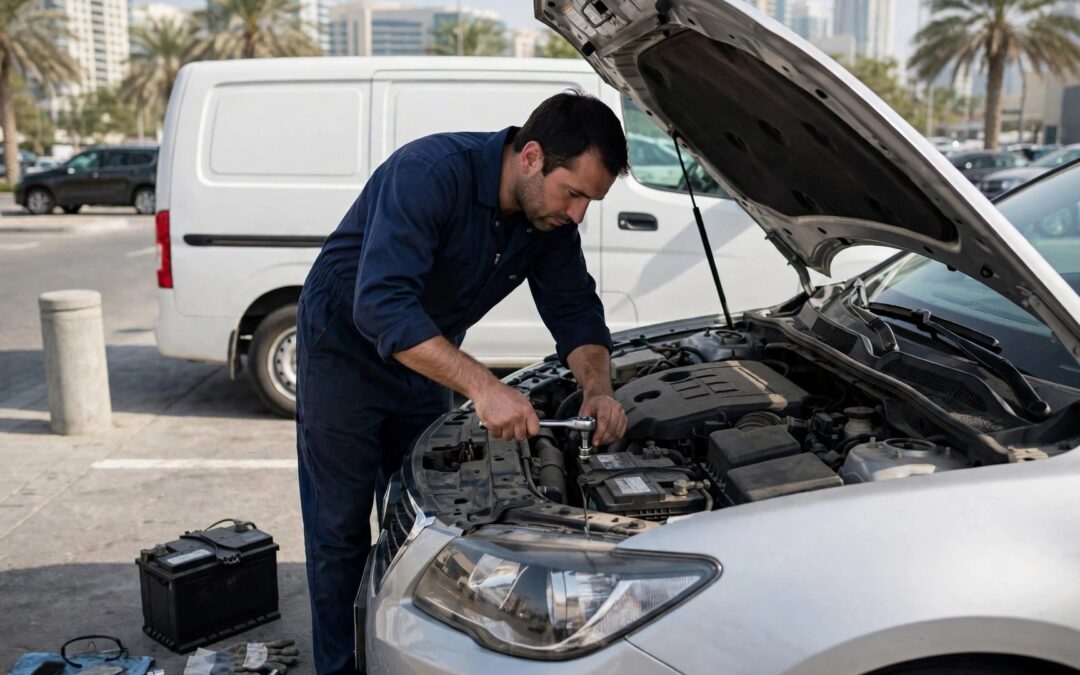
A car that will not start changes the whole day in seconds. The dashboard stays dark, the starter clicks or says nothing at all, and a schedule built around that car suddenly has no transport in it. Mobile car battery replacement exists for exactly that moment: instead of arranging a tow to a garage, a technician comes to the car — at home, at work, in a car park, or at the roadside — tests the battery and the charging system on the spot, fits the correct replacement where one is needed, and checks that the car starts and charges properly before leaving.
This article explains how mobile battery replacement works in Dubai, what a proper on-site visit includes, how to tell a dying battery from a deeper electrical fault, what affects battery life in UAE heat, and what to expect on price — so that the next no-start morning is a short delay, not a lost day.
Help in 15–20 Minutes, Anywhere in the UAE
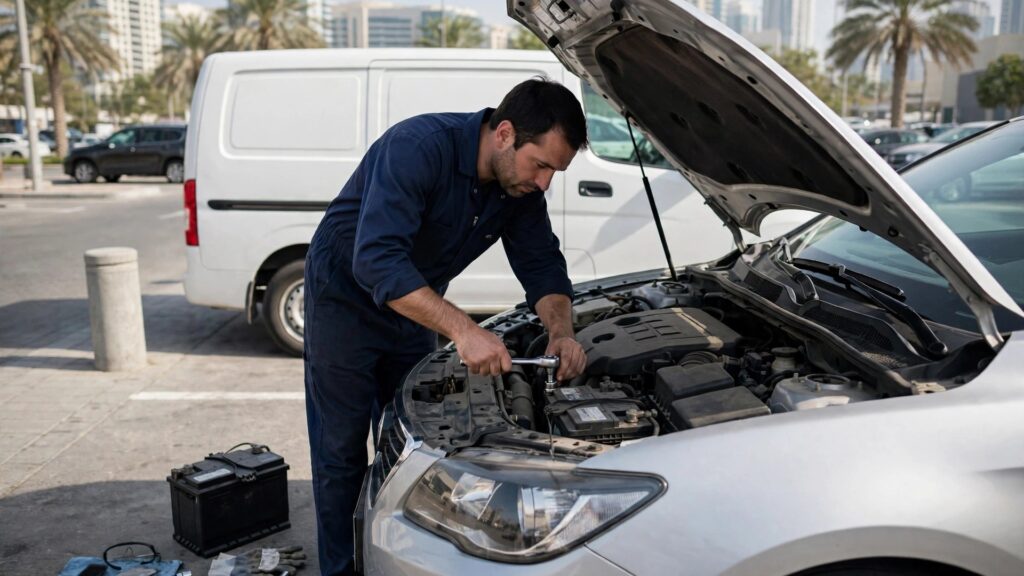
When a battery dies, waiting is the worst part. 95 Services runs a 15–20 minute response time for mobile battery help: call or WhatsApp, share a live location and the vehicle details, and help is dispatched to reach the vehicle within 20 minutes. Services cover the complete UAE — Dubai, Sharjah, Abu Dhabi, Ajman, Ras Al Khaimah, Fujairah, and Umm Al Quwain — so a driver anywhere in the country calls the same number and gets the same response standard.
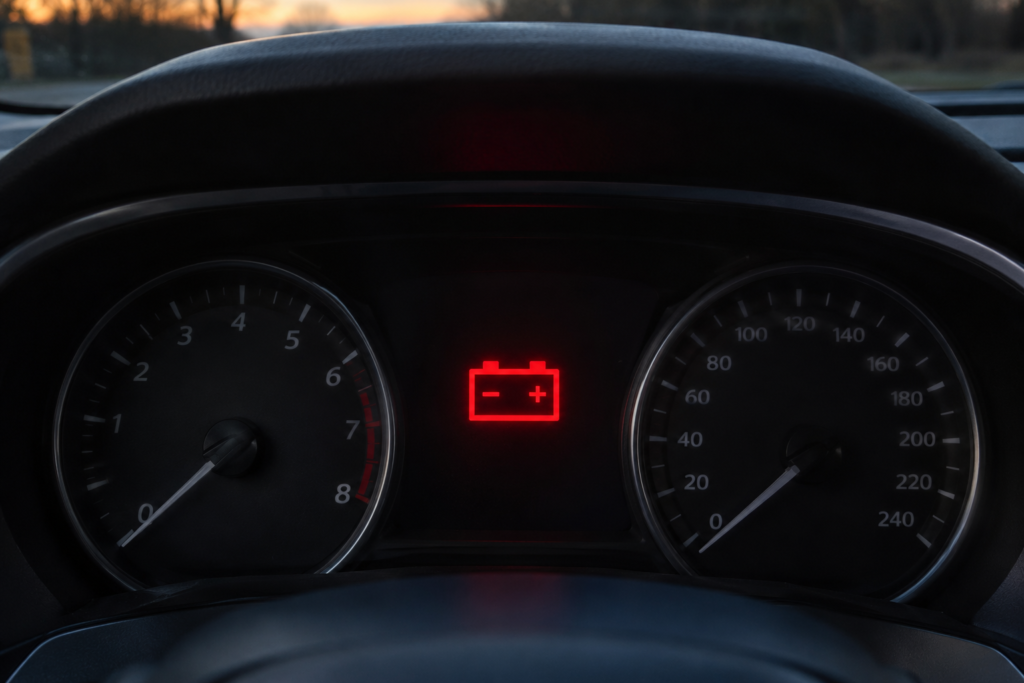
For the fastest help, share three things in the first message: the exact location as a live pin, the vehicle make, model, and year, and what happened — whether the car clicks, cranks slowly, shows a battery warning light, or does nothing at all. A photograph of the dashboard warning lights helps too. With those details, the technician arrives with the right testing equipment and a clear idea of what to check first, instead of spending the first minutes working out what kind of fault it might be.
What a Mobile Battery Visit Actually Includes
A proper mobile battery replacement is more than swapping one box for another. A rushed swap without testing is how drivers end up with a new battery fitted onto a faulty charging system — and the same dead car a few days later. A complete on-site visit follows five steps.
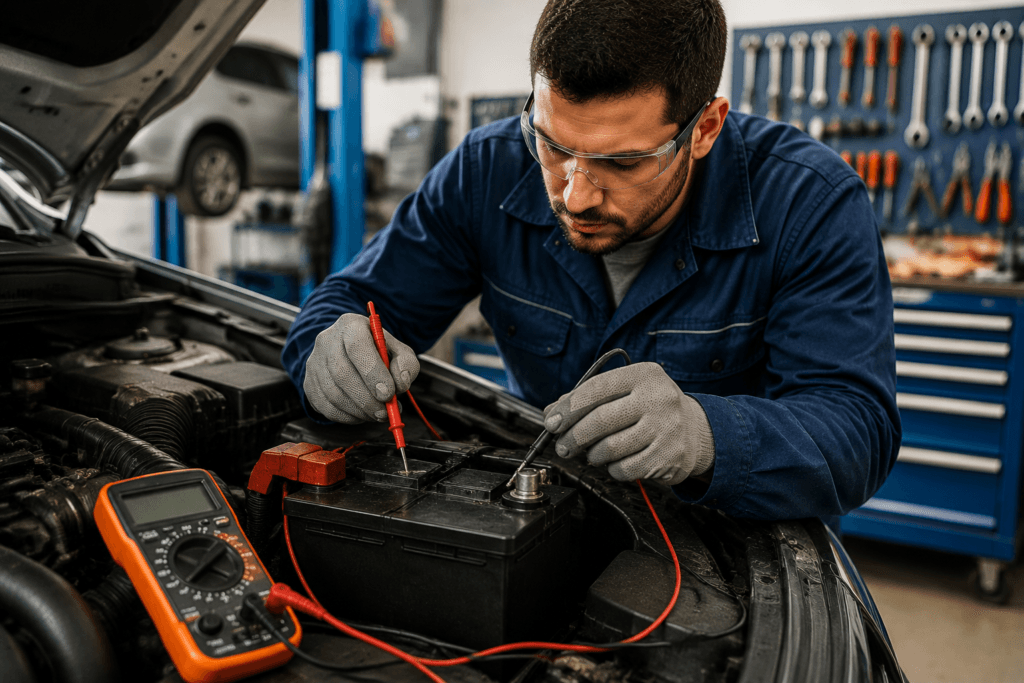
First, battery testing. A conductance or load test measures the battery's real condition: its voltage at rest, its ability to deliver starting current, and whether it holds a charge. A battery can show a healthy-looking voltage and still fail under load, which is why a proper test matters more than a glance at a dashboard light. The result answers the central question honestly: is this battery finished, or is something else draining or failing to charge it?
Second, charging-system checks. With the engine running, the alternator output, belt condition, and terminal connections are checked. A failing alternator, a slipping belt, or a corroded terminal can all mimic a dead battery — and fitting a new battery without checking them leaves the real fault in place. This step is what separates a replacement from a repair: the cause is found, not just the symptom.
Third, correct battery selection. Batteries differ by size, terminal layout, capacity, and cold-cranking performance, and fitting the wrong specification can cause poor starting, short life, or damage to hold-downs and cables. The replacement is matched to the vehicle's requirements and physical battery tray, not chosen by what happens to be on the van. Start-stop vehicles need particular care, because they require battery types designed for repeated cycling.
Fourth, fitting and connection care. Terminals are cleaned, connections are tightened to the right tension, hold-downs are secured, and any battery monitoring sensor is handled correctly. Corrosion on terminals is cleaned rather than covered up, because a dirty connection adds resistance and mimics a weak battery. The work area is left clean, and the old battery is taken away for proper handling rather than left behind.
Fifth, start and charging verification. The car is started, the charging voltage is confirmed, warning lights are checked, and accessories — lights, air conditioning, infotainment — are run briefly to confirm the system copes under load. The driver is told what was found, what was fitted, and what to watch for. Only then is the job finished.
Signs a Battery Is Failing — and When It Is Something Else
Batteries rarely fail without warning, but the warnings are easy to dismiss until the morning the car will not start. Slow cranking — the engine turning over noticeably more slowly than usual — is the most common early sign. Dim headlights at idle that brighten when the engine revs, a battery warning light, a swollen battery case, corrosion around the terminals, and electrical quirks such as slow windows or a resetting clock all point toward a battery near the end of its life. A full guide to the signs a battery needs replacement explains each symptom in detail.
Not every no-start is a battery, though. A single loud click with no cranking can be a starter motor fault. A car that starts with a jump and then dies again within minutes usually has a charging fault, not just a flat battery. A car that drains a new battery overnight has a parasitic drain — something drawing current while the car is off — and needs electrical diagnosis, not another battery. The guide to a car battery dying overnight explains the drains and charging faults behind repeated discharge. Honest testing tells these cases apart before any money is spent on parts.
Jump Start or Replacement? How the Decision Is Made
A jump start and a replacement solve different problems, and choosing wrong wastes time or money. A jump start is right when the battery is flat but healthy — left lights on, a long stand, a single deep discharge — and the charging system is working. Flat battery assistance brings jump-start help to the vehicle for exactly that case, with a charging check afterwards to confirm the alternator is replenishing the battery.
Replacement is right when testing shows the battery can no longer hold a charge or deliver starting current: it fails a load test, its voltage collapses under cranking, or it has visible damage such as a swollen case or a cracked terminal. Age matters too — in UAE heat, batteries live hard lives, and a battery that has already needed two jump starts in a month is telling the driver something. The technician's test result, not a guess, makes the call, and the driver hears the result before approving the replacement.
Why Batteries Fail Faster in UAE Heat
Heat is the enemy of battery life. High under-bonnet temperatures accelerate the chemical reactions inside a battery, increasing self-discharge and corroding internal grids faster than in cooler climates. Short trips make it worse: frequent starts with little driving time never fully recharge the battery, so it spends its life partly discharged — the state in which sulphation, the build-up of lead sulphate crystals on the plates, does its damage. Add Dubai traffic idling with the air conditioning at full load, and the charging system works hard for long periods at low engine speed.
None of this means batteries are disposable here. It means testing matters more, terminal care matters more, and ignoring the early signs costs more. A battery tested at the first slow crank is a planned replacement at a convenient time; the same battery ignored becomes a no-start in a basement car park at the worst possible moment. Regular checks — voltage, terminals, hold-down, and a load test when symptoms appear — catch decline while it is still a choice rather than an emergency.
Battery Types: What Fits Your Car
Most cars use a conventional flooded lead-acid battery, and for many vehicles that is exactly right. But modern cars increasingly need more. Enhanced flooded batteries (EFB) handle the deeper cycling of basic start-stop systems. Absorbent glass mat (AGM) batteries suit advanced start-stop, regenerative braking, and cars with heavy electrical loads, because they recharge faster, resist vibration better, and tolerate deeper discharge. Fitting a conventional battery where the manufacturer specifies AGM or EFB risks short life and poor start-stop behaviour; fitting AGM where it is not needed simply costs more than necessary.
The correct choice follows the vehicle: its original specification, its start-stop system, and its electrical load. That is a specification question, not a sales question, and the answer should be explained before fitting — what type is being fitted, why it suits the car, and what the alternatives would change. If a quote does not mention battery type at all, ask. The type is part of the job, not a detail to discover later.
What Mobile Battery Replacement Costs — and How Quotes Work
Service prices at 95 Services are kept very low as a matter of policy, and battery work follows the same rule as every other job: the scope and the price are discussed and confirmed before work begins. No battery is fitted on a guess, and no surprise appears on the bill afterwards. The quote reflects the battery specification the car needs, the testing and fitting work, and the location — confirmed in writing before the technician starts.
What affects the cost is straightforward: the battery type and capacity the vehicle requires, whether the fault is the battery alone or includes charging-system work, and the location and timing of the call-out. A jump start costs less than a replacement; a replacement with a charging fault found during testing costs more than a straight swap — and the driver hears about the extra work first and approves it, rather than discovering it on the invoice. Low prices only work when they are honest, so the confirmed quote comes before the work, every time.
Mobile Service or Workshop Visit?
Most battery work is genuinely mobile work: testing, jump starts, replacement, terminal care, and charging checks are all done where the car stands, with equipment carried to the vehicle. That is the whole point of a mobile service — the car does not need to move for the most common battery jobs.
Some cases belong in a workshop: a parasitic drain that needs extended monitoring, a starter motor or alternator replacement that needs a ramp and more tooling, or a fault that only appears under specific conditions. When that is the case, the honest answer is given on the spot — what was found, why workshop facilities are needed, and how car recovery to the workshop is arranged where the car cannot be driven. Either way, the response time, the low prices, and the confirmed quote stay the same.
How It Works: From Your Call to a Car That Starts
Every battery job follows the same five steps. First, the call: phone or WhatsApp with the location, vehicle details, and what happened. Second, the response: help dispatched within the 15–20 minute standard. Third, testing: battery and charging-system checks to find the real cause. Fourth, the quote: scope and price confirmed before any fitting work begins. Fifth, fitting and verification: the agreed work completed, the car started and charging confirmed, and the findings explained. That sequence never changes, because speed without diagnosis is guessing, and a repair without testing is a promise unverified.
Battery Care: Getting More Life From a Battery in Dubai
A battery's life is not fixed — how it is treated decides whether it lasts its full expected span or fails early. The simplest habit is also the most effective: drive long enough, often enough, for the alternator to fully recharge the battery. A car used only for five-minute trips lives in a state of permanent partial charge, and sulphation builds up quietly until the first slow crank. A longer drive at least a few times a week, with the air conditioning running as normal, keeps the battery properly charged.
Terminal care comes next. Corrosion — the white or greenish crust that forms around terminals — adds resistance and mimics a weak battery, and it worsens in heat and humidity. Terminals should be clean, dry, and tight, with the hold-down secure so the battery does not vibrate against its tray. A loose battery is a damaged battery in waiting: vibration cracks internal connections and shortens life. Checking the terminals takes a minute and needs no tools beyond a glance — if crust is visible or a terminal wiggles, it needs attention before it becomes a no-start.
Electrical discipline helps too. Switching off lights, air conditioning, and accessories before shutting the engine down reduces the load on the next start, and avoiding long periods with the ignition on but the engine off — waiting with the radio and lights running — prevents deep discharges that age a battery fast. For cars parked for weeks, a periodic start and a proper drive, or a maintenance charger where one is available, keeps the battery from sitting discharged. And when the first symptoms appear — a slow crank, dim lights at idle, a warning light — a test then is worth far more than a test after the failure. Batteries in UAE heat reward attention and punish neglect, and the difference between the two is usually one ignored warning sign.
Frequently Asked Questions
How fast can a technician reach my car?
The response time is 15–20 minutes. Call or WhatsApp +971 54 344 3513 with a live location, vehicle details, and a description of the problem, and help is dispatched to reach the vehicle within 20 minutes, anywhere in the UAE.
Will the technician test the battery before replacing it?
Yes. Every visit includes battery testing and charging-system checks before any replacement. If the battery is healthy and the fault is elsewhere — a charging fault, a drain, or a connection problem — that is found first, so money is not spent on a battery the car does not need.
My car starts with a jump but dies again. Is it the battery?
Usually not — that pattern points to a charging fault, such as a failing alternator, rather than the battery itself. Testing with the engine running shows whether the charging system is replenishing the battery. A replacement fitted onto a faulty charging system will drain again within days.
What battery type does my car need?
It depends on the vehicle's specification, start-stop system, and electrical load — conventional flooded, EFB, or AGM. The technician matches the replacement to the vehicle's requirements and explains the choice before fitting.
Do you take the old battery away?
Yes. The old battery is taken away for proper handling as part of the visit, and the work area is left clean.
Can you help if the car is in a basement car park or at the roadside?
Yes. Mobile battery service travels to homes, offices, car parks, and roadsides across the complete UAE. Share a live pin and any access details — such as a parking level or gate code — in the first message so the technician reaches the car without delay.
Contact 95 Services: Fast Mobile Battery Help Across the UAE
Whatever the battery problem — a slow crank, a warning light, a car that will not start, or a battery that keeps dying — the first step is one call. Contact 95 Services on +971 54 344 3513 by phone or WhatsApp, or email info@95services.com, with the vehicle details, the location, and what has happened. Help is dispatched within the 15–20 minute response standard, prices stay very low, and the quote is confirmed before any work begins. The office is at Ahmed Ali Al Owais Showroom Building, Office M05, Abu Hail, Al Khabaisi, Dubai, UAE. Call before visiting so the correct service arrangement can be confirmed. For the full battery service, see car battery replacement, or visit the contact page to send an enquiry.
