
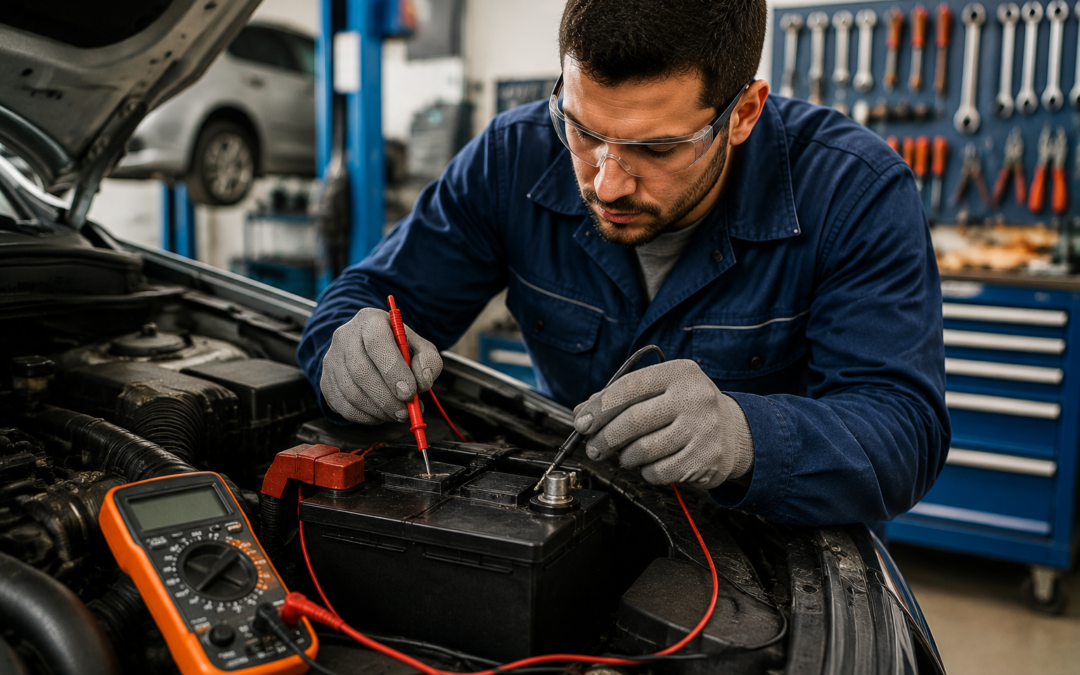
It happens at the worst possible moment: the key turns, the dashboard flickers, and instead of the engine there is a click — or nothing at all. A dead battery strands the car wherever it stopped, and the driver's first thought is usually the same: get a jump start and get moving. A jump start is the right first step in most cases, but it is also a procedure with real risks when done wrong — reversed cables, damaged batteries, and electrical spikes can turn a simple rescue into an expensive repair.
This article explains why batteries die in Dubai, how a safe jump start is done, what should never be attempted, when a jump start will not help, and what must be checked after the engine is running again — so the car gets moving safely, and stays moving.
Why Car Batteries Die in Dubai
Heat is the battery's main enemy, and Dubai has it in abundance. Sustained high temperatures accelerate the chemical reactions inside a battery, corroding internal plates and evaporating electrolyte faster than in cooler climates. A battery that lasts five years in a temperate country may last two to three in the Gulf — and it usually fails without the slow decline drivers expect. One morning it starts the car; the next it does not.
Heat is not the only cause. Short trips starve the battery: each start draws a large charge, and a five-minute drive does not run the alternator long enough to replace it. Repeated short trips drain the battery a little further each time until it cannot crank the engine. Parasitic drain — lights left on, a faulty module staying awake, an aftermarket accessory drawing current — empties a healthy battery overnight. Age finishes what heat started: as plates corrode and capacity falls, the battery holds less and less charge until a hot afternoon or a cold morning exposes it. And a failing alternator can masquerade as a battery fault: the battery is fine, but nothing is recharging it. The guide to a car battery dying overnight explains the drain side of the problem in detail.
What a Jump Start Does — and What It Cannot Do
A jump start uses a charged battery — from another vehicle or a portable jump pack — to supply the cranking current the dead battery cannot. The donor battery's power turns the starter motor, the engine fires, and the alternator takes over, recharging the dead battery as the car runs. It is a rescue, not a repair: it gets the engine running so the car can move and the battery can be tested. It does not fix a battery that has lost its capacity, a charging system that is not working, or a starter motor that has failed.
That distinction matters because a successful jump start can mislead. The car starts, the driver feels relieved, and the underlying fault — a dying battery, a parasitic drain, a weak alternator — waits for the next stop. A jump start should always be followed by testing: battery health, charging voltage, and a check for drains. If the battery tests weak, replacement is the answer, and mobile car battery replacement covers testing and fitting at the location. If the battery tests healthy but keeps dying, the cause is elsewhere, and finding it matters more than another jump.
The Safe Jump Start Procedure, Step by Step
A professional jump start follows a fixed sequence, and every step exists for a reason. First, both vehicles are switched off, and the dead battery is inspected: a cracked case, leaking electrolyte, a swollen case, or a strong sulphur smell means the battery must not be jumped — it needs replacement. Second, the cables are connected in order: positive (red) to the dead battery's positive terminal, positive to the donor battery's positive terminal, negative (black) to the donor battery's negative terminal, and the final negative clamp to an unpainted metal ground point on the dead car's engine block, away from the battery. That last point matters: the final connection can spark, and sparks near a battery — which vents hydrogen gas — are a fire risk. Grounding away from the battery keeps the spark away from the gas.
Third, the donor vehicle is started and left running for a few minutes to transfer some charge. Fourth, the dead car is started. Fifth, the cables are removed in reverse order, starting with the ground clamp. Sixth, the rescued car is left running, and the battery and charging system are tested before anyone declares the job done. Portable jump packs follow the same principles, with the added advantage of built-in reverse-polarity protection — one reason professionals carry them.
Jump Packs vs Jumper Cables: Which Is Safer?
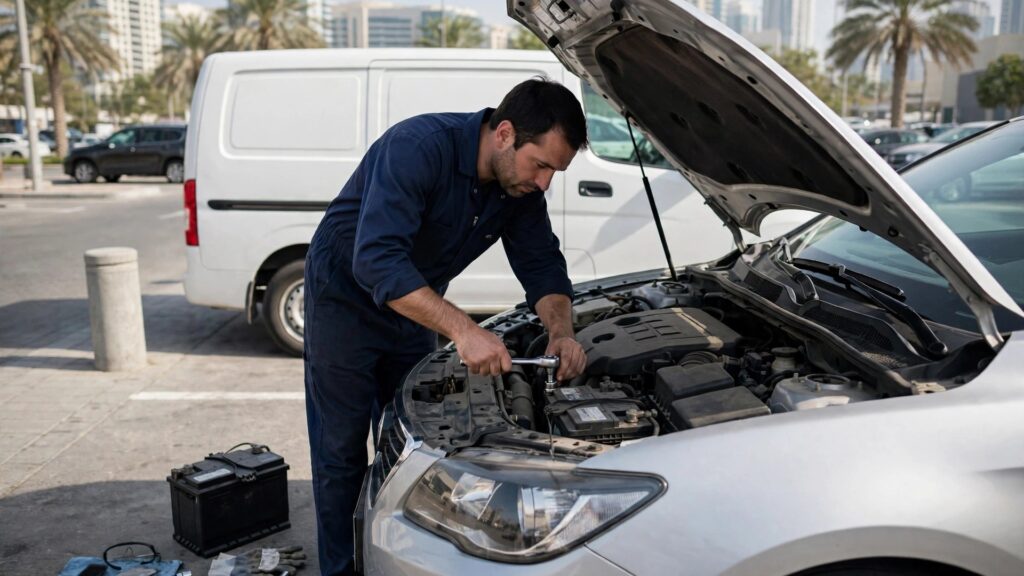
Both work, but they are not equal. Jumper cables need a second vehicle, a driver willing to help, and careful attention to the connection order — and they carry the full risk of reversed polarity if the clamps go on the wrong terminals. Portable jump packs need no second vehicle, work in tight parking spaces where nose-to-nose positioning is impossible, and most modern packs include reverse-polarity protection, spark-proof clamps, and over-voltage safeguards that refuse to deliver power when connected wrongly. That protection is why professionals carry packs: they remove the single most expensive mistake from the procedure entirely.
Cables still have their place — a running donor vehicle can deliver sustained charging current that a small pack cannot, which helps when the dead battery is deeply discharged and needs time to recover before cranking. The choice depends on the situation, and a service vehicle carries both. What matters is not which tool is used but that the procedure is followed, the battery is inspected first, and the testing afterwards is not skipped. A jump done with the right tool and the wrong sequence is still a risk; a jump done with either tool and the right sequence is safe.
What Never to Do: Jump Start Mistakes That Cause Damage
Reversed polarity is the most expensive mistake: connecting positive to negative sends current through the electrical system backwards, and can destroy the alternator diodes, the engine control unit, fuses, and modules in seconds. Modern vehicles are especially vulnerable, with sensitive electronics throughout. If the cables were connected backwards, even briefly, the car needs inspection before it is driven — damage may not be obvious immediately.
Never jump a battery that is visibly damaged, frozen, or leaking. Never jump a car with the donor vehicle running at high revs — steady idle is enough, and excess voltage stresses both systems. Never let the cable clamps touch each other while connected. Never keep cranking a car that will not start after several attempts: repeated cranking overheats the starter and drains the donor battery, and a car that will not start after a proper jump has a fault beyond the battery. And never assume a jump start "fixed" the car — the testing afterwards is the part that prevents the next breakdown.
When a Jump Start Will Not Help
A jump start only helps when the battery is the problem. If the engine cranks strongly but will not fire, the fault is fuel, ignition, or sensors — a jump adds nothing. If there is a single loud click and no cranking, the starter motor or its solenoid may have failed. If the engine cranks slowly even with a donor battery connected, there may be a bad connection, a seized component, or a starter drawing excessive current. If the dashboard stays completely dead with a donor connected, a main fuse, a battery cable, or a ground connection has likely failed.
These are the cases where a jump start attempt wastes time and risks damage. Diagnosis comes first: battery voltage, cable condition, starter behaviour, and fault codes together point at the real fault. A car that needs a starter, an alternator, or a fuel system repair needs that repair, not another jump — and where it cannot be driven, car recovery brings it to the workshop.
Battery Warning Lights & Dashboard Messages Explained
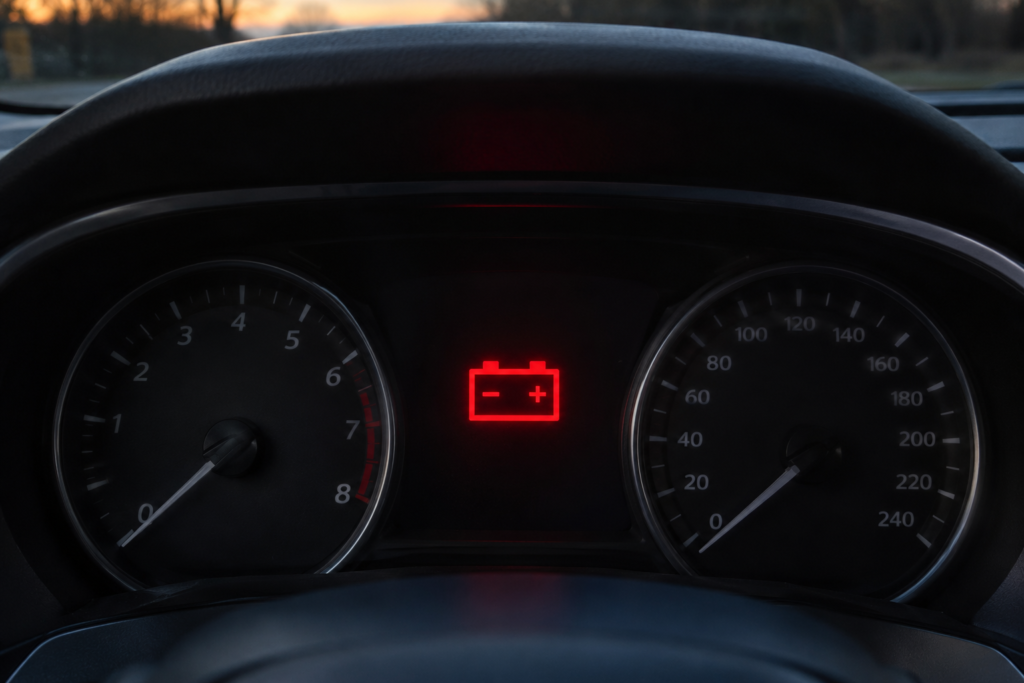
The dashboard tells the driver more than most people realise, if the messages are read correctly. The battery warning light — a battery symbol, usually red — does not mean the battery is dead; it means the charging system is not charging. It appears when the alternator is not delivering, the belt has failed, or a charging circuit fault exists, and it means the car is running on battery power alone, with limited time before it stops. Driving on with that light illuminated is borrowing time: switch off non-essential electrics and get the charging system checked promptly.
Slow cranking with dim lights points at a weak or discharged battery. A rapid clicking with no cranking usually means the battery has too little charge to hold the starter solenoid engaged. A single solid click with no cranking points more at the starter or its connections. And a dashboard that stays dark with the key on suggests a main power failure — a dead battery, a broken main cable, or a blown main fuse. None of these is a diagnosis on its own, but together with voltage testing they narrow the fault fast, and they help the driver describe the problem accurately on the first call.
After the Jump: Testing That Prevents the Next Breakdown
Once the engine is running, the job is half done. The battery is tested with a proper battery tester — voltage, cranking capacity, and state of health — not judged by whether the car started. A battery that starts the car but tests weak will fail again, soon, and the driver should know that before leaving. The charging system is tested next: alternator output voltage at idle and under load, which confirms whether the battery is actually being recharged as the car runs. A healthy battery with a failing alternator dies again within days, and the alternator is the repair, not the battery.
The connections are checked too: corroded terminals, loose clamps, and damaged cables all mimic a dead battery, and cleaning or tightening them is often the whole fix. And if the battery has died repeatedly, a parasitic drain test finds what is drawing current while the car sleeps. The driver is told the results plainly — what tested good, what tested weak, and what is recommended — so the decision is theirs, on evidence.
Jump Start vs Replacement: Making the Right Call
The decision follows the test results. A battery that died from a one-off cause — lights left on, a long stand — and tests healthy afterwards needs no replacement: it needs a full recharge and a watchful eye. A battery that tests weak, holds a low voltage, or has failed before needs replacement, because the next failure is a matter of when, not if. A battery past its expected life in Gulf heat, even if it still starts the car, is living on borrowed time, and the driver should hear that honestly.
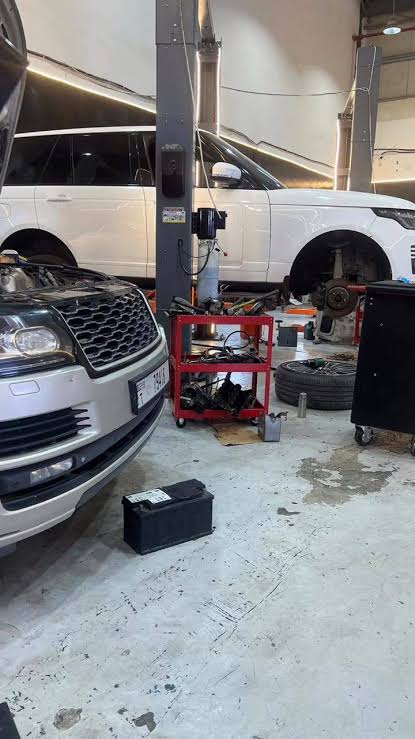
Replacement at the location follows the same pattern as every job: the correct battery specification for the vehicle, confirmed before fitting; the old battery removed safely and taken away; terminals cleaned and protected; and the charging system re-tested after fitting to confirm the new battery is being charged properly. The full detail is in the mobile car battery replacement guide. For drivers stranded with a flat battery, the dedicated flat battery assistance page covers the service directly.
Preventing the Next Dead Battery
Prevention is mostly habit. Drive long enough, often enough, for the alternator to recharge what starting took — a weekly longer drive helps cars that mostly do short trips. Switch off lights, accessories, and chargers when parking. Watch for the early signs: slower cranking, dimming lights on start, a battery warning light, or a battery that needs a jump more than once. Have the battery tested at every service, and before summer, when heat stress peaks. Keep terminals clean and tight — corrosion on the terminals is visible, cheap to clean, and a common cause of no-starts that look like battery failure. And if the car will stand unused for weeks, arrange for the battery to be maintained or disconnected properly, rather than discovering a dead battery on return.
What a Jump Start Visit Costs — and How Quotes Work
Service prices at 95 Services are kept very low as a matter of policy, and jump start visits follow the same rule as every other job: the scope and the price are discussed and confirmed before work begins. No work starts on a guess, and no surprise appears on the bill afterwards. If the visit reveals that the battery needs replacement, or that the fault is the starter or alternator, the driver hears about it first and approves the next step — the jump start is never used as a reason to sell work that testing does not support.
How It Works: From Your Call to a Running Engine
Every jump start visit follows the same five steps. First, the call: phone or WhatsApp with the location, vehicle details, and symptoms. Second, the response: help dispatched within the 15–20 minute standard, anywhere in the complete UAE. Third, inspection: the battery, cables, and connections checked before any jump is attempted. Fourth, the jump and testing: a safe jump start, then battery and charging-system tests to find the real cause. Fifth, the honest answer: what was found, what is recommended, and the confirmed price before any further work. That sequence never changes, because speed without inspection is guessing, and a start without testing is a promise unverified.
Frequently Asked Questions
How long should I drive after a jump start?
Long enough for the alternator to recharge the battery — a sustained drive, not a five-minute trip. But driving does not fix a weak battery: get it tested, because a battery that needed a jump may need replacement even if the car runs fine afterwards.
Is it safe to jump start a modern car?
Yes, when done correctly with the right equipment and cable order. Modern electronics are sensitive to reversed polarity and voltage spikes, which is why the procedure and the ground point matter — and why a professional jump pack with protection is safer than improvised cables.
My car needed a jump start twice this week. What is wrong?
Either the battery has lost its capacity, something is draining it while parked, or the alternator is not recharging it. Battery testing, a charging-system test, and a drain check together identify which.
Can a jump start damage my car?
A correctly done jump start does not damage the car. Reversed cables, jumping a damaged battery, or repeated cranking can. Inspection before the jump and correct procedure during it are what keep it safe.
How fast can help reach me?
The response time is 15–20 minutes. Call or WhatsApp +971 54 344 3513 with a live location, vehicle details, and symptoms, and help is dispatched to reach the vehicle within 20 minutes, anywhere in the UAE.
Are 95 Services prices low?
Yes — service prices are kept very low as a matter of policy. The scope and price are confirmed before work begins, and no work starts without the customer's approval.
Contact 95 Services: Jump Starts & Battery Help Across the UAE
Whether the car clicks, stays silent, or has died more than once, the first step is one call. Contact 95 Services on +971 54 344 3513 by phone or WhatsApp, or email info@95services.com, with the vehicle details, the location, and the symptoms. Help is dispatched within the 15–20 minute response standard, prices stay very low, and the quote is confirmed before any work begins. The office is at Ahmed Ali Al Owais Showroom Building, Office M05, Abu Hail, Al Khabaisi, Dubai, UAE. Call before visiting so the correct service arrangement can be confirmed. For general repairs, see car repair and maintenance, or visit the contact page to send an enquiry.
