
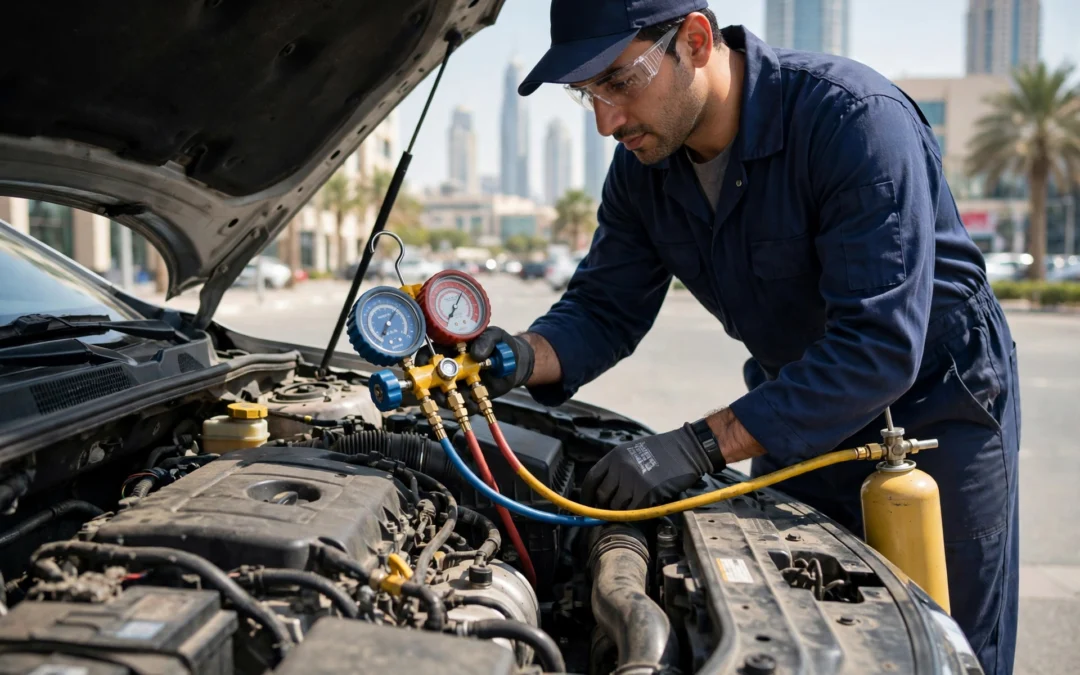
When a car's air conditioning starts to weaken in Dubai, the first thought most drivers have is the same: it probably just needs a gas refill. Sometimes that is exactly right. Often, though, the weak cooling is a symptom of something else — a leak, a failing part, a blocked filter, or an electrical fault — and a refill on its own will not fix it. Refilling a system that has a leak is money spent twice: the gas escapes again, the cooling weakens again, and the driver is back where they started, having paid for a refill that was never going to hold.
This article explains what actually happens during a proper AC gas refilling visit, what should be checked before any gas goes in, what should be checked afterwards, and how to tell whether the problem is low gas or something that needs repair. It stays focused on the recharge visit itself and the refill-versus-repair decision. For the full picture of car air conditioning — every part of the system, every common fault, and how the system is maintained — read the complete AC repair and gas refilling guide. And if a refill has already been done and the cooling has not held, the guide to car AC not cooling after a gas refill covers what to check next. This article is the one to read before the visit, so the driver knows what a good recharge looks like and can recognise when something more is needed.
In Dubai, air conditioning is not a comfort extra. It is a safety system. A car without working air conditioning in the hot season is undrivable, and a gradual decline in cooling is the usual pattern before a complete failure. Understanding the recharge process helps drivers act early, ask the right questions, and avoid paying for the same refill twice.
How Car Air Conditioning Works, in Plain Language
A car air conditioning system moves heat out of the cabin, rather than creating cold air from nothing. A refrigerant — the "gas" in gas refilling — circulates through a sealed loop of parts: a compressor that pressurises it, a condenser at the front of the car that releases heat, an expansion part that lets it cool rapidly, and an evaporator inside the dashboard that absorbs heat from the cabin air blown across it. A fan blows cabin air across the evaporator, and the cooled air comes out of the vents. A filter cleans the air entering the cabin, and a set of controls and sensors manages the whole process.
Two facts about that loop matter for every recharge decision. The first is that the system is sealed. In a healthy system, the refrigerant does not get "used up" the way fuel does. It circulates, again and again, and the amount in the system stays broadly the same. The second is that when the amount does fall, it falls because it has escaped — through a leak, a worn seal, or a damaged part. Low gas is therefore not usually a condition on its own. It is evidence that something has let gas out, and the question a good recharge visit asks first is where it went.
That does not mean every recharge is pointless. Seals age, small amounts escape slowly over time, and a system that has lost a little gas can often be recharged successfully — provided the system is checked first, and provided the loss is small and no active leak is found. The distinction between a system that needs a top-up and a system that needs a repair is exactly what the checks before refilling are for, and it is the distinction this article is built around.
Signs That Point Toward Low Gas, and Signs That Point Elsewhere
Weak cooling has many possible causes, and the pattern of the symptoms often hints at which one applies. The hints are not a diagnosis — only an inspection can say for certain — but they help the driver describe the problem clearly when calling, and they help the driver understand what the technician is looking for.
Signs that fit with low gas include cooling that has weakened gradually over time, air that is cool but not properly cold, and cooling that works better at speed than in slow traffic. A system low on gas can still cool a little, because some refrigerant is still circulating, but it cannot cool properly, and the weakness tends to get slowly worse. If the cooling faded gradually and nothing else changed — no new noise, no new smell, no warning light — low gas is a reasonable possibility, and a checked recharge may be the answer.
Signs that point elsewhere are worth noticing just as carefully. Air that is warm from the start, with no cooling at all, may point to a compressor or electrical fault rather than to gas level. Weak airflow even on a high fan setting often points to a blocked cabin filter or a blower fault, not to the refrigerant. A musty smell from the vents often points to the cabin filter or to moisture in the system. A new noise — grinding, rattling, or squealing when the air conditioning is switched on — points to a mechanical part, most often the compressor. Cooling that comes and goes, or a system that cycles on and off rapidly, points to a control, sensor, or electrical issue. And cooling that was restored by a refill and then faded again quickly points strongly to a leak, which is the subject of the guide to AC not cooling after a gas refill.
The driver's description should include the pattern: when the weakness started, whether it came on gradually or suddenly, whether airflow is strong or weak, whether there is a smell or a noise, and whether a refill has been done before and how long it lasted. Those details decide where the inspection starts, and they often decide whether a recharge is the right next step at all.
Before Any Gas Goes In: The Checks That Come First
A proper recharge visit does not start with a refill. It starts with checks. The purpose of those checks is to find out whether the system is sound enough to hold a recharge, and whether anything else is causing the weak cooling. Skipping them is how drivers end up paying for refills that do not last. The checks themselves are straightforward, and a driver who knows what they are can tell whether they have been done.
A Conversation About the Symptoms
The visit starts with the driver's account: when the cooling weakened, how it behaves now, whether airflow is affected, whether there is a smell or a noise, and whether the system has been refilled before. The technician listens for the pattern, because the pattern points to the cause area. A gradual fade, a sudden failure, weak airflow, and a musty smell are different problems, and they are investigated differently. The driver's account is not a formality. It is the first diagnostic step, and a good technician treats it that way.
A Visual Inspection of the System
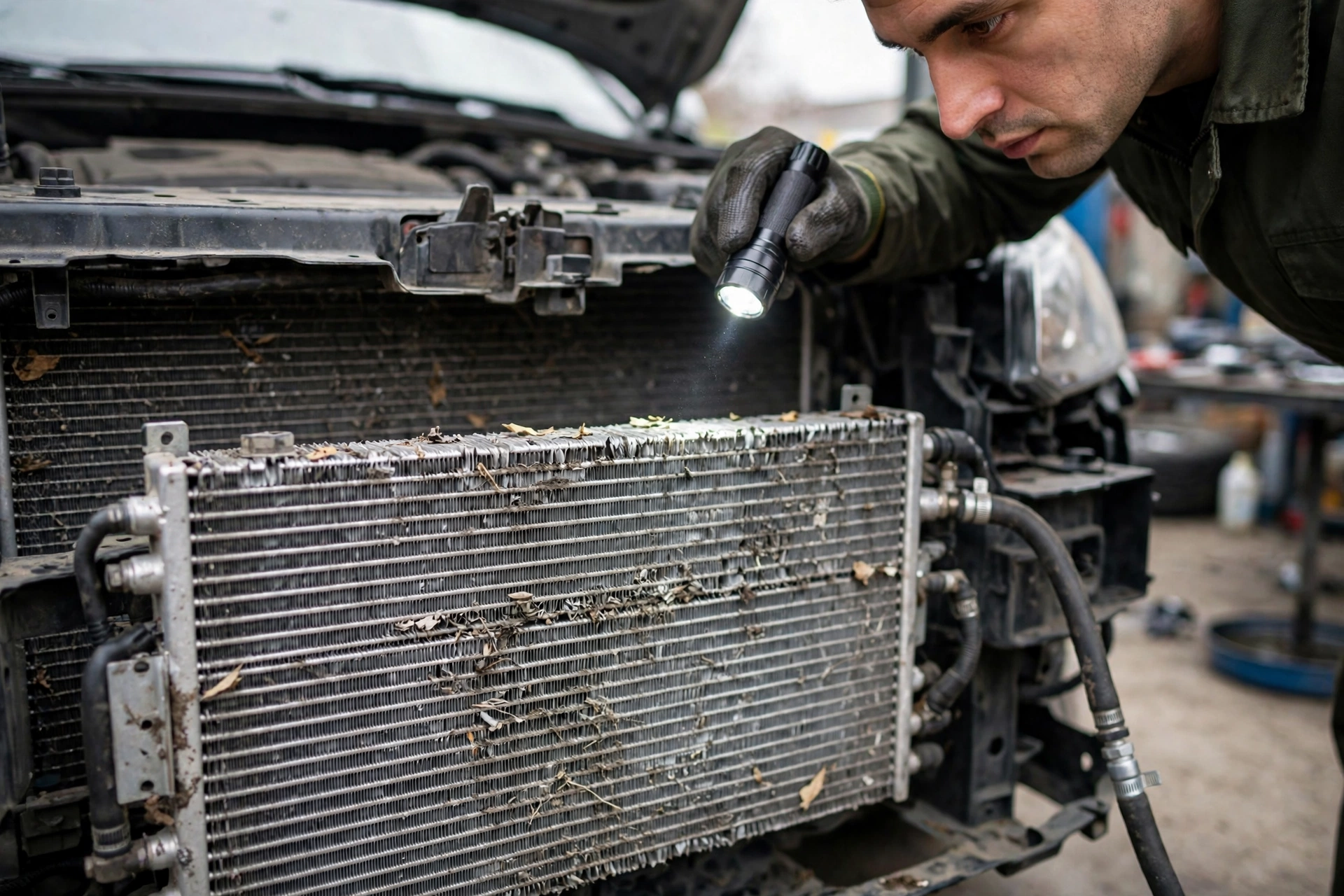
Next comes a look at the parts that can be seen: the condenser at the front of the car, for damage, blockage, or debris; the visible hoses and connections, for signs of leakage, damage, or wear; and the compressor, for visible damage, leaks, or belt condition. Oily residue around a connection or a part is a classic sign of a refrigerant leak, because the refrigerant carries oil with it as it escapes. Damage to the condenser — bent fins, a stone strike, or a build-up of debris — reduces the system's ability to release heat, and no amount of gas will fix a condenser that cannot do its job.
Leak Detection
Leak detection is the most important check before refilling, and the one most often skipped in a rushed job. The technician checks for evidence of leakage using the methods suited to the system — visual signs, detection equipment, and pressure behaviour — and looks particularly at the connections, seals, and parts most prone to leaking. If an active leak is found, refilling without repairing it is not a repair. It is a temporary restoration of cooling that will fade as the gas escapes again, and the driver should be told plainly that the leak must be addressed first.

A system with no active leak found, and only a small loss, is a reasonable candidate for a recharge. A system with a leak found is a repair job, and the scope and the price of the repair should be confirmed before work begins. The distinction is the whole point of the check, and a driver who understands it will never again accept a refill offered without a leak check.
Cabin Filter, Blower, and Controls
The cabin filter, the blower, and the controls are checked because they cause weak cooling without any fault in the refrigerant loop at all. A blocked cabin filter restricts airflow, so even a healthy system cannot push enough cooled air into the cabin. A blower fault does the same. A control or sensor fault can prevent the system from engaging properly, or cause it to cycle incorrectly. Checking these parts before refilling avoids the common frustration of a recharge that changes nothing, because the fault was never in the gas level.
The car AC repair page sets out the full range of inspection, leak detection, and repair work available. The checks described here are the minimum a driver should expect before any gas is added, and they are what separate a proper recharge visit from a quick top-up.
How a Recharge Visit Works, Step by Step
With the checks done and the system judged sound enough to recharge, the recharge itself follows a careful sequence. The driver does not need to understand every technical detail, but knowing the shape of the process helps the driver recognise a thorough job and ask sensible questions.

Step One: Recovery of What Remains
The refrigerant remaining in the system is recovered first, using proper equipment. This is not waste. It is how the technician knows how much was in the system, and it allows the system to be recharged with the correct amount rather than topped up blindly. Recovery also removes old refrigerant and any contamination, so the recharge starts from a known state. A recharge done without recovery is a guess about how much gas the system needs, and guesses are a poor basis for a sealed system.
Step Two: Evacuation and a Vacuum Check
The system is then evacuated — air and moisture are drawn out under vacuum. Moisture inside an air conditioning system causes damage over time, and air in the system reduces cooling performance, so this step matters more than it sounds. The vacuum is also held for a period as a check in itself: if the vacuum does not hold, that is further evidence of a leak, and the recharge should not proceed until the leak is found and addressed. A system that holds vacuum is a system that is, on this evidence, sealed and ready to recharge.
Step Three: Recharging With the Correct Amount
The system is recharged with the correct amount of refrigerant for that specific car, along with the correct oil where the system requires it. The amount matters. Too little gas, and the system cannot cool properly. Too much gas, and the system is overcharged, which can cause poor cooling, strain on the compressor, and damage over time. The correct amount is specified for the car, not guessed, and a proper recharge uses equipment that measures what goes in. The driver should not need to ask for this — it is part of a proper job — but a driver who knows it can ask, with confidence, whether the recharge is being measured.
Step Four: Performance Checks While the System Runs
With the recharge complete, the system is run and its performance is checked: vent cooling, compressor behaviour, cycling, noises, and airflow. The technician watches for the signs of a healthy system — steady cooling, smooth compressor operation, no unusual noises — and for the signs of a problem that the earlier checks missed. This is the moment when a fault that only shows itself under running conditions reveals itself, and it is why the visit does not end the moment the gas goes in.
Step Five: A Short Settling Check and Advice
After the initial performance check, the system is allowed to settle and is checked again, and the driver is given advice on what to watch: how the cooling should feel, what to notice over the coming days, and what to do if the cooling weakens again. If the cooling weakens quickly after a recharge, that is important information, and it points back to a leak or a part fault — the subject of the guide to AC not cooling after a gas refill. The driver should not wait and hope in that case. A quick return, with a clear account of what happened, lets the technician find the fault while the evidence is fresh.
Checks After a Refill: What Good Cooling Should Feel Like
After a successful recharge, the driver should notice a clear difference: air from the vents that is properly cold, airflow that is strong and even, and a system that cools steadily rather than in bursts. The compressor should engage smoothly and run without grinding, rattling, or squealing. There should be no new smell, and no new noise when the system is switched on. These are the signs of a recharge that has worked, on a system that is sound.
Over the days that follow, the driver should watch for the cooling holding steady. A recharge that holds is a recharge on a sound system. A recharge that fades — cooling that weakens again over days or weeks — is evidence of a leak or a developing part fault, and it should be reported promptly, with the detail of how quickly it faded. That detail helps the technician: a rapid fade points to a significant leak, while a slow fade points to a smaller one or a seal that is failing gradually. Either way, the answer is not another refill without investigation. The answer is a leak check and a repair, with the scope and the price confirmed before work begins.
It is also worth noticing airflow and smell after a recharge, because a refill does not fix a blocked cabin filter or a blower fault. If cooling is cold but airflow is weak, or if a musty smell persists, those are separate faults that need separate attention. A proper recharge visit checks them before refilling, but a driver who notices them afterwards should raise them rather than assuming the recharge was supposed to fix everything.
When Refill Is Not the Answer: Leaks, Parts, and Electrical Faults
There comes a point in many AC problems where the honest answer is that a refill will not fix it. Recognising that point saves the driver money and time, and it gets the real fault repaired instead of masked. The main cases are leaks, part failures, and electrical faults, and each has its own signs.
Leaks: The Most Common Reason a Refill Does Not Hold
A leak is a breach in the sealed loop — a worn seal, a cracked hose, a damaged condenser, or a failing connection — through which refrigerant escapes. The signs are cooling that fades after a refill, oily residue around a connection or part, and a system that needs refilling repeatedly. Leaks vary in size, and a small leak can be hard to find, which is why proper leak detection matters. The repair is to find the leak, repair or replace the affected part or seal, and then recharge the system. Refilling a leaking system without repairing the leak is not a repair, however cold the air feels on the day. The gas will escape again, and the driver will pay again.
Part Failures: Compressor, Condenser, and the Rest
The compressor, the condenser, and the other parts of the loop can fail in their own right, and no amount of gas will fix a part that is not working. A compressor that grinds, seizes, or fails to engage is a part fault. A condenser that is blocked or damaged cannot release heat properly. A blocked expansion part or a failed valve prevents the system from cooling even with the correct amount of gas. The signs — noises, no cooling at all, or cooling that behaves erratically — point to the part, and the inspection confirms which one. The repair is the part, with the scope and the price confirmed before work begins, and the recharge follows the repair, not the other way around.
Electrical and Control Faults
The air conditioning system is managed by controls, sensors, and electrical parts, and a fault in any of them can prevent cooling without any fault in the refrigerant loop. A system that does not engage at all, a system that cycles rapidly, or a system that behaves differently each time it is switched on may have an electrical or control fault. These faults need diagnosis, not a refill, and a driver who is offered a refill for a system that does not engage should ask how the electrical side has been checked. Diagnosis first, refill second, is the order that saves money.
The Refill-Versus-Repair Decision: Questions That Help
When a technician recommends a refill, a repair, or both, a few questions help the driver make a sensible decision. Has a leak check been done, and what did it find? Is the system holding vacuum? Are the cabin filter, blower, and controls in good order? What is the scope of the work, and what is the price, confirmed before work begins? And if a refill is recommended, what should the driver watch for afterwards, and what happens if the cooling fades again?
A technician who can answer those questions plainly is offering a decision the driver can trust. A recommendation that cannot answer them — a refill offered without a leak check, a repair offered without an explanation of the fault — is a recommendation to question. The driver is entitled to understand what is being done and why, and a good technician welcomes the questions, because they show a driver who wants the fault fixed properly rather than masked temporarily.
The decision itself is usually straightforward once the checks are done. A sound system with a small loss gets a recharge. A system with a leak gets a repair and then a recharge. A system with a part fault gets the part repaired or replaced, and then a recharge. A system with an electrical fault gets diagnosis and repair, and a recharge only if the checks show it is needed. In every case, the scope and the price are confirmed before work begins, and no work starts without the driver's approval. Prices are kept very low as a matter of policy, which makes the decision easier — but the habit of deciding on evidence, not on hope, matters whatever the price.
Looking After the Air Conditioning Between Visits
A recharged system stays healthy longer when it is used sensibly between visits. Running the air conditioning regularly, even in the cooler months, keeps the seals lubricated and the system exercised. A system left unused for a long stretch can develop seal problems that regular use would have prevented. Keeping the cabin filter in good order, and having it replaced when it is dirty rather than waiting for weak airflow or a musty smell, protects both cooling performance and the air the driver breathes.
Parking in shade where possible reduces the heat load on the system and on the car as a whole, and using a windscreen sunshade helps. Noticing gradual decline early — cooling that is a little weaker this week than last, airflow that is a little less strong — and getting it inspected at the first sign, rather than waiting for a complete failure, is the habit that prevents most AC emergencies. The guide to car maintenance tips covers the seasonal checks that keep the system in good order, and the complete AC guide explains the system and its maintenance in full.
What to Tell the Technician When You Call
A clear description when calling helps the technician arrive prepared and start the inspection in the right place. Say what the cooling is doing now — cold, cool, warm, or nothing — and when the change started. Say whether the change was gradual or sudden. Say whether airflow is strong or weak, whether there is a smell or a noise, and whether the system has been refilled before and how long the refill lasted. Say where the car is, and send a live location. These details take less than a minute to give, and they save far longer in diagnosis.
The response time is 15–20 minutes, anywhere in the complete UAE, and the business is open 24 hours, so a weakening air conditioning system does not need to wait for a convenient day. In the hot season, it should not wait at all. A system that is weakening is a system giving warning, and warning acted on early is a repair. Warning ignored is a failure, usually on the hottest day of the week.
Frequently Asked Questions
Does my car AC just need a gas refill?
Sometimes — but low gas is usually evidence of a leak or a slow loss, not a condition on its own. A proper visit checks for leaks, inspects the visible parts, and checks the cabin filter, blower, and controls before any gas goes in. If the system is sound, a measured recharge is the answer. If a leak or a part fault is found, that must be addressed first.
How can I tell if the problem is a leak rather than low gas?
Cooling that was restored by a refill and then faded again is the strongest sign of a leak. Oily residue around a connection or a part is another. A proper leak check, and a vacuum check during the recharge process, will confirm it. Refilling a leaking system without repairing the leak will not hold.
My AC cools, but the airflow is weak. Will a refill fix that?
Probably not. Weak airflow with cold air usually points to a blocked cabin filter or a blower fault, not to the refrigerant level. Those should be checked before refilling, because a recharge will not restore airflow.
How long should a recharge last?
On a sound system with no active leak, a recharge should hold and the cooling should stay steady. If the cooling weakens again over days or weeks, that is evidence of a leak or a developing fault, and it should be reported promptly with the detail of how quickly it faded. Do not simply pay for another refill without investigation.
How fast can help reach me?
The response time is 15–20 minutes. Call or WhatsApp +971 54 344 3513 with a live location and the car details, and help is dispatched to reach the vehicle within 20 minutes, anywhere in the complete UAE. The business is open 24 hours.
Are 95 Services prices low?
Yes — service prices are kept very low as a matter of policy. The scope and the price are confirmed before work begins, and no work starts without the customer's approval.
Contact 95 Services: AC Recharge, Leak Checks & Repair Across the UAE
Whether the air conditioning needs a checked recharge, a leak investigation, or a repair, the first step is one call. Contact 95 Services by phone on +971 54 344 3513, by WhatsApp on https://wa.me/971543443513, or by email at info@95services.com. Send the car details, the location, and a description of what the cooling is doing. Help is dispatched within the 15–20 minute response standard, anywhere in the complete UAE, prices stay very low, and the quote is confirmed before any work begins. The business is open 24 hours. The office is at Ahmed Ali Al Owais Showroom Building, Office M05, Abu Hail, Al Khabaisi, Dubai, UAE. Call before visiting so the correct service arrangement can be confirmed. Or visit the contact page to send an enquiry.
