
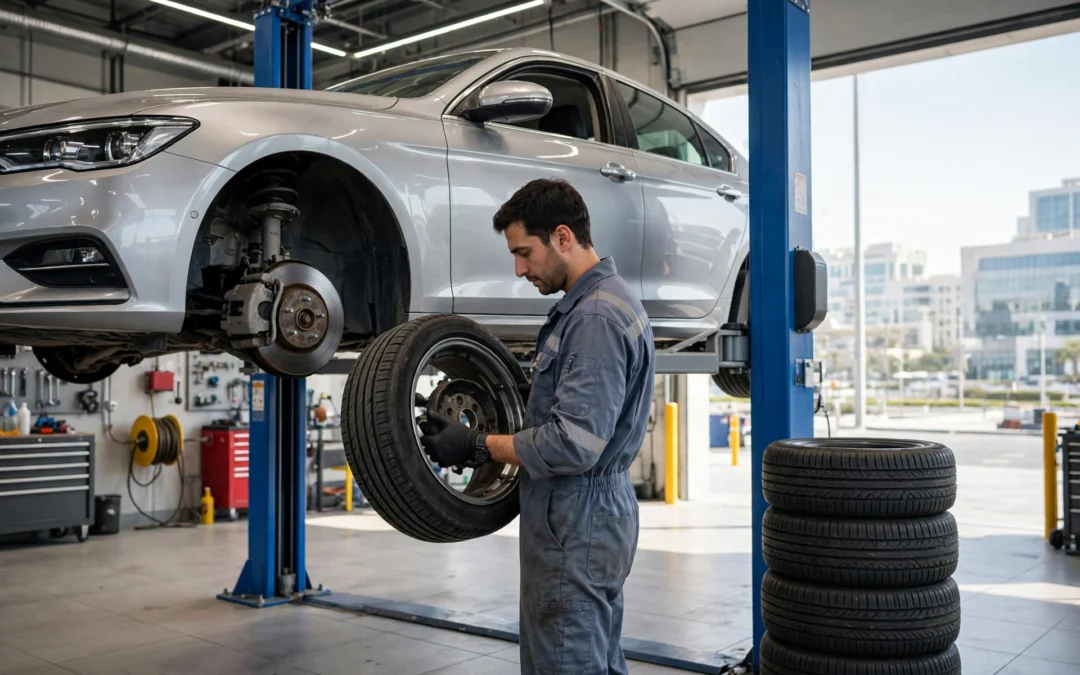
Most drivers in Dubai never think about their tyres until something goes wrong. A flat on Sheikh Zayed Road, a vibration at 120 km/h, a tyre that wears out far too soon — that is usually the moment the tyres finally get some attention. But there is a simple, quick job that quietly prevents a lot of that trouble, and it costs far less than a new set of tyres: tyre rotation.
Tyre rotation means moving each tyre to a different position on the car at regular intervals. The front-left tyre goes to the back, the back tyres come forward, and every tyre takes its turn in each corner of the car. It sounds almost too simple to matter. Yet it is one of the most effective ways to make a set of tyres last longer, wear evenly, and keep the car feeling steady and safe on the road.
In Dubai, rotation matters even more than it does in cooler climates. Summer temperatures regularly push past 45 degrees, the tarmac gets hot enough to soften rubber, fine dust works its way into everything, and many of us spend long hours at highway speeds driving between Dubai, Abu Dhabi and Sharjah. Heat, speed and dust all wear tyres faster, and they do not wear them evenly. The front tyres on most cars do far more work than the rears, so without rotation the fronts can be worn out while the rears still look nearly new. That is money thrown away, and it is also a safety problem, because uneven tyres grip the road unevenly.
This guide explains tyre rotation the way it actually works in real driving conditions here in the UAE. You will find out when to rotate your tyres, which rotation pattern suits your car, what to do about the spare, the warning signs that rotation is overdue, and how rotation is different from wheel alignment and wheel balancing — three jobs that drivers often mix up. And if you would rather have someone else take care of it, 95 Services can come to your home or office anywhere in the UAE, open 24 hours, with help that can arrive within 20 minutes.
What Tyre Rotation Actually Is
Every tyre on your car lives a different life. On a front-wheel-drive car, which is what most family cars, hatchbacks and small SUVs in Dubai are, the front tyres do almost everything. They carry the weight of the engine, they pull the car forward, they do most of the braking, and they turn the car every time you steer. The rear tyres, by comparison, mostly just follow along. It should come as no surprise that the front tyres wear out much faster.
On a rear-wheel-drive car the work is shared a little differently — the rear tyres push the car forward while the fronts steer and brake — but the wear is still uneven. And on all-wheel-drive cars, all four tyres work hard, but the front pair still tends to wear faster because of steering and the weight of the engine sitting over them. No matter what you drive, the four tyres never wear at exactly the same rate.
Rotation fixes that by sharing the work around. Move the front tyres to the back and the back tyres to the front, and each tyre spends some of its life in the hard-working positions and some in the easier ones. Over the life of the set, all four tyres wear down at roughly the same pace. That means you replace all four together, later, instead of replacing the front pair early while the rears still have plenty of life left in them.
There is a safety side to this as well. When all four tyres have similar tread depth, the car brakes more evenly, grips better in the rain — and yes, it does rain in Dubai, sometimes very hard — and feels more predictable in a sudden swerve or an emergency stop. A car with two nearly bald front tyres and two healthy rear tyres can feel nervous and unbalanced, especially on a wet road. Even tread means even grip, and even grip is what keeps you in control.
Rotation is also the moment when small problems get spotted early. A technician who takes all four wheels off will see things you never would from the outside: a nail buried in the tread, a cut in the sidewall, a wheel that is starting to corrode, or a wear pattern that points to a suspension problem. Catching those things during a routine rotation is far better than discovering them on the hard shoulder of a motorway at night. If a puncture or damage is found, you can read more about your options on our tyre repair services in Dubai page rather than guessing whether the tyre can be saved.
When to Rotate Your Tyres in Dubai
The standard advice you will hear almost everywhere is to rotate your tyres every 8,000 to 10,000 kilometres, or about every six months, whichever comes first. That is a good starting point, and for most drivers in Dubai it is the right one. But the honest answer is that the best interval depends on your car, your tyres, and the way you drive — and Dubai driving has a few quirks that push you towards the shorter end of that range.
First, check your owner's manual. The car manufacturer knows your car better than any general guide does, and the manual will state a rotation interval for your exact model. Some manufacturers say every 10,000 kilometres, some say every 8,000, and a few tie rotation to the regular service interval. If the manual and this article disagree, follow the manual. If your tyres came with their own guidance from the tyre maker, that counts too.
Second, think about heat. Rubber ages and wears faster in hot weather, and Dubai summers are among the hottest driving conditions anywhere in the world. A tyre that might comfortably last 10,000 kilometres between rotations in a mild climate is working much harder when the road surface is scorching and the air temperature is in the mid-forties. If you do most of your driving in the summer months, or your car spends its days parked in the open sun, rotating closer to every 8,000 kilometres is the sensible choice.
Third, consider your daily driving. A car that does short trips around the neighbourhood wears its tyres very differently from a car that does a daily Dubai to Abu Dhabi commute at motorway speeds. Long highway runs at 120 km/h generate heat in the tyres and wear the tread steadily, while stop-start city driving with constant turning wears the shoulders of the front tyres. Neither is gentle. If you drive more than most people — say 25,000 kilometres a year or more — you will simply hit the kilometre interval sooner, and you should rotate by distance rather than waiting for the calendar.
As a practical rule for UAE conditions, most drivers are well served by this approach:
- Rotate every 8,000 to 10,000 kilometres, or every six months, whichever comes first.
- If you drive mainly in summer heat, on motorways, or with a fully loaded car, aim for the 8,000-kilometre end of that range.
- If you drive very little — under 10,000 kilometres a year — rotate every six months anyway, because time and heat still age the rubber even when the car is parked.
- Always rotate when you fit new tyres, and again at the first service after that, so the set starts its life wearing evenly.
- After any suspension work, a kerb strike, or a long desert trip, have the tyres checked and rotated if they need it.
One more habit helps enormously: tie rotation to something you already do. Book it with your regular service, or with your oil change, or set a reminder on your phone for six months after the last rotation. The drivers who get the most life out of their tyres are not the ones who know the most about tyres — they are the ones who simply never forget the appointment. And if getting to a workshop is the hard part, a mobile visit takes the excuse away entirely. Our team can rotate your tyres at your home, your office, or wherever the car is parked, anywhere in the UAE, open 24 hours.
Tyre Rotation Patterns: Which One Fits Your Car
Rotation is not just a matter of swapping the fronts with the backs. The pattern — which tyre goes where — depends on how your car sends power to the wheels, and on the type of tyres you have. Use the wrong pattern and you can actually make wear worse, or in the case of directional tyres, fit a tyre so it rolls the wrong way. The pattern below is the one a good technician will choose for your car, and it is worth knowing what it is so you can tell whether the job has been done properly.
Before any pattern is chosen, the technician should check two things: whether your car is front-wheel drive, rear-wheel drive, or all-wheel drive, and whether your tyres are directional. Directional tyres have a tread pattern designed to roll in one direction only, and they carry an arrow on the sidewall showing which way they should turn. They can only move from front to back on the same side of the car. Non-directional tyres can cross from one side to the other, which gives more options.
Front-Wheel-Drive Cars: The Forward Cross Pattern
Most cars on Dubai roads are front-wheel drive — your typical sedan, hatchback, or compact SUV. For these cars, the standard pattern is called the forward cross. The front tyres move straight back to the rear on the same side: front-left goes to rear-left, front-right goes to rear-right. The rear tyres cross over to the front on the opposite side: rear-left goes to front-right, and rear-right goes to front-left.
The logic is simple. The tyres that have been doing the hardest work at the front move to the easier rear positions, and the less-worn rear tyres cross to the front, where they will now do the heavy work. Crossing the rears also evens out the wear across the width of the tread, because the left and right sides of a car do not always wear a tyre in exactly the same way. If your tyres are directional, the pattern changes: the fronts move straight back and the rears move straight forward, staying on the same side, because a directional tyre must never switch sides.
Rear-Wheel-Drive Cars: The Rearward Cross Pattern
Rear-wheel-drive cars — many larger sedans, sports cars, and some SUVs and pickup trucks — use the rearward cross, which is the mirror image of the front-wheel-drive pattern. Here the rear tyres move straight forward on the same side: rear-left to front-left, rear-right to front-right. The front tyres cross over to the rear on the opposite side: front-left to rear-right, and front-right to rear-left.
Again, the idea is to move the hardest-working tyres to the easier positions and bring the fresher tyres forward into the working roles. On a rear-wheel-drive car the rear tyres do the pushing, so they take the most wear from acceleration, while the fronts wear from steering and braking. Swapping them around with the cross pattern shares both kinds of wear across all four tyres. With directional tyres, the same rule applies as before: straight front-to-back, same side only, no crossing.
All-Wheel-Drive and 4x4 Vehicles: The X Pattern
All-wheel-drive cars and 4x4 vehicles, which are common in Dubai — from family SUVs to Land Cruisers and Patrols heading out to the desert — usually use the X pattern. Every tyre crosses to the opposite corner: front-left swaps with rear-right, and front-right swaps with rear-left. All four tyres change both axle and side in one move.
On an all-wheel-drive vehicle, all four tyres are driven, so the wear is more evenly shared to begin with — but it is still not equal. The fronts still steer and carry the engine weight, and on many systems the front axle still does a little more work. The X pattern is the most thorough way to even things out, because every tyre gets a completely different position. Some manufacturers of all-wheel-drive cars recommend the forward cross instead, so once again the owner's manual is the final word. What matters most is that the pattern is followed consistently at every rotation, not changed at random each time.
For serious 4x4 vehicles that see desert driving, rotation matters even more. Sand driving scrubs the tread in a very different way from tarmac, and a trip to the dunes can leave the tyres wearing in unusual patterns. After a desert trip, it is worth having the tyres inspected and rotated if the wear looks uneven, and checking the pressures too — many drivers lower their pressures for sand and forget to bring them back up for the road, which wears the shoulders of the tyres very quickly.
Directional Tyres, Staggered Setups and Different Sizes
Not every car can use a cross pattern. Directional tyres, as mentioned, can only move front to back on the same side. Your technician will check the arrow on the sidewall before moving anything, and if the arrow would point the wrong way after a cross, the tyres stay on their own side.
Some performance cars have a staggered setup, where the rear tyres are wider than the front tyres. On those cars the tyres cannot move between axles at all, because a wide rear tyre will not fit on the front. The only rotation possible is swapping left and right on the same axle, and only if the tyres are not directional. Many owners of staggered cars simply accept that rotation is limited and budget for earlier replacement of the driven axle instead.
There is also the case of cars with a different-size spare, which is covered in the next section, and cars where the front and rear tyres are different sizes for another reason. In all of these cases, the honest answer is that rotation is limited — and a good technician will tell you so rather than forcing a pattern that does not fit your car.
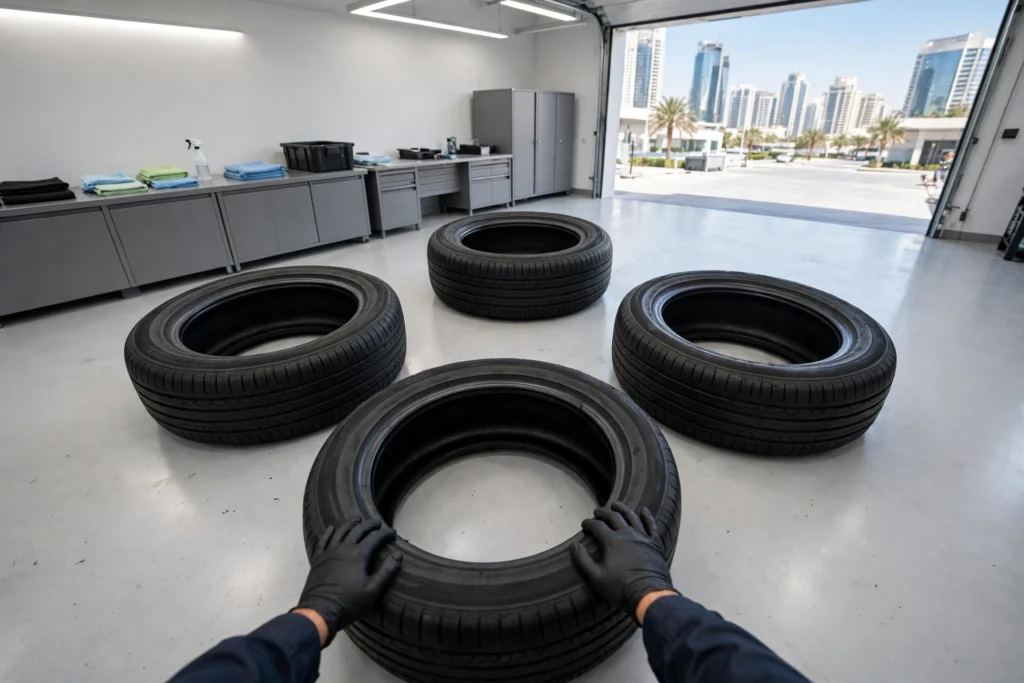
Rotation Including the Spare: When It Helps and When It Does Not
Many drivers forget the spare tyre exists until they need it, and then they discover it is flat, cracked with age, or so old that the rubber has hardened. Including the spare in the rotation is one way to stop that happening — but only when the spare is a proper full-size tyre that matches the other four.
If your car has a full-size spare — a fifth wheel and tyre identical to the other four — it can join the rotation. The usual pattern is a five-tyre rotation: the spare goes to one of the rear positions, the rear tyre it replaces crosses to the front, the front tyres move as normal, and the tyre that comes off the front becomes the new spare. That way all five tyres wear at the same rate, and when the time comes to replace the set, you replace all five together. It also means the spare is never an old, forgotten tyre — it has been on the road recently and you know it holds air and has good tread.
The catch is that the spare must match. Same size, same type, same speed rating, and ideally the same make and model of tyre. If any of those do not match, the spare should not be rotated in. Many cars with a full-size spare still have a different wheel — a steel wheel while the others are alloys, for example — and that is usually fine for rotation as long as the tyre itself matches.
A space-saver spare, the small skinny wheel found in the boot of many modern cars, must never be part of a rotation. It is a temporary emergency wheel, designed to get you to a workshop at low speed for a short distance. It is a different size, it has a different tread, and it is not safe at normal speeds or for normal distances. The same goes for cars that have no spare at all and carry a repair kit or a can of sealant instead — there is nothing to rotate, and the kit should be checked regularly to make sure it has not expired.
Even if your spare never joins the rotation, do not ignore it. Check its pressure every few months — a spare loses air over time just like any tyre — and look at the rubber for cracks. A spare that is ten years old with cracked sidewalls is not a spare you can rely on, however deep its tread looks. If you are unsure how old your spare is, the date code on its sidewall tells the story. Our guide to reading the tyre age DOT code shows you exactly where to find it and what the numbers mean.
Signs Your Tyre Rotation Is Overdue
Your tyres will tell you when rotation is overdue, if you know what to look for. The most useful check you can do costs nothing and takes two minutes: walk around the car and look at each tyre. Crouch down and look at the tread across the full width of the tyre, not just the middle. Then run your hand — carefully, in case there is anything sharp — across the tread from one side to the other. What you feel and see tells you a great deal.
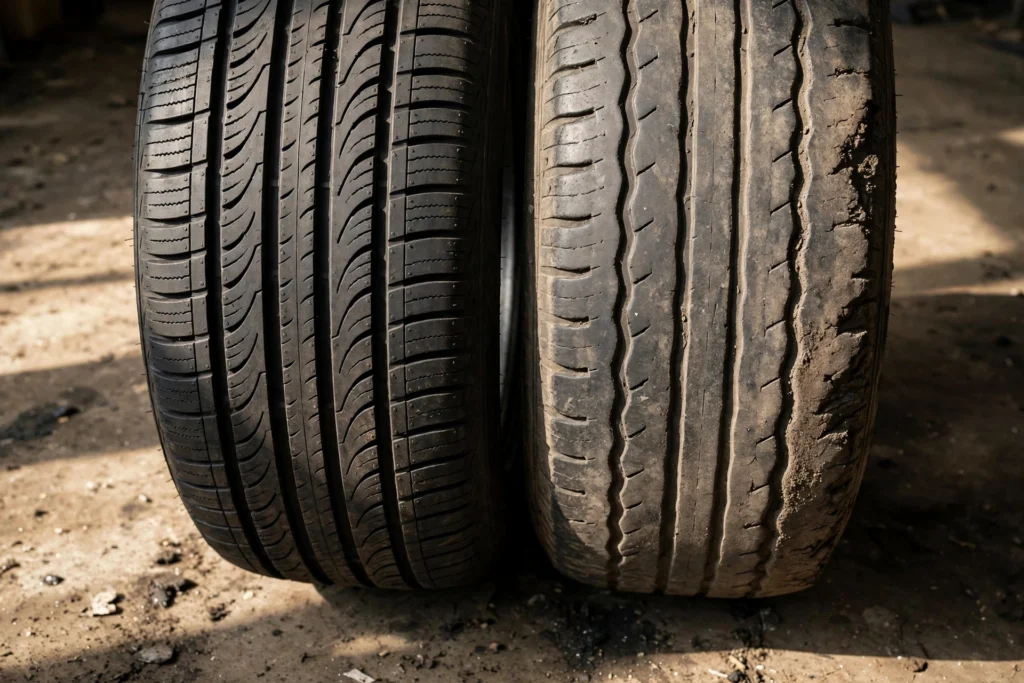
Uneven Wear Patterns
Uneven wear is the clearest sign that rotation is overdue. If the front tyres look noticeably more worn than the rears, that is normal wear doing its job — but it is also the moment rotation should have happened already. The longer you leave it, the bigger the gap becomes, and the less rotation can help, because a tyre that is already heavily worn cannot be un-worn.
Look for these specific patterns:
- Wear on both edges with a healthy middle usually means the tyre has been running under-inflated. The edges of the tread carry the load when the pressure is too low, so they wear first.
- Wear in the centre with healthy edges usually means over-inflation. The middle of the tread bulges out and takes all the wear.
- Wear on one edge only — the inside edge or the outside edge — often points to an alignment problem rather than a rotation problem. Rotation alone will not fix it, and the alignment needs checking too.
- Patchy, scalloped wear, sometimes called cupping, where the tread looks scooped out in places, often points to worn suspension parts or a wheel that is out of balance.
- Feathering, where the tread blocks feel smooth in one direction and sharp in the other when you run your hand across them, is a classic sign of alignment trouble, usually the toe setting.
Rotation evens out the normal difference between front and rear wear. It does not fix wear caused by wrong pressures, bad alignment, or worn suspension. Those need their own fixes first, and then rotation keeps the corrected wear even from then on. If you spot any of these patterns, have the tyres inspected before simply rotating them — rotating a tyre with an alignment problem just moves the problem to a different corner of the car.
Noise, Vibration and Pulling
Tyres also speak through the way the car feels. A humming or droning noise that gets louder as you speed up, and that changes when you turn slightly left or right, is often a tyre wearing unevenly. The tread blocks are no longer striking the road evenly, so they make noise — sometimes a lot of it. Drivers often mistake this for a wheel bearing problem, and sometimes it is, but uneven tyre wear is a common and much cheaper cause that is worth ruling out first.
Vibration through the steering wheel or the seat is another warning. Some vibration comes from a wheel that is out of balance, which is a different job (explained below), but vibration can also come from a tyre that has worn into an uneven shape. If the vibration appeared gradually over weeks or months and the tyres look uneven, rotation is overdue and the tyres may already be too far gone to be saved by it.
Pulling to one side is the third sign. If the car drifts left or right on a straight, flat road when you loosen your grip on the wheel for a moment, something is wrong. It can be alignment, it can be a tyre with different pressure from its partner, or it can be one tyre far more worn than the others gripping less. Never ignore pulling — have it checked promptly, because it affects braking and emergency handling as well as comfort.
Finally, watch for faster wear than you expected. If a set of tyres that should last 40,000 kilometres is looking tired at 25,000, missed rotations are very likely part of the reason. The fronts have been doing all the work without relief. It is worth checking the wear on all four tyres with a tread depth gauge, or even a coin, and comparing them. A difference of more than a millimetre or two between the front and rear tread depth is a clear sign that rotation has been missed.
Rotation vs Wheel Alignment vs Wheel Balancing: Three Different Jobs
This is the part of tyre care that causes the most confusion, and it is an expensive confusion, because drivers either pay for a job they do not need or skip the job they actually do need. Rotation, alignment and balancing are three separate jobs. They solve different problems, they are done with different equipment, and none of them replaces the others.
What Each Job Does
Tyre rotation changes the position of the tyres on the car so they wear evenly. Nothing is adjusted and nothing is measured on a machine — the wheels come off, move to their new positions, and go back on. It is a maintenance job, done on a schedule, to prevent uneven wear before it happens.
Wheel alignment, also called tracking, adjusts the angles at which the wheels meet the road. There are three main angles — camber, caster and toe — and when any of them is out of specification, the tyre drags or scrubs against the road instead of rolling cleanly. Alignment is a correction job, done when there is a symptom or after a specific event. It is measured with laser or camera equipment and adjusted with spanners on the suspension. Our wheel alignment service in Dubai covers the symptoms and the process in detail.
Wheel balancing deals with weight, not position or angle. A wheel and tyre are never perfectly balanced from the factory — one side is always slightly heavier. A balancing machine spins the wheel and finds the heavy spot, and the technician sticks small weights to the rim to even it out. Balancing is a correction job too, done when there is vibration, or whenever a new tyre is fitted to a wheel.
When Each One Is Needed
- Rotation: every 8,000 to 10,000 kilometres or six months, as routine maintenance, whether or not anything feels wrong. Prevention, not repair.
- Alignment: when the car pulls to one side, the steering wheel sits off-centre, the tyres show one-sided wear or feathering, or after hitting a kerb or a large pothole, or after suspension work. Also worth checking once a year as a precaution on Dubai roads, where heat and hard use wear suspension parts.
- Balancing: when you feel vibration through the steering wheel or seat, usually at motorway speeds, or whenever a new tyre is fitted, or after a tyre repair. Also after hitting a pothole hard enough to damage a wheel.
Think of it this way: rotation decides where each tyre sits, alignment decides the angle each wheel points, and balancing decides whether each wheel spins smoothly. All three affect how long your tyres last and how the car feels, but they work on different parts of the problem. A car can have perfectly rotated tyres and still pull to one side because the alignment is out. A car can have perfect alignment and still vibrate because a wheel is out of balance. And a car can be perfectly aligned and balanced and still wear its front tyres out early because nobody ever rotated them.
The practical advice is simple: rotate on schedule, and have the alignment and balance checked whenever a symptom appears. If a technician recommends alignment or balancing during a rotation, ask what they saw that makes them suggest it. A good technician will show you the wear pattern or the vibration reading, not just quote a job. And beware of any workshop that tells you rotation alone will fix pulling or vibration — it will not, and you will be back in a few weeks with the same problem and more worn tyres.
Tyre Rotation for Electric Cars and Hybrids
Electric cars and hybrids are becoming a common sight in Dubai, and their tyres have a harder life than most drivers expect. An electric car is heavy — the battery pack alone can add hundreds of kilograms — and an electric motor delivers its full torque the moment you press the accelerator. That combination wears tyres faster, particularly on the driven axle, and it makes rotation more important, not less.
Most electric cars are rear-wheel drive or all-wheel drive, so the rearward cross or the X pattern usually applies, but the owner's manual is especially important here. Some electric cars have different tyre sizes front and rear, some have tyres designed specifically for EVs with extra load ratings and low rolling resistance, and a few manufacturers recommend more frequent rotation than a petrol car — sometimes every 8,000 kilometres rather than 10,000. Follow what the manufacturer says for your model.
Hybrids are simpler. Most hybrids are front-wheel drive and behave like a normal petrol car for rotation purposes, using the forward cross pattern. The one difference is that regenerative braking changes how the brakes and tyres share the work, but it does not change the rotation pattern or the interval in any meaningful way. Rotate on the same schedule as any other car, and check the pressures just as often.
One thing is true for both EVs and hybrids: because their tyres often cost more than ordinary tyres, getting the most life out of each set matters even more. Skipping rotations on an electric car is a fast way to waste a set of expensive tyres. If you drive an EV in Dubai, treat rotation as part of the routine, not an optional extra.
What a Tyre Rotation Visit Includes
If you have never had a rotation done, it is a straightforward job, and knowing what should happen means you can tell whether it has been done properly. A proper rotation visit, whether at a workshop or at your home with a mobile technician, should include all of the following.
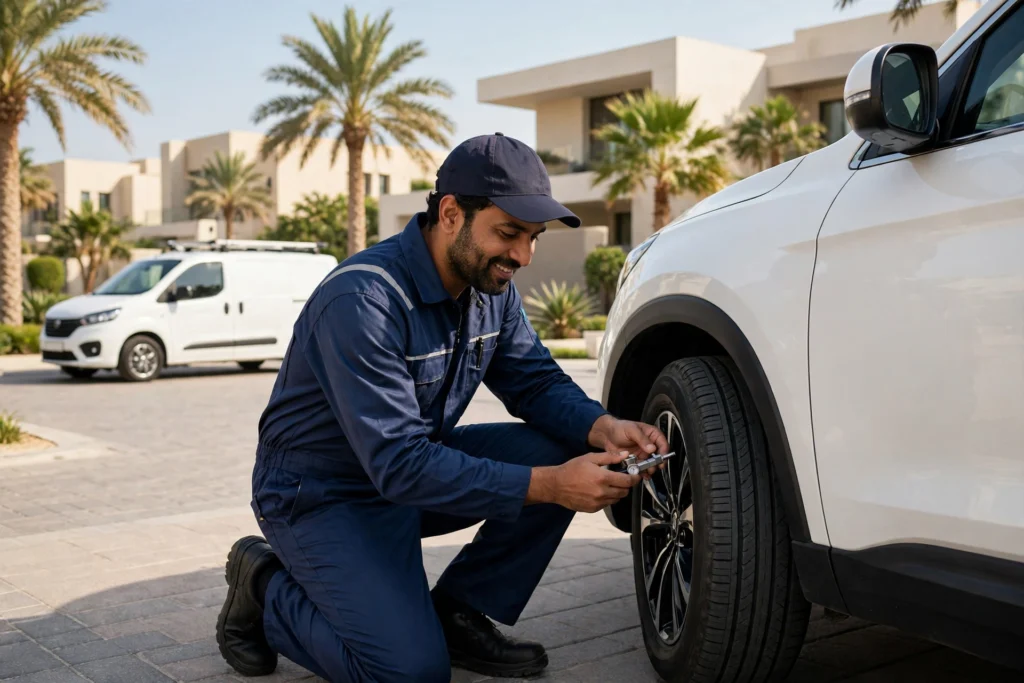
- A check of the tread depth on all four tyres, and the spare if it is being included, so the wear is measured rather than guessed.
- A look at each tyre for damage — nails, screws, cuts, bulges, cracks in the sidewall, and any sign of a previous repair.
- The wheels removed and refitted in the correct pattern for your car, with the wheel nuts tightened to the right torque, not just as tight as possible.
- A check of the tyre pressures, set to the pressures on the sticker inside your driver's door or fuel flap, not to a guess. Remember that pressures should be checked when the tyres are cold, before a long drive heats them up.
- A check of the valve caps and valves, which are small parts that cause slow leaks when they fail.
- A quick look at the brakes and suspension parts that are visible with the wheels off, because that is the best moment to spot a worn brake pad or a leaking shock absorber.
- A note of the date and mileage, so the next rotation can be scheduled at the right time.
The whole job usually takes around half an hour to an hour, depending on the car and whether anything else needs attention. It does not need a ramp or a workshop — a mobile technician with a jack, a torque wrench and a tread gauge can do it properly on your driveway. That is worth knowing in Dubai, where driving to a workshop, waiting around, and driving back can eat half a day. A mobile visit at your home or office, open 24 hours, turns the job into something that happens while you get on with your day.
After the rotation, the car should feel the same or slightly better. If it pulls to one side, vibrates, or makes a new noise after a rotation, that is not normal — call the technician back. It usually means a wheel nut is not seated correctly, a tyre has a problem that only showed up in its new position, or an alignment issue has been unmasked. None of those are reasons to panic, but all of them are reasons to have the car checked again rather than driving on and hoping it settles.
Making Your Tyres Last Longer Between Rotations
Rotation is the single most effective habit for even wear, but it works best alongside a few other simple habits. None of these is difficult, and together they can add thousands of kilometres to the life of a set of tyres.
First, keep the pressures right. Check them at least once a month, and always when the tyres are cold. Under-inflated tyres wear their edges, overheat, and use more fuel. Over-inflated tyres wear their centres and grip less well. The correct pressures are on the sticker in the driver's door jamb or on the fuel filler flap — not the maximum pressure printed on the tyre sidewall, which is a different number entirely and a common source of confusion.
Second, drive smoothly. Hard acceleration spins the driven tyres and scrubs rubber off them, and hard braking does the same. You do not need to drive slowly — just avoid the sudden bursts. On Dubai motorways, steady cruising is far kinder to tyres than repeated speeding up and slowing down in traffic.
Third, avoid kerbs and potholes where you can. A hard kerb strike can damage the sidewall, knock the alignment out, and even crack a wheel. If you do hit something hard, have the tyres and alignment checked soon afterwards rather than waiting for the next rotation.
Fourth, keep the load sensible. A car that is always fully loaded, or carrying a roof box at motorway speeds, wears its tyres faster. That is normal — just remember that a heavily loaded car benefits from rotation at the shorter end of the interval, and check that the pressures match the loaded recommendation in the manual if you regularly carry a full load.
Finally, choose the right tyres in the first place. Cheap tyres with a low wear rating can cost more in the long run than a good set that lasts longer and grips better. If you are buying new tyres and are unsure which ones suit your car and your driving, our guide on how to choose tyres in Dubai walks through the markings, sizes and types in plain language. And for anything beyond rotation — a puncture, a damaged tyre, or a full replacement — the team at 95 Services car repair and maintenance can help, anywhere in the UAE.
Frequently Asked Questions About Tyre Rotation
How often should I rotate my tyres in Dubai?
Every 8,000 to 10,000 kilometres, or every six months, whichever comes first. In Dubai's heat, with motorway driving and heavy summer use, aim for the 8,000-kilometre end of that range. Always follow your owner's manual if it gives a different interval for your car.
Can I rotate my tyres myself at home?
You can, if you have a jack, axle stands, a torque wrench, and a flat, safe surface to work on. But the job needs the car lifted safely, the wheel nuts tightened to the correct torque, and the right pattern for your car. If any of that is uncertain, a professional rotation is a quick job and it includes a tread and damage inspection that is easy to miss on your own. Never work under a car supported only by a jack.
Does tyre rotation really save money?
Yes. A set of tyres that wears evenly lasts noticeably longer than a set where the fronts wear out early. Rotation spreads the wear across all four tyres, so you replace the whole set later instead of replacing the front pair early. Over the life of a car, that adds up to real savings — and the car also brakes and handles better with even tread.
What happens if I never rotate my tyres?
The front tyres on most cars will wear out well before the rears. You will replace the front pair early, the car may develop noise or vibration as the tread wears unevenly, and braking and grip will be less even, particularly in the rain. Nothing dramatic happens overnight, but you will pay for new tyres sooner and the car will not handle as well as it should.
Should rotation be done at the same time as alignment or balancing?
Not necessarily. Rotation is routine maintenance done on a schedule. Alignment and balancing are done when there is a symptom — pulling, vibration, or uneven wear — or after a specific event like a kerb strike. A technician may recommend checking the alignment during a rotation if they spot one-sided wear, but the three jobs are separate, and you should not be charged for alignment or balancing unless there is a reason for it.
Do new tyres need rotation too?
Yes, and the first rotation after fitting new tyres is one of the most important. A new set starts with even tread, and rotating early keeps it that way. If you wait too long, the fronts will already be ahead in wear, and the set will never be truly even again. Book the first rotation at the same time you buy the tyres, so it is not forgotten.
The Simple Habit That Makes Tyres Last
Tyre rotation is not glamorous work. Nobody shows off a rotated set of tyres, and there is no warning light on the dashboard to remind you. But it is one of those small, regular jobs that quietly saves money and keeps a car safe — the kind of maintenance that separates cars that run well for years from cars that always seem to need new tyres.
The pattern is simple: rotate every 8,000 to 10,000 kilometres or every six months, use the pattern that matches your car, include the spare only when it is a proper full-size match, and pay attention to what the tyres are telling you between visits. Add a monthly pressure check and a smooth driving style, and a set of tyres will last far longer than one that is left to wear however it pleases.
If you would like the job done without the trip to a workshop, 95 Services can rotate your tyres at your home, your office, or wherever your car is parked. Our mobile technicians cover the complete UAE, we are open 24 hours, and help can arrive within 20 minutes. Call or WhatsApp us on +971 54 344 3513 to book a rotation, or to have your tyres inspected if you have noticed uneven wear, noise, or vibration. A half-hour visit now can save you a set of tyres later — and keep your car gripping the road the way it should.
