

Toyota Corolla and Camry in the UAE: The Common Faults to Check — AC, Suspension, Oil Use and Hybrid Batteries
If you drive in Dubai for even one week, you will see them everywhere. A white Corolla waiting at a traffic light on Sheikh Zayed Road. A silver Camry pulling out of a parking in Deira. A Corolla in a company fleet, a Camry outside a villa in Mirdif, another Corolla doing school runs in Sharjah. They are the cars of the UAE in a way that very few other models are. Taxi drivers trust them. Families trust them. Companies buy them by the dozen. And when people ask me which car is the safest used buy in this country, the answer is almost always one of these two.
I have spent years working on cars in Dubai, and I have spent a good part of those years with my hands under the bonnet of a Corolla or a Camry. I know the sound of them. I know how they feel when they are healthy, and I know how they feel when something is starting to go wrong. And I can tell you the truth that every honest mechanic in this city will tell you: these are good cars. They are tough cars. But they are not magic cars. They wear out like everything else, and in UAE heat and UAE traffic, they wear out in particular ways that are worth knowing about — whether you already own one, or you are thinking of buying one.
This guide is written for drivers, not for mechanics. I will not throw part numbers at you, and I will not pretend I can diagnose your car from a page on the internet. What I will do is tell you, in plain words, what actually goes wrong on Corollas and Camrys as we see them in the UAE: the air conditioning that slowly loses its cold, the suspension that starts to knock over speed bumps, the older engine that begins to use oil, and the hybrid battery that, after years of faithful work, starts to show its age. I will tell you what each problem feels like from the driver's seat, what to check, what can wait a little and what should not wait at all, and what to look for if you are buying one of these cars second-hand.
One thing before we start. When I say "common fault" in this guide, I mean something I have seen again and again across many cars of this family, over many years. I do not mean that every Corolla or Camry will get it, and I do not mean that one model year is worse than another. Cars differ by how they were driven, how they were serviced, and how many kilometres they have done. A well-looked-after Corolla with high mileage can be a far better car than a neglected one with low mileage. So read this guide as a map of the places where trouble usually shows up — and then go and check the actual car in front of you.

Why the Corolla and Camry Are Everywhere in the UAE
Before we talk about faults, it is worth understanding why these two cars are so common here, because that explains a lot about how they wear.
The first reason is simple: they suit this country. The UAE is hot, the distances are long, and the traffic is a mix of fast motorway driving and slow, crawling queues. A car here needs to start every morning in August without complaint, sit in traffic on Sheikh Zayed Road with the air conditioning on full, and then cruise at motorway speed to Abu Dhabi and back. The Corolla and the Camry were designed to do exactly that kind of unglamorous, everyday work, day after day, without fuss. They are not the fastest cars on the road and they are not the flashiest. But they do the job, and they keep doing it.
The second reason is running cost. Most owners I meet are not looking for excitement. They are looking for a car that does not surprise them. A car that goes to the workshop for a service and comes back without a long list of extras. A car that a mechanic anywhere in the country can work on, with parts that are easy to find. That is where these two Toyotas earn their reputation. Any workshop in Dubai knows them. Parts are widely available. A good independent mechanic can look after one without needing special dealer-only tools for most jobs. That matters a lot when you own a car for years, because it keeps the running of the car straightforward and the cost of keeping it healthy low.
The third reason is resale. Because so many people want a Corolla or a Camry, they hold their value well here, and they are easy to sell when the time comes. That also means there are a lot of used ones for sale — and that is exactly where this guide earns its keep. A used Corolla or Camry can be one of the best buys in the country. It can also be a car that has done hard fleet work for years and has had its problems quietly covered up for the sale. Knowing what to check before you pay is the difference between those two outcomes.
Now, a word about the two cars themselves. The Corolla is the smaller of the two — a compact family sedan that is easy to park, easy to drive in city traffic, and light on fuel. The Camry is the bigger brother — more room in the back seat, a quieter ride on the motorway, a car that feels made for long distances. They are different cars, but under the skin they share the same Toyota way of building things: simple, strong, and designed to be looked after without drama. And because they share so much of that thinking, they also share many of the same wear patterns. That is why it makes sense to talk about them together.
There is one more thing that shapes how these cars age in the UAE, and it is the same for every car here: the heat. I say this in almost every guide I write, and I will say it again here, because it is the single biggest factor in how a car wears out in this country. A summer day in Dubai is not like a summer day in most of the places these cars were designed for. The temperature outside can sit in the high forties. The inside of a parked car can get far hotter than that. Rubber parts, plastic parts, fluids and batteries all age faster when they live in that kind of heat year after year. The air conditioning has to work harder than it ever would in a cooler country, and it has to do it for most of the year. So when I talk about a fault being "common in the UAE", what I often mean is that the heat has made a normal wear item wear a little faster than it would somewhere cooler. That is not the car's fault. That is the climate. And once you understand that, the whole guide makes more sense.
How to Use This Guide
Let me be honest about what this guide can and cannot do. It cannot tell you that your specific car has a specific problem. It cannot replace a mechanic looking at your car, listening to it, and putting it on a lift. What it can do is help you notice things earlier, describe them clearly when you talk to a workshop, and avoid the two mistakes I see most often: ignoring a small sign until it becomes an expensive repair, and panicking over something small that a proper check would have settled in ten minutes.
As you read, keep three questions in mind for each fault. First, what does it feel like? Every problem in this guide starts with something you can notice from the driver's seat — a change in the cold air, a new noise, a smell, a light on the dashboard. Second, what happens if I leave it? Some things can wait for the next service. Some things get worse quickly in this heat and should not wait. I will tell you which is which. Third, what should I ask the mechanic to check? You do not need to know the part name. You need to know how to describe the symptom and what check to ask for. A good mechanic will take it from there.
And if you are buying used, the last big section of this guide is for you. It is a step-by-step check you can do before you pay, in plain order, covering the air conditioning, the suspension, the oil, the hybrid system, and everything else that matters. Take it with you when you go to see the car. It will not make you a mechanic, but it will make you a much harder person to sell a tired car to.
Air Conditioning: The Fault You Feel Every Single Day
Let us start with the system that matters most in this country, because it is the one you feel every single day. In Dubai, air conditioning is not a comfort feature. It is the difference between a car you can use and a car you cannot. I have seen drivers put up with a noisy suspension for months, but nobody puts up with weak air conditioning in July for more than a day or two. It is that important.
The good news is that the air conditioning in a Corolla or a Camry is generally a strong, well-built system. When it is healthy, it cools the cabin quickly, it stays cold in traffic, and it does not make a fuss. The bad news is that it works harder here than almost anywhere else on earth, and hard work wears things out. Over time, the most common story I hear from owners goes like this: the air conditioning used to be ice cold, and now it is just cool. Or it is cold on the motorway but warm in traffic. Or it is cold on the driver's side and warm on the passenger's side. Or it smells musty when it first starts. Each of those stories points to something different, so let me take them one at a time.
When the Air Is Cool But Not Cold
This is the most common air conditioning complaint I hear on these cars, and it usually creeps up slowly. You do not notice it on one day. You notice it over a summer. Last year the car was freezing within two minutes of starting. This year it takes five minutes, and even then it never quite gets as cold as it used to. On a mild day it feels fine. On a hot afternoon, sitting in traffic near Mall of the Emirates with the sun on the windscreen, it feels like the system is struggling.
There are a few usual causes, and they are all worth understanding. The first is that the system is low on refrigerant gas. Air conditioning systems do not consume gas the way an engine consumes fuel — in a perfect world, the gas stays inside forever. But in the real world, tiny amounts can escape over years through seals and joints, especially in cars that live in extreme heat. When the gas level drops, the cooling gets weaker, and the system has to work harder for less result. A proper check will measure the gas level, and if it is low, a good mechanic will look for where it is escaping rather than just topping it up and sending you away. Topping up without finding the leak is like filling a bucket with a hole in it. It works for a while, and then you are back where you started.
The second usual cause is a dirty condenser. The condenser sits at the front of the car, in front of the radiator, and its job is to let the heat out of the system. In the UAE, it lives a hard life. Dust from construction sites, sand from the desert wind, and dead insects all collect on its fins. When it is clogged, air cannot pass through it properly, and the system cannot shed heat. The result is air conditioning that feels weaker, especially when you are moving slowly, because there is less air flowing through the front of the car. A visual check and a careful clean can make a real difference here, and it is one of the simplest fixes there is.
The third cause is a tired compressor. The compressor is the heart of the air conditioning system — it pumps the gas around and makes the cooling happen. Over years of constant work in the heat, it can wear. Sometimes it still works but not as strongly as it used to. Sometimes it starts to make a noise. Sometimes it cuts in and out. A worn compressor is a bigger job than a top-up or a clean, and it is one of those things you want to catch early, because a compressor that fails completely can send debris into the rest of the system and turn one repair into several.
What should you do if your air conditioning is cool but not cold? Do not just wait for it to get worse, because in this climate it will. Get it checked before the worst of the summer. A proper air conditioning check will measure the gas, look at the condenser, listen to the compressor, and check the cabin filter. It is a routine job, and it is far cheaper than waiting until the system stops working altogether on the hottest day of the year. If you want to know more about how we look after air conditioning, our car AC repair in Dubai page explains what a proper check covers.
Cold on the Motorway, Warm in Traffic
This one is very specific, and if it is happening to your car, it is telling you something useful. The air conditioning is cold when you are driving fast on Sheikh Zayed Road, and it turns warm when you slow down and sit in traffic. Then it gets cold again when you speed up. That pattern almost always points to airflow at the front of the car.
When you are driving fast, air rushes through the condenser and the radiator at the front, and the system can shed its heat easily. When you are sitting still in traffic, there is no rush of air. The car has to rely on its cooling fan to pull air through. If that fan is not working properly — if it is slow, if it only works sometimes, or if it has stopped altogether — the system overheats and the cooling fades. The engine can also start to run hotter than it should in the same situation, which is another reason not to ignore this symptom.
I have seen owners live with this for a whole summer, telling themselves it is just the heat. It is not just the heat. A healthy car should keep its air conditioning cold in traffic on a hot day. If yours does not, get the fan checked. It is a straightforward diagnosis, and the fix is usually a fan or a fan control part rather than a whole new system. But leave it, and you are asking the engine to run hotter than it should, and that is how small problems become big ones.
Cold on One Side, Warm on the Other
This is a strange one when it first happens, because it feels like the car is arguing with itself. The driver's side is cold, the passenger's side is warm. Or the other way round. Sometimes it changes when you adjust the temperature. Sometimes one side stays warm no matter what you do.
On cars with separate temperature controls for the driver and the passenger, this usually points to the little motors and flaps inside the dashboard that direct the air. These are called blend doors, and they move to mix cold air and warm air to the temperature you asked for. Over time, one of them can stick, or its motor can wear out, and then one side of the car gets the wrong mix. It is not dangerous, but it is annoying, and it usually needs a proper look inside the dashboard to sort out. It is not a job to guess at, because the parts are small and buried deep behind the dashboard, and getting to them properly matters.
If your car has a single temperature control for the whole cabin and one side is still warmer, the cause is more likely to be low gas or a partial blockage, so it comes back to a proper gas and system check. Either way, describe the symptom exactly as you feel it when you talk to the mechanic — which side, when it happens, whether it changes with the controls — because that detail is what points them in the right direction.
Musty Smell When the Air Conditioning Starts
If your air conditioning smells musty or stale for the first minute after you switch it on, and then the smell fades, you are not imagining it. This is a very common complaint in the UAE, and it has a simple cause: moisture and mould growing inside the system.
When the air conditioning cools the air, moisture condenses inside the system, and in a hot, humid climate that moisture does not always dry out fully between trips. Over time, mould can grow on the surfaces inside, and the cabin filter can pick up dust and moisture too. The smell is the first sign. It is usually worst after the car has been parked for a few hours or overnight.
The usual fix is straightforward: replace the cabin filter, and have the system cleaned properly. The cabin filter is a small, inexpensive part that most owners forget about entirely, and on a car driven in dusty city traffic it can get clogged surprisingly quickly. A clogged cabin filter also reduces the airflow from the vents, so the air conditioning has to work harder and the cabin cools more slowly. If you cannot remember the last time your cabin filter was changed, it is overdue. Ask for it at your next service.
There is also a small habit that helps. In the last few minutes before you reach your destination, switch the air conditioning off but leave the fan running. That lets the system dry out a little before you park, and it reduces the moisture that mould needs to grow. It is a small thing, but over a summer it makes a difference.
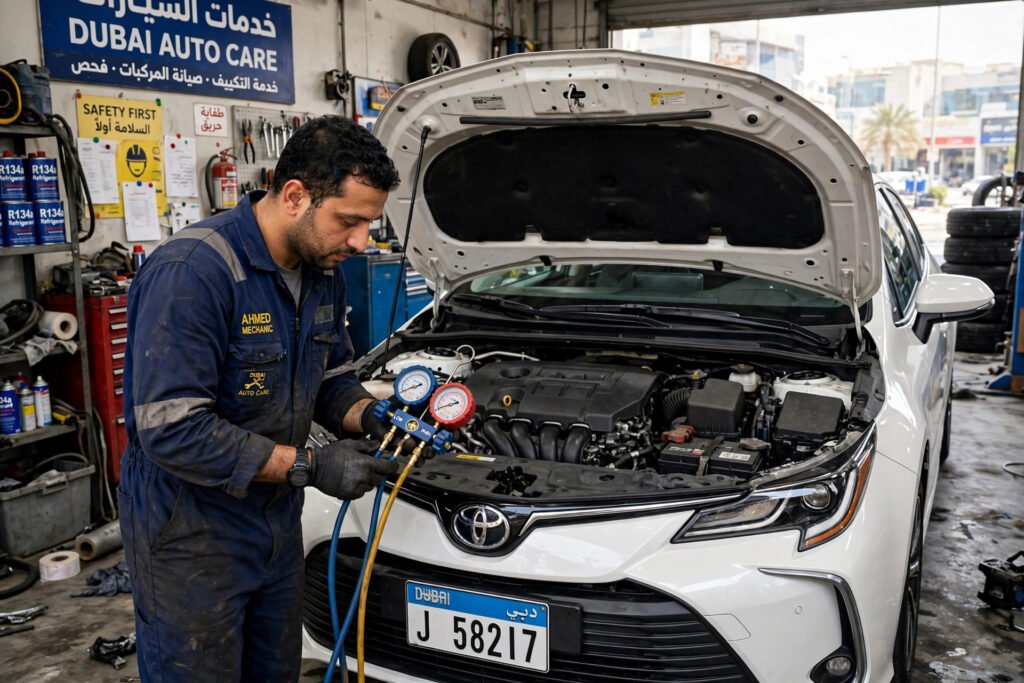
Noises From the Air Conditioning
Air conditioning should be quiet. You should hear the fan, and you should feel the cold air, but you should not hear grinding, squealing, rattling or clicking from the system itself. If you do, listen carefully to when it happens, because that tells the mechanic a lot.
A squeal when the air conditioning first switches on can point to the belt that drives the compressor. Belts wear, they stretch, and they can slip, especially in the heat. A rattle or grinding noise that comes and goes with the air conditioning can point to the compressor itself wearing out. A clicking noise behind the dashboard when you change the temperature can point to those little blend-door motors I mentioned above. None of these noises should be ignored, because a noise is the system telling you that something is moving in a way it should not be. Get it listened to early, while the fix is still small.
Looking After the Air Conditioning Before Summer
I tell every Corolla and Camry owner the same thing: get the air conditioning checked before summer, not during it. In April or May, before the worst heat arrives, have a workshop do a proper check. Gas level, condenser condition, fan operation, cabin filter, and a listen to the compressor. It is a short job, and it is the difference between a summer of cold air and a summer of sitting in traffic with the windows down, hoping for a breeze that is not coming.
If you run your air conditioning all year — and most of us in the UAE do — then it is not a seasonal system. It is an everyday system, and it deserves the same regular attention as the engine. A little care before summer is worth far more than an emergency repair in July, when every workshop in the city is busy and you are stuck in a hot car.
Suspension: The Knocks, Creaks and Wobbles of UAE Roads
If the air conditioning is the fault you feel most, the suspension is the fault you hear most. It is the knock over a speed bump. The creak when you turn into a parking. The clunk when you go over a hump too fast. The feeling that the car is not as tight and quiet as it used to be.
Let me explain what the suspension does, in plain words, because it helps everything else make sense. The suspension is the set of parts between the wheels and the body of the car — the springs, the shock absorbers, the bushings, and the arms that hold the wheels in place. Its job is to let the wheels move up and down over bumps while keeping the body of the car steady and comfortable. When it is healthy, you barely notice it. The car feels planted, the steering feels steady, and bumps are a soft thud rather than a crash. When parts of it wear out, you start to notice everything.
Corollas and Camrys are known for a comfortable, quiet ride when they are new, and that is one of the reasons people love them. But comfort depends on rubber and fluid, and both of those age in the heat. Rubber bushings harden and crack over time. Shock absorbers lose their strength slowly, so slowly that you often do not notice until someone else drives your car and says it feels bouncy. And UAE roads, for all that they are generally excellent, still give the suspension plenty of work: speed bumps in residential areas, humps in parking areas, uneven surfaces on roads under repair, and the occasional pothole.
The Knock Over Speed Bumps
The most common suspension complaint I hear on these cars is a knock or a clunk when going over a speed bump or a hump, especially at low speed. It is a dull knocking sound from the front or the back, and it often gets worse over time. Sometimes you can feel it through the steering wheel or through the floor.
The usual cause is a worn bushing. A bushing is a small rubber part that sits between two metal parts and stops them from knocking against each other. Think of it as a cushion. When it is new, it is soft and it absorbs the knock. When it is old, it hardens, cracks, and shrinks, and then the metal parts start to knock. It is not dangerous in the early stages, but it is not something to ignore either, because worn bushings let the wheel move in ways it should not, and that wears the tyres unevenly and makes the car feel less steady.
Another common cause of the same knock is a worn link rod or a worn ball joint — the small joints that connect the suspension parts together. These also wear with use, and they also knock when they get loose. A mechanic can find the loose part quickly by putting the car on a lift and checking each joint by hand. It is a routine diagnosis, and it is far better than guessing, because several different parts can make a very similar knock.
If your car knocks over bumps, get it on a lift and checked. It is usually a straightforward fix — replace the worn part — and the car feels new again afterwards. Owners are often surprised at how much quieter and tighter the car feels after a suspension fix, because they had slowly got used to the noise over months and had forgotten how the car used to feel.
The Car Feels Bouncy or Floaty
This is a slower, sneakier problem than a knock, because it creeps up so gradually that many owners never notice it until it is quite bad. The car feels bouncy after a bump, as if it keeps bouncing when it should have settled. Or it feels floaty on the motorway, as if it is wallowing over gentle rises in the road. Or the front of the car dips sharply when you brake, and the back squats when you accelerate.
That is usually the shock absorbers wearing out. A shock absorber is a part filled with fluid that controls how the spring moves. When it is healthy, it lets the wheel move up over a bump and then settles it straight away. When it is worn, it cannot control the movement properly, and the car keeps bouncing. Shock absorbers do not usually fail all at once. They fade slowly, over tens of thousands of kilometres, which is why owners adjust to the change without realising it.
Worn shock absorbers matter for more than comfort. They affect how the car handles in an emergency, how well the tyres stay in contact with the road, and how quickly the car stops. A car with worn shocks takes longer to stop and is less stable when you swerve. That is why I take this seriously even when the owner says the car "still drives fine." It might drive fine in normal conditions, but it will not be at its best when you need it most.
There is a simple test you can do at home, though it is not a replacement for a proper check. Push down firmly on one corner of the car — the front wing above the wheel — and let go. The car should bounce once and settle. If it keeps bouncing up and down, the shock absorber on that corner is likely worn. Try it on all four corners. And if you are not sure, ask a mechanic to check. It takes a few minutes on a lift, and they can tell you straight away whether the shocks are still doing their job.
Creaks, Squeaks and Groans When Turning
A creak or a groan when you turn the steering wheel at low speed, especially when parking, is another common complaint. Sometimes it comes from the front suspension, sometimes from the steering itself. Worn bushings are often the cause, but so are dry joints that have lost their lubrication over years of heat and use.
This is one of those sounds that is easy to dismiss as "just an old car noise", and sometimes it is just that. But it is also a sound that can mean a joint is wearing and getting looser, and a loose joint in the steering or suspension is something you want to know about. If the creak is new, if it is getting louder, or if it comes with a feeling of looseness in the steering, get it checked. Do not wait for it to become a clunk.
Pulling to One Side and Uneven Tyre Wear
If your car pulls to one side when you drive on a straight, flat road, or if your tyres are wearing more on one edge than the other, the suspension and the wheel alignment need attention. Wheel alignment is the setting of the angles at which the wheels sit on the road, and it changes slowly as suspension parts wear. A knock to a wheel — a hard hit on a kerb, a deep pothole — can change it suddenly too.
Uneven tyre wear is the clue most owners miss. They look at the tyre and see that it still has tread, but they do not notice that the inside edge is worn smooth while the outside edge is fine, or the other way round. That kind of wear means the wheel has not been sitting straight on the road, and it means the tyre is wearing out far faster than it should. It also means the car is not gripping the road as well as it should. Get the alignment checked when you notice uneven wear, or when the car pulls, or after any hard knock to a wheel. It is a routine job, and it saves you the cost of tyres that wear out early. Our tyre repair services in Dubai page covers what we look for when we check tyres and alignment together.
Steering Feels Loose or Vague
On a healthy Corolla or Camry, the steering feels direct and honest. You turn the wheel a little, and the car turns a little. You can feel the road through the wheel, but not too much. When suspension and steering parts wear, that feeling changes. The steering can feel loose, as if there is a small dead spot in the middle where nothing happens when you turn the wheel. Or it can feel vague, as if the car is wandering slightly and you are always making small corrections on the motorway.
A loose feeling in the steering is often a worn joint in the steering or suspension, and it is something to get checked promptly. Steering is a safety system, and it is not a place to take chances. If the steering feels different from how it used to feel — looser, heavier, noisier, or less precise — get it looked at. Describe exactly what you feel when you talk to the mechanic: when it happens, whether it is worse at low speed or high speed, whether there is a noise with it. That detail matters.
Suspension and the Pre-Summer Check
Like the air conditioning, the suspension deserves a proper look before summer, because summer is when you will be driving long distances on hot roads with a full car. A suspension check is part of a good service: the car goes on a lift, the mechanic checks each bushing, each joint, each shock absorber, each spring, and the tyres, and tells you what is worn and what is still fine. If you drive over a lot of speed bumps every day — and in Dubai, most of us do — that check matters even more.

Oil Use: When an Older Engine Starts Drinking Oil
This is the section that worries owners the most, and it is the one where calm, honest advice matters more than anything. If you own an older Corolla or Camry with high mileage, and you have noticed that the oil level on the dipstick is dropping between services, you are not alone. It is one of the most common things we see on older, high-mileage cars of this family in the UAE — and it is also one of the most misunderstood.
First, let me say what oil use is not. It is not always a sign that the engine is finished. It is not always a sign that you need a new engine. And it is not something to panic about the moment you notice it. Many older engines use a little oil, and they keep running perfectly well for a long time as long as the level is kept topped up and the car is serviced properly. What matters is how much oil it is using, how quickly that is changing, and whether there are other signs with it.
How Engines Use Oil
To understand oil use, you need to understand what oil does inside an engine. The oil coats the moving parts, lets them slide past each other without wearing out, and carries heat away. Inside the engine, there are small gaps between the pistons and the cylinder walls, and the oil has to seal those gaps. When an engine is new, those gaps are tiny, and very little oil gets past them. As an engine does more and more kilometres, the parts inside wear slowly, and the gaps get slightly bigger. A little more oil can get past them and be burned with the fuel. That is normal wear, and it happens to every engine eventually. It just happens sooner on some cars than on others, depending on how they were driven and how they were serviced.
Heat makes this worse. In the UAE, engines run hot, oil gets hot, and hot oil is thinner than cold oil. That means it can slip through small gaps more easily. Stop-start traffic in the heat is hard on an engine too, because the engine spends a long time running at low speed with the air conditioning on full, and the oil is working hard the whole time. None of this means the car is badly made. It means the car has done a lot of work in hard conditions, and it is showing it.
What to Watch For
The most important thing is to check the oil level regularly, and I mean regularly — not once a year at service time. On an older, high-mileage car, check the oil every couple of weeks, or every time you fill up with fuel. It takes two minutes. Park on flat ground, wait a few minutes after switching the engine off so the oil can settle, pull the dipstick out, wipe it, push it back in, pull it out again, and read the level. The dipstick has marks showing the minimum and maximum. The level should be between them, closer to the top. If it is at the minimum, top it up with the correct oil. If you are not sure which oil your car needs, check the handbook, or ask your mechanic. Using the wrong oil is a mistake that makes oil use worse, not better.
Watch for other signs too. Blue smoke from the exhaust, especially when you first start the car in the morning or when you accelerate after sitting at a traffic light, can be a sign that oil is getting into the engine's combustion chambers. A smell of burning oil, or oil spots where you park, can mean a leak rather than the engine burning oil — and a leak is a different problem with a different fix. If you see oil spots on the ground under your car, or if you can smell oil after a drive, get the underside checked. A leaking seal or gasket is common on older cars, and it is often a straightforward fix.
And watch the rate of change. If the oil level has been steady for years and suddenly starts dropping faster, that is worth investigating. If it has been dropping slowly and steadily for a long time, and the car still runs well, that is a different story. The change is what matters. A sudden change means something has changed inside the engine or in a seal, and it deserves a proper look.
Living With an Engine That Uses Oil
If your car's engine uses a little oil, here is the honest advice I give owners. First, keep the oil topped up. Running an engine low on oil is how a small problem becomes a ruined engine. Oil is cheap compared to an engine, and checking it is free. Do not let the level drop to the minimum and stay there. Top it up.
Second, do not stretch your service intervals. On an engine that uses oil, regular services matter more, not less. The oil that is left in the engine is working harder, and it needs to be changed on time. Use the correct oil for your car — the grade and specification in the handbook — and do not be tempted by a cheaper oil that "should be fine." It might be fine for a different engine. For yours, the correct oil is the correct oil.
Third, get the car checked properly before you decide anything big. A mechanic can check whether the oil is being burned, whether it is leaking, how much it is using, and whether there are other signs of wear. That check will tell you whether you are looking at a car that needs a top-up between services and will keep going for years, or a car that needs a bigger decision. Do not make that decision based on worry alone. Make it based on what the check shows.
Fourth, do not pour in additives that promise to stop oil use. I have seen owners spend good money on bottles that promise miracles, and I have never seen one fix a worn engine. At best they do nothing. At worst they make the oil do its job worse. If a product sounds too good to be true, it is.
Finally, a word about buying a used car that uses oil. If you are looking at a used Corolla or Camry and the seller says "it uses a little oil, but that is normal for these cars," be careful. A little oil use on a high-mileage car can be normal. But you should still check the level yourself, look for smoke, look for leaks, and get a pre-purchase inspection that includes a proper look at the engine. Do not take the seller's word for how much oil it uses. Check it, and price what you find into your decision.
Hybrid Batteries: The Question Every Hybrid Owner Asks
If you drive a hybrid Corolla or Camry — and there are more and more of them on UAE roads every year — then at some point you will ask the question every hybrid owner asks: how long will the hybrid battery last, and how will I know when it is getting tired?
Let me start with the reassuring part. Toyota's hybrid system is one of the most proven systems on the road. These cars have been running as hybrids for many years, in many countries, doing high mileage in taxi fleets and family cars alike. The system is designed to last, and in normal use it does. The hybrid battery is not like a phone battery that needs replacing every couple of years. It is a large, well-protected part of the car, built to work for the life of the car under normal conditions. Most hybrid owners I meet never have a single problem with their hybrid battery.
But "built to last" does not mean "lasts forever". Like every part of a car, a hybrid battery ages. Its capacity — the amount of energy it can hold — falls gradually over years and kilometres. In the UAE, heat is again a factor. Batteries do not like extreme heat, and a hybrid battery that spends its life in Dubai summers will age a little faster than one that lives in a cooler climate. That is not a fault. That is chemistry. And because hybrid Corollas and Camrys are now old enough in the UAE that some of them have done serious mileage, we are starting to see the early signs of battery ageing on older, high-mileage cars. That is why this section matters.
How a Hybrid Battery Shows Its Age
A hybrid battery does not usually fail suddenly. It fades. And the signs of that fading are things you can notice from the driver's seat, if you know what to look for.
The first sign is often fuel consumption. A hybrid saves fuel because the battery helps the engine, especially in slow traffic, where the electric motor does a lot of the work. When the battery's capacity falls, it cannot help as much, and the engine has to work harder. The result is that the car starts using more fuel than it used to, especially in city driving. If your hybrid used to be very light on fuel in traffic and now it is noticeably thirstier, and nothing else has changed — same roads, same driving, same traffic — that is worth a check. If you want to understand fuel use more generally, our guide on a car using more fuel than usual covers the other causes that are worth ruling out first.
The second sign is the engine running more often. On a healthy hybrid, the engine switches off at low speed and when you are waiting at a traffic light, and the car moves on electric power alone for short distances. As the battery ages, the engine may stay on more of the time, or start up sooner after stopping. The car may feel less smooth in the way it switches between electric and engine power. If the engine is running when you expect it to be off, and this is happening more and more, that is a sign to get checked.
The third sign is a warning light or a message on the dashboard. Hybrid systems have their own checks, and when the system detects a problem with the battery, it will usually tell you. A hybrid system warning light, or a message saying to check the hybrid system, should never be ignored. It does not always mean the battery is finished — it can mean a cooling problem, a sensor problem, or a single weak cell — but it does mean the car needs a proper diagnostic check with equipment that can read the hybrid system. A general fault-code reader that works for a normal engine may not give you the full picture on a hybrid. Make sure the workshop checking your car has the right equipment and the right knowledge for hybrids.
The fourth sign is less power when you need it. A healthy hybrid gives you a smooth surge of power when you accelerate, because the electric motor helps the engine. If that surge feels weaker than it used to, or if the car feels sluggish pulling away from a traffic light, the battery may not be delivering the help it used to. Again, this can have other causes, so it needs a proper check rather than a guess.
The Cooling Fan You Did Not Know Your Car Had
Here is something many hybrid owners do not know: the hybrid battery has its own cooling system, and on many of these cars it uses a fan that pulls air from the cabin to cool the battery. That fan has a filter or an intake, and it can get clogged with dust. In the UAE, dust gets everywhere, and a clogged hybrid battery cooling intake is a real and common problem.
When the battery cannot cool properly, it gets hotter than it should, and heat makes a battery age faster. It can also make the system reduce power to protect the battery, which you feel as the car being less responsive. The fix is simple and cheap: the intake filter needs to be cleaned or replaced regularly. On some cars it is behind the rear seat or in the side of the boot. The location varies, so check your handbook or ask your mechanic to show you where it is. If you have never had it checked, ask for it at your next service. It is a small job that protects an expensive part, and it is one of the easiest wins in hybrid ownership.
There is also a simple habit that helps. Do not block the air intake to the hybrid battery with bags, coats, or luggage piled against it. I have seen cars where the intake was completely covered by things in the back seat, and the owner had no idea it was even there. Keep it clear, keep it clean, and the battery will thank you.
What Happens If a Hybrid Battery Needs Work
I will be honest with you here, because this is the part owners worry about most. A hybrid battery is an expensive part. Replacing the whole battery is one of the biggest jobs you can face on a hybrid car. That is the truth, and I will not pretend otherwise.
But there are two things worth knowing before you worry. First, a hybrid battery problem does not always mean a whole new battery. Sometimes the problem is a single weak cell, or a cooling problem, or a connection that needs attention. A proper diagnostic check can show exactly which part of the battery is weak, and sometimes a repair is possible that costs far less than a full replacement. Do not agree to a full battery replacement until a proper hybrid diagnostic has shown what is actually wrong.
Second, the battery is a long-life part, and most hybrids will never need a battery replacement at all. The owners who do face it are usually driving older, high-mileage cars, and by that point the car has given many years of cheap, reliable service. When you are thinking about buying a used hybrid, the condition of the battery is part of what you are paying for — which is why the pre-purchase section later in this guide covers hybrid checks in detail.
One more thing: never try to open, repair, or jump-start a hybrid battery yourself. Hybrid batteries run at high voltage, and they can be dangerous if handled by someone who does not know what they are doing. This is a job for a workshop that knows hybrids. If a warning light comes on, drive carefully, get the car checked, and let a professional handle it.

Hybrid Myths Worth Clearing Up
There are a few myths about hybrid batteries that I hear all the time, and they cause owners to worry for no reason. Let me clear up the most common ones.
The first myth is that the hybrid battery needs to be replaced on a schedule, like a service item. It does not. There is no fixed replacement interval. It is checked when the car is serviced, and it is replaced when a proper diagnosis shows it needs to be. Many hybrids drive for years beyond what their owners expected without ever needing battery work.
The second myth is that a hybrid battery dies suddenly and leaves you stranded. In most cases it does not. It fades gradually, giving you warning signs — higher fuel use, the engine running more, a dashboard message — long before it stops working. That is why paying attention to those signs matters. They are the car giving you time to get it checked.
The third myth is that hybrids are complicated and no independent workshop can look after them. That is not true either. Hybrids have extra systems, yes, and they need the right diagnostic equipment and the right knowledge. But a good workshop that knows Toyotas and has invested in hybrid equipment can look after a hybrid Corolla or Camry perfectly well. The key is to choose a workshop that is honest about what it can and cannot do. If a workshop tells you they cannot check a hybrid system, believe them, and find one that can.
Cooling System: The Quiet Guardian in the Heat
The air conditioning gets all the attention in the UAE, but the engine cooling system is just as important, and it works just as hard. Its job is to keep the engine at the right temperature, and in Dubai heat, that job is never easy.
The most common cooling problem I see on Corollas and Camrys is not a dramatic breakdown. It is a slow drop in coolant level, or a radiator that is partly blocked with dust, or a fan that is not working as well as it should. The signs are subtle at first. The temperature gauge sits a little higher than it used to. The gauge climbs in traffic and falls on the motorway. The air conditioning gets warm in traffic — because the same fan and the same airflow serve both systems.
Coolant is the fluid that carries heat away from the engine, and it needs to be at the right level and in good condition. Over time it loses its protective qualities, and it can become less effective at preventing corrosion inside the engine. That is why the coolant is not a "top up and forget" fluid. It needs to be checked at service, and changed when the schedule says so. If the level keeps dropping, do not just keep topping it up. Ask for a pressure test. A pressure test will find a leak that you cannot see, because a small leak can evaporate on a hot engine before it ever reaches the ground as a puddle.
The radiator deserves attention too. Like the air conditioning condenser, it sits at the front of the car and collects dust, sand and insects. A blocked radiator cannot shed heat properly, and on a hot day in traffic that matters. A visual check and a careful clean are part of a good pre-summer check.
And the temperature gauge is your friend. Learn where it normally sits on your car. On most of these cars it sits in the middle, steady, whatever the weather. If it starts sitting higher, or if it moves around more than it used to, get the cooling system checked before summer makes it worse. An engine that runs hot is an engine that wears faster, and in this climate, cooling problems do not fix themselves.
Brakes, Tyres and the 12-Volt Battery: The Everyday Essentials
Not every fault on a Corolla or Camry is a big story. Some of the most common things we see are the everyday items that wear on every car, and they are worth a short section because they are easy to miss until they become urgent.
Brakes first. The brakes on these cars are generally strong and reliable, and they give good warning before they need attention. A squeal when you brake, a grinding noise, a vibration through the pedal, or a pedal that feels soft or sinks further than it used to — all of these are signs to get the brakes checked straight away. Brake pads are a routine wear item. They are meant to be replaced. What you do not want is to wear them down so far that they damage the discs, because that turns a routine job into a bigger one. A good service will check the pads, the discs, and the brake fluid, and tell you how much life is left. If they say the pads need changing, change them. Brakes are not a place to save money by waiting.
Tyres next. In the UAE, tyres age from heat as well as from use. A tyre can look fine on the outside and still be old and hardened, especially if the car has been parked in the sun for long periods. Check the tread, but also look for cracks in the sidewall, and check the age of the tyre. Uneven wear — more worn on one edge than the other — usually points to an alignment or suspension issue, which I covered earlier. And keep the pressures right. Under-inflated tyres wear faster, use more fuel, and make the car less safe. It takes two minutes at a petrol station, and it is worth doing regularly.
The 12-volt battery is something hybrid owners sometimes forget about. A hybrid car has a big hybrid battery, but it also has a small ordinary 12-volt battery, just like a normal car, and that small battery runs the lights, the locks, the dashboard, and the systems that wake the car up. When it gets weak, the car can refuse to start, or throw up strange warnings, or behave oddly in ways that look like a bigger problem than they are. If your hybrid is doing strange electrical things, get the 12-volt battery tested before you worry about the hybrid battery. It is a much simpler and cheaper fix, and it is the cause more often than owners expect. Our mobile car battery replacement in Dubai page explains how a battery check works and what we look for.
On a normal petrol Corolla or Camry, the same advice applies. The battery lives a hard life in the heat, and it usually gives warning before it fails — slow cranking on a cold start, dim lights, a car that was fine yesterday and slow to start today. Get it tested before summer. A battery test takes a few minutes, and it is far better than being stuck in a car park with a car that will not start.
Electrics, Warning Lights and Small Annoyances
Modern Corollas and Camrys have more electronics than the older cars many of us grew up with — sensors, control units, screens, driver assistance features. Most of the time they work quietly and you never think about them. When they do act up, the symptoms can be confusing, because one weak battery or one loose connection can make several unrelated warnings appear at once.
If your dashboard suddenly shows several warnings together, do not panic, and do not agree to expensive repairs on the spot. Get the battery tested first, and get a proper diagnostic check that reads the fault codes. In many cases, the real cause is simple — a weak battery, a poor connection — and the warnings are the car's computers complaining about low voltage, not about the systems the warnings name. A good diagnostic check will separate the real faults from the side effects.
Other small electrical issues are common and usually minor: a window that moves slowly, a central locking button that works sometimes and not others, a sensor that gives a false warning now and then. These are usually wear in a switch, a motor, or a connection, and they are routine fixes. What matters is not to ignore a warning light because "it is always on." A warning light always means something, even if you have learned to live with it. Get it read, find out what it means, and then decide what to do. Ignoring it is how a small electrical fault becomes a car that will not start.
A Service Routine That Actually Works in the UAE
I have given you a lot of detail in this guide, so let me pull it together into a simple routine — the routine I give to Corolla and Camry owners, and the one that keeps these cars healthy for years in this climate.
Before summer, get a proper summer check. This is the most important check of the year in the UAE. Have the air conditioning checked — gas, condenser, fan, cabin filter. Have the cooling system checked — coolant level and condition, hoses, radiator, fan. Have the battery tested. Have the tyres checked, including their age and pressures. Have the suspension given a quick look on a lift. A check in April or May is far better than a breakdown in July, and it is the single best money you can spend on your car each year.
At service time, do the service. Do not stretch it. These cars forgive a late service better than many others — that is part of their reputation — but forgiving is not the same as not caring. The oil, the filters, the fluids all have a life, and in this heat that life is not longer than the handbook says. It is, if anything, a little shorter. Do the jobs the schedule lists, use the correct oil and parts, and ask the mechanic to show you what they found. Keep the service book up to date and keep the invoices. That history will help you, and it will help the next owner if you ever sell the car. If you are not sure what a minor service and a major service each include, our guide on minor vs major car service cost in Dubai explains the difference in plain words.
Between services, do the small checks yourself. Oil level every couple of weeks on an older car. Coolant level now and then — only when the engine is cold, never open a hot cooling system. Tyre pressures once a month. A look under the car for spots where you park. A listen for new noises. None of this needs a mechanic. All of it helps you catch things early, when they are cheap to fix.
And when something changes — a new noise, a new smell, a warning light, a change in how the car feels — do not wait for the next service to mention it. Get it checked. The sooner you listen to the car, the cheaper the fix is likely to be. That is true for every car, and it is especially true in a climate where heat makes small problems grow faster.
If you drive a European car as well as a Toyota, or you are comparing the two, our European car maintenance in the UAE guide explains how the service rhythm differs. The Toyota way is simpler and more forgiving. That is a genuine advantage. But even a forgiving car needs looking after.
Buying a Used Corolla or Camry in the UAE: What to Check Before You Pay
This is the section I most want you to read carefully, because a used Corolla or Camry is one of the best buys in the UAE — and one of the easiest cars to buy badly if you do not check it properly. The reason is simple: because these cars have such a good reputation, buyers trust the badge and stop checking the car. Sellers know this. A car that looks clean and shiny can still be hiding worn suspension, weak air conditioning, an engine that uses oil, or a tired hybrid battery. The badge does not protect you. The check does.
Take this section with you when you go to see a car. Go through it in order. Do not rush. A seller who is confident in their car will not mind you taking your time. A seller who rushes you, or who refuses a check, is telling you something.
Start With the Paperwork and the Story
Before you even look at the car, ask for its story. Who owned it? Was it a private car or a fleet car? How many kilometres has it done? Is there a service history — a stamped service book, or invoices from a workshop? A car with a clear service history, where the services were done on time, is a different car from one with no history at all.
Be honest with yourself about mileage. A Corolla or Camry with high mileage is not automatically a bad car — these cars are built to do high mileage — but high mileage changes what you should check, and it changes what the car is worth. A car that has done a lot of kilometres in a few years has probably done a lot of motorway driving, which is gentler than years of short city trips. A car with low mileage but no service history is a bigger risk than a car with high mileage and a full history. The history tells you how the car was looked after. The mileage only tells you how far it has gone.
Check that the car matches its paperwork, and that there are no warning signs in the story itself. If the seller cannot answer simple questions about the car — when was it last serviced, where was it serviced, has anything major been replaced — that is a warning sign. An owner who looked after their car usually knows its story.
The Cold Start
Always see the car start from cold. This matters more than almost anything else. A car that has been warmed up before you arrive can hide a lot — a slow start, smoke on start-up, a rough idle when cold. If the seller says "I just warmed it up for you," ask to come back when it is cold, or wait until it has cooled down.
When the car starts from cold, listen. It should turn over briskly and start without a long crank. The engine should settle into a smooth, even idle within a short time. Watch the exhaust for the first minute. A small puff of vapour on a cool morning is normal. Blue smoke is not — it can be a sign of oil getting into the engine. White smoke that does not clear, or black smoke, also deserves a proper check. Listen for rattles, knocks, or squeals that fade as the engine warms up. Some noises when cold are harmless. Some are the first sign of a worn part. You do not need to know which is which. You need to notice them, and to get a mechanic to listen too.
While the engine is warming up, turn the air conditioning on full and feel the air from the vents. It should get cold within a few minutes. If it is only cool, or if it takes a long time, that is a negotiating point at best and a repair bill at worst. Check every vent, and check both sides of the car if it has separate temperature controls. Check that the fan works at every speed, and listen for rattles or squeals from behind the dashboard.
Walk Around the Car Slowly
Walk around the car slowly, and look at it properly. Look at the tyres. Are they the same brand and type on all four corners, or a mix? Are they worn evenly, or more on one edge? Are there cracks in the sidewalls? Check the tread depth — if the tyres are nearly worn out, that is a cost you will face soon, and it should be reflected in the price.
Look at the body. Are the panel gaps even? Is the paint the same shade on every panel, or does one door look slightly different? Different paint on one panel can mean a repair after an accident, which is not automatically a reason to walk away, but it is a reason to ask questions and to check the car underneath properly.
Look under the car if you can. Look for oil spots on the ground where it is normally parked, and look at the underside for fresh oil, for damp patches, or for parts that look recently cleaned. A clean underside on an old car can mean it was looked after. It can also mean someone cleaned up a leak before the viewing. A pre-purchase inspection will tell you which one it is.
The Test Drive That Actually Tests Something
A test drive around the block tells you almost nothing. You need a proper drive — at least twenty minutes, on different roads. City traffic, a speed bump or two, and a stretch of motorway.
In the city, listen for knocks over speed bumps and humps. Feel for the steering pulling to one side. Listen for creaks when you turn. At low speed, turn the steering wheel from one side to the other and listen for groans or clunks. On the motorway, feel whether the car tracks straight, whether the steering feels steady, whether there is a vibration through the wheel or the seat at speed. A vibration at motorway speed can be a wheel balance issue, a worn tyre, or a suspension problem. Any of them is worth knowing about before you pay.
Test the brakes. On a quiet, safe road, brake firmly from a moderate speed. The car should stop in a straight line, without pulling to one side, without a vibration through the pedal, and without a grinding noise. If the pedal feels soft, or if it sinks, or if the car pulls, that needs a check.
Test the air conditioning in traffic, not just on the motorway. Sit in traffic for a few minutes with the air conditioning on. Does it stay cold? Does the temperature gauge climb? Does the engine sound different? This is the test that matters in Dubai, and it is the test most buyers skip because they do the test drive on a fast road.
If the car is a hybrid, pay attention to how it behaves in slow traffic. Does the engine switch off when you expect it to? Does the car move on electric power at low speed? Does the change between electric and engine power feel smooth? Watch the fuel consumption figure on the dashboard over the drive, and compare it with what you would expect. A hybrid that never runs on electric power, or that uses far more fuel than it should in traffic, needs a hybrid diagnostic check before you buy. And check that there is no hybrid system warning light or message on the dashboard.
The Checks Only a Mechanic Can Do
No matter how carefully you check a car yourself, some things need a lift and proper equipment. That is why I always recommend a pre-purchase inspection from a workshop that knows Toyotas — and, for a hybrid, a workshop that knows hybrids.
A good inspection will put the car on a lift and check the suspension — every bushing, every joint, every shock absorber — for wear. It will check the underside for leaks. It will check the brakes, the tyres, and the exhaust. It will read the fault codes and tell you what the car is hiding — including codes the seller may have cleared before the viewing. It will test the battery, and on a hybrid it will check the hybrid battery properly, including the cooling fan and filter I mentioned earlier. It will check the oil level and condition, and look for signs of oil use or leaks.
I know some buyers think an inspection is a waste of money. It is the opposite. It is the cheapest insurance you will ever buy for a used car. A few hundred dirhams of inspection can save you from a repair bill many times larger, and it gives you the facts you need to negotiate fairly. A seller who is confident in their car will not mind an inspection. A seller who refuses one is telling you something, and you should listen.
Walking Away Is Always an Option
Finally, remember that you can always walk away. There are many Corollas and Camrys for sale in the UAE. If something does not feel right — if the story does not add up, if the seller rushes you, if the car has several small problems that add up to a big bill, if the inspection finds something serious — walk away and find another one. The right car is out there. The wrong car, bought in a hurry, is a regret that lasts for years. Buy the car in front of you, on the evidence of its condition and its history, not on the strength of the badge on the back.
The Honest Summary
So here is the honest summary of the Corolla and the Camry in the UAE. They are good cars. They are tough, simple, comfortable, and cheap to run when they are looked after. They are the right choice for a huge number of drivers in this country, and their reputation is earned, not invented.
But they are not perfect, and they are not immune to wear. The air conditioning works harder here than anywhere else, and it will slowly lose its cold if it is not looked after. The suspension works hard over speed bumps and rough roads, and its rubber parts harden and wear in the heat. An older, high-mileage engine may start to use oil, and it needs a careful owner who checks the level and keeps it topped up. And a hybrid battery, after years of faithful work, will slowly lose capacity, and it will tell you through higher fuel use and a warning light if you know what to look for.
None of those things should put you off buying or owning one of these cars. They are all normal wear, all well understood, and all fixable by a workshop that knows these cars. What matters is knowing about them before they become a problem, checking for them regularly, and getting them looked at early. That is how you get the best out of a Corolla or a Camry in the UAE — not by hoping nothing ever goes wrong, but by knowing what to watch for and looking after the car properly. Do that, and these cars will look after you for years.
For a broader look at keeping any car healthy in this climate, our car repair and maintenance services page covers what a proper service includes and how often each job is due.
Frequently Asked Questions
Is the Toyota Corolla reliable in Dubai heat?
Yes, the Corolla is one of the most reliable cars you can drive in Dubai heat, as long as it is serviced on time and the cooling system and air conditioning are looked after. The heat does not make a Corolla unreliable on its own. Neglect in the heat does. A Corolla that has its coolant checked, its air conditioning serviced before summer, its oil changed on schedule, and its battery tested will usually give years of trouble-free driving. The problems in this guide are wear items that appear over time on any car, and they are all manageable when they are caught early.
Why is my Camry's air conditioning not as cold as it used to be?
The most common causes are low refrigerant gas, a dirty condenser at the front of the car, or a compressor that is wearing out after years of hard work in the heat. It can also be a cooling fan that is not working properly, which usually shows up as cold air on the motorway and warm air in traffic. A proper air conditioning check will measure the gas, look at the condenser, test the fan, and listen to the compressor. Do not just keep topping up the gas without finding out where it is going, because a leak will bring the problem back.
My Corolla knocks over speed bumps. Is it dangerous?
A knock over speed bumps is usually a worn bushing or a worn joint in the suspension, and in the early stages it is more annoying than dangerous. But it should not be ignored, because worn suspension parts let the wheel move in ways it should not, wear the tyres unevenly, and make the car less steady. Get the car on a lift and have the suspension checked. It is usually a straightforward fix, and the car feels much quieter and tighter afterwards. If the knock comes with loose steering or the car pulling to one side, get it checked promptly rather than waiting for the next service.
My older Camry is using oil between services. Should I worry?
A little oil use on an older, high-mileage engine is common, and it does not automatically mean the engine is finished. What matters is how much it is using, whether that is changing, and whether there are other signs like blue smoke or oil leaks. Check the oil level every couple of weeks and keep it topped up with the correct oil — running low on oil is how a small problem becomes a ruined engine. If the oil use has suddenly got worse, or if there is smoke or a smell of burning oil, get the engine checked properly before you decide anything. Do not pour in additives that promise to stop oil use. They do not fix a worn engine.
How do I know if my hybrid Corolla's battery is getting old?
The most common signs are higher fuel consumption than the car used to have, especially in city traffic, the engine running more often when you expect it to be off, less electric-only driving at low speed, and a hybrid system warning light or message on the dashboard. None of these on their own proves the battery is finished — a proper hybrid diagnostic check is needed to see what is actually happening. Also ask for the hybrid battery cooling filter to be checked and cleaned, because a clogged filter makes the battery run hot and age faster. Never try to open or repair a hybrid battery yourself. It runs at high voltage and needs a workshop that knows hybrids.
What should I check before buying a used Corolla or Camry?
Check the service history, see the car start from cold, test the air conditioning properly in traffic, and take it for a proper test drive of at least twenty minutes on city roads, over speed bumps, and on the motorway. Listen for suspension knocks, check for pulling or vibration, test the brakes, and look at the tyres for uneven wear. On a hybrid, check that it runs on electric power at low speed and that there is no hybrid warning light. Then get a pre-purchase inspection from a workshop that knows Toyotas. It will check the suspension on a lift, look for leaks, read the fault codes, test the battery, and check the hybrid system. It is the cheapest insurance you will ever buy for a used car.
My Camry pulls to one side. Is it the tyres or the suspension?
It can be either, and often it is both together. Worn suspension parts change the wheel alignment, and bad alignment wears the tyres unevenly, which makes the pulling worse. Start with a check of the tyre pressures and a look at the tyres for uneven wear, then get the alignment and the suspension checked together. A proper check will show whether a suspension part is worn and needs replacing first, or whether an alignment adjustment is all that is needed. Do not just change the tyres and hope the pulling goes away, because worn suspension will wear the new tyres unevenly too.
How often should I service my Corolla or Camry in the UAE?
Follow the schedule in your handbook, and do not stretch it. In UAE heat and traffic, the oil, the filters, and the fluids work harder than the handbook's gentlest assumptions, so on-time servicing matters more here, not less. As a minimum, get a proper summer check every year before the worst heat arrives — air conditioning, cooling system, battery, tyres, and suspension — and do the scheduled service when it is due. If your car is older or has high mileage, check the oil level between services as well. Regular, on-time servicing is the single best way to keep a Corolla or Camry reliable in this country.
Call 95 Services
If you drive a Toyota Corolla or a Camry in the UAE, you do not need to work all of this out on your own. You need a mechanic who knows these cars, who will check the air conditioning properly before summer, look at the suspension on a lift, test the battery, check the hybrid system with the right equipment, and tell you plainly what needs doing now and what can wait.
That is what we do at 95 Services. We come to you, anywhere in the UAE, and we look after Corollas and Camrys the way they need to be looked after — with the right checks, the right parts, and honest advice in plain words. Whether it is air conditioning that has lost its cold, a knock over speed bumps, an engine that is using oil, a hybrid warning light you are not sure about, a service that is due, or a used car you want checked before you pay, call us and we will help.
Call 95 Services on +971 54 344 3513. Our response time is 15–20 minutes, we serve the complete UAE, and our prices are low. If your air conditioning is struggling, if your car is knocking, if a warning light has come on, or if you just want a proper check before summer, call us now — before a small problem becomes a big one.
