

Car Pulling to One Side in Dubai? Alignment, Tyres, Brakes and the Checks That Tell Them Apart
I have worked on cars all over Dubai for years now, and if there is one complaint I hear more than almost any other, it is this one. A driver comes to me and says the car keeps drifting to the left, or it keeps tugging to the right, and they have to hold the steering wheel slightly off-centre just to keep going straight. Sometimes it started suddenly after they clipped a kerb in a parking bay in Marina. Sometimes it crept in slowly over months of school runs and daily drives up and down Sheikh Zayed Road, so slowly that they only noticed it when a passenger pointed it out. Either way, the feeling is the same: the car has a mind of its own, and the driver is fighting it the whole way.
Here is the thing most drivers do not realise. A car pulling to one side is not one problem. It is a symptom, and that symptom has several possible causes. It could be the wheel alignment. It could be a tyre that has worn unevenly or is simply low on air. It could be a brake that is sticking and dragging on one side. It could be a worn bush or a tired spring in the suspension, or something loose in the steering. And here in Dubai, our heat, our dust, our sand, our speed bumps and our kerbs all play their own part in wearing these things out faster than a driver might expect. The good news is that these causes leave different clues, and if you know what to look for, you can often tell them apart before you ever set foot in a workshop.
I wrote this guide the way I would talk a driver through it if they called me from a petrol station car park. Plain words, no workshop jargon unless I explain it on the spot, and honest advice about what is safe to keep driving with and what is not. I will explain what pulling feels like in its different forms, because a pull caused by a tyre feels different from a pull caused by a brake. I will show you the simple tests you can do yourself in a safe, empty stretch of road or a quiet car park, and I will explain exactly what a proper alignment check looks like so you know what you are paying for when a workshop puts your car on the machine. And because I have seen the expensive mistakes — the driver who paid for four new tyres when the real problem was a sticking calliper, the driver who had three alignments in a month when a worn bush was the cause — I will tell you the mistakes to avoid, so you do not repeat them.
One more thing before we start. Your car talks to you through the steering wheel. A slight drift on a cambered road is normal — roads are built with a gentle slope so rainwater runs off, and that slope can nudge a car to one side. But a pull that you have to fight, a steering wheel that sits crooked when you are going straight, a car that darts to one side when you brake, or a pull that has got worse over a few days — those are your car asking for attention. In Dubai's summer heat, with long fast drives and heavy traffic, a small steering or braking problem can turn into a bigger one quickly. So read through this, do the simple checks, and if anything here matches what your car is doing, get it looked at sooner rather than later.
What Pulling to One Side Actually Feels Like
Not all pulling feels the same, and the differences matter more than most drivers think. The first kind is the steady drift. You are driving in a straight line on a flat road, you relax your grip on the wheel for a second, and the car slowly wanders to the left or to the right. You have to hold the wheel a few degrees off-centre to keep the car straight. This is the most common kind, and it usually points to alignment or tyres. It is annoying rather than frightening, and because it comes on gradually, many drivers get used to it. They adjust without thinking. Then one day they drive someone else's car and realise how straight a car is supposed to feel.
The second kind is the sharp pull. You are driving along, everything feels normal, and then the car tugs suddenly to one side. Or you press the brake and the car darts left or right. This one is more urgent. A sharp pull under braking almost always points to the brakes — one side is gripping harder than the other, or one side is not gripping at all. A sharp pull when you accelerate can point to a tyre problem or something loose in the suspension. Either way, a sudden pull is a warning. It means something has changed, and changed quickly, and that deserves attention the same day.
The third kind is the wandering car. The car does not pull to one side so much as it never settles. You are constantly correcting, left then right, and on the highway the car feels nervous, like it is being pushed around by the wind even when there is no wind. This often points to worn suspension parts or steering parts that have developed play — little gaps where there should be none, so the wheels are free to wander slightly. Worn bushes and ball joints are the usual suspects here, and our Dubai heat and dust do them no favours.
Then there is the crooked steering wheel. The car goes straight, but the steering wheel sits turned to one side when it does. This is a classic sign that the alignment has shifted, often after a knock to one wheel. Drivers sometimes ignore it because the car still goes where they point it, but it is telling you something: the wheels are not pointing the way the steering wheel thinks they are. It also means your tyres are probably wearing unevenly while you ignore it, and uneven wear only ever gets worse.
Finally, there is the pull that only appears at certain speeds. Some cars pull at low speed in traffic but feel fine on the highway. Others feel fine around town and start drifting once they are up to highway speed on Sheikh Zayed Road. Speed changes the forces on the car, so a small fault that is invisible at low speed can show itself once the car is moving fast. If your pull only shows up at speed, make a note of it, because that detail helps a mechanic narrow the cause down quickly. And if the pull is joined by other symptoms — a vibration through the steering wheel, a grinding or squealing noise, a smell like hot brakes after a drive, or one wheel that feels hot to the touch — write those down too. Each extra clue cuts the list of suspects shorter.
How to Test It Safely Before You Book Anything
Before you spend anything, there are a few simple tests you can do yourself. They cost nothing, they take only a few minutes, and they give you real information. But the safety rules come first, because a couple of these tests involve taking your hands off the wheel, and that must only ever be done in the right place.
Find a quiet, flat, straight stretch of road with no traffic — an empty car park early in the morning, or a quiet service road. Never do these tests on a busy road, on Sheikh Zayed Road, or anywhere with other cars around you. The road must be dry. Wet roads change how a car behaves and hide the very things you are trying to feel. And the test must be done at low speed, not highway speed. If the pull is strong, or if the car darts when you brake, do not do the hands-off test at all. That is a job for a workshop, and driving to one carefully at low speed is the right move.
The first test is the straight-line test. Drive in a straight line at a slow, steady speed on your flat, empty stretch. Hold the steering wheel straight, then relax your grip just enough to feel what the car wants to do — keep your hands hovering right over the wheel so you can take control instantly. If the car drifts gently to one side within a few seconds, note which side and how strong the drift is. Then turn the car around and drive the same stretch in the opposite direction. This second run matters more than the first, because roads slope slightly to let rainwater run off, and that slope alone can push a car to one side. If the car pulls to the same side in both directions, the problem is in the car. If it pulls left going one way and right coming back, the road is probably doing it, and your car may be fine.
The second test is the braking test. On the same quiet stretch, at low speed, press the brake gently and evenly, with both hands on the wheel. Does the car stay straight, or does it tug to one side as it slows? A car that pulls when you brake has a braking problem until proven otherwise — one side is working harder than the other. Now try a slightly firmer press, still at low speed, still with both hands on the wheel. If the tug gets stronger as you brake harder, that points even more firmly at the brakes. If the car brakes straight every time but still drifts when you are just cruising, the brakes are probably not the cause, and you can look at tyres and alignment instead.
The third test needs no driving at all. Park on flat ground, switch the engine off, and walk around the car. Look at each tyre from the front and from behind. Is one tyre visibly lower than the others? Run your hand carefully across the tread of each front tyre — not along it, across it, from the inside edge to the outside edge. Does the tread feel smooth and even, or can you feel one edge is lower than the other? Look for feathering, where the tread blocks feel sharp on one side and smooth on the other. Check for bald patches, bulges in the sidewall, and cracks. A tyre that has gone soft will make a car pull to that side, and a tyre worn down on one edge will do the same. This two-minute walk-around catches more problems than most drivers expect.
The fourth test is the heat test, and it is the one that catches a sticking brake. After a normal drive — not a long highway run, just your usual trip — park somewhere safe and carefully hold the back of your hand near each wheel, without touching anything. You are feeling for heat in the air around the wheel. If one wheel is noticeably hotter than the others, or if you can smell something hot and sharp near one wheel, that wheel's brake may be dragging. Do not touch the wheel or the brake parts themselves; they can be hot enough to burn. Just feel the heat from a safe distance and compare the wheels. One hot wheel and one cool wheel is a clear clue, and it is one you should act on the same day.
Write down what you find. Which side does it pull to? Does it pull while cruising, braking, or accelerating? Is the steering wheel crooked? Is one tyre worn on one edge? Is one wheel hot? These few notes turn a vague complaint into a clear description, and a clear description saves time, money, and wrong guesses when the car goes in for a check.
Wheel Alignment, in Plain Words
Ask ten drivers what wheel alignment means and you will get ten different answers, and most of them will be wrong. So let me explain it the way I explain it to a customer standing next to their car. Alignment is simply the direction your wheels point, and the angle at which they meet the road. When a car leaves the factory, all four wheels are set to point in very precise directions. They are not set straight ahead like a shopping trolley; each wheel has a slight angle built in, because those angles help the car go straight, grip the road, and wear its tyres evenly. Alignment is the job of checking those angles and putting them back to the factory settings when they have moved.
There are three angles that matter, and every alignment check measures all three. The first is toe. Imagine looking down at your car from above. If the front edges of the two front wheels point slightly towards each other, like a person standing pigeon-toed, that is toe-in. If they point slightly away from each other, that is toe-out. A tiny amount of toe-in is normal on most cars and helps the car track straight. But too much toe in either direction makes the car pull, makes the steering feel heavy or vague, and scrubs the tyres across the road so they wear out fast. Toe is the angle that goes out most easily and most often, and it is also the angle most affected by a knock to a wheel.
The second angle is camber. Imagine looking at your car from the front. If the top of the wheel leans in towards the car, that is negative camber. If the top leans out away from the car, that is positive camber. A small amount of camber is normal and helps the tyre grip when the car corners. But when the camber on one side is different from the camber on the other side, the car will pull towards the side with the most positive camber — towards the wheel that is leaning outwards at the top. Uneven camber also wears one edge of the tyre, usually the inside or the outside edge, depending on which way the wheel is leaning. So if you see one front tyre worn smooth on its inner edge while the other looks fine, uneven camber is high on the list of suspects.
The third angle is caster. This one is harder to see, so think of the front wheel of a shopping trolley or a bicycle. The steering pivot — the line the wheel turns around when you steer — is not vertical. It leans slightly, and that lean is caster. Positive caster is what makes your steering wheel return to centre after you turn a corner, and it is what makes the car feel stable at speed. If the caster is different on the left and the right, the car will pull towards the side with less caster. Caster is less likely to change from a small knock, but a hard hit — a deep pothole at speed, a heavy kerb strike — can bend the parts that set it, and then the pull can be strong and stubborn.
Here is the part that surprises people. The three angles work together, and a small error in one can hide behind the others. That is why a proper alignment check measures all three on all four wheels, rather than just adjusting one thing and hoping. It is also why alignment is not a guess. A trained mechanic with a proper alignment machine can see the angles to a fraction of a degree, and can tell you exactly which angle is out and by how much. When a driver tells me their car pulls left, the first thing I want to know is what those three angles are doing, because the numbers usually tell the story in seconds.
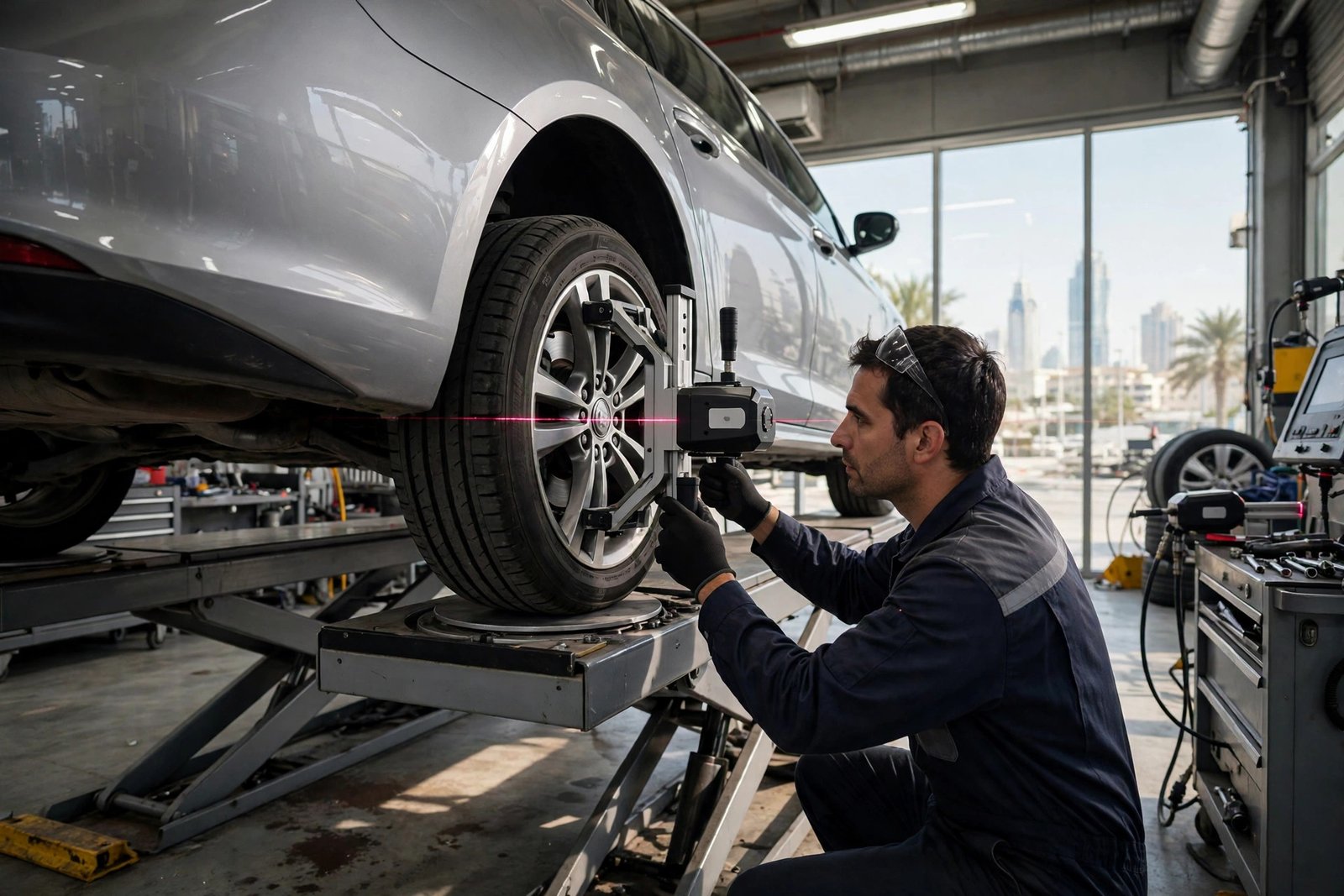
If your car needs an alignment, a good place to start is a proper wheel alignment in Dubai check, where the angles are measured on a machine and set back to the manufacturer's settings. A quick visual look at the wheels is never enough. The angles we are talking about are measured in fractions of a degree, and no human eye can see a fraction of a degree. Anyone who tells you they can align a car by eye is selling you a guess, not a service.
Why Dubai Roads Knock Alignment Out
Dubai has some of the smoothest highways in the world, and drivers who spend their lives on Sheikh Zayed Road sometimes assume their alignment should last forever. But the daily reality of driving in this city is harder on a car's wheels than a highway cruise suggests. The damage rarely comes from one dramatic event. It comes from dozens of small knocks that add up, week after week, until the angles have moved enough for the driver to feel it.
Kerbs are the first culprit, and they are everywhere in daily Dubai driving. Tight parking bays in malls and residential towers, high kerbs outside villas in communities like Arabian Ranches or Jumeirah, the concrete edges around petrol stations and drive-throughs. A wheel that climbs a kerb at an angle, even slowly, pushes sideways on the suspension. Do it once and nothing much happens. Do it a few times a week for months, always on the same side because of the way you park, and the toe angle on that wheel creeps out. I have seen cars where the driver parks the same way every single day, clipping the same kerb on the same side, and the alignment on that side is always the one that is out. Parking slowly, and straightening up before you mount a kerb, makes a real difference over the life of a car.
Potholes and road works are the second culprit. Dubai's roads are well maintained, but the city is always building, and road works, temporary ramps, uneven patches and drainage grates appear overnight on roads you drive every day. A pothole hit at speed is a sharp shock that travels straight up through the tyre and into the suspension. At low speed in a residential area it is usually harmless. At highway speed it can bend a suspension arm, knock the camber out, or even crack a wheel. The worst ones are the holes you do not see — a dip hidden in shadow on an unlit road at night, or a patch of broken tarmac after rain. If you hit a pothole hard and the car starts pulling the next day, the two events are almost certainly connected, and the alignment should be checked before the tyres start wearing unevenly.
Speed bumps are the third culprit, and Dubai has more of them than most cities. Every residential community, every school zone, every mall car park has them, and some are taller and sharper than others. Taken slowly and square-on, a speed bump is harmless. Taken fast, or taken at an angle with one wheel on the bump and one wheel off it, it twists the suspension. The one-wheel-at-an-angle habit is the damaging one, because it loads one side of the suspension while the other side is unloaded, and that uneven load is exactly what shifts alignment angles over time. School-run drivers feel this most, because they cross the same bumps four times a day, five days a week, often in a hurry. Slow down for bumps, take them straight, and your alignment will thank you.
Then there is the simple wear of daily driving. Suspension parts are made of metal and rubber, and rubber ages. In our heat, rubber bushes harden and crack faster than they would in a cooler climate. A bush that has gone soft lets a suspension arm move a little more than it should, and that little bit of movement changes the alignment angles every time the car goes over a bump or around a corner. So sometimes the alignment is out not because of a knock, but because the parts that hold the alignment have worn out. In that case, adjusting the alignment without replacing the worn part is a waste of money — the angles will drift out again within weeks, because the worn part is still letting the wheel move. A good mechanic checks the suspension parts before touching the alignment machine, and that order matters.
Finally, there is the work that other people do on your car. New tyres, new suspension parts, a steering repair — any job that involves taking wheels or suspension parts off and putting them back on can change the alignment. A responsible workshop checks the alignment after that kind of work as a matter of routine. If a car starts pulling the day after a repair, the first question to ask is whether the alignment was checked after the work was done. More than once I have fixed a pull simply by doing the alignment check that should have followed a previous job.
Uneven Tyre Wear and Tyre Pressure
Tyres are the only part of your car that actually touches the road, and they are the most common cause of a pull that drivers misdiagnose. I would say that in my experience, a large share of pulling complaints turn out to be tyre problems, not alignment problems — and the difference matters, because new tyres cost far more than an alignment check, and an alignment will not fix a tyre that is already worn unevenly. So before anything else, look at your tyres properly.
Tyre pressure is the simplest cause of all, and the one most drivers overlook. If the front left tyre is low on air and the front right is at the right pressure, the car will pull to the left, towards the soft tyre. The soft tyre has a bigger contact patch with the road, it rolls with more resistance, and it effectively drags that side of the car backwards. The effect is strong enough to feel, and it can appear overnight if a tyre has a slow leak from a small nail or a faulty valve. Dubai's summer heat makes this worse in two ways: heat makes tyre pressures rise during the day and fall overnight, so a tyre that was fine in the afternoon can be noticeably soft on a cool morning, and heat also makes slow leaks worse, because the air inside a hot tyre is under higher pressure and escapes faster through any weak point. Checking your pressures once a month, when the tyres are cold, is the cheapest habit in car ownership. Your car's correct pressures are printed on a sticker inside the driver's door frame or in the owner's manual — use those numbers, not the number printed on the tyre itself, which is a maximum, not a recommendation.
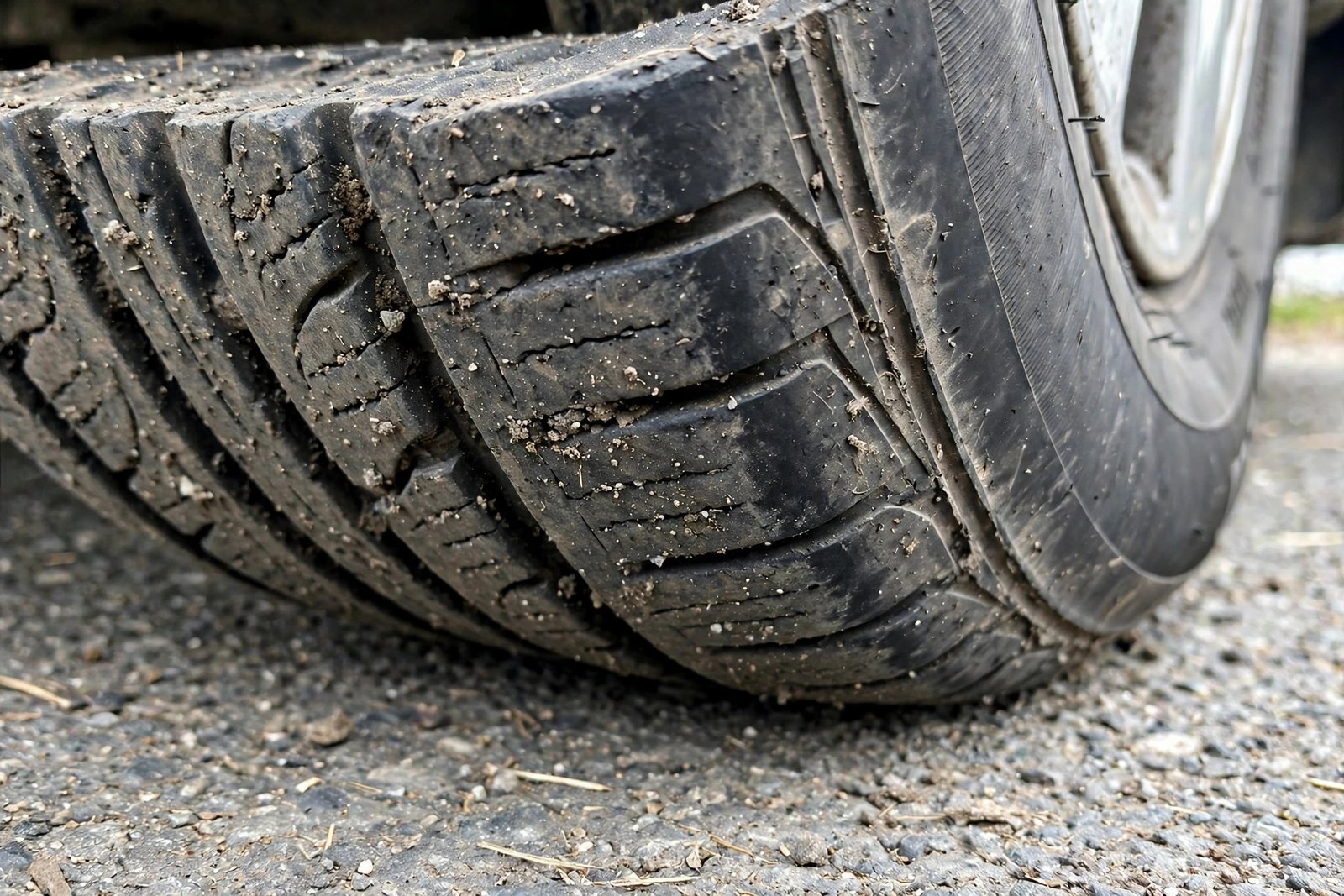
Uneven wear is the next thing to look for, and it tells a story if you know how to read it. A tyre worn smooth on one edge only — the inside edge or the outside edge — usually means the alignment angles have been out for a while, and the tyre has been scrubbing along the road at the wrong angle. A tyre worn in the middle means it has spent too long overinflated. A tyre worn on both edges but not the middle means it has spent too long underinflated. A tyre with patchy bald spots around the tread, like a map of worn islands, usually means a balance problem or a worn suspension part letting the wheel bounce. And a tyre with a sawtooth pattern — run your hand across the tread and feel sharp edges in one direction and smooth in the other — usually means the toe angle is out, dragging the tread blocks sideways as the tyre rolls. Each pattern points to a different cause, and a mechanic who reads the wear pattern can often tell you what is wrong before the car even goes on a lift.
Mismatched tyres are another common Dubai problem. Many drivers replace one tyre at a time, which is understandable — tyres are not cheap. But if the new tyre is a different brand, a different tread pattern, or a different size from the one on the other side, the two front tyres will grip the road differently and roll at slightly different rates, and the car will pull towards the side with more grip or more rolling resistance. The same applies to mixing a nearly new tyre with a nearly worn-out one on the same axle. The pair should match as closely as possible. If you must replace one tyre, try to match the brand and tread pattern of the one on the other side, and put the two newest tyres on the rear axle if you have any doubt, because a mismatch at the rear is less likely to make the car pull than a mismatch at the front.
The tyre swap test is the most useful do-it-yourself check for tyre-related pulling, and it is simple. If your car pulls to the left, swap the two front tyres from side to side — left to right and right to left — and drive the car again on the same quiet road. If the pull changes direction and the car now pulls to the right, the tyres are the cause: something about one of those tyres is making it pull, and it followed the tyre across the car. If the pull stays exactly the same, to the same side, the tyres are probably not the cause, and you can look at alignment and suspension instead. If the pull disappears altogether, the two tyres may have been cancelling each other out, and you still need to check them properly. This test works because it is the only test that moves the suspect from one side of the car to the other. I use it in the workshop all the time, and it saves drivers from paying for an alignment when the real problem was a single worn tyre. Just remember: if your tyres are directional — marked with an arrow on the sidewall showing which way they should rotate — do not swap them side to side without checking with a tyre shop first, because a directional tyre fitted backwards is worse than useless in the rain.
One more tyre problem is worth knowing about, because it is a safety issue, not just a comfort issue. A tyre with a bulge in the sidewall, or a tyre that has been repaired badly, can make a car pull and can also fail suddenly at speed. A bulge means the inner structure of the tyre has been damaged, usually by a hard kerb strike or pothole, and the tyre is weak at that spot. If you see a bulge, do not drive on the highway, do not wait until the weekend, and do not try to fix it yourself. A damaged tyre needs replacing, and the sooner the better. If you need help with tyres, proper tyre repair services in Dubai can check the tyre, tell you honestly whether it can be repaired or must be replaced, and make sure the replacement matches the other side.
A Sticking Brake Calliper
Of all the causes of pulling, a sticking brake is the one that worries me most, because it is the one that can turn dangerous without much warning, and because drivers often live with it far longer than they should. Let me explain what it is in plain words. Each wheel has a brake, and the brake works by squeezing a disc — a round metal plate that turns with the wheel — between two pads. The squeezing is done by a part called a calliper, which is a bit like a clamp. When you press the brake pedal, the calliper squeezes. When you let go, the calliper should release fully, so the pads pull back and the wheel spins freely. A sticking calliper is one that does not release properly. It keeps squeezing, even lightly, after you have taken your foot off the pedal. That wheel is now dragging, like driving with the handbrake half on, but only on one side — and the car pulls towards the dragging side.
The signs of a sticking calliper are distinctive once you know them. The pull gets worse the longer you drive, because the dragging brake gets hotter and hotter, and a hot brake grips more than a cool one. After a drive, one wheel is much hotter than the others, and you may smell something sharp and hot near that wheel, like burning. You may notice the car feels sluggish, as if it is working harder than usual, and the fuel gauge seems to drop faster than normal. Sometimes there is a squealing or grinding noise from one wheel, or a vibration through the pedal. In bad cases the car pulls strongly to one side every time you brake, and then keeps pulling even when you are not braking. If you notice any of these signs together — a pull plus heat plus smell — stop using the car for long trips and get the brake checked the same day.
What makes a calliper stick? The most common cause here in Dubai is corrosion and dirt. The calliper has a piston inside it that slides in and out, and it slides on a thin seal. Over time, dust, sand and road salt get in, the piston surface corrodes, and the piston stops sliding freely. Our summer heat speeds this up, because heat bakes the grease out of the sliding pins and dries out the rubber seals. Cars that sit parked for long stretches — a second car that only comes out at weekends, or a car left standing while its owner is travelling — are more prone to it, because the brake parts are not moving regularly and corrosion sets in. A damaged rubber hose can also cause it: the hose can collapse inside, letting brake fluid in under pressure but not letting it flow back out, so the brake stays partly applied. And sometimes the cause is simpler — the sliding pins that the calliper moves on have gone dry and rusty, and a clean and a fresh coat of the right grease fixes the whole problem.
A sticking calliper is not a problem that fixes itself, and it is not a problem that stays the same size. The dragging brake wears the pads on that wheel much faster than the other side, it overheats the disc until the disc warps, and a warped disc then causes vibration every time you brake. The heat can also damage the wheel bearing on that side, and in a bad case it can boil the brake fluid, which makes the brake pedal feel soft and the braking weaker overall. What starts as a small pull can end up needing new pads, a new disc, a new calliper, and possibly a bearing — several jobs instead of one, all because the first symptom was ignored. This is why I tell drivers to take the heat test seriously. One hot wheel is not a mystery. It is a message.
There is one more brake-related cause of pulling that is worth mentioning, because it is common after brake work. If brake pads have been replaced on one side only, or if one side has new pads and the other side has old, worn pads, the two sides will grip differently and the car will pull when you brake. Brake work should always be done in pairs — both front wheels together, or both rear wheels together. The same applies to discs: one new disc and one old disc will not match. If your car started pulling the day after a brake job, go back to the workshop that did the job and ask them to check that both sides match. A good workshop will check this without argument, because it is a basic part of the job.
If any of this sounds like your car, do not keep driving on long trips while you think about it. Brakes are the one system where waiting is never the right answer. A proper brake repair in Dubai check will find whether the calliper is sticking, whether the pins need cleaning, or whether the pads and discs need attention on one side, and it will put the braking back to even on both sides.
Suspension Wear: Bushes, Ball Joints and Springs
Suspension is the part of the car most drivers never think about until something goes wrong, and that is a shame, because the suspension holds the wheels in position. Every alignment angle I talked about earlier — toe, camber, caster — is held in place by suspension parts. When those parts wear out, the angles stop staying put, and the car starts pulling, wandering, or wearing its tyres unevenly. Suspension wear is a slow problem. It does not happen in a day. It happens over tens of thousands of kilometres of speed bumps, potholes, and heat, and by the time a driver notices the pull, the worn part has often been worn for a long time.
Bushes are the usual first suspects. A bush is a small piece of rubber, or rubber and metal, that sits where a suspension arm joins the body of the car. Its job is to let the arm move slightly while absorbing vibration and noise. Rubber ages, and in Dubai it ages faster than in cooler places. Our summer heat dries rubber out, makes it hard, and then it cracks. A cracked bush lets the suspension arm shift position slightly every time the car goes over a bump or brakes, and that shifting changes the wheel's angle momentarily. The result is a car that wanders, a steering wheel that feels vague, and a pull that comes and goes depending on the road surface. You may also hear a dull knocking or clunking from the front when you go over speed bumps or turn into a parking bay. That knock is the worn bush letting metal move against metal. It is one of the most recognisable sounds in a workshop, and when a driver describes it to me, I already have a good idea what I will find.
Ball joints are the next part to understand. A ball joint is a small ball-and-socket connection, a bit like the joint in your shoulder, that lets the wheel turn for steering while also moving up and down over bumps. It is a clever part, but it wears, and when it wears it develops play — a small amount of looseness. Play in a ball joint means the wheel can wobble slightly, and a wobbling wheel does not hold its alignment. The car may pull to one side, the steering may feel loose, and the tyre on that side may wear in a patchy, uneven pattern. A worn ball joint is also a safety issue, because in a very worn state it can separate, and a separated ball joint means the wheel is no longer properly attached to the car. That is rare, and it gives plenty of warning first — knocking noises, wandering steering, uneven tyre wear — but it is exactly why a knocking suspension should never be ignored for months.
Springs are the third part, and they fail in a way that surprises people. A coil spring is a heavy steel coil that holds the car's weight and absorbs bumps. Springs can sag with age, and they can crack or break, often at the bottom coil where road salt and grit collect. A sagging spring on one side makes that corner of the car sit lower than the other side. That changes the camber angle on that wheel, and the car pulls towards the side that sits lower. A broken spring is more obvious — you may hear a loud clunk, the car may sit visibly lopsided, and the ride becomes harsh. But a spring that has sagged by a small amount is harder to spot, and it causes a gentle, persistent pull that drivers often blame on alignment. If your car pulls and the alignment keeps going out, or if one corner of the car sits lower than the other when parked on flat ground, ask for the springs and the ride height to be checked.
Shock absorbers, which most people call shockers, are worth a mention too. Their job is to control the spring, stopping the car from bouncing after a bump. A worn shock absorber lets the wheel bounce more than it should, and a bouncing wheel does not stay in proper contact with the road. The result is patchy tyre wear and a car that feels unsettled over bumps. A simple check is the bounce test: push down firmly on one corner of the car and let go. The car should rise back up and settle straight away. If it keeps bouncing up and down, the shock absorber on that corner is worn. It is a rough test, not a precise one, but it catches badly worn shockers, and it is worth doing if you suspect suspension trouble.
Here is the key point about suspension wear and alignment. If a bush, a ball joint or a spring is worn, adjusting the alignment will not fix the pull, because the worn part will let the wheel move out of position again as soon as you drive away. The alignment numbers may look perfect on the machine while the car is standing still, and then change the moment the car is moving and the worn part is loaded. That is why a good mechanic always inspects the suspension before aligning a car. If worn parts are found, they are replaced first, and the alignment is done after. Anyone who offers to align your car without checking the suspension first is doing half the job. If you want to read more about the warning signs, our guide to suspension problems in Dubai covers the noises, the feelings and the tyre wear patterns in detail, and when parts do need replacing, proper suspension repair puts the car back to the way it should feel.
Steering Faults That Make a Car Pull
The steering system is the link between your hands and the wheels, and when something in that link wears or goes wrong, the car can pull, wander, or feel strange in ways that look like alignment trouble but are not. Most modern cars in Dubai have power steering, either hydraulic or electric, and each type has its own faults. Understanding the basics helps you describe the problem clearly and stops you paying for an alignment when the steering is the real cause.
The first steering fault to know is play in the steering rack or the track rod ends. The track rod ends are small joints that connect the steering rack to the wheels. Like ball joints, they wear and develop play. When they do, the steering wheel can feel loose — you turn it a little and nothing happens, then the car responds suddenly. The car wanders on the highway because the wheels are free to move slightly without the steering wheel moving. The classic test is simple: parked safely with the engine off, gently rock the steering wheel left and right through a small amount, and feel for looseness or a knocking sound. A small amount of free movement is normal. A loose, knocking feeling is not. Track rod ends are not expensive parts, but they are safety parts, and a worn one should be replaced promptly.
The second fault is a steering rack problem. The rack is the long bar that pushes the wheels left and right when you turn the steering wheel. Inside it are seals and gears, and over time the seals can wear and leak. On a hydraulic power steering car, a leaking rack shows up as a drop in the power steering fluid level, a whining noise when you turn the wheel, and steering that feels heavier on one side than the other. Steering that is heavy one way and light the other way is a strong clue that the rack, or the valve inside it, is faulty. On an electric power steering car, the faults are different — a failing motor or sensor can make the steering assistance cut in and out, or pull to one side under its own power. If your car pulls and the steering feels different turning left compared with turning right, mention that to your mechanic, because it points at the steering system rather than the tyres or alignment.
The third fault is low or contaminated power steering fluid, on cars that still use hydraulic steering. The fluid is what carries the force from the pump to the rack. When the level drops because of a leak, or when the fluid is old and dirty, the assistance becomes uneven and the steering can feel notchy or heavy. The fluid reservoir is usually easy to find under the bonnet, with a minimum and maximum mark on the side. If the level is low, that is a sign of a leak somewhere, and topping it up without finding the leak is only a temporary fix. The leak will still be there, the level will drop again, and the steering will get worse. Find the leak, fix it, and the steering comes back to normal.
Then there is the steering column itself, and the simple thing that catches people out: a steering wheel that was never centred properly after a repair. If a steering rack or a track rod has been replaced and the steering wheel was not centred during the job, the wheel will sit crooked even though the car drives straight, and the driver will read it as a pulling problem. This is not a fault in the car so much as a fault in the last job done on it. It is fixed by centring the wheel properly during the alignment, and it is one of the first things a careful mechanic checks when a driver says the wheel sits crooked.
One last steering point, and it is a Dubai-specific one. Our sand and dust get into everything, including the rubber boots that protect the steering joints. Those boots are called gaiters, and their job is to keep dust and grit away from the joints inside. When a gaiter splits — and heat and age make them split — dust gets in and grinds the joint away from the inside. A split gaiter is cheap to replace. The joint it protects is not. So if you ever have the car on a lift for any reason, ask the mechanic to glance at the steering gaiters. It is a thirty-second check that can save a much bigger bill later. Steering faults, like suspension faults, are part of a full car repair and maintenance services check, because the steering, the suspension and the tyres all work as one system, and a fault in one shows up as a symptom in another.
How the Checks Tell Them Apart: A Step-by-Step Diagnostic Order
By now you have a list of suspects: alignment, tyres, brakes, suspension, steering. The question is how to narrow that list down without guessing, and without paying for parts you do not need. The answer is order. There is a right order to check things in, and it is the same order I follow in the workshop. It starts with the free and easy checks and works towards the checks that need equipment, and each step rules something out before you move on to the next one. Follow this order and you will almost always find the cause.

Step one is tyre pressures. Check all four tyres when they are cold, before you have driven anywhere, and set them to the pressures on the sticker inside the driver's door frame. A soft tyre is the cheapest cause of a pull, and it is also the most common cause that drivers miss. I have lost count of the cars that came in for an alignment and left with nothing more than a top-up of air. After setting the pressures, drive the car on your quiet test stretch and see if the pull is gone or reduced. If it is gone, you have your answer, and you should still keep an eye on that tyre for the next few days, because a tyre that keeps going soft has a slow leak that needs finding. If the pull is unchanged, move to step two.
Step two is the tyre inspection and the swap test. Look at the tread on all four tyres. Feel across the tread for uneven wear, look for bulges, cracks and bald patches, and check that the two front tyres match in brand, size and tread pattern. If one front tyre looks different from the other — more worn, a different brand, a different pattern — that is a strong suspect. Then do the swap test: swap the two front tyres from side to side and drive the car again. If the pull changes direction, the tyres are the cause. If the pull stays the same, the tyres are probably not the cause, and you can move on with confidence. If the tyres are visibly worn unevenly, do not just swap them and forget about it — uneven wear means something else made them wear that way, and that something still needs finding.
Step three is the braking test. Drive at low speed on a quiet, flat stretch, with both hands on the wheel, and brake gently, then a little more firmly. Does the car pull to one side as it slows? Does the pull get stronger the harder you brake? If yes, the brakes are the prime suspect, and the next check is the heat test. After a normal drive, carefully feel for heat near each wheel without touching anything, and note whether one wheel is much hotter than the others. A pull under braking plus one hot wheel is a sticking calliper until proven otherwise, and that car should go to a workshop the same day.
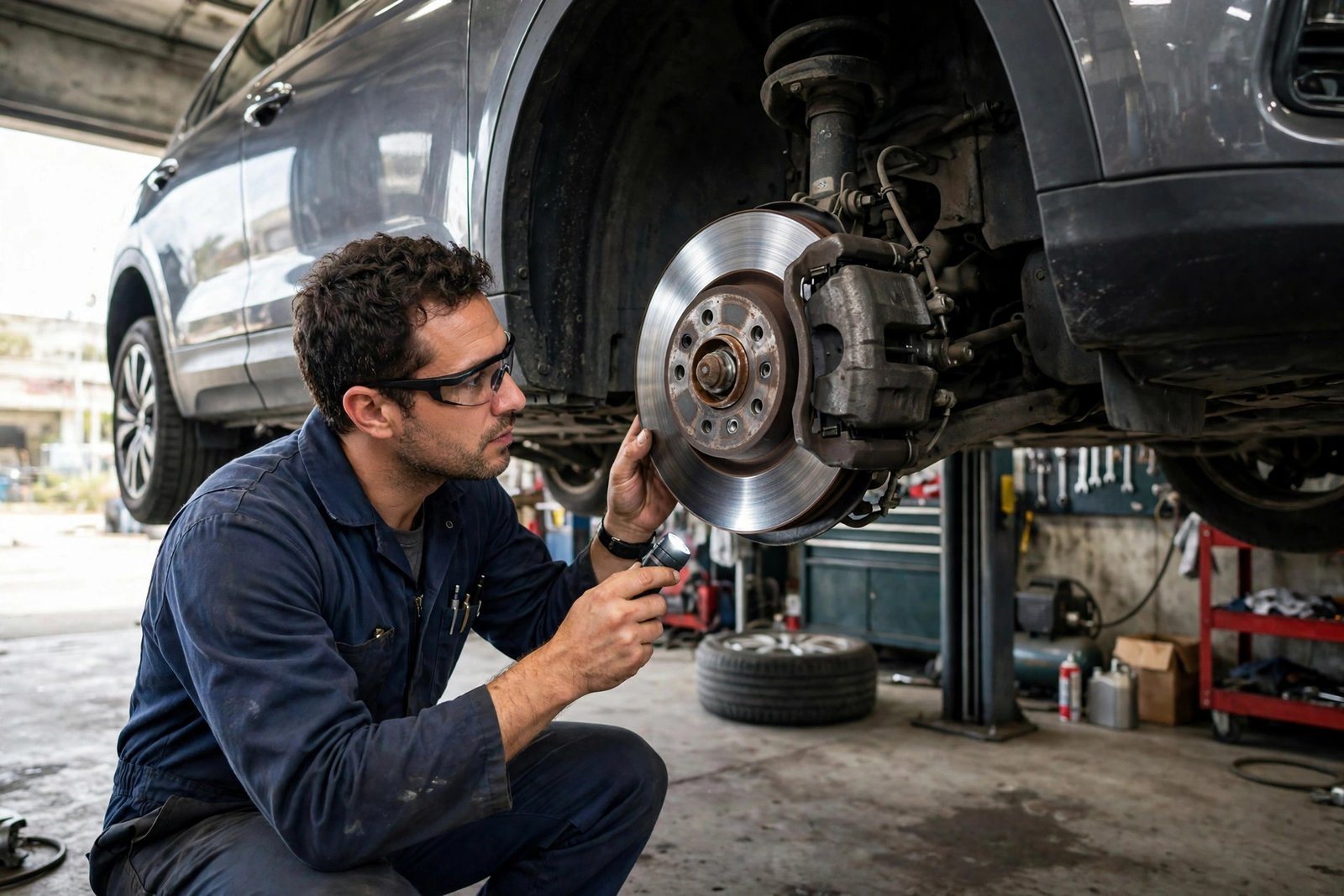
Step four is the suspension and steering check, and this one needs the car raised up. With the car safely lifted, a mechanic checks each wheel for play — rocking the wheel top to bottom and side to side, feeling for looseness that should not be there. Play at the top and bottom of the wheel usually points to a ball joint or a wheel bearing. Play from side to side usually points to a track rod end or the steering rack. The mechanic will also look at the bushes for cracks and splits, check the springs for sagging or breakage, and look at the shock absorbers for leaks. This is a hands-on check that takes a few minutes per wheel, and it catches worn parts that no alignment machine can see, because a machine measures angles while the car is standing still, and a worn bush only shows its play when the suspension is loaded and moving.
Step five is the alignment check itself, on a proper alignment machine. This comes last, not first, and the order matters. If you align a car with a worn bush or a sticking brake, the alignment will be wrong again within weeks, and you will have paid for a job that could not last. The machine measures toe, camber and caster on all four wheels and compares them with the manufacturer's settings for your exact car. The mechanic adjusts what can be adjusted, and if a reading cannot be brought into range, that tells you something is bent or worn, and it needs to be found and fixed. I will explain exactly what this check looks like in a later section, because knowing what a proper check involves is the best protection against a poor one.
Step six is the road test after the work. Whatever was found and fixed — pressures, tyres, brakes, suspension parts, alignment — the car should be driven again on a real road to confirm the pull is gone. A good workshop does this as part of the job, and a good mechanic will tell you honestly if the pull is fully fixed or only improved, because a pull that is only improved means there is still something else going on. If your car comes back from a workshop and the pull is still there, go back and say so. A pull that survives a repair is information, not a failure, and it tells the mechanic to look at the next suspect on the list.
One more piece of advice about this order: write down the results at each step. Pulled left before the pressure check, pulled left after, swapped tyres and still pulled left, pulled left under braking, one wheel hot. That short record is worth more than a long description, because it lets a mechanic skip the steps you have already done and go straight to the ones that matter. It also stops you paying twice for the same check, and it stops a workshop from starting at the expensive end of the list when the answer was at the cheap end all along.
Dubai Heat, Sand and Dust: The Hidden Factors
Most guides about pulling cars are written for cooler countries, and they miss the factors that make Dubai different. Our climate is not just a background detail. Heat, sand and dust actively wear out the parts that keep a car going straight, and they do it in ways that are worth understanding, because they change how often you should check things and what you should watch for.
Heat is the biggest factor. In the middle of a Dubai summer, the air temperature is high, the road surface is far hotter, and the temperature inside a wheel and tyre can climb well beyond what the same car would see in a cooler country. Rubber ages faster in heat. The bushes in your suspension, the seals in your callipers, the boots that protect your steering joints — all of these are rubber, and all of them harden, crack and shrink sooner in our climate than their makers expected. A bush that might last for years in a mild climate can be cracked and worn here much sooner, and a cracked bush is a bush that lets the wheel move, which changes the alignment, which makes the car pull. Heat also thins the grease in calliper pins and wheel bearings, so parts that should slide smoothly start to stick and drag. And heat makes tyre pressures swing more between morning and afternoon, which means a pressure problem that is invisible at midday can be obvious on a cool early morning drive.
Sand and dust are the second factor. Dubai is a desert city, and fine dust gets everywhere, including places you would not expect. It gets into suspension joints, into brake parts, and past damaged rubber boots into steering joints. Once inside, dust acts like grinding paste, wearing away metal surfaces a tiny bit at a time. It also mixes with grease to form a gritty paste that stops parts sliding freely. Cars that are driven regularly on sandy or dusty roads — construction areas, desert tracks, unpaved parking areas — suffer this faster, but even a car that never leaves tarmac picks up dust every day. The defence is simple: keep the rubber boots and seals in good condition, because they are the dust's way in, and replace a split boot quickly rather than leaving it for the next service. A boot is a small, cheap part. The joint behind it is not.
The third factor is the way we drive here. Long, fast highway runs at high speed put different loads on a car than slow city driving. At highway speed, a small imbalance or a small alignment error is felt much more strongly, and the tyres run hotter. Stop-start traffic in the summer, with the air conditioning working hard and the engine bay hot, keeps everything under the bonnet and around the wheels at high temperature for long periods. And the school run — the same speed bumps, the same tight turns, the same kerbs, four times a day — wears one side of the suspension more than the other if the route always turns the same way. None of this means Dubai driving is bad for cars. It just means the checks should be done a little more often here than the owner's manual might suggest, and that a pull should be taken seriously a little sooner.
There is also a seasonal pattern I notice every year. Pulling complaints rise in the summer, when the heat is at its worst and the rubber parts are under the most stress, and they rise again after the first rains, when dust that has built up on the roads turns into a slippery film and drivers notice handling changes they had been ignoring. If your car has started pulling as the weather has changed, the weather may not be the cause, but it may be the thing that made a problem that was already there finally noticeable. Either way, the checks are the same, and the order is the same: pressures, tyres, brakes, suspension, alignment.
What Is Safe to Keep Driving With — and When to Stop
This is the question every driver really wants answered, and I will give it to you straight, because getting it wrong has consequences. A gentle, steady drift is usually safe to drive with for a short time while you arrange a check, as long as you drive carefully, keep your speed down, and avoid long highway trips. It is annoying, it is wearing your tyres unevenly, and it needs fixing, but it is not an emergency. Book the check within days, not weeks, and do not let a gentle drift become a habit you stop noticing.
A pull that has appeared suddenly is different. If your car was driving straight yesterday and pulling today, something has changed, and something that changes suddenly can change again suddenly. Drive carefully, keep your speed low, avoid the highway if you can, and get the car checked the same day. A sudden pull after hitting a pothole or a kerb is especially worth a same-day check, because a bent suspension part or a damaged tyre can fail without further warning, and the cost of the check is small compared with the cost of a failure at speed.
A pull under braking is a same-day problem, every time. Brakes that pull the car to one side are brakes that are not working evenly, and uneven braking is longer stopping distances and less control in an emergency. If your car pulls when you brake, drive gently to a workshop, keep your distance from the car in front, and do not take the car on the highway. If the pull under braking is strong, or if the brake pedal feels soft, or if you can smell hot brakes, consider calling for mobile help rather than driving the car at all. Brakes are the one system where being cautious costs nothing and being brave can cost everything.
A sticking brake — one hot wheel, a burning smell, a pull that gets worse the longer you drive — is a stop-driving problem. Do not take that car on a long trip. Do not drive it to the other side of the city. Get it checked where it is, or have help come to you. A dragging brake generates serious heat, and that heat can damage the disc, the bearing and the brake fluid. In a worst case it can cause a tyre to fail or a brake to fade when you need it most. This is the one cause on this list where the right answer is to stop, not to keep going.
A car with a knocking suspension, a visibly lopsided stance, a bulging tyre sidewall, or a steering wheel with obvious looseness is also a stop-driving problem, or at least a drive-very-carefully-and-very-shortly problem. A bulging tyre can fail at any moment. A broken spring can damage the tyre it sits on. A steering joint with heavy play can separate. These are not things that improve with time, and they are not things to test on Sheikh Zayed Road at highway speed. Park the car somewhere safe, call for help, and let a mechanic come to you.
For everything else, use this simple rule: if the pull is getting worse, get it checked sooner. A problem that is stable is less urgent than a problem that is growing. If the pull was slight last week and strong this week, something is wearing out quickly, and the check should happen now. And if you are ever in doubt, doubt is itself a reason to get a check. A proper inspection is quick, and the peace of mind of knowing your brakes and steering are sound is worth far more than the time it takes.
What a Proper Alignment Check Looks Like
If you have never watched an alignment being done, the process can seem mysterious, and that mystery is what lets poor work hide. So here is what a proper alignment check looks like from start to finish, so you know what to expect and what to ask for. If a workshop skips steps, you will know. If a workshop does it properly, you will know that too, and you can drive away confident the job was done right.
It starts before the car goes on the machine. A good mechanic inspects the car first. They check the tyre pressures and set them correctly, because an alignment measured on soft tyres is meaningless. They look at the tyres for uneven wear, bulges and damage. They check the suspension — rocking each wheel to feel for play in the ball joints and wheel bearings, looking at the bushes for cracks, checking the springs and the shock absorbers. They check the steering for looseness. Only when the mechanic is satisfied that the suspension and steering are sound does the car go on the alignment machine. If worn parts are found, they should be discussed with you before any alignment work starts, because aligning a car with worn suspension is money spent on a result that will not last.
Next, the car is driven onto the alignment lift, which is a flat platform with turntables under the front wheels. The turntables let the wheels turn freely while the car is standing still, so the steering can be moved without the tyres scrubbing against the platform. The mechanic attaches targets or sensors to each wheel — these are the devices the machine uses to measure the angles. On a modern machine, the targets are reflective boards that cameras read, and the machine works out toe, camber and caster for all four wheels to a fraction of a degree. The car must be sitting level, with no one sitting in it and no heavy load in the boot, because extra weight changes the angles. Some workshops also ask about the fuel level, because a full tank adds weight at the back. These details matter, and a careful workshop pays attention to them.
Then comes the measurement. The mechanic turns the steering wheel from side to side through a set pattern, and the machine reads the angles as the wheels move. This is how caster is measured — it cannot be read from a still wheel, so the machine watches how the camber changes as the wheel is steered. The whole measurement takes a few minutes, and the result appears on a screen as a set of numbers, usually shown in green where the angle is within the manufacturer's range and red where it is outside it. Ask to see this screen. A good workshop will show it to you happily and explain what it means. The printout matters too: a proper alignment job ends with a before-and-after printout showing the angles as they were when the car arrived and as they are after the adjustment. Keep that printout. It is your proof the job was done, and it is useful the next time the alignment is checked, because it shows what changed.
The adjustment itself is done with the car still on the lift. The mechanic adjusts the track rods to set the toe, and on many cars the camber and caster can be adjusted with bolts on the suspension. On some cars, camber and caster are not adjustable, and if those angles are out, it means something is bent or worn and needs replacing, not adjusting. A careful mechanic will tell you this honestly rather than pretending an adjustment was made. After the adjustments, the machine measures everything again to confirm the angles are now in range, the steering wheel is centred — this is important, because a car can have correct toe and a crooked steering wheel if the wheel was not centred during the adjustment — and the car is taken for a road test. The road test is the final check. The car should drive straight on a flat road with the steering wheel level, and the pull should be gone. If it is not, the mechanic should say so and look further, not hand the car back and hope you do not notice.
A few things to be wary of. Be wary of an alignment offered without a printout, because without the numbers you have no way to know what was actually done. Be wary of a workshop that aligns your car in a few minutes with no inspection first, because the inspection is part of the job. Be wary of being told you need new parts without being shown the worn part or the measurement that proves it. And be wary of a price that seems far below every other workshop in the area — proper alignment takes time, a proper machine, and a trained operator, and a job priced far below the going rate is usually a job with steps skipped. None of this means you should pay the highest price you can find. It means you should judge the job by the process, not by the price tag: inspection first, measurement on a proper machine, a before-and-after printout, a centred steering wheel, and a road test.
How often should alignment be checked? There is no single answer, because it depends on how and where you drive. As a rough guide, have it checked once a year as part of a normal service, and have it checked sooner after any hard knock — a deep pothole, a kerb strike, a bump at speed — or whenever you notice the car pulling, the steering wheel sitting crooked, or a tyre wearing on one edge. Have it checked after any suspension or steering work, and after fitting new tyres, because new tyres deserve a correct alignment and because the work of fitting them can disturb the settings. In Dubai, where the heat ages rubber parts faster and where speed bumps and kerbs are part of daily life, a yearly check is sensible, and a check after a hard knock is simply common sense.
Mistakes to Avoid When Your Car Pulls to One Side
I have seen every one of these mistakes made by good, sensible drivers, and each one cost money or time or both. Learn from other people's errors and you will save yourself the same expense.
The first mistake is paying for an alignment before checking the tyre pressures. It sounds too simple to be real, but it happens constantly. A driver feels a pull, books an alignment, and the car comes back fixed — not because the alignment was out, but because the workshop set the tyre pressures as part of the job. The driver paid for an alignment when all the car needed was air. Check the pressures first. It takes five minutes and costs nothing, and it rules out the cheapest cause before you spend anything.
The second mistake is buying four new tyres when the alignment is the problem. New tyres will make the car feel better for a while, because fresh tread grips well and masks a small pull. But if the alignment angles are wrong, those expensive new tyres will start wearing unevenly within weeks, and within months they will look just like the old ones. Always fix the cause before replacing the parts the cause damaged. Check the alignment, fix the worn bush, free the sticking calliper — then put the new tyres on, so they last as they should.
The third mistake is the opposite one: getting an alignment when a suspension part is worn. As I said earlier, a worn bush or ball joint lets the wheel move, so the angles measured on a stationary car are not the angles the car has when it is moving. The alignment may look perfect on the machine and be wrong again within days of driving. If a workshop aligns your car and the pull comes back quickly, the most likely reason is a worn part that was not checked or not replaced. Insist on the suspension inspection first, and if a part is worn, replace it and then align the car.
The fourth mistake is replacing parts on one side only. Brakes, tyres, suspension parts — these all work in pairs. One new brake pad against one old pad, one new tyre against one worn tyre, one new spring against one sagging spring: the two sides will behave differently, and the car will pull. Whatever you replace on one side, replace on the other side too. It costs more in the moment, but it costs far less than chasing a pull caused by mismatched parts for months.
The fifth mistake is ignoring a pull because it is only slight. A slight pull is a small problem today and a bigger problem tomorrow. It is wearing one tyre faster than the other, it is making you work harder on every drive, and it is a sign that something has moved or worn. A slight pull caused by a sticking brake will get worse as the brake gets hotter and more damaged. A slight pull caused by a worn bush will get worse as the bush deteriorates further. Catching a problem early is almost always cheaper than catching it late, and in the case of brakes and steering, it is also safer.
The sixth mistake is trusting a visual check instead of a measurement. Alignment angles are fractions of a degree. Tyre wear that looks minor to the eye can be a serious problem in millimetres. A brake that looks fine from the outside can be sticking inside. Human eyes are wonderful things, but they cannot measure toe to a tenth of a degree, and they cannot see inside a calliper. If a workshop tells you the alignment is fine because they looked at the wheels and they look straight, that is not a check. Ask for the machine, ask for the numbers, and ask for the printout.
The seventh mistake is driving on a bulging or badly damaged tyre while you wait for an appointment. A bulge means the tyre's structure has failed at that spot, and a tyre with failed structure can blow out without warning, especially at speed and especially in our summer heat. If you find a bulge, do not drive the car on the highway, do not put it off until the weekend, and do not let anyone tell you it is fine. A damaged tyre needs replacing now, and the cost of a new tyre is nothing against the cost of a blowout at speed.
The eighth mistake is letting a workshop replace parts without showing you the old ones or explaining the measurement. You are entitled to see the worn bush, the cracked spring, the uneven tyre, and the alignment printout. A good workshop shows you these things without being asked, because a shown fault is a trusted diagnosis. If a workshop will not show you the evidence, that is a reason to pause and get a second opinion before you agree to the work.
The ninth mistake is forgetting the road itself. Before you book anything, do the two-direction test I described earlier: drive the same stretch in both directions and see if the pull changes sides. Roads are built with a slope for drainage, and that slope alone can make a car drift. I have seen drivers spend money chasing a pull that was actually the camber of the road outside their house. The two-direction test costs nothing and rules the road out in a few minutes.
And the tenth mistake is the simplest of all: not writing anything down. When did the pull start? Which side does it pull to? Does it pull when cruising, braking, or accelerating? Is one wheel hot? Is one tyre worn on one edge? Five short notes, and a mechanic can narrow the cause down in minutes instead of hours. Drivers who arrive with clear notes get faster, cheaper, more accurate diagnoses than drivers who arrive with only a vague feeling that something is wrong. Your notes are part of the diagnosis, so take them seriously.
What Happens If You Ignore a Pull
A car that pulls to one side will not fix itself. I wish I could tell you otherwise, because I know how easy it is to get used to a small problem and stop noticing it. But every cause on this list gets worse with time, not better, and the cost of waiting is almost always higher than the cost of checking early. Let me walk you through what happens with each cause, so you can see why a small pull deserves attention now rather than later.
Start with tyres. A tyre that is wearing unevenly because the alignment is out will keep wearing unevenly, and it will wear faster and faster as the tread gets thinner on that edge. A tyre that starts with a small worn patch on one edge can be worn down to the cords on that edge while the rest of the tread still looks healthy. Once the cords are showing, the tyre is finished, and it is also dangerous, because the thin spot is the weakest part of the tyre and the most likely place for it to fail. A driver who ignores a slight pull for a few months often ends up buying two new tyres and paying for the alignment anyway — the tyres they could have saved, plus the job they were putting off.
Now think about a sticking brake. A calliper that drags slightly today will drag more next month, because the heat it generates damages the seals and the piston surface further, which makes it stick more, which generates more heat. It is a cycle that feeds on itself. The pads on that side wear down, the disc overheats and warps, the wheel bearing takes heat it was never designed for, and the brake fluid gets hot enough to lose its effectiveness. What could have been a clean and a fresh set of seals becomes a new calliper, new pads, a new disc, and possibly a new bearing. The difference between those two bills is simply the time between noticing the problem and acting on it.
Suspension wear follows the same pattern. A bush with a small crack today will have a bigger crack in a few months, because every bump and every turn flexes it a little more. A ball joint with a small amount of play will develop more play, and as the play grows, the wheel moves more, the tyre wears faster, and the steering feels worse. Springs that have sagged slightly will sag further. None of these parts heals, and none of them stays the same. The longer a worn part stays in the car, the more damage it does to the parts around it, because a loose joint lets other joints take loads they were not designed for.
There is also the driver to think about. Driving a car that pulls is tiring. You are holding the wheel off-centre, correcting constantly, and concentrating harder than you should need to. On a long drive to Abu Dhabi or up to Ras Al Khaimah, that constant correction becomes real fatigue, and fatigue slows your reactions. A car that pulls also behaves less predictably in an emergency. If you have to brake hard or swerve suddenly, a car with uneven brakes or a worn suspension part will not respond the way a sound car responds, and in that moment the difference matters. A straight-driving car is not just more comfortable. It is safer when something unexpected happens.
The good news is that the fix is usually straightforward once the cause is found, and the check that finds the cause is quick. Pressures, tyres, brakes, suspension, alignment — in that order, and the answer is usually found within the first few steps. So if your car has started pulling, do the simple checks in this guide, write down what you find, and get the car looked at. The earlier you catch it, the smaller the job, and the sooner you get back to a car that drives the way it should.
Frequently Asked Questions
Why does my car pull to the left in Dubai but drive straight in other places?
The most likely reason is the road, not the car. Roads are built with a gentle slope so rainwater runs off to the side, and that slope can push a car towards one side. Some roads slope more than others, and a car that feels fine on a flat road can drift on a road with a strong slope. The way to tell is the two-direction test: drive the same stretch of road in both directions. If the car pulls left going one way and right coming back, the road is doing it, and your car is probably fine. If the car pulls to the same side in both directions, the problem is in the car, and the most common causes are a soft tyre on that side, uneven tyre wear, or the alignment angles. Dubai's road network has many different surfaces and slopes, from smooth highways to older roads in residential areas, so a car can feel different from one road to the next. If the pull follows the car everywhere, get the pressures, the tyres and the alignment checked in that order.
Can low tyre pressure really make a car pull to one side?
Yes, and it is one of the most common causes I see. When a tyre is low on air, it squashes down more where it meets the road, so it has a bigger contact patch and more rolling resistance than the tyre on the other side. That extra resistance drags that side of the car backwards, and the car pulls towards the soft tyre. Even a small difference in pressure between the two front tyres is enough to feel, and a bigger difference makes a strong, obvious pull. The tricky part is that a tyre can look fine and still be low, because a modern tyre holds its shape well even when it is soft. The only way to know is to check with a pressure gauge. Check the pressures when the tyres are cold, before driving, and use the numbers on the sticker inside the driver's door frame. In Dubai's heat, pressures change more between morning and afternoon than they do in cooler countries, so a tyre that was fine yesterday can be soft today, especially if it has a slow leak from a small nail or a faulty valve. If one tyre keeps going soft, have it checked for a leak rather than just topping it up again and again.
Is it safe to drive my car if it pulls to one side?
It depends on how strong the pull is and what is causing it. A gentle, steady drift that has been there for a while, where the car stays controllable and brakes straight, is usually safe to drive carefully for a short time while you arrange a check. Keep your speed down, avoid long highway trips, and book the check within days. A sudden pull, a strong pull, a pull when you brake, a pull joined by a hot wheel or a burning smell, or a pull joined by knocking noises or a visibly damaged tyre is not safe to keep driving with. Those signs point to brakes, steering or tyre damage, and those systems can fail without further warning. If your car pulls when you brake, drive gently to a workshop and keep a good distance from the car in front. If one wheel is hot or you can smell burning, or if a tyre has a bulge, stop using the car and call for mobile help instead. When in doubt, get it checked sooner rather than later, because a check is quick and the peace of mind is worth it.
How do I know if the problem is alignment or tyres?
The best way is the tyre swap test. Swap the two front tyres from side to side and drive the car again on the same quiet road. If the pull changes direction — it pulled left before and now pulls right — the tyres are the cause, because the problem followed the tyre across the car. If the pull stays exactly the same, to the same side, the tyres are probably not the cause, and alignment or suspension is more likely. You can also look at the tyres for clues. A tyre worn smooth on one edge only usually means the alignment has been out for a while. A tyre worn in the middle usually means it has been overinflated. A tyre worn on both edges usually means it has been underinflated. And a tyre with a sawtooth pattern, where the tread blocks feel sharp in one direction and smooth in the other, usually means the toe angle is out. Remember that a proper alignment check measures the angles on a machine and gives you a printout, so if you are still unsure after the swap test, the alignment machine will settle the question with numbers rather than guesses.
Why does my car pull to one side only when I brake?
A car that pulls when you brake almost always has a braking problem, and the most common cause is a sticking calliper on one side. The calliper is the clamp that squeezes the brake disc, and when it sticks, it keeps squeezing after you take your foot off the pedal, so that wheel drags and the car pulls towards it. The pull gets worse the longer you drive, because the dragging brake gets hotter and grips more. After a drive, that wheel will be much hotter than the others, and you may smell something sharp and hot near it. Other possible causes are brake pads that are worn unevenly from side to side, a brake disc that is worn or warped on one side, or brake work done on one side only, so the two sides grip differently. Whatever the cause, a car that pulls under braking should be checked the same day, because uneven braking means longer stopping distances and less control in an emergency. Drive gently, keep your distance from the car in front, and do not take the car on the highway until it has been looked at.
Can a pothole or hitting a kerb cause my car to pull?
Yes, and it is one of the most common causes in Dubai. A pothole hit at speed sends a sharp shock straight up through the tyre and into the suspension, and that shock can bend a suspension arm, knock the camber or toe angle out, or damage the tyre itself. A kerb strike does the same thing in a sideways direction, pushing the wheel and the suspension parts it is attached to. A single hard hit can be enough to cause a pull that appears the very next day. Repeated small knocks add up too — clipping the same kerb every day when you park, or crossing the same sharp speed bump at an angle, can shift the angles gradually over weeks and months. If your car started pulling the day after you hit a pothole or a kerb, the two events are almost certainly connected. Get the alignment checked, and ask the mechanic to inspect the suspension parts and the tyre on the side that took the hit, because a bent part or a damaged tyre will make the alignment go out again if it is not fixed first.
How often should I get my wheel alignment checked in Dubai?
As a rough guide, have the alignment checked once a year as part of a normal service, and have it checked sooner whenever something changes. That means after any hard knock, such as a deep pothole or a kerb strike, whenever you notice the car pulling, the steering wheel sitting crooked, or a tyre wearing on one edge, and after any suspension or steering work or after fitting new tyres. In Dubai, a yearly check is sensible because our heat ages the rubber bushes and seals faster than in cooler countries, and because speed bumps and kerbs are part of daily driving here. The check itself is quick, and a proper one ends with a before-and-after printout showing the angles, so you have proof of what was done. Think of it like a dental check-up: doing it regularly catches small problems before they become expensive ones, and the cost of the check is small compared with the cost of a set of tyres worn out early by bad alignment.
What should I do first if my car starts pulling to one side?
Start with the free checks, in this order. First, check the tyre pressures when the tyres are cold and set them to the numbers on the sticker inside the driver's door frame, then drive the car and see if the pull is gone. Second, walk around the car and look at each tyre for uneven wear, bulges, cracks and damage, and check that the two front tyres match in brand, size and tread pattern. Third, do the swap test if the tyres look uneven: swap the front tyres from side to side and see if the pull changes direction. Fourth, do the braking test on a quiet, flat stretch at low speed and note whether the car pulls when you brake, and feel for heat near each wheel after a drive to check for a sticking brake. Write down what you find at each step. If the pressures, the tyres and the brakes all check out and the car still pulls, the next step is a professional alignment check on a proper machine, with a suspension inspection first. And if at any point you find a bulging tyre, a hot wheel, a strong pull under braking, or knocking from the suspension, stop driving the car for long trips and get help the same day.
Call 95 Services
If your car is pulling to one side and you want it sorted properly, call 95 Services on +971 54 344 3513. We are a mobile service, so we come to you — at your home, your office, or wherever your car is parked — anywhere in the complete UAE. You do not need to drive a pulling car across the city to reach a workshop, and you do not need to wait around in a waiting room while the work is done.
When you call, tell us which side the car pulls to, whether it pulls when you are cruising or when you brake, and anything else you have noticed — a hot wheel, a worn tyre edge, a crooked steering wheel. Those few details help us bring the right equipment and get straight to the cause. Our response time is 15–20 minutes, and help can arrive within 20 minutes, so you are not left waiting and wondering. We check the simple things first — the tyre pressures, the tyres, the brakes — and then work through the rest in the right order, so you pay for the fix you actually need and not for guesses. And our prices are very low, because a fair price is part of good service, not an extra.
A car that pulls to one side is your car asking for attention. Sometimes the answer is as simple as air in a tyre. Sometimes it is an alignment, a sticking brake, or a worn suspension part. Either way, it is worth finding out, because a car that drives straight is a car that is safer, easier to drive, and kinder to its tyres. Call 95 Services on +971 54 344 3513 and let us take a look. We will find the cause, explain it to you in plain words, and put it right.
