

Nissan Sunny and Altima in the UAE: The Common Faults to Check — CVT, AC, Suspension and Electricals
I have worked on cars all over Dubai for years now, and if there is one thing I can tell you from standing under bonnets in August heat, it is this: the Nissan Sunny and the Nissan Altima are everywhere. You see them outside offices in Business Bay, lined up at the RTA test centres, waiting outside schools in Sharjah, doing airport runs at three in the morning, and parked three deep outside labour accommodation in Sonapur. They are the cars that quietly do the work. They are not flashy. They do not turn heads on Sheikh Zayed Road. But they start in the morning, they sip fuel, and they carry families and fleets alike without making a fuss about it. That is exactly why so many people in the UAE end up owning one — or thinking about buying a used one.
And that is also why I am writing this. Because when a car is this common, the faults become common too. Not because the Sunny and the Altima are bad cars. They are not. They are honest, simple cars that do their job well for a long time. But they have weak points, and those weak points show up faster here than they would in a cooler country. The heat, the dust, the stop-start traffic on Al Khail Road, the long fast runs to Abu Dhabi, the high mileage that rental and fleet cars rack up — all of it pushes the same few parts harder than the engineers in Japan ever really planned for. If you know what to look for, you can buy a good one and keep it running for years. If you do not know, you can buy a car that looks clean and shiny and then find out the gearbox was already on its way out.
So this is not a sales page, and it is not a lecture. It is the walkaround I would do with you if you brought a Sunny or an Altima to me and said, "Tell me honestly what is wrong with this car." I will go through the gearbox first, because that is the big one, then the air conditioning, because in this country a weak AC is not a small problem, then the suspension, the electrics, the engine, and the brakes. Then I will give you two checklists: one for before you buy a used one, and one for the car you already own. Everything here is written in plain words. Where a fault only affects some model years, I will say so. Where something is a commonly reported issue rather than something every car will get, I will say that too. No car is perfect, and no honest mechanic will tell you otherwise.
One more thing before we start. When I talk about generations in this article, I am talking about the cars you will actually find for sale in the UAE. For the Sunny, that mostly means the N17 generation, which ran from around 2011, and the newer B17 generation that followed it. For the Altima, that mostly means the L32, the L33 from around 2013, and the L34 from around 2019. The names matter, because a fault that is common on one generation may barely exist on another. So whenever you are reading a fault below, check the year of the car in front of you. It makes all the difference.
Why the Sunny and the Altima Are Everywhere in the UAE
Walk through any used car market in the UAE — Ras Al Khor, Sharjah, the listings on your phone — and you will trip over Sunnys and Altimas. There is a reason for that, and it is not an accident. These two cars sit in the sweet spot of what most people here actually need. The Sunny is small, cheap to run, easy to park, and big enough inside for a family. The Altima is bigger, quieter, more comfortable on the highway, and still far cheaper to run than the big SUVs that fill the other lanes. Between them they cover almost every buyer in the country: the first-time buyer, the family on a budget, the company buying ten cars for its drivers, the rental company buying fifty.
The Sunny became the default car of the UAE in a way few cars ever do. It is the car your colleague drives. It is the car the delivery company uses. It is the car the driving school teaches in. Its little 1.5 and 1.6 litre engines are not powerful, and nobody buys a Sunny for speed, but they are simple engines with a timing chain instead of a belt, which means one less big job to worry about, and they are happy to do short trips all day in the heat. The cabin is roomy for the size of the car, especially in the back, and that matters here because the Sunny often carries four adults and not just two. It is also one of the cheapest cars to keep on the road: parts are everywhere, every workshop in the country knows how to fix one, and nothing on it is exotic or hard to find.
The Altima sits one step up. It is a proper mid-size sedan, the kind of car that feels settled at 120 on the highway to Abu Dhabi and does not feel strained doing it. The 2.5 litre four-cylinder is the common one here, and on some model years there was also a 3.5 litre V6, which is a strong, smooth engine that owners tend to love. The Altima gives you more space, more comfort, more equipment, and a quieter cabin than the Sunny, and for a used buyer it is often a lot of car for the money. That is the attraction, and it is a real one. But it is also the reason you have to be careful, because a cheap Altima with a tired gearbox is not a bargain at all. It is a bill waiting to happen.
Both cars share something else too: they were built in huge numbers, and a big share of the ones in the UAE have lived hard lives. A large number of Sunnys started life as rental cars or fleet cars or taxis. That does not make them bad cars — fleet cars are usually serviced on schedule, and a rental Sunny that was maintained properly can be a fine buy — but it does mean you cannot judge the car by the number on the dashboard alone. A Sunny that has done most of its kilometres on the highway between Dubai and Abu Dhabi will feel very different from a Sunny that has spent its whole life crawling through Deira traffic with a different driver every week. The wear is in different places. The seats, the steering wheel, the pedals, the gearbox — they all tell a story if you know how to read them.
The heat is the other thing that shapes these cars here. A Sunny or an Altima in the UAE lives a harder life than the same car in a mild climate. The air conditioning runs almost all year. The cooling system works harder. Rubber parts — hoses, bushes, seals — age faster in the sun. Dust gets into everything. And because fuel here is affordable, people drive a lot: long distances, high speeds, heavy use. That is the context for everything in this article. A fault that sounds alarming in a forum post from another country might be a small, manageable thing here, and a fault that sounds small might be a big deal in August when the temperature is over forty-five degrees and you are stuck on Sheikh Zayed Road with the AC blowing warm air.
So the point of this article is simple. I am not here to talk you out of buying a Sunny or an Altima. I would happily own either one myself, and I have recommended both to friends and family. I am here to make sure that if you buy one, you buy a good one, and if you already own one, you know which parts to watch before they turn into a breakdown. The checks are not complicated. Most of them you can do yourself in a car park with your eyes, your ears, and your hands. The rest need a proper look underneath the car, and that is what a good inspection is for.

First, Know Which Sunny and Which Altima You Are Looking At
Before you believe anything anyone tells you about "Sunny problems" or "Altima problems", stop and ask one question: which one? Because the name Sunny has been on Nissan's small sedan for decades, and the name Altima has been on the mid-size sedan for decades too, and the cars wearing those badges in different years are not the same car underneath. A fault that is common on one generation can be almost unknown on the next. So the first job is to work out what you are standing in front of.
In the UAE, the Sunny you will meet most often is the N17 generation, which arrived around 2011 and was sold for many years. It is the familiar, upright little sedan with the big boot and the simple dashboard. Most N17 Sunnys here have the 1.5 litre HR15DE engine or the 1.6 litre HR16DE engine, both four-cylinder petrol engines with a timing chain. Early N17 cars were often fitted with a four-speed automatic gearbox, and later ones with a CVT automatic. That difference matters a lot, and I will come back to it in the gearbox section, because the two gearboxes behave very differently and have very different weak points. The newer Sunny, the B17 generation, followed the N17 and is related to the Versa sold in the Americas. It is a more modern car with a more modern cabin, but the same basic idea: a simple, economical small sedan. The same checks apply, but the details change, so always check the year.
The Altima's generations matter even more, because the gearbox story changes sharply from one to the next. The L32 generation is the older one you will still see on the road here, a solid, comfortable car. The L33 generation arrived around 2013 and ran to about 2018, and it is the one you will see most often in the used market today. It came with the 2.5 litre four-cylinder QR25DE engine on most cars, and the 3.5 litre V6 VQ35DE on some. The L34 generation arrived around 2019 and is the current, most modern Altima, with a sharper look, a better interior, and a 2.5 litre engine on most cars, plus a 2.0 litre VC-Turbo engine on some model years. The L34 is a nicer car in many ways, but the CVT is still the thing to check first, and the newer electronics bring their own small issues.
Here is the practical point. When you are reading about faults online, or when a seller tells you "these cars never have problems", or when a friend tells you "my Altima's gearbox failed", always ask: which year, which engine, which gearbox? A 2013 Altima and a 2021 Altima are both Altimas, but they do not share the same weak points. A 2012 Sunny with the old four-speed automatic and a 2017 Sunny with a CVT are both Sunnys, but the gearbox checks are completely different. The year and the gearbox type are the two facts that decide which parts of this article matter most for your car.
You can find the year on the registration card, the mulkiya, and on the plate on the driver's door frame. The gearbox type you can usually work out from the year and the model, but if you are not sure, a mechanic can tell you in a minute by looking at the car and the chassis number. If you are buying used, ask the seller for the chassis number and check the service history and any open recalls with a Nissan dealer by VIN before you pay. That one phone call can save you from buying a car with an unfinished safety recall, and it costs you nothing but a few minutes.

One more thing about names. In other countries the Sunny is sold as the Almera, the Versa, or the Latio, and the Altima is sold as the Teana in some markets. That matters when you are searching for information online, because a fault reported on a Versa in America or a Teana in Australia is often the same fault on the Sunny or Altima here — the car is the same underneath, even if the badge is different. But the reverse is also true: a fault reported on a car in a cold country, where the gearbox never gets properly hot, may not behave the same way here. So use overseas reports as a guide, not as a verdict. The UAE test is the one that matters: how does this car behave, in this heat, on these roads, with this mileage?
Now that you know which car you are looking at, we can talk about the parts themselves. And we start, as always, with the gearbox.
The CVT: The One Thing to Understand Before Anything Else
If you remember one thing from this article, make it this: on a Sunny or an Altima, the gearbox is the part that decides whether the car is a good buy or a bad one. Everything else — the AC, the suspension, the brakes — can be fixed for a manageable amount of money and a bit of time. The gearbox is the expensive one. It is also the one that owners complain about most, on both cars, across many model years. So you need to understand what a CVT is, how it behaves when it is healthy, and how it behaves when it is not.
A CVT is a continuously variable transmission. Most gearboxes you have driven have fixed gears — first, second, third, fourth — and you feel the car shift between them. A CVT does not have fixed gears in the same way. It uses a belt or a chain running between two pulleys that change size, so the ratio changes smoothly and constantly. The idea is simple and clever: the engine can stay at its most efficient speed while the car speeds up, which saves fuel and makes the drive smooth. When it works well, a CVT feels calm and quiet. You press the accelerator, the revs rise a little, and the car gathers speed without any jerking or shifting. That is how a healthy Sunny or Altima CVT should feel.
But there is a catch, and it is a real one. The CVT in these cars — a Jatco unit, fitted across much of Nissan's range — is sensitive to two things above all else: the condition of its fluid, and heat. The fluid inside a CVT is not like ordinary gearbox oil. It is a special fluid, and on the Altima it is the NS-3 type, and on the Sunny's CVT it is the correct Nissan CVT fluid for that unit. It does a hard job: it lubricates, it cools, and it provides the grip between the belt and the pulleys. When it is fresh and clean, everything works. When it is old, dark, and tired, the belt starts to slip and shudder, the gearbox gets hotter, and the wear speeds up. Many owners never change the CVT fluid at all, because nobody told them to, or because they thought a gearbox was sealed for life. It is not. On a car that has done high mileage in the UAE without a single CVT fluid change, the gearbox is living on borrowed time.
Heat makes everything worse. A CVT that is already worn will often behave itself when it is cold, and only start showing problems once it is properly warm — after twenty or thirty minutes of driving, or after a long run on the highway, or after climbing in the heat. That is why a short test drive around the block tells you almost nothing about a CVT. You need a long drive, with the car fully warm, before you can trust what you feel. I have seen cars that felt perfect for the first ten minutes and then started shuddering badly once the gearbox was hot. The seller, of course, will always suggest a short drive. Do not accept it. Take the car for a proper drive, and drive it the way you will actually drive it: in slow traffic, on the highway, up a slope, and from a standing start several times.
Now, the generation differences. This is where you have to be careful not to lump every car together. On the Sunny, the early N17 cars with the old four-speed automatic are generally tougher in the gearbox department — it is a simpler, older design, and while it is not as smooth or as economical as the CVT, it tends to put up with neglect better. The later N17 cars with the CVT — the JF015E unit — are the ones where you need to be careful. Owners and workshops commonly report shudder and hesitation on high-mileage N17 CVTs, especially when the fluid has not been changed, and a shudder between city speeds on light throttle is the classic symptom. The newer B17 Sunny also uses a CVT, and the same care applies: fluid condition and a warm test drive.
On the Altima, the picture changes by generation, and it is worth knowing the shape of it. The L33 generation, from around 2013, is the one with the heaviest CVT reputation. The early L33 cars, particularly from the 2013 to 2016 model years, drew a large number of owner complaints about shudder, hesitation, and failure, and the issue was widely reported enough to become the subject of legal action in other markets. I am not going to quote figures here, because figures from other countries do not tell you what will happen to the car in front of you — but the pattern is well known to anyone who works on these cars: the L33 CVT is the one to check hardest. The L34 generation, from around 2019, is a better car in many ways, but owners still report CVT shudder, hesitation, and overheating warnings on some model years, and the CVT remains the part I check first on an L34 as well. The L32, the older Altima, has its own CVT concerns on some cars too, particularly at high mileage. So the rule is simple and it does not change: whatever the generation, check the CVT properly, warm, and on a long drive.
What does a healthy CVT feel like? It feels smooth. From a standing start, the car moves off without a jolt or a shudder. As you speed up gently, the revs rise and hold steady while the car gathers speed. There is no vibration through the floor or the steering wheel at steady speed. There is no whining noise that rises with speed. The car does not hesitate when you press the accelerator, and it does not feel like the engine is revving without the car going anywhere. There is a feeling some people describe as a "rubber band" effect — you press the pedal, the revs rise, and the car takes a moment to catch up — and a small amount of that is normal for a CVT, especially under hard acceleration. It is the nature of the design. But it should be mild, and it should not feel like slipping. If the revs flare up and the car does not follow, that is not normal. That is a warning.
What does a worn CVT feel like? The most common symptom is shudder, a vibration or juddering that you feel through the car, often at light throttle and at city or highway cruising speeds. On the Altima, owners commonly report it at steady speeds, and on the Sunny, commonly at low to medium speeds. It can feel like driving over a slightly rough road when the road is actually smooth. Another symptom is hesitation on takeoff — you press the pedal and the car pauses before it moves, or moves with a jerk. Another is a whine, a high-pitched noise that rises with speed and does not go away. Another is delayed engagement: you move the lever from Park to Drive or to Reverse, and nothing happens for a second or two, sometimes with a clunk. And the most serious symptom is the car going into a kind of self-protection mode — a warning on the dashboard, a sudden loss of power, the car refusing to go faster than a crawl — which is the gearbox protecting itself from heat or from damage. If you feel any of these on a test drive, stop and get the car checked by a specialist before you go any further. Do not buy a car hoping a gearbox problem will stay small. It almost never does.
The fluid is your best early clue, and it is a simple check. On many of these cars you cannot easily check the CVT fluid yourself, because there is no dipstick in the way there is for engine oil — the level and condition need a workshop check. But a mechanic can check it, and what they are looking for is straightforward: the fluid should be a clear pinkish colour and should not smell burnt. Dark fluid with a burnt smell means the gearbox has been running hot and the fluid is worn out. It does not automatically mean the gearbox is finished — a fluid change can help a gearbox that is only mildly worn — but it does mean the car has not been maintained the way it should have been, and you should be extra careful with the rest of your checks. And if the seller cannot tell you when the CVT fluid was last changed, or says it has never been changed on a high-mileage car, treat that as a red flag. A Sunny or an Altima that has had its CVT fluid changed on schedule is a very different car from one that has never had it done.
There is one more thing to understand about the CVT, and it is about how you drive it. A CVT does not like to be driven hard from cold, and it does not like to be thrashed. It likes smooth, steady driving, with the fluid warm and the car moving. If you own one of these cars, the kindest thing you can do for the gearbox is to drive it gently for the first few minutes, let everything warm up, and avoid flooring the accelerator from every traffic light. That is not a promise — a worn gearbox will fail however gently you drive it — but it is the difference between a gearbox that lasts and a gearbox that gives up early. And if you are buying used, the way the previous owner drove the car matters just as much as the mileage. A car that was driven hard every day in the heat will have a more tired gearbox than a car that was driven gently on the highway, even at the same mileage.
So the gearbox is the heart of this article, and everything else follows from it. If the CVT is healthy, a Sunny or an Altima is a sensible, economical car that will serve you well. If the CVT is tired, the car is a risk, and no amount of shiny paint or new tyres should talk you out of that fact. Check it warm, check it long, check the fluid, and if anything feels wrong, walk away or get a proper inspection. A good inspection costs a small amount. A bad gearbox costs many times more. For a closer look at gearbox care in general, see our page on transmission repair in Dubai.
CVT Warning Signs: What to Feel, Hear and Smell on a Test Drive
Reading about a gearbox is one thing. Feeling one is another. So here is exactly what I do on a test drive when someone brings me a Sunny or an Altima and asks me to check the gearbox. You can do most of this yourself, and you should, before you pay for a car. The whole point is to get the car warm and to make the gearbox work in the situations where problems show up.
Start the car from cold and listen. A healthy car starts cleanly and settles into a smooth idle. Move the lever from Park to Drive and count. It should engage promptly, without a long delay and without a clunk. Do the same into Reverse. If there is a delay of more than a second or two, or a hard clunk when it engages, make a note of it. Then move off gently, several times, from a standing start. The car should pull away smoothly. If it shudders or judders as it moves off, or if the revs rise and the car hesitates, that is the first warning sign, and on a CVT it is one you should take seriously.
Now drive in slow traffic, or find a quiet street where you can drive at a steady low to medium speed with a light foot on the accelerator. This is where CVT shudder most often shows itself. You are not accelerating hard. You are just cruising, gently, at a steady speed. If you feel a vibration through the floor, the seat, or the steering wheel — a juddering, buzzing feeling that comes and goes — that is shudder. It can be mild at first, a faint trembling that you almost talk yourself out of noticing. Do not talk yourself out of it. Turn the radio off, put the windows up, and feel for it. On the Altima, owners commonly report this shudder at steady highway speeds as well as in town. On the Sunny, it is commonly reported at city speeds on light throttle. Either way, if it is there, it is there, and it will not get better on its own.
Next, get the car onto a highway. This is the part most buyers skip, and it is the part that matters most. Drive at a steady highway speed for at least ten minutes, then accelerate firmly — not flat out, but a proper, deliberate press — and feel what happens. The revs should rise and the car should follow, smoothly and without slipping. If the revs flare up and the car does not speed up to match, the belt is slipping. If you hear a whine that rises with speed, a high-pitched noise like a distant siren that follows the car's speed rather than the engine's revs, that is another warning. A healthy CVT is quiet. A whining CVT is a tired CVT. And if you are going up a slope or a flyover, pay attention there too, because a worn CVT often shows itself first on a climb, when the load is higher and the gearbox is working hardest.
While you are driving, watch the dashboard. A gearbox warning light, or a message about the transmission, or the car suddenly losing power and refusing to go faster — these are the gearbox protecting itself, and they mean the car needs a specialist check before you drive it any further. Do not ignore a warning light and hope it was a one-off. On a test drive, a warning light is an answer, not a question. It is telling you something is wrong.
Now use your nose. When you get out of the car after a long drive, walk around it and take a careful sniff near the front. A burnt smell, a hot, acrid smell that reminds you of overheated oil, is a sign that something has been running too hot. It could be the gearbox, or it could be something else, but it is not normal, and it is worth mentioning to a mechanic. Inside the car, a burnt smell after a drive is also a warning. And when you are looking under the bonnet, look for leaks around the gearbox and the engine — fresh oil, wet patches, or oil that has been sprayed around the underside. A small leak is a repair. A big leak, or a gearbox that is wet all over, is a bigger conversation.
There are two more checks that buyers often forget. The first is the hill test, in a way: if you can, find a slope and pull away from a standstill on it. A healthy CVT pulls away smoothly. A worn one hesitates or shudders more on a slope, because the load is higher. The second is the cold-start check for the engine, which I will cover in the engine section, but it matters here too: a car that has been warmed up before you arrive may be hiding a cold-start problem, whether in the engine or in the gearbox. If you can, see the car start from completely cold. A seller who insists the car is already warm when you arrive is not necessarily hiding something — it might just be a hot day — but it is worth asking to see a cold start, and worth coming back another morning if you cannot.
One last point about test drives, and it is a practical one. A CVT shows its problems when it is warm. That means your test drive needs to be at least twenty to thirty minutes long, with a good stretch on the highway, and the car needs to be properly warm by the end of it. A five-minute drive around the block in the seller's neighbourhood will tell you nothing about the gearbox, and that is exactly the drive most sellers want you to take. Be polite, be firm, and take the time you need. You are about to spend a large amount of money. A proper test drive is the least the car owes you.
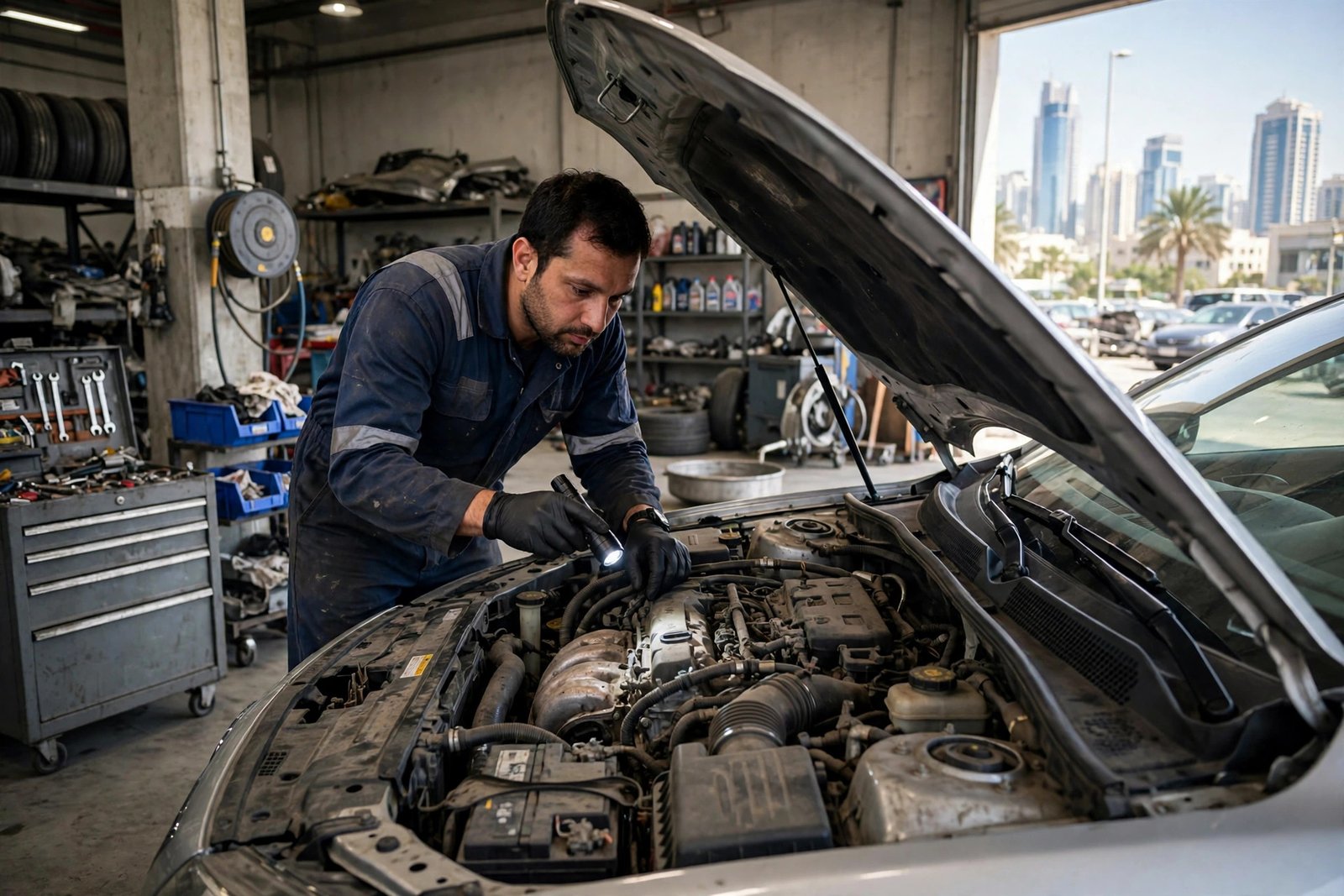
Air Conditioning: The Fault That Matters Most in UAE Heat
In many countries, a weak air conditioner is a minor annoyance. In the UAE, it is a real problem. When the temperature outside is over forty-five degrees, and you are sitting in traffic on Sheikh Zayed Road with the sun coming through the windscreen, the AC is not a luxury. It is the difference between a car you can use and a car you cannot. And on the Sunny and the Altima, the air conditioning is one of the most commonly reported weak points, particularly as the cars get older and the mileage climbs.
Let me be clear about what "weak AC" means, because it is not one fault. It is a family of faults, and they feel different. The most common complaint I hear is that the AC blows cool but not cold, or that it is cold when you are driving on the highway but goes warm when you are sitting in traffic. That pattern — cold at speed, warm at idle — usually points to a cooling or airflow problem: the condenser at the front of the car is not getting enough air when the car is standing still, or the fan is not working properly, or the system is low on refrigerant because of a slow leak. Another common complaint is that the AC works for a while and then fades, or that it blows cold on one side and warm on the other, or that it is cold in the morning and useless by the afternoon. All of these are clues, and a good mechanic reads them the way a doctor reads symptoms.
The compressor is the heart of the AC system, and it is the part that fails most expensively. On the Altima, particularly on the L33 generation, a failing AC compressor is a commonly reported issue: the compressor gets noisy, the cooling gets weak, or the system stops cooling altogether. On some cars you will hear a squealing or grinding noise from the front of the engine when the AC is switched on — that can be the compressor clutch bearing wearing out, which is a known issue on some Altima model years. On the Sunny, the compressor is generally simpler and the system is smaller, but it still wears, and on high-mileage cars the compressor can get weak and noisy in the same way. A noisy compressor is a compressor that is telling you it is on its way out. Do not turn the music up and ignore it.
Then there are the leaks. The AC system is a sealed loop of pipes, hoses, and components filled with refrigerant gas, and over time, in this heat, seals dry out and small leaks develop. The evaporator — the part inside the dashboard that actually makes the air cold — can develop a slow leak on some Sunny model years, and the signs are a musty smell when you first switch the AC on and cooling that gets weaker over weeks and months. The condenser, which sits at the very front of the car behind the bumper, takes a beating from stones, sand, and dust on UAE roads, and a damaged condenser can leak or can get clogged with dirt so that air cannot pass through it properly. A system that is low on refrigerant because of a leak will blow cool rather than cold, and simply topping it up without finding the leak is a waste of money: the gas will leak out again, and you will be back in the same place in a few weeks.
The cabin filter matters more than people think. It is a small filter behind the glovebox that cleans the air coming into the cabin, and in this country it clogs with dust and sand far faster than it would elsewhere. A clogged cabin filter chokes the airflow, so even if the AC is making cold air, not enough of it reaches you. The result feels like weak AC, but the fix is a simple filter change. It is one of the first things I check when someone tells me their AC is weak, because it is cheap and it is often the answer. If the car you are looking at has a dirty cabin filter and a seller who has never changed it, that tells you something about how the car was maintained in general.
The blower and the fan are the other parts to listen for. On some Altima model years, owners report that the blower only works on certain speeds, or that it stops and starts, which usually points to the blower resistor or the control module. It is not a dangerous fault, but it is an annoying one, and in August it is the difference between a comfortable car and a miserable one. The cooling fan at the front of the car — the one that pulls air through the condenser and the radiator — is also worth checking, because if it is not working properly, the AC will be warm in traffic and the engine will run hotter too. Listen for the fan cutting in and out when the car is idling with the AC on. You should hear it. If you do not, ask why.
So how do you check the AC on a test drive? Do it properly, the way you will use it. Start the car, switch the AC on, set it to the coldest setting and the highest fan speed, and put your hand in front of the vent. Within a minute or two, the air should be properly cold — not just cool, but cold enough that you would turn it down after a few minutes. Let the car idle for five minutes with the AC on and see if the air stays cold. Then drive, and check again at highway speed. Then sit in traffic, or just sit still for a few minutes, and check again. If the air gets warm when the car is standing still, that is a real symptom, and it matters in this country, where you will spend a lot of time standing still. Check every vent, not just the driver's one, and listen for any squealing, grinding, or rattling when the AC is switched on. And smell the air: a musty smell when the AC first comes on can mean a leak or a dirty evaporator, and a sweet smell can mean a coolant leak, which is a different problem altogether.
For a Sunny or an Altima, my advice is simple. The AC is not a part you can afford to be relaxed about in the UAE. If the cooling is weak, get it diagnosed properly — a leak test, a check of the compressor, a look at the condenser and the fan — before you buy the car, or before the summer arrives if you already own it. A small AC problem in March becomes a big problem in July, and it always costs more when you are desperate. For more detail on what a proper AC check involves, see our page on car AC repair in Dubai.

Suspension and Steering Wear: The Knocks, Clunks and Wandering
The suspension is the part of the car you feel with your whole body. It is what keeps the tyres on the road, what soaks up the speed bumps in your neighbourhood, and what decides whether the car feels solid and planted or loose and tired. On the Sunny and the Altima, the suspension is generally tough — these are not fragile cars — but the parts that wear are the same ones that wear on almost every car in the UAE, and they wear faster here because of the heat, the dust, and the condition of some of our roads.
Start with the noises, because that is how most suspension problems first show themselves. A clunk or a knock when you go over a speed bump, a rattle on a rough road, a thud when you turn into a driveway — these are the sounds of worn suspension parts, and on the Sunny and the Altima the usual suspects are the same. The stabiliser links, also called sway bar links, are small parts that connect the stabiliser bar to the suspension, and they wear out and start knocking over bumps. On the Sunny, front stabiliser links and rear beam bushes are known consumables on high-mileage cars, and a clunk over speed bumps is often one of these two. On the Altima, owners commonly report a knocking or rattling from the rear suspension on some model years, often traced to the rear lower links. The bushes — the rubber pieces that cushion the joints — dry out and crack in the heat, and once they are gone, metal starts knocking on metal, and you hear it on every bump.
The shock absorbers are the next thing to feel for. A shock absorber's job is to control the spring, to stop the car bouncing after a bump. When shocks wear out, the car bounces more than it should, it wallows over dips, it dives forward when you brake, and it leans more in corners. On a test drive, you can feel this: drive over a speed bump at normal speed and count the bounces. A healthy car settles after one bounce. A car with worn shocks keeps bouncing. Push down firmly on each corner of the car when it is parked and let go — the car should rise and settle, not keep bouncing up and down. And look at the shocks themselves, if you can see them, for oil leaking down the body of the shock. A shock that is leaking oil is a shock that is finished.
The steering is part of the same story. On a straight, flat road, the car should track straight with the steering wheel centred. If it pulls to one side, or if the steering wheel sits crooked when the car is going straight, something is worn or the alignment is out. A little pull can be as simple as uneven tyre pressures, so check those first, but a strong pull, or a car that wanders and needs constant correction, usually means worn steering or suspension parts, or a wheel alignment that has been knocked out by a pothole or a kerb. On some Altima model years, particularly the L33, electric power steering failures have been reported, where the steering goes heavy or a warning comes on. That is not a common fault on every car, but it is one to be aware of on that generation, and if the steering feels heavy or strange on a test drive, or a steering warning light appears, get it checked before you buy.
Wheel bearings are another wear item that shows up with mileage, and they are easy to check by ear. A worn wheel bearing makes a humming or droning noise that rises with speed, and it often gets louder when you turn one way and quieter when you turn the other. On the Altima, worn wheel bearings causing a hum at higher speeds are a commonly reported issue on some model years. It is not a dangerous fault in its early stages, but it gets worse, and it is the kind of noise that is easy to miss if the radio is on during the test drive. Turn the radio off. Drive at highway speed. Listen. A car that hums is a car that is telling you something.
Tyres tell a story about the suspension too, and it is a story you can read in a car park. Look at the tread across the width of each tyre. If the inside edge is worn more than the outside, or the outside more than the inside, or the tread is worn in patches, the alignment is out or a suspension part is worn. Uneven tyre wear is not just a tyre problem. It is a suspension problem wearing a tyre's clothes. And while you are looking at the tyres, check their age as well — the date code on the sidewall tells you when they were made, and in this heat, old tyres harden and crack even if the tread looks fine. A car with four different brands of tyre, or with tyres that are old and cracked, has not been looked after the way it should have been.
The practical check for suspension is simple, and you can do most of it yourself. Drive over speed bumps and listen for clunks. Drive on a rough road and listen for rattles. Brake firmly and feel whether the car dives or pulls. Drive on a straight road and see if the car tracks straight. Turn the steering wheel from lock to lock when the car is parked and listen for clunks or grinding. And get underneath the car, or get a mechanic to, and look at the bushes, the links, the shocks, and the boots on the joints. A split rubber boot lets dust and sand into a joint, and in this country, dust is everywhere, so a split boot is a joint that is already on its way out. For a deeper look at what worn suspension feels like and what to do about it, see our page on suspension problems in Dubai.
Electrical Issues: Battery Drain, Sensors and Lights
The Sunny and the Altima are not complicated cars electrically, and that is a good thing. There is no maze of electronics to go wrong, no air suspension, no complicated hybrid system. But they do have their electrical niggles, and in the UAE, the heat is the enemy of electrics just as much as it is of everything else. Batteries die faster here. Wiring gets brittle. Sensors get confused by heat and dust. And because these cars are often used hard, with the AC on full blast and the lights on and the phone charging, the electrical system works harder than it would in a milder climate.
The battery is the first thing to talk about, because it is the most common electrical complaint, and it is the one that strands people. A car battery in Dubai does not last as long as the same battery would last in a cool country. The heat cooks it from the inside, and the constant short trips — start the car, drive five minutes, switch it off, start it again — never give it a proper charge. The signs of a dying battery are easy to miss until the morning the car will not start: the engine turns over more slowly than it used to, the lights dim when you start the car, the dashboard flickers, or the car needs a jump start after being parked for a few days. On some Altima model years, particularly the L34, owners report battery drain from parasitic draws — something in the car drawing power when the car is switched off, so the battery is flat in the morning. That is not a fault on every L34, but it is a known pattern on some cars, and if a car you are looking at has a new battery and the seller cannot explain why, ask the question. A new battery on a car that is only a year old is a clue, not a selling point.
The starter and the alternator are the battery's partners, and they wear too. The starter is the motor that turns the engine over when you turn the key or press the button. When it gets tired, you hear a clicking sound, or the engine turns over slowly, or nothing happens at all on the first try. The alternator is the part that charges the battery while you drive. When it gets weak, the battery warning light comes on, the lights dim, and the battery slowly goes flat even while you are driving. Neither of these is a complicated repair, but both are the kind of thing that strands you, so if the car is slow to start, or the battery light has ever come on, do not ignore it.
Sensors are the next thing. Modern cars are full of them — sensors that measure the air coming into the engine, the oxygen in the exhaust, the speed of the wheels, the temperature of the coolant — and when one of them starts to fail, the car usually tells you with a check engine light and a change in how it drives. On the Altima's 2.5 litre engine, a failing mass airflow sensor is a commonly reported cause of a check engine light and drivability quirks on some model years: the car idles roughly, hesitates, or feels flat. On the Sunny, oxygen sensors and throttle body issues can need attention around mid-life mileage on some cars, and a tired engine mount can add a low-speed vibration that disappears at higher speeds. None of these are catastrophic, but they are the reason a check engine light should never be ignored, and never be cleared by a seller just before you arrive to look at the car. If the light is on, ask what the code is. If the light has been cleared, ask why. A diagnostic scan takes a few minutes and tells you what the car is hiding.
The lights and the small electrics are the niggles that owners notice every day. On the Sunny, door lock actuators and window switches are known to get lazy on some cars — a door that will not lock with the central locking, a window that is slow or stops halfway. They are inexpensive parts and widely available, but they are annoying, and they are a sign of the car's age and use. On the Altima, the L34 generation brought more electronics, and with them, more electronic quirks on some cars: the touchscreen can behave strangely, with ghost touches or bubbling on the screen, and the automatic emergency braking system has been reported to activate on some cars when there is no obstacle in front of them. These are not faults on every L34 — many owners never see them — but they are worth checking on a test drive. Play with the touchscreen. Press every button. Make sure the screen responds properly and does not have a mind of its own. Check every light, every window, every lock, the horn, the wipers, and the indicators. It takes five minutes, and it tells you whether the car's electrics have been looked after or left to rot.
The dashboard warning lights deserve a paragraph of their own. When you start the car, all the warning lights should come on for a moment and then go out. That is the car checking itself. If a light stays on — the check engine light, the battery light, the ABS light, the airbag light, the gearbox warning — that is the car telling you something is wrong, and it is not a small thing. And here is a trick that dishonest sellers sometimes use: they remove the bulb or cover the light so that you cannot see it. So when you start the car, watch the dashboard carefully. If the check engine light never comes on at all, not even for a second when you turn the key, that is suspicious. The light should appear and then disappear. If it never appears, someone may have hidden it. A diagnostic scan will tell you the truth, and it is one of the best few minutes you can spend before buying a used car.
Engine Oil Use and Cooling: The Quiet Wear
The engines in the Sunny and the Altima are, by and large, good engines. They are not powerful, and they are not exciting, but they are simple, they are well understood by every workshop in the country, and they will do high mileage if they are looked after. The key phrase there is "if they are looked after", because the engine problems I see on these cars are almost always problems of neglect rather than problems of design. The engine did not fail. It was starved of oil, or it was cooked, or it was run for too long on old oil in the heat. The car pays the price, and the owner pays the bill.
Oil use is the first thing to check. As engines get older and the mileage climbs, some of them start to use oil — a little oil disappears between services, and the level on the dipstick slowly drops. A small amount of oil use on a high-mileage engine is normal and nothing to worry about, as long as the owner tops it up and keeps the level correct. But heavy oil use, or an engine that is low on oil when you check it, is a different story. It means the engine is worn inside, or it means the owner has not been checking the level, and either way it is a warning. On a Sunny, check the dipstick and ask how much oil the car takes between services — a straight question, and the answer tells you a lot. On an Altima, the 2.5 litre engine is generally not a heavy oil user when it is healthy, but on high-mileage cars some oil use is commonly reported, and the same check applies. Pull the dipstick out, wipe it, put it back in, pull it out again, and look. The oil should be a golden-brown colour and should be between the marks. If it is black and thick, it is overdue a change. If it is low, the car has been running short of oil. If it smells of fuel, or if it looks milky, like coffee with milk in it, that is a serious sign — milky oil can mean coolant is getting into the oil, and that is a problem you do not want to buy.
The timing chain is the next thing to listen for, particularly on the Sunny. Both the Sunny's 1.5 and 1.6 litre engines use a timing chain rather than a rubber timing belt, which is a good thing, because a chain is designed to last the life of the engine and does not need to be replaced on a schedule the way a belt does. But a chain can stretch with age and mileage, and when it does, it rattles. The classic sign is a rattle for a few seconds after a cold start — a metallic, rattling noise from the front of the engine that goes away once the oil pressure builds up. If you hear that rattle, make a note of it. A stretched chain is not an emergency on the day you hear it, but it is a repair that needs doing, and if it is ignored for long enough, it can cause real engine damage. That is why a cold start is so important when you are looking at a used car. A warm engine hides a timing chain rattle, and a seller who will only show you a warm car is a seller you should be cautious about.
The cooling system is where the UAE heat really shows itself. The radiator, the hoses, the water pump, the thermostat, the cooling fan — all of them work harder here than they would in a cooler country, and all of them fail sooner. The signs are straightforward: the temperature gauge climbing higher than it should, the gauge moving up and down instead of sitting steady, steam or a sweet smell from under the bonnet, or coolant leaking onto the ground where the car is parked. Coolant is usually green, pink, or orange, and a puddle of coloured liquid under the front of the car is a cooling system leak until a mechanic proves otherwise. On the Sunny and the Altima, the cooling system is not known for any one dramatic fault, but the parts are consumables in this climate, and a car that has never had a hose or a thermostat replaced at high mileage is a car that is due for one. Check the coolant level in the reservoir when the engine is cold — it should be between the marks — and look at the hoses for cracks, swelling, or softness. A hose that is hard and cracked, or soft and swollen, is a hose that is ready to fail, and a hose that fails on Sheikh Zayed Road in August is a breakdown you do not want.
The ignition coils are a small part that causes a surprisingly common problem. Each spark plug has a coil that provides the spark, and when a coil gets tired, the engine misfires: it shakes at idle, it hesitates when you accelerate, it loses power, and the check engine light often flashes. On the Sunny, a shaking idle or a flashing check engine light is often a worn coil on high-mileage cars. It is not an expensive part, and it is not a hard repair, but it is the kind of fault that makes the car feel broken, and it is easy to mistake for something much worse. If the car you are looking at idles roughly, or shakes, or the check engine light is flashing, get the codes read before you decide anything. It might be a coil. It might be something else. But you need to know which.
The engine mounts are worth a mention too, because they are a quiet wear item that owners often do not notice until it is pointed out. The engine sits on rubber mounts that absorb vibration, and in this heat, the rubber hardens and cracks. When a mount fails, you feel more vibration through the car, especially at idle and at low speed, and you may feel a clunk when you move off or when you change gear. On the Sunny, a tired engine mount can introduce a low-speed vibration that disappears at higher speeds. It is not a dangerous fault, but it makes the car feel old and tired, and it is a simple check for a mechanic on a ramp.
The overall point about engines is this: the Sunny's and Altima's engines are forgiving, but they are not indestructible. They need clean oil, at the right level, changed on time. They need a cooling system that works. They need a cold start to be heard properly. And they need an owner who checks the dipstick. If you are buying used, the service history is your best friend — a car with regular oil changes, recorded and stamped, is worth more than a car with a shiny exterior and no history at all. And if you already own one of these cars, the cheapest engine protection you can buy is a habit: check the oil every couple of weeks, watch the temperature gauge, and do not ignore a new noise. For engine concerns in general, see our page on car engine repair in Dubai.
Brakes: What Worn Brakes Feel and Sound Like
Brakes are not the most common complaint on the Sunny and the Altima, and that is a good thing, because brakes are the one system you never want to gamble with. But they are a wear item, and on cars that have done high mileage in stop-start Dubai traffic, they wear faster than they would on a car that spends its life on the highway. The brake pads, the discs, the rear shoes on some Sunny models — all of them wear, and all of them tell you when they are worn, if you listen.
The most obvious sign is noise. A squeal when you brake, especially a high-pitched squeal that goes away when you press the pedal harder, often means the pads are worn down to their wear indicators. A grinding noise is worse — it means the pad material is gone and metal is rubbing on metal, and the discs are being damaged with every stop. On the Sunny, the rear brakes on many cars are drum brakes, and the rear shoes can squeal if they are neglected; a simple cleaning and proper adjustment often sorts it out, but if it is ignored, the shoes wear unevenly and the braking gets worse. If you hear any noise when you brake on a test drive, do not dismiss it. Brakes are not a place for optimism.
The feel of the pedal tells you just as much. A brake pedal should feel firm and should stop the car in a straight line. If the pedal feels soft or spongy, or if it sinks slowly towards the floor when you hold it down, there may be air in the system or a leak, and that needs attention. If the car pulls to one side when you brake, one side is braking harder than the other, which can mean a sticking caliper or uneven wear. If you feel a vibration or a pulsing through the pedal when you brake at speed, the discs may be warped, often from heat. Warped discs are a common result of hard braking in hot conditions, and they are the reason a car can feel fine around town but shudder every time you brake on the highway.
The check is simple and you should do it on every test drive. Find a quiet, straight road and brake firmly from a moderate speed, with both hands on the wheel. The car should slow down smoothly, in a straight line, without pulling, without vibrating, and without any noise. Do it more than once. Then, when the car is parked, look at the discs through the wheels if you can see them: they should be smooth and clean, not deeply grooved or rusted, and the pads should have material left on them. Look at the brake fluid reservoir under the bonnet too — the fluid should be between the marks and should not be dark and dirty. Brake fluid absorbs moisture over time, and in this humidity, old fluid is a real problem. It lowers the boiling point of the fluid, which means the brakes can fade when they get hot, and that is the last thing you want on a long downhill run or in heavy traffic.
One more thing: the handbrake. On a Sunny with rear drums, the handbrake should hold the car firmly on a slope, and it should not need to be pulled up to the very top of its travel. If the handbrake lever comes up very high before it holds, the rear brakes need adjusting. It is a small job, but it is a safety job, and it is worth checking.
Dubai Heat, Dust and High Mileage: What the UAE Does to These Cars
Everything in this article so far has been about specific parts. But it is worth stepping back and talking about the bigger picture, because the UAE is not a neutral place for a car. It is one of the hardest environments in the world for a car to live in, and the Sunny and the Altima feel that harder than most, simply because there are so many of them here and they are driven so much.
The heat is the first and biggest factor. In the summer, the temperature inside a parked car can be far hotter than the air outside, and that heat attacks everything: the rubber in the hoses and bushes, the plastic in the dashboard, the battery, the seals in the AC system, the fluid in the gearbox. A Sunny that has spent its life parked in the sun will have a dashboard that is faded and cracked, plastics that are brittle, and rubber parts that have aged years ahead of their time. That is why a car with a sunshade and a car that was parked in a basement look so different after five years. The heat does not just make the car uncomfortable. It ages the car.
The dust and sand are the second factor. Fine dust gets into everything: into the cabin filter, into the engine air filter, into the condenser at the front of the car, into the joints and the bearings. A clogged cabin filter chokes the AC. A clogged engine air filter chokes the engine. A condenser clogged with dust cannot shed heat properly, so the AC struggles and the engine runs hotter. The dust is also why the rubber boots on suspension joints and steering joints matter so much here — once a boot splits, sand gets into the joint, and the joint wears out far faster than it would in a clean environment.
The driving pattern is the third factor. The UAE combines two extremes: long, fast highway runs, and slow, stop-start city traffic. The highway runs are actually kind to a car in many ways — the engine gets properly warm, the gearbox gets properly warm, everything gets up to temperature and stays there. But the city driving is hard on a car: constant stopping and starting, the gearbox shifting and slipping, the brakes working all the time, the AC running at full blast while the car is barely moving. And many Sunnys and Altimas do both, every day, for years, with different drivers, and that is why mileage alone does not tell you the whole story. A car that has done most of its kilometres on the highway will often be in better shape than a car with half the mileage that has spent its life in city traffic.
The high mileage of fleet and rental cars is the fourth factor, and it is specific to these two models. A large share of Sunnys in the UAE started life as rental cars, and a large share of Altimas were fleet cars or company cars. That is not a reason to avoid them — fleet cars are usually serviced on a schedule, and a rental company that maintains its cars properly can produce a good used car — but it is a reason to look harder. Compare the wear with the odometer reading. A car with low mileage but a worn driver's seat, a shiny steering wheel, worn pedals, and a tired rear seat has not done low mileage. The wear and the number should tell the same story. If they do not, the number is the one that is lying.
And finally, the maintenance culture matters. Some owners service their cars on time, every time, at a proper workshop. Some owners service their cars only when something breaks. On a Sunny or an Altima, the difference between those two owners is the difference between a car that will do high mileage happily and a car that will start falling apart at the same mileage. The CVT fluid, the oil, the coolant, the filters — these are not optional extras. They are the difference between a good car and a bad one. And in this climate, the intervals matter more, not less. A service that is late by a few thousand kilometres in a cool country is a small thing. Here, in the heat, with the dust, it matters more.
What to Check Before Buying a Used Sunny or Altima: The Pre-Purchase Checklist
This is the section to read with the car in front of you. Print it, save it on your phone, or just remember the order. It is the same order I follow when someone brings me a Sunny or an Altima and asks me to tell them whether to buy it. It takes about an hour if you do it properly, and it is the best hour you will spend before handing over your money.
Start with the paperwork, before you even touch the car. Ask for the registration card, the mulkiya, and check that the year, the chassis number, and the engine number match the car. Ask for the service history — receipts, a service book, anything that shows the car was serviced regularly and on time. If the seller has no service history at all, that is not a reason to walk away on its own, but it means you have to rely entirely on what you can see and feel, and you should be more careful with every other check. Ask for the chassis number and check the service history and any open recalls with a Nissan dealer by VIN. It is a short phone call, and it can reveal a recall that was never done, or a service history that does not match what the seller told you. And ask the seller, directly, whether the car has ever been in an accident, whether it has had a replacement engine or gearbox, and whether the odometer reading is genuine. The answer matters less than the way they answer it. A seller who is open and relaxed is a good sign. A seller who gets defensive about simple questions is telling you something.
Now walk around the car. Look at the body in good light, and look along the panels rather than straight at them — a panel that has been repainted will often show a slight difference in shade or texture when you look along it. Check the gaps between the panels: the gap between the bonnet and the wings, between the doors and the body, between the boot and the rear wings. The gaps should be even. A gap that is wider on one side than the other can mean the car has been in an accident and repaired. Open and close every door, the bonnet, and the boot. They should close smoothly and with a solid sound. Look at the paint on the leading edge of the bonnet and on the front bumper for stone chips — a few are normal, but heavy chipping can mean a lot of highway driving. Look underneath the car for rust, for damage to the floor, and for any sign of oil or coolant leaking. And look at the tyres: are they all the same brand? Are they worn evenly? What is the date code on the sidewall? Four matching, evenly worn, reasonably fresh tyres are a sign of a car that was looked after. Four different tyres, worn unevenly, are a sign of a car that was not.
Now sit inside. Look at the driver's seat, the steering wheel, and the pedals. On a low-mileage car, these should look fresh. On a high-mileage car, they will show wear, and that is fine — what matters is whether the wear matches the number on the dashboard. A car showing low mileage with a shiny, worn steering wheel and a sagging driver's seat has not done low mileage. Check the roof lining, the dashboard, and the door cards for damage, for holes, for stickers, for signs that the car was a rental or a taxi. A few rental stickers or a hole in the roof lining does not make a car a bad buy, but it tells you about the car's past, and it should be reflected in the price. Press every button. Try every window, every lock, the mirrors, the horn, the wipers, the indicators, the lights, the AC, and the touchscreen if the car has one. Check that the airbag light and the check engine light come on when you start the car and then go out. Smell the interior: a musty smell can mean a leak in the AC evaporator or water getting in somewhere, and a sweet smell can mean a coolant leak.
Now start the car from cold, if you can. Listen to the engine for the first few seconds. A rattle that lasts a few seconds and then goes away can be a stretched timing chain on a Sunny, and it is worth noting. A rough idle that settles down can be a coil or a sensor. Let the car idle and listen. Then check the oil on the dipstick — colour, level, smell — and check the coolant level in the reservoir. Look under the bonnet for leaks, for cracked hoses, for anything that looks out of place. And look at the battery: is it clean, are the terminals tight, is there corrosion? A battery covered in white or green crust is a battery that has not been looked after.
Then drive the car, and drive it properly. Twenty to thirty minutes, at least, with the car fully warm by the end. Start with slow driving and feel for the CVT shudder on light throttle, the hesitation on takeoff, the delayed engagement from Park to Drive and to Reverse. Drive on the highway and feel for shudder at steady speed, for whining, for slipping when you accelerate firmly. Drive up a slope if you can. Brake firmly on a straight road and feel for pulling, vibration, or noise. Go over speed bumps and listen for clunks from the suspension. Turn the steering from lock to lock and listen for noises. Test the AC properly: coldest setting, highest fan, and check whether it stays cold when the car is standing still in traffic, not just when it is moving. Turn the radio off for part of the drive and just listen to the car. A car that hums, whines, rattles, or shudders is a car that is talking to you. Listen to it.
If the car passes your checks, the last step is a professional inspection, and I would not skip it, especially on an Altima, and especially on any car where the CVT is a question. A proper inspection means the car on a ramp, underneath, with a mechanic looking at the suspension, the bushes, the leaks, the brakes, and the underside, and a diagnostic scan to read the fault codes, including any codes that have been cleared. It also means a check of the CVT fluid condition, which you cannot do properly without a workshop. A pre-purchase inspection is a small cost next to the price of the car, and it is the only way to know what you cannot see from the driver's seat. If the seller will not let you take the car for an inspection, that is your answer. Walk away. A good car has nothing to hide. For more on what an inspection covers, see our page on pre-purchase car inspection in Dubai.
What to Check on a Car You Already Own
If you already own a Sunny or an Altima, this article is not just for buyers. It is for you too, because most of the faults in this article start small and get bigger, and catching them early is the difference between a simple repair and a breakdown. So here is a routine you can follow, without any special tools, to keep an eye on your own car.
Once a month, or every couple of weeks if you drive a lot, check the oil. Pull the dipstick, wipe it, put it back, pull it out again, and look at the level and the colour. Top it up if it is low, and make a note of how much you are adding between services. If you find yourself adding oil more and more often, the engine is using oil, and it is worth mentioning to a mechanic. Check the coolant level in the reservoir when the engine is cold, and look under the car where you park for any new puddles or drips. A new puddle is a new problem, and it is always cheaper to find out what it is now than to find out on the highway later.
Every time you drive, listen to your car. You know how it sounds when it is healthy. If something changes — a new rattle over bumps, a new hum at highway speed, a new shudder when you pull away, a new whine, a new squeal when you brake — do not turn the radio up and hope it goes away. It will not. It will get worse, and it will cost more. Make a note of when it happens, whether the car is cold or warm, whether it happens at low speed or high speed, and tell a mechanic. The more detail you can give, the faster they can find it.
Pay attention to the AC, especially before the summer. In March or April, test it properly: coldest setting, highest fan, and see if it stays cold when the car is standing still. If it is weak, get it checked before the heat arrives, not after. A leak test, a check of the compressor, a look at the condenser, and a new cabin filter will sort out most AC problems, and they are all much easier to deal with in spring than in July. And change the cabin filter regularly — in this country, with this dust, it clogs faster than the schedule suggests, and a clogged filter makes the AC feel weak even when the system is fine.
Watch the CVT, because it is the part that matters most. Drive smoothly, let the car warm up before you push it, and do not floor the accelerator from every traffic light. If you feel a new shudder, or hesitation, or the revs flaring without the car following, get it checked. And ask your mechanic about the CVT fluid: when was it last changed, what does it look like, and is it due? On a high-mileage car that has never had a fluid change, a change is worth discussing with a specialist — not as a cure for a gearbox that is already failing, but as maintenance for a gearbox that is still healthy. Do not let anyone tell you the gearbox is sealed for life. It is not, and the fluid is the gearbox's lifeblood.
Finally, keep the service history. Keep every receipt, every invoice, every stamp in the book. It is not just paperwork. It is the proof that the car was looked after, and it is worth real money when you come to sell the car. A Sunny or an Altima with a full service history is a different car in the used market from the same car with no history at all. And if you service the car regularly — oil, filters, coolant, brakes, and the CVT fluid on schedule — you will find that the car rewards you. These are simple cars, and simple cars that are looked after will run for a long time. For keeping up with routine care in general, see our page on car repair and maintenance services.
What a Proper Check Looks Like
I have mentioned a proper inspection several times in this article, so it is worth explaining what one actually is, because not every "check" is the same. A quick look around a car park is not an inspection. A proper inspection is a methodical job, and it takes time, and it is worth knowing what you are paying for.
It starts with a conversation. A good mechanic will ask you about the car: the year, the mileage, what you have noticed, whether there are any noises or warnings, and what you want the car for. Then they will start the car from cold if possible, and listen. They will check the oil, the coolant, the brake fluid, and the battery, and they will look under the bonnet for leaks, cracked hoses, and anything that looks wrong. They will read the fault codes with a diagnostic scanner, including the codes that have been stored and cleared, and they will check the live data — the readings from the sensors while the engine is running — because live data often shows a problem before a fault code appears.
Then the car goes on a ramp, and this is the part you cannot do in a car park. Underneath, the mechanic can see the suspension properly: the bushes, the links, the shocks, the boots on the joints, the brakes, the discs, the pads, the exhaust, and the underside of the engine and gearbox for leaks. They can check for play in the wheel bearings and the suspension joints by moving the wheels by hand, and they can see whether the car has been in an accident underneath — bent parts, fresh underseal hiding a repair, or a floor that has been straightened. On a Sunny or an Altima, this underneath check is where a lot of problems are found, because the bushes and links wear out of sight, and you cannot feel a worn bush properly until you can see it and move it by hand.
Then comes the test drive, and it is the same drive I described earlier, but done by someone who has driven hundreds of these cars and knows what a healthy one feels like. The mechanic will get the car fully warm, drive it in traffic and on the highway, feel for CVT shudder and hesitation, listen for whining and humming, test the brakes, test the AC at idle and at speed, and check the steering. And on the CVT, they will check the fluid condition, which is the single most informative check on these cars, and which you cannot do properly without a workshop.
At the end, a good inspection gives you a report, not just a verdict. It should tell you what is fine, what needs attention soon, what needs attention now, and what is a reason to walk away. It should be honest about what is a small job and what is a big one, and it should not be a sales pitch for work you do not need. If you are buying a used Sunny or Altima, that report is worth its weight in gold. It turns a gamble into a decision, and it gives you something to negotiate with — or a reason to walk away and find a better car.
Mistakes to Avoid
I have seen people make the same mistakes with these cars again and again, so here they are, plainly, so you can avoid them.
The first mistake is buying on looks alone. A clean car with shiny paint and new seat covers can still have a tired gearbox, and a car that looks a little dusty can have a healthy gearbox and a full service history. The paint does not tell you anything about the CVT. The test drive does. Never buy a Sunny or an Altima without a proper, long, warm test drive, and never let a seller rush you into a short drive around the block.
The second mistake is ignoring the gearbox because the car is cheap. A cheap Altima with a bad CVT is not a bargain. It is the most expensive cheap car you will ever buy. If the gearbox shudders, hesitates, whines, or shows a warning on the test drive, do not buy the car hoping it will be fine. It will not be fine. Walk away, or get a specialist to look at it and tell you honestly what it needs, and then decide with the full picture.
The third mistake is never changing the CVT fluid. I hear it all the time: "Nobody told me the gearbox needed fluid." Now you know. The fluid is the gearbox's lifeblood, and on a high-mileage car in this heat, it matters more than anywhere else. Ask when it was last changed. If the answer is "never", be careful.
The fourth mistake is topping up the AC gas without finding the leak. If the AC is weak because the system is low on gas, the gas went somewhere, and it will go again. A top-up without a leak test is money thrown away. Find the leak, fix the leak, then fill the system properly.
The fifth mistake is ignoring a warning light. A check engine light, a battery light, a gearbox warning — these are the car telling you something is wrong. Clearing the light does not fix the problem. It just hides it until it comes back, usually at the worst possible time. Get the codes read. Find out what the car is saying.
The sixth mistake is judging a car by the odometer alone. The number on the dashboard is one piece of information, not the whole story. Compare it with the wear on the seats, the steering wheel, and the pedals, and with the service history. If the wear and the number do not match, trust the wear.
And the seventh mistake is skipping the inspection to save a small amount of money. A pre-purchase inspection is a small cost next to the price of the car, and it is the only way to know what you cannot see. Skipping it to save money is like buying a house without looking inside. Do not do it.
Frequently Asked Questions
Is the Nissan Sunny CVT reliable in the UAE?
It can be, but it depends on the car and how it was looked after. The CVT in the later N17 Sunny and in the newer B17 Sunny is generally reliable when its fluid is changed on schedule and the car is driven smoothly. The problems I see most often are on high-mileage cars where the fluid was never changed, or where the car was driven hard in the heat every day. On those cars, shudder and hesitation are commonly reported. So the honest answer is: a Sunny CVT with a good service history and a clean, warm test drive is a reasonable buy. A Sunny CVT that shudders on the test drive, or that has never had a fluid change at high mileage, is a risk. Always test the car when it is fully warm, for at least twenty minutes, and ask when the CVT fluid was last changed. If the seller cannot answer, get the fluid checked by a mechanic before you decide.
Which Altima generation has the most CVT problems?
Of the generations you will find in the UAE, the L33, from around 2013 to 2018, carries the heaviest CVT reputation, particularly the cars from the early years of that generation. Owners reported shudder, hesitation, and failure in large numbers, and the issue is well known to workshops. The L34, from around 2019, is a better car in many ways, but the CVT is still the part to check first, and owners still report shudder and hesitation on some model years. The older L32 has its own CVT concerns at high mileage on some cars. So there is no generation where you can skip the CVT check. The difference is in how hard you check: on an L33, be extra careful, take a long test drive, and get a professional inspection. On any Altima, the rule is the same — warm, long, and listen.
Why does my Altima AC blow warm air in traffic but cold on the highway?
This is one of the most common AC complaints I hear, and it usually points to a cooling or airflow problem rather than a problem with the AC itself. When you are driving on the highway, air rushes through the condenser at the front of the car and the system works well. When you are sitting in traffic, there is no airflow, and the system relies on the cooling fan to pull air through the condenser. If the fan is weak or not working, or if the condenser is clogged with dust and sand, or if the system is low on refrigerant because of a slow leak, the AC cannot shed heat properly and the air goes warm. A weak compressor can also struggle at idle. The fix starts with a proper diagnosis: a check of the fan, the condenser, the refrigerant level, and a leak test. Simply topping up the gas without finding the leak will not solve it.
How do I know if a used Sunny was a rental or fleet car?
There are several clues, and they are usually visible if you look. Check the driver's seat, the steering wheel, and the pedals for wear that does not match the mileage. Look at the rear seat and the roof lining for wear, holes, or marks. Look for rental stickers, or the marks where stickers used to be, on the windows or the body. Check the service history: fleet and rental cars are often serviced on schedule, which is a good sign, but the history may show a company name rather than a private owner. Ask the seller directly who owned the car before. A car that was a rental is not automatically a bad buy — rental cars are usually maintained — but it should be reflected in the price, and you should check it more carefully, because it will have had many different drivers.
What does CVT shudder feel like?
CVT shudder feels like a vibration or juddering through the car, usually when you are accelerating gently or cruising at a steady speed with a light foot on the pedal. It can feel like driving over a slightly rough road when the road is actually smooth, or like a trembling through the floor, the seat, or the steering wheel. On the Sunny it is commonly reported at city speeds on light throttle. On the Altima it is commonly reported at steady highway speeds as well as in town. It often starts mild and gets worse over time, and it often only appears when the gearbox is properly warm, which is why a short test drive can miss it. If you feel a vibration that comes and goes at steady speed, turn the radio off, put the windows up, and feel for it again. If it is there, get the car checked by a specialist before you buy it.
Is it expensive to fix suspension problems on a Sunny or Altima?
It depends on what is worn, but in general, suspension work on these cars is manageable, because the parts are common and every workshop in the UAE knows these cars well. Small parts like stabiliser links and bushes are simple jobs. Shock absorbers cost more, especially if all four need doing, but they are still a normal wear item, not a disaster. The expensive part of suspension work is not the parts — it is ignoring the problem. A worn bush that is left alone will wear out the joint it is supposed to protect, and a worn shock will wear out the tyres. So the cheapest time to fix suspension wear is when you first notice it, not months later. Get the car on a ramp, get the worn parts identified, and fix what needs fixing. Your tyres and your comfort will thank you.
Should I buy a Sunny or an Altima with high mileage?
High mileage on its own is not a reason to walk away, but it is a reason to look harder. What matters is not the number on the dashboard, but how the car got there and how it was looked after. A car that did most of its kilometres on the highway, with regular servicing and a full history, can be in better shape than a car with half the mileage that spent its life in city traffic with no service history. On a high-mileage Sunny or Altima, the checks matter more: the CVT must be tested warm and long, the fluid must be checked, the oil use must be checked, the suspension must be looked at underneath, and the AC must be tested in traffic. If the car passes those checks and the service history is good, high mileage is not a problem. If the car fails them, low mileage will not save it.
What should I do if my Sunny or Altima shows a gearbox warning light?
Do not ignore it, and do not keep driving as if nothing happened. A gearbox warning light, or a sudden loss of power where the car will only crawl, is the gearbox protecting itself from heat or damage. The first thing to do is to pull over safely, switch the engine off, and let the car cool down. When you start it again, drive gently and get the car to a mechanic as soon as you can. Do not clear the warning and carry on with your day. The warning will come back, and the problem will get worse. A diagnostic scan will tell the mechanic what the gearbox is reporting, and a check of the fluid condition will tell them how worn the gearbox is. If you are far from home or the car will not drive properly, call for mobile help rather than risking a breakdown on the highway.
Call 95 Services
If you drive a Nissan Sunny or an Altima anywhere in the UAE, and something in this article sounds familiar — the shudder when you pull away, the AC that goes warm in traffic, the clunk over speed bumps, the warning light you have been ignoring — do not wait for it to turn into a breakdown. Call 95 Services on +971 54 344 3513 and tell us what the car is doing. We will come to you, wherever you are, because we are a mobile service and we cover the complete UAE. Our response time is 15–20 minutes, and help can arrive within 20 minutes, so you are not waiting around for hours. And our prices are very low, because we believe good car care should be affordable, not a luxury.
Whether you need a pre-purchase check before you buy a used Sunny or an Altima, or a proper look at the car you already own, or help with a gearbox worry, weak AC, worn suspension, or an electrical niggle, we will check the car properly, explain what we find in plain words, and sort it out. Call 95 Services on +971 54 344 3513 today, and let us look after your car.
