

You know your car. You know roughly how far a full tank takes you, how often you stop at the petrol station, and what a normal week of driving costs you. So when that pattern changes — when the tank that used to last you until Thursday is empty by Tuesday, when the fuel gauge seems to drop faster than it should, when you are filling up more often but driving the same roads — you notice it straight away. And the first question that comes to mind is a fair one: why is my car using more petrol suddenly?
There is rarely one single answer. Fuel consumption is not decided by one part. It is the result of a whole chain working together: air coming in, fuel going in, the spark that burns the mixture, the tyres rolling on the road, the sensors telling the engine what to do, and the way you drive in between. When one link in that chain gets weak, the engine compensates, and compensation almost always means more fuel. A clogged filter makes the engine work harder. A soft tyre makes it drag. A tired sensor makes it guess wrong. A worn spark plug makes it burn fuel badly. None of these things stops the car. That is the tricky part. The car still starts, still drives, still gets you to work. It just drinks more while doing it.
In Dubai, this shows up in its own way. The heat is real, and it changes how a car behaves. The air conditioning runs hard for most of the year, and on a hot afternoon it is not a luxury, it is the only way to sit in the car. Traffic on Sheikh Zayed Road, in Business Bay, around the Marina, or on the way in from Sharjah in the morning, means long stretches of stopping and starting. Short trips are common too — school run, grocery run, a quick drive to the mall — and short trips are some of the hardest driving a car can do when it comes to fuel. Add dust in the air, long stretches of highway driving to Abu Dhabi or Ras Al Khaimah, and a car that has not had a proper service in a while, and you have a perfect recipe for fuel consumption creeping up without any obvious warning light.
This article is a proper walk-through, written the way I would explain it if you brought the car to me and asked me to look at it. We will start with the simplest checks — the ones you can do yourself in your parking bay in ten minutes — and work through the filters, the tyres, the sensors, the ignition system, and your driving patterns. We will talk about how to track your fuel use properly, because guessing is the enemy here, and how to tell the difference between a real problem and a normal change in your routine. And at the end, we will be honest about when it is time to stop guessing and get a proper diagnostic check, because some causes hide where you cannot see them without the right tools.
Nothing in this article is a guess dressed up as a fact. If a fix needs a part, I will say so. If a check needs a mechanic, I will say that too. And I will not quote you prices here, because the honest price of any job depends on your car — its make, its model, its year, and what we actually find when we look at it. What I will give you is the knowledge to walk into any garage, including ours, and know what you are talking about.

First, Make Sure It Really Is Sudden
Before you spend anything, slow down for a minute. The most common thing I hear in the workshop is, "It started using more petrol last week." And sometimes that is exactly right. But sometimes, when we sit down and work through it together, the change happened slowly over two or three months, and last week was just the week the owner finally noticed. That matters, because a slow change points to wear — filters getting dirty bit by bit, tyres losing pressure a little at a time, spark plugs ageing — while a truly sudden change, something that happened from one tank to the next, points to something different: a part that has failed, a leak, a sensor that has stopped reading properly, or a change in the fuel itself.
So the first job is not under the bonnet. It is in your own memory, and in your own routine. Ask yourself a few honest questions. Has your driving changed? Did you start a new job with a longer commute, or move house? Are you doing more short trips than before — dropping the kids at school, popping to the shops, driving to the gym — instead of one longer drive? Short trips use more fuel per kilometre than longer ones, and we will come back to why that is. Has the weather changed? When the hot season arrives and the air conditioning starts working at full strength all day, fuel use goes up, and that is normal. Have you started carrying more weight — a roof box, a boot full of things you keep meaning to take out, a car full of passengers every day? Weight matters. Has your tyre pressure been checked lately? We will get to that in detail, but a slow leak in one tyre can quietly add up over weeks.
Think about the car itself too. When was its last service? Not a rough guess — the actual date and mileage. If it has been a long time, or a long distance, since the last proper service, then filters, plugs and fluids are all older than they should be, and each one of them is a small drag on efficiency. Has a warning light come on, even briefly? A light that came on and went off again still means something happened, and it is worth remembering. Has the car started behaving differently in any other way — a rough idle, a hesitation when you press the accelerator, a smell of petrol, smoke from the exhaust, a noise you had not heard before? Fuel consumption rarely changes on its own. It usually brings friends, and those friends are clues.
There is also the question of the fuel itself. Did you fill up at a different station than usual? Did you switch between grades? Most cars in Dubai run on the fuel they were designed for, and switching grades does not normally cause a big change, but if you filled up somewhere unfamiliar and the problem started on that exact tank, it is worth noting. A bad batch of fuel is rare, but it happens, and the timing will tell you. If the car was fine on the last tank and terrible on this one, and nothing else changed, the fuel is a fair suspect. If the problem has been building for months, the fuel is almost certainly not the cause.
And here is the honest part that most articles skip: sometimes the car is fine, and the maths is wrong. People judge fuel use by the gauge, and the gauge is not a measuring instrument. It is a rough guide. The needle drops faster in the second half of the tank than the first half on many cars. The range display on the dashboard — the "kilometres to empty" number — is an estimate based on your recent driving, and it changes its mind constantly. One hot week of traffic can make it drop sharply, and then one smooth highway drive can bring it back up. That is the computer doing its job, not the car breaking down. So before you decide something is wrong, you need a real measurement. That is what the next section is for.
How to Track Your Fuel Consumption Yourself
This is the single most useful thing in this whole article, and it costs you nothing. If you track your fuel use properly for two or three tanks, you will know — with numbers, not feelings — whether your car is really using more fuel, how much more, and whether it is getting worse. You will also have something useful to show a mechanic, which saves time and saves you from paying for guesses.
There are two simple ways to do it. The first is the manual way, and it is the most reliable. Fill the tank completely until the pump clicks off. Do not top it up after the click. Reset your trip meter to zero, or write down the odometer reading. Drive normally — do not change how you drive just because you are measuring, or the result will not mean anything. When the tank is nearly empty, fill it completely again until the pump clicks off, and write down how many litres went in and how many kilometres you drove since the last fill. Then divide the kilometres by the litres. That gives you kilometres per litre. Do it the same way for the next two or three tanks, and write each result down with the date. You are looking for a pattern. One bad tank can be a one-off — heavy traffic that week, a long day with the air conditioning on full, a trip to Abu Dhabi and back. Three tanks in a row that are all worse than what you remember is a pattern, and a pattern is worth investigating.
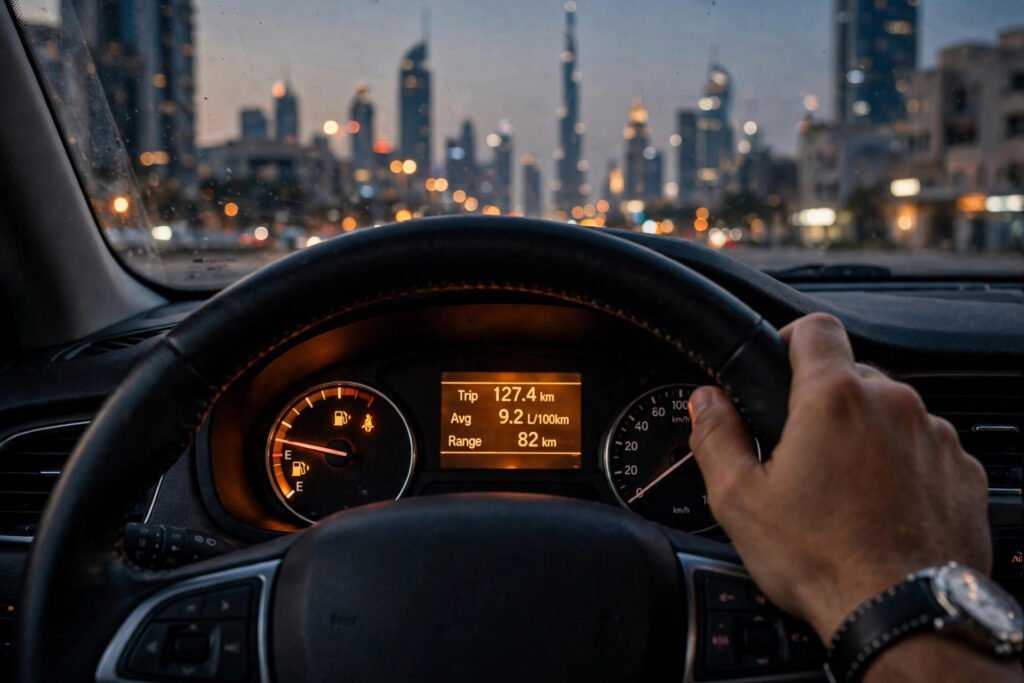
The second way is to use your car's own trip computer, if it has one. Most modern cars show average fuel consumption on the dashboard. It is convenient, but treat it as a guide, not gospel. The trip computer calculates from the car's own sensors, and if a sensor is part of the problem, the computer's maths can be off too. Still, it is useful for watching trends. Reset it at the same time as you fill up, drive normally, and note the number at the end of the tank. If the manual calculation and the trip computer disagree by a lot, that disagreement itself is interesting — mention it to your mechanic.
A few practical tips make the numbers honest. Always fill at the same pump if you can, or at least the same station, because pumps click off at slightly different points. Always fill to the first click, not to the brim, because topping up after the click is inconsistent and can flood the fuel vapour system. Write down the numbers on your phone the moment you fill up — do not trust your memory at the end of the week. And note what kind of driving that tank was: mostly city, mostly highway, a mix, a lot of idling, a hot week, a week with school runs. That context turns a number into a story.
What is a normal number? That is the question everyone asks, and the honest answer is that there is no single normal number. A small hatchback and a large SUV will never match. A car that does mostly highway driving will always beat the same car doing mostly city driving. The number in the brochure is measured in laboratory conditions that have nothing to do with Dubai traffic in August. So do not compare your car to the brochure, and do not compare it to your neighbour's car. Compare it to itself — to what it used to do on the same kind of driving, six months ago, a year ago. That is the only comparison that tells you something is wrong.
If your numbers are steady — the same as they have always been for the same kind of driving — then the car is probably fine, and what changed is your driving, the weather, or the traffic. If your numbers have dropped noticeably and stayed down across three tanks, then something in the car has changed, and the rest of this article will help you find it. Keep those numbers. Bring them with you when you come in. A mechanic who can see the numbers will find the problem faster than a mechanic who only hears, "It uses more petrol now."
The Simple Checks First: What You Can Look at in Ten Minutes
Before we go anywhere near the complicated parts, there are checks you can do yourself, in your parking bay, with no tools at all. I always start here, because more than once the answer has been sitting in plain sight.
Look at your tyres. Not a glance — a proper look. Are any of them visibly softer than the others? Does one tyre look flatter at the bottom where it meets the ground? Run your hand over the tread. Does it feel even, or is one edge worn smooth while the other still has tread? Uneven wear is a message. It tells you about pressure, about alignment, about how the car is sitting on the road. We will go deep on tyres later, but this first look takes thirty seconds and it is worth doing.
Look under the car where you normally park. Is there a stain on the ground? A dark patch, a wet patch, a patch that smells of petrol? A fuel leak is not common, but it is serious, and it is the one cause of high fuel consumption that is also a safety issue. Do not ignore a petrol smell. If you smell petrol around the car, or inside it, that needs attention the same day. If you see a dark oily patch, that is worth checking too — an oil leak will not directly raise your fuel use much, but it tells you the car needs attention, and leaks of any kind should not be left. If you want to know more about what different leaks look like, read our guide on a fluid leak under your car — it will help you tell a fuel stain from an oil stain from a coolant stain before you come in.
Open the bonnet and look, even if you do not know what you are looking at. You are not diagnosing anything yet. You are looking for the obvious: a hose that has come loose, a cap that is not sitting properly, a belt that looks cracked, anything that looks out of place, any smell of petrol under the bonnet. Check that the fuel cap clicks shut properly when you close it — a loose or damaged fuel cap can let fuel vapour escape, and on some cars it will trigger a warning light. Check the engine oil level with the dipstick if you know how. Low oil makes the engine work harder, and hard work costs fuel. None of these checks needs a mechanic. They just need five minutes and a bit of attention.
Check your boot. This sounds like a joke, and it is not. I have opened boots that were carrying a full set of tools, a box of books, a child's bicycle, bags of sand left over from a job, and a spare tyre sitting on top of a full-size spare wheel that was never taken out. Every extra kilo costs fuel, especially in stop-start city driving where you are accelerating that weight over and over again. Take out what you do not need. The same goes for a roof rack or roof box that stays on the car all year. On the highway, a roof box pushes against the wind, and the engine has to work harder to hold speed. If you only use it a few times a year, take it off between trips. You will feel the difference, and your fuel numbers will show it.
Check the air conditioning. This is a Dubai check, and it matters more here than in most places. When it is hot outside, the air conditioning is doing heavy work, and heavy work costs fuel. But there is a difference between normal air conditioning use and a system that is struggling. If the air coming out of the vents is not as cold as it used to be, if the compressor is cycling on and off constantly, if the car idles roughly when the air conditioning kicks in, then the system may need attention — low refrigerant, a tired compressor, a clogged cabin filter. The air conditioning is not usually the main cause of a sudden jump in fuel use, but in Dubai it is always part of the picture, and a struggling system adds to the load on an engine that is already working hard in the heat.
And check the simplest thing of all: are you idling more than you used to? Sitting in the car with the engine running while you wait for someone, while you take a phone call, while the kids finish at school — that is fuel burned for zero kilometres. In Dubai's heat, idling with the air conditioning on is understandable, and sometimes there is no choice. But if your routine has changed and you are spending an extra twenty or thirty minutes a day sitting with the engine running, that alone will show up in your fuel numbers. The car is not using more fuel per kilometre. It is using fuel while going nowhere. The fix is not a part. It is a habit. Turn the engine off when you are waiting for more than a minute or two, if it is safe and practical to do so, and watch what happens to your numbers over the next tank.
If all of these checks come back clean — tyres look fine, no leaks, no smell, boot is empty, air conditioning feels normal — then the cause is deeper, and the next sections will walk you through it, one system at a time.
Air Filter: The Engine Trying to Breathe Through a Dirty Cloth
The engine needs air. A lot of it. For every litre of petrol it burns, it pulls in a large volume of air, mixes the two together in a precise ratio, and burns the mixture to make power. If the air cannot get in freely, the whole balance is thrown off. The engine still needs to make the same power to move the car, so it compensates — and compensation, as always, means more fuel.
The air filter is the gatekeeper. It sits in a box under the bonnet, and its job is to catch dust, sand and dirt before they reach the engine. In Dubai, that is a hard job. The air carries fine dust, especially during windy days and sandstorms, and a filter that would last a long time in a cleaner climate can clog up faster here. When the filter clogs, less air gets through. The engine gets a mixture that is too rich — too much fuel, not enough air — and a rich mixture burns badly. You get less power from each drop of fuel, so you press the accelerator harder to get the same speed, and you burn more fuel to go the same distance. It is a quiet, gradual thing. The car does not break down. It just gets thirstier, week by week, as the filter gets dirtier.
How do you know the air filter is the problem? There are signs, and they are worth knowing. The car feels sluggish when you accelerate, especially when you need a quick burst of speed to merge or overtake. The engine sounds different — a little strained, a little muffled. You may notice a dark puff of smoke from the exhaust when you accelerate hard, because unburned fuel is going out the back. And your fuel numbers, tracked the way we described, have crept down over a few months rather than dropping off a cliff in one day. That slow creep is the classic filter pattern.
The good news is that the air filter is one of the cheapest and simplest parts on the car. On most cars it takes a mechanic a few minutes to check, and replacing it is a quick job. A mechanic can hold the old filter up to the light: if you cannot see light through it, it is done. Some filters can be tapped clean as a temporary measure, but a filter that is properly clogged needs replacing, not cleaning. And while you are at it, ask the mechanic to check the air intake pipes for cracks or loose connections, because a leak in the intake lets in unfiltered air and confuses the sensors we will talk about shortly.
The fuel filter is the other half of this story, and it is less visible. Its job is to catch dirt and rust in the fuel before it reaches the engine. When it clogs, the fuel pump has to work harder to push fuel through, and the engine can be starved of fuel at higher speeds or under load. A clogged fuel filter does not usually make the car use more fuel directly — in fact, it can make the car feel weak and hesitant — but it is part of the same picture: a fuel system that is not delivering cleanly. On many modern cars the fuel filter is inside the fuel tank and is not a regular service item, while on others it is an external part that should be changed on schedule. Your car's service schedule will say which type you have. If you do not know, ask at the next service. What matters for you is this: filters are service items, not lifetime parts. They wear out by doing their job. If your car has not had a proper service in a long time, the filters are almost certainly part of the story, and they are the cheapest place to start fixing it.

A quick word on service intervals, because this is where a lot of fuel problems start. The service schedule in your owner's manual is not a suggestion from the manufacturer to make money. It is the timetable for exactly these parts — filters, plugs, fluids — to be checked and changed before they start costing you fuel. In Dubai's heat and dust, the timetable matters even more. A car that is serviced on time uses less fuel than the same car serviced late, and the difference is not small over a year of driving. If you are not sure what a service includes or what the difference is between a small service and a big one, our guide on minor vs major car service cost explains it in plain terms — not to sell you a service, but so you know what you are paying for and when each job is due.
Tyres: Pressure, Alignment and the Drag You Cannot See
If the air filter is the engine struggling to breathe, the tyres are the car struggling to roll. And the tyres are where a surprising amount of fuel goes, because every kilometre you drive is a kilometre your tyres are in contact with the road, and the harder they are to roll, the harder the engine has to work.
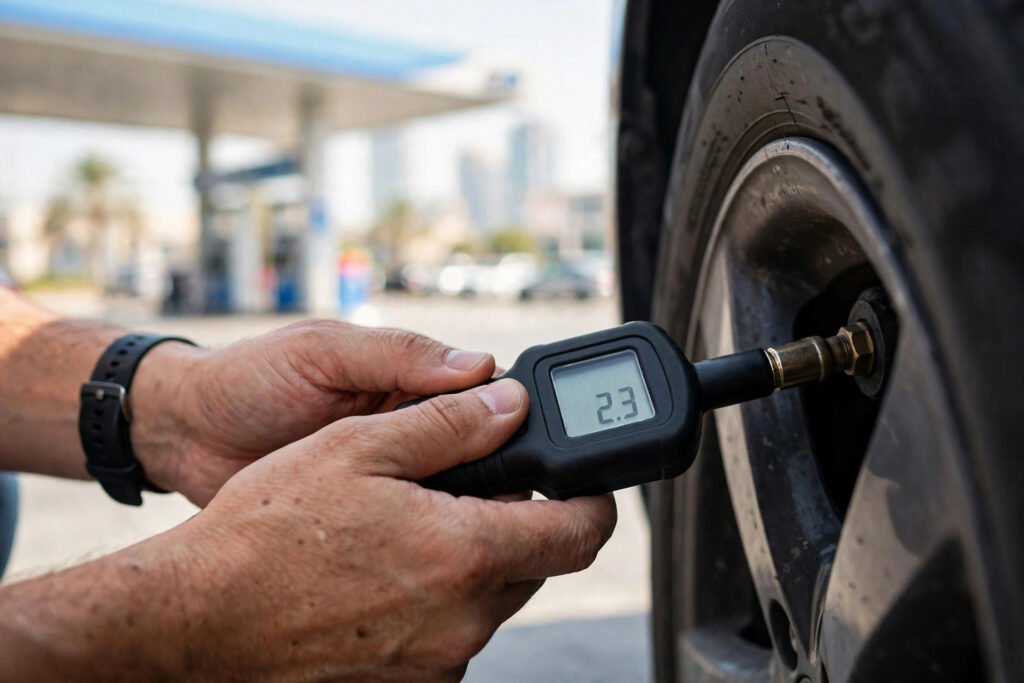
Tyre pressure is the first thing, and it is the most common cause I see. A tyre that is under-inflated does not roll freely. It squashes down where it meets the road, and the contact patch — the area of rubber touching the tarmac — gets bigger. A bigger contact patch means more friction, more rolling resistance, and more work for the engine. The car feels heavier, the steering feels a little vague, and the fuel gauge drops faster. The worst part is that a tyre can be significantly under-inflated and still look fine to the eye. A tyre that is down by a noticeable amount does not always look flat. You need a gauge to know.
Pressure drops naturally over time. Tyres lose a small amount of air every month, through the rubber itself and through the valve. Temperature changes make it worse — a tyre filled on a cool morning will read lower on a hot afternoon, and the other way round, and Dubai's swing between a cool winter morning and a blazing summer afternoon is bigger than most places. A slow puncture, a nail in the tread, a valve that is not sealing properly — any of these can let pressure out gradually, and you will not notice until the fuel numbers tell you, or until the tyre starts wearing unevenly. That is why pressure should be checked regularly, not just when something feels wrong. Once a month is a good habit, and always when the tyres are cold — before you have driven far — because driving heats the air inside and gives a false high reading.
The correct pressure is not a guess. It is printed on a sticker, usually on the driver's door frame or inside the fuel filler flap, and it is in your owner's manual. It is specific to your car, and sometimes different for the front and rear tyres, and different again when the car is fully loaded. Do not use the number printed on the tyre itself — that is the maximum pressure the tyre can take, not the pressure your car needs. And do not trust the last person who filled your tyres to have got it right. Check it yourself, or ask at a petrol station, and write down what you find. If one tyre is always lower than the others, that tyre has a problem — a slow leak, a valve issue, or damage to the wheel — and it needs to be looked at, not just topped up again and again.
Alignment is the second tyre issue, and it is the one people forget about. Alignment is about the angles of your wheels — whether they are pointing straight ahead, whether they are leaning in or out, whether they are in line with each other. When alignment is correct, the tyres roll straight and true. When it is out, the tyres are effectively dragging sideways, scrubbing against the road as they roll. That scrubbing is friction, and friction costs fuel. It also wears the tyres out unevenly and faster, so you pay twice: more fuel now, and new tyres sooner than you should need them.
Alignment goes out for ordinary reasons. Hitting a pothole, clipping a kerb while parking, driving over a speed bump too fast, the wear and tear of everyday driving — any of these can knock the angles out by a small amount. You will not always feel it. Sometimes the car pulls gently to one side, or the steering wheel sits slightly off-centre when you are driving straight, or the steering feels vague. Sometimes there is no feeling at all, and the only sign is the tyre wear: one edge of the tread worn smooth while the other edge still looks new, or a feathered pattern you can feel with your hand. If you see uneven wear, get the alignment checked. It is a quick check with the right equipment, and correcting it is one of the best value jobs you can do for both fuel use and tyre life.
Tyre balancing is related but different. Balancing is about weight, not angle — making sure the wheel spins evenly without wobbling. An unbalanced wheel vibrates, and vibration is wasted energy. It also wears the suspension and the tyres unevenly. Balancing is normally done when tyres are fitted or rotated, and it is worth doing properly, because a wheel that is out of balance will tell you about it through the steering wheel at highway speed. If you want the full picture on this, our guide on wheel alignment and tyre balancing walks through both jobs and when each one is due.
The tyres themselves matter too. Old tyres, worn tyres, and the wrong tyres for your car all cost fuel. A tyre that is worn down to the point where the tread is nearly gone has less grip, and the car has to work harder in wet conditions and under braking. A tyre that is the wrong size for the car — wider than standard, or a different profile — changes the rolling resistance and can throw the speedometer and the fuel calculations off. And a tyre that is simply old, even if the tread looks fine, has rubber that has hardened and lost its flexibility. Tyres age, and in Dubai's heat they age faster than in cooler climates. The age of a tyre is stamped on its sidewall in a code, and if you want to know how to read it, our guide on tyre age will help you check whether your tyres are older than you think. The point is simple: tyres are not just round black things that hold air. They are one of the biggest factors in how much fuel your car uses, and they are the easiest factor to check and to fix.
Sensors: When the Engine Is Working From Bad Information
Modern cars do not decide how much fuel to use by feel. They decide by information — from sensors that measure the air coming in, the exhaust going out, the temperature of the engine, and the position of your foot on the accelerator. The engine control unit, the car's computer, takes all of that information and works out exactly how much fuel to inject, moment by moment. When the information is good, the engine runs efficiently. When a sensor starts reading wrong, the computer makes the wrong decision, and the wrong decision almost always means more fuel.
The oxygen sensor is the one I see most often. It sits in the exhaust, and its job is to measure how much oxygen is left in the exhaust gases after combustion. That tells the computer whether the mixture was too rich or too lean, and the computer adjusts the next injection accordingly. It is a constant conversation, hundreds of times a minute. When the oxygen sensor gets old, or gets coated with deposits, it starts responding slowly, or it starts reading wrong. The computer, trusting the sensor, keeps the mixture richer than it needs to be — more fuel than the engine can burn cleanly. The result is higher fuel consumption, and often a rough idle, a hesitation when you accelerate, and sometimes a smell of fuel from the exhaust. On many cars a failing oxygen sensor will eventually trigger the check engine light, but not always, and not straight away. It can be wrong for weeks before the light comes on, and all that time you are paying for the extra fuel.
The airflow sensor — the mass airflow sensor — does a similar job at the other end of the engine. It measures how much air is coming into the engine, so the computer knows how much fuel to match it with. If the sensor is dirty, or it starts to fail, it can under-read the airflow. The computer thinks less air is coming in than there really is, and it injects the wrong amount of fuel for the real conditions. Or it can over-read, and the computer injects too much. Either way, the mixture is wrong, the burn is inefficient, and fuel is wasted. A dirty airflow sensor is sometimes just that — dirty — and cleaning it carefully can help, but it is a delicate part, and it should be cleaned or replaced by someone who knows what they are doing. Spraying the wrong cleaner on it can destroy it. If the sensor itself has failed, it needs replacing, and the new one needs to be the right one for your car.
There are other sensors in the chain. The coolant temperature sensor tells the computer whether the engine is cold or warm. When the engine is cold, the computer deliberately injects extra fuel — a rich mixture — to help it start and warm up. That is normal. But if the temperature sensor is faulty and keeps telling the computer the engine is cold when it is actually warm, the computer will keep injecting that extra fuel all day, every day. The car will use more fuel, and it will feel like the engine never quite warms up properly. The throttle position sensor tells the computer how far you have pressed the accelerator. If it is worn or faulty, it can send a jerky or incorrect signal, and the engine will respond with uneven fuelling. None of these sensors is expensive in itself, but finding which one is at fault takes proper diagnostic equipment — a scan tool that can read the live data from the sensors while the engine is running, not just a code reader that tells you a light is on. That is the difference between guessing and diagnosing, and we will come back to it.
A word of caution here, because this is where people waste money. Sensors should not be replaced on a guess. I have seen cars come in with three new sensors fitted by someone who was guessing, and the problem was still there — because the real problem was a vacuum leak, or a dirty filter, or a wiring fault. A sensor is only the answer when the diagnostic data says it is the answer. A proper diagnostic check reads the sensor values, compares them to what they should be, and finds the one that is lying. That is a skill, and it is worth paying for, because it is cheaper than replacing parts at random until the problem goes away.
Ignition: Spark Plugs and Coils
The ignition system has one job: to light the fuel-air mixture at exactly the right moment, with a spark strong enough to burn it cleanly and completely. When it does that job well, you get full power from the fuel. When it does it badly, some of the fuel does not burn properly, or burns at the wrong time, and that fuel is wasted — out the exhaust, as heat, as smoke, as nothing at all.
Spark plugs are the heart of it. A spark plug fires thousands of times every minute you drive, and each firing wears it a tiny amount. Over time the gap between the electrodes widens, the spark gets weaker, and the burn gets less complete. A worn plug can still fire, so the car still runs, but it runs less efficiently. You may notice a rough idle — the car shaking slightly when you are stopped at a light — or a hesitation when you press the accelerator, or a feeling that the car has lost some of its pull, especially going uphill or when the air conditioning is on. Fuel consumption creeps up because the engine is not getting full value from each injection. Spark plugs are a service item. They have a life, and that life is in your owner's manual. In Dubai's heat, and with the stop-start driving many of us do, they can wear faster than the manual suggests. Replacing them on schedule is one of the cheapest ways to keep fuel consumption where it should be.
Ignition coils are the partners of the spark plugs. Each coil takes the car's low-voltage power and turns it into the high-voltage spark the plug needs. When a coil starts to fail, the spark it produces gets weak or intermittent. The engine misfires — it skips a beat, or several beats — and a misfiring cylinder is not burning its fuel at all. That fuel goes straight out the exhaust, unburned. You will feel a misfire: a jerking, a stumbling, a loss of power, a flashing check engine light if it is bad enough. A misfire is not a small thing. It wastes fuel, it can damage the catalytic converter in the exhaust, and it needs attention quickly. If your car is shaking, jerking, or misfiring, do not keep driving it for weeks hoping it will go away. It will not, and the longer you drive with a misfire, the more it costs you — in fuel, and in damage to other parts. Our guide on engine misfire explains the symptoms and causes in more detail, and it is worth reading if your car is doing any of the things described here.
The ignition system and the fuel system work together, so a problem in one can look like a problem in the other. A weak spark and a dirty injector can produce similar symptoms — rough running, poor fuel use, hesitation. That is why a proper diagnosis matters. A mechanic with a scan tool can see which cylinder is misfiring, can test the coils, can check the plugs, and can tell you whether the problem is ignition or fuel. Without that, you are guessing, and guessing with ignition parts is how people end up replacing the wrong things.
There is one more ignition point worth making, because it catches people out. Short trips are hard on spark plugs. When the engine does not get fully warm, the plugs do not get hot enough to burn off the deposits that build up on them. Over weeks and months of short trips — school run, shops, short hop to work — those deposits build up, the plugs foul, and the spark gets weaker. The engine uses more fuel, and the plugs wear out sooner. If your daily driving is mostly short trips, your plugs will need attention sooner than the manual says. A longer drive once in a while — a proper run on the highway, where the engine gets fully warm and stays warm — helps the plugs stay clean. It is not a cure for worn plugs, but it is good for the car, and it is one of the reasons a car that does regular longer drives often feels healthier than a car that only ever does five-minute trips.
Driving Patterns: The AC, the Traffic, the Short Trips and the Right Foot
This is the part of the article that nobody wants to hear, because it is about us, not the car. But it is the truth, and a good mechanic will tell you the truth: the way you drive is one of the biggest factors in how much fuel your car uses. Two identical cars, same model, same year, same condition, can use very different amounts of fuel depending on who is driving them. The difference is not small. It is the kind of difference you can see in your numbers, tank after tank.
The air conditioning is the Dubai factor. In the summer, and for much of the year, the air conditioning is running from the moment you start the car until the moment you switch it off. It has to be. Nobody sits in a parked car in Dubai in August without it. The air conditioning compressor is driven by the engine, and it takes power to run. When it is working hard — cooling a car that has been sitting in the sun all day, or holding a low temperature on a very hot day — it takes more power, and the engine burns more fuel to provide it. That is normal, and it is not a fault. But there are ways to use it more efficiently. Park in the shade when you can, or use a sunshade, so the car is not baking when you get back to it. Open the doors for a few seconds before you start driving, to let the trapped hot air out, so the air conditioning does not have to fight it. Do not set the temperature to the lowest possible setting and leave it there — a comfortable temperature, rather than the coldest, is easier on the system and on your fuel use. And if the air conditioning is not cooling properly, get it checked, because a system that is struggling uses more power than a system that is working well.
Idling is the second Dubai factor. We idle a lot here. Waiting in the car while someone runs into a shop, sitting in a queue, waiting at school pickup, sitting in traffic with the engine running. Every minute of idling is fuel burned for no distance at all. The engine is running, the air conditioning is running, and the car is going nowhere. If you are going to be stopped for more than a minute or two, and it is safe to do so, switch the engine off. In traffic, you cannot do that, and nobody is asking you to. But in a car park, waiting for someone, it is an easy saving, and over a week of waiting it adds up to a real amount of fuel.
Short trips are the third factor, and they are the hardest on fuel. When you start a cold engine, the computer injects extra fuel to help it warm up. The oil is thick, the parts have not expanded to their proper size, the catalytic converter is not up to temperature yet, and the engine is running rich. For the first few minutes of any drive, the car uses more fuel per kilometre than it will for the rest of the journey. If your drive is only five or ten minutes long, the engine never gets out of that warm-up phase. The whole trip is done on a rich mixture. If you do several short trips a day, with the engine cooling down in between, every trip starts cold, and every trip is expensive in fuel. The car is not broken. It is just being used in the hardest possible way. Where you can, combine short trips into one longer one. Do the school run, the shops and the errand in one outing, rather than three separate cold starts. Let the engine get warm and stay warm. Your fuel numbers will show the difference.
Traffic is the fourth factor, and in Dubai it is a big one. Stop-start traffic is the worst kind of driving for fuel use. Every time you accelerate away from a stop, you are using fuel to get the car's weight moving. Every time you brake, you are throwing that energy away as heat. Do it a hundred times on the way to work, and the fuel adds up. Highway driving, by contrast, is efficient — steady speed, steady throttle, the engine in its comfortable range. That is why the same car can use noticeably more fuel in a week of city traffic than in a week that includes a highway trip to Abu Dhabi. You cannot avoid traffic, and nobody is suggesting you should. But you can drive smoothly in it. Gentle acceleration, looking ahead so you can ease off the accelerator instead of braking hard, keeping a steady gap to the car in front so you are not constantly speeding up and slowing down — all of this saves fuel, and it saves your brakes and tyres too. The driver who races to the next red light and brakes hard uses more fuel than the driver who eases off early and rolls up to it. It is not about driving slowly. It is about driving smoothly.
Speed matters too, especially on the highway. Fuel use rises sharply at high speed, because the engine has to push the car through the air, and air resistance grows faster than speed does. The difference between a steady cruise and a fast cruise is real, and it shows in the numbers. You do not need to drive slowly on the highway. You just need to know that the faster you go, the more fuel you use, and that the saving from arriving a few minutes earlier is paid for at the pump. A steady, legal, comfortable speed is the efficient speed.
And then there is the right foot. Hard acceleration — foot to the floor at every green light — is the single most expensive driving habit. It floods the engine with fuel to get maximum power, and most of that power is wasted in the first few seconds. You do not need full throttle to get moving in normal traffic. A smooth, progressive press on the accelerator gets you to the same speed, a second or two later, on noticeably less fuel. The same goes for braking. Every time you brake hard, you are wasting the fuel you just used to get up to speed. Looking ahead, anticipating the traffic, easing off early — this is not slow driving. It is smart driving. And over a month of driving, it is the cheapest fuel saving there is, because it costs nothing at all.
None of this means you have to change how you live. You still need the air conditioning. You still have to do the school run. You still have to sit in traffic. But knowing which parts of your driving cost the most fuel lets you make small changes where they are easy, and it stops you from blaming the car for something your routine is doing. If your fuel numbers have gone up and your driving has changed — more short trips, more idling, more traffic, hotter weather — then the car may be fine, and the answer may be in your diary, not in the workshop.
Other Causes Worth Knowing About
Filters, tyres, sensors, ignition and driving patterns cover most cases of rising fuel use. But there are other causes, and they are worth knowing about, because they are the ones that get missed when someone only checks the obvious things.
A dragging brake is one of them. A brake calliper that is sticking, or a handbrake that is not releasing fully, means the brake is lightly applied all the time, even when your foot is off the pedal. The engine has to drag the car against that brake, and that costs fuel. You may notice the car feels sluggish, or that one wheel is hotter than the others after a drive, or that there is a smell of hot brakes. A dragging brake also wears the brake pads and the discs unevenly, so it is worth catching early. If you have had brake work done recently and the fuel use went up at the same time, mention it to your mechanic — the two may be connected.
A fuel leak is rarer, but it matters more than the others, because it is a safety issue as well as a fuel issue. A leak can be a damaged fuel line, a loose connection, a cracked seal, or a fault in the fuel tank. The sign is usually a smell of petrol — around the car, under the bonnet, or inside the cabin — and sometimes a stain on the ground where you park. If you smell petrol, do not ignore it, and do not keep driving for days hoping it will go away. Get it checked the same day. A fuel leak is not a job for guesswork, and it is not a job to put off.
The exhaust system can tell you a lot, if you know what to look for. Smoke from the exhaust is never normal on a healthy car, and the colour of the smoke is a clue to what is wrong. Black smoke usually means too much fuel is being burned, or fuel is not being burned completely — a rich mixture, a sensor fault, an injector problem. Blue smoke usually means oil is being burned. White smoke can be steam on a cold morning, which is normal, or it can mean something more serious. If you are seeing smoke, and your fuel use has gone up at the same time, the two are almost certainly connected, and our guide on exhaust smoke colours will help you understand what you are seeing before you come in. Do not drive for weeks with smoke coming from the exhaust. It is the car telling you, in the clearest way it can, that something is wrong.
The cooling system is another quiet contributor. If the engine is running cooler than it should — because the thermostat is stuck open, for example — the computer will keep the mixture rich, thinking the engine is still warming up. The temperature gauge on the dashboard will tell you: if the needle never quite reaches its normal position, even after a long drive, the engine is running cold, and it is using extra fuel all the time. The opposite problem — an engine that runs hot — is more obvious and more urgent, but a cold-running engine is the one that quietly costs you fuel for months before anyone notices.
Wheel bearings, suspension parts and the transmission can all add drag too. A wheel bearing that is wearing out creates friction and noise, and the engine has to overcome that friction. A transmission that is slipping, or that is not shifting properly, wastes power between the engine and the wheels. These are not the first things to check, but they are worth knowing about, because a car that feels like it is dragging, or that sounds different, or that does not accelerate the way it used to, may have a mechanical drag somewhere in the drivetrain. A mechanic can check for this by feeling the wheels, listening for bearing noise, and checking the transmission fluid.
And then there is the simple fact of age and mileage. A car with high mileage is not the same as a car with low mileage. Parts wear. Seals harden. Injectors get dirty. The engine loses a little compression. None of this happens overnight, and none of it means the car is finished. It means the car needs more attention, more regular servicing, and a little more care to keep it running efficiently. A well-maintained older car can be surprisingly efficient. A neglected older car will drink fuel, and it will keep drinking more until someone looks after it properly.
A Step-by-Step Diagnosis You Can Follow
By now you have a lot of information. Here is how to put it together, in order, so you are not guessing and not wasting money. This is the order I would follow if your car came into the workshop with this complaint.
Step one: track your fuel use for three tanks, the way we described earlier. Write down the kilometres, the litres, the dates, and what kind of driving each tank was. Do not skip this step. Without numbers, everything else is a feeling, and feelings do not diagnose cars. If the numbers are normal, stop here — the car is fine, and what changed is your driving or the weather. If the numbers are down, keep going.
Step two: do the ten-minute checks. Tyres — look at them, check the pressure with a gauge, look for uneven wear. Under the car — any stains, any smell of petrol. Under the bonnet — anything loose, anything leaking, oil level. Boot — take out the weight you do not need. Air conditioning — is it cooling properly? Write down what you find, even if it is "nothing obvious." That is useful information too.
Step three: think about your driving. Has it changed? More short trips, more idling, more traffic, hotter weather, more weight, a roof box that went on and never came off? Be honest. If your driving has changed, and your numbers have changed by a similar amount, then your driving may be the whole answer. Try a week of smoother driving — gentle acceleration, less idling, combined trips — and see what the numbers do on the next tank. If they come back up, you have your answer, and it cost you nothing.
Step four: think about service history. When was the last proper service? What was done? Were the filters changed? Were the spark plugs changed? If the service is overdue, or if you do not know when it was last done, then a service is the right next step — not a guess, but the maintenance the car is due for anyway. A service is not a waste of money when the car is overdue for one. It is the car catching up on the care it should have had, and fuel use is often one of the first things to improve after a proper service.
Step five: look for the symptoms that point to a specific system. Rough idle, hesitation, loss of power, misfire, jerking — that points to ignition or fuel delivery. Black smoke, smell of fuel — that points to a rich mixture, a sensor or an injector. Car pulling to one side, uneven tyre wear, steering wheel off-centre — that points to alignment. Warning light on the dashboard — that points to whatever the computer has detected, and the code will tell a mechanic where to look. Write the symptoms down. A list of symptoms is far more useful than a vague "it uses more petrol."
Step six: if you have done all of this and the numbers are still down, it is time for a proper diagnostic check. That is not a failure. It is the sensible next step. Some causes — a lazy oxygen sensor, a dirty airflow sensor, a sticking thermostat, a dragging brake, a fuel injector that is not spraying properly — cannot be found by looking and listening alone. They need a scan tool, a pressure gauge, and a mechanic who knows how to read the live data. Bring your fuel numbers with you. Bring your list of symptoms. Bring the service history if you have it. The more you bring, the faster the problem will be found, and the less you will pay for someone else's guesswork.
When to Get a Diagnostic Check — and What a Good One Looks Like
There is a point in every fuel problem where guessing stops being useful. Here is how to know you have reached it. If your fuel numbers have been down across three tanks, and the simple checks are clean, and your driving has not changed enough to explain it, then it is time. If a warning light is on — the check engine light, or any light that stays on after you start the car — then it is time. If the car is misfiring, jerking, stalling, smoking, or smelling of petrol, then it is time now, not next week. If the car feels different to drive — sluggish, hesitant, rough — and the feeling has been there for more than a few days, then it is time. And if you have already replaced a part on a guess and the problem is still there, then it is definitely time, because guessing is how people spend money without fixing anything.
A good diagnostic check is not a quick plug-in and a printout. A code reader will tell you that a fault code exists, but it will not tell you why. A proper diagnostic check starts with a conversation: what are the symptoms, when did they start, what has changed, what are your fuel numbers? Then a mechanic will look at the car, check the simple things first — filters, pressure, plugs, leaks — and then connect a scan tool and read the live data while the engine is running. Live data is the key. It shows what the sensors are actually reading, moment by moment, and a mechanic who knows what those numbers should be can see which sensor is lying, which cylinder is misfiring, whether the fuel mixture is rich or lean, and whether the engine is reaching its proper temperature. From there, the mechanic can test the specific part that the data points to, rather than replacing parts at random.
You should expect the mechanic to explain what they found, in plain language, before they do any work. What is the cause, what needs to be fixed, what will it involve, and what will it cost — not a number invented here, but a price based on your car and the actual job. If a garage cannot explain the cause, or wants to replace several parts "just in case," ask questions. A good garage will welcome them. And if the problem is something simple — a filter, a tyre pressure, a spark plug — then the fix should be simple too, and you should be back on the road quickly.
One more thing: do not ignore a problem because the car still drives. A car that uses more fuel than it should is a car that is telling you something is wearing out, or failing, or out of adjustment. Left alone, a small problem becomes a bigger one. A dirty filter becomes a damaged sensor. A worn plug becomes a misfire. A misfire becomes a damaged catalytic converter. A dragging brake becomes a worn disc. The fuel you are wasting now is the cheapest part of the problem. The damage that comes later is the expensive part. Getting it checked early is not spending money. It is saving it.
FAQ: Fuel Consumption Questions We Hear Every Week
Why is my car using more petrol suddenly when nothing has changed?
If truly nothing has changed — same driving, same routes, same weather — then something in the car has changed, even if you cannot see it. The most common hidden causes are a clogged air filter, low tyre pressure, a lazy oxygen sensor, or worn spark plugs. All of them develop gradually, so the change can feel sudden when you finally notice it. Track your fuel use for three tanks to confirm the change is real, do the simple checks in this article, and if the numbers are still down, get a diagnostic check. A sudden change from one tank to the next, with no other explanation, is worth checking quickly, because it can also mean a fuel leak or a sensor that has failed outright.
Does the air conditioning really use that much fuel?
Yes, in Dubai it does — and it is normal. The air conditioning compressor is driven by the engine, and in hot weather it works hard. You will use more fuel in the summer than in the winter, and that is expected. What is not normal is a big jump in fuel use when the weather has not changed, or an air conditioning system that is not cooling properly. If the air from the vents is weak or warm, get the system checked, because a struggling system uses more power than a healthy one. Park in the shade, use a sunshade, let the hot air out before you drive, and set a comfortable temperature rather than the coldest — all of it helps.
Will low tyre pressure really make a noticeable difference to fuel use?
Yes. Under-inflated tyres have more rolling resistance, and the engine has to work harder to keep the car moving. One soft tyre makes a small difference. Four soft tyres, or one tyre that is badly under-inflated, makes a difference you can see in your fuel numbers. The problem is that a tyre can be well below its correct pressure and still look fine. Check the pressure with a gauge once a month, when the tyres are cold, and use the pressure on the sticker in your door frame, not the number on the tyre. If one tyre keeps losing pressure, it has a leak or a valve problem, and it needs to be looked at.
How often should I change my air filter and spark plugs?
Follow the schedule in your owner's manual, and remember that Dubai's dust and heat can shorten the life of both. The air filter should be checked at every service and changed when it is dirty — a mechanic can tell in seconds by holding it up to the light. Spark plugs have a life measured in distance, and they should be changed on schedule, not when they fail. If your driving is mostly short trips, your plugs will foul faster, and they may need attention sooner. A service that is overdue is one of the most common reasons fuel use creeps up, because filters and plugs are the parts that wear out quietly.
My check engine light is on and my car is using more fuel. Is it safe to drive?
It depends on what the light means, and you cannot know that without reading the code. A steady check engine light with no other symptoms is usually safe to drive to a garage, but you should not ignore it for weeks. A flashing check engine light, or a light combined with misfiring, jerking, stalling, smoke, or a smell of petrol, means you should get the car checked as soon as you can, and avoid long or hard driving until you do. A misfire can damage the exhaust system if you keep driving with it. If you are unsure, call a mechanic and describe the symptoms — that phone call costs nothing and it is the right thing to do.
Can short trips really use that much more fuel?
Yes, and this surprises a lot of people. A cold engine runs rich — it injects extra fuel to warm up — and it stays in that rich phase for the first few minutes of every drive. If your drive is only five or ten minutes, the whole trip is done while the engine is still warming up. Do that several times a day, and every trip starts cold. Combine short trips into one longer outing where you can, let the engine get fully warm, and you will see the difference in your fuel numbers. It is not a fault in the car. It is the hardest kind of driving there is.
I filled up at a different station and my fuel use went up. Is the fuel bad?
It is possible, but it is rare. If the problem started on that exact tank and goes away on the next tank from your usual station, then the fuel is a fair suspect. If the problem continues across several tanks from different stations, the fuel is not the cause — something in the car is. Note the timing, note the station, and if you are concerned, mention it to your mechanic. Do not keep filling up at a station you do not trust. Use a station you know, fill to the first click, and track your numbers so you have real evidence, not just a feeling.
When should I stop trying to fix this myself and call a mechanic?
When you have tracked your fuel use for three tanks and the numbers are still down, when the simple checks are clean, when a warning light is on, or when the car is misfiring, smoking, or smelling of petrol. Also when you have already tried one fix and it did not work — that is the point where guessing starts costing money. A proper diagnostic check, with live sensor data, will find the cause faster and cheaper than replacing parts at random. Bring your fuel numbers and your list of symptoms with you. It will help more than you think.
Call 95 Services
If your car is using more petrol than it used to, and you have worked through the checks in this article, we can help you find out why — properly, with a diagnostic check, not a guess. We are a mobile car service, which means we come to you, wherever you are in the UAE. Home, office, car park, roadside — if your car is there, we can be there too.
Our response time is 15–20 minutes, our service covers the complete UAE, and our prices are low. That is our standard, and it is the standard we work to on every job, whether it is a diagnostic check, a filter change, a set of spark plugs, a tyre pressure check, or a full service.
Call us on +971 54 344 3513. Tell us what your car is doing, what your fuel numbers look like, and what you have already checked. We will talk you through it honestly, and if the car needs us, we will come to you and sort it out. Do not drive for months on a problem that is costing you fuel every single day. Get it checked, get it fixed, and get back to the fuel use your car is supposed to have.
