
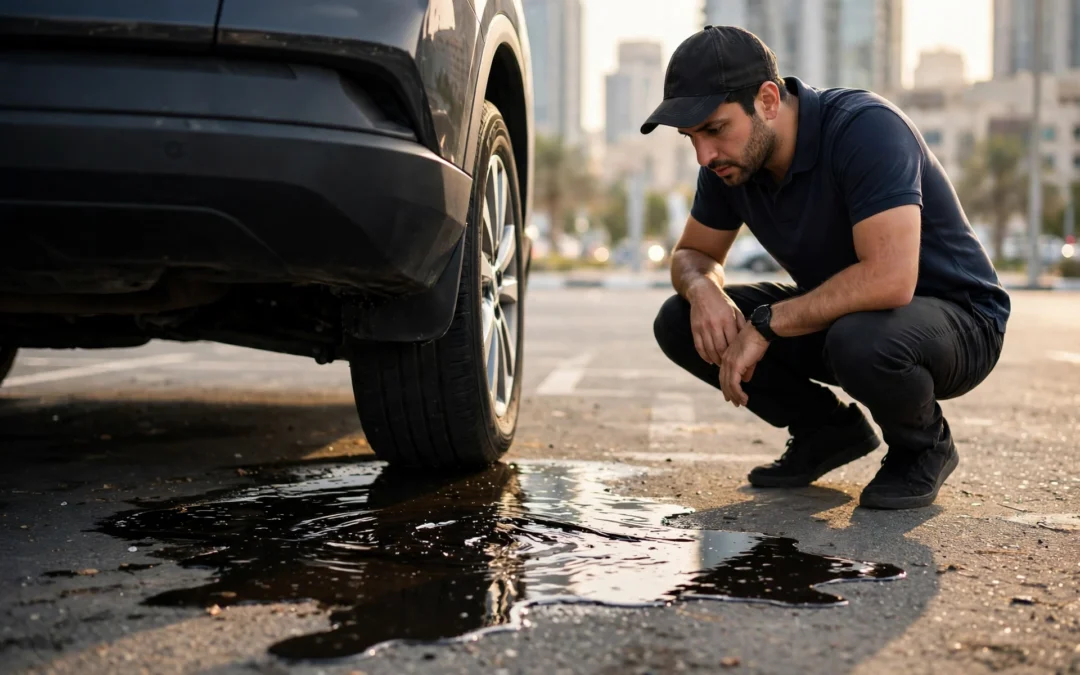
You walk out to your car in the morning and there it is: a dark patch on the ground where your car was parked overnight. Or a bright green puddle. Or something clear and watery that you are not sure is anything at all. Most drivers in Dubai have had this moment, and most of them do the same thing — they look at it for a few seconds, decide it is probably nothing, and drive off.
Sometimes it really is nothing. In Dubai, the most common puddle under a car is just water from the air conditioning, and your AC works hard enough here that it can leave a proper puddle on a hot afternoon. But the same patch of ground can also be the first warning of a brake fluid leak, a fuel leak, or an engine running low on oil — and the difference between those two situations is not something you should guess at. A brake fluid leak does not give you a second warning. A fuel leak does not wait for a convenient day.
The good news is that you do not need tools, a ramp, or any mechanical knowledge to work out what is leaking. You need four clues, and you already have all of them: the colour, the feel, the smell, and where under the car it landed. This guide walks through each fluid one by one, in plain language, so you can tell in about five minutes whether to drive on, book a check, or not drive at all.
The two rules that matter most: if you smell fuel, or if you find a clear-to-amber fluid near a wheel that could be brake fluid, do not drive the car. Call for help instead. Every other leak in this guide can wait for a proper check — but those two cannot.
1. The Five-Minute Method: Colour, Feel, Smell, Location
Before you read a single section below, do this. It takes five minutes and it makes everything else in this guide work.
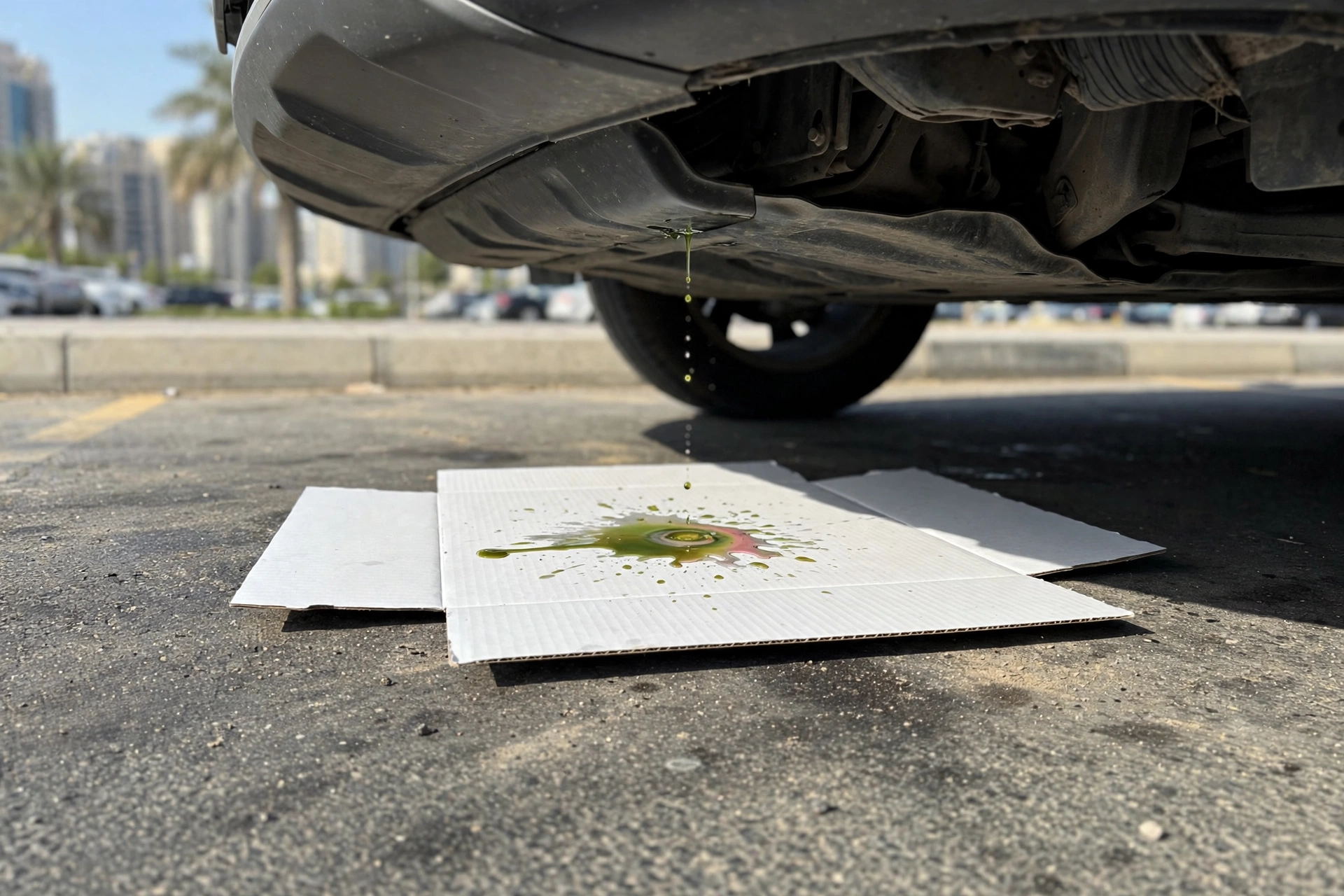
First, slide a piece of white cardboard, a white plastic bag, or a few sheets of white paper under the car, roughly where the drip landed, and leave it there overnight — or for a few hours if the drip is fresh. Concrete and asphalt hide colour. A dark patch on grey concrete tells you almost nothing; the same fluid on white cardboard tells you its true colour, how much is coming out, and exactly where it is falling from.
Second, touch a drop with one fingertip. Is it watery and thin, or thick and greasy? Does it feel slippery like oil, or slimy like coolant? Wipe it on the cardboard and look at the colour in daylight, not under a yellow parking light.
Third, smell it — from a little distance, not with your nose in the puddle. Sweet? Oily and burnt? Sharp like petrol? Or no smell at all? And fourth, note the location: under the front of the engine, in the middle of the car, near a wheel, or under the back near the fuel tank. Colour alone can mislead you — old transmission fluid turns brown, pink coolant looks like transmission fluid, and fresh engine oil looks a lot like gear oil — but colour plus feel plus smell plus location almost always gives you the answer.
One more thing before you start: check whether the puddle is even from your car. If you park in a shared basement or a busy street, the car before you may have left it. The cardboard test solves that too — if the cardboard stays dry overnight, the puddle was not yours.
2. Clear, Watery, No Smell: Usually Just Air Conditioning
Clear fluid that feels like water, has no smell, and dries without leaving a stain is, nine times out of ten, condensation from your air conditioning. Your AC pulls moisture out of the air, and in Dubai — where the AC runs most of the year and the humidity can be heavy — that water has to go somewhere. It drips from a drain under the front passenger side of the car, and on a hot day it can leave a puddle big enough to worry you.
How to be sure: it only appears after you have been running the AC, it is directly under the front of the car, and it evaporates cleanly. If you dab it with a white paper towel, the towel stays white. That is normal, and it needs no repair at all.
There are two exceptions. If the clear fluid is under the back of the car rather than the front, or if it appears on a cold morning without the AC running, it could be water from the exhaust — also usually harmless condensation — or, much less commonly, a coolant leak in a car that runs clear water instead of coloured coolant. And if the puddle is clear but feels slippery, or smells faintly sweet, treat it as coolant, not water, and read the next sections. When in doubt, the cardboard test plus one look at your coolant reservoir will settle it: if the reservoir level is where it should be and the fluid is odourless water, drive on.
3. Amber, Brown or Black and Greasy: Engine Oil
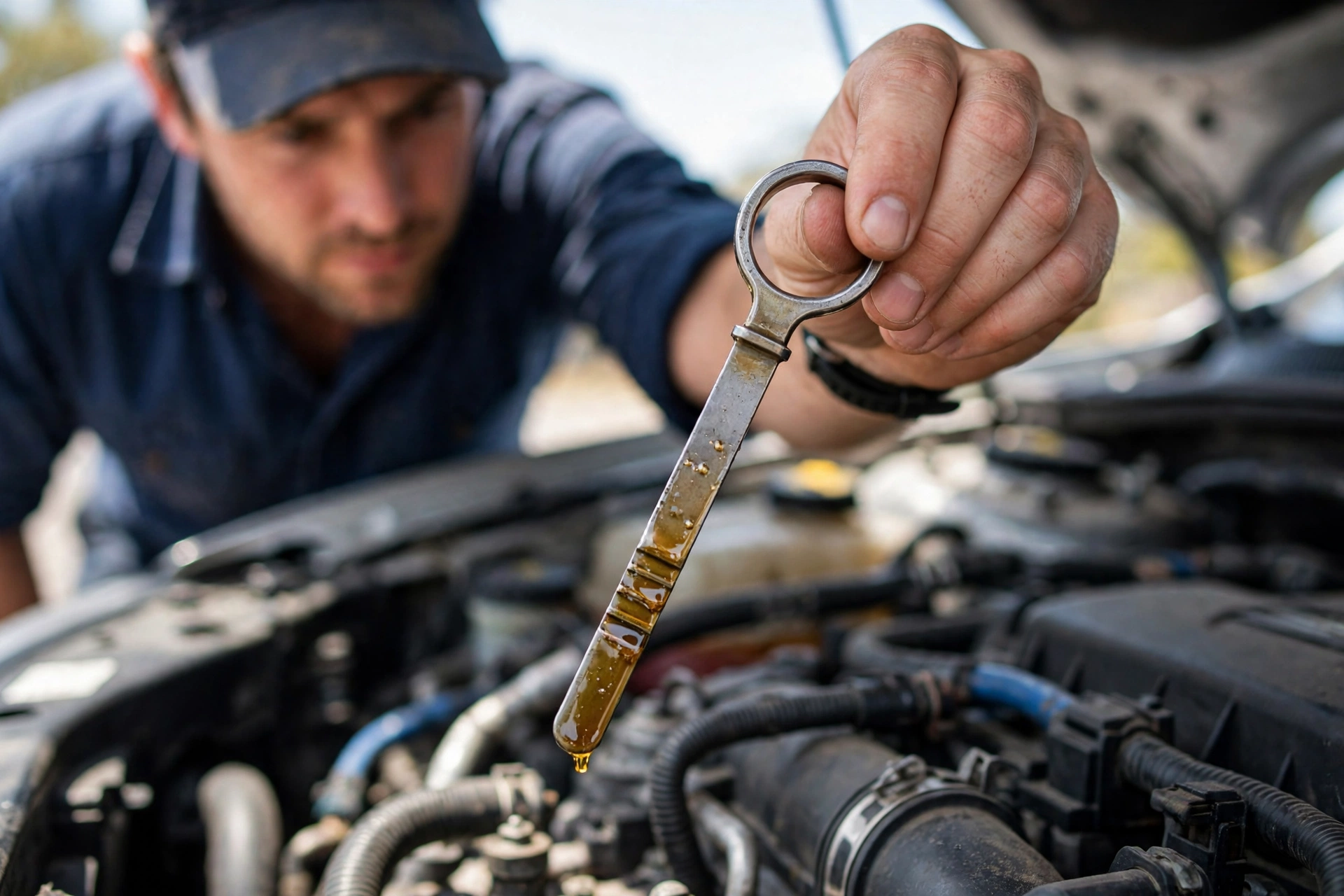
Engine oil is the leak most drivers meet first, and it is also the one that is easiest to recognise once you know what to look for. Fresh engine oil is a honey-amber colour. As it does its job inside the engine it picks up soot and heat, so it darkens to brown and then to black. A spot of it on your cardboard is greasy, slick between your fingers, and it does not dry — it leaves a dark stain that stays.
It usually lands under the front half of the car, directly beneath the engine. Common causes are the oil drain plug, the oil filter, a valve-cover gasket, or a sump gasket that has gone hard with age and heat. Dubai heat is not kind to rubber gaskets: they harden, shrink slightly, and start to weep, especially on older cars and on cars that sit for long stretches between drives.
How urgent is it? That depends on how much is coming out. A few small spots after a week of parking is a slow weep — get it checked soon, but check your oil level first and top up if needed. A puddle that grows every night, or oil dripping while the engine is running, is a different matter: low oil damages an engine fast, and an engine that runs dry does not give you a warning you can ignore. If the red oil-pressure light comes on, stop the car and switch the engine off. Do not drive on to see if it goes away.
To check the level, park on flat ground, wait a few minutes after switching the engine off, pull the dipstick, wipe it, push it back in fully, and pull it out again. The oil should sit between the two marks. If it is below the lower mark, top it up with the grade your manual specifies and get the leak found. And if you are not sure which grade your car takes, do not guess — a quick call to a mechanic is cheaper than the wrong oil.
4. Bright Green, Orange, Pink or Blue and Sweet-Smelling: Coolant
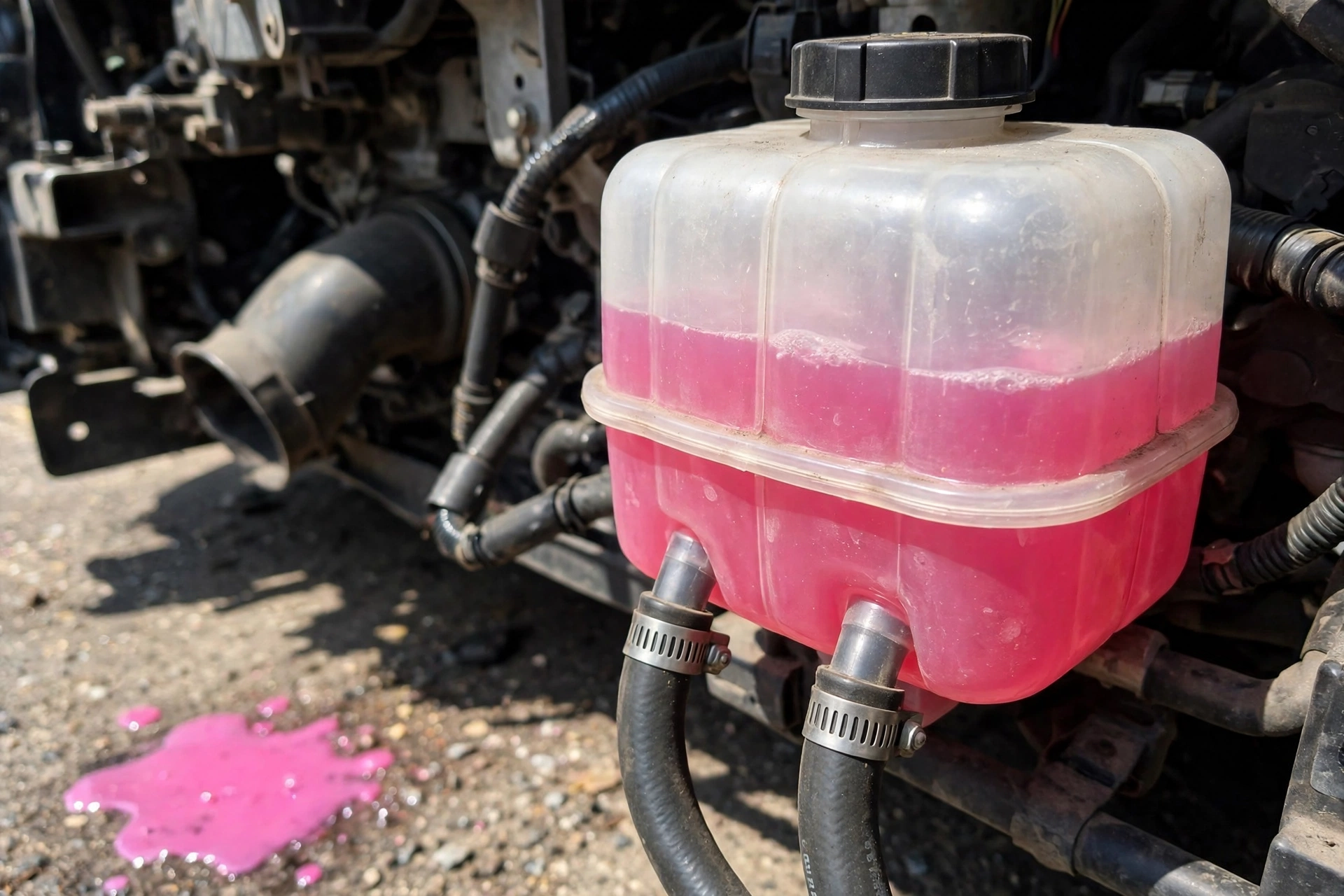
Coolant is the easiest fluid to spot and the one people most often misread. It comes in bright, almost artificial colours — green, orange, pink, blue, sometimes yellow — because manufacturers dye it deliberately so leaks are easy to find. It feels thin and watery but slightly slimy between your fingers, and it has a faintly sweet smell, like syrup. If you see a brightly coloured puddle under the front of the car, near the radiator or the hoses, that is almost certainly coolant.
Coolant is what stands between your engine and overheating. It carries heat away from the engine to the radiator, and when it leaks, the engine loses that protection. A slow coolant leak can go unnoticed for weeks because the car still drives normally — until the level drops far enough that the temperature gauge starts to climb, and by then you are already in trouble. That is why a coolant puddle deserves attention even when the car feels fine.
Check the coolant reservoir — the translucent plastic tank near the front of the engine bay, usually marked with MIN and MAX lines. Check it when the engine is cold, never when it is hot: opening a hot cooling system is dangerous, and the level reads differently when the system is pressurised. If the level is below MIN, or if it keeps dropping after you top it up, there is a leak somewhere — a hose, the radiator, the water pump, or the reservoir itself — and it needs finding. If the temperature gauge climbs while you are driving, pull over, switch the engine off, and let it cool. Never open the radiator cap on a hot engine.
One confusion to watch for: pink coolant, which is common on Toyotas, looks a lot like transmission fluid at first glance. The feel gives it away — coolant is watery and sweet-smelling, transmission fluid is oily and smells of petroleum. And coolant usually lands at the very front of the car, under the radiator, while transmission fluid lands further back, under the middle.
5. Red or Pink and Oily: Transmission Fluid — or Power Steering Fluid
Red is the colour that causes the most arguments, because two different fluids share it. Automatic transmission fluid is dyed red or pink when new, and it darkens to a reddish-brown as it ages. Power steering fluid is also often red or pink. Both feel oily but thinner than engine oil, and both smell faintly of petroleum. So how do you tell them apart?
Location is your best clue. Transmission fluid usually appears under the middle of the car, beneath the gearbox, and it often comes with a symptom: the car hesitates or jerks when it changes gear, shifts late, or slips out of gear. Power steering fluid appears toward the front, near the steering rack, and it usually announces itself with a whining or groaning noise when you turn the wheel, or a steering wheel that feels heavier than usual.
A transmission leak is not a do-not-drive emergency in the same way a brake or fuel leak is, but it is not something to leave for months either. A gearbox running low on fluid wears out from the inside, and the repair for a worn gearbox is in a different league from the repair for a leaking seal or a loose cooler line. If you notice red fluid under the middle of the car, get it checked within days, not weeks — and if the gears start slipping, stop driving and get it looked at the same day.
One note for modern cars: some CVT gearboxes use green or blue fluid instead of red, and some cars have no transmission dipstick at all — the level can only be checked from underneath. If your car is one of those, do not try to check it yourself. The colour and location of the drip are enough to tell a mechanic where to start.
6. Clear to Amber Near a Wheel: Brake Fluid — Do Not Drive
Brake fluid is the leak this whole guide is really about, because it is the one where the wrong decision has immediate consequences. New brake fluid is almost clear, or a pale yellow. As it ages it turns amber and then brown. It feels slippery, thinner than engine oil, and it has very little smell. It usually shows up near a wheel — inside the tyre, on the back of a wheel, or under the brake master cylinder at the back of the engine bay. It can also strip paint, so a patch of bubbled or missing paint near a wheel is worth a look.
Here is the problem: brake fluid and clean water can look alike, and a small brake fluid leak can look like nothing at all. The clues are the location and the feel. Water from the AC lands under the front passenger side and feels like water. Brake fluid lands near a wheel or under the master cylinder and feels slippery and oily. If you are not sure which one it is, do not guess — and do not test it by driving.
If you suspect a brake fluid leak, do not drive the car. Check the brake fluid reservoir in the engine bay first: if the level is low, or if the brake pedal feels soft, spongy, or sinks further than usual, the car needs to be towed, not driven. Brakes do not fail politely. They fade, and then they do not come back. This is also one of the leaks the RTA inspection checks for — a car with a visible brake fluid leak will not pass — so it needs fixing whether or not you have a test coming up.
7. A Strong Smell of Petrol or Diesel: Do Not Start the Car
Fuel does not need a colour chart. You will smell it before you see it. Petrol is clear to pale yellow, very thin, and evaporates quickly, leaving a rainbow sheen on wet ground. Diesel is slightly oily and evaporates much more slowly. Either way, the smell is unmistakable, and the rule is the same.
If you smell fuel around your car, or you see a puddle under the fuel tank or the fuel lines, do not start the engine, do not switch anything electrical on, and do not drive. Fuel vapour ignites easily, and a running engine, a hot exhaust, or even a spark from a switch is enough. Move away from the car, and call for help — a mobile mechanic can come to you, and the car can be towed once the leak is found. This is one of the few car problems where waiting outside the car is the right thing to do.
Fuel leaks usually come from a cracked hose, a loose connection, or damage underneath the car — a speed bump, a stone, or a corroded fuel line on an older car. They are more common after a car has been parked for a long time, when rubber hoses dry out and shrink. If the smell is faint and only appears just after filling up, it may be a splash from the pump or a loose fuel cap — tighten the cap, wipe the area, and see if it comes back. If it comes back, or if the smell is strong, treat it as a leak.
8. The Ones People Forget: Washer Fluid, Gear Oil and Diesel Exhaust Water
Not every puddle belongs to the big six. Washer fluid is usually bright blue — sometimes green, pink or orange — very thin and watery, and it smells faintly of alcohol or cleaning fluid. It leaks from the washer reservoir or a cracked hose near the front corner of the car, usually after the reservoir has been filled too full or a hose has come loose. It is the least urgent leak on this list: your windscreen washers will stop working, and that is about it. Fix it when convenient.
Gear oil is the one that smells like trouble — literally. It is thick, amber to dark brown, and it has a strong sulphur smell, like rotten eggs or a struck match. It leaks from the differential or the axles, usually on four-wheel-drive cars and older rear-wheel-drive cars, and it lands under the middle or the back of the car. It is not a do-not-drive emergency, but a differential running low on oil wears fast, so get it checked soon.
And then there is the puddle that is not a leak at all: a small amount of clear water dripping from the exhaust pipe on a cold start. That is condensation inside the exhaust system burning off as the engine warms up, and it is completely normal — especially on cool winter mornings in the desert, when the temperature drops overnight and the exhaust is cold. If it stops once the car is warm, ignore it.
9. How Fast Is It Leaking? The Check That Decides Whether You Drive
Knowing what the fluid is only answers half the question. The other half is how fast it is coming out, and that decides whether you drive, drive carefully, or do not drive at all.
A slow leak leaves a few drops overnight — a coin-sized spot on the cardboard, or a damp patch that does not grow. That is a book-a-check-soon leak: check the relevant level, top up if you know how, and get it looked at within days. A steady leak leaves a puddle the size of your hand after a few hours parked, or drips while the engine is running. That is a same-day check, and you should check the level before every drive until it is fixed. A fast leak — a stream, a puddle that grows while you watch, or any leak that leaves the reservoir or the dipstick dry — is a do-not-drive leak. Tow it.
Before any drive with a known leak, check the level of that fluid. Engine oil on the dipstick, coolant in the reservoir when cold, brake fluid in the reservoir, transmission fluid only if your car has a dipstick for it and your manual says you can check it. If a level is below the minimum, do not assume a top-up fixes the problem — a top-up buys you a drive to the workshop, not a repair. And if a warning light comes on — oil pressure, temperature, brake, or battery — believe it. Warning lights are not suggestions.
A word about stop-leak products: they are sold everywhere, and they sometimes slow a small leak for a while. They do not fix the cause, and in a cooling system they can clog things you do not want clogged. If a leak is big enough to notice, it is big enough to find properly. A mechanic with a UV dye — a dye added to the system, then traced with a UV light — or a pressure test on the cooling system will find in minutes what guessing cannot find in weeks.
10. Leaks and the RTA Test: Fix Them Before You Book
If your registration renewal is coming up, a leak is not just a mechanical problem — it is a test problem. The RTA technical inspection checks the car for leaks, and oil, fuel and coolant leaks are all listed among the common reasons cars fail. The inspection also checks fluid levels, so a car that is slowly losing coolant or brake fluid can fail on the level alone, even if no puddle is visible on the day.
The practical point is simple: do the cardboard test a week or two before your test, not the night before. If you find a leak, you have time to fix it and re-check. If you find it the night before, you are choosing between driving to the test with a known fault and paying for a re-test. Our RTA inspection checklist walks through the full pre-check — tyres, lights, brakes, fluids and the rest — so you can find the small problems before the testing centre does.
And if your car has already failed on a leak, the fail report tells you exactly which fluid and roughly where. Keep that report: it is the fastest way for a mechanic to know what to look for, and it saves you paying for the same diagnosis twice.
11. When the Leak Comes With Another Symptom
A puddle on its own is one thing. A puddle plus a symptom is a louder message, and it is worth listening to.
Coolant leak plus a temperature gauge that climbs: stop driving. That combination is the road to an overheated engine, and our engine overheating guide explains exactly what to do in the first minutes — and what never to open while the engine is hot.
Red fluid plus slipping gears or a delay when you shift: get the gearbox checked the same day. Low transmission fluid is one of the most common causes of gearbox trouble, and catching it early is dramatically cheaper than repairing the damage from driving on. Our transmission repair page covers the signs in more detail.
Oil leak plus a burning smell through the vents: oil is dripping onto the hot exhaust. It will not fix itself, and the smell will get worse. Get it checked before a long drive.
Any leak plus a warning light on the dashboard: stop and check the level before you drive further. If you are not sure what the light means, our car won’t start guide covers the dashboard warnings that matter most, and a quick call will settle the rest.
12. What to Do in the First 10 Minutes After Spotting a Leak
Finding a puddle under your car is the kind of thing that can ruin a morning if you let it. The trick is to slow down for ten minutes before you do anything else, because those first ten minutes are when you learn almost everything you need to know — and when the wrong move, like starting the engine with a fuel leak, is most likely to happen.
First, do not start the car yet. Walk around it instead. Look at where the puddle sits — front, middle, back, near a wheel — and take a photo with your phone. A photo costs you nothing and it is genuinely useful later: a mechanic can tell a lot from a picture of the puddle and where it sits under the car, and you will not have to remember the exact colour an hour later when you are trying to describe it over the phone.
Second, do the paper towel test. Dab the fluid with a white paper towel or a piece of white cardboard. Note the colour in daylight, whether it feels greasy or watery, and whether it smells of anything — sweet, oily, sharp like fuel, or nothing at all. Keep your nose a little way back; you do not need to breathe it in deeply to know. And never taste it. Some of these fluids are poisonous, and coolant in particular tastes sweet, which is exactly why it is dangerous around children and pets.
Third, check the level of the fluid you think it is — but only if you can do it safely. Engine oil on the dipstick, coolant in the reservoir when the engine is cold, brake fluid in its reservoir. If the level is where it should be, you have time. If it is low, or if a warning light is on, the car is telling you not to guess. And if you smell fuel, skip all of this: do not start the engine, do not switch anything on, step away and call for help.
Finally, decide what happens next before you drive anywhere. Fuel or brake fluid means do not drive, full stop. A slow oil or coolant weep with a correct level means a short drive to a workshop is reasonable — but check the level again before you set off, and keep an eye on the temperature gauge on the way. That is the whole ten minutes: look, photograph, touch, smell, check the level, decide. It is a small habit, and it is the difference between a cheap fix and a tow truck.
13. Is It a Leak or Just Water From the AC?
In Dubai, this question comes up more than anywhere else, because here the air conditioning runs most of the year — and it makes real water. A car AC works by pulling warm, humid air across a freezing-cold coil inside the dashboard, and the moisture in that air turns into liquid, just like the sweat on a cold glass. Tests have found a car AC can sweat off around 1.9 litres of water in an hour, and half a litre over a 30-minute drive is not unusual at all. So a proper puddle under the front passenger side of the car is often just the car doing exactly what it was designed to do.
There are five checks that settle it. First, the fluid is clear and has no smell. Second, it feels exactly like water — thin, not greasy, not slimy. Third, it only appears after you have been running the AC. Fourth, it stops within about half an hour of switching the AC off. And fifth, it dries without leaving a stain, and a white paper towel dabbed in it stays white. If all five are true, it is condensation, and it needs no repair at all.
But there are times when clear water is not just water. If it has any colour to it, or a sweet smell, treat it as coolant, not condensation. If it feels slippery or oily, it could be brake fluid — and that is a do-not-drive situation, not a wait-and-see one. If it appears under the middle or the back of the car rather than the front passenger side, it is not the AC drain. And if it keeps dripping long after the AC has been off, or it appears on a cold morning when the AC has not run at all, something else is going on.
There is one more AC problem worth knowing about: a blocked drain. The water the AC makes has to go somewhere, and if the little drain tube under the dashboard gets clogged, the water backs up into the cabin instead — usually soaking the carpet on the front passenger side. If your passenger footwell is wet and there is no puddle under the car, that is very likely what has happened, and it does need a mechanic. And if you are still not sure after all five checks, the cardboard test from the start of this guide settles it: leave white cardboard under the car overnight, and in the morning you will know exactly what you are dealing with.
14. How Much Fluid Loss Is Too Much?
The size of a puddle tells you less than you think. A small spot every night for a month can add up to a serious loss, while one big splash after you overfilled the washer bottle means nothing at all. The reservoir and the dipstick are the real measure — they show what is actually left inside the car, and that is the number that matters.
Engine oil should sit between the two marks on the dipstick. If it is below the lower mark, top it up before you drive, and get the leak found the same day — never do a long drive on low oil. Coolant should sit between MIN and MAX on the reservoir, checked when the engine is cold. If it keeps dropping after you top it up, the leak is active, and the level will only keep going down. Brake fluid should sit near the top of its reservoir. If it has dropped noticeably, have it checked — a falling brake fluid level always deserves attention. Transmission fluid is harder, because many modern cars have no dipstick for it at all, so you have to judge by the drip rate and by symptoms like slipping gears or late shifts.
A simple habit makes all of this much easier: check your levels once a week, on the same day, with the engine cold and the car on flat ground. If you like, write the levels down. A slow drop over three weeks is a pattern, and a pattern is far easier for a mechanic to work with than “it was low once”. It also tells you how fast the leak really is, which is what decides whether you drive, drive carefully, or do not drive at all.
The line itself is simple. Any fluid at or below its minimum mark, or a level that has dropped a lot in a single day, means do not drive. And a top-up is a bridge to the workshop, not a fix — it buys you one careful drive, not another month. If you find yourself topping up the same fluid every week, the leak is no longer a small thing, and it is time to have the source found properly.
15. Why Leaks Get Worse in Dubai Heat
Dubai heat is not just uncomfortable for drivers — it is hard on cars. Summer air temperatures here regularly pass 45 degrees, and asphalt sitting in direct sun can reach 70 to 80 degrees. Park on it at midday and everything underneath your car is baking, including the rubber that is supposed to keep your fluids where they belong.
Rubber hoses are the weak point. A typical rubber radiator hose lasts around five to seven years, and heat, sun and stop-start driving all shorten that. Every hot-cold cycle makes the rubber a little harder and a little less flexible, until it cracks — usually at a bend or near a clamp, where it is stressed most. Gaskets and seals go the same way: they harden, shrink slightly, and start to weep. That is why an oil leak that did not exist in March can appear in August, and why a coolant hose that survived the winter can split on the hottest afternoon of the year.
Stop-start traffic makes it worse. In a jam the engine stays hot, the fan works hard, and there is no airflow to cool things down. Short trips are no kinder — the engine heats up and cools down again and again, and each cycle wears the rubber a little more. Cars that sit unused for weeks are not spared either: rubber dries out when it is not flexing, and a car that has been parked for a month can start leaking on its very first drive back.
A quick summer check costs nothing, and it takes about a minute. When the engine is cold, squeeze the big coolant hoses. A healthy hose feels firm but pliable. One that is hard and stiff has been baked brittle; one that feels soft and spongy is damaged inside. Either way, have it looked at before it splits on a hot afternoon — because a hose that lets go in August traffic does not give you a warning, and the temperature gauge will be the first thing you notice, which is already too late.
16. How 95 Services Checks a Leak at Your Location
You do not have to drive anywhere to find out what is leaking. 95 Services covers the complete UAE with a mobile team, open 24 hours, and we usually reach you within 15 to 20 minutes. You call, you tell us what you have seen, and we come to you — at home, at work, or in a car park.
Here is what happens when the technician arrives. First, the questions: what colour was it, where under the car, any smell, any warning light on the dashboard? A photo of the puddle helps a lot here — it is often the fastest way to narrow it down. Then the check itself: a torch underneath the car, a look at the levels, and tracing the drip upwards, because a leak rarely lands directly below its source. Fluid runs along pipes and brackets before it drops, so the puddle can be some distance from the actual leak. For a coolant leak, that can mean a pressure test on the cooling system, or a UV dye that glows under a light and shows exactly where it is escaping.
Then comes the honest answer, before any work starts: is it safe to drive, can it be topped up and driven to the workshop, or does the car need to be towed? Small things — a loose clamp, a top-up — can sometimes be sorted on the spot. Bigger jobs go to the workshop, and the car can be recovered there. Either way, you will know what it needs and what it will involve before anything is done.
All you need when you call is the colour, the location, and any smell — plus the make and model of the car. Call or WhatsApp 95 Services on +971 54 344 3513, any time of day or night. We will tell you straight whether it is safe to drive or whether the car should stay exactly where it is.
Frequently Asked Questions
Is it normal for a car to leak a little water in Dubai?
Yes. The most common puddle under a car in Dubai is condensation from the air conditioning, which runs most of the year. It is clear, odourless, feels like water, and appears under the front passenger side after the AC has been running. If it dries without a stain, it is normal and needs no repair.
How do I know if a leak is serious?
By what it is and how fast it is coming out. Fuel leaks and brake fluid leaks are serious at any size — do not drive. A fast leak of any fluid, or any leak that leaves a reservoir or dipstick dry, is serious. A slow weep of engine oil or coolant is less urgent, but it still needs a check within days, because levels only go one way.
Can I drive with an oil leak?
With a slow weep and a correct oil level, a short drive to a workshop is usually fine. With a fast leak, a growing puddle, or the oil-pressure light on, do not drive. Check the dipstick first: if the oil is below the lower mark, top it up before driving, and get the leak found the same day.
Why does my car leak only when it is parked?
Most leaks show up when the car is parked because that is when the fluid has time to collect in one place. A car that is driven every day can have the same leak and never leave a puddle — the fluid blows back under the car or evaporates while you drive. Parking overnight on cardboard is the most reliable way to catch it.
Can a fluid leak fail the RTA inspection?
Yes. The RTA technical inspection checks for oil, fuel and coolant leaks, and for fluid levels. A visible leak or a low level can fail the test. Check for leaks a week or two before your test date, so there is time to fix anything you find.
What should I do if I find a leak and I am not sure what it is?
Take a photo of the puddle on white cardboard, note the colour, where under the car it is, and whether it has a smell — then call a mechanic and describe exactly that. Those four details are usually enough to tell whether the car can be driven in or needs to be collected. If you are in Dubai or anywhere in the UAE, you can call or WhatsApp 95 Services on +971 54 344 3513 — we come to you, usually within 15 to 20 minutes, and we will tell you honestly whether it is safe to drive or whether the car should be towed.
A puddle under your car is your car telling you something, and most of the time the message is a simple one: a seal has gone hard, a hose has cracked, or a gasket has given up after years of Dubai heat. None of that is a disaster — but all of it is cheaper to fix the week you notice it than the month you ignore it. Do the five-minute check, note the colour, the feel, the smell and the location, and if the answer is fuel or brakes, do not drive. For everything else, book the check, check the level before you drive, and let a mechanic find the source. That is the whole job — and it starts with a piece of white cardboard and five minutes in the morning.
If you have found a leak and you would like it checked without driving the car anywhere, 95 Services covers the complete UAE with a mobile team. Call or WhatsApp +971 54 344 3513 and tell us the colour and where it is — we will come to you, usually within 15 to 20 minutes, find the source, and tell you what it needs before any work starts. Our car repair and maintenance page and our engine repair and diagnostics page cover the checks in more detail, and if the leak is near a wheel, our brake repair page explains what the brake check includes.
