
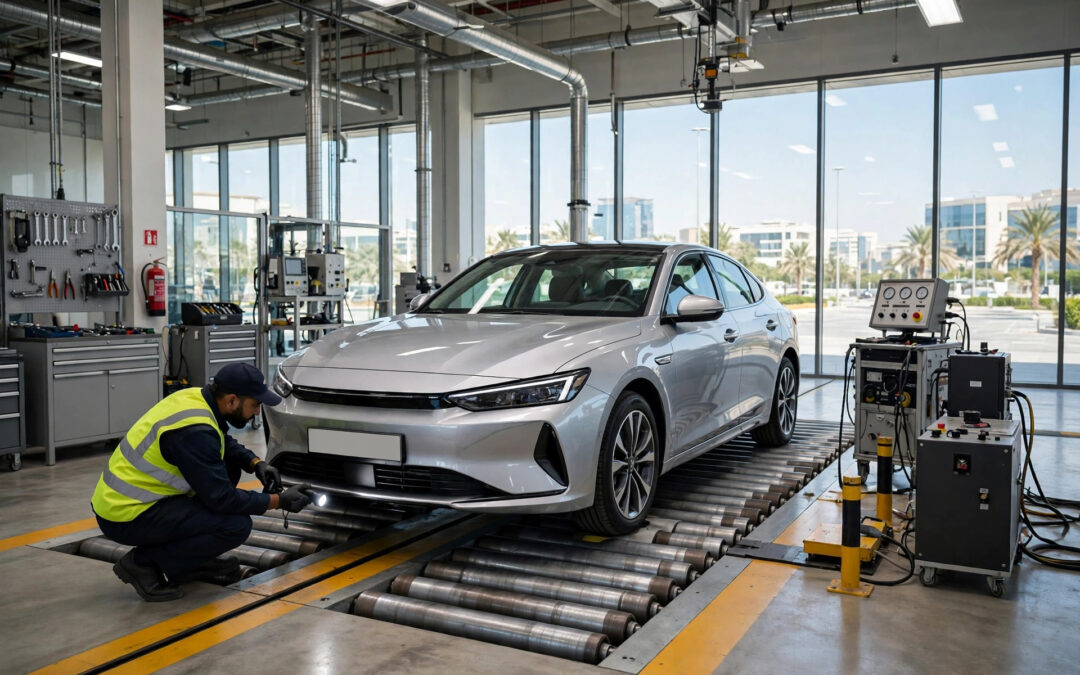
Every Dubai driver with a car over three years old knows the routine. The renewal notice arrives, and before the Mulkiya can be renewed the car has to pass its technical inspection — the test most drivers just call “passing” or “Tasjeel”. The test itself is short. The RTA says to allow about 32 minutes for a light vehicle. A fail, though, costs far more than half an hour: a repair, a return trip to the centre, and a renewal left waiting while the certificate clock runs.
Most fails are avoidable. Inspectors work through a fixed roadworthiness checklist, and the faults that fail cars — worn tyres, a dead brake light, weak brakes, a cracked windscreen — are almost all visible before the test if you know where to look. This guide covers who needs the test and when, how to book, exactly what inspectors check, the pre-test checks you can do yourself, the most common fail reasons, and what happens if the car fails. The rules and steps follow the RTA’s own service description for the Vehicle Technical Inspection, checked in November 2026.
One date matters more than any other. The Vehicle Technical Inspection Certificate is valid for 30 days from the day the car passes. Renew the registration inside that window. If the certificate expires before renewal is complete, the car has to be tested again.
1. Who Needs the RTA Inspection, and When
The rule, in one sentence: in Dubai, a car needs a passing technical inspection before its registration can be renewed, unless it is still inside its new-vehicle exemption. The exemption and the annual cycle around it are where most confusion starts, so they are worth setting out exactly.
The three-year exemption for new cars
The RTA exempts a vehicle from the technical inspection for three years when three conditions all hold: you are the first owner, the vehicle is new, and it has no mileage. The three years run from the year of manufacture or the year of registration, whichever comes first. That last detail catches people out: a car manufactured in late 2023 but first registered in early 2024 measures its exemption from 2023, so its first test falls due sooner than the registration date alone suggests. If the car was bought used, imported, or previously registered elsewhere, do not rely on the three-year rule — it is written for a first owner with a new, zero-mileage car.
Annual testing once the exemption ends
Once the three years are up, the test becomes annual. Every renewal needs a fresh pass certificate, and the certificate lasts 30 days, so the practical rhythm is simple: book the test in the weeks before the registration expires, pass it, and renew straight away. Leaving the test to the last day is the most common self-inflicted problem in the whole process. A fail on the final day leaves no room for a repair and a return visit.
Other inspection types beyond renewal
Renewal is the most common reason for a test, but not the only one. The RTA lists several inspection types, and booking asks which one applies: registration of a vehicle, renewal, export with plates, registration for vehicle sale purposes, reinspection after a failed test, data verification, and export or transfer outside the UAE without plates. Trailers and semi-trailers have their own inspection route, including chassis-number engraving, and classical vehicles — those over 30 years old — are inspected under their own criteria covering body condition, brakes, lighting, engine function and leaks. If your situation is anything other than a straightforward renewal, select the inspection type that matches it. This guide covers Dubai and the RTA; the other emirates run their own arrangements.
2. Booking the Test, Step by Step
Booking is not optional for most tests. The RTA requires an appointment booked through its website or the RTA Dubai app for registration, renewal and export-with-plates inspections. A small set of cases needs no reservation: vehicles of People of Determination and senior Emiratis and residents registered in Dubai, registration for vehicle sale purposes, reinspection of vehicles that failed the previous test, data verification, and export or transfer outside the UAE without plates. The Tasjeel Hatta centre also takes vehicles without a reservation. Everyone else should book before turning up.
How to book through the RTA website or app
The RTA’s own booking steps are straightforward, and the booking itself is instant once the details are entered:
- Log in. Use a username and password, UAE Pass, or the details of an Emirates ID, driving licence, plate number or traffic file. On the app, choose Vehicle Inspection Appointment after logging in.
- Select the plate source. Dubai plates verify through the account; plates from another emirate need the extra information the form asks for.
- Select the vehicle and the inspection type. Choose the car and the reason for the test — renewal for most drivers.
- Select the inspection centre. Pick from the RTA-approved Vehicle Registration and Inspection Centres. The main networks drivers know are Tasjeel, Shamil, Wasel and Tamam, with several branches across Dubai.
- Book the appointment and confirm it. Choose a slot and confirm. The booking details arrive by email and SMS.
- Bring the vehicle to the centre. Arrive within 15 minutes either side of the appointment time — the RTA states this as a condition of the booking.
- Pay the fees. Fees are paid at the centre. Rely on the fee shown at booking; this guide does not quote a test fee because published figures differ and change.
- Confirm the email address. The certificate arrives electronically, so confirm the email that should receive it.
What to bring, and when to arrive
Bring the car, and have the registration card and Emirates ID details to hand. What needs attention before the visit is everything around the test: renewal itself needs valid insurance and cleared fines, which are separate from the test lane — but sorting them in the same week avoids passing the inspection and then finding the renewal blocked. If the car is returning for a reinspection after a fail, no new appointment is needed, and the previous fail report is the document that matters. If the car cannot be brought to a centre at all, the RTA also lists a Mobile Technical Inspection service, where an equipped inspection vehicle comes to the location — offered through Tasjeel ENOC, Wasel, Al Mutakamela and Aber centres.
Two booking mistakes waste more time than any mechanical fault. The first is turning up without an appointment for a renewal test and being sent away to book. The second is arriving well outside the appointment window — the RTA asks drivers to arrive no more than 15 minutes before or after the booked time. Book the slot, set a reminder, and arrive inside the window.
3. What Inspectors Actually Check
The inspection is a roadworthiness check, not a full mechanical strip-down. Inspectors look for safety failures, not minor wear, and they work through the same systems on every car. Knowing the list in advance is the whole secret to passing first time: every item below can be checked at home or in a workshop before the appointment, and Section 4 turns this list into a do-it-yourself routine.
Brakes: stopping power, balance and the handbrake
Brakes get the most thorough examination on the lane. The car is driven onto a roller brake tester that measures braking force at each wheel, so the inspector sees not just whether the car stops but whether it stops evenly. A car that pulls to one side under braking, or where one wheel brakes far harder than the other, is a fail. Pads and discs are checked for wear, the handbrake is tested for holding power, and the system is checked for leaks. A falling brake-fluid level never means evaporation; it signals pad wear or a leak. Before the appointment, brake firmly from a moderate speed on a quiet, safe stretch: the car should stop straight, without pulling, vibration, grinding, or a handbrake lever that travels too far. The brake warning signs guide sets out what each sound, feeling and warning light means, and car repair and maintenance services covers the brake work itself.
Steering and suspension: control, wear and alignment
Steering and suspension are tested for excess play, wear and damage: looseness in the steering, worn joints and bushes, leaking shock absorbers, broken springs, and anything that affects stability. Wheel alignment sits in this area too: a car that drifts to one side on a straight road, or a steering wheel that sits off-centre while driving straight, points to an alignment problem to correct before the test. See wheel alignment and tyre balancing for what the service involves.
Lights and signals: every bulb, correctly aimed
Every exterior light is checked: headlights on dipped and main beam, indicators front and rear, brake lights, tail lights, reverse lights, fog lights where fitted, hazard lights, and the number-plate light. Headlight aim matters as well as function — lights that dazzle oncoming traffic or point too low fail just as surely as a dead bulb. Walk around the car with a helper working the switches, or use reflections in a shop window: check each light in turn, including the third brake light and the small plate bulb most drivers forget exists.

Exhaust and emissions: the probe test
A probe in the exhaust measures what the car emits, with limits depending on fuel type and vehicle. Visible smoke is an immediate problem — thick smoke of any colour suggests a fault needing diagnosis before the test, not after it. The exhaust system itself is checked for leaks, damage, secure mounting, and unauthorised modifications such as a non-standard exhaust. A car running with a lit check-engine light, rough idling or heavy fuel use should be diagnosed before booking, because an emissions fail usually means something upstream needs fixing. The engine warning signs guide explains the dashboard warnings that should never be ignored in the run-up to a test.
Tyres: tread, condition, age and matching
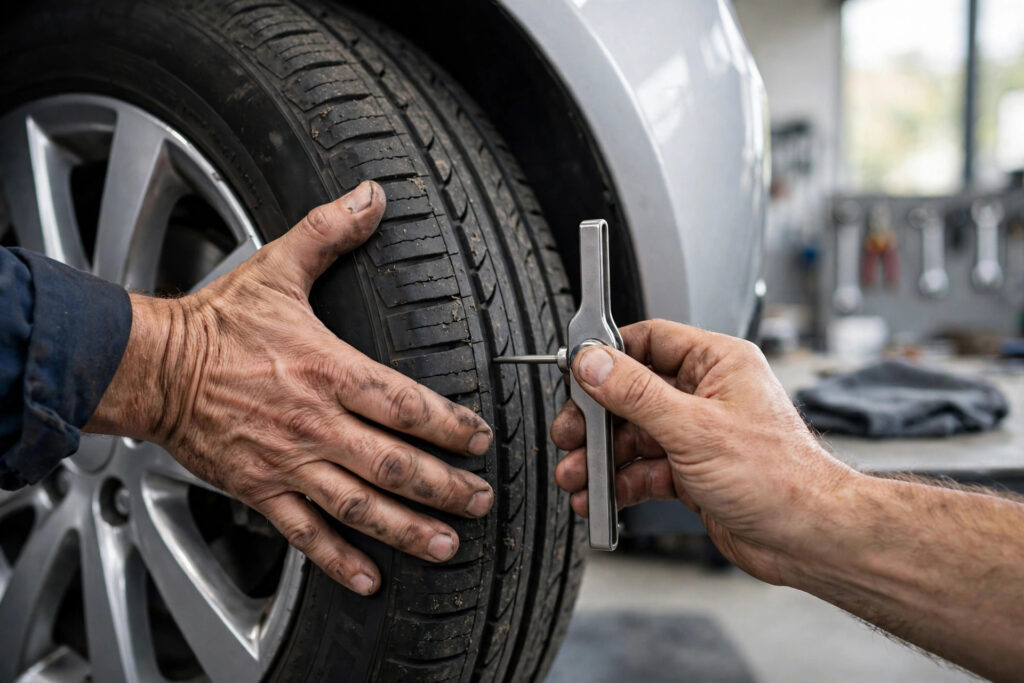
Tyres are checked on four counts: tread depth, physical condition, age, and matching. The legal tread minimum is 1.6 mm, and anything near that figure is living on borrowed time. Sidewalls are inspected for cracks, bulges, cuts and exposed cords, and tyres on the same axle must match in size and type. Age is checked from the four-digit DOT code on the sidewall, which gives the week and year of manufacture. Rubber hardens and cracks with sustained Dubai heat and sun, so an older tyre can fail on age and condition even when the tread looks usable. This guide deliberately does not state a single age limit in years, because the figure applied has varied and the current rule sits in the RTA inspection brochure — check the DOT code on every tyre including the spare, and confirm the current age rule before the test if any tyre is several years old. See tyre repair services in Dubai, the tyre puncture repair guide, and the extreme heat maintenance guide on how Dubai heat ages tyres and how to read the DOT code.
Chassis and underbody: structure, rust and damage
With the car on a lift, the inspector examines the chassis and underbody for structural damage, corrosion, poor repairs and welding that does not meet standard. Bent members, cracked welds or rust that has weakened a structural part do not pass. A pre-test lift inspection is valuable for any car with accident history — ask the workshop to confirm the underbody is straight and solid before booking.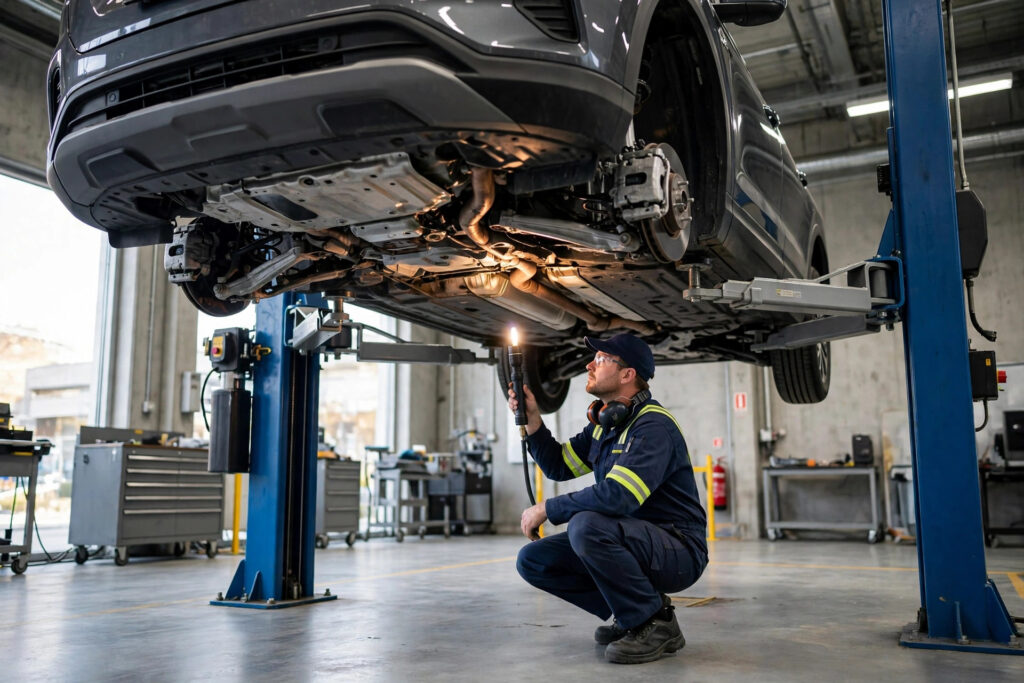
Glass, mirrors and visibility
The windscreen and windows are checked for cracks and chips, with damage in the driver’s direct line of sight treated most seriously. A small chip at the edge of the screen and a crack across the driver’s view are very different findings. Mirrors must be present, secure and adjustable, and the wipers must clear the screen effectively with working washers. Check the windscreen in daylight from inside the car: chips catch the light and cracks spread. Wiper blades harden fast in Dubai heat, so replace streaking blades before the test.
Seatbelts, horn, wipers and interior safety
Inside the car, inspectors check that seatbelts extend, retract and latch properly, that the horn works, and that no dashboard warning light indicates a safety fault. Airbag and ABS lights that stay on after starting mean a safety system is reporting a fault, and the car needs diagnosis. Test every seatbelt, including the rear ones, and listen for the horn. These checks take two minutes at home and fail cars every day when skipped.
Leaks, fluids and the engine bay
Fluid leaks are checked from below and in the engine bay. Fuel, oil, coolant and brake-fluid leaks are all fail material, with fuel leaks treated as the most urgent. Fluid levels should sit between their marks: engine oil, coolant (checked only when the engine is completely cold), brake fluid and washer fluid. The battery must be secure in its tray with clean, tight terminals. If the car needs a jump start to get going, fix the charging fault first — and car battery replacement covers testing and fitting when the battery itself is the confirmed fault.
Window tint, modifications and identity checks
Window tint is measured against the legal limit, and cars do fail inspection over tint that is too dark. The consistent position used in this guide’s companion articles is that front side windows must allow at least 50% visible light transmission and the front windscreen must remain untinted except for a narrow sun strip along the very top, with rear-window guidance varying — verify the current RTA position before the test if the car carries dark film. Modifications are checked against what the car is approved to carry: substantial changes — engine or body modifications, lift kits, non-standard exhausts — can send the car to the RTA Technical Inspection Committee, and a colour change needs a permit obtained before the change is applied. Finally, identity checks confirm the car is the car on the paperwork: the chassis number must match the registration record, plates must be fitted and legible, and the Salik tag is verified.
4. The Pre-Test Checklist You Can Do Yourself
Run through this checklist a week or two before the appointment, not the night before. Work through it in daylight, with the car parked on level ground and the engine cold for the fluid checks.
- Walk around the car. Damage, loose trim, missing mirrors, cracked lights, anything hanging below the body line. Both number plates fitted, clean and legible.
- Check every light. Dipped and main beam, indicators, brake lights including the third brake light, tail lights, reverse lights, fog lights, hazards and the number-plate light.
- Check the tyres. Cold pressures against the door placard, tread across the full width, sidewalls for cracks and bulges, the DOT age code, matching sizes on each axle, and the spare.
- Check the glass and wipers. Windscreen chips and cracks from inside the car, mirrors secure and adjustable, wipers clearing cleanly, washer jets spraying.
- Check the brakes by feel. Firm pedal, straight stop, no grinding or vibration, handbrake holding on a slope with sensible lever travel.
- Check fluids cold. Engine oil, coolant, brake fluid and washer fluid between their marks. Look under the car for fresh drips.
- Check the interior. Every seatbelt latching and retracting, horn working, no warning lights staying on after starting, battery secure with clean terminals.
- Start the car and listen. Smooth idle, no warning lights, no unusual smoke, no knocking from the suspension over a speed bump taken slowly.
- Check the tint and modifications. Dark film, non-standard exhaust, lift kits — confirm the current rules and have any approval paperwork ready.
- Wash the car. Dirt hides chips, cracks and leaks that the inspector will find anyway. Clean the plates, lights and windscreen properly.
Fix borderline items before booking rather than after failing — one workshop visit beats the test, the repair, the return trip and the renewal delay.
| System | What inspectors check | Your pre-test check |
|---|---|---|
| Brakes | Force and balance, pads, handbrake, leaks | Straight firm stop, no pull or grind |
| Steering & suspension | Play, wear, leaks, damage, alignment | Straight tracking, no knocks |
| Lights | All bulbs working, headlight aim | Every light tested, plate bulb included |
| Emissions | Probe readings, smoke, exhaust condition | No warning lights or thick smoke |
| Tyres | Tread depth, condition, age, matching | Tread, sidewalls, DOT code, pressures |
| Chassis & underbody | Structure, rust, repair quality | Lift inspection if accident history |
| Glass & mirrors | Cracks and chips, mirror condition | Screen checked from inside |
| Interior safety | Seatbelts, horn, warning lights, wipers | All belts, horn, wipers tested |
| Leaks & fluids | Fuel, oil, coolant, brake-fluid leaks | Levels cold, ground checked |
| Tint & modifications | Tint level, approved modifications only | Rules verified, paperwork ready |
For the everyday habits that keep the car in this condition all year, the car maintenance tips for Dubai drivers guide is a useful companion to this checklist.
5. The Most Common Reasons Cars Fail
Fail reports follow a pattern. The same handful of faults appears again and again, and almost all of them are cheap to fix before the test and expensive in time afterwards:
- Tyres. Tread at or below the limit, cracked sidewalls, bulges, mismatched tyres on an axle, or tyres too old for the current age rule.
- Lights. A dead brake light, a failed indicator, a headlight out of aim, a forgotten number-plate bulb.
- Brakes. Worn pads, imbalance between wheels, a weak handbrake, or a fluid leak. Any pull, grind or softness needs a workshop before the test.
- Windscreen damage. Cracks and chips in the driver’s line of sight. A spreading crack should be dealt with before booking.
- Emissions and smoke. Visible smoke or a probe-test fail usually means an underlying fault — ignition, fueling, sensors or a worn engine — that needs diagnosis, not a quick clean.
- Leaks. Oil, coolant or brake-fluid leaks found on the lift. A car that marks its parking space every day will be found out on the lane.
- Tint and modifications. Film darker than the limit, or modifications without approval. Both are avoidable with a check of the current rules beforehand.
- Warning lights. Airbag, ABS or check-engine lights that stay on. The lane treats a lit safety warning as a fault to fix, not a light to ignore.
Notice what is not on this list: age, mileage and brand. Inspectors fail cars for specific, visible, measurable faults — which means the result is largely in the owner’s hands before the appointment is even booked.
6. If the Car Fails: Report, Repairs, Retest and Appeal
A fail is not the end of the process. It is a report, a repair list and a return visit.
The fail report
When a car fails, the centre issues a report listing every item that did not meet the standard. Keep that report — it is the exact scope of work for the repair, and it is what the reinspection will re-check. Ask the workshop to quote against the listed items specifically. A fail report for one dead bulb and a worn tyre is a short job; a report listing brake imbalance, an emissions fail and a leaking shock absorber is a proper workshop visit.
Repairs and the reinspection
Fix the listed items, keep the receipts, and return for reinspection. The RTA states that no new appointment is needed for the reinspection of a vehicle that failed the previous test. The reinspection fee for a light vehicle is listed on the RTA service page as AED 50, with a separate Knowledge and Innovation fee of AED 20 also listed — confirm the current figures at the centre, since fees change. Return promptly after the repair: published guidance differs on the exact return window, so ask the centre when the fail report is issued and work to the window it gives you.
Appealing a result
If the result itself is disputed, the RTA provides an appeal route through the Technical Inspection Committee, booked through the Vehicle Registration and Inspection Centres. The owner or a legal representative must attend in person, the vehicle must be brought to the specified place and time, and the committee issues its decision after five working days. That decision is final and cannot be reconsidered until a new request is submitted after all issues are fixed. Appeals are for genuinely disputed results, not faults that are plainly present.
7. Costs and Timing: What to Confirm Before You Go
This guide states only the figures the RTA itself publishes on its service page: the light-vehicle inspection takes about 32 minutes, the certificate is valid for 30 days, the reinspection fee for a light vehicle is listed as AED 50, and a Knowledge and Innovation fee of AED 20 is listed. The standard test fee is deliberately not quoted here, because published figures from other sources disagree and fees change. The reliable figure is the one shown during booking and at the centre. Confirm the retest window and tyre age rule with the centre or the RTA brochure rather than relying on a number remembered from a previous year. Book a few weeks before the registration expires, arrive inside the 15-minute window, allow about half an hour for the test plus waiting time, and renew promptly once the certificate is issued.
Frequently Asked Questions
Does my car need an inspection if it is less than three years old?
Not if you are the first owner, the car is new and it has no mileage — the RTA exempts such vehicles for three years from the year of manufacture or registration, whichever comes first. Used, imported or previously registered cars should be treated as needing a test.
Do I have to book an appointment for the RTA inspection?
Yes, for registration, renewal and export-with-plates inspections — book through the RTA website or the RTA Dubai app. No reservation is needed for reinspections after a fail, for People of Determination and senior Emiratis and residents with Dubai-registered vehicles, for sale registration, data verification, export without plates, or at the Tasjeel Hatta centre.
How long is the inspection certificate valid?
Thirty days from the day the car passes. Complete the registration renewal inside that window, or the car will need to be tested again.
What happens if my car fails the inspection?
The centre issues a fail report listing every item to fix. Repair the listed items, then return for reinspection — no new appointment is needed. Ask the centre for the return window when the report is issued. The reinspection fee for a light vehicle is listed on the RTA service page as AED 50.
Can I appeal an inspection result?
Yes. Book an appointment to present the car to the Technical Inspection Committee through the Vehicle Registration and Inspection Centres. You or your legal representative must attend in person with the vehicle, and the committee decides after five working days.
What is the most common reason cars fail?
Tyres and lights lead the list: worn or aged tyres, and dead bulbs including the number-plate light.
Conclusion: Pass First Time by Checking First
The RTA inspection rewards preparation and punishes procrastination. The test is short, the checklist is fixed, and the faults that fail cars are almost all visible a week before the appointment to anyone who looks. Book early, work through the pre-test checklist, fix the borderline items before the test rather than after a fail, and renew inside the 30-day certificate window. The choice is made before the appointment, not on the lane.
Contact 95 Services: Pre-Test Checks & Fast Help Across the UAE
Whether the car needs a pre-inspection check, tyre help, brake work, a bulb replaced, or urgent roadside help, the first step is one call. Contact 95 Services on +971 54 344 3513 by phone or WhatsApp, or email info@95services.com. Help is dispatched within the 15–20 minute response standard, to arrive within 20 minutes, anywhere in the complete UAE, and the business is open 24 hours. Service prices stay very low. The office is at Ahmed Ali Al Owais Showroom Building, Office M05, Abu Hail, Al Khabaisi, Dubai, UAE. For general enquiries, visit the contact page to send a message.
