
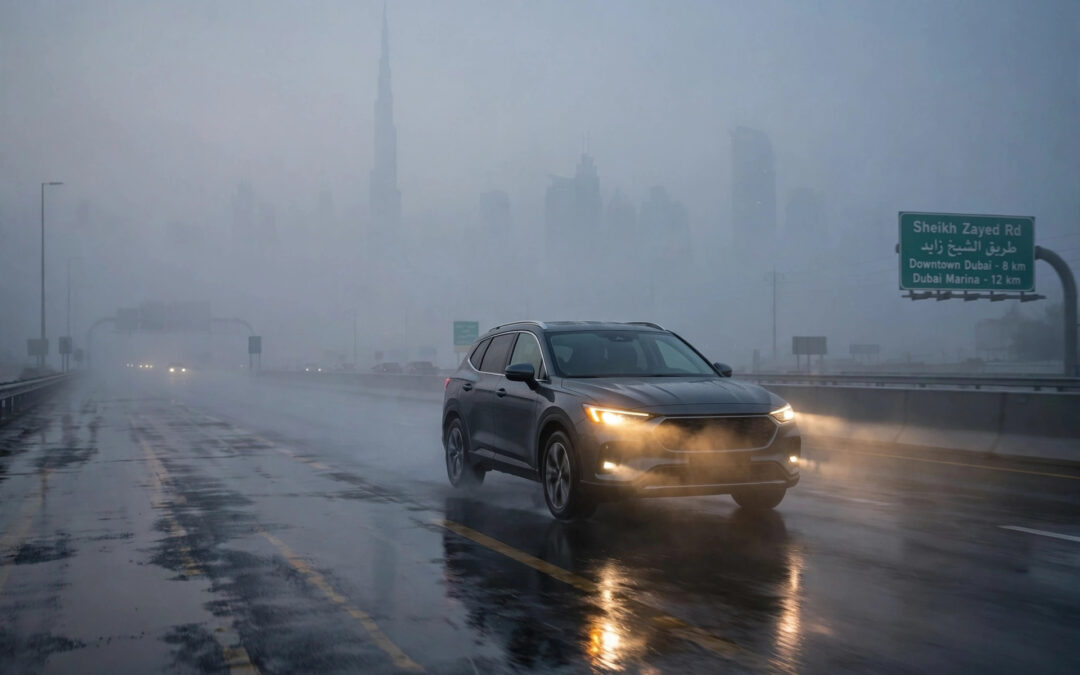
Fog in Dubai does not arrive the way rain does. There is no build-up, no darkening sky to warn you. One minute you are driving on a clear stretch of Emirates Road in the early morning, and the next the tail lights ahead of you have dissolved into a white wall and you cannot tell whether the road bends left or right. It is the most disorientating thing that can happen to a driver in the UAE, and it happens most often exactly when people are in a hurry — the school run, the first commute of the day, the drive to Abu Dhabi before the sun is properly up.
Most fog here forms between about 3 in the morning and 10 in the morning, and it is most common from November to May, with December and January usually the worst months. The National Centre of Meteorology issues yellow, orange and red alerts for it, and the police put out warnings on the same mornings. Yet every winter there are still pile-ups on the highways — sometimes involving dozens of cars — and almost every one of them starts with the same few mistakes: driving too fast for what can be seen, the wrong lights, and a lane change into a car nobody saw coming.
This guide is the practical version of the official advice. It follows what the RTA, Dubai Police and Abu Dhabi Police actually tell drivers, and it adds the part the official leaflets leave out — what to check on your car before a foggy morning, and what to do when the fog is so thick that driving on is no longer a sensible option.
The one rule to remember: low-beam headlights on, fog lights on if your car has them, high beams off, and hazard lights off while you are moving. Hazards are for a stopped car only. Getting the lights right is the single biggest thing you can do in fog — more important than any gadget, and it costs nothing.
1. Why Fog in the UAE Catches Good Drivers Out
Fog in the desert is not like fog in a cold country. It forms overnight when the ground cools quickly after a warm day and moisture in the air condenses close to the surface, and it often sits in patches. You can drive through a clear stretch, hit a bank of fog two hundred metres long, and come out the other side into clear road again. That patchiness is what makes it dangerous, because it invites the wrong reaction: drivers keep their speed up through the clear stretch and then brake hard when the wall of white appears.
Visibility inside thick fog can drop to a few car lengths. At 100 km/h you cover about 28 metres every second, so if you can only see 30 metres ahead, you have roughly one second between seeing an obstacle and reaching it. That is not enough time to react, let alone stop. The maths is the whole argument for slowing down, and it is why the police repeat the same advice every winter: your speed has to match what you can see, not what the sign on the road says. A posted limit is a maximum for normal conditions. In fog it is not a target.
There is a second problem that surprises people who have not driven in fog before. Everything looks slower than it is. Without buildings, trees or roadside objects passing by, your brain loses its sense of speed, and 80 km/h can feel like 50. Drivers who rely on feel instead of the speedometer drift faster than they realise. That is why the RTA’s safety guidance tells drivers to watch the speedometer constantly in fog and to reduce speed gradually rather than in one sharp movement. A sudden brake in fog is itself a hazard, because the driver behind you may not see your brake lights until they are very close.
The third factor is other drivers. In a pile-up, the first collision is often survivable and the second, third and fourth are what cause the serious injuries — cars arriving at speed into a crash they could not see. Keeping a bigger gap, staying in one lane and using the right lights are not just about your own car. They are about giving the driver behind you a chance as well.
2. Before You Leave: The Five-Minute Fog Check
The best time to deal with fog is before you are in it. If you are up early and the air outside your window looks milky, or your phone shows an NCM fog alert, take five minutes before you turn the key. It is a short routine, and it answers the one question that matters most on a foggy morning: should I drive at all, or can this trip wait an hour?
First, check the forecast and the alerts. The NCM app and the RTA and Dubai Police apps carry fog warnings, and the electronic signs on the highways show reduced speed limits when visibility drops. If the alert is red, or the police are advising drivers to stay off a particular road, take that seriously. An hour’s delay is a small price against a morning spent at the side of a highway. If the journey cannot wait, leave earlier than usual so you are never tempted to make up time in the fog.
Second, walk around the car and check the lights. Switch on the low beams and the fog lights and look at them from the front and the back. Fog lights are low, wide-beam lamps designed to light the road surface without throwing light up into the fog; many cars have them at the front and some have a rear fog light as well. If a bulb is out, you will not discover it by guessing. While you are there, check the brake lights — ask someone to press the pedal, or back up to a wall or a shop window at night and watch the reflection. Brake lights are how the driver behind you knows you are slowing down, and in fog they are often the first thing they see.
Third, check the windscreen inside and out. Fog outside the car and condensation inside it often arrive together. A dirty windscreen mists up faster and clears more slowly, so wipe the inside of the glass properly, not just the outside. Make sure the demister works and that you know how to turn it on without hunting through menus while driving. The air conditioning is part of this: running the AC with the demister clears the inside of the glass far faster than hot air alone, because it dries the air. If your AC is weak or the cabin filter is clogged, the glass will keep fogging up. Our guide to car AC repair in Dubai covers the symptoms that mean the system needs attention before winter, not during it.
Fourth, check the wipers. In fog the wipers are not for rain — they clear the fine film of moisture that settles on the glass, and they keep the screen clear enough for the demister to work. Wipers that smear or judder are worse than useless in fog because they leave streaks right in your line of sight. If they are more than a year old, or they have spent a summer baking on a hot windscreen, replace them before fog season rather than after the first bad morning.
Fifth, check the tyres and the fuel. Tyre pressure drops in the cooler winter mornings, and an under-inflated tyre grips less well on a damp road. The pressure stamped on the driver’s door jamb is the cold pressure — check it before driving, not after. And keep the tank at least half full in winter. If you do end up stopped at the side of the road in fog, you may be sitting there with the engine running for a while, and running out of fuel on a foggy highway is a problem you do not need. If you are unsure how to read the age and condition of your tyres, our guide to tyre repair services in Dubai explains the checks that matter most.
The fog-morning checklist: NCM/RTA alert checked — journey can wait or leave early — low beams, fog lights and brake lights all working — windscreen clean inside and out, demister working — wipers clearing properly — tyre pressure checked cold — fuel tank at least half full.
3. Lights: The Exact Setup, and the Two Mistakes Everyone Makes
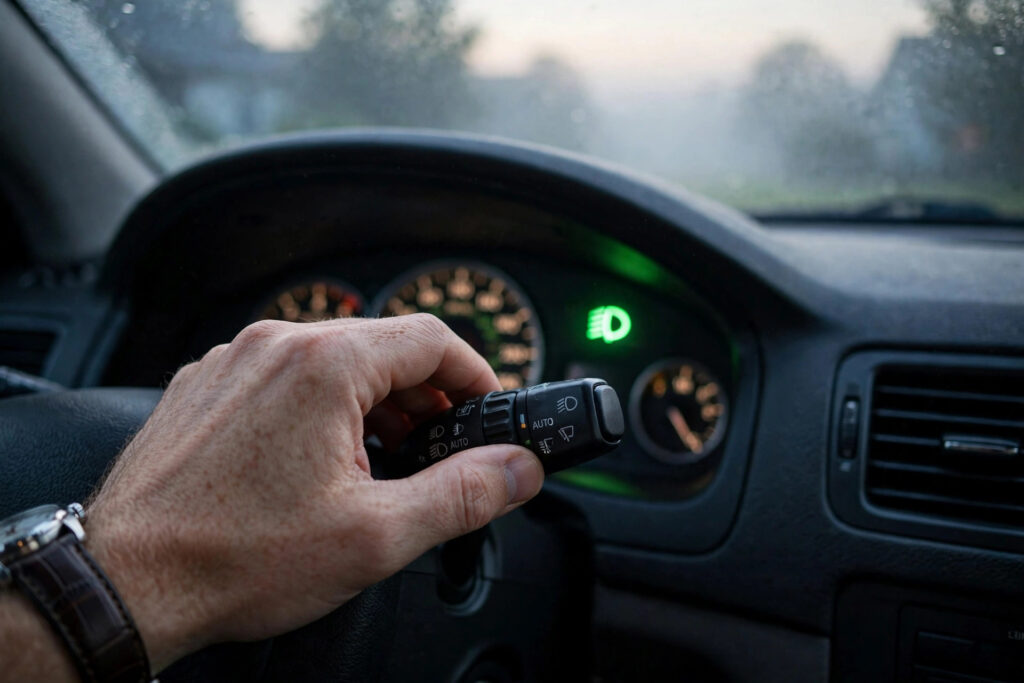
Lights in fog are not about seeing further. They are about being seen, and about lighting the road surface just in front of the car without creating a wall of glare. Once you understand that, the official rules make sense, and the two most common mistakes become obvious.
The correct setup is simple: low-beam headlights on, front fog lights on if you have them, rear fog light on if your car has one. Low beams point downwards and light the road surface. Fog lights sit even lower and throw a wide, flat beam that cuts under the fog rather than into it. Together they give you the best view you are going to get, and they make your car visible from behind, which matters more than most drivers realise — in fog, the car behind you is the one you need to worry about.
High beams are the first mistake. It feels natural to want more light when you cannot see, but high beams do the opposite of what you want. The light hits the tiny water droplets in the fog and bounces straight back at you, turning the air in front of the car into a glowing white wall. The RTA says this plainly in its safety guidance: do not use high beam headlights in fog, because the light is reflected and reduces visibility for you and for oncoming vehicles. Abu Dhabi Police say the same thing. If you have ever switched to high beam in fog and felt like you could see even less, that is why. Dip the lights and the road comes back.
Hazard lights while moving are the second mistake, and it is the one the police are most frustrated about. It feels like the safe, considerate thing to do — make yourself as visible as possible. In practice it does the opposite. With all four indicators flashing, other drivers cannot tell whether you are braking, stopping, or about to change lanes, because the indicators they rely on for that information are already flashing. A driver behind you sees a flashing car and has no idea what it is about to do. That is why hazard lights are reserved for a stopped or broken-down car, and why using them while driving in fog is an offence in the UAE, fined at AED 500 with four black points. When you have stopped safely off the road, that is the moment to switch them on.
There are two smaller points that still matter. First, keep the lights on even when the fog seems to be thinning. Fog lifts in patches, and a car with its lights off that drives back into a thick patch is invisible until it is too late. Second, if your car has automatic lights, do not assume they will switch on in fog. The sensor measures darkness, not fog, and a bright foggy morning can be light enough that the automatic system leaves the headlights off. Switch them on yourself.
4. Speed and Distance: Drive to What You Can See
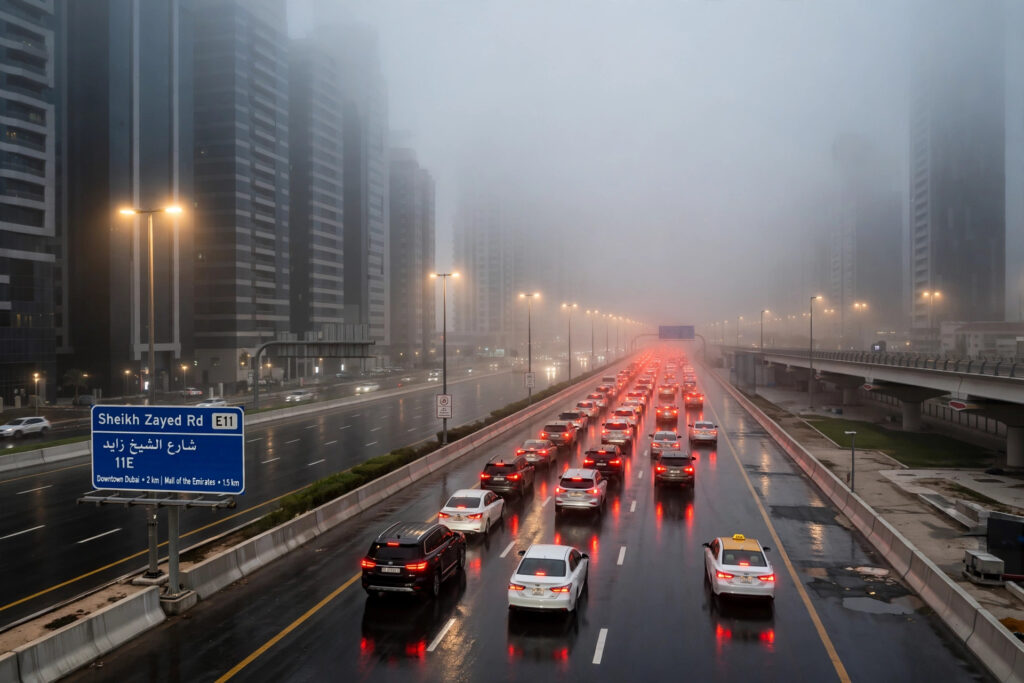
If the lights are the first rule of fog driving, speed is the second, and it is the one that saves lives when it is followed. The principle is straightforward: you must be able to stop within the distance you can see clearly. If you can see 50 metres, your stopping distance at your current speed has to be less than 50 metres. On a damp road in fog, with a second or two of reaction time, that means going far slower than you would like — and slower than the drivers around you may be going.
Slow down gradually, not suddenly. Lift off the accelerator early and let the car lose speed on its own before you touch the brake. The RTA guidance makes this point because it is a common cause of rear-end collisions in fog: a driver brakes hard at the edge of a fog bank, and the driver behind, who cannot see the brake lights until late, runs into the back of them. If you need to slow down a lot, tap the brakes gently a few times first so the brake lights warn the driver behind you before you actually lose much speed.
Watch the electronic signs and follow temporary limits. On the major highways the authorities can lower the speed limit when visibility drops, and the signs are there for exactly this situation. In Abu Dhabi, the police have reduced speed limits to 80 km/h on affected roads during fog since 2019, and the same approach is used on Dubai’s highways when conditions demand it. The number on the sign is a maximum for the conditions, not a safe speed in itself — if you can only see two car lengths ahead, even 80 km/h is too fast, and the right speed is whatever lets you stop in the distance you can see.
Double the gap you would normally leave, and then double it again if the road is wet as well. Fog and damp roads often arrive together, and a wet road needs a longer stopping distance. Pick a fixed point — a sign, a lamp post, a cat’s eye — and count the seconds between the car in front passing it and you passing it. In clear weather two seconds is the usual advice. In fog, aim for at least four or five, and more if the car in front is braking often. If someone pulls into the gap in front of you, do not close up behind them. Ease off and rebuild the gap.
Turn the cruise control off. Cruise control is designed for clear, steady motorway driving, and it is the wrong tool in fog. It keeps the speed constant when you should be adjusting it constantly, and it reacts a fraction later than your foot would when something appears ahead. In fog you want full control of the accelerator and the brake, and you want to feel the car through your hands and feet rather than letting a system hold it at a set speed. The same applies to lane-keeping and other driver aids: they are helpers, not replacements for looking at the road, and their cameras and sensors do not work well when they cannot see the lane markings either.
Finally, do not let the traffic around you set your speed. In fog there is always a driver who seems confident, who overtakes at speed and disappears into the white. Do not follow them. You do not know what they can see, and you do not know whether they are about to find the back of a slow-moving truck. Drive at your own speed, in your own lane, and let the impatient drivers go past if they insist on it. Your arrival time is not worth a place in a pile-up.
5. Staying in Your Lane: The Discipline That Prevents Pile-Ups
Most of the serious fog accidents on UAE highways are not single cars running off the road. They are chains of cars, each one running into the one in front, often after a lane change into a vehicle that was there all along but could not be seen. The way to avoid being part of one is almost boringly simple: pick a lane, stay in it, and do not overtake.
Use the right-hand lane on the highway when you can. The RTA’s fog guidance says to stay to the right of your lane to stay clear of oncoming traffic, and the same logic applies to choosing a lane: the right lane is the slowest lane, it keeps you away from faster traffic, and it puts you closest to the hard shoulder if you need to stop. The left lanes are where the speed is, and speed is the last thing you want in fog.
Follow the road markings, not the car in front. In thick fog the white lines and the cat’s eyes on the road surface are often the only reliable guide to where the road goes. Keep the line on your right or left in sight and steer by it. Do not follow the tail lights of the car ahead as your only guide — if that driver drifts, you will drift with them, and if they brake or turn, you will have no warning. And never use the centre of the road as a guide on a two-way road. In fog, oncoming traffic can appear with almost no warning.
Do not overtake, and change lanes only if you have to. Dubai Police repeat this in every fog warning they issue, and it is easy to see why: an overtaking manoeuvre in fog means moving into a lane you cannot see, at a higher speed, past a vehicle whose speed you can only guess. If you must change lanes, signal early and for longer than usual, check the mirrors twice, and move across slowly and smoothly so other drivers have time to react. If you are not sure the lane is clear, stay where you are.
Keep your attention on the road and nowhere else. Fog driving is tiring because it demands constant concentration with very little to look at, and that is exactly when the mind wanders — to the phone, to the radio, to the meeting you are late for. Put the phone away before you set off. If you need to check directions, do it before you leave, not while you are peering through a white windscreen. And if you feel your concentration slipping, that is a sign to pull over at the next safe place and take a break rather than to push on.
6. When the Fog Wins: Stopping Safely Instead of Driving On
There comes a point in genuinely thick fog where the right decision is not to drive more carefully. It is to stop. Knowing where that point is, and how to stop without creating a new hazard, is the most important skill in this whole guide.
The point to stop is when you cannot see far enough to drive at any useful speed — when you are crawling along at 20 km/h and still cannot see the road markings clearly, or when you cannot see the car in front of you until you are almost on top of it. At that point you are not really driving any more. You are guessing, and the longer you guess, the more likely it is that the guess is wrong. Pulling over is not giving up. It is the correct decision, and it is the one the police advise when fog becomes too dense to continue.
How you stop matters as much as the decision. Do not stop in a live lane, and do not stop on the hard shoulder of a busy highway if there is a safer option. The hard shoulder is where broken-down vehicles are hit, and in fog a stopped car on the shoulder is almost as dangerous as a stopped car in a lane. If there is a petrol station, a service area, a lay-by or an exit within a short distance, drive to it slowly and stop there. That is the safest place to wait.
If there is no safe place nearby and you must stop on the roadside, get as far off the carriageway as you possibly can, switch on the hazard lights — this is when they are meant to be used — and keep your seatbelt on. Turn off the headlights if you are parked behind a barrier or well away from traffic, so that other drivers do not mistake your lights for the road ahead and follow them into you. This sounds strange, but it is a real danger in fog: drivers follow lights. A parked car’s lights at the side of the road have drawn moving traffic towards them before.
Once you have stopped, call for help if you need it rather than trying to fix a problem at the side of a foggy highway. If your car has broken down, stay in the car with your seatbelt on if it is safe to do so, or move well away from the road behind a barrier if it is not. Do not stand behind the car, and do not try to change a tyre or check under the bonnet in fog — the road is still live, and the next driver may not see you. If anyone is in danger, call 999. For a breakdown with no injuries, a mobile mechanic can reach you at the roadside, and our team covers the whole of the UAE with a 15–20 minute response. The full breakdown procedure, including what to do in the first ten minutes after a car stops on a highway, is covered in our car repair and maintenance services pages, and our engine repair and diagnostics page explains what a mechanic checks first when a car will not run properly.
Never stop in a live lane. If the car breaks down and you cannot move it, switch the hazards on immediately, keep everyone in the car with seatbelts on, and call 999 if the car is in moving traffic. A car stopped in fog on a highway is one of the most dangerous places in the UAE — get help to you, do not try to solve it alone at the roadside.
7. Fog and Your Car: The Checks That Matter Before Winter
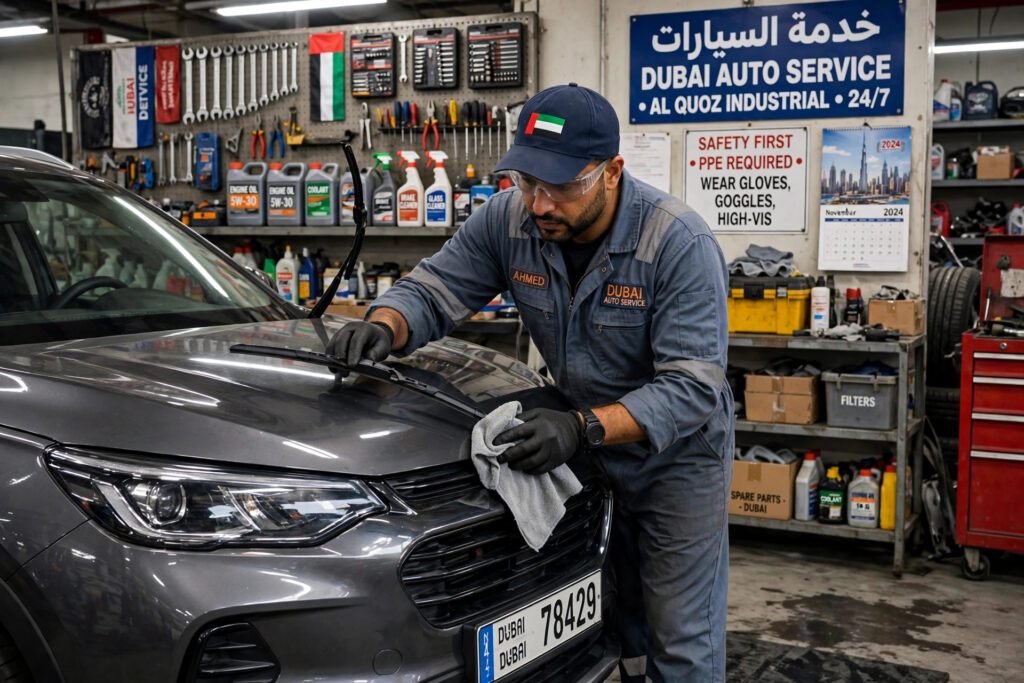
Fog season is also the season when small car problems announce themselves. The cooler mornings, the damp air and the extra load on the lights and demister expose weaknesses that the summer hid, and a few checks in November save a lot of trouble in January.
Headlights come first. A cloudy or yellowed headlight lens can cut the light output by a surprising amount, and in fog that lost light is the difference between seeing the road markings and not seeing them. If your headlights look dim or hazy even after a wash, the lenses need restoring or the bulbs need replacing. This is a winter job, not a summer one, because fog is when you need every bit of light you have. We will cover headlight restoration in detail in our 27 November article on cloudy, yellow or dim headlights.
The battery is next. Cold mornings are harder on batteries than hot afternoons, and a battery that was already weak after the summer often fails on the first cold, foggy morning of the year — usually when the driver is already late and the demister, lights and wipers are all drawing power at once. If the engine turns over slowly, or the lights dim when you start the car, have the battery tested before it strands you. Our guide to what to do when a car won’t start explains how to tell whether the battery, the alternator or the starter is at fault, so you replace the right part instead of guessing.
Then the cooling system, which is easy to forget in winter. Foggy mornings are cool, but a car that has a slow coolant leak will still overheat — it just takes longer, and it often happens in slow traffic after the fog has lifted. If the coolant level keeps dropping with no puddle underneath, that is a problem worth finding before it becomes a breakdown. Our guide to engine repair and diagnostics explains what a mechanic checks first when an engine is not running properly, and the extreme heat maintenance guide covers the cooling system checks that apply all year round, not just in summer. If the temperature gauge does climb, our guide to engine overheating in Dubai explains what to do immediately and what never to open hot.
Finally, the tyres. The tyre-age rule matters in winter because the RTA inspection checks tyre age and tread, and fog-season driving puts more demand on grip than a dry summer road. Old, hard rubber grips less well on a damp road, and a tyre that is close to the tread limit will aquaplane more easily if the fog leaves the road wet. Check the tread depth and the sidewalls for cracks, and know how old the tyres are — our 23 November article on reading the DOT code will show exactly where to find the age of a tyre and what the inspection limit means.
8. The Fines: What Fog Driving Can Cost You
The UAE does not treat fog driving as a matter of personal judgement. There are specific penalties, and they are enforced — the police step up patrols on the highways during fog, and the cameras and patrols are looking for exactly the behaviours described in this guide.
The fine most drivers are caught by is using hazard lights while driving. It carries a fine of AED 500 and four black points, and it is widely reported in the official guidance precisely because so many drivers believe they are being safe when they do it. The same level of fine applies to driving without lights in fog, though the exact published figure for that offence varies between sources, so it is worth checking the current schedule on the Dubai Police app rather than relying on a number in an article.
Dangerous driving in fog — speeding through thick fog, tailgating, or driving without taking the safety precautions the conditions demand — is treated far more seriously, with fines reported at up to AED 2,000, 23 black points and a 60-day vehicle impoundment. The precise figures change from time to time, and they are less important than the principle: in fog, the law expects you to slow down and leave space, and if you do not, the consequences are not a small fine but a serious one.
None of this is a reason to be frightened of driving in fog. It is a reason to drive the way the guidance describes: lights on, speed down, gap up, no overtaking, no hazards while moving. A driver who does those five things is not only safer, they are also on the right side of every rule that matters.
9. Frequently Asked Questions
When is fog season in Dubai?
Fog is most common from November to May, usually between about 3 in the morning and 10 in the morning, with December and January often the worst months. The National Centre of Meteorology issues colour-coded alerts — yellow, orange and red — and the worst mornings are usually the ones where the alert is already out before you wake up.
Should I use hazard lights in fog?
No — not while you are moving. Hazard lights are for a stopped or broken-down car only. Using them while driving is an offence in the UAE, fined at AED 500 with four black points, because they stop other drivers from knowing whether you are braking, stopping or changing lanes. Use low beams and fog lights while moving, and switch the hazards on only once you have stopped safely off the road.
Are high beams better in fog?
No. High beams reflect off the water droplets in the fog and create a wall of glare that makes it harder for you to see, and harder for oncoming drivers to see as well. The RTA and both Dubai and Abu Dhabi Police all give the same advice: low beams and fog lights, never high beams in fog.
What speed should I drive at in fog?
There is no single safe number. Drive at whatever speed lets you stop within the distance you can see clearly, and follow the temporary limits shown on the electronic signs — in Abu Dhabi the limit on affected roads is reduced to 80 km/h during fog. If you can only see a few car lengths ahead, even 80 km/h is too fast.
What should I do if my car breaks down in fog?
Get as far off the road as you can, switch the hazards on, keep your seatbelt on, and call for help rather than trying to fix it at the roadside. If the car is in live traffic and anyone is in danger, call 999. A mobile mechanic can come to you — 95 Services covers the complete UAE with a 15–20 minute response, 24 hours a day.
Can I delay my journey until the fog lifts?
Yes, and on a red-alert morning it is often the best decision you can make. Fog in the UAE usually lifts by late morning as the sun warms the ground. If the trip can wait an hour or two, waiting is safer than driving through the thickest part of it, and it costs you far less than a collision.
Driving in Fog in Dubai? We Come to You
Fog season is when breakdowns are most stressful — early in the morning, on a busy road, with visibility too poor to work safely at the roadside on your own. That is exactly the situation our mobile service is built for. We cover the complete UAE, our response time is 15–20 minutes, and we are available 24 hours a day.
If your car breaks down in fog, or it will not start on a cold, foggy morning, call or WhatsApp us on +971 54 344 3513. Tell us where you are and what the car is doing, and we will come to you. Our prices are very low, and we will tell you honestly what the problem is before any work starts.
Before your next foggy morning, take five minutes to check the lights, the wipers and the windscreen — and check the NCM alert before you leave. A little preparation is worth more than any amount of careful driving once you are already inside the fog.
