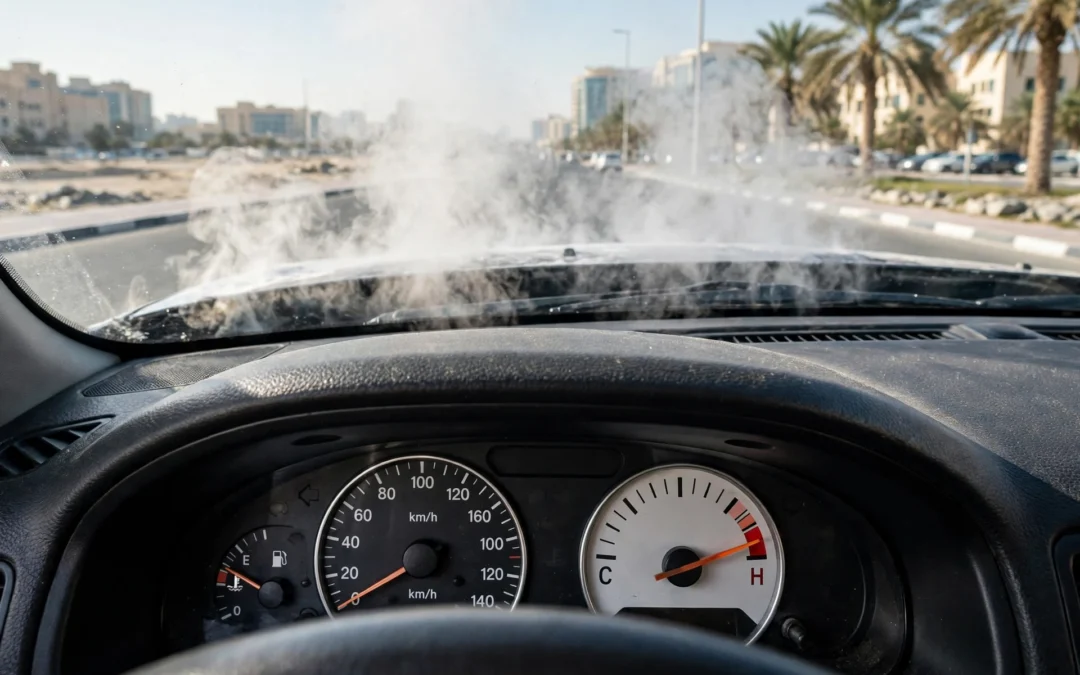
There is a particular kind of quiet that falls inside a car in Dubai when the temperature needle climbs past the middle and keeps going. The air conditioning is still blowing, the traffic on Sheikh Zayed Road is still moving, and then the little red thermometer lights up on the dashboard — or worse, a warning message tells you the engine is overheating. Your first thought is usually the same as everyone else’s: can I make it to the next exit?
The honest answer is that you should not try. An overheating engine is one of the few car problems where a few more minutes of driving can turn a simple repair into a very expensive one. A car that only needed a hose or a thermostat can end up needing a cylinder head if it is driven hot for long enough. The difference between those two outcomes is usually decided in the first two minutes after the warning appears — by what the driver does, and just as importantly, by what the driver does not do.
This guide covers exactly that. What to do the moment the gauge hits red, what never to open or pour while the engine is hot, the checks you can safely make once it has cooled, and the causes a mechanic will look for first. It is written for Dubai driving — slow traffic with the air conditioning running flat out, desert roads, and the climb up towards Hatta — because that is where overheating shows up most.
The one rule to remember: if the gauge is in the red or the overheating warning is on, pull over safely and switch the engine off. Never open the radiator cap or the coolant reservoir cap while the engine is hot. The cooling system is pressurised, and hot coolant can spray out and cause serious burns.
1. What the Temperature Gauge Is Actually Telling You
Most cars have a temperature gauge with a cold mark on one side and a red zone on the other. In normal driving it sits somewhere near the middle and barely moves. That middle position means the coolant is carrying heat away from the engine about as fast as the engine is making it, which is how the system is supposed to work.
When the needle starts climbing above the middle, something in that balance has changed. Either the engine is making more heat than usual — a long climb, a heavy load, slow traffic with the air conditioning on — or the cooling system is no longer removing heat as well as it should. A needle that creeps up slowly in traffic and drops again when you pick up speed is often an airflow or fan problem. A needle that shoots up quickly, or that goes straight into the red within a few minutes of starting, usually means coolant is missing or not circulating at all. Both are worth taking seriously, but the second one is the more urgent of the two.
Some newer cars have no gauge at all, only a blue light when the engine is cold and a red warning when it is too hot. If you drive one of those, the red light is your gauge — when it comes on, treat it the same way you would treat a needle buried in the red. A few cars will also cut the air conditioning or limit engine power on their own when they get too hot. That is the car protecting itself, and it is a sign to pull over rather than a reason to keep going.
It is worth knowing what normal looks like on your own car before anything goes wrong. Glance at the gauge on a normal drive and remember where it usually sits. Then, on a hot day or a long climb, you will notice a change early instead of only noticing it when the warning light comes on. Catching it at three-quarters is a much better position than catching it in the red.
2. What to Do Immediately When the Gauge Hits Red
Stay calm and do the steps in order. They take less than a minute, and they matter in this sequence.
Turn the air conditioning off and turn the heater on full. This sounds backwards on a hot Dubai afternoon, but the heater draws heat out of the engine coolant and into the cabin, which genuinely helps bring the temperature down. Open the windows, point the vents away from you, and put the fan on its highest setting. It will be uncomfortable for a few minutes. It is worth it.
Pull over somewhere safe as soon as you can. Look for a hard shoulder, a service road, a petrol station forecourt, or a parking bay — somewhere flat, away from moving traffic, where you can open the bonnet without standing next to fast cars. Put your hazard lights on. If you are on a motorway, do not stop in a live lane, and do not walk across traffic to look at the engine. Getting the car somewhere safe comes before everything else.
Switch the engine off. Once you are stopped safely, turn the engine off. A running engine keeps making heat; a stopped one starts cooling down. Do not rev the engine to try to cool it, and do not leave it idling in the hope that the temperature will fall on its own. With the engine off, the temperature will drop much faster.
Wait, and keep everyone away from the bonnet. Give the engine at least 30 minutes before you even think about touching anything under the bonnet — longer on a hot day. The gauge on the dashboard will fall as it cools, but the coolant inside the hoses and the radiator stays dangerously hot for a long time after the needle drops. While you wait, call for help if you need it. If you are a 95 Services customer, that is what our mobile team is for — we come to you anywhere in the UAE, usually within 15 to 20 minutes, day or night, and a call or WhatsApp to +971 54 344 3513 is enough to get a mechanic on the way.
Look, do not touch. Once the engine has had time to cool, you can look under the car for a puddle and glance at the coolant reservoir from a distance. Green, pink, orange or blue liquid under the car is coolant, and it means something has leaked. Steam coming from under the bonnet means the system has boiled over. Both are useful things to tell the mechanic when you call. What you should not do is touch hoses, open caps, or try to top anything up while anything is still hot.
A note on steam: if steam is pouring from under the bonnet, do not open it straight away. Stand back, let the steam clear, and give it time. Steam can burn just as badly as liquid, and opening the bonnet into a cloud of it is how people get hurt. The engine is not going anywhere. Wait for it.
3. What Never to Do With a Hot Engine
Most of the injuries and most of the extra damage in overheating breakdowns come from the same handful of mistakes. They are all understandable in the moment, and they are all worth knowing in advance so you do not make them under stress.
Never open the radiator cap or coolant reservoir cap while the engine is hot. This is the big one. A cooling system runs under pressure, and that pressure keeps coolant liquid at temperatures well above boiling point. Open the cap while it is hot and that pressure escapes in an instant — the coolant can boil violently and spray out. People have suffered serious burns to their hands, arms and face this way. Even the reservoir cap on a car with a separate expansion tank can be dangerous. Wait until the engine is properly cool, and squeeze the top hose gently first: if it feels hard and pressurised, or hot to the touch, leave the cap alone.
Never pour cold water into a hot radiator. Pouring cold water into an overheated engine can crack a cylinder head or an engine block as the metal contracts suddenly. It is one of the fastest ways to turn a repairable problem into a ruined engine. If the engine has cooled down properly, topping up the coolant reservoir with the right coolant is fine — but cold water into a hot engine is not a rescue, it is a risk.
Never keep driving to reach the next exit, the next petrol station, or home. Five more minutes of driving with the gauge in the red can warp a cylinder head. Ten more minutes can seize an engine. The cost of a tow or a mobile mechanic call-out is small next to the cost of an engine rebuild, and in Dubai a mobile mechanic can usually reach you in 15 to 20 minutes anyway. If the gauge is in the red, the car has already told you it cannot make the trip.
Never ignore a small leak because the car “only overheats sometimes”. A car that overheats only in slow traffic, only with the air conditioning on, or only on long climbs still has a fault. It is just a fault that only shows under load. It will get worse, and it will eventually show itself at the worst possible moment — usually on a Friday evening, a long drive, or a day when you are already late. A cooling system that works properly does not overheat in any of those situations.
Never top up with plain water and then forget about it. In an emergency, once the engine is cool, clean water in the reservoir can get you to a workshop. But coolant is not just water — it raises the boiling point, stops the system from freezing and corroding, and protects the water pump. Driving for weeks on plain water in a Dubai summer is asking for the problem to come back. Use it to get moving, then get the system checked and refilled with the right coolant as soon as you can.
4. Once It Has Cooled: The Checks You Can Safely Make
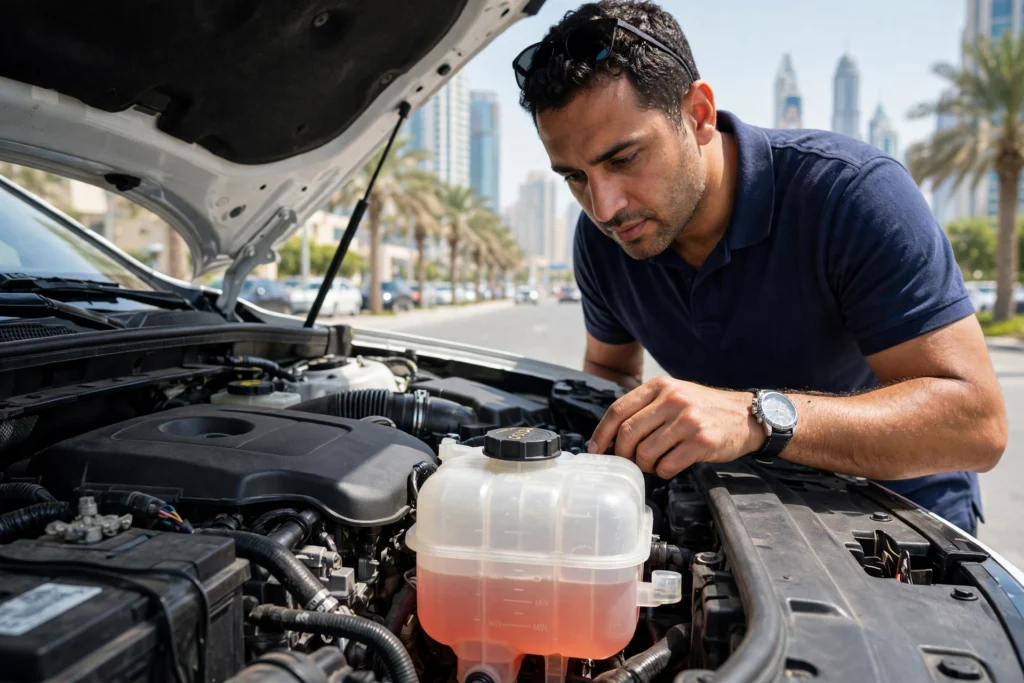
After at least 30 to 45 minutes, with the engine cool to the touch and the top hose soft rather than hard, there are a few checks you can make without any tools. They will not fix the car, but they will tell you — and the mechanic you call — a lot about what has gone wrong.
Check the coolant level in the reservoir. The reservoir is the plastic tank with minimum and maximum marks on the side, usually near the radiator. If the level is well below the minimum mark, or the tank is empty, the system has lost coolant somewhere. Look underneath the car for a puddle, and look at the hoses for a wet patch or a white, crusty stain where coolant has dried. A puddle under the middle of the car that is coloured — green, pink, orange or blue — is coolant. A puddle of clear water under the car on a hot day, near the front passenger side, is usually just condensation from the air conditioning, and that is normal.
Look at the radiator and the hoses. A hose that has swollen, split, or come loose at its clamp is easy to spot once you know to look. A radiator with bent fins, a damp patch along its bottom edge, or a visible stain is likely leaking. Do not squeeze hot hoses; do not pull at anything. You are only looking.
Check the oil dipstick. Pull it out, wipe it, push it back in and pull it out again. The oil should look like oil — dark amber or brown, and fluid. If it looks milky, like coffee with too much milk, that is a warning sign: coolant may be mixing with the oil, which can mean a head gasket problem. That is a workshop job, not a roadside top-up, and the car should not be driven. Tell the mechanic what you saw.
Look at the drive belt. The belt that runs the water pump — often the same belt that runs the alternator and the air conditioning compressor — should be intact and tight. A snapped belt stops the water pump, and without the pump the coolant does not circulate, so the engine overheats quickly. A belt that has shredded will usually be visible hanging or missing altogether. If the belt is gone, do not drive the car.
Start it only if it is fully cool and the coolant is topped up. If you have found nothing alarming, the coolant level looks right and the engine is properly cool, you can try starting it and watching the gauge for a minute or two. If the needle climbs again quickly, switch it off and call for help. If it sits normally, drive gently and slowly towards the nearest workshop with the heater on and the air conditioning off, watching the gauge the whole way — and be ready to pull over again. This is a short, careful trip to a workshop, not a decision that the car is fixed.
Everything above is about gathering information, not about repairing the car at the roadside. Cooling system faults are rarely fixed by topping up a bottle and carrying on. The leak, the stuck thermostat or the failed fan is still there, and the car will overheat again — usually further from help than the first time. If you are unsure about anything you have seen, that is exactly the situation a mobile mechanic is for. Our team carries coolant, pressure testers and the common hoses and caps, and we can test the system where the car is standing rather than guessing from a description over the phone. Call or WhatsApp +971 54 344 3513 and tell us what the gauge did, what you saw underneath, and where you are — anywhere in the UAE, day or night.
5. The Causes to Check First
When a mechanic looks at an overheating car, they work through the same short list of suspects in roughly the same order, because these causes account for the great majority of overheating breakdowns. Knowing the list helps you understand what the mechanic is doing, and what the repair is likely to involve.
Coolant loss — a leak somewhere in the system. This is the most common cause of all. Coolant escapes through a split hose, a worn hose clamp, a leaking radiator, a failing water pump seal, or a heater hose at the back of the engine. Sometimes the leak is obvious — a puddle, a hissing sound, a smell of sweet coolant. Sometimes it is slow and invisible, losing a little coolant on every drive until one day the level is low enough for the temperature to climb. A pressure test is the proper way to find it: the system is pressurised with a hand pump, and the leak shows itself as a drip or a hiss. If your car needs topping up more than once, there is a leak, and it needs finding rather than refilling.
A thermostat stuck closed. The thermostat is a small valve that opens to let coolant flow to the radiator once the engine is warm. When it sticks closed, the coolant stays trapped around the engine and never reaches the radiator to cool down, so the temperature climbs fast — often within a few minutes of starting. A thermostat that sticks open causes the opposite problem: the engine takes forever to warm up. The stuck-closed version is the one that strands people, and it is a common failure on older cars. It is also a relatively quick repair for a mechanic with the part in hand.
A radiator fan that is not running. At motorway speed, air flows through the radiator on its own. In slow traffic — the Dubai afternoon crawl, a car park, a queue at a mall — the electric fan has to do that job. If the fan motor, its fuse, its relay or its temperature sensor has failed, the car will be fine at speed and will overheat the moment traffic slows down. That pattern — fine on the motorway, hot in traffic — is the classic fan fault, and it is one of the first things a mechanic checks. You can check it yourself in a limited way: with the engine warm and the air conditioning on, the fan should be spinning. If it is silent in slow traffic while the temperature climbs, the fan circuit is a strong suspect. Do not put your hands near the fan to check it — it can start without warning.
A failing water pump. The water pump pushes coolant around the engine. When its impeller wears down or its bearing fails, the coolant moves too slowly, and the engine runs hotter and hotter, especially under load. A failing pump often gives warning first: a whining or grinding noise from the front of the engine, a leak from the small weep hole underneath the pump, or a wobble in the pulley. Ignore those signs for long enough and the pump stops moving coolant altogether.
A blocked or damaged radiator. A radiator full of scale inside, or with its fins blocked by dust and sand outside, cannot shed heat properly. The engine then runs hot at exactly the times it needs cooling most. This is covered in more detail in the Dubai section below, because it is a bigger factor here than in most places.
A head gasket failure. This is the serious one, and the reason for the rule about never driving a hot engine. The head gasket seals the cylinder head to the engine block. If it fails, exhaust gas can push into the cooling system — which forces coolant out and makes the engine overheat — or coolant can leak into the cylinders and the oil. The warning signs are white smoke from the exhaust that smells sweet, bubbles in the coolant reservoir with the engine running, coolant disappearing with no visible leak, and the milky oil on the dipstick mentioned above. A head gasket repair is a major workshop job, and it is exactly what the early steps in this guide are trying to prevent. If you see those signs, do not drive the car.
Low engine oil. Oil does more than lubricate — it carries heat away from the engine’s moving parts. An engine that is very low on oil runs hotter, and in extreme cases the extra friction alone can push the temperature up. It is not the most common cause of overheating, but it is the easiest to rule out, and a mechanic will check the oil level as a matter of course. If your car is due a service, or you have not checked the oil in a while, this is a good moment to start. Our car repair and maintenance service covers routine checks like this, and the engine repair and diagnostics page explains what a proper engine check looks like when something is wrong.
6. Why Overheating Shows Up More in Dubai
Overheating can happen anywhere, but Dubai driving adds three factors that make it more likely, and they are worth knowing about before a long drive rather than during one.
The air conditioning is always working hard. In slow traffic, the engine is doing two jobs at once: moving the car and running the air conditioning compressor at full load. The compressor adds heat to the engine bay and puts extra load on the engine, while the slow speed means almost no air is flowing through the radiator on its own. That is why so many overheating breakdowns in Dubai happen in traffic rather than on the open road — and why the fan matters so much here. If your car only overheats in slow traffic, the fan is the first thing to suspect.
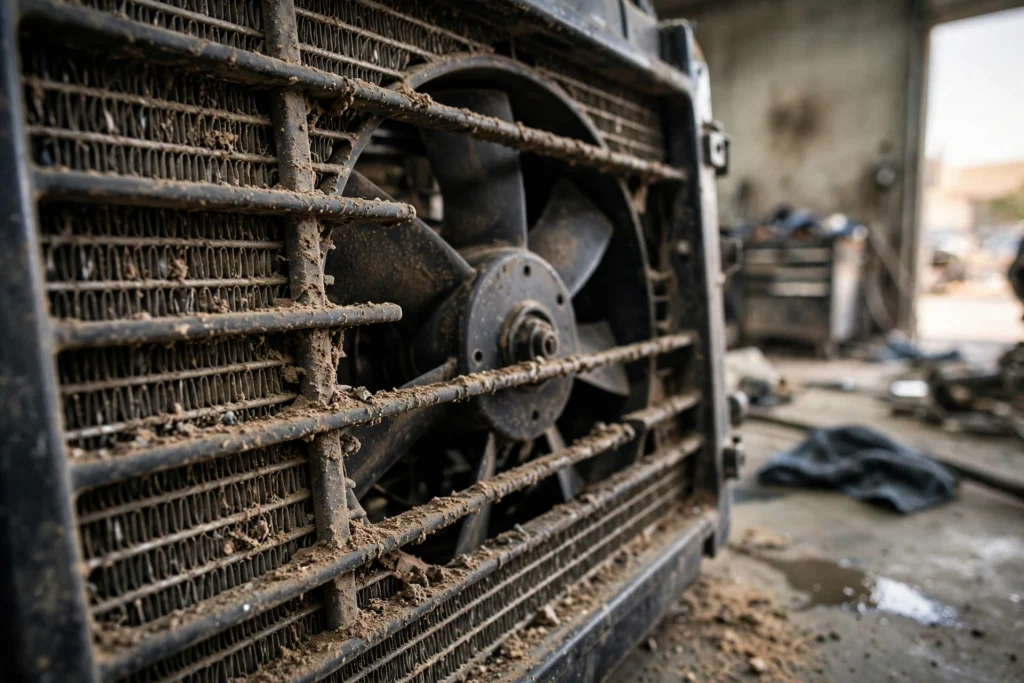
Sand and dust block the radiator. Desert dust and fine sand get drawn into the radiator fins, and over time they form a layer that insulates the radiator and stops air passing through it properly. It builds up slowly, so the car gets gradually worse rather than failing all at once — the temperature creeps a little higher each summer until one hot afternoon is too much. A radiator that looks clean from the front can be blocked from behind. A mechanic cleaning the radiator fins as part of a service is a small job that prevents a big one, and it is one of the things covered in our extreme heat maintenance guide, which also covers battery, tyre and air conditioning checks for hot-weather driving.
Mountain roads and desert driving push the engine hardest. The climb towards Hatta, a long stretch of soft sand, or a fully loaded car on a desert road all ask the engine to work much harder than a city commute does. More work means more heat, and if the cooling system is already weakened — a thermostat that is slow to open, a radiator that is partly blocked, coolant that is old and tired — that is the moment it shows. Before a trip into the mountains or the desert, the coolant level and condition, the fan, and the hoses are worth a five-minute check. If you would rather have a professional look, a pre-trip check takes far less time than a recovery from the side of a mountain road.
Old coolant loses its protection. Coolant does not last forever. Over time it loses its anti-corrosion additives, and the inside of the system starts to scale and corrode. That scale narrows passages and coats the radiator from the inside, which is why manufacturers give a replacement interval for coolant just as they do for oil. If your car’s coolant has not been changed in years, a coolant flush and refill is cheap insurance. It is also something a mechanic will recommend after any overheating repair, because the old coolant may be part of the reason the system failed.
7. Roadside Fix or Workshop Job?
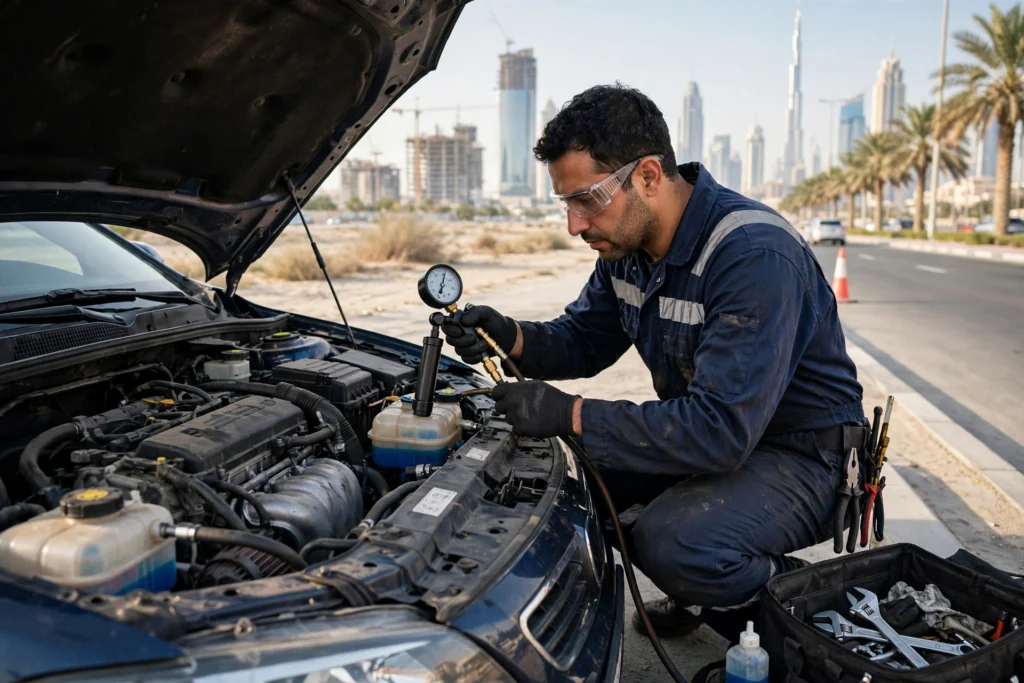
Not every overheating breakdown needs a tow, but knowing which ones do saves a lot of trouble. A rough guide: if the engine cooled down normally, the coolant level was only slightly low, there is no visible leak, no milky oil and no steam, and the car holds a normal temperature on a short gentle drive, a careful trip to a workshop is reasonable — with the gauge watched the whole way and the heater on. If the car overheats again within a few minutes, stop and call for help rather than pushing on.
A mobile mechanic at the roadside can do more than most drivers expect: top up and pressure-test the cooling system, replace a split hose or a failed cap, test the fan, check the thermostat, and read the fault codes. What a mobile mechanic cannot do at the roadside is a head gasket repair, a radiator replacement on some models, or a water pump that needs the timing belt removed. In those cases the honest answer is a tow to the workshop, and a good mobile mechanic will say so rather than attempting a repair that will not hold.
If the car has overheated badly — steam, a smell of burning, the gauge buried in the red for several minutes — do not try to drive it at all, even to a nearby workshop. Get it recovered. The risk is a warped head or a seized engine, and the cost of that is many times the cost of a recovery. If you need help deciding, call us and describe what happened: the gauge, the steam, the puddle, the noise. A short call is free, and it can be the difference between a repair and a rebuild. We cover the complete UAE, 24 hours a day, and our prices are very low — call or WhatsApp +971 54 344 3513.
8. Preventing the Next Overheating Breakdown
Cooling system failures rarely arrive without warning. They arrive after months of small signs that were easy to miss: a coolant level that needs topping up a little too often, a temperature needle that sits a fraction higher than it used to, a faint sweet smell after a drive, a damp patch under the car that dries before you look at it twice. The prevention is mostly about paying attention to those signs early, and about a few habits that cost nothing.
Check the coolant level once a month, when the engine is cold. It takes thirty seconds, and it is the single most useful check on this list. If it is dropping, find out why instead of topping it up and forgetting it. Look at the hoses when you check the oil — a hose that is soft, swollen, cracked or weeping at its clamp is a hose that will fail, and it is far better to replace it in a workshop than on the hard shoulder. Get the coolant changed at the interval in your car’s manual, not when something goes wrong. And before a long drive — to Abu Dhabi, to Hatta, into the desert — do the full five-minute check: coolant level, oil level, belt condition, fan running with the air conditioning on, and a look under the car for any fresh puddle.
There is a useful overlap with the checks in our other guides. A car that will not start on a hot morning and a car that overheats in the afternoon are often suffering from the same neglect — a battery and a cooling system that have both gone too long without attention. If you have not read it, our car won’t start guide explains how to tell battery, alternator and starter faults apart before replacing anything. And if your car is coming up to its RTA test, remember that cooling problems can show up there too — our RTA inspection checklist covers the pre-checks that help a car pass first time, including the coolant and leak checks that inspectors look at.
9. Frequently Asked Questions
Can I drive a short distance with the gauge in the red?
It is not worth the risk. Even a short drive with the gauge in the red can warp the cylinder head. Pull over, switch off, and call for help.
How long should I wait before opening the coolant cap?
At least 30 minutes, and longer on a hot day. The engine should be cool to the touch and the top hose soft, not hard and pressurised. If you are unsure, leave the cap alone and let a mechanic open it.
My car only overheats with the air conditioning on. What does that mean?
Usually a fan problem or a partly blocked radiator — the extra load of the compressor and the lack of airflow at low speed expose a cooling system that is already weak. Get the fan and the radiator checked.
Is it safe to top up with water instead of coolant?
Once the engine is fully cool, clean water will get you to a workshop in an emergency. But it is a temporary measure: coolant raises the boiling point and protects against corrosion, and the system should be refilled with the correct coolant as soon as possible.
The gauge went into the red once and then went back to normal. Is the car fine now?
Not necessarily. A one-off overheat usually means something is starting to fail — a thermostat sticking, a fan cutting out, a slow leak. Get the system checked before the next long drive, not after the next breakdown.
How much does an overheating repair cost?
It depends entirely on the cause: a hose or a cap is a small job, a thermostat or a fan is a moderate one, and a head gasket is a major repair. That is why catching it early matters so much. We keep our prices very low and we will tell you the cause and the cost before we start work — call or WhatsApp +971 54 344 3513 for a quote.
Overheating in Dubai? We Come to You
An overheating engine does not wait for a convenient moment, so neither do we. 95 Services is a mobile car repair service across the complete UAE — Dubai, Abu Dhabi, Sharjah, Ajman, Ras Al Khaimah, Fujairah and Umm Al Quwain. Our mechanics come to where your car is, usually within 15 to 20 minutes, 24 hours a day, with coolant, pressure testers and the common cooling system parts on board. We find the cause, explain it plainly, and fix it at a very low price.
If your temperature gauge is climbing right now, pull over safely, switch the engine off, and call or WhatsApp +971 54 344 3513. Tell us what the gauge did and what you can see, and we will be on our way.
