Your tyres can look perfectly fine and still be illegal. The tread can be deep, the sidewalls can look clean, the car can drive straight and quiet — and the RTA test can still fail you on the spot. The reason is printed on the sidewall of every tyre in the country, in four small digits most drivers have never looked at: the DOT date code. In the UAE, a tyre’s life is counted from the day it was made in the factory, not the day it was fitted to your car, and the limit is five years.
That surprises a lot of people, because in most other countries a tyre is judged mainly by its tread. Here the heat changes the calculation. A tyre sitting on 60-degree asphalt through a Dubai summer ages from the inside out. The rubber hardens, tiny cracks spread through the sidewall, and the bond between the rubber and the steel belts underneath weakens — all while the tread on top can still look almost new. A five-year-old tyre with deep tread is not a bargain. It is a tyre that has already had its full life.
This guide shows you how to read the date on your own tyres in about thirty seconds, what the RTA actually checks, how to measure your tread without any tools, what the TPMS light on your dashboard is really telling you, and what to check before you pay for a new set — including the one check that stops a shop fitting you a “new” tyre that is already two years old.
The one rule to remember: a passenger-car tyre in the UAE must not be more than five years old from its date of manufacture — the date stamped in the DOT code on the sidewall. Tread depth does not override the age limit, and the clock starts at the factory, not on the day the tyre was fitted.
1. How to Read the DOT Code on Your Tyre
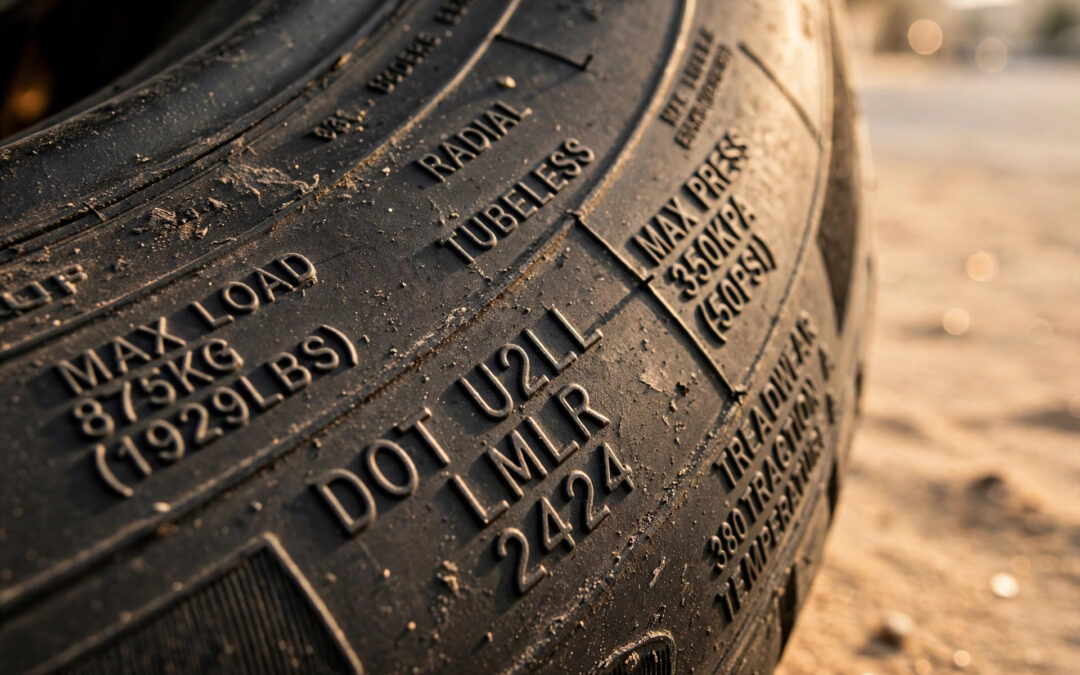
Every tyre sold anywhere in the world carries a DOT code — DOT stands for Department of Transportation, the American authority that started the system, and the code is now used globally. You will find it moulded into the sidewall, usually near the rim, in a string of letters and numbers that starts with the letters DOT. The date is the last four digits of that string, often sitting inside a small oval on their own.
The four digits work like this. The first two are the week of the year the tyre was made, from 01 to 52. The last two are the year. So a code ending in 2423 means the tyre was made in week 24 of 2023 — roughly the middle of June 2023. A code ending in 0525 means week 5 of 2025, early February 2025. A code ending in 3521 means week 35 of 2021, late August 2021 — and in November 2026 that tyre is already more than five years old and needs to come off, however good it looks.
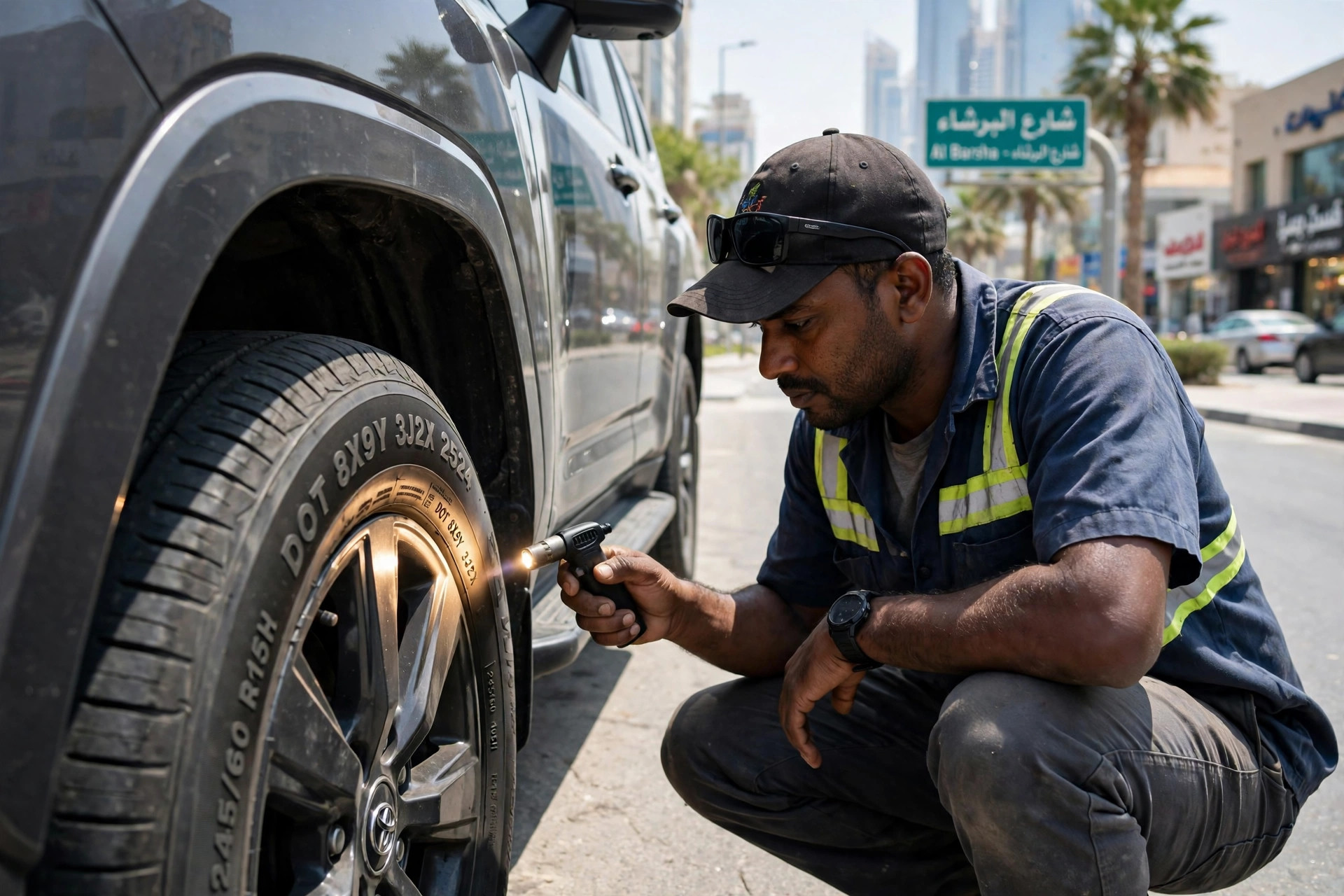
Three practical points that catch people out. First, the date code is sometimes only stamped on one side of the tyre, so if you cannot see it on the outside, look at the inner sidewall with a torch — or turn the steering to full lock and look at the front tyres from the front. Second, check all four tyres and the spare, because they are very often different ages. It is common to find three tyres from one year and one older replacement, or a spare that has sat untouched in the boot for six years and is expired before it has ever touched the road. Third, the date is the manufacturing date, not the purchase date. A tyre bought “new” in 2026 but made in 2023 has already used up three of its five years in a warehouse. That is why the check before fitting matters so much — see section 7.
Do the maths the simple way: add five years to the DOT date. A tyre made in week 24 of 2023 expires in week 24 of 2028. A tyre made in week 35 of 2021 expired in week 35 of 2026 — if you are reading this in late 2026, that tyre is already over the limit. If any of your tyres is within a few months of its fifth birthday, start planning the replacement now rather than waiting for the RTA test to catch it, because a fail means a second trip, a re-test, and a renewal that cannot be finished until the tyres are changed.
2. The UAE 5-Year Rule and the RTA Test
The RTA has stated publicly that a vehicle will not pass the technical test if its tyres are expired — that is, their lifespan has exceeded five years from the date of manufacture. The same test also fails tyres that are seriously worn out or have cuts, and it treats certain types, such as mountain and snow tyres, as not fit for use on public roads. Inspectors check the DOT code, so tread depth alone will not save an old tyre. A tyre with 7 mm of tread and a 2020 date code fails; a tyre with legal tread and a 2024 date code passes, as long as it is not damaged.
This is not a rule that exists only on paper. The RTA has run field inspection campaigns checking tyres on Dubai roads, and tyre condition is part of the annual technical test every car over three years old must pass before its registration can be renewed. A fail on tyres blocks the renewal until the tyres are replaced and the car is re-tested. That is the expensive version of the lesson: the cheap version is a thirty-second check in your own parking space, months before the test is due. Our RTA inspection checklist covers the full pre-test routine, including tyres, so a tyre fail does not catch you by surprise.
It is worth understanding why the limit is five years here when tyre makers in cooler countries sometimes talk about six or even ten years. The answer is heat and sunlight. Rubber ages through oxidation — oxygen and heat slowly hardening the compound — and a tyre in the UAE spends its life on hot asphalt, parked in direct sun, with summer road temperatures far above anything a tyre sees in Europe. The process is invisible from the outside for a long time, which is exactly why the rule is based on a date rather than on how the tyre looks. You cannot see hardened rubber, and you cannot see a weakening bond between the rubber and the steel belts. You can only see the date.
One thing the five-year rule is not: a promise that every tyre stays safe for five years. Age is the maximum, not a guarantee. A tyre can become unsafe well before its fifth birthday if it is worn, cut, cracked, bulging, or has been run under-inflated — and all of those fail the test too. The rest of this guide covers those checks, because the date code is only the first of them.
3. Why UAE Heat Ages Tyres Faster Than Mileage Does
Most drivers think about tyres in kilometres: how far they have driven. In the UAE, time matters at least as much as distance, and for a low-mileage car time matters more. A car that does 25,000 km a year will wear its tyres out through use in roughly two years. But a second car that does 5,000 km a year — the school-run car, the weekend car — can have tyres that look almost new after four years and are already on their way to being unsafe. The tread is barely worn, yet the rubber has spent four summers baking. That is the car most likely to fail on age, because nobody thought to check a tyre that still looks good.
Heat does three things to a tyre. It hardens the rubber compound, so the tyre grips less and rides harder. It dries out the sidewall, which is where you will eventually see fine cracks — sometimes called weather checking — spreading like a map of tiny lines. And it weakens the internal structure, the layers of rubber and steel cord that hold the tyre together under pressure. A tyre that has hardened and cracked is more likely to fail suddenly, and a sudden failure at highway speed is the outcome every other check in this guide exists to prevent.
Parking matters too. A car parked in the sun all day, every day, ages its tyres faster than one parked in shaded or underground parking, and the side facing the sun ages fastest of all. That is another reason to check all four tyres rather than assuming they are the same age and condition: the two on the sunny side of a parked car can be noticeably worse than the two in the shade. None of this needs special equipment to spot. It needs a minute, a torch, and knowing what to look for — which is the next two sections.
4. Tread Depth: The 1.6 mm Legal Minimum and the Coin Test
Alongside age, the second number that decides whether your tyre passes is tread depth. The legal minimum in the UAE for passenger cars is 1.6 mm of tread, measured across the central part of the tyre. Below that, the tyre is illegal, and driving on it is treated as driving on an unfit tyre. But 1.6 mm is the legal floor, not a sensible target. Grip in the wet falls away sharply as tread wears down, and on a rainy Dubai day — rare, but when it comes it is sudden and the roads are slick with months of oil and dust — the difference between 1.6 mm and 3 mm of tread is the difference between stopping and sliding.
Most tyre professionals advise replacing at around 3 mm, and that is the number to plan around. If your tread is at 3 mm and your RTA test is six months away, you will very likely be below it by the time the test comes, so changing the tyres now is cheaper than a fail and a re-test later. The age rule and the tread rule also work together: a tyre that is four years old with 3 mm of tread is a tyre to replace soon, not a tyre to squeeze another year out of.
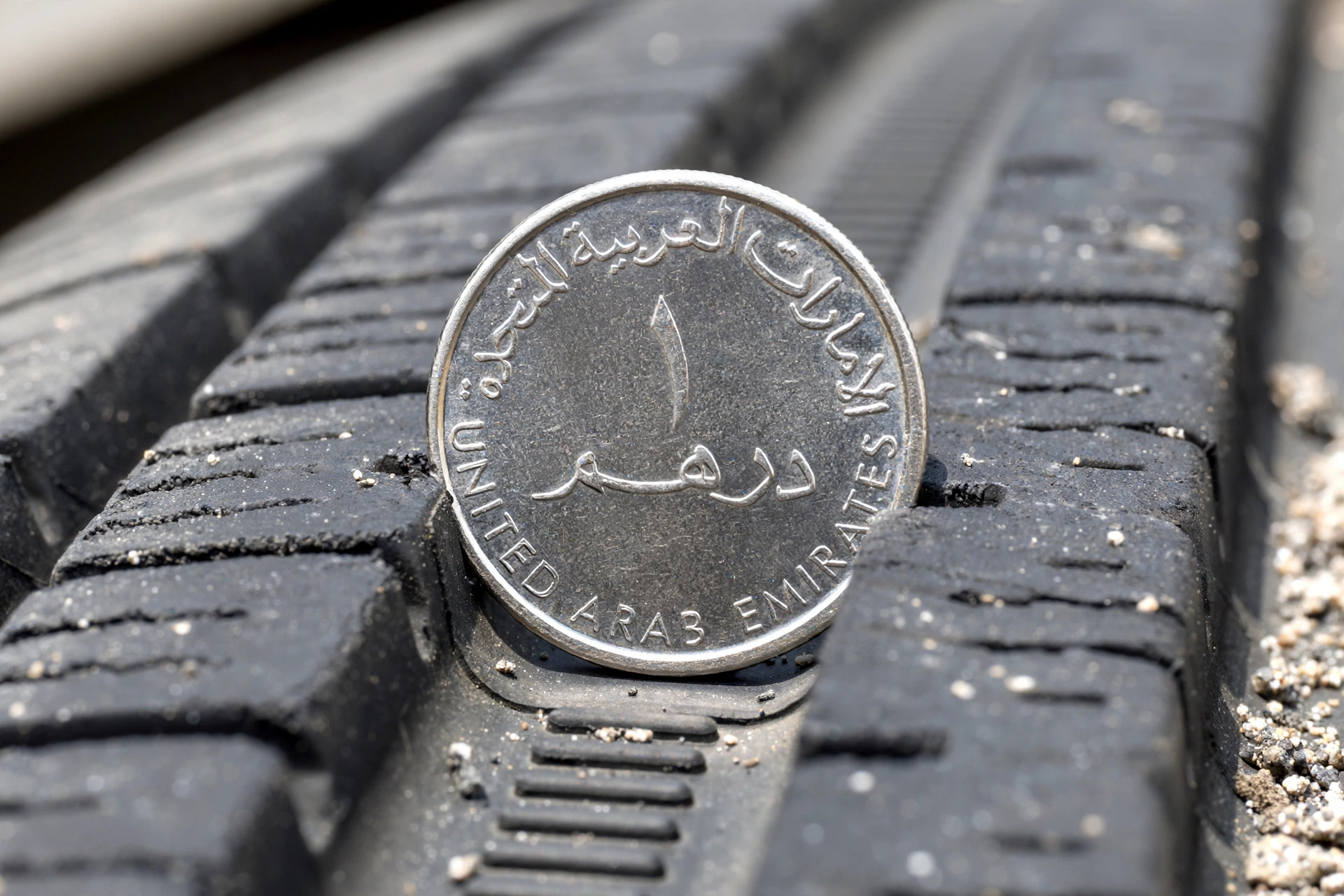
You can check tread depth without buying anything. Every tyre has tread wear indicator bars — small raised blocks running across the bottom of the main grooves, marked on the shoulder by a small triangle or the letters TWI. When the tread surface is level with those bars, the tyre is at about 1.6 mm and must be replaced. Do not wait for that point. The coin test is quicker: push a 1-dirham coin into a main groove. If you can see the top of the coin, your tread is below 1.6 mm and the tyre is already illegal. If the inner gold ring is fully visible, you are below roughly 3 mm and it is time to shop. Check several grooves on each tyre, and check the inner and outer edges, because a tyre worn on one edge only — often a sign of a wheel-alignment problem — can be illegal on that edge while the middle still looks fine.
Uneven wear is a message, not just a worn tyre. Wear in the middle usually means the tyre has been run over-inflated. Wear on both edges usually means under-inflation. Wear on one edge only often points to alignment, and a bald patch in one place can mean a suspension problem. If you see uneven wear, get the cause checked when the tyres are changed, or the new set will wear the same way. Our tyre repair page covers punctures and mobile replacement, and the car repair and maintenance page covers the alignment and suspension checks that go with it.
5. Cracks, Bulges and Cuts: The Damage That Fails the Test on Sight
Age and tread are measured. Damage is judged by looking, and the RTA test fails tyres that are seriously worn or cut — so the visual check matters as much as the numbers. Walk around the car once a month and look at each tyre properly, including the inner sidewall where you can see it. You are looking for four things.
First, fine cracks in the sidewall. A few hairline cracks on a tyre that is three years old are normal ageing. Deep cracks, or a network of cracks that you can feel with a fingernail, mean the rubber is drying out and the tyre is on its way out — even if it is not yet five years old. Second, any bulge or bubble on the sidewall. A bulge means the internal cords have broken and the air pressure is pushing the rubber outwards. A bulging tyre can blow out without warning, and it should not be driven on at all — not to the tyre shop, not “just to the end of the road”. If you find one, call for mobile help and have it changed where the car is standing.
Third, cuts, chunks missing from the tread, or anything embedded in the tyre. A nail or a screw in the tread can often be repaired properly, but a cut in the sidewall almost never can — the sidewall flexes every time the wheel turns, and no repair holds there. Fourth, exposed cords or wires. If you can see fabric or steel through the rubber, the tyre is finished. Stop driving on it.
Also look at the valve and the rim. A cracked valve can leak slowly and leave you with a flat tyre in the morning, and a bent or cracked rim can do the same. While you are there, check that the wheels are the size your car is supposed to have. The correct tyre size and pressure are printed on the sticker on the driver’s door jamb — that sticker, not whatever a previous owner fitted, is the authority. Tyres of different sizes or different tread patterns on the same axle can also be a problem at inspection, so a mismatched pair is worth fixing before the test, not after.
6. What the TPMS Light Really Means
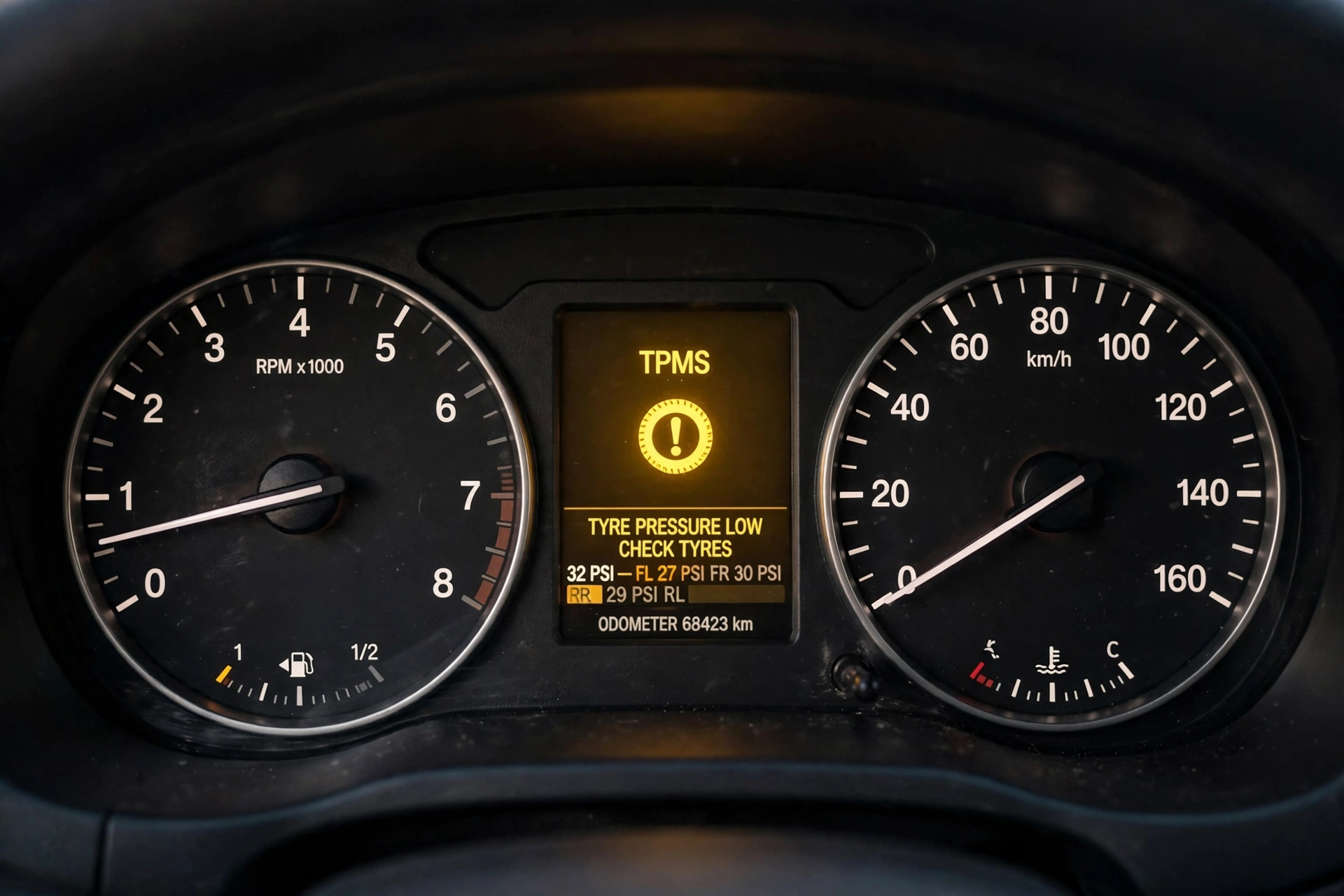
Then there is the yellow light on the dashboard that looks like a flat tyre with an exclamation mark in the middle. That is the Tyre Pressure Monitoring System, TPMS, and it is the most misunderstood light in the car. Here is what it is actually saying.
A steady TPMS light means the pressure in one or more tyres has dropped below the level the car expects — usually about 25 percent below the recommended pressure. It does not tell you which tyre, and it does not tell you by how much. It is a warning to check the pressures, not a diagnosis. Check all four tyres with a gauge when they are cold, before driving, and inflate them to the pressure on the door-jamb sticker — not the maximum pressure printed on the tyre sidewall, which is a different number. If one tyre keeps losing pressure while the others hold, it probably has a slow puncture or a leaking valve, and it needs looking at rather than just topping up every week.
A light that flashes for about a minute when you start the car and then stays on steadily means something different: the monitoring system itself has a fault, usually a dead sensor battery in one of the wheels or a sensor that has failed. The car can no longer watch its own tyre pressures, so the light stays on to tell you that. The tyres might be perfectly inflated — the system just cannot confirm it. That needs a diagnostic check, not air.
Three things the TPMS light does not do. It does not measure tread depth, so a bald tyre will not trigger it. It does not know the age of your tyres, so a six-year-old tyre will not trigger it. And in many cars it does not monitor the spare at all, so the spare can be flat for months without the dashboard ever knowing. The light is a pressure alarm only. Age, tread and sidewall condition still need your own eyes, which is why this guide keeps coming back to the thirty-second check.
One more practical point: cold mornings can trigger the light on their own. Air contracts as it cools, so a tyre that was at the right pressure on a warm afternoon can read low on a cold morning and set the light off. If the light comes on with the first cool mornings of winter, check the pressures before assuming there is a puncture. And if the light comes on while you are driving, do not ignore it — a tyre losing air at speed heats up fast, and a hot, under-inflated tyre is the one most likely to fail. Slow down, find somewhere safe to stop, and check it. Foggy mornings make the same point about preparation: our guide to driving in fog in Dubai covers the lights, speed and checks to do before a foggy morning.
7. Buying New Tyres: The Check to Do Before They Are Fitted
Most people buy tyres the way they buy anything else: they ask the price, they say yes, and the shop fits them. In the UAE there is one more step that matters more than the price, and it takes ten seconds: read the DOT code on the new tyres before they go on the car.
A tyre that has been sitting in a warehouse for two years is still sold as new, and legally it is new — it has never been used. But it has already used two of its five years. If you pay full price for a tyre made in 2024 and it is now late 2026, you are buying three years of use, not five. Tyre guides here advise refusing a “new” tyre that is more than about two years old, and asking for a fresher one from stock. A reputable shop will not argue with that request — it is a normal thing to ask, and it is your right to check before fitting, because once the tyre is on the car the argument is much harder.
When the new tyres are fitted, check that the sizes match the door-jamb sticker, that the two tyres on the same axle match each other in size and tread pattern, and that the valves are replaced at the same time — old valves on new tyres are a common cause of slow leaks. Ask the shop to check the spare as well. A spare that has been in the boot since the car was new is very likely expired, and discovering that on the side of Emirates Road at night is the worst time to find out. If the spare is over five years old, replace it with the best of the old set if it is still within date and in good condition, or budget for a new one.
Do not buy tyres by price alone, and do not let anyone sell you a used tyre without checking its DOT code first. A used tyre at a low price with a 2021 date code is not a bargain in November 2026 — it is a tyre with weeks of legal life left. And never fit a tyre that is the wrong size because it was cheap. The wrong size changes the car’s handling, its speedometer reading, and whether it passes inspection. If you are unsure what your car takes, the door-jamb sticker has the answer, and any decent tyre shop will read it with you.
8. The Fine, the Failed Test and What Expired Tyres Really Cost
Driving on unfit tyres — which includes expired tyres and tyres below the legal tread depth — is listed in the federal traffic violations schedule at AED 500, with 4 black points and a 7-day vehicle impoundment. That is the fine as currently listed; new executive regulations under the 2024 traffic law are due to take effect on 1 January 2027, so if you are reading this after that date, check the current schedule in the Dubai Police or RTA app before relying on the figure. The fine is only part of the cost. A car that fails its RTA test on tyres cannot complete its registration renewal until the tyres are replaced and the car passes a re-test, which means a second visit, a second fee, and days without a legally registered car.
There is also the cost nobody budgets for: a blowout. A tyre that fails at speed can damage the wheel, the suspension and the bodywork, and it can cause a collision that costs far more than four new tyres ever will. Tyres are the only part of the car that touches the road. Everything else — the brakes, the steering, the airbags — depends on them doing their job. Four tyres are the cheapest safety system on the car, and they are the one most often left until it is too late.
If the budget is tight, remember that tyres do not all have to be replaced on the same day if they are not all the same age — but the two on the same axle should match, and the oldest one is the one to replace first. What you should never do is replace one tyre with a used tyre of unknown age to “get through the test”. The test checks the date code, and a used tyre with an old code fails exactly the same way.
9. The Ten-Minute Tyre Check to Do Today
Do this once, now, and then once a month after that. It takes ten minutes and no tools except a torch and a 1-dirham coin.
First, read the DOT code on all four tyres and the spare, and write the dates down — on your phone, in a note, wherever you will find them again. Work out the expiry date for each one by adding five years. Any tyre already past its date needs replacing now. Any tyre within six months of its date needs replacing before your next RTA test.
Second, check the tread. Look at the wear indicator bars in the grooves, and do the coin test on several grooves on each tyre, including the inner and outer edges. If the tread is level with the bars, or you can see the top of the coin, the tyre is illegal. If the gold ring of the coin is fully visible, you are below about 3 mm and should plan the replacement.
Third, look at the sidewalls. Any bulge means stop driving on that tyre and call for help. Deep cracks, cuts, or visible cords mean the tyre is finished. A nail or screw in the tread can usually be repaired — our tyre puncture repair team can come to you for that — but a cut in the sidewall cannot be repaired.
Fourth, check the pressures with a gauge, cold, against the door-jamb sticker — and check what the TPMS light is doing. A steady light means low pressure. A flashing-then-steady light means the system itself needs a diagnostic check.
Fifth, check the spare. If it is flat, inflate it. If it is over five years old, plan to replace it. A spare that cannot be used is just weight in the boot.
If anything in that check worries you — a bulge, a cut, a tyre that is past its date, or a pressure that keeps dropping — do not drive on it and hope. Call or WhatsApp us and we will come to you. Our mobile tyre service covers the complete UAE with a 15–20 minute response, 24 hours a day, and our prices are very low.
Frequently Asked Questions
How do I know how old my tyres are?
Read the last four digits of the DOT code on the sidewall: the first two are the week of manufacture and the last two are the year. A code ending in 2423 means week 24 of 2023. Add five years to that date — that is when the tyre expires in the UAE.
Can I use a tyre that is more than five years old if the tread looks good?
No. The RTA test fails tyres more than five years from their manufacturing date, regardless of tread depth. Heat ages the rubber from the inside, so a tyre can look fine and still be unsafe.
Does the five-year rule start from when I bought the tyre?
No, it starts from the manufacturing date in the DOT code. A tyre bought new in 2026 but made in 2023 has already used three of its five years. Always check the DOT code before a shop fits new tyres.
What is the minimum legal tread depth in the UAE?
1.6 mm for passenger cars. When the tread is level with the wear indicator bars in the grooves, the tyre is at about 1.6 mm and must be replaced. Most professionals advise replacing at around 3 mm, before grip falls away.
What does the TPMS light mean?
A steady light means one or more tyres is low on pressure — check all four with a gauge when cold. A light that flashes for about a minute and then stays on means the monitoring system itself has a fault, usually a dead sensor, and needs a diagnostic check. The light does not measure tread depth or tyre age.
Is my spare tyre also covered by the five-year rule?
Yes. The spare ages in the boot just like the others, and an expired spare can fail the inspection and will not help you at the roadside. Check its DOT code and its pressure as part of the monthly check.
What is the fine for driving on expired tyres?
The federal schedule lists driving on unfit tyres at AED 500, 4 black points and a 7-day vehicle impoundment. It also means failing the RTA test and being unable to renew your registration until the tyres are replaced. Check the current schedule in the Dubai Police or RTA app, as new traffic regulations are due from 1 January 2027.
How Old Are Your Tyres? We Can Check Them Where You Are
If you have read this far, the next step takes less time than reading the article did. Go out to the car, find the DOT code on each tyre, and work out the dates. If any tyre is past five years, if the tread is below the wear bars, if there is a bulge or a deep crack, or if a tyre keeps losing pressure — do not wait for the RTA test or for a blowout to make the decision for you.
We come to you anywhere in the UAE, our response time is 15–20 minutes, and we are available 24 hours a day. Call or WhatsApp us on +971 54 344 3513 and tell us what you found — the DOT dates, the tread, or just “the light is on and I am not sure”. We will check the tyres, tell you honestly what needs changing and what does not, and fit the replacement at your home or office. Our prices are very low.
And if your car has just failed its RTA test on tyres, we can help with that too — a fresh set fitted where the car is standing, so the re-test is a formality instead of a second headache. Before your renewal date, take ten minutes and check the dates. It is the cheapest ten minutes of car ownership in Dubai.
