
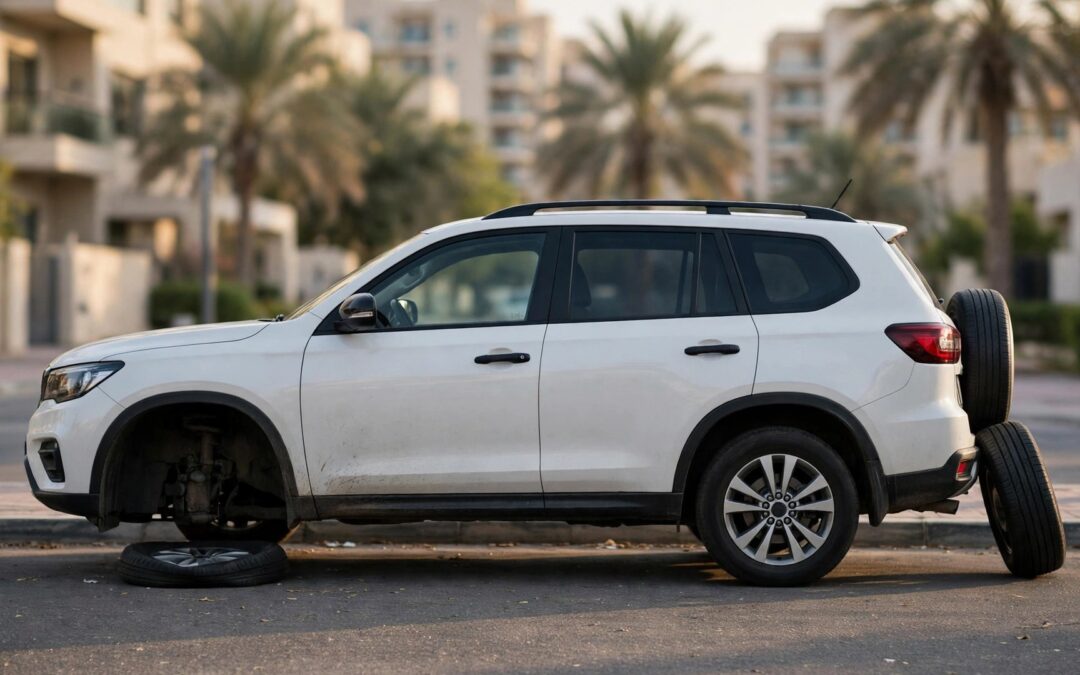
It’s morning, you’re already late, and the car sits low on one corner. Or you’re on the road and something feels off. Either way, you need flat tyre repair near me in Dubai, and you need to know what to do first.
The good news: a flat tyre is manageable if you slow down and take it in order. Two questions, one at a time: are you safe where you are, and is the tyre safe enough for a spare, a pump, or a short move — or should the car not move at all? Rush either decision and you risk extra damage.
Get somewhere safe, then stop properly
Ease off and pull away from moving traffic as soon as you safely can — a parking bay or service road beats a narrow shoulder on a fast road. Once stopped: hazards on, parking brake on, engine off. If you carry a warning triangle and can place it safely, put it well behind the car.
Get passengers away from the traffic side, and into the shade if there’s any going. Don’t work on a slope, soft ground, or next to fast-moving traffic — if the spot feels unsafe, it is. Call for help instead.
Have a proper look before you touch anything
Walk round and look at all four tyres, not just the flat one: something stuck in the tread, a cut, a bulge, sidewall damage, a rim that looks bent or cracked. Is it completely flat or only partly down? Which wheel is it? Knowing that helps a lot if you call for help.
Two things not to do. Don’t pull out anything embedded in the tyre — it may be slowing the leak. And don’t drive a few metres to “test” a flat tyre, especially if the rim is touching the ground; that short drive can finish off the tyre and the rim. If the sidewall is bulging, split, or deeply cut, treat the tyre as done.
Spare, pump, or call for help?
What you can do next depends on your car, your tools, and how bad the damage is. Some cars have a temporary spare, some a full-size spare, some just a repair kit. Your manual will tell you what’s in your car and what limits apply — worth knowing before you’re standing in a car park in August.
As a rough rule: fit a spare only on flat, firm ground, with the right tools, if you’re confident following the manual. Use an inflation kit only for a small tread leak, exactly as its instructions say. Call for help if the damage is bad, there’s no usable spare, the nuts won’t shift safely, or the location isn’t safe. There’s no shame in that call.
If you’re fitting the spare yourself
Stay on flat, stable ground. Crack the nuts loose before jacking, jack at the correct lifting point (the manual shows where — don’t guess), fit the spare, tighten in a star pattern, lower the car, then tighten again. Drive gently, and get the damaged tyre looked at promptly. A temporary spare gets you home; it isn’t a long-term fix.
If anything feels wrong — the car rocks on the jack, a nut won’t move, the ground gives way — stop. Lower the car carefully if you safely can, and wait for professional help. Saving twenty minutes isn’t worth a car slipping off a jack.
Times when you really shouldn’t drive at all
Some flats mean the car stays put. Don’t drive, not even slowly, if:
- The tyre is completely flat with the rim on the ground, or the sidewall is split, bulging, or deeply cut
- The rim is bent or cracked, or the car pulls hard or shakes badly
- The spare is flat, damaged, or missing, or the wheel nuts are seized
- You’re on a fast road, slope, or soft ground where a safe change isn’t possible
In those cases, mobile help is safer. A technician can inspect the wheel where the car is and advise on spare fitting, repair, or replacement. For tyre repair in Dubai, sharing your location, vehicle details, and a plain description of the damage helps the team turn up prepared.
A few things worth keeping in the boot
Nobody thinks about this until they need it. Keep these checked, and know where they are before the day you need them:
- A usable spare or approved repair kit, jack, wheel wrench, and locking wheel-nut key if your car has one
- A pressure gauge, torch, gloves, warning triangle, and basic first-aid kit
- The manual’s jacking points and spare limits, plus a roadside help number saved in your phone
Check the spare’s pressure with the other tyres, replace missing tools promptly, and check sealant expiry dates — out-of-date sealant lets you down at the worst moment.
After the spare is on, the job isn’t finished
A spare gets you to help — that’s its job. Drive gently, keep the trip short, and get the damaged tyre inspected soon, inside, rim, and valve included. Ask about the other three tyres too; uneven wear or ageing rubber causes the same problem twice. And if you used a sealant kit, say so — it changes how the tyre needs checking.
A flat spotted at home or work is no different — mobile support can often come to you there. For mobile tyre repair in Dubai, contact the team to confirm availability. How quickly help reaches you depends on location and traffic.
Quick answers
Can I drive a short distance on a flat tyre?
Not if it’s fully flat or the rim is on the ground — even a very short drive can ruin the rim and tyre. Stop safely, fit a spare if safe, or call for help.
How far can I drive on a temporary spare?
Whatever your manual says for speed and distance. Spares are for short, gentle trips to reach help. Get the original tyre checked promptly.
What if my car has no spare wheel?
Many newer cars carry a repair kit or run-flat tyres. Use the kit only as instructed, for small tread leaks. For bigger or sidewall damage, call for help.
Is a sealant kit a permanent fix?
No — it’s temporary, to get you to help. Tell whoever inspects the tyre that you used it.
Should I check the other tyres after a flat?
Yes. Check pressures and look for cuts, bulges, and uneven wear. A second low tyre can point to something worth sorting early.
Stuck with a flat in Dubai?
Stop safely, look properly, don’t drive on a flat tyre. For flat tyre repair and roadside help in Dubai, contact 95 Services.
Call or WhatsApp +971 54 344 3513, email info@95services.com, or visit the Dubai location at Abu Hail, Al Khabaisi, Dubai, UAE. Share your vehicle details and location.
