

If your car AC is not cooling after a gas refill, the most likely reason is that the refrigerant has escaped again through a leak that was never found — a refill adds gas, but it does not seal anything. Other causes include a failing compressor, a blockage, an electrical or fan fault, or the wrong amount of refrigerant, including too much. Paying for a second recharge without diagnosing the cause usually wastes the refill cost. The time pattern — how quickly cooling faded — tells a good workshop where to look first.
Why cooling fades after a refill
AC systems are sealed: refrigerant is not “used up”, so a system that needed a refill was already losing gas or had another fault. A refill restores cooling temporarily; if the escape route is still open, cooling fades again.
A leak is the most common cause. Refrigerant escapes through worn seals, cracked hoses, corroded fittings, a damaged condenser, or a leaking compressor shaft seal. Small leaks take weeks to show; large ones empty the system in a day.
Compressor problems. If the clutch fails to engage or the internals are worn, the system will not cool no matter how much gas is in it. Noise, rapid cycling, or no engagement points here rather than at a leak.
Blockages. A blocked expansion valve or a saturated receiver-drier restricts refrigerant flow. Cooling may be weak or one-sided, and does not improve with more gas.
Electrical and fan faults. Pressure switches, relays, and fuses govern whether the compressor runs and whether the condenser fan moves enough air. A failing condenser fan is a classic Dubai pattern: cooling on the motorway, fading at idle.
Wrong charge — including overcharge. Too little refrigerant cools weakly. Too much also cools weakly, because pressures rise beyond the designed range.
The time pattern is the diagnostic clue
When the cooling faded narrows the cause before any tool is connected.
| Time pattern | What it usually points to | What to tell the workshop |
|---|---|---|
| Cold for a day, then warm | Large leak, or a major component failure | “Cold the day of the refill, warm the next morning” |
| Fading gradually over weeks | Slow leak through a seal, hose, or fitting | “Cooling weakened over about three weeks” |
| Never cold after the refill | Compressor, blockage, electrical fault, or wrong charge | “Never cooled properly, even right after the refill” |
| Cold at speed, warm in traffic | Condenser fan fault, or a partially blocked condenser | “Cools on the motorway but fades at idle” |
| Cold on one side only | Blockage, blend-door fault, or low charge | “Driver’s side is cool, passenger side is warm” |
Patterns, not diagnoses — only testing separates them. Note yours before you arrive.

Symptoms to note before you book
Note these before calling.
- When did it fade? The day of the refill, a few days later, or gradually over weeks?
- Airflow or temperature? Strong warm air: refrigerant circuit. Weak airflow: blower, filter, or evaporator.
- One side or both? Uneven cooling narrows the fault.
- Noises? Clicking, grinding, rattling, or rapid compressor cycling.
- Smells? Musty: evaporator/drain. Chemical: possible refrigerant leak.
- Water under the car? A working AC drips water. None on a humid day suggests no cooling or a blocked drain.
- Visible signs? Oily residue or green dye at fittings can mark a leak. Don’t touch refrigerant lines.
- Fan behaviour? Worse at idle, better at speed? Engine temperature rising too?
- What was done last time? A top-up or a full recover-and-recharge? Was a leak test done? Was dye added?
What a workshop must check before another recharge
A second recharge without diagnosis wastes gas that will escape the same way. Before recharging again, a competent workshop should work through this sequence.
- Recover and weigh the remaining refrigerant. Remaining gas is recovered and weighed. Compared with the specified charge, that shows how much escaped and how fast.
- Vacuum hold test. The system is evacuated and watched; a decaying vacuum confirms a leak but not its location.
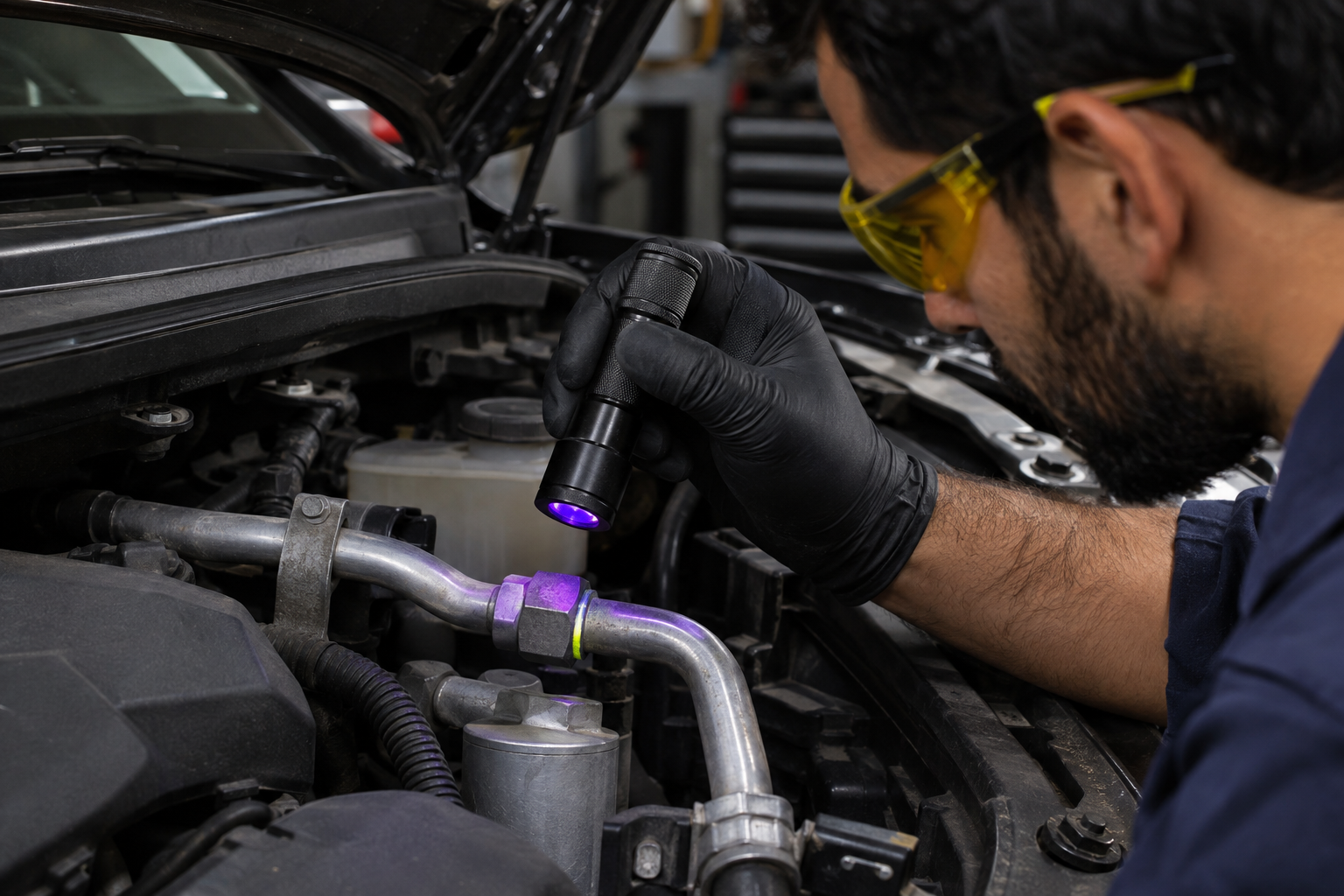
- Leak detection. Two standard methods: pressurising with nitrogen and testing joints with a detector, and UV dye, which fluoresces at the leak point under ultraviolet light. Skipping this step and going straight to a recharge skips the diagnosis.
- Inspect the common failure points. Condenser, compressor seal, hoses, fittings, and evaporator drain.
- Check the compressor, electrics, and fans. Clutch engagement, pressure switches, relays, fuses, and fan operation at idle.
- Recharge by weight. Only after the cause is found and fixed — to the figure on the under-bonnet sticker, not by guesswork.
A “just top it up again” offer without the first five steps is a warning sign, not a bargain. The refill is the cheapest part of the job; the diagnosis is what makes it last.
Overcharge, charge-by-weight, and R134a vs R1234yf
Overcharge is a real fault, not a safety margin. An overcharged system runs high pressures, cools poorly, and strains the compressor. The correct charge is a weight in grams, specified by the manufacturer and set with a scale on the charging machine.
R134a and R1234yf are not interchangeable. Older cars use R134a; most newer models use R1234yf, which has a much lower global-warming potential and is more expensive. The gas type is marked on the under-bonnet sticker and service ports. Using the wrong gas, or mixing them, damages the system.
The price difference is substantial. Indicative market examples list an R134a refill from AED 150, and R1234yf from AED 450–700 — one Al Quoz workshop lists R1234yf from AED 550, another lists a general refill from AED 249 (gas type unstated). VAT treatment is unstated in these figures. Indicative market examples, not 95 Services rates; refill only. When quoted a refill price, ask which gas it is for and whether leak detection is included.
Dubai-specific: sand, stone chips, and traffic heat
Condenser damage: the condenser sits at the front of the car, directly in the path of sand, grit, and stone chips. Damaged fins reduce heat rejection, and a punctured tube leaks refrigerant slowly. A battered condenser is a legitimate suspect, and a visual inspection can assess it quickly.
Fan load in traffic heat: at motorway speed, airflow through the condenser does much of the cooling work. At idle and in slow traffic, the condenser fan carries the full load in ambient temperatures that can exceed 45°C. A weak fan shows up first in traffic, at lights, and in queues. Cold on the open road but warm in traffic? Say so first — it points at the fan and condenser.
What leak repair and compressor work cost
No reliable published Dubai figures for AC leak repair or compressor replacement were found in the research for this guide. Workshops quote both by inspection, because cost depends on which component failed, parts availability, and how much of the system must be opened. Any article printing a single figure for either job in Dubai is guessing. Control the quote instead: ask for the failed component to be named, part and labour shown separately, and whether the quote includes gas recovery, receiver-drier replacement, vacuuming, and recharge by weight. Ask whether the part is new, remanufactured, or used, and what warranty applies.
Get the cause found before the next recharge
A refill that fades is the system telling you something. The cheapest next step is not another recharge — it is a proper check that finds why the gas escaped, or why the system never cooled. For car AC repair in Dubai, call 95 Services on +971 54 344 3513 or message on WhatsApp. Say when the refill was done and how quickly cooling faded. If engine temperature is rising or warning lights show, check the engine warning signs guide and the engine diagnostics page.
FAQs
My AC was cold for a few days after a refill, then went warm again — what does that pattern mean?
It usually means a significant leak that emptied the refilled system within days. A second recharge without leak detection will repeat the result — the workshop should find the leak before recharging again.
Can too much refrigerant (overcharge) cause weak cooling, and how is the correct charge set?
Yes. Too much refrigerant raises pressures beyond the designed range and cools poorly, while straining the compressor. The correct charge is a weight in grams specified by the manufacturer, on the under-bonnet sticker, and set with a scale on the charging machine.
What should a workshop check before recharging my AC a second time?
Recover and weigh the remaining refrigerant, run a vacuum hold test, carry out leak detection (nitrogen test or UV dye), inspect the condenser, compressor seal, hoses, and fittings, and check compressor engagement, electrics, and fan operation. Only then recharge, by weight.
R134a vs R1234yf: which gas does my car take, and why does the refill price differ?
Your gas type is marked on the under-bonnet sticker and service ports. Older cars generally use R134a; most newer models use R1234yf, which costs more. Indicative Dubai examples list R134a from AED 150 and R1234yf from AED 450–700. The gases must not be mixed.
Is it safe to keep driving with weak AC in Dubai heat?
Weak AC can become a health risk in Dubai summer heat, especially for children, older passengers, and pets. Get it checked promptly if engine temperature is also rising, if there are grinding noises from the compressor area, if you smell chemicals near the vents, or if warning lights come on.
