

Automatic Transmission Slipping in Dubai? Gears That Flare, Hesitate or Drop Out — Causes and Urgency
You are driving down Sheikh Zayed Road, you press the accelerator to overtake, and instead of the car moving forward, the engine revs up and the car... does not. The needle climbs, the engine sounds busy, and the speed stays where it was. A second later the gear catches with a small jolt and off you go. Or maybe it happens at a traffic light in Deira: you move the lever to Drive, you lift your foot off the brake, and nothing happens for a couple of seconds — then the car creeps forward as if it has just woken up. Or the worst version: you are in the middle of a roundabout and the car suddenly feels as if it has slipped into neutral all on its own.
I have spent years working on cars in Dubai, and I can tell you plainly: if your gearbox is doing any of that, it is talking to you. It is not being moody. It is not "just a Dubai heat thing" that you can ignore. It is telling you that something inside the transmission is not holding the way it should. The good news is that slipping does not always mean a dead gearbox. Sometimes it is low fluid. Sometimes it is old, tired fluid. Sometimes it is a small part that can be fixed before the big parts are damaged. The bad news is that the longer you keep driving on a slipping gearbox, the more damage you do — and the difference between a small repair and a big one is often just a few weeks of ignoring the signs.
This guide is written for drivers, not for mechanics. I will explain in plain words what slipping feels like, why it happens, what is most likely causing it in your car, and — most importantly — how to decide whether to stop driving right now, drive slowly to a workshop, or book a check for the next day or two. I will also tell you what a proper diagnostic check actually involves, so that when a workshop talks to you, you will know what they should be doing and what questions to ask. I will not drown you in part numbers or workshop talk. Where something varies by car model and year, I will say so.
One thing before we start: this article is about the symptoms and the diagnosis. It is not the full repair guide. If you want to know about transmission repair itself, we have separate pages for transmission repair in Dubai and car transmission repair Dubai. This page is about recognising the problem early and knowing how urgent it is — because that is the part that saves you the most money.
What Does a Slipping Transmission Actually Feel Like?
Most drivers have never been told what slipping feels like, so when it starts, they are not sure whether it is real or whether they imagined it. Let me describe it the way owners describe it to me, sitting in the driver's seat next to me on a test drive.
The most common one is the flare. You are speeding up gently, the gearbox changes from one gear to the next, and for a moment the engine revs jump up by themselves — like the car has slipped into neutral for half a second — before the next gear engages. It feels like a small surge, a little hiccup in the middle of an otherwise smooth gear change. On a quiet road you might barely notice it. In traffic, when you are speeding up and slowing down all the time, you will notice it again and again.
Then there is the hesitation. You press the accelerator and there is a delay before anything happens. Not a long delay — a second or two — but enough that you feel it. It is worst when you are pulling away from a standstill, or when you need power suddenly, like joining a fast road from a slip lane. You press, you wait, the car finally moves. The first time it happens you might think you just did not press hard enough. The third or fourth time, you know something is off.
Then there is revving without acceleration. This is the clearest sign of all. You are driving along, you press the accelerator, the revs climb — 3,000, 4,000 — and the speed barely changes. It feels like the engine and the wheels have stopped talking to each other. In a manual car, this is what a worn clutch feels like. In an automatic, it means the clutches or bands inside the gearbox are not gripping properly, or the fluid pressure is too low to hold them.
Then there is dropping out of gear. This one frightens people, and rightly so. You are driving normally and suddenly the car feels as if it has gone into neutral. The engine revs, the car coasts, and you have to lift off the accelerator and press it again — or sometimes move the lever — before drive comes back. It can happen once and not again for a week, which makes people hope it was a one-off. It is not a one-off. It is a warning.
There are a few other signs that travel with slipping, and they are worth knowing. Delayed engagement is one: you move the lever from Park to Drive, or from Drive to Reverse, and there is a long pause — two seconds, three seconds, sometimes more — before the gear actually engages, sometimes with a clunk when it finally does. A shudder or vibration during a gear change is another: the car shakes a little as it changes gear, like driving over a rough patch of road that is not there. And harsh or rough gear changes — a hard thump when the gearbox changes gear — can be part of the same picture, even though they feel like the opposite of slipping. Inside the gearbox, slipping and harsh shifting are often two sides of the same problem: the clutches are not engaging smoothly and at the right time.
You might also notice a smell. Transmission fluid that has overheated smells burnt — a sharp, acrid smell, a bit like burnt toast. If you smell that after driving, especially after a long drive in summer heat, take it seriously. And you might notice a leak: a reddish or dark brown puddle under the car where you park, usually somewhere under the middle of the car. Transmission fluid is usually red or reddish-brown when it is healthy, and it turns dark brown or black when it is old and worn out. A puddle of red fluid is not engine oil and it is not coolant — it is the gearbox losing the very fluid it needs to work.
One more thing: a warning light. Some cars will show a gearbox warning light, or a general warning, or the engine light. Some will go into what mechanics call limp mode — the car limits itself to one gear, or limits the speed, to protect itself. If your car does that, do not try to push through it. Limp mode is the car telling you it has already decided the gearbox needs protecting, and arguing with it will only make things worse.
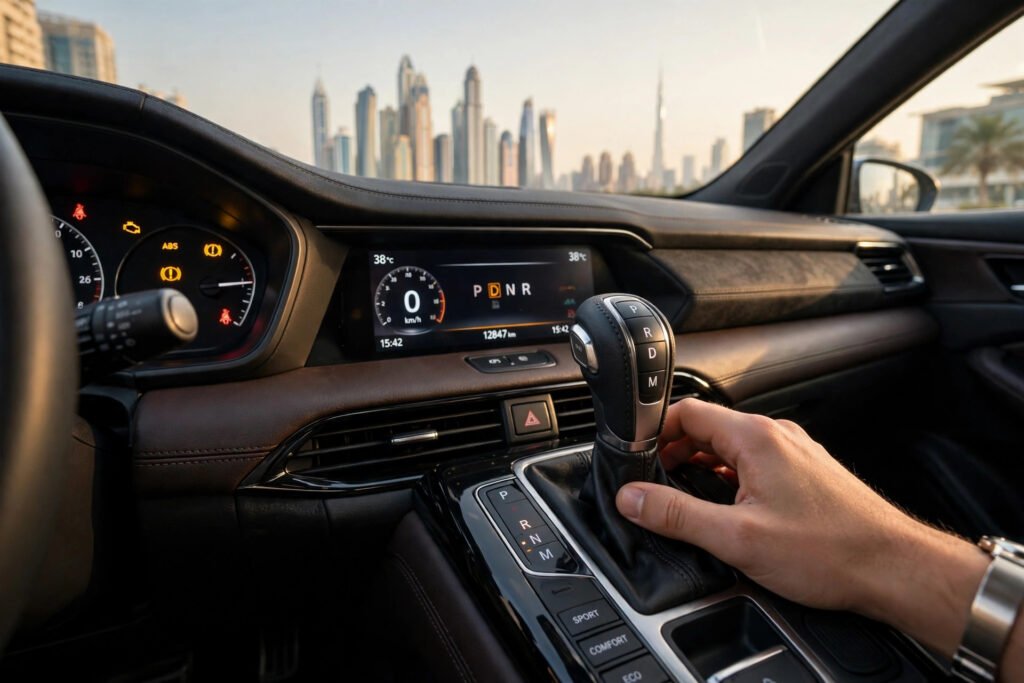
Why Slipping Happens More Often in Dubai Than People Expect
Dubai is a hard place for an automatic gearbox. That is not an excuse for a bad gearbox, but it is a fact that every mechanic here knows, and it explains why slipping shows up here more than it might in a cooler country.
The first reason is the heat. In the middle of a Dubai summer, the air temperature is in the high forties, the road surface is hotter still, and the gearbox is sitting in a hot engine bay with hot air all around it. Transmission fluid does two jobs: it transfers power and it cools and lubricates the parts inside the gearbox. When the fluid gets too hot for too long, it breaks down. It gets thinner, it loses its ability to grip, and it stops protecting the parts it is supposed to protect. A gearbox that would be fine for years in a cooler climate can wear faster here simply because the fluid is working in conditions it was not really designed for.
The second reason is the traffic. Think about a normal drive in Dubai: you are on Sheikh Zayed Road, then you are in slow traffic near a mall, then you are crawling through a residential area, then you are back on a fast road. The gearbox is changing gear constantly. Every gear change is a small moment of friction inside the gearbox, and in stop-start traffic there are hundreds of them in a single journey. Over months and years, that adds up. It is like the difference between walking on flat ground and walking up and down stairs all day — the stairs wear you out faster.
The third reason is the way many of us drive here without realising it. Short trips are common — a quick run to the shops, a short drive to school, a five-minute trip to the petrol station. On a short trip the gearbox never fully warms up to its proper working temperature, and the fluid never gets a chance to do its job properly. Then the next trip might be a long, fast drive on the highway. That constant switching between cold short runs and hot long runs is hard on the fluid and hard on the seals inside the gearbox. Seals are the rubber rings that keep the fluid pressure where it should be. When they get old and hard from heat, they start to leak pressure — and low pressure is one of the main causes of slipping.
The fourth reason is towing and heavy loads. Dubai is a city where people tow — a trailer, a boat, a jet ski, a caravan for a desert weekend. Towing puts a much bigger load on the gearbox, and it makes the fluid much hotter. If the car was not built for that weight, or if the towing is done in summer heat, the gearbox suffers. The same goes for a car that is regularly loaded up with a full boot and a full set of passengers on a long drive to Abu Dhabi or Ras Al Khaimah in the middle of the day. None of this means you cannot tow or load your car. It means the gearbox deserves more attention — and more frequent fluid checks — if you do.
And the fifth reason is the one nobody likes to hear: the fluid was never changed. Many owners believe the line that transmission fluid is "sealed for life" and never needs changing. I hear it all the time. The truth is that no fluid lasts forever, and in Dubai heat, it lasts less long than it would elsewhere. The fluid gets dirty, it gets thin, it loses the additives that help the clutches grip. A gearbox that has never had its fluid changed in eight or ten years of Dubai driving is a gearbox that is living on borrowed time. That is not a criticism of the owner — the idea of sealed-for-life fluid came from the car makers themselves. But in our climate, it is a myth that costs people a lot of money.
The Most Likely Causes, in Plain Words
When a customer comes to me and says the gearbox is slipping, I do not guess. I check. But it helps you, as the owner, to know what the likely causes are, because it helps you understand what the mechanic is talking about, and it helps you judge whether the advice you are given makes sense. Here are the causes I see most often, in the order I usually find them.
Low transmission fluid
This is the first thing I check, and the most common cause of all. The gearbox needs a certain amount of fluid, at a certain pressure, to hold the clutches together. If the fluid level is low — because of a slow leak, because a seal has gone hard, because a cooler line is weeping — the pressure drops, the clutches cannot hold, and the gearbox slips. A low fluid level is also the best news you can get, because if the leak is found early and the fluid is topped up or changed, the gearbox can go back to normal without any big repair. But "best news" only applies if you act quickly. Driving for weeks on low fluid wears the clutches, and worn clutches cannot be fixed by topping up the fluid.
Where does the fluid go? Usually out through a seal or a gasket that has gone hard in the heat, or through a line that connects the gearbox to its cooler. Sometimes it leaks slowly enough that you never see a puddle — it drips onto a hot part and burns off, or it collects on the undertray under the car. That is why I always check underneath the car, not just on the ground where it was parked. If you have noticed a red or dark stain on your parking spot, tell the mechanic. That one detail can save an hour of searching.
Old, worn-out or burnt fluid
Even if the level is right, the fluid itself can be the problem. Transmission fluid has a hard life. It is heated, cooled, squeezed, and sheared thousands of times a day. Over time it breaks down. It gets dark, it smells burnt, it gets thin, and it stops doing its job. The clutches inside the gearbox rely on the fluid to grip smoothly. When the fluid is worn out, they slip, and when they slip, they get hotter, and when they get hotter, the fluid breaks down faster. It is a cycle that feeds on itself, and once it starts, it gets worse quickly.
This is why I always look at the fluid and smell it during a check. Healthy fluid is usually red or pinkish-red and smells slightly sweet, like oil. Old fluid is dark brown or black and smells burnt. That is not a small detail. It is one of the most useful clues in the whole diagnosis, and it takes about a minute to check on cars that have a dipstick. Some newer cars do not have a dipstick — the fluid is checked from underneath, on a lift, at the right temperature. That is a workshop job, not a driveway job, and I will come back to that.
Worn clutches or bands inside the gearbox
Inside an automatic gearbox there are clutch packs — sets of discs that press together to hold a gear — and in some designs, bands that grip around a drum. When they are new, they grip firmly. When they wear, they grip less firmly, and the gear slips. This is normal wear over a long life, but it happens faster if the gearbox has been run on low or burnt fluid, or if it has been overheated. Worn clutches are a bigger job than a fluid change. The gearbox has to come out and be opened up, and the worn parts replaced. That is why catching the problem early matters so much: a fluid change at the first sign of slipping can save the clutches. A fluid change after months of slipping often cannot, because the damage is already done.
Solenoid problems
A solenoid is a small electrically operated valve inside the gearbox. It controls the flow of fluid to the clutches, telling them when to engage and how firmly. If a solenoid is sticking, or its electrical connection is poor, or it has failed, the fluid does not go where it should, when it should. The result can be slipping, or harsh shifting, or delayed engagement — sometimes all three, at different times, which makes it confusing for the owner. The good news is that a solenoid problem can often be fixed without rebuilding the whole gearbox. The bad news is that it has to be found properly, with a scan tool and a pressure check, and not guessed at. A mechanic who says "it is the solenoids" without testing them is guessing, and guessing is expensive.
Overheating
A gearbox that gets too hot will slip, and a gearbox that slips will get hotter. It is another cycle. The gearbox has a cooler — sometimes a separate small radiator, sometimes a section of the main radiator — and if that cooler is blocked, or if the fluid is old and cannot carry the heat away, the temperature climbs. In Dubai, I see this most often after a long drive in summer heat, especially with a loaded car or a car that has been towing. The slipping might only show up when the car is hot, and disappear when it cools down. That is a very useful clue: if the problem only happens when the car is hot, tell the mechanic exactly that. It points straight at heat and fluid.
If your temperature gauge is also climbing, or if you have had an engine overheating worry before, the two can be connected — a hot engine makes a hot gearbox, and a blocked cooler hurts both. Our guide on engine overheating in Dubai explains the cooling side in more detail, and it is worth a read if you have had any temperature trouble.
Torque converter trouble
The torque converter is the part that connects the engine to the gearbox in most automatic cars. Think of it as a fluid coupling — it lets the engine keep running while the car is stopped, and it multiplies the pulling power when you move off. Inside it there is a clutch that locks up at higher speeds to save fuel. If that lock-up clutch wears, or if the converter itself is worn, you can get a shudder or a slipping feeling, often at a particular speed — commonly when cruising on the highway. It feels a bit like driving over a rumble strip, or like the car cannot decide which gear it wants. It is a less common cause than fluid or clutch wear, but it is a real one, and it needs a proper test drive to identify, because it only shows up in certain conditions.
Sensors, wiring and software
A modern gearbox is controlled by a computer, and the computer relies on sensors: speed sensors, temperature sensors, pressure sensors. If a sensor sends a wrong reading, the computer can make the wrong decision — changing gear too early, too late, or not at all. A loose electrical connection, a damaged wire, or a sensor that is starting to fail can cause slipping symptoms that come and go, which is maddening for the owner. And sometimes the gearbox software itself needs an update, or a re-learn after a battery change. I mention this because it is one of the reasons a proper scan is part of the diagnostic check. A gearbox that is slipping because of a faulty sensor does not need a new gearbox. It needs a new sensor. But you only find that out by scanning, not by guessing.
Something else that only feels like slipping
Not everything that feels like slipping is the gearbox. A worn engine mount can make the car thump when the gearbox changes gear. A weak engine — a misfire, a fuel problem — can make the car hesitate when you press the accelerator, and feel like the gearbox is slipping when it is actually the engine not making power. Low engine power and gearbox slipping can feel very similar from the driver's seat. That is another reason a proper diagnosis matters: it separates the gearbox problem from the engine problem, so you do not pay for a gearbox repair when the real fault is somewhere else. If your car is also hard to start, or cranks slowly, read our guide on car won't start — battery, alternator or starter — a weak battery and a misbehaving gearbox are more connected than most people think, because the gearbox computer needs clean, steady power.

How Urgent Is It? The Triage Guide
This is the section that matters most. When your gearbox starts slipping, the question in your head is not "what is a solenoid?" — it is "can I drive this car, or do I need to stop?" So here is the honest answer, in three groups: stop now, drive carefully to a workshop, and book a check soon.
Stop driving immediately
Stop the car safely, switch it off, and call for help if any of these are happening:
- The gearbox has dropped out of gear more than once, or the car keeps losing drive while you are moving. A car that loses drive on a fast road is dangerous, not just expensive. You do not want to be in the fast lane of Sheikh Zayed Road when the gearbox decides to take a break.
- The car will not move at all, or it moves only in one gear, or it is stuck in limp mode and will not go above a crawl. Do not try to force it. Limp mode is the car protecting itself, and pushing through it can turn a repair into a replacement.
- There is a loud grinding, banging or whining noise from the gearbox, or a strong burning smell that is getting worse. Noise plus slipping means metal parts are touching in ways they should not be, and every minute of driving is doing more damage.
- You can see a large puddle of red fluid under the car, or the fluid is pouring out. A gearbox with no fluid will destroy itself very quickly. Do not drive it even a short distance.
- The gearbox warning light is on and the car is behaving badly at the same time — slipping, shuddering, or dropping out of gear. One of those alone is a worry. Both together mean stop.
In these cases, call us or call a recovery service. We come to you anywhere in the UAE, and a short wait on the hard shoulder is far cheaper than a gearbox that has been driven until it stopped completely. Do not let anyone tell you to "just drive it slowly to the workshop" when the car is losing drive. Slow does not help if the gearbox is not engaging at all.
Drive slowly and carefully to a workshop — today
If the slipping is mild and the car is still driving more or less normally, you can usually drive it to a workshop, but do it today, not next week, and drive it gently:
- The flare happens occasionally, once or twice on a drive, and the car otherwise behaves normally. Drive gently, avoid hard acceleration, avoid overtaking, and go straight to a workshop.
- The hesitation is mild — a short delay when you pull away, but the car then drives fine. Avoid fast roads if you can. Take the service road or the slower route. Do not floor the accelerator to "clear" the problem. Flooring it makes slipping worse, not better.
- You noticed a small red stain where you park, but the gearbox is still working. Check the fluid if your car has a dipstick (I will explain how below), and drive to a workshop the same day. A small leak becomes a big leak, and a big leak becomes an empty gearbox.
- The slipping only happens when the car is very hot, after a long drive, and it is fine when cold. Let the car cool down, then drive gently to a workshop. Do not take it on a long hot drive to "test" it.
When you drive a slipping car to a workshop, keep it simple. Gentle acceleration. No sudden overtaking. No towing. No heavy load in the boot. Air conditioning is fine, but if the car is overheating as well, switch the air conditioning off and the heater on — I know that sounds miserable in Dubai, but it pulls heat away from the engine, and it is only for a short drive. If the slipping gets worse on the way, pull over somewhere safe and call for help instead of pushing on.
Book a check in the next day or two
Some signs are less urgent, but they are still signs. Book a diagnostic check within a day or two if:
- The gear changes feel slightly rough or jerky, but there is no real slipping yet — no revving without acceleration, no dropping out of gear. Rough shifting can be the early stage of the same problem, and an early check is the cheapest check you will ever have.
- The delayed engagement happens occasionally — a second or two before Drive engages — but the car then drives normally. It is worth checking before it gets worse.
- You have noticed the fluid is dark, or you cannot remember the last time the fluid was changed, and the car has done a lot of mileage in Dubai heat. A fluid check and change is routine maintenance, and it is the single best thing you can do for an automatic gearbox in this climate.
- A warning light came on once and then went off, and the car is driving normally. Do not ignore it because it went away. The gearbox computer stores fault codes even after the light goes out, and a scan will show what happened. That is a free piece of information, and it is worth having.
The honest rule is this: if you are reading this article because something felt wrong, you are already past the point of "wait and see". A gearbox does not fix itself. The fluid does not get cleaner on its own. The clutches do not heal. Every day you wait, the repair gets a little more expensive and a little less certain. The cheapest transmission job I ever did was a fluid change for a customer who came in the day the slipping started. The most expensive ones were the cars that came in months later, after the owner had got used to the slipping and learned to drive around it.
What You Can Check Yourself — Safely, in Five Minutes
There are a few simple checks you can do yourself before you call a workshop. They will not tell you the whole story, but they will give you — and the mechanic — useful clues. Do them with the car parked on flat ground, in a safe place, and never under a car that is only held up by a jack.
First, look under the car. Get down and look at the ground where the car is usually parked. Is there a reddish or dark brown stain? Is there a fresh wet patch? Touch it if you can — transmission fluid feels slippery and oily, and it is usually red, pink, or dark brown. If you see a red puddle, take a photo of it. That photo is genuinely useful to a mechanic, and it is much better than trying to describe the colour over the phone.
Second, check the fluid, if your car has a dipstick. Not all cars do — many newer ones have a sealed gearbox with no dipstick, and the fluid can only be checked from underneath on a lift. If your car does have a dipstick, it is usually at the back of the engine bay, with a red or yellow handle. The check is done with the engine warm and running, the car in Park, on flat ground. Pull the dipstick out, wipe it clean, push it back in fully, pull it out again, and look at the fluid on the end. There are marks on the dipstick for the correct level. Look at the colour: red or pinkish-red is healthy. Dark brown or black is old. Smell it: a slightly sweet oily smell is normal. A burnt smell is not. If the level is low, or the fluid is dark and smells burnt, tell the mechanic exactly that. Do not just top it up yourself and carry on — topping up without finding the leak, or using the wrong type of fluid, can make things worse. Different gearboxes need different fluid, and the wrong fluid can damage the clutches. If you are not sure, leave it to the workshop.
Third, notice when it happens. This is the most useful thing you can do, and it costs nothing. Does the slipping happen when the car is cold, or only when it is hot? Does it happen in all gears, or only when changing from first to second, or only at highway speed? Does it happen when you accelerate gently, or only when you accelerate hard? Does it happen in Drive, in Reverse, or both? Write it down, or make a note on your phone. When you tell a mechanic "it slips when it is hot, only on the upshift from second to third, and only when I press hard", you have just saved them an hour of guessing, and you have made the diagnosis much more accurate. A good mechanic will ask you these questions. A great owner already has the answers.
Fourth, listen and smell. After a drive, walk around the car. Is there a burning smell? Is there a whining or humming noise that was not there before? Does the car shudder when it changes gear? These are all clues. You do not need to know what they mean — you just need to notice them and report them.
Fifth, check the dashboard. Is there a gearbox warning light, an engine light, or any warning you have not seen before? Has the car gone into limp mode? Take a photo of the dashboard with the warning showing. Again, that photo is worth more than a description, because the exact light and the exact message tell the mechanic where to start looking.
What you should not do: do not keep driving the car hard to "test" it. Do not add a bottle of stop-slip additive and hope for the best — additives can mask a problem for a short while, and they can also clog the small passages inside the gearbox. Do not let anyone change the fluid without checking the level and the condition first, and do not let anyone open the gearbox without a proper diagnosis. A gearbox is a precise piece of engineering. It rewards careful checking and punishes guessing.
What a Proper Diagnostic Check Involves
When you bring a car to us with a slipping gearbox, or when any good workshop does the job properly, here is what should happen. I am telling you this so you know what to expect, and so you can tell the difference between a proper diagnosis and a guess.
It starts with a conversation. The mechanic should ask you what you felt, when it happens, how long it has been happening, whether there is a smell or a leak, and what the car has been doing lately — long drives, towing, hot weather, anything unusual. If a workshop does not ask you anything and goes straight to quoting a price, walk away. The conversation is part of the diagnosis, not a waste of time.
Then comes a visual check. The car goes on a lift, and the mechanic looks underneath: for leaks, for damaged cooler lines, for a damaged sump, for anything loose or broken. They will look at the fluid — the level, the colour, the smell. They will check the cooler and the lines. They will look at the wiring and the connectors on the outside of the gearbox. A lot of faults are found in this stage, before any tool is plugged in.
Then comes the scan. A diagnostic scanner is plugged into the car's diagnostic port, and the mechanic reads the fault codes stored in the gearbox computer and the engine computer. These codes do not always tell you the exact fault, but they tell you where to look. A code for a solenoid, a code for a speed sensor, a code for high temperature — each one narrows the search. The mechanic should also look at live data: the fluid temperature, the pressure, the gear the computer thinks it is in, and what the sensors are reading while the car is running. That live data is often more useful than the fault codes on their own.
Then comes the road test. The mechanic drives the car — ideally with you, so you can point out exactly when the slipping happens. They will drive it gently, then a little harder, in traffic and on a faster road if it is safe to do so. They will feel the gear changes, listen for noises, watch the revs, and see whether the problem happens cold, hot, or both. A road test is not a joyride. It is a controlled test, and it is the part of the diagnosis that no computer can replace.
Then, depending on what has been found, there are further checks. A pressure test, which measures the fluid pressure inside the gearbox at different gears. A check of the fluid pressure at the cooler. A check of the torque converter, often by driving at a steady speed and watching the revs. And if the fluid is dark or burnt, the mechanic may drop the sump — the pan at the bottom of the gearbox — and look at what is inside. If there are metal particles or clutch material in the pan, that tells a story about what is wearing inside. It is a messy job, but it is honest evidence.
Only after all of that should anyone talk about a repair. And the repair should be explained in plain words: what is wrong, what needs to be done, what it will cost, and what would happen if you left it. If the diagnosis shows the problem is low fluid from a leaking seal, the fix is a seal and a fluid change. If it shows worn clutches, the fix is bigger, and the mechanic should explain why. If it shows a faulty solenoid or sensor, the fix is that part, and nothing more. A good workshop will also tell you what can wait and what cannot, and will not push you into a bigger job than the diagnosis supports.
How long does a diagnostic check take? Usually an hour or two, depending on the car and on how easy the problem is to reproduce. Some problems show up immediately. Some only show up when the car is hot, and the car has to be driven until it is properly warm. That is normal, and it is worth the time. A rushed diagnosis is how people end up paying for the wrong repair.
And what should it cost? I will not give you a number here, because it varies by car and by workshop, and I do not invent prices. What I will say is that a diagnostic check is the cheapest part of any transmission job, and it is the part that saves you the most money, because it stops you paying for a repair you do not need. Ask the workshop what the diagnostic check includes before you agree to it, and ask them to show you what they found — the fluid, the codes, the readings — before they start any repair. A workshop that is happy to show you is a workshop you can trust.

What Happens If You Keep Driving on a Slipping Gearbox
I understand why people keep driving. The car still moves. The slipping is only occasional. You have places to be. You are hoping it will go away. I have heard all of it, many times, from good people who were not being careless — they were being busy. So let me tell you plainly what happens inside the gearbox while you wait, because it is not a scare story. It is mechanics.
When a clutch slips, it generates heat. Heat is the enemy of everything inside a gearbox. The heat burns the fluid, and burnt fluid grips less, so the clutch slips more, and slips more heat, and the cycle goes on. The friction material on the clutch discs — the rough surface that makes them grip — wears away. Once it is gone, the clutch is metal on metal, and metal on metal wears fast and makes debris. That debris circulates in the fluid, and it gets into the small passages, the solenoids, the valve body — the parts that control the fluid flow. Now you do not have one worn part. You have a gearbox full of debris, and the repair has grown from one part to many parts.
Meanwhile, the heat is also hard on the seals. Seals that were already old and hard get harder. They leak more. The fluid level drops further. The pressure drops further. The slipping gets worse. And because the gearbox is working harder to do the same job, it is putting more load on the engine as well, and using more fuel. I have seen cars where the owner thought the problem was "just a bit of slipping" and the gearbox had got so hot that the fluid had turned to something like varnish, coating everything inside.
There is also the safety side, which matters more than the money. A gearbox that drops out of gear at the wrong moment is dangerous. It is most dangerous on a fast road, in a roundabout, or when you are overtaking — exactly the moments when you need power and you do not have it. I have had customers tell me they were in the middle of a roundabout when the car lost drive, and they were lucky that the drivers behind them were paying attention. Luck is not a maintenance plan.
And there is the cost side, which is the part that surprises people. The difference between a fluid and seal job done early and a full rebuild done late is not small. It is the difference between a routine repair and a major one. I am not going to give you numbers, because they vary too much by car, but the principle is simple and it is true for every automatic gearbox I have ever worked on: the earlier you catch slipping, the smaller the repair. That is not a sales line. It is what I see in the workshop, week after week.
So if your gearbox is slipping, please do not wait for it to get worse. It will get worse. That is the one thing about a slipping gearbox that is certain.
Driving Habits That Make Slipping Worse — and Ones That Help
You cannot fix a slipping gearbox by driving differently. If the clutches are worn or the fluid is burnt, no driving style will repair them. But you can avoid making it worse while you get to a workshop, and you can look after a healthy gearbox so that it does not start slipping in the first place. These are the habits that matter in Dubai.
The first is to stop flooring the accelerator when the car hesitates. I know the instinct. The car is not responding, so you press harder. But pressing harder when the gearbox is slipping just makes the clutches slip more and get hotter. If the car hesitates, lift off the accelerator gently, let the gear engage, then press again smoothly. It feels slower. It is slower. But it is kinder to the gearbox, and it will get you to the workshop with less damage done.
The second is to avoid towing or carrying a heavy load until the gearbox has been checked. A heavy load makes the gearbox work harder and hotter, and a slipping gearbox under load is a gearbox that is wearing fast. If you were planning a desert trip or a towing job, postpone it until the gearbox has been looked at. The trip can wait. The gearbox cannot.
The third is to let the car warm up a little before you ask a lot of it. You do not need to sit in the driveway for ten minutes. But the first minute or two of a drive, especially on a cold morning in winter, is when the fluid is thickest and the gearbox is least happy. Drive gently for the first minute or two, and let the car get up to temperature before you join fast traffic. In summer the car warms up quickly, so this matters less, but the principle is the same: gentle at first, then normal.
The fourth is to use the gearbox properly. Do not shift from Drive to Reverse while the car is still moving. Do not sit in Drive with your foot on the brake for a long time in traffic if you can put the car in Neutral or Park instead — on a long wait at a light, Neutral takes the load off the gearbox and lets it cool a little. Do not use the gearbox to hold the car on a hill — use the handbrake or the footbrake. These are small habits, but over years they make a real difference to how long a gearbox lasts.
The fifth is to keep the cooling system healthy. The gearbox cooler depends on the engine cooling system, and a car that runs hot is a car whose gearbox runs hot. If your coolant level is dropping, or your temperature gauge is climbing, get it checked. Our guide on losing coolant with no puddle explains why a falling coolant level with no puddle under the car is still a problem worth checking, and it is relevant here, because a hot engine and a slipping gearbox often travel together.
The sixth is to change the fluid on time. I will say it again, because it is the single most useful thing in this whole article: automatic transmission fluid does not last forever, and in Dubai it lasts less long than the handbook might suggest for a cooler country. If your car has done a lot of mileage in the UAE and the fluid has never been changed, ask a workshop to check it. A fluid change is routine maintenance, like an oil change, and it is far cheaper than a rebuild. If you want to know how routine servicing fits together, our page on car repair and maintenance services and our guide to minor vs major car service cost in Dubai will help you understand what a service should include and when it is due.
The Fluid Change Question: "Will Changing the Fluid Fix It?"
This is the question I am asked most often, and it deserves an honest answer, because the answer is "sometimes, and it depends on when you ask it."
If the slipping has just started, the fluid is low or old, and the clutches are not yet badly worn, then yes — a proper fluid change, with the right fluid, and with the leak fixed if there is one, can bring the gearbox back to normal. I have seen it many times. The customer comes in early, we change the fluid, we fix a weeping seal, and the car drives like itself again. That is the best outcome, and it is the reason I keep telling people to come in early.
If the slipping has been going on for weeks or months, the fluid is black and smells burnt, and there is clutch material in the sump, then a fluid change alone will probably not fix it. It might make it a little better for a short while, because fresh fluid grips better than burnt fluid. But the worn clutches are still worn, and the slipping will come back. In that case, a fluid change is not a waste of money — it is still part of the repair, and the gearbox will need fresh fluid after the worn parts are replaced — but it is not the whole repair, and any workshop that tells you it is should be asked to explain why they think the clutches are fine.
There is also a myth I need to deal with, because I hear it a lot: "if you change the fluid on an old gearbox, it will start slipping." The idea is that the old, dirty fluid is somehow holding the worn clutches together, and fresh fluid will make them slip. There is a small grain of truth in it — if a gearbox is already badly worn, fresh fluid can make the slipping more obvious, because the old fluid was thick with debris and was masking the wear. But the fluid was not fixing the gearbox. It was hiding the problem. And leaving burnt, dirty fluid in a gearbox does not make it last longer. It makes the wear worse, faster. If a workshop tells you not to change the fluid because the gearbox is old, ask them what they think will happen if you leave the burnt fluid in. The answer is that the gearbox will keep wearing, and the repair will keep getting bigger.
The right approach is simple: check the fluid, look at what is in the sump if needed, and make the decision based on evidence. If the fluid is the problem, change the fluid. If the clutches are the problem, fix the clutches and change the fluid as part of the job. Either way, the fluid gets changed. It is not a gamble. It is maintenance.
One more detail: not all fluid changes are the same. A simple drain and refill replaces only part of the fluid, because a lot of it stays inside the torque converter and the cooler lines. A full fluid exchange, done with the right equipment, replaces more of it. And the filter — if your gearbox has one — should be changed at the same time. Ask the workshop what they will do, what fluid they will use, and whether they will change the filter. The right fluid matters: different gearboxes need different fluid, and using the wrong one can cause slipping on its own. A good workshop will know the right fluid for your car, and will be happy to tell you what it is.
Slipping in Different Situations: What the Pattern Tells You
Gearbox problems are not all the same, and the pattern — when it happens, and how — is one of the most useful clues in the whole diagnosis. Here are the patterns I see most often in Dubai, and what they usually point to.
Slipping when the car is cold, which goes away when it warms up. This often points to the fluid, or to seals that are hard when cold and seal better when they warm up and expand. It can also point to a fluid level that is just a little bit low. It is worth checking early, because cold slipping that goes away is easy to ignore, and it usually gets worse over time.
Slipping when the car is hot, which is fine when it is cold. This is the classic Dubai summer pattern, and it usually points to heat: old fluid that cannot cope when it gets hot, a cooler that is not working properly, or a gearbox that is overheating under load. If your car only slips on a hot afternoon after a long drive, tell the mechanic exactly that. It is a strong clue, and it points straight at the cooling and the fluid.
Slipping only on one gear change — for example, only from second to third. This usually points to a specific clutch pack, or a specific solenoid, because each gear uses different clutches. It is a useful detail, because it narrows the search. A gearbox that slips on every gear change has a more general problem — low fluid, low pressure, or widespread wear. A gearbox that slips on one change has a more specific one.
Slipping only at highway speed, or a shudder when cruising. This often points to the torque converter lock-up clutch, the part that locks the converter at higher speeds. It feels like a vibration or a shudder, sometimes like driving over a rough surface, and it usually happens at a steady speed rather than when you are speeding up. It needs a road test at highway speed to find, so if this is your pattern, tell the mechanic, and make sure the road test includes a stretch of faster road.
Slipping in Reverse but not in Drive, or the other way round. This is a useful clue too, because Reverse and Drive use different parts of the gearbox. If Reverse is slow to engage or slips, but Drive is fine, that tells the mechanic where to look. Do not assume that because Drive works, the gearbox is fine. Check both.
Slipping after a battery change or after the battery went flat. This one surprises people. When the battery is disconnected or goes flat, the gearbox computer can lose its learned settings — the settings it has built up over time about how your particular gearbox behaves. When the car is started again, the computer has to re-learn, and the gear changes can feel rough or strange for a while. Usually it settles down after some driving. But if it does not settle, or if the slipping is severe, get it checked. And if your car is also slow to start or the battery is weak, read our guide on car won't start — battery, alternator or starter — a weak battery can cause more gearbox trouble than most people realise, because the gearbox computer and the solenoids need clean, steady voltage to work properly.
Slipping that comes and goes, with no pattern at all. This is the hardest pattern, and it is often electrical: a sensor that works sometimes and not others, a loose connection, a solenoid that sticks occasionally. It is frustrating, because the car can behave perfectly on the day you take it to the workshop. That is why the fault codes matter — the computer remembers what happened even when the car is behaving itself. And it is why your notes matter too. If you have written down when it happened, how often, and in what conditions, you have given the mechanic something to work with even when the car will not repeat the fault on demand.
Repair, Rebuild or Replace: How the Decision Is Made
When the diagnosis is done and the problem is clear, the next question is what to do about it. I am not going to tell you which option is right for your car, because that depends on the car, the fault, and the condition of the gearbox. But I can tell you how the decision is made, so that when a workshop talks to you, you understand the options.
If the problem is the fluid, a leak, a solenoid, a sensor, or a cooler, the repair is usually straightforward: fix the part, change the fluid, test the car. This is the best outcome, and it is the outcome you get when you come in early.
If the problem is worn clutches or worn internal parts, the gearbox usually needs to come out and be opened up. The worn parts are replaced, the seals are replaced, the fluid is changed, and the gearbox is tested. This is a rebuild, and it is a bigger job, but it is a normal job. A rebuilt gearbox, done properly with the right parts, can give the car many more years of service. The key words are "done properly" and "the right parts". Ask the workshop what parts they will replace, whether they will replace all the seals while the gearbox is open, and how they will test it before they give the car back.
If the gearbox is very badly damaged — if it has been driven for a long time while slipping, if there is a lot of metal debris inside, if the case itself is damaged — then a replacement gearbox, either a rebuilt unit or a used unit in good condition, can be the better option. A good workshop will explain why they are recommending a replacement rather than a repair, and will show you the evidence: the debris in the sump, the worn parts, the damage. If a workshop recommends a replacement without showing you why, ask them to show you. It is your car, and your money, and you are entitled to see the evidence.
What you should not do is agree to a repair based on a phone call, without a diagnosis. A gearbox is too expensive a part to guess at. The diagnosis comes first. The quote comes second. And if a workshop gives you a quote before they have looked at the car, that quote is a guess, not a price.
One more thing: ask about the warranty on the work. A good workshop will stand behind a transmission repair, and will tell you plainly what is covered and for how long. I will not give you a number here, because it varies, but the principle is simple: if a workshop will not stand behind its work, find one that will.
Choosing a Workshop for a Gearbox Problem
A gearbox is not a job for just any garage. It needs the right diagnostic equipment, the right knowledge, and the right attitude. Here is what to look for, and what to ask.
First, ask whether they have the diagnostic equipment for your car. Modern gearboxes need a scanner that can talk to the gearbox computer, read live data, and check the fluid temperature and pressure. A workshop without that equipment is guessing, no matter how experienced the mechanic is. Experience matters, but it is not a substitute for the data.
Second, ask whether they will do a proper diagnosis before quoting a repair. The answer should be yes, and they should be able to tell you what the diagnosis includes: a visual check, a scan, a fluid check, a road test. If they cannot describe it, they are probably not doing it.
Third, ask them to show you what they found. The fluid, the fault codes, the readings, the parts. A good workshop is happy to show you. A workshop that is not happy to show you is a workshop to be careful about.
Fourth, ask what fluid they will use, and whether it is the right fluid for your car. This is a simple question, and the answer should be simple too: the correct specification for your make and model, not "the same fluid we use for everything".
Fifth, ask about the service history of your car. If you have the service book, bring it. If you know when the fluid was last changed, say so. If you do not know, say that too. Honesty helps. A mechanic who knows the car has never had a fluid change will look at the problem differently from one who thinks it was changed last year.
And finally, trust your instincts. If a workshop is pushy, if they will not answer your questions, if they quote a price before looking at the car, or if they tell you the gearbox is dead without any evidence, get a second opinion. A gearbox repair is a big decision, and a second opinion is always worth having. We are happy to give one. We come to you, we check the car properly, and we tell you plainly what we find — including when the news is good and the fix is small.

A Short Word on Dubai Summer: The Season That Tests Every Gearbox
If there is one time of year when slipping shows up most, it is summer. The heat, the traffic, the long drives with the air conditioning on full — it is the hardest season for a gearbox, and it is the season when a small problem becomes a big one fastest.
Before summer, get the gearbox checked as part of a pre-summer check. Have the fluid level and condition checked. Have the cooler checked. Have the cooling system checked, because a hot engine makes a hot gearbox. If the fluid is due for a change, change it before summer, not in the middle of it. It is a simple job, and it is the best preparation you can give the car for the months ahead.
During summer, be a little kinder to the car. Avoid hard acceleration when the car is very hot. Avoid towing in the middle of the day. If you are stuck in traffic on a very hot afternoon, and you have a long wait, put the car in Neutral or Park rather than sitting in Drive with your foot on the brake. It takes the load off the gearbox, and it lets the fluid cool a little. And if the car starts slipping on a hot day, do not push it. Pull over somewhere safe, let it cool down, and call for help if it does not recover.
After summer, if you noticed any slipping, any hesitation, any rough shifting during the hot months, get it checked even if it seems to have gone away now that the weather is cooler. A problem that only shows up in the heat is still a problem. It will come back next summer, and it will be worse. The cooler months are the best time to fix a summer problem, because the workshop is less busy, the car is not under the same stress, and you have time to get it done properly before the heat returns.
That is the rhythm of looking after a car in Dubai: check before summer, be kind during summer, fix after summer. It works for the gearbox, and it works for the car as a whole.
Frequently Asked Questions
What does it mean when my automatic transmission is slipping?
It means the gearbox is not holding the gear properly. The engine revs up but the car does not speed up in the same way, or the gear changes feel delayed, or the car drops out of gear. Inside the gearbox, the clutches that hold a gear are not gripping firmly enough, usually because the fluid is low, old or burnt, or because a part — a clutch, a solenoid, a seal — is worn. It is a real mechanical problem, not a quirk, and it needs a diagnostic check.
Can I still drive my car if the transmission is slipping?
It depends on how bad it is. If the car is losing drive, making loud noises, leaking a lot of fluid, or stuck in limp mode, stop and call for help — do not drive it. If the slipping is mild and the car is still driving more or less normally, you can usually drive it gently to a workshop the same day, avoiding hard acceleration and fast roads. If you are not sure, call a workshop and describe what is happening. A good workshop will tell you honestly whether to drive in or wait for help.
Why does my transmission only slip when the car is hot?
Heat is the most common reason for slipping that only appears when the car is warm. Transmission fluid breaks down when it gets too hot, and in Dubai summer heat, old fluid, a blocked cooler, or a gearbox that is overheating will slip when hot and behave normally when cold. It is a strong clue, and it points at the fluid and the cooling. Tell the mechanic exactly when it happens, because it narrows the diagnosis a lot.
Will changing the transmission fluid fix the slipping?
Sometimes, yes — if the slipping has just started and the fluid is low or old, and the clutches are not yet badly worn, a proper fluid change with the right fluid can fix it. If the slipping has been going on for a long time and the clutches are worn, a fluid change alone will not fix it, though it is still part of the repair. The only way to know is a proper check: look at the fluid, check the level, scan for fault codes, and test the car. Never agree to a fluid change as a blind fix without a check first.
How do I check my transmission fluid?
If your car has a dipstick, check it with the engine warm and running, the car in Park, on flat ground. Pull the dipstick out, wipe it, push it back in, pull it out again, and look at the level and the colour. Healthy fluid is red or pinkish-red. Dark brown or black fluid that smells burnt is old and needs attention. Many newer cars have no dipstick, and the fluid can only be checked from underneath on a lift — that is a workshop job. Do not top up the fluid yourself with the wrong type. Different gearboxes need different fluid, and the wrong fluid can make things worse.
Is slipping dangerous, or just expensive?
Both. A car that loses drive on a fast road or in a roundabout is dangerous, and it can happen without warning once the slipping has started. And the longer you drive on a slipping gearbox, the more damage you do inside it, so the repair gets bigger and more expensive. The cheapest transmission job is always the one done early. If your gearbox is slipping, get it checked — for your safety, and for your wallet.
My car went into limp mode. What should I do?
Limp mode is the car protecting the gearbox by limiting it to one gear or a low speed. Do not try to push through it. Drive slowly to a safe place if you can, or stop and call for help if the car will not move properly. A diagnostic scan will show the fault code that put the car into limp mode, and that code is the starting point for the repair. Limp mode is not the fault itself — it is the car's response to a fault — so the fault still needs to be found and fixed.
How can I prevent my transmission from slipping in Dubai?
Change the fluid on time, and do not believe that it is sealed for life — in Dubai heat, the fluid wears out faster than in a cooler country. Keep the cooling system healthy, because a hot engine makes a hot gearbox. Avoid towing heavy loads in the middle of a summer day, drive gently for the first minute or two, and do not shift between Drive and Reverse while the car is still moving. And when something feels wrong — a flare, a hesitation, a rough gear change — get it checked early, before a small problem becomes a big repair. If you want to know more about transmission repair itself, see our pages on transmission repair in Dubai and car transmission repair Dubai.
Call 95 Services
If your gearbox is flaring, hesitating, revving without acceleration, or dropping out of gear, do not wait for it to get worse. It will not fix itself, and every day you drive on a slipping gearbox, the repair gets a little bigger.
That is what we do at 95 Services. We come to you, anywhere in the UAE, and we check your gearbox properly — the fluid, the level, the colour, the smell, the fault codes, the road test — and we tell you plainly what is wrong, what needs doing, and what can wait. If it is low fluid or a small leak, we will say so. If it needs more work, we will show you why. No guessing, no jargon, no repair you do not need.
Call 95 Services on +971 54 344 3513, or reach us on WhatsApp at wa.me/971543443513. Our response time is 15–20 minutes, we serve the complete UAE, and our prices are low. If your car is slipping, if it will not move properly, or if you just want a proper check before the summer heat comes back, call us now — before a small problem becomes a big one.
