

If you drive in Dubai for any length of time, you will hear the same conversation sooner or later. Usually it starts in a car park, or at a petrol station, or while someone is waiting for their car to be washed. One person points at a bonnet full of tiny white dots and says, "I should have got PPF." Another person shakes their head and says, "No, ceramic is enough, it does the same thing." And then a third person joins in and says both of them are a waste of money.
They cannot all be right, because PPF and ceramic coating are not the same thing at all. They do different jobs. They protect against different problems. They need different care. And they cost very different amounts of time and money to put right if something goes wrong.
I have spent years working on cars all over Dubai and the wider UAE — new cars fresh from the showroom, family cars that do the school run every day, 4x4s that go out to the desert at the weekend, and cars that spend most of their life parked outside in the sun. I have seen PPF save a front end. I have seen ceramic coating make a car much easier to keep clean. And I have also seen plenty of owners pay good money for one of them, then feel disappointed, not because the product was bad, but because nobody explained clearly beforehand what it would and would not do.
The short answer is this: PPF is a physical film. It sits on top of your paint and takes the hit so your paint does not have to. Ceramic coating is a liquid layer that hardens on your paint. It makes water run off, it adds gloss, and it helps resist certain chemicals and light marks, but it is thin, and it will not stop a stone chip. If you want protection from stones and scratches, that is PPF's job. If you want easier washing and a deeper shine, that is ceramic's job. Some cars benefit from both. Some cars need neither. It depends on how you drive, where you park, how long you plan to keep the car, and how much effort you are willing to put into looking after it afterwards.
Read the rest of this guide before you pay anyone anything, and you will walk into that conversation knowing exactly what to ask.
The Short Answer, If You Are in a Hurry
Let me save you some time. If you only read one section, read this one.
PPF, which stands for paint protection film, is a clear, tough plastic film applied to the painted panels of your car. Think of it like a screen protector for your phone, only much bigger, much thicker, and fitted by hand to the curves of a bonnet, bumper, wing, mirror, or door. When a stone flies up on Sheikh Zayed Road or on the way to Abu Dhabi, it hits the film first. When a light brush or a careless touch would have left a mark on the paint, the film takes it instead. Good PPF is almost invisible when it is fitted well. Bad PPF is not, and you will see the edges, the bubbles, and the lifting corners every single day.
Ceramic coating is different. It is not a film. It is a liquid that is applied to clean paint and then bonds to the surface as it cures. Once it is on, water tends to bead up and roll off instead of sitting flat. Dirt does not cling quite so stubbornly. The paint often looks deeper and glossier, especially on a dark car. It can help against things like bird droppings, tree sap, and certain chemicals, because those things sit on the coating rather than directly on the paint — but only if you clean them off reasonably quickly. What ceramic coating does not do is stop a stone chip. It is far too thin for that. It also does not make your car scratch-proof, no matter what anyone tells you. A key, a stone, a rough cloth, or a gritty sponge will still mark it.
So which one protects better? It depends on what you mean by protection. Against physical impact — stones, chips, light scratches, scuffs — PPF wins, and it is not close. Against water, dirt, and chemical staining, and for making the car look glossy and easier to wash, ceramic coating wins. They are solving two different problems.
A lot of owners in Dubai end up with both, and there is a sensible reason for that. They put PPF on the parts of the car that get hit the most — the front bumper, the bonnet, the front wings, the mirrors, sometimes the door edges and the sills — and then they put ceramic coating over the top of the film and the rest of the paint, so the whole car is easier to keep clean and looks more even. That combination can work very well. It is also the most involved and the most expensive route, and it only makes sense if you are going to keep the car for a while and you actually care about the paint.
If your main worry is stone chips on the motorway, ceramic coating alone will not fix it. If your main worry is that your black car always looks dusty and dull two days after a wash, PPF alone will not fix that either. Be honest with yourself about which problem is bothering you most, and the choice gets a lot clearer.
One more thing before we go further. Neither PPF nor ceramic coating is a substitute for looking after your car. A protected car that is washed badly, parked under a tree full of birds for weeks, or left with bird droppings baking in the summer sun will still suffer. Protection buys you time and a margin for error. It does not make the paint indestructible. Anyone who tells you otherwise is selling, not advising.
Why This Choice Matters More in Dubai Than in Most Places
Dubai is hard on car paint. That is not an exaggeration, and it is not a sales line. It is just what you see when you work on cars here every day.
First, there is the sun. It is strong, it is there for most of the year, and it is relentless on anything left outside. Paint fades and oxidises faster when it is baked day after day. Plastic trims go dull. Headlights go cloudy — if yours already have, our guide to cloudy headlights restoration explains what is happening there and what can be done about it. A car that lives in a shaded car park or a garage will age very differently from a car that lives in an open car park in the same building. That matters when you are deciding whether protection is worth it for you, because a car that is always in the sun has more to gain from a layer that helps shield the paint.
Second, there is sand and dust. Dubai is a desert city. Fine dust gets everywhere, even when there is no storm. It settles on the car overnight. It blows across the road while you are driving. And when you wipe that dust off with a dry cloth, or when a wash uses a cloth that has picked up grit, that dust acts like very fine sandpaper. Over months and years, that is how you get the faint swirl marks and the dull, hazy look that so many cars here develop, especially dark ones. You can see it best in direct sunlight, or under a petrol station light at night. It is not one big scratch. It is thousands of tiny ones.
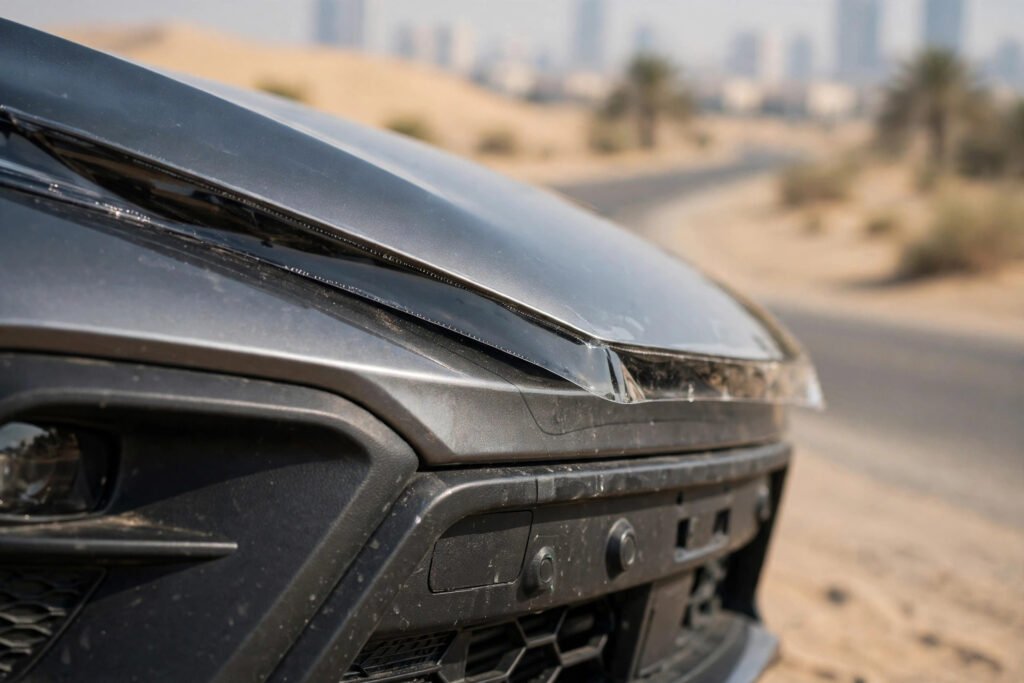
Third, there is the driving itself. Long, fast motorway runs are normal here. Dubai to Abu Dhabi, Dubai to Sharjah and back, trips out towards the desert — at motorway speed, even a small stone or a piece of grit kicked up by the lorry in front of you hits with real force. That is how the front of a car ends up peppered with little white chips, one after another, until the bumper and the leading edge of the bonnet look tired even though the rest of the car is still in good shape. If you do a lot of motorway driving, your front end is doing a lot more work than the rest of the car, and it shows.
Fourth, there is parking. Tight underground car parks, busy malls, school pick-up, villa driveways where the kids' bikes live next to the car — doors open, trolleys roll, bags brush past. Most of those knocks are light, but light is enough to mark unprotected paint, especially on door edges and sills.
None of this means every car in Dubai needs full protection. It means the conditions here are genuinely tougher than in a mild, rainy climate where a car mostly sits in a garage and does short, slow trips. When you are weighing up PPF versus ceramic, you are not weighing up a luxury add-on in the abstract. You are weighing up how your car actually lives, day to day, in this city. A car that does short trips and parks underground is a different case from a car that does long motorway runs every week and parks outside. Keep your own routine in mind as you read, because the right answer for your neighbour might be the wrong answer for you.
What PPF Actually Is
Paint protection film is exactly what the name says: a film that protects paint. It is a clear, flexible sheet, usually made from a tough urethane material, that is cut to fit a panel and then applied by hand with a solution, a squeegee, and a lot of patience. The installer cleans the paint properly first, then lays the film down, works out the water and air underneath it, trims it to the edges, and seals it. When it is done well, you have to look closely to see it at all. When it is done badly, you will see it from across the car park.
The point of the film is simple. It is a sacrificial layer. It sits between your paint and the world. A stone hits the film, not the paint. A light scuff marks the film, not the clear coat underneath. If the film gets damaged, in many cases that one piece can be replaced without repainting the panel. That is the whole idea, and it is a good one.
Most modern films have a property people call self-healing, and it is worth understanding what that really means, because the name makes it sound more magical than it is. A light, shallow mark in the film — the kind left by a fingernail, a soft brush, or a light rub — can fade when the film is warmed, either by the sun or by warm water. The film softens very slightly and the shallow mark levels out. It is a real effect and it is genuinely useful. But it has limits. It will not heal a deep cut, a tear, or a mark that has gone right through the film. It will not fix a dent. It will not undo a bad installation. Think of it as the film being forgiving of light marks, not invincible.
PPF is usually applied to the parts of the car that are most exposed. The most common starting point is the front: bumper, bonnet, front wings, headlights, and mirrors. That is often called a front package, although different installers use different names for it. Some owners go further and cover the full bonnet and wings rather than just the leading edge. Some cover the doors, the sills, the rear bumper top where luggage gets dragged across, and the door handle cups where fingernails scratch every day. A full-body wrap covers the whole car. Each step up covers more paint, and each step up takes more time, more film, and more skill to fit neatly, especially around curves, badges, and panel gaps.
That fitting skill is everything with PPF. The film itself matters, of course — a good film stays clear, resists yellowing, and stays stuck down — but two cars can have the same film and look completely different depending on who fitted it. A careful installer takes time over the edges, tucks them where they should be tucked, and does not stretch the film so hard around a curve that it wants to lift back later. A rushed installer leaves visible edges, trapped dust, bubbles, and corners that start to peel after a few washes. You cannot judge that from a price list. You judge it by looking at cars they have actually done, by seeing the edges up close, and by asking what happens if an edge lifts.
One thing people often get wrong about PPF is the idea that it makes the car look different. Good, clear film should not change the colour of your car in any noticeable way. On a gloss car it should look like gloss paint. On a dark car, if the paint underneath is clean and polished before the film goes on, the film will show that clean paint. What it will not do is hide damage that is already there. If there are swirl marks, chips, or dull patches under the film, they will still be there, just under a clear layer. That is why proper preparation matters so much. The paint needs to be cleaned, and in many cases lightly polished, before the film goes on. If someone offers to put film straight over a dirty or unprepared car, that is a warning sign, not a bargain.
Another thing to be clear about: PPF is not maintenance-free. It needs washing, just like paint does. It can stain if bird droppings or bug splatter are left on it for a long time in the heat. Its edges can lift if you aim a pressure washer directly at them. It can be marked by harsh chemicals. It is tough, but it is not a fit-and-forget product. Later in this guide we will go through exactly how to look after it, because a lot of the disappointment people feel about PPF comes not from the film itself, but from treating it as if it needs no care at all.
What Ceramic Coating Actually Is
Ceramic coating is a liquid product that is applied to the paint by hand, usually panel by panel, and then left to cure and bond to the surface. Once cured, it forms a thin, hard, transparent layer on top of the clear coat. You cannot see it as a separate layer in the way you can see the edge of a film. You notice it by how the car behaves: water beads up, dirt slides off more easily, and the paint often looks glossier and deeper, especially after a wash.
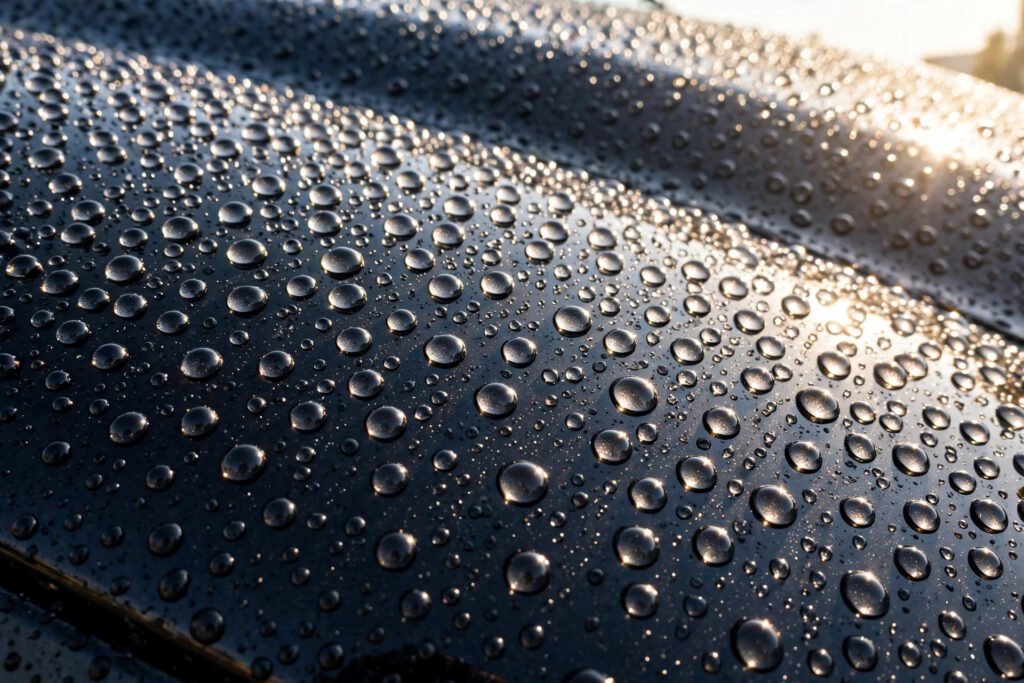
The main thing ceramic coating gives you is a change in how the surface behaves. Uncoated paint lets water spread out and sit flat. Coated paint makes water form into beads that roll off. That is called hydrophobic behaviour, and it is the thing most owners notice first. After rain, or after a wash, the car dries faster and there are fewer water spots — although not none, and we will come back to that, because Dubai water and Dubai sun together can still leave marks if a car is left to dry in direct heat with water sitting on it.
Ceramic coating also makes washing easier, in a practical, everyday way. Dust and road grime do not grip the surface quite as hard, so a proper wash takes less scrubbing, and less scrubbing means fewer new swirl marks over time. That is a real benefit, and for a lot of owners it is the main reason they get it. If you wash your car often, or you pay someone to wash it, a coated car is simply more pleasant to keep clean.
It also gives some resistance to chemicals. Bird droppings, tree sap, bug splatter, and certain road chemicals are less likely to eat straight into the paint if they land on a coating, because the coating is in the way. The key words there are "less likely" and "if you clean them off." A coating buys you time. It does not give you permission to leave a bird dropping baking on a black bonnet in August for two weeks and expect no mark at all. In Dubai heat, anything left on paint for long enough will cause trouble, coating or no coating. The sensible habit is the same either way: get it off promptly, gently, with water, and do not scrub it dry.
What ceramic coating does not give you is impact protection. This is the point that causes the most confusion and the most disappointment, so let me say it as plainly as I can. A ceramic coating is measured in microns — it is an extremely thin layer. A stone travelling at motorway speed does not care about a thin layer. It will go straight through it and chip the paint underneath, just as it would have done without the coating. A key dragged along a door will still scratch. A shopping trolley will still mark. The coating might make a very light, very shallow mark slightly less likely to bite into the clear coat, but it is not armour. If someone tells you a ceramic coating will protect your car from stone chips, they are either mistaken or they are selling you something under the wrong name.
Ceramic coating also does not fix paint that is already damaged. It will not fill in a chip. It will not remove swirl marks on its own. It will not make a faded panel look new. In fact, it will lock in whatever is underneath it. That is why a proper ceramic job starts with a proper wash and, in most cases, a polish to remove swirl marks and bring the paint back to a good condition first. The coating then preserves that good condition. If the preparation is skipped, you end up with glossy swirl marks — shiny, but still swirled. That is why preparation is not an optional extra. It is most of the job.
There are different grades and types of ceramic products, and different installers will use different ones, but for you as an owner, the brand name matters less than three things: was the paint properly prepared, was the coating applied evenly and allowed to cure properly, and were you told honestly how to look after it afterwards? A modest coating applied well to well-prepared paint will serve you better than a top-of-the-range product rushed onto unprepared paint.
Ceramic coating needs care too. It is not permanent in the sense that you can forget about it. It wears over time, especially on panels that are washed often, exposed to harsh chemicals, or cleaned with abrasive methods. It can be topped up or maintained with the right products, and it can be reapplied when it has worn down. How long it lasts in practice depends on the product, the preparation, how the car is washed, where it is parked, and how much sun and dust it sees. Any installer who gives you a single fixed number for every car, without asking how you use yours, is giving you a sales figure, not an honest estimate. Ask instead what affects its life, what maintenance it needs, and what the warranty actually covers — we will cover those questions in detail later.

PPF vs Ceramic Coating: The Side-by-Side Comparison
Talk is useful, but a table makes the difference easier to see at a glance. Keep this in mind as you read the rest of the guide — the details below explain why each row is the way it is.
| What you are comparing | Paint Protection Film (PPF) | Ceramic Coating |
|---|---|---|
| What it is | A clear, tough physical film applied to the paint | A liquid that cures into a thin, hard layer bonded to the paint |
| How thick it is | A physical layer you can feel at the edge | Extremely thin — you cannot feel an edge |
| Stone chips | Yes — this is its main job. It takes the impact so the paint does not | No — a stone will go through it and chip the paint |
| Light scratches and scuffs | Yes, for light marks. Many films can self-heal shallow marks with warmth | Only very limited help. It does not make paint scratch-proof |
| Swirl marks from washing | Helps, because the film takes the marks instead of the paint, and light marks may fade | Helps indirectly, because the car is easier to wash with less scrubbing, so fewer new swirls form |
| Water beading and easier washing | Some water repellence, but this is not its main strength | Yes — this is one of its main strengths. Water beads and rolls off, dirt releases more easily |
| Gloss and depth | Keeps the paint looking as it was underneath. Good film is clear and glossy, but it does not add depth the way a coating can | Often adds noticeable gloss and depth, especially on dark colours |
| Chemical resistance | Good resistance to many everyday contaminants, as a physical barrier | Good resistance as a sacrificial layer, but contaminants still need to be cleaned off promptly |
| Bird droppings and bug splatter | The film takes the hit. Clean them off promptly and the paint underneath is protected | The coating gives you extra time, but the mark still needs to be removed promptly |
| Sun and fading | Helps shield the paint underneath from direct exposure | Helps, but it is a thin layer, not a shade. Parking and care still matter most |
| How visible it is | Almost invisible when fitted well. Edges can be visible up close if you look for them | Invisible. No edges to see |
| What happens if it is damaged | The damaged piece of film can often be replaced without repainting the panel | The coating cannot be patched like film. The panel usually needs to be prepared and recoated |
| Maintenance | Wash normally and gently. Do not aim a pressure washer at the edges. Keep contaminants off it | Wash with suitable products and methods. Avoid harsh chemicals and abrasive washing. May need periodic maintenance |
| Best for | Cars that do motorway miles, cars with vulnerable front ends, owners who want to prevent chips | Cars that are washed often, dark cars, owners who want easier cleaning and more gloss |
| Main limitation | It is a film, so edges, fitting quality, and care around those edges matter. It does not make washing effortless on its own | It is thin, so it gives no real impact protection. It locks in whatever condition the paint was in when it was applied |
Read that table twice. The pattern is clear: PPF protects by being in the way, physically. Ceramic protects by changing how the surface behaves. Neither one does the other one's job properly. That is why so many of the arguments you hear about which one is "better" miss the point. They are not two versions of the same thing. They are two different tools.
What PPF Actually Protects Against — And What It Does Not
PPF is genuinely good at protecting against stone chips. That is the headline, and it is true. On a motorway, small stones, grit, and road debris are constantly being thrown up. Without film, each one can leave a tiny chip in the paint, and over time those chips add up, especially on the bumper, the leading edge of the bonnet, and the front wings. With film, the stone hits the film. The film may mark, but the paint underneath is usually untouched. That is a real, visible difference after a year or two of motorway driving, and it is the reason so many owners who do long trips choose PPF for the front of the car at least.
PPF is also good against light scratches and scuffs. The kind of mark left by a fingernail around a door handle, a bag brushing against a sill, a light touch in a car park — those are the marks a film can absorb or, if they are shallow, heal with warmth. It will not protect against a deep key scratch that cuts through the film, and it will not protect against a dent. If someone reverses into your door, no film will save the panel. That is bodywork, not paint protection.
PPF helps against swirl marks too, but in a different way from ceramic. Swirls are usually caused by washing with grit on the surface or with a rough cloth. If the film is on the paint, the swirls form in the film, not in your clear coat. And because many films self-heal light marks, some of those faint swirls fade over time in the sun. That does not mean you can wash a filmed car carelessly. It means you have a more forgiving surface to work with.
PPF also gives a physical barrier against bird droppings, bug splatter, tree sap, and road tar. Those things land on the film, not on your paint. That is useful, because in Dubai heat they can bake on quickly and stain. The film gives you a better chance of cleaning them off without leaving a mark on the paint underneath. But again, "better chance" is not "no need to clean." If you leave a dropping on the film for weeks in summer, it can still stain the film itself. Clean it off gently and promptly, and you will get the benefit.
What PPF does not do is make your car easier to wash in the way ceramic does. A filmed car still gets dusty. Dust still settles on it. Water does not bead and roll off a plain film in the same dramatic way it does on a fresh ceramic coating, although some films do have a water-repellent top layer. If your main frustration is that your car looks dirty two days after every wash, PPF alone will not solve that feeling. It will protect the paint, but it will not change the daily experience of keeping the car looking clean.
PPF also does not hide existing damage, and it does not fix faded paint. If the bonnet is already chipped, filming over it will seal those chips in. They will still be visible, just under a clear layer. If the paint is dull, the film will show dull paint. A good installer will tell you this and will suggest polishing or touching up the worst chips first. A poor installer will just film over the lot and let you discover it later.
Finally, PPF does not last forever without care. It can yellow over time, especially if it is a lower-quality film or if it is left dirty and exposed to harsh chemicals. Its edges can lift if they are not fitted well or if a pressure washer is aimed straight at them. It can stain, it can peel, and it can look tired if it is neglected. That does not make it a bad product. It makes it a product that needs the same honest care as any other part of the car.
What Ceramic Coating Actually Does — And What It Does Not
Now the same honest treatment for ceramic coating, because it is the product that gets oversold most often.
Ceramic coating is genuinely good at making a car easier to keep clean. That is its strongest, most everyday benefit, and it is the one owners notice most in the first weeks after it is applied. Water beads. The car sheds water after rain. Dust does not cling as stubbornly. When you wash it properly, the dirt comes off with less effort, and because you are scrubbing less, you are putting fewer new swirls into the paint over time. For someone who washes their car every week, or who has it washed professionally, that difference adds up. It is not a small thing. It is the difference between a car that is a chore to keep looking good and a car that is noticeably easier to live with.
It is also genuinely good for gloss. On a well-prepared car, especially a dark one, a ceramic coating can make the paint look deeper, wetter, and more reflective. That is partly the coating itself, and partly the fact that a proper ceramic job includes a proper polish beforehand, which is what really brings the paint back to life. Do not underestimate that polish. A lot of the "wow" people see on the day they collect a ceramic-coated car is the polish, preserved by the coating. That is a good thing, as long as you understand where the gloss came from and that keeping it means keeping up the washing habits that protect it.
Ceramic coating gives useful chemical resistance too. Bird droppings, tree sap, bug splatter, and some road chemicals sit on the coating rather than directly on the clear coat. That buys you time to clean them off before they etch into the paint. In Dubai, where a dropping can bake hard in a single hot afternoon, that extra time matters. But it is extra time, not immunity. The habit is still the same: see it, soften it with water, remove it gently, do not scrub it dry. If you leave it there, coating or no coating, you are asking for a mark.
Ceramic coating helps with water spots, but it does not eliminate them. This is a point worth pausing on, because Dubai water is hard and the sun is strong. If you wash a car and leave it to dry in direct sun, water droplets can leave mineral marks behind, even on a coated car. The coating helps the water roll off, so there is less water sitting there in the first place, but it does not make hard water harmless. Drying the car properly, in shade where possible, still matters. So does not washing the car in the middle of the day when the panels are hot enough to dry the soap before you can rinse it.
What ceramic coating does not do, and this needs to be said clearly again because it is the most common misunderstanding, is protect against stone chips. It is too thin. A stone at motorway speed will go through it. If your front bumper is already peppered with chips and you put ceramic coating on it without PPF, you will have a glossy, easy-to-wash bumper that still gets new chips every week. The coating will not stop them. It was never designed to.
It also does not make paint scratch-proof. It is harder than bare clear coat, and it may resist very light marring slightly better, but a key, a stone, a zip, or a gritty cloth will still scratch it. The word "scratch-proof" should never appear in an honest conversation about ceramic coating. The honest word is "scratch-resistant to light marks, in some conditions." That is a much less exciting sentence, but it is the true one.
It does not remove swirl marks, and it does not fill chips. It preserves the condition of the paint as it was when it was applied. If the paint was polished properly first, that is a good condition to preserve. If it was not, you have preserved swirls and dullness under a glossy layer. Always ask what preparation is included before you agree to a ceramic job, and be suspicious of any job that promises a coating with no preparation at all.
And it does not last forever. It wears down, gradually, from washing, from sun, from dust, and from time. It does not suddenly fall off one day. It just becomes less hydrophobic, less slick, less effective, panel by panel. That is normal. What matters is whether the installer told you that, told you how to maintain it, and told you what happens when it needs to be refreshed. A coating that is sold as "fit and forget forever" is a coating that will disappoint you.
The Dubai Test: Sun, Sand, Motorways, and Parking
Let us put both products through the conditions your car actually faces here, one by one, because the brochure version of protection and the Dubai version are not the same.
Sun first. Dubai sun is strong for most of the year, and it punishes paint that is left outside. Over time, unprotected paint can oxidise and fade, and the clear coat can lose its gloss. Both PPF and ceramic coating help here, but in different ways and to different degrees. PPF puts a physical layer between the sun and the paint. Ceramic puts a thin chemical layer there. Both are better than bare paint, but neither one is a substitute for shade. If you can park in shade, in an underground car park, or under a cover, do it. That one habit will do more for your paint over five years than any product. If you cannot, and your car lives outside, protection becomes more worthwhile, because the paint is taking the full force of the sun every day. Just do not expect a coating or a film to make a car that lives in an open car park in August look like a car that lives in a garage. It will help, but it will not work miracles.
Sand and dust next. This is the quiet killer of paint in Dubai. It is not dramatic like a stone chip. It is slow. Fine dust settles on the car every night. In the morning, someone wipes it off with a dry cloth, or a wash uses a cloth that has already picked up grit, and thousands of tiny scratches are made. Over a year, that is the haze you see on so many cars. Ceramic coating helps here, because a slicker surface means less scrubbing and less chance of dragging grit across the paint. PPF helps too, because the grit marks the film instead of the paint, and light marks in the film may heal. But neither product helps if the washing method is wrong. The single most important habit for paint in Dubai is not which product you buy. It is washing properly: rinse the dust off first, use clean water and a clean wash mitt, do not wipe a dusty car dry, and do not use a rough cloth. If you get the washing right, both products will last longer and look better. If you get it wrong, both will suffer.
Motorways next. This is where PPF earns its money. At motorway speed, a small stone is not small any more. It hits hard. If you drive to Abu Dhabi regularly, or you spend a lot of time on Sheikh Zayed Road and the outer motorways, your front end is being sandblasted, slowly, every week. Ceramic coating will not stop that. PPF will. This is the clearest dividing line in the whole comparison. If motorway chips are your main complaint, the answer is PPF on the front, not ceramic. If you rarely leave the city and mostly do short, slow trips, chips are less of an issue, and ceramic on its own becomes a more sensible choice.
Parking and daily knocks next. Door edges, sills, handle cups, rear bumper tops — these are the places that get touched every day. PPF on those small areas can be very effective, because it takes the daily wear that would otherwise go straight into the paint. Ceramic helps a little here too, because a slicker surface is slightly more forgiving, but it is not a physical barrier, so a bag dragged across a sill will still mark a coated car. For these high-touch areas, film is the practical answer, even if it is only a small piece of film in the right place.
Desert trips deserve a mention of their own. If you take your 4x4 out to the desert, the paint faces a different kind of punishment: fine sand blowing at speed, branches and scrub brushing against the sides, dust getting into every gap. PPF on the sides and front can take a lot of that punishment. Ceramic on its own will not. If desert driving is a regular part of your life, read our guide to preparing your 4x4 for desert season as well, because protection is only one part of getting a car ready for that kind of use. The point here is simple: the rougher the driving, the more the case for a physical film grows.
Finally, washing. In Dubai, a lot of cars are washed by someone else — a building wash, a petrol station wash, a mobile wash at your home or office. That is convenient, but it means you are not always in control of the method. A coated car is more forgiving of a quick wash, because dirt releases more easily. A filmed car is more forgiving of a slightly rough wash, because the film takes the marks. Neither is forgiving of a truly bad wash — a dirty cloth, a gritty sponge, a dry wipe on a dusty car. If you have your car washed by someone else, ask them how they wash it, and look at the cloths they use. That conversation will protect your paint more than any product on its own.
When PPF Makes the Most Sense
PPF is not for everyone, and anyone who tells you it is has stopped listening to what you actually need. It makes the most sense in a few clear situations.
It makes sense if you do a lot of motorway driving. If your week includes regular long runs, and your front bumper and bonnet are already showing chips, that is the car telling you what it needs. Film on the front will stop new chips from reaching the paint. You will still get marks in the film over time, but the paint underneath will stay in much better shape, and that is what matters when it comes to keeping the car looking tidy and holding its condition.
It makes sense if you have just bought a new car and you plan to keep it for several years. A new car has perfect paint. That is the best time to protect it, because the film goes onto clean, unchipped paint and preserves it from day one. Waiting a year, letting the front end get chipped, and then filming over the chips is still better than nothing, but it is not the same as starting clean. If you have just taken delivery and you are already thinking about protection, talk about PPF before the car has done its first long motorway run.
It makes sense if your car is a colour that shows chips badly. White and silver hide small chips better than most colours. Black, dark blue, dark grey, and red show every white dot where the paint has chipped down to primer or metal. If you have a dark car and you drive on motorways, you will see the chips sooner and they will bother you more. That does not mean a white car does not need PPF — it still gets chipped, you just notice it less — but the visual case is stronger on dark colours.
It makes sense if you take your car off-road or out to the desert, even occasionally. Branches, sand, and grit do not care about your paint. Film on the front, sides, and sills takes the punishment that would otherwise go straight into the clear coat. For a 4x4 that is used as a 4x4, that is not a luxury. It is practical protection for the way the car is actually used.
It makes sense if you are particular about your paint and you notice every mark. Some owners can live with a few chips. Others cannot, and it genuinely bothers them every time they walk up to the car. There is nothing wrong with that. If you are the kind of person who notices, and you are going to keep the car for a while, PPF will give you peace of mind that ceramic alone will not. Be honest about which kind of owner you are. It is your money and your car.
It makes less sense if you rarely drive on motorways, you mostly do short city trips, your car already has a lot of chips and faded paint that would need a lot of work before filming, or you are planning to sell the car soon. In those cases, the benefit is smaller, and the money might be better spent on a proper polish, a ceramic coating for easier washing, or simply keeping the car clean and tidy. PPF is an investment in the future condition of the paint. If that future is short, the return is smaller.
When Ceramic Coating Makes the Most Sense
Ceramic coating makes the most sense when your main frustration is not chips, but keeping the car looking clean and glossy.
It makes sense if you wash your car often, or you have it washed often, and you want that wash to be easier and to last longer. A coated car sheds water, releases dirt more easily, and dries with fewer marks. If you are someone who notices that your car looks dusty again two days after a wash, ceramic will not stop the dust from settling — nothing will, in Dubai — but it will make the next wash quicker and less likely to add new swirls.
It makes sense if you have a dark car. Black, dark blue, and dark grey cars look superb when they are clean and coated, and they show every swirl and every water mark when they are not. Ceramic coating, applied after a proper polish, is one of the best ways to get that deep, wet look and to keep it for longer, because the slick surface is more forgiving and the gloss is protected by the coating. If you love the look of a freshly detailed dark car, ceramic is the product that helps you keep something close to that look between washes.
It makes sense if your car is parked outside and exposed to bird droppings, tree sap, and dust. The coating gives you extra time to clean those things off before they etch into the paint. That is not a small benefit in Dubai, where a car parked under a tree or near a building with birds can be marked in a single day. The habit still matters — clean it off promptly — but the coating gives you a margin that bare paint does not.
It makes sense if you want the whole car to look even and glossy, not just the front. PPF is usually applied to specific panels. Ceramic is usually applied to the whole car. If you want a consistent finish, with water beading the same way on the roof as it does on the bonnet, ceramic gives you that. It is a whole-car treatment in a way that a front-only PPF package is not.
It makes sense if you are not ready for PPF, or you do not need it, but you still want your paint to be protected and easier to look after. Ceramic is a sensible middle step. It is less involved than a full film wrap, it covers the whole car, and it makes a real difference to daily care. For a lot of owners, especially those who do mostly city driving, it is the right choice on its own.
It makes less sense if your main problem is stone chips, if your paint is already badly chipped and you are hoping a coating will hide it, or if you are not willing to wash the car properly afterwards. A coating will not hide chips. It will not survive bad washing. And it will not make a car that is never washed look clean. If you are not going to look after it, the benefit will fade quickly, and you will feel as if you paid for something that did not last. The honest answer in that case is to spend the money on regular, proper washing first, and think about coating later.
When Both Together Makes Sense — And When It Does Not
A lot of owners ask me, "Can I have both?" Yes, you can. And in the right circumstances, it is the best combination available.
The usual way it works is this: PPF goes on the panels that need physical protection — the front bumper, the bonnet, the wings, the mirrors, sometimes the doors and sills — and ceramic coating goes over the top of the film and the rest of the paint. The film does the hard work of stopping chips and scratches. The coating makes the whole car, film and paint alike, easier to wash, glossier, and more water-repellent. The result is a car that is protected where it is most vulnerable and easy to keep clean everywhere else.
That combination makes sense if you plan to keep the car for a long time, you drive on motorways regularly, you care about the paint, and you are willing to look after it afterwards. It is the most complete protection you can get without wrapping the car in something far more extreme. If you have just bought a new car that you love and you want to keep it looking new for years, this is the route most detailers will suggest, and for once the suggestion is not just about selling you more. It is about using each product for the job it is actually good at.
It does not make sense if you are selling the car soon, if you rarely drive on motorways, if your budget is tight, or if you are not going to wash the car properly afterwards. In those cases, doing both is spending money on protection you will not use. Pick the one that solves your main problem, do it well, and look after it. That will serve you better than doing both badly or doing both and then neglecting the car.
There is also a practical point about order. PPF goes on first, directly onto clean, prepared paint. Ceramic goes on after, over the film and the paint. You cannot put film over a fresh ceramic coating and expect it to stick properly. If someone suggests doing it the other way round, that is a misunderstanding of how the products work, and you should ask them to explain their process carefully. The sequence matters, and any installer who does both regularly will know it.
And a word about cost, in general terms, without numbers, because the numbers vary so much by car size, by coverage, and by installer. PPF is the more involved job. It takes more time, more material, and more skill to fit. Ceramic is also a skilled job, because the preparation and the application matter so much, but it is usually less involved than a full film wrap. Doing both is the most involved route of all. That is not a reason to avoid it. It is a reason to be clear about what you are paying for, to get the scope in writing — which panels, which product, what preparation is included — and to compare like with like when you get quotes. A quote that looks cheap because it covers half the panels is not cheaper than a quote that covers the whole front properly. It is just a different job.
Partial PPF, Full PPF, and Which Panels Actually Matter
One of the most practical questions you will face is not just "PPF or ceramic?" but "How much PPF?" Because PPF is fitted panel by panel, you can choose how far to go, and that choice affects both the protection you get and the amount you spend.
The front is where most of the damage happens, and it is where most owners start. The front bumper takes the brunt of stones and bugs. The leading edge of the bonnet takes the next hit. The front wings, the mirrors, and the headlights are also in the line of fire. Covering those areas is the most efficient use of film, because you are protecting the panels that are most likely to be chipped. For a car that does a lot of motorway driving, a front package is often the single best investment in paint protection you can make.
Some owners go further and cover the full bonnet and the full front wings, rather than just the leading edge. The reason is simple: a partial bonnet leaves a visible line across the bonnet where the film ends, and stones can still chip the uncovered part. A full bonnet costs more in film and time, but it looks cleaner and it protects the whole panel. Whether that matters to you depends on how much you notice the line and how much motorway driving you do. Ask the installer to show you the line on a car they have done with a partial bonnet, and decide for yourself.
Doors, sills, and rear bumper tops are the next level. These are not about stones. They are about daily life. Door edges get knocked in car parks. Sills get scuffed by shoes. The top of the rear bumper gets marked every time luggage is dragged across it. Small pieces of film in those places can prevent a lot of small, annoying marks that add up over time. They are not glamorous, but they are practical, and they are often the areas owners wish they had protected after the first year.
A full-body wrap covers the whole car. That is the most complete protection, and it is also the most time-consuming and the most expensive. It makes sense for a new car that you plan to keep for a long time, for a car that is used in rough conditions, or for an owner who wants the paint preserved as completely as possible. It does not make sense for every car. For most owners, a well-chosen front package, plus a few high-touch areas, plus a ceramic coating over the whole car, gives most of the benefit without covering panels that rarely get damaged.
Whatever level you choose, ask the installer to list the panels in writing. "Front PPF" can mean different things to different people. Does it include the mirrors? The headlights? The full bonnet or just the front half? The front wings fully or partly? Get the list, so you know what you are paying for and so you can check it when you collect the car. A clear list protects both you and the installer, and it avoids the awkward conversation later when you realise a panel you thought was covered was not.
New Car, Used Car, and the Paint You Already Have
The condition of your paint when you start matters a great deal, and it changes the advice.
If your car is new, or nearly new, you are in the best position. The paint is clean, unchipped, and unswirled. Protection applied now preserves that condition. You do not need a lot of correction work first, and the result will be the best it can be. If you are thinking about PPF or ceramic, this is the time to do it — before the first long motorway run, before the first summer of sun, before the paint has had a chance to pick up the marks that you will then have to live with under a clear layer.
If your car is a year or two old and in good condition, with a few light swirls and a few small chips, you are still in a good position, but you need preparation. The swirls will need to be polished out before a ceramic coating goes on, otherwise you will be preserving them. The chips will need to be assessed before PPF goes on — small chips can often be touched up, but they will still be visible under the film if you look closely. A good installer will be honest about this. They will show you the chips, explain what can be done, and tell you what will still be visible afterwards. That honesty is worth more than a promise that everything will look perfect.
If your car is older, with faded paint, heavy swirling, and a lot of chips, protection is still possible, but the conversation changes. The question becomes: is it better to spend money on protection, or to spend it first on restoring the paint — a proper polish, a touch-up, or in some cases a respray of the worst panels — and then protect the restored paint? There is no single right answer. It depends on the car, on how long you plan to keep it, and on how much the appearance matters to you. What you should not do is put an expensive film or coating over paint that is already in poor condition and expect it to look new. It will not. It will look like poor paint under a clear layer.
Colour matters too, in a practical way. Dark cars show swirls, chips, and water marks more clearly than light cars. That means the benefit of protection is more visible on a dark car, but it also means the preparation has to be better, because any swirl left under a coating will show. White and silver cars hide small marks better, which is forgiving, but they can also show staining and yellowing more clearly if a film is neglected. There is no colour that does not benefit from protection, but the reasons are slightly different, and a good installer will talk to you about your colour specifically, not just in general terms.
And size matters, in a practical sense. A small hatchback has less paint to cover than a large SUV or a 4x4. That affects the time, the amount of film, and the work involved. It does not change the principles, but it does mean you should compare quotes for your car, not for a generic car. If someone gives you a price without asking what car you have, they are not quoting for your job.
How Long Does Each One Last? The Honest Answer
This is the question every owner asks, and it is the question that gets the most misleading answers, because there is no single number that applies to every car.
How long PPF lasts depends on the quality of the film, the quality of the fitting, how the car is used, how it is washed, where it is parked, and how much sun and heat it sees. A well-fitted, good-quality film on a car that is washed properly and parked in shade will last longer than the same film on a car that is washed badly, left in the sun, and cleaned with harsh chemicals. That is not a vague answer to avoid giving you a number. It is the truth. Any installer who gives you a single fixed lifespan for every car, without asking how you use yours, is not giving you a realistic estimate.
The same is true for ceramic coating. Its life depends on the product, the preparation, the application, and the aftercare. A coating on a car that is washed gently with suitable products, kept clean, and maintained as the installer recommends will last longer than the same coating on a car that is washed with harsh chemicals, scrubbed with a rough cloth, or left dirty for weeks at a time. It wears gradually, not suddenly. You will notice it first as water beading less, or the surface feeling less slick, or dirt clinging a little more stubbornly. That is the coating telling you it needs attention.
What you should ask, instead of "How long will it last?", is a set of better questions, which we will cover in full in the warranty section later. How does it wear? What does the warranty actually cover? What maintenance does it need? What happens when it needs to be refreshed or replaced? Those answers will tell you far more about what you are buying than a single number ever will.
One thing you can rely on: neither product is permanent. Both are maintenance items, not one-time fixes. PPF will eventually need to be replaced on a panel if it becomes too marked, stained, or damaged. Ceramic will eventually need to be maintained or reapplied. That is normal. It does not mean the product failed. It means it did its job for a period of time and now needs attention. Budget for that in your head when you are deciding. If you are not willing to maintain it, do not buy the most involved option. Buy the simpler one, look after it well, and you will get more from it.
How to Care for PPF, Step by Step
PPF is tough, but it is not care-free. How you wash it and how you treat its edges will decide how long it looks good.
First, wait before you wash it. After PPF is fitted, the film needs time to settle and bond fully. Your installer should tell you how long to wait before the first wash, and you should follow that advice, not guess. Washing too soon, especially with a pressure washer, can lift an edge that has not fully settled yet. If the installer does not tell you a waiting time, ask. It is a basic part of the handover, and any installer who does not mention it has missed a step.
When you do wash a filmed car, wash it gently, in the same way you would wash good paint. Rinse the dust and loose dirt off first, before you touch the car with anything. Use clean water, a clean wash mitt, and a suitable car shampoo. Work panel by panel, rinse often, and do not let soap dry on the surface in the sun. That advice sounds basic, but it is the advice that prevents most of the damage I see. Most PPF problems are not caused by the film failing. They are caused by washing that drags grit across the surface, or by soap drying in the heat and leaving marks.
Be careful around the edges. This is the one rule that is specific to PPF. Do not aim a pressure washer directly at the edge of the film. A pressure washer held close to an edge can get underneath it and lift it. Keep the nozzle back, keep it at an angle, and let the water flow across the film, not into the edge. The same applies to a strong jet at a petrol station wash. If you use a pressure washer at home, keep your distance and do not chase an edge. If someone else washes your car, tell them it has PPF and ask them to be careful around the edges. Most good washers will know this, but it is worth saying.
Do not use harsh chemicals, abrasive polishes, or rough cloths on the film. If you need to remove bug splatter, bird droppings, or tar, soften it first with water or a suitable gentle cleaner, let it sit for a moment, and then wipe it away gently. Do not scrape it off dry. Do not use a rough sponge. The film can take a lot, but it is still a surface that can be marked by abrasive treatment. Treat it as you would treat good paint, and it will last longer.
Bird droppings and bug splatter deserve a special mention in Dubai, because the heat makes them bake on fast. The rule is the same as for paint, but it matters even more on film, because a stain in the film is a stain you will see every day. If you see a dropping, get it off the same day if you can. Soften it with water, lift it gently, and rinse the area. Do not leave it for the weekend. Do not leave it for next week. A few minutes now saves you a mark that might not come out later.
Check the edges occasionally. After a wash, have a quick look at the edges of the film, especially on the bonnet, bumper, and mirrors. If an edge is starting to lift, do not pull at it, and do not try to stick it back down yourself with glue or tape. Take it back to the installer and let them deal with it. A small lift caught early is a quick fix. A lift that is pulled at, or left to collect dirt underneath, becomes a bigger job. The same applies to a bubble or a piece of trapped dust that appears after fitting. Do not poke it. Show the installer.
Finally, do not polish PPF in the way you would polish paint, unless the installer specifically tells you a product is suitable. Some films can be treated with certain maintenance products, and some cannot. If you are unsure, ask the installer what they recommend for maintenance, and use that. Using the wrong product can dull the film or damage its top layer, and that is a problem that is hard to undo.
If you look after PPF well, it will look good for a long time. If you neglect it, it will show it. That is not a fault in the product. It is just how a physical layer on the outside of a car behaves.
How to Care for Ceramic Coating, Step by Step
Ceramic coating is also not fit-and-forget. It needs the right washing habits, and it rewards them.
The first rule is the same as for PPF: wait after application. A fresh ceramic coating needs time to cure. Your installer should tell you how long to avoid washing the car, and whether to avoid rain or water in the first day or so. Follow that advice. Washing too soon can interfere with the curing, and that can affect how well the coating bonds. If you are not told a curing time, ask for it in writing before you leave.
After that, wash the car properly, and wash it regularly. That sounds obvious, but it is the heart of ceramic care. A coating works best when it is clean. If dirt, dust, and road film are left to build up for weeks, the coating cannot bead water properly, it cannot feel slick, and it cannot protect the paint underneath as well as it should. Regular, gentle washing keeps the coating working. It does not need to be a long, complicated wash. It needs to be a proper wash: rinse first, use a clean mitt and suitable shampoo, rinse well, and dry the car properly.
Use suitable products. Harsh, highly alkaline cleaners, strong degreasers, and abrasive compounds can wear a coating down faster than normal washing. That does not mean you cannot ever use a stronger cleaner for a specific problem, but it does mean your everyday wash should be with a product that is suitable for a coated car. If you are not sure what to use, ask the installer what they recommend. They should be able to tell you, in plain terms, what to use and what to avoid. If they cannot, that tells you something about the handover.
Do not wash the car in direct sun when the panels are hot, if you can avoid it. In Dubai, that is not always easy, but it is worth trying. When soap or water dries on a hot panel, it can leave marks, even on a coated car. Wash in the shade, or early in the morning, or in the evening when the car has cooled down. Rinse panel by panel, and dry the car after washing instead of letting it air-dry in the sun. A clean drying towel, used gently, will prevent most water marks. Letting the car dry itself in the heat will cause them.
Do not wipe a dusty car dry. This is one of the most common causes of swirl marks in Dubai, and it applies to coated cars just as much as to uncoated ones. If the car is covered in dust, rinse that dust off first. Do not take a dry cloth and wipe it across the paint, because you are dragging fine grit across the surface. The coating might be slightly more forgiving than bare paint, but it is not forgiving enough to survive that habit for long. If you have the car washed by someone else, check how they do it. A good wash starts with a rinse. A bad wash starts with a dry cloth.
Remove contaminants promptly. Bird droppings, bug splatter, tree sap, and tar should be removed as soon as you notice them, not left to bake. On a coated car, they will sit on the coating, and you have more time than you would on bare paint, but that time is still limited in Dubai heat. Soften the mark with water, lift it gently, and rinse. Do not scrub it dry. Do not use a harsh chemical unless you know it is safe for the coating. The habit is simple: see it, soften it, remove it gently, rinse.
Watch for the signs that the coating is wearing. Water beading less, water sitting flat instead of rolling off, the surface feeling less slick, dirt clinging more than it used to — those are all signs that the coating is wearing down. That does not mean it has failed overnight. It means it is time to talk to the installer about maintenance. Many coatings can be maintained with a suitable top-up product, applied by a professional, to restore the water behaviour and the slickness. That maintenance is part of owning a coated car. It is not an extra that you can ignore and expect the coating to last the same.
Do not try to polish a coated car yourself unless you know what you are doing. Polishing removes a very thin layer of material. On a coated car, that means you can polish the coating off if you are not careful. If the paint needs correction, or the coating needs to be refreshed, take it to someone who understands coatings and can do the work properly. A well-meaning polish with the wrong product can do more harm than good.
If you keep those habits, a ceramic coating will make your life easier every week. If you ignore them, it will fade quickly and you will wonder what you paid for. The product is only half the story. The other half is how you look after it.
Washing in Dubai: The Habits That Matter More Than the Product
I have said this a few times already, because it matters that much. Let me put it in one place, so you can remember it.
The biggest threat to your paint in Dubai is not one big event. It is the daily wash. Dust settles overnight. Someone wipes it off dry. A wash uses a dirty cloth. Soap dries in the sun. Those small things, repeated hundreds of times, are what create the haze, the swirls, and the dullness that make a car look old before its time.
So here is the washing routine that will protect both PPF and ceramic, and bare paint too.
Rinse first. Always. Before you touch the car with a cloth, mitt, or sponge, rinse the loose dust and dirt off with water. That one step removes most of the grit that would otherwise be dragged across the paint. If you skip it, you are washing with sandpaper, however soft the cloth feels in your hand.
Use clean tools. A wash mitt that has been dropped on the ground, a cloth that has been used to clean wheels and then used on paint, a sponge full of grit — all of those will mark paint. Use a clean mitt for the paint, keep wheel tools separate, and rinse the mitt often while you wash. If you have your car washed by a mobile service, look at what they use. If the cloth looks dirty, say something. You are paying for a clean car, not for new swirls. Our guide to mobile car cleaning at your location explains what a proper mobile wash should look like, and it is worth reading if you use that kind of service regularly.
Use a suitable shampoo, not washing-up liquid and not a harsh household cleaner. Car shampoo is designed to clean without stripping protection or leaving residue. Household cleaners are not. They can be too harsh, they can dull the surface, and they can wear a coating down faster. It is a small detail, but it makes a difference over time.
Work in the shade, or when the car is cool. Do not wash a car that has been sitting in the sun all day and is too hot to touch. The water and soap will dry before you can rinse them, and you will be left with marks. Early morning or evening is best. If you have no shade, work panel by panel: wash one panel, rinse it, move to the next. Do not soap the whole car and then leave it to bake while you wash the wheels.
Dry the car. Do not let it air-dry in the sun. Use a clean, soft drying towel and pat or gently wipe the water off. That prevents water marks, which are a particular problem in Dubai because the water is hard and the sun is strong. A coated car will shed a lot of water on its own, but it will still need drying to look its best and to avoid spots.
Clean contaminants promptly, as described above. Do not leave bird droppings, bug splatter, or sap to bake. A quick rinse and a gentle wipe now is worth more than a polish later.
And do not over-wash. Washing too often with poor technique is worse than washing less often with good technique. If the car is only lightly dusty, a rinse may be enough. If it needs a wash, wash it properly. Quality matters more than frequency.
If you take nothing else from this article, take this: the best protection product in the world will not save paint that is washed badly, and a car with no protection at all, washed well, will look better for longer than a protected car washed badly. The product helps. The habit decides.
Common Mistakes Owners Make With PPF and Ceramic
It is easier to learn from other people's mistakes than from your own, especially when your own mistake costs money. Here are the ones I see most often.
The first mistake is believing the sales pitch instead of the product. "Scratch-proof." "Stone-chip-proof." "Never wash your car again." "Lasts forever." None of those are true for either product. If you hear them, walk away, or at least ask the person to put it in writing and explain exactly what they mean. A good installer will not use those words. They will talk about what the product does, what it does not do, and what you need to do to look after it. That honesty is the sign you are dealing with someone you can trust.
The second mistake is choosing on price alone. PPF and ceramic are skilled jobs. The preparation, the fitting, the curing, and the handover all take time. A quote that is far cheaper than everyone else's is usually cheaper for a reason: less preparation, a lower-quality product, a rushed fit, or no aftercare. That does not mean you should always choose the most expensive quote. It means you should compare what is actually included — which panels, which product, what preparation, what warranty, what aftercare — and ask why one quote is so different from the others. If the answer is vague, that is your answer.
The third mistake is skipping preparation. This is the one that causes the most disappointment with ceramic coating in particular. A coating applied to unpolished, swirled paint will preserve those swirls. A film applied to dirty paint will trap dirt under it. Preparation is not an optional extra to save money on. It is the foundation of the whole job. If someone offers to coat or film your car without cleaning and, where needed, polishing it first, do not accept it.
The fourth mistake is not asking about the warranty before paying. We will cover this in detail in the next section, but the short version is this: a verbal promise is not a warranty. A warranty that covers only the product and not the fitting, or that excludes the very things that are most likely to go wrong, is not a useful warranty. Ask for it in writing, read it, and ask what it actually covers before you pay.
The fifth mistake is treating the car as if it is now indestructible. A protected car still needs washing. It still needs contaminants removed promptly. It still needs to be parked with care. Protection buys you a margin. It does not remove the need for care. The owners who get the most from PPF and ceramic are the ones who keep looking after the car afterwards, not the ones who think the job is done on the day they collect it.
The sixth mistake is using the wrong products afterwards. Harsh chemicals, abrasive polishes, rough cloths, and pressure washers aimed at film edges will all shorten the life of your protection. Use the products your installer recommends, or ask them before you use something new. It is a short conversation that can save you a lot of trouble.
The seventh mistake is ignoring a small problem until it becomes a big one. A lifting edge, a bubble, a stain, a panel where the water no longer beads — those are all small problems when they first appear. They are easy to fix early. Left alone, they get worse. If you notice something, take it back to the installer and ask. A good installer would rather fix a small issue early than deal with a bigger one later.
The Warranty Questions to Ask Before You Pay
This is the part of the article that will save you the most money and the most frustration, so read it carefully before you hand over any payment.
A warranty is only useful if you understand what it covers, what it does not cover, and what you have to do to keep it valid. A lot of owners find this out after something has gone wrong, when it is too late. Ask these questions first, get the answers in writing, and keep that written record with your invoice.
First, ask what exactly is covered. Does the warranty cover the product itself, the fitting, or both? A film that peels because it was fitted badly is a fitting problem, not a product problem. A coating that fails because it was applied to unprepared paint is an application problem. If the warranty only covers the product, and not the workmanship, you may find that the very problem you have is not covered. Ask for a clear answer: if the film lifts, if it bubbles, if it yellows, if the coating stops beading water, is that covered, and by whom?
Second, ask what is not covered. Every warranty has exclusions. The question is whether those exclusions are reasonable and whether they were explained to you. Does it exclude damage from stone chips, from accidents, from harsh chemicals, from improper washing, from parking damage? Some exclusions are fair — a warranty cannot cover a car that has been in an accident. Others are so broad that they exclude almost everything that is likely to happen. Read the exclusions, and if they seem to exclude the main reasons you bought the product, ask why.
Third, ask how long the warranty lasts and what affects that length. Do not accept a single number without context. Ask whether the length depends on maintenance, on where the car is parked, on how it is washed, or on bringing the car back for inspections. Some warranties require you to return for a check or a maintenance treatment at intervals. If you do not do that, the warranty may not be valid. That is not necessarily a bad thing — it can be a sensible way to keep the protection working — but you need to know about it before you pay, not after you have missed a required visit.
Fourth, ask what maintenance is required to keep the warranty valid. Does the warranty require you to wash the car in a certain way, to use certain products, to avoid certain chemicals, or to bring the car back for a maintenance treatment? If so, get that list in writing. It will help you look after the car, and it will protect you if there is ever a dispute about whether you followed the instructions.
Fifth, ask what happens if something goes wrong. Who do you contact? Do you go back to the installer, or to the product supplier? How quickly will they look at it? Will they repair it, replace the panel, or recoat it? Is there a charge for inspection? Is there a charge for the repair if it is covered? Those are practical questions, and the answers will tell you a lot about how the installer works. A good installer will have a clear, simple process. A poor one will be vague.
Sixth, ask whether the warranty is in writing, and ask for a copy before you pay. A verbal promise — "Don't worry, we will look after you" — is not a warranty. It is a friendly sentence. A warranty is a written document that says what is covered, for how long, under what conditions, and what you need to do. If the installer cannot provide that, or will not provide it until after you have paid, that is a warning sign. Walk away and find someone who will.
Seventh, ask about yellowing, staining, and peeling specifically, for PPF. These are the problems owners worry about most with film, and they are the problems that are most likely to be excluded or limited in a warranty. Ask directly: if the film yellows, is that covered? If it stains from a bird dropping that was cleaned off promptly, is that covered? If an edge lifts through no fault of mine, is that covered? Get the answers in writing. Do not assume.
Eighth, ask about the coating wearing down, for ceramic. A coating does not fail suddenly. It wears gradually. Ask how that wear is handled under the warranty. At what point is it considered to have failed? Who decides? Is a maintenance treatment covered, or is it charged separately? Those are the questions that will matter in a year or two, when the water no longer beads the way it used to.
Ninth, ask whether the warranty transfers if you sell the car. Some do, some do not. If you plan to keep the car for a long time, it may not matter. If you might sell it, a transferable warranty can be a selling point, and it is worth knowing about in advance.
Tenth, ask what proof you need to keep. Invoices, receipts, the warranty document itself, records of maintenance visits — keep them all. If you ever need to make a claim, you will need to show what was done, when, and by whom. Keep the paperwork in a safe place, and take a photo of it as a backup.
Finally, ask the installer to walk you through the aftercare before you leave, and to give you that aftercare in writing. How long before the first wash? What products to use? What to avoid? What to do if you notice a problem? That handover is part of the job, not an extra. If it is rushed or skipped, that tells you something about the service you have bought.
None of these questions are difficult, and none of them should offend a good installer. In fact, a good installer will welcome them, because they show you are a serious owner who will look after the car. If an installer becomes defensive, vague, or impatient when you ask about the warranty, that is your answer. Find someone else.
How to Choose an Installer You Can Trust
The product matters, but the installer matters more. A good product fitted badly will disappoint you. A modest product fitted well, on well-prepared paint, will serve you better than you expect. So how do you choose?
Start by looking at their work, not their advertising. Ask to see cars they have actually done, in person, in daylight. Look at the edges of the film. Are they neat? Are they lifting? Can you see bubbles or trapped dust? Look at a coated car. Does the paint look clean and swirl-free? Does the water bead evenly? If they cannot show you a finished car, or they will only show you photos, be cautious. Photos can hide a lot. A real car in daylight cannot.
Ask about preparation. What do they do before the film or coating goes on? Do they wash the car properly? Do they polish it? Do they remove contaminants? How long does the preparation take? If the answer is vague, or if they say preparation is not needed, that is a problem. Preparation is most of the job, and an installer who skips it is cutting a corner you will pay for later.
Ask about the environment where the work is done. PPF and ceramic both need a clean, controlled space. Dust in the air will end up under the film or in the coating. A proper studio, with good lighting and a clean floor, is not a luxury. It is a necessity. If the work is being done outside, in a dusty yard, or in a space that is not clean, the result will show it. Ask to see the space. It will tell you a lot.
Ask how long the job takes. A proper PPF or ceramic job takes time. Preparation alone can take hours. Fitting film panel by panel takes hours more. Curing takes time. If someone promises a full-body PPF wrap in a couple of hours, or a full ceramic coating with full preparation in an afternoon, be suspicious. Speed is not a sign of skill in this work. Care is.
Ask what happens after you collect the car. Will they show you the finished work in daylight? Will they walk you through the aftercare? Will they give you the warranty in writing? Will they ask you to come back for a check after a short period, to make sure everything has settled properly? A good installer will do all of those things, because they want to know the job has held up, and they want you to be happy with it.
Ask for the scope in writing. Which panels are covered? Which product is being used? What preparation is included? What is the warranty? What is the aftercare? Get it all on the invoice or on a written quote before you pay. That protects you, and it protects the installer too, because everyone knows what was agreed.
And trust your instinct. If the installer listens to you, asks about how you use your car, explains the options honestly, and tells you when a product is not right for you, that is a good sign. If they push you towards the most expensive option, use words like "scratch-proof" and "forever," or become impatient when you ask questions, that is also a sign — just not a good one.
You do not need to be an expert to choose a good installer. You need to ask clear questions, look at real work, and pay attention to how you are treated. The installer who takes time to explain is the installer who will take time over your car.
What It Costs — In General Terms, Without False Precision
I am not going to give you numbers in this article, and there is a reason for that. The cost of PPF or ceramic coating varies so much — by the size of your car, by how many panels are covered, by the product, by the preparation needed, and by the installer — that any number I give you here would be misleading by the time you read it. A small car with a front-only film is a different job from a large SUV with a full-body wrap. A car that needs a lot of polishing before coating is a different job from a car that is already in perfect condition. A quote that includes a proper warranty and aftercare is a different job from a quote that includes none of those things.
What I can tell you, in general terms, is how the costs compare to each other, so you can plan sensibly.
PPF is generally the more involved and more costly route, especially for full coverage, because it uses more material and takes more skilled time to fit. A front-only package is the most accessible way into PPF, and for many owners it is the best value, because it protects the panels that are most at risk. A full-body wrap is the most complete, and it is also the most involved. There is no shame in choosing a front package. It is a sensible, practical choice, and it solves the main problem for most cars.
Ceramic coating is generally less involved than a full PPF wrap, but it is still a skilled job, and the cost reflects the preparation as much as the coating itself. A cheap ceramic job that skips preparation is not a bargain. It is a coating over swirls and dirt, and you will see it. A proper ceramic job, with a proper polish, is a different job, and it is priced accordingly. When you compare quotes, compare the preparation, not just the headline.
Doing both together is the most involved route, and it should be priced as such. If someone offers you both for a price that seems too low, ask what is being left out. Is the PPF only on a few panels? Is the preparation minimal? Is there no warranty? The answers will explain the price.
Think about it as an investment in the condition of your paint over the time you plan to keep the car, not as a one-off expense. If you plan to keep the car for several years, and you drive on motorways, and you care about the paint, the cost of protection spread over those years is easier to understand than a single figure on a quote. If you plan to sell the car soon, or you rarely drive on motorways, the return is smaller, and a simpler option may be better. That is not about the price. It is about whether the protection matches how long you will keep the car and how you will use it.
Get more than one quote. Ask each installer for the scope in writing, so you can compare like with like. And do not be afraid to ask why one quote is higher or lower than another. The explanation will often tell you more than the number itself.
Myths About PPF and Ceramic Coating
There are a lot of myths about these products, and they cause a lot of disappointment. Let us clear up the most common ones.
Myth one: ceramic coating makes your car scratch-proof. It does not. It is a thin layer. It may resist very light marring slightly better than bare paint, but it will not stop a key, a stone, or a rough cloth from scratching. Anyone who uses the word "scratch-proof" is not describing ceramic coating honestly.
Myth two: PPF makes your car bulletproof. It does not. It is tough, and it will stop stones and light scuffs, but it will not stop a deep cut, a dent, or an accident. It is a film, not armour. It protects paint, not bodywork.
Myth three: you never need to wash a coated car again. You do. A coated car is easier to wash, and it stays cleaner for longer between washes, but it still gets dusty, it still gets dirty, and it still needs washing. If you stop washing it, the coating will not keep it clean on its own. It will just be a dirty coated car.
Myth four: PPF and ceramic coating last forever. They do not. Both wear over time, and both need maintenance. PPF will eventually need replacing on a panel. Ceramic will eventually need maintaining or reapplying. That is normal. It is not a failure. It is how these products work.
Myth five: a coating will hide chips and swirls. It will not. It will preserve whatever was underneath it when it was applied. If the paint was swirled, the swirls will still be there, under a glossy layer. If there was a chip, it will still be there. Preparation is what removes swirls. Coating is what preserves the result.
Myth six: PPF will yellow immediately, or it will never yellow. Neither is true. Good-quality modern film resists yellowing well when it is looked after, but any film can yellow or stain if it is neglected, exposed to harsh chemicals, or left dirty for long periods. The quality of the film and the care you give it both matter.
Myth seven: you can put PPF over a fresh ceramic coating. You should not. Film needs to bond to clean paint. A fresh coating changes the surface and can prevent the film from sticking properly. The correct order is film first, then coating over the top. If someone suggests the other way round, ask them to explain why, and be cautious.
Myth eight: the most expensive product is always the best. It is not. The best product is the one that is fitted well, on well-prepared paint, by someone who explains the aftercare and stands behind the warranty. A modest product fitted well will outperform an expensive product fitted badly, every time.
Myth nine: protection means you do not need to worry about parking. You do. Protection helps with light marks, but it does not prevent dents, deep scratches, or damage from a careless door opening. Park with care, and your protection will last longer.
Myth ten: all installers are the same. They are not. The difference between a careful installer and a rushed one is visible in the edges, in the preparation, in the handover, and in how the car looks a year later. Choose the installer as carefully as you choose the product.
A Simple Decision Guide
If you have read this far, you have a lot of information. Let me make the decision simpler with a few clear cases. Find the one that sounds most like you, and start there.
If you do a lot of motorway driving and your front end is already chipped, start with PPF on the front. That is your main problem, and PPF is the product that solves it. Add ceramic over the top and on the rest of the car if you also want easier washing and more gloss, and if you plan to keep the car for a while.
If you mostly drive in the city, you rarely do long motorway runs, and your main frustration is that your car always looks dusty and dull, start with ceramic coating after a proper polish. That will make washing easier and the paint will look deeper. You may not need PPF at all, unless there are specific panels that get knocked often.
If you have just bought a new car and you plan to keep it for several years, consider both: PPF on the front and high-touch areas, ceramic over the whole car. That is the most complete protection, and it preserves the new paint from the start. It is the most involved route, but it is also the one that gives you the most peace of mind over time.
If you have a dark car and you love the look of a freshly detailed car, ceramic coating after a proper polish will give you the gloss you want and make it easier to maintain. Add PPF on the front if you also do motorway miles, because gloss will not stop chips.
If you take your 4x4 out to the desert, PPF is the practical choice for the panels that get brushed by sand and scrub. Ceramic on its own will not protect against that kind of contact. Talk to your installer about which panels are most exposed on your car, and protect those first.
If you are planning to sell your car soon, or your paint is already in poor condition and would need a lot of work before protection, think carefully before spending on PPF or ceramic. A proper wash, a polish, and a tidy-up may be a better use of the money, and you can protect the next car from the start.
If you are not willing to wash the car properly afterwards, or you are not willing to bring it back for maintenance, choose the simpler option and look after it well. A simple product looked after well will always beat a complex product neglected.
And if you are still unsure, do not rush. Talk to a trusted installer, show them your car, tell them how you use it, and listen to what they suggest. A good installer will not push you towards the most expensive option. They will suggest the option that fits your car and your routine. If they do that, you have found someone you can trust.
What to Do on the Day You Collect Your Car
The day you collect your car after PPF or ceramic is an important day, and it is worth taking your time.
Inspect the car in daylight, not under artificial light in a workshop. Daylight shows up edges, bubbles, dust, and unevenness that workshop lighting can hide. Walk around the car slowly. Look at the edges of the film. Are they neat? Are they lifting anywhere? Can you see bubbles or trapped dust? Look at the paint. Does it look clean and swirl-free? Does the water bead evenly on a coated car? If you see something you are not happy with, say so there and then, before you drive away. It is much easier to fix it on the spot than to come back later and argue about whether it was there when you collected it.
Ask the installer to walk you through the aftercare, and to give it to you in writing. How long before the first wash? What products should you use? What should you avoid? What should you do if you notice a problem? Do not leave without that information. It is part of the job.
Check the paperwork. Do you have the invoice, with the scope listed — which panels, which product, what preparation was included? Do you have the warranty in writing, with the terms and the exclusions? Do you have a record of what was done, and when? Keep those documents. Take a photo of them as a backup. You will need them if you ever need to make a claim.
Ask about a follow-up check. Many good installers will ask you to come back after a short period, so they can check that the film has settled and the coating has cured properly. If they do not offer it, ask for it. It is a sign of a professional service, and it gives you a chance to raise any small issue early, while it is easy to fix.
And drive the car home knowing what you have bought. You have not bought an indestructible car. You have bought time, protection, and easier care — but only if you look after it. The next wash, the next time you see a bird dropping, the next time you park in a tight space, you will have a chance to protect that investment. Take it.

Frequently Asked Questions About PPF vs Ceramic Coating in Dubai
Is PPF better than ceramic coating?
It depends on what you mean by better. For stone chips and light physical damage, PPF is better, and it is not close — it is a physical film that takes the hit. For easier washing, water beading, and gloss, ceramic coating is better. They do different jobs. The best choice is the one that solves your main problem, and for many owners in Dubai, that means PPF on the front and ceramic over the whole car.
Does ceramic coating protect against stone chips?
No. This is the most important thing to understand about ceramic coating. It is a very thin layer, and a stone at motorway speed will go straight through it and chip the paint underneath. If stone chips are your main worry, you need PPF, not ceramic alone. Ceramic can make washing easier and add gloss, but it cannot stop a chip.
Is PPF worth it in Dubai?
For many owners, yes — especially if you do a lot of motorway driving, you have a dark car that shows chips clearly, you have just bought a new car and plan to keep it, or you take your car out to the desert. The front of a car in Dubai takes a lot of punishment from stones and sand, and PPF is the only product here that gives real physical protection against that. If you rarely drive on motorways and your car is mostly used for short city trips, the case is weaker, and ceramic on its own may be enough.
Can I have both PPF and ceramic coating on the same car?
Yes, and it is a common and sensible combination. PPF goes on first, on the panels that need physical protection, and ceramic goes over the top of the film and the rest of the paint. The film stops chips, the coating makes the whole car easier to wash and glossier. Just make sure the order is right — film first, coating after — and that you are willing to look after both afterwards.
Will PPF change the colour or look of my car?
Good, clear PPF should not change the colour of your car in any noticeable way. It should look like clear paint. What it will do is show the condition of the paint underneath, so if the paint is swirled or chipped before the film goes on, you will still see that under the film. That is why preparation matters. A good installer will clean and, where needed, polish the paint first, so the film goes onto the best possible surface.
Does ceramic coating make my car easier to wash?
Yes, and that is one of its main benefits. Water beads and rolls off, dirt does not cling as stubbornly, and a proper wash takes less scrubbing. That also means fewer new swirl marks over time, because you are not scrubbing the paint as hard. It does not mean you never need to wash the car. It means washing is quicker and easier, and the car stays looking cleaner for longer between washes.
How do I wash a car with PPF?
Wash it gently, just as you would wash good paint. Rinse the dust off first, use a clean mitt and a suitable shampoo, and dry the car afterwards. The one extra rule for PPF is to be careful around the edges — do not aim a pressure washer directly at an edge, because it can lift it. Keep the nozzle back, let the water flow across the film, and tell anyone who washes your car that it has PPF, so they are careful too.
How do I wash a car with ceramic coating?
Wash it regularly and gently, with a suitable shampoo, and dry it afterwards. Rinse the dust off first, do not wipe a dusty car dry, and avoid harsh chemicals and abrasive cloths. Wash in the shade or when the car is cool, if you can, and remove bird droppings and bug splatter promptly. If the water stops beading the way it used to, that is a sign the coating is wearing and needs attention.
Does ceramic coating replace detailing?
No, and this is an important distinction. Detailing is the process of cleaning, polishing, and restoring the paint to a good condition. Ceramic coating is a layer that preserves that condition afterwards. In fact, a proper ceramic job starts with detailing — a wash and a polish — because the coating locks in whatever condition the paint is in when it is applied. If you want to understand what a full detail involves, read our car detailing guide — it explains the cleaning and restoration side, which is separate from the protection we have been talking about here. Think of it this way: detailing makes the paint look good, protection helps keep it looking good.
Will PPF or ceramic coating stop my paint from fading in the sun?
Both help, because they put a layer between the sun and the paint, but neither is a substitute for shade. A car that lives outside in Dubai sun will still age faster than a car that lives in a garage or an underground car park, even with protection. If you can park in shade, do it. Protection helps, but parking habits matter more over the long term.
What about my headlights, wipers, and visibility in general?
Protection for the paint does not fix cloudy headlights or worn wipers, and those affect how well you can see at night and in rain. If your headlights have gone cloudy, that is a separate job, and it is worth sorting out on its own. Similarly, if your wipers are streaking or your washer jets are weak, that is a visibility problem, not a paint problem. Our guide to wiper blades, washer jets and demisters covers that side of keeping a car safe and clear, and it is worth a read alongside this guide — because a glossy car that you cannot see out of properly is not a well-looked-after car.
Can PPF be removed? What happens to the paint underneath?
Yes, PPF can be removed by a professional, and when it is removed properly, the paint underneath should be in the condition it was in when the film was applied — which is the whole point. That is why it is important to have it removed by someone who knows how to do it, rather than peeling it off yourself, especially if the film is old or has been baked by the sun. A professional removal, with the right heat and technique, is much less likely to damage the paint.
What if I already have stone chips? Should I still get PPF?
You can, but be honest about what it will do. PPF will stop new chips, but it will not hide the chips that are already there. They will still be visible under the film, even if they are protected from getting worse. A good installer will show you the chips, suggest touching up the worst ones first, and tell you what will still be visible afterwards. If the chips bother you a lot, it may be better to have the worst panels touched up or repainted first, and then protect the fresh paint. That is a conversation to have with the installer, looking at your car together, not a decision to make from a price list.
How often should I have my coated or filmed car checked?
Ask your installer what they recommend, and follow it. Many installers will ask you to come back after a short period for a first check, and then at intervals for maintenance. That is not a way to sell you more work. It is how they make sure the film has settled, the coating has cured, and any small issue is caught early. If your installer does not offer a follow-up check, ask for one. It is a sign of a professional service.
I am still not sure which one to choose. What should I do?
Do not rush, and do not let anyone rush you. Look at your car in daylight. Look at the front bumper and bonnet — are they chipped? Look at the paint in the sun — is it swirled or dull? Think about how you use the car — motorways or city, outside parking or underground, desert trips or school runs, how long you plan to keep it. Then talk to a trusted installer, show them the car, and tell them what you have noticed. A good installer will listen, will suggest the option that fits your car and your routine, and will explain why. If they push you towards the most expensive option without asking about your car, find someone else.
The Bottom Line
PPF and ceramic coating are not rivals. They are two different answers to two different problems, and the reason so many owners get confused is that they are sold as if they were the same thing.
PPF is a physical film. It protects your paint from stones, chips, and light scratches by taking the hit itself. It is the right choice if you do motorway miles, if your front end is already chipped, if you have a new car you want to preserve, or if you use your car in rough conditions. It needs care around its edges, it needs proper washing, and it needs to be fitted well, but when it is, it does a job that no liquid coating can do.
Ceramic coating is a thin, hard layer that makes your car easier to wash, more water-repellent, and glossier. It helps against chemicals and light marks, and it preserves a good polish, but it does not stop stone chips and it does not make your car scratch-proof. It is the right choice if you wash your car often, if you have a dark car and you love the gloss, if you want the whole car to be easier to keep clean, or if you want a sensible middle step without a full film wrap. It needs proper washing, suitable products, and periodic maintenance, but when it is looked after, it makes daily care noticeably easier.
Both together — film where the car gets hit, coating over the whole car — is the most complete protection, and it makes sense if you plan to keep the car for a long time and you are willing to look after it. It is also the most involved route, and it is not right for every car or every owner. Choose the option that fits your driving, your parking, your budget, and how long you will keep the car, not the option that sounds most impressive in a sales pitch.
Above all, remember that protection is not a substitute for care. Wash properly, rinse the dust off first, do not wipe a dusty car dry, remove bird droppings promptly, park with care, and bring the car back for a check if you notice a problem. Those habits will do more for your paint over the years than any product on its own, and they will make whatever protection you choose last longer and look better.
Ask the warranty questions before you pay. Look at real work in daylight before you choose an installer. Get the scope in writing. And take your time on the day you collect the car — inspect it, ask about the aftercare, and keep the paperwork. Those simple steps will save you money, frustration, and disappointment, and they will help you get the result you actually wanted when you first started thinking about protecting your car.
Your paint is the first thing you see every time you walk up to your car, and it is the first thing anyone else sees too. It is worth protecting well, and it is worth protecting honestly — with the right product, fitted well, and looked after properly afterwards. Do that, and your car will look better for longer, in Dubai sun, on Dubai motorways, and in everyday Dubai life.
Call 95 Services
If you are thinking about protecting your car, or you are not sure which option is right for yours, talk to us first. We work on cars all over Dubai and across the complete UAE, and we will give you a straight answer based on your car and how you actually use it — not a sales pitch.
Call 95 Services on +971 54 344 3513. We aim to respond in 15–20 minutes, we serve customers across the complete UAE, and we keep our prices low. Whether it is advice on PPF versus ceramic, a proper wash, or help looking after the paint you already have, call us and we will help you work out the right next step for your car.
