
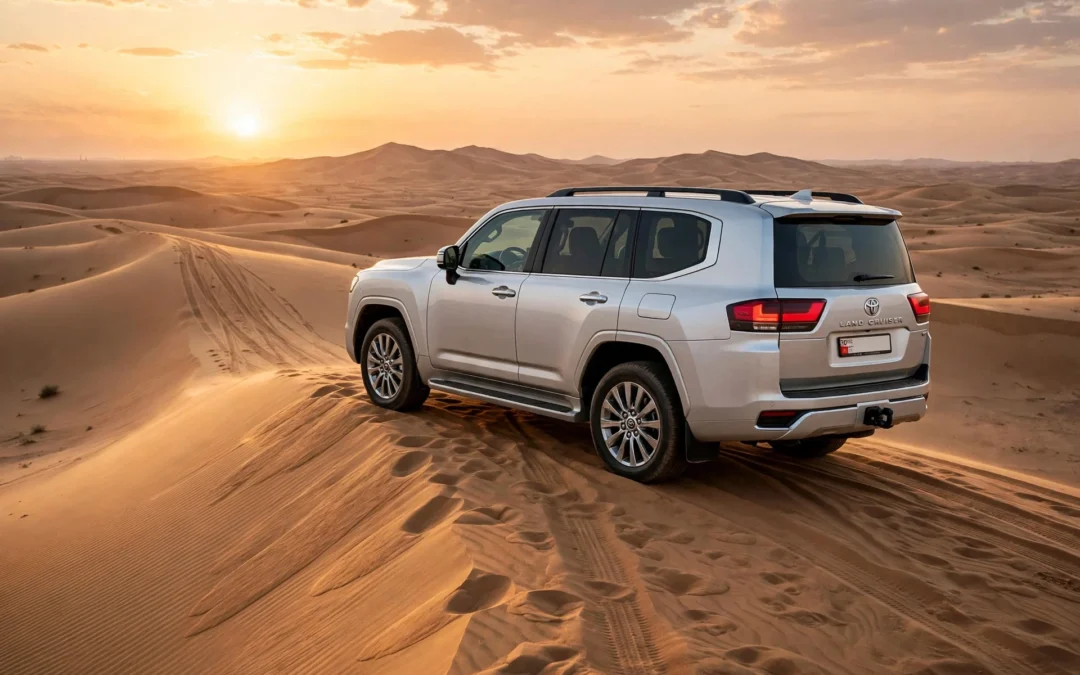
Every October, the same thing happens across the UAE. The temperature drops a few degrees, the evenings turn pleasant, and suddenly every Land Cruiser, Patrol and Pajero in the country is heading for the sand. Desert season runs roughly from October to April, when daytime temperatures sit in a comfortable range and the dunes are at their best — and the first weekends of the season are the busiest of the year. The Liwa Festival, running this year from 11 December 2026 to 3 January 2027 in Al Dhafra, draws thousands of drivers to the edge of the Empty Quarter.
Most of those drivers will have a good day. Some will not, and the difference is almost never luck. It is preparation. A car that spent the summer cooking in city traffic — its coolant tired, its tyres hardened by heat, its underbody never once looked at — is being asked to do the hardest work of its year on its first day out. Sand driving punishes every weak point a car has, and it does it a long way from the nearest workshop.
This guide is the full preparation: tyres, cooling, underbody, four-wheel-drive settings, recovery gear, technique and the week-before checklist, written for drivers heading out in the UAE — whether that is a first trip to the bowls near Al Qudra or a run to the big dunes at Liwa. It is not about buying a new car. It is about making sure the one you have is ready for the sand.
The two rules that matter most: never go into the desert alone — always drive with at least one other 4×4 — and never leave the tarmac without a way to put air back in your tyres. Everything else in this guide is detail. Those two are the difference between a story and a rescue.
1. Desert Season: Why October to April, and Why the First Trip Matters Most
Desert season in the UAE is the cooler half of the year, roughly October to April, when daytime temperatures generally sit between the low twenties and low thirties. Outside those months the sand itself becomes the problem: in high summer the surface of the sand can get far hotter than the air, and a breakdown in that heat is dangerous for the driver as well as the car. The season is also when the desert community comes alive — weekend convoys, organised trips, training days for beginners and the Liwa Festival at the turn of the year.
The first trip of the season deserves more care than the tenth, for a simple reason: your car has just spent five or six months doing the easiest driving of its year. City driving in summer is hot, stop-start work, and it ages some parts faster than others. Rubber hoses and seals harden in the heat. Coolant degrades. Tyres that sat in the sun all summer have aged even if the tread looks fine. A car that was fine in September can show its first weakness in October, the moment you ask it to work hard on soft sand, far from help.
That is the logic behind this whole guide: do the checks before the season, not on the first dune. A coolant flush, a tyre inspection, an underbody look and a recovery kit packed properly take an afternoon in the city. The same jobs in the desert take a tow truck.
2. Tyres: The Single Biggest Decision You Will Make
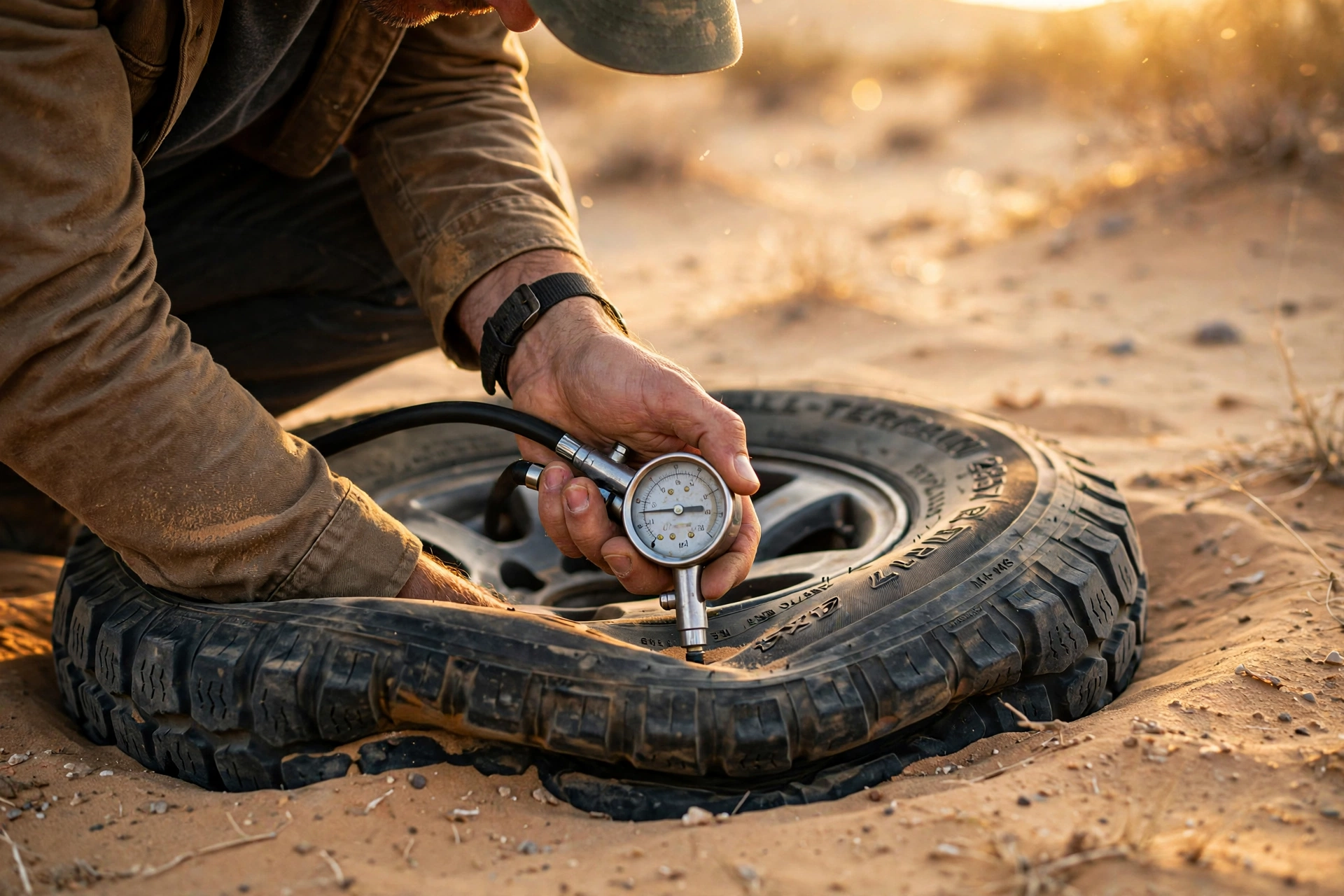
If there is one thing that decides whether you get stuck in the sand, it is tyre pressure. On the road, your tyres run hard — somewhere in the low thirties in psi for most SUVs — and that is right for tarmac. On soft sand, hard tyres dig. They cut into the surface instead of floating on it, and a car on road pressure will bury itself to the axles in seconds on soft sand. Letting air out is what makes sand driving possible.
The numbers most experienced desert drivers use are these: start around 18 psi for firmer desert and for your first outings — it is a safe, forgiving baseline. For soft, steep or powdery sand, drop to around 15 psi, and some drivers go as low as 12 psi on the softest stuff. The lower you go, the gentler you must steer, because a very soft tyre can roll off the rim if you turn sharply. Use a proper deflator with a gauge rather than guessing with a key, and bring all four tyres down evenly. And whatever pressure you choose, the rule that matters is the one after it: re-inflate before you drive on the road again. Driving on the highway at dune pressures overheats a tyre and can destroy it — which is why a portable 12-volt compressor is not optional. It is the thing that gets you home.
Before you go, look at the tyres themselves, not just the pressure. Check the tread depth — below about 3 mm on sand is asking for trouble — and look at the sidewalls for cracks, bulges or cuts. Summer heat in the UAE is hard on rubber, and a tyre that is more than four or five years old can look fine and still be past its best. All-terrain tyres, marked A/T on the sidewall, are the sweet spot for most drivers: good enough on the road, grippy enough off it. If you are serious about the desert, a second set of wheels with all-terrain tyres is one of the best investments you can make. And carry a full-size spare, not a space saver — a space saver is useless in the sand — plus a pressure gauge and a repair kit. Our tyre age guide explains how to read the DOT code on your sidewall and work out exactly how old your tyres are, because the date on the tyre matters more than the tread in Dubai heat.
One more tyre point that first-timers miss: check your tyre pressures when the tyres are cold, and check them again at the desert. A tyre that reads correctly in the morning in Dubai can read differently after an hour on the highway, and the pressure you set at the roadside before the sand is the one that counts.
3. Cooling System: Your Engine’s Desert Test
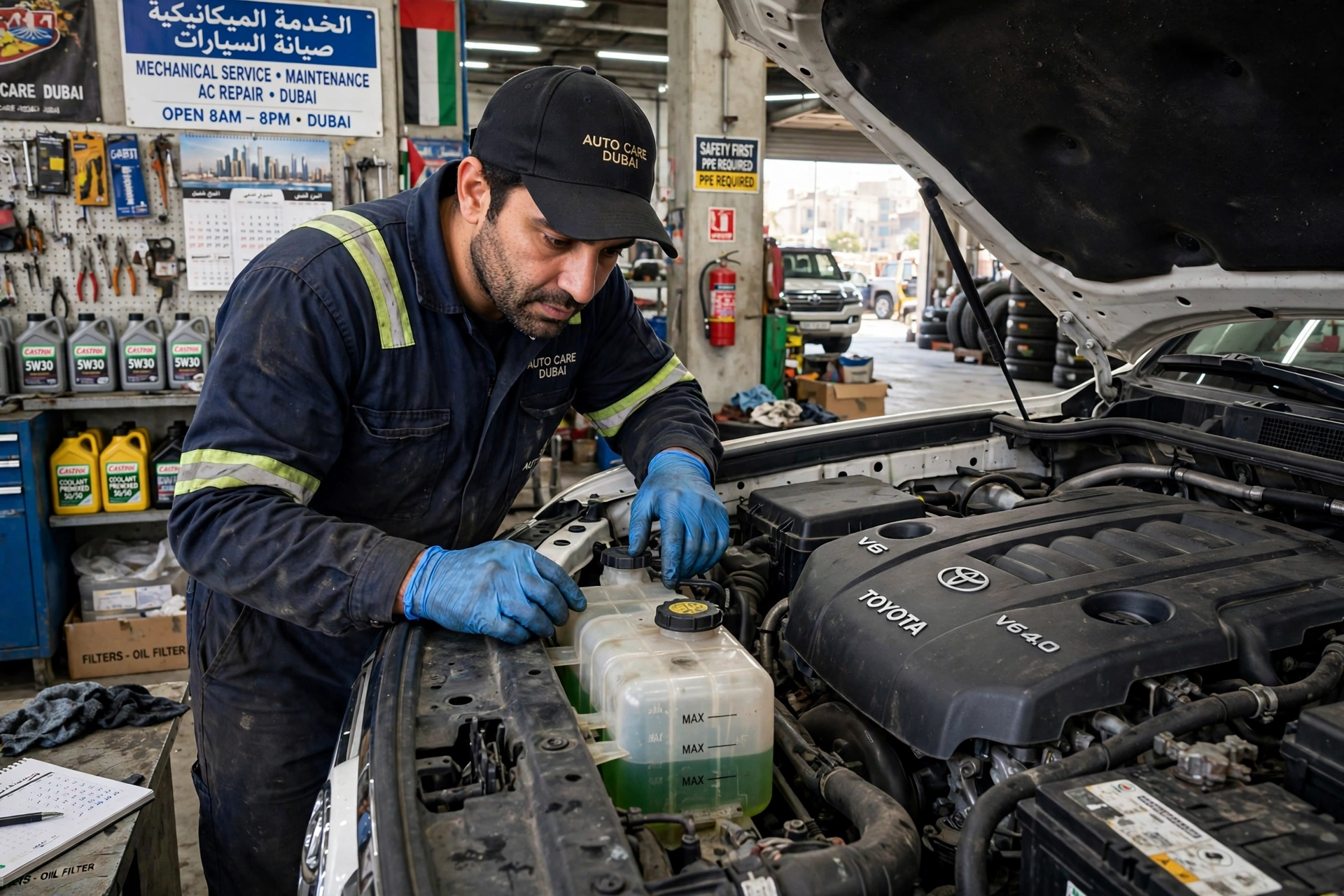
A car that survived the summer in Dubai traffic has already proved its cooling system can cope with heat — but the desert asks more of it. On sand, the engine works harder at low speed, with less airflow through the radiator than on the highway, and the load is constant: soft sand is like driving uphill all the time. A cooling system that was just about coping in the city can be the thing that lets go on the first long dune climb.
Start with the coolant itself. Check the level in the reservoir when the engine is cold — it should sit between the MIN and MAX lines — and look at the colour. Fresh coolant is bright, green, orange, pink or blue depending on the type. Coolant that looks brown, rusty or muddy is past its best and needs changing. If your coolant has not been changed in a couple of years, the start of desert season is the right time: old coolant loses its ability to stop corrosion and to carry heat, and both matter more off-road than on it. And check the hoses while you are there. Squeeze the big radiator hoses when the engine is cold: a healthy hose feels firm but pliable. One that is hard and stiff has been baked brittle by the heat; one that feels soft and spongy is damaged inside. Either way, have it looked at before it splits on a dune, because a hose that lets go in the desert does not give you a warning, and the temperature gauge will be the first thing you notice, which is already too late.
Look at the radiator too. Sand, dust and insects clog the fins over a summer, and a radiator that cannot breathe cannot cool. A gentle clean of the fins — water from the front, never a pressure washer at close range — makes a real difference. Check the radiator cap as well: its rubber seal hardens with heat, and a cap that cannot hold pressure lets coolant boil away as steam. It is a small, cheap part, and it is one of the most common causes of coolant loss. Our losing coolant guide covers the cap, the pressure test and the hidden leaks in full — and if your level has been dropping and you cannot find a puddle, read it before you head for the sand, because a slow coolant leak becomes a fast overheating problem the moment the engine is working hard.
Finally, the battery. Desert driving is hard on batteries in a different way: a night of camp lights, a fridge, phone charging and a winch will drain a battery that was already weak, and a flat battery in the dunes is a common end to a good day. If your battery is more than three years old, or the car has been slow to start in the mornings, have it tested before the season. Our car won’t start guide covers the battery and charging warning signs, and if you are unsure, a test takes minutes.
4. Underbody: What the Sand Hits First
The underside of your car takes the most punishment in the desert and gets the least attention in the city. Before the season, get underneath it — on a ramp at a workshop, or at least with a torch and a careful look — and check the three things that matter.
First, the skid plates. These are the metal plates that protect the sump, the transfer case and the fuel tank from rocks and sand ridges, and they are the first thing to hit the ground when you crest a dune wrong. Check that they are all there, that none are cracked or bent, and that the bolts holding them are tight. A missing or cracked skid plate leaves the most expensive parts of your car unprotected, and the damage from one bad crest can be far worse than the cost of a replacement plate.
Second, the CV boots. These are the rubber boots over the axle joints, and they are one of the parts Dubai heat kills fastest. The rubber dries out, goes hard, and splits — and once a boot splits, sand gets into the joint. Sand in a CV joint is like sandpaper inside a bearing: it destroys the joint quickly, and a failed joint in the desert means the car stops moving under its own power. Look for cracks, splits or grease leaking out around the boots, and replace any that are damaged before the season. It is a small job in the city and a tow in the desert.
Third, the heat shields. These are the thin metal plates around the exhaust and the fuel tank, and they work loose over time. A loose shield rattles, and it can catch on a sand ridge or a rock and tear off — or worse, bend into something it should not touch. Tighten or replace any that are loose. While you are under there, look at the suspension bushes and the steering boots too, and check for any fluid weeping from the engine, gearbox or differentials. Our fluid leak guide explains how to tell what a leak is by its colour, feel, smell and location — and a leak you find in the city is a repair, while a leak you find in the desert is a problem.
5. Four-Wheel Drive: 4H, 4L, Diff Locks and Traction Control
A 4×4 is not one thing. The same car behaves very differently depending on which mode it is in, and using the wrong mode in the sand is one of the most common first-timer mistakes. Here is the short version, and it is worth knowing before your first trip, not during it.
Four-high, or 4H, is the mode for most general sand driving. It gives you four-wheel drive at normal road speeds, and it is the mode you will spend most of your time in on the dunes. Four-low, or 4L, is for the slow, hard stuff: steep climbs at low speed, controlled descents, getting yourself out when you are stuck, and crawling through soft sections where you need maximum torque and minimum speed. The rule is simple: if you are moving steadily across the sand, use 4H. If you are going slowly, climbing steeply, or recovering, use 4L. And learn how to switch between them before you need to — on most cars you need to be stopped, or nearly stopped, in neutral, and the change takes a few seconds. Trying to work it out while you are sinking is the wrong time to learn.
Then there is traction control. On the road, traction control is your friend: it cuts power to a spinning wheel and keeps the car stable. On sand, it is often your enemy. A wheel spinning in sand is normal — the car needs to keep momentum, and traction control cutting the power at exactly the wrong moment is what gets people stuck. Most experienced desert drivers switch traction control off before they leave the tarmac, and on many cars there is a dedicated sand or off-road mode that does this for you. Read your owner’s manual before your first trip and find out where the button is and what your car’s sand mode actually does. And if your car has a rear differential lock, know how it works: it locks the two rear wheels together so they turn at the same speed, which is what gets you out when one wheel is on soft sand and the other is on firm ground. It is not for normal driving — it makes the car hard to steer — but in a recovery it is the difference between moving and staying put.
One more thing to check before the season: the transfer case and differential oils. These are the fluids that keep the four-wheel-drive system working, and they are often forgotten in a normal service. If they have not been changed in a long time, or the car has done a lot of hard driving, have them checked. Low or dirty oil in a transfer case is a quiet way to lose four-wheel drive at the worst possible moment.
Before your first trip, test the system properly. Find a quiet stretch of ground — not the road, and not the middle of a dune field — and engage 4H, then 4L, then back to two-wheel drive, and make sure each mode goes in smoothly and the dashboard indicator shows what you expect. If a mode will not engage, or the car makes a grinding noise, or the indicator light flashes and never settles, get it looked at before the season, not on the sand. The same goes for the diff lock: engage it once, on soft ground, and make sure it locks and unlocks. And read the owner’s manual for your specific car. Every 4×4 is different — some want you to be stopped in neutral to change range, some let you change on the move at low speed, and some have a sand mode that changes the throttle response, the gearbox and the traction control all at once. Knowing what your car does is part of the preparation, and it is the part most people skip.
6. Recovery Gear: The Kit That Gets You Home
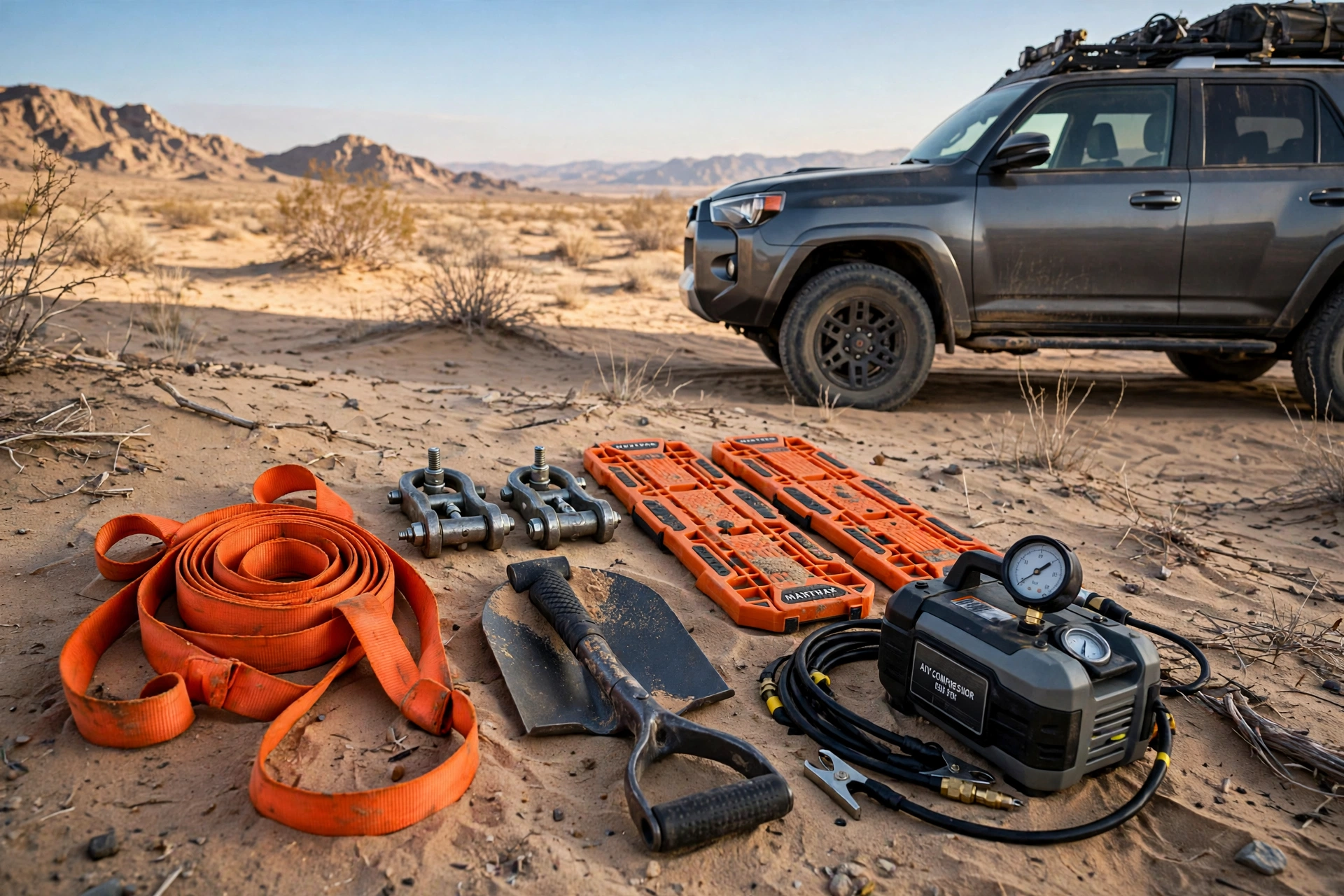
No matter how good your car is, you will get stuck in the desert. It is part of desert driving. The question is whether you get out in ten minutes or three hours, and the answer is the kit in your boot. Here is the minimum, and none of it is optional.
A kinetic recovery strap, also called a snatch strap: this is the strap that pulls a stuck car out, and it needs to be rated for your vehicle’s weight — at least 8,000 kg for a full-size SUV. A cheap tow rope is not a recovery strap: it does not stretch, and when it snaps under load it becomes a whip. Two rated bow shackles, or soft shackles, to connect the strap to the car’s recovery points — never hooks, which can fly off under load, and never a tow ball, which can shear off and become a projectile. A recovery damper, a weighted bag that goes over the strap during a pull and absorbs the energy if anything lets go. A shovel, compact and metal-bladed, for digging sand away from the tyres and from under the chassis before any pull. Traction boards, the flat boards that go under the drive wheels to give them something to grip — the fastest self-recovery there is, and worth every bit of boot space. A tyre deflator with a gauge and a 12-volt compressor, for the pressures in section 2. Gloves, a jack, and a flat base board so the jack does not just sink into the sand. And know where your car’s recovery points are before you are stuck, not while you are — they are usually marked, and they are not the same as the tie-down points used for shipping.
That is the vehicle kit. The personal kit matters just as much: far more water than you think you need — for drinking and for the radiator — a first-aid kit, a torch, a charged phone and a power bank, and offline maps downloaded before you leave, because there is no signal in much of the desert. A flag on a tall pole helps other drivers see you over a dune, and it is cheap insurance on a busy weekend. And if you are going deep into the desert, a satellite communicator is worth considering: it is the only way to call for help when there is no mobile signal at all.
Pack the kit the same way every time, and check it before every trip. A strap left at home is the same as no strap at all, and the trip where you need it is never the trip you expected to need it on.
7. Self-Recovery: What to Do When You Are Stuck
Being stuck is not a failure. It happens to everyone, including the experienced drivers, and the difference between a ten-minute delay and a three-hour ordeal is what you do in the first minute. The first rule is to stop. Do not keep spinning the wheels — every second of spinning digs the car deeper, buries the chassis on the sand, and turns a small problem into a big one. Take your foot off the throttle, put the car in park, and get out and look.
Look at where the car is sitting. Are the wheels buried? Is the chassis resting on the sand? Is the car high-centred, with its weight on the belly instead of the wheels? The answer decides the recovery. Start with the shovel: dig sand away from the front of all four tyres and from under the chassis if it is touching. Then let a little more air out of the tyres — a couple of psi lower can make the difference — and put the traction boards in front of the drive wheels if you have them. Then, with the wheels straight, use gentle throttle and try to climb out slowly. Do not stamp on the accelerator: a gentle, steady climb is what works, and a burst of wheelspin just digs you back in.
If that does not work, it is time for a pull. This is where the recovery kit and the second car earn their keep. Attach the strap to the rated recovery points on both cars — never to a tow ball, never to a bumper — lay the damper over the strap, and agree on signals before anyone moves. The recovering car takes up the slack gently and then pulls steadily; the stuck car drives gently at the same time. It is a team effort, and it works because the strap stretches and pulls with a steady force instead of a sudden jerk. And if you are stuck alone — which is why you should not be alone — the traction boards and the shovel are your only tools, and patience is the third. Dig, lower the pressure, try again, and if it is not working, stop and think instead of digging deeper.
One thing to know about sand and heat: a stuck car with its engine running in soft sand will heat up fast, because the engine is working hard with almost no airflow. Keep an eye on the temperature gauge during any recovery, and if it starts climbing, stop and let the car cool. A car that overheats while stuck is a car with two problems instead of one.
8. Driving Technique: Momentum, Reading the Sand and Taking Slopes
Sand driving is a skill, and it is mostly about two things: momentum and reading the surface. Momentum is your friend and panic is not. On soft sand, you want to carry a steady speed and keep it — not too fast, not too slow. Stabbing the throttle digs the wheels in; lifting off suddenly in the middle of a climb kills your speed and leaves you stopped on a slope, which is the worst place to be. The rhythm is smooth: steady throttle, smooth steering, and look far ahead, not at the sand right in front of the bonnet.
Reading the sand is the other half. Not all sand is the same. Firm, damp sand near the bottom of a dune is easy. Soft, powdery sand on the top of a dune, or sand that has been churned up by other cars, is the stuff that swallows cars. The colour and the texture tell you: darker sand is usually firmer, lighter and fluffier sand is usually softer, and the crest of a dune — the sharp top edge — is where the sand is softest and the drop on the other side is steepest. Approach a crest slowly, and never crest a dune fast: you cannot see what is on the other side, and there may be another car coming up the other face, or a drop, or a stuck vehicle. Stop before the crest, get out and look if you are unsure, and only cross when you can see the way down.
Take slopes straight up and straight down. Crossing a steep dune face at an angle is how cars roll, and a car on its side in the desert is a serious problem. If you are climbing and you feel the car losing speed, keep the throttle steady and the wheels straight — do not turn, do not lift off suddenly, and do not try to reverse down a steep face. And on the way down, use low range and let the engine do the braking: riding the brakes on a steep sandy descent overheats them and gives you less control, not more. If you have hill descent control, learn how it works before you need it — it is genuinely useful in the sand, and it is better to discover that on a gentle slope than on a steep one.
9. Fuel, Water and Supplies: More Than You Think You Need
There are no petrol stations in the desert, and there is no shop that sells water. Everything you need has to go with you, and the margin for error is small. Start with a full tank of fuel — fill up in the city or at the last station before the desert, and if you are going far, carry extra fuel in a proper jerry can, secured upright and outside the passenger compartment. Sand driving uses far more fuel than road driving: the engine is working hard at low speed, and a tank that would last a week in the city can disappear in a day in the dunes. Do not plan a trip that needs the last quarter of the tank. Plan it so you come back with fuel to spare.
Water is the same logic, and it matters more. Bring far more water than you think you need — for drinking, for washing sand out of your eyes, and for the radiator if the cooling system needs topping up. A car that has lost coolant in the desert needs water, and the water you drink is the same water the radiator needs. Pack it in the shade if you can, and carry it where it will not spill over the recovery gear. Food is less critical for a day trip, but snacks and something with salt in it are worth having: desert driving in the sun is tiring, and tired drivers make mistakes.
And the small things: a torch, because a recovery that starts in daylight can end in the dark; a first-aid kit that you have actually looked inside; sun protection, because the sun in the desert is stronger than it feels from inside an air-conditioned car; and a charged phone with a power bank. Check the phone signal before you leave the tarmac and know where it disappears — that is the point after which you are on your own until you come back into range.
One more thing worth packing, and it is the one people forget most: shade. A small pop-up awning or a shade sail takes up little space and makes a real difference if you are stopped for a recovery in the middle of the day, or if you are waiting for a second car to catch up. The sun in the desert is stronger than it feels from inside an air-conditioned car, and shade is the difference between a comfortable wait and a miserable one. Pack a spare set of clothes too, and a pair of old shoes you do not mind getting full of sand — you will be kneeling in it, digging in it, and walking through it, and the clothes you drove in will not be the clothes you want to drive home in. These are small comforts, and they matter more than they sound like they do, because a comfortable driver is a careful driver, and a hot, tired, sunburnt driver is the one who makes the mistake.
10. Navigation and Communication: Tell Someone Your Plan
Getting lost in the desert is easier than most people think. The dunes all look the same, the tracks cross and fade, and a wrong turn can put you kilometres from where you meant to be. Download offline maps before you leave — apps that work without a signal — and mark your starting point before you drive off the road. A GPS device or a phone with offline maps is not a luxury in the desert; it is the way you get home. And know how to use it before you need it: a map you cannot read in the moment is not a map at all.
The other half of communication is telling someone your plan. Before you leave, tell a friend or family member where you are going, who you are going with, and when you expect to be back. It costs nothing and it is the single most important safety step there is: if something goes wrong and you cannot call for help, the person who knows your plan is the person who raises the alarm. Go in the cool hours of the day — early morning or late afternoon — and avoid the middle of the day when the heat is at its worst and the sand is at its softest.
Drive with at least one other 4×4, and agree on the basics before you leave: who leads, who follows, how far apart you stay, and what you do if one car gets stuck. A convoy is not just company — it is your recovery, your spare parts, your extra water and your second opinion. The desert is a wonderful place to be, and it is a very lonely place to be stuck in. Do not go alone.
11. Where to Go First: The Beginner-Friendly Dunes Near Dubai and Abu Dhabi
If this is your first desert season, start close and start easy. The dunes near Dubai are the training ground for a reason. Big Red, on the Dubai–Hatta road, is the region’s best-known beginner area: a mix of gentle bowls and bigger dunes, including the famous tall dune itself, with plenty of space and plenty of other drivers around. Al Qudra and Al Faya, and the Lahbab area, are close to the city and forgiving — good places to learn how your car behaves on sand, how to air down, and how to get yourself out of a small stuck before you try anything harder.
Liwa is the other end of the scale. On the edge of the Empty Quarter, the dunes there are bigger, softer and more remote than anything near Dubai, and the Moreeb Dune is around 300 metres of sand — one of the tallest dunes in the world. Liwa is a trip, not a morning out: it is a two-and-a-half to three-hour drive from Abu Dhabi, and the dunes demand a properly prepared car, a full recovery kit and a convoy. It is also where the Liwa Festival runs, from 11 December 2026 to 3 January 2027, and if you go during the festival, expect crowds and plan accordingly. Start with the bowls near Dubai. Earn Liwa.
Wherever you go, respect the desert. Stick to established tracks where they exist, do not drive over vegetation or through oases, and carry all of your waste out with you. The desert is fragile: the tracks you leave outside the usual corridors damage the ground for years, and the areas around oases and wadi beds are home to wildlife that has nowhere else to go. The rules are simple, and they are the same ones that keep the desert open for everyone: stay on the tracks, take your rubbish home, and leave the place as you found it.
12. The Week-Before Checklist: Do It in the City, Not on the Sand
Here is the whole guide in one checklist, to run through in the week before your first trip of the season. Tyres: tread above 3 mm, sidewalls in good shape, all-terrain tyres if you have them, full-size spare, deflator with a gauge and a 12-volt compressor. Coolant: level correct, colour fresh, hoses firm and pliable, radiator fins clean, radiator cap seal good. Battery: tested if it is more than three years old, terminals clean and tight. Underbody: skid plates intact and bolted tight, CV boots sealed, heat shields secure, no fluid leaks. Four-wheel drive: 4H and 4L both engage properly, diff lock works if you have one, traction control switch found and understood. Recovery kit: strap, shackles, damper, shovel, traction boards, gloves, jack and base board, all packed and checked. Supplies: full tank, extra water, first-aid kit, torch, phone charged with power bank, offline maps downloaded, flag fitted. And the plan: convoy confirmed, someone at home told where you are going and when you will be back.
If anything on that list is a question mark — a coolant level that keeps dropping, a hose that feels wrong, a CV boot that is split, a battery that is slow to turn over, a four-wheel-drive mode that will not engage — that is the moment to get it looked at, not the morning of the trip. A pre-season check at a workshop takes an hour and costs very little compared with a recovery from the dunes. If your car needs a check before the season, call or WhatsApp 95 Services on +971 54 344 3513 — we come to you anywhere in the UAE, open 24 hours, and a mobile check before your trip is a lot easier than a rescue after it. Our RTA inspection checklist covers the same ground from a different angle, and our car repair and maintenance page explains what a proper service includes.
Frequently Asked Questions
What tyre pressure should I use for sand driving in the UAE?
Start around 18 psi for firmer desert and your first trips — it is a safe, forgiving baseline. For soft, steep or powdery sand, drop to around 15 psi, and some drivers go as low as 12 psi on the softest sand. The lower you go, the gentler you must steer, because a very soft tyre can roll off the rim. Always use a proper deflator with a gauge, bring all four tyres down evenly, and re-inflate to road pressure with a 12-volt compressor before you drive on the tarmac again.
Do I need a permit to drive in the desert in the UAE?
It depends on where you go. Some areas, particularly in Abu Dhabi, have permit requirements for off-road driving in protected desert zones, and the rules can change — so check with the Abu Dhabi Police portal or the relevant authority for the area you plan to visit before you go, rather than assuming. The well-known beginner areas near Dubai are generally used without a formal permit, but if you are heading to Liwa or a remote area, check first.
Can I take a normal SUV or a rental car into the desert?
A proper 4×4 with low range — Land Cruiser, Patrol, Prado, Wrangler, Fortuner or similar — is what you need for real sand driving. A soft-roader or a two-wheel-drive SUV will get stuck quickly and cannot be recovered easily. Rental insurance almost never covers off-road driving, so if you are in a rental car, stay on the tarmac or book a guided 4×4 trip instead.
What is the best time of year for desert driving in the UAE?
October to April is desert season, with November to March the best months — daytime temperatures are comfortable and the sand is at its best. Avoid the summer months: the heat is dangerous, the sand surface gets extremely hot, and a breakdown in those conditions is a serious problem. The Liwa Festival runs from 11 December 2026 to 3 January 2027.
What should I do if my car gets stuck in the sand?
Stop immediately — do not keep spinning the wheels, or you will dig deeper. Get out and look: dig sand away from the front of all four tyres and from under the chassis, lower the tyre pressure a little more, put traction boards under the drive wheels if you have them, and try to climb out gently with the wheels straight. If that does not work, use a recovery strap from a second car, attached to the rated recovery points, with a damper over the strap. And if you are alone, this is why you should not be — always drive with at least one other 4×4.
How do I know if my car is ready for the desert?
Run the week-before checklist in section 12: tyres, coolant, battery, underbody, four-wheel-drive modes and recovery kit. If anything is a question mark — a coolant level that keeps dropping, a split CV boot, a battery that is slow to start, a 4L mode that will not engage — get it checked before the trip, not on the day. A pre-season mobile check is the easiest way to be sure, and 95 Services comes to you anywhere in the UAE, open 24 hours.
Desert season is the best time of year to own a 4×4 in the UAE. The dunes are there, the weather is right, and the community is out in force. The preparation is not hard — an afternoon of checks, a kit packed properly, and a convoy to drive with — but it is the difference between a season of good days and a season that starts with a tow truck. Do it in the city. Enjoy it in the desert. And if your car needs a check before you go, call or WhatsApp 95 Services on +971 54 344 3513 — we will come to you, anywhere in the UAE, open 24 hours.
