
Inside every engine there is a part you never see, never hear and almost never think about — until the day it fails. It is the timing system: the belt or chain that keeps the crankshaft and the camshafts turning in perfect step, so the valves open and close at exactly the right moment relative to the pistons. When it works, the engine runs smoothly and you never know it is there. When it fails, the engine stops — and on most modern engines, the damage that follows is the most expensive repair a car can have.
The question every driver in the UAE should be able to answer is a simple one: does my car have a timing belt, or a timing chain? The answer decides how you maintain the car, what you watch for, and how much warning you will get before something goes wrong. A belt is a consumable with a published replacement interval — a job you plan and pay for on schedule. A chain is a metal component that is meant to last far longer, but it is not maintenance-free, and when it does wear out, it fails in a different way and costs more to fix.
This guide explains both systems, how to tell which one your car has, the warning signs for each, what happens when they fail, and why the UAE heat changes the maths for both. It is written for drivers in Dubai and across the Emirates — including the Land Cruiser, Patrol, Camry, Corolla, Altima and X-Trail owners who make up so much of the traffic here — because the timing question is one of the few maintenance questions where getting it wrong can cost you an engine.
The one fact to remember: a timing belt has a replacement interval in your owner’s manual — follow it, because a belt often fails with no warning. A timing chain has no interval, but it depends on clean engine oil — skip oil changes and the chain will tell you, usually with a rattle on a cold start.
1. What the Timing System Actually Does
An engine is a machine that turns fuel and air into motion, and it does it by opening and closing valves at exactly the right moment. The pistons move up and down inside the cylinders, and the valves let fuel and air in and exhaust gases out. The crankshaft is connected to the pistons, and the camshafts control the valves — and the timing belt or chain is what links the two, keeping them in step so the valves open and close in perfect harmony with the pistons.
If the timing is right, the valves open when the piston is out of the way, and close before the piston comes back up. If the timing is wrong — if the belt slips, the chain stretches, or either one breaks — the valves and the pistons can end up in the same place at the same time. On most modern engines, that means the pistons hit the valves, bending them, and the engine stops. The repair is not a new belt or chain. It is a cylinder head removed, valves replaced, and sometimes a full engine rebuild. That is why the timing system matters more than almost any other part of the car: it is the one component whose failure can destroy the engine it serves.
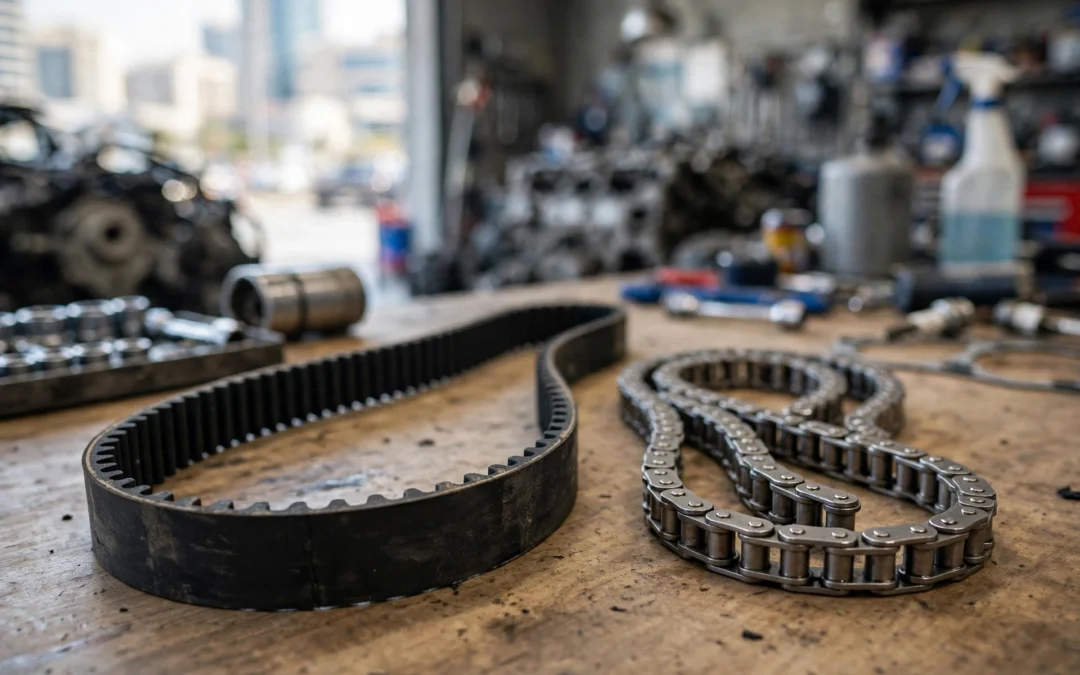
Both belts and chains do the same job, and they do it with very different materials. A timing belt is a reinforced rubber belt with moulded teeth, running dry behind a cover, on toothed pulleys. A timing chain is a metal roller chain, mechanically similar to a bicycle chain, running inside the engine in engine oil. The difference between them is not which job they do — it is how long they last, how they fail, and what they cost when they do.
2. The Timing Belt: Rubber, Quiet, and on a Schedule

A timing belt is made of reinforced rubber with high-tensile fibres, and it is light, quiet and inexpensive to manufacture — which is why it is common on many petrol engines. It runs dry, behind a plastic cover, and it is tensioned by pulleys or hydraulic tensioners. It does its job silently, and for most of its life you will never know it is there.
But rubber ages, and that is the whole story of the timing belt. Heat accelerates the ageing, oil contamination destroys it, and the teeth eventually lose their profile. That is why manufacturers specify a replacement interval — usually every 60,000 to 100,000 miles, with some cars going to 120,000 miles, and in kilometres the figures most often quoted in the UAE are 60,000 to 100,000 km, with some cars rated to 90,000 to 160,000 km. The interval is given as a distance and an age, and the belt is due at whichever comes first: a car that has done low mileage but is seven to ten years old can still need a new belt, because rubber ages whether the car is driven or not.
The most important thing to know about a timing belt is that it often fails with little or no warning. A belt can look fine and still be close to breaking, and when it breaks, the engine stops at once. That is why the interval matters so much: the belt is a consumable with a published replacement date, and replacing it on schedule is not optional maintenance. It is the job that stops a broken belt from becoming a destroyed engine. And when the belt is replaced, the tensioner, the idler pulleys and usually the water pump are replaced at the same time — because they wear at the same rate, and the labour to reach them is already being paid for. Replacing only the belt and leaving a worn tensioner is a false saving: a new belt on a failing tensioner will fail early.
3. The Timing Chain: Steel, Oiled, and Built to Last
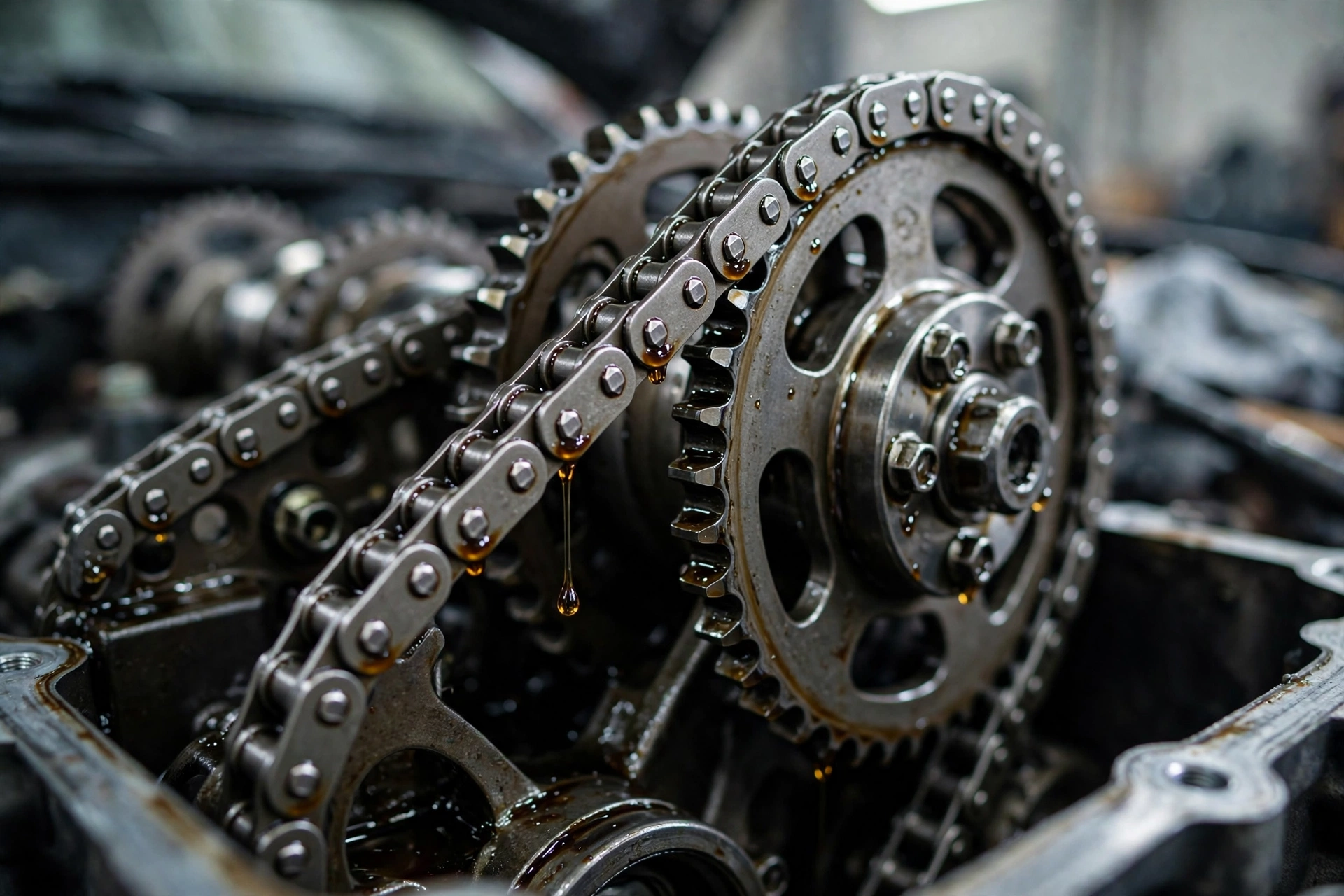
A timing chain is a different animal. It is made of hardened steel links, it runs inside the engine bathed in engine oil, and it is heavier, noisier and considerably stronger than a belt. Because it is lubricated continuously, it can last far longer than any belt — many chains last 150,000 to 250,000 miles or more, and with proper maintenance a chain can last the life of the engine.
But a chain is not maintenance-free, and that is the misunderstanding that costs people money. A chain does not run alone: it depends on a hydraulic tensioner keeping it taut, and on plastic or composite guides holding its path — and those components wear in ways the chain itself does not. Most timing-chain failures are not broken chains. They are stretched chains, failed tensioners or worn guides that allowed the chain to jump a tooth on the sprocket, throwing the engine out of timing. And the tensioner is hydraulically actuated by engine oil pressure, which means the chain’s life is driven by oil condition: degraded, contaminated or low oil reduces the tensioner’s ability to keep the chain taut, which lets the chain slap against its guides. It is a gradual, self-reinforcing process, and it is entirely driven by how well the engine’s oil has been looked after.
That is the key difference between a belt and a chain. A belt is indifferent to oil: it is a mechanical component on a schedule, and a neglectful owner shortens its life far less than they shorten a chain’s. A chain in an engine serviced properly with the specified oil routinely exceeds 200,000 miles. The same chain in an engine serviced casually can need attention far earlier. The chain rewards good maintenance and punishes bad maintenance, and the punishment arrives as a rattle on a cold start — which is why the oil change is the most important thing you can do for a chain-driven engine.
4. Belt vs Chain, Side by Side
Put the two systems next to each other and the trade-off is clear. A timing belt is reinforced rubber, runs dry outside the engine, is very quiet, lasts 60,000 to 100,000 miles, needs scheduled replacement, and costs less to replace — but it can break suddenly and with little warning. A timing chain is hardened steel, runs inside the engine in oil, is slightly louder, lasts 150,000 to 250,000 miles or more, is usually maintenance-free in the sense that it has no replacement interval, and costs more to replace — but it wears gradually and usually warns you first.
The cost comparison over a long ownership is where the conventional wisdom starts to wobble. A belt-driven engine will need one belt replacement at the specified interval, and possibly a second, depending on whether the interval is 60,000 or 100,000 miles. Each job is planned, quotable in advance, and typically bundled with the water pump and tensioner since the labour to reach them is already being paid for. It is an inconvenience with a known price. A chain-driven engine will either need nothing across the same distance — which is the best outcome there is — or it will need a chain, guides and tensioner job that costs more than a belt job, because the chain is inside the engine and reaching it means taking the front of the engine apart. The chain is the better bet if the oil has been changed properly. The belt is the better bet if it has not, because the belt does not care about the oil.
Neither system is better in every case. The belt is simpler, quieter and cheaper to service, and its replacement is a known cost on a known date. The chain is stronger, longer-lived and needs no scheduled replacement, but it depends on oil quality and it costs more when it does need work. What matters is not which one is better in theory — it is which one your car has, and what that means for how you look after it.
There is one more way to think about the choice, and it is the way owners actually experience it. A belt-driven car gives you a bill you can plan for: the manual says the belt is due, you book the job, you pay a known amount, and you drive away knowing the engine is safe for another interval. A chain-driven car gives you either no bill at all — which is the best outcome, and the most common one — or a bill that arrives without a date on it, when the rattle starts or the check engine light comes on. The belt is a cost you can budget. The chain is a risk you can manage, and the way you manage it is the oil. That is why the argument about which is better never ends: the belt is better for the owner who wants certainty, and the chain is better for the owner who maintains their car properly. In the UAE, where the heat punishes both rubber and oil, the owner who maintains their car properly is the one who wins either way — and the owner who does not is the one who pays, whichever system their car has.
5. Interference vs Non-Interference: Why It Matters So Much
There is one more distinction that matters more than belt versus chain, and it is the one most drivers have never heard of: whether your engine is an interference engine or a non-interference engine. On an interference engine, the pistons and the valves use some of the same space, just at different moments — and the timing belt or chain is what keeps them apart. If the belt breaks or the chain jumps, the pistons can hit the open valves. The result is usually bent valves, and the cylinder head then has to come off for repair. On a non-interference engine, a broken belt strands you, but no internal damage should occur: the engine stops, and you need a tow, but the engine itself is not destroyed.
Most modern engines are interference engines, which is why a broken timing belt is so serious. The large majority of modern designs use interference layouts, because they allow higher compression and better efficiency — and that means losing timing is not an inconvenience, it is an engine rebuild. You cannot tell which type you have by looking at the engine, so look it up by engine code, or ask a workshop. If yours is an interference engine, treat the belt interval as a hard deadline, not a suggestion. And if your chain starts to rattle, treat that as the same kind of deadline: a chain that has jumped a tooth on an interference engine does the same damage a broken belt does.
This is also why the timing question matters so much when you buy a used car. A car with a belt that is overdue for replacement is a car with a hidden deadline, and a car with a chain that rattles on a cold start is a car with a hidden repair. Both are things a pre-purchase inspection should catch, and our pre-purchase inspection guide explains what a proper check includes — including the cold start, which is when a chain rattle shows up. And if a belt failure has already bent the valves, our cylinder head repair guide explains what that repair involves.
6. How to Tell Which One Your Car Has
The most reliable answer is in your owner’s manual. Look for a timing belt line in the maintenance schedule: if the manual lists a belt replacement interval, your car has a belt, and the interval is the number to follow. If there is no belt interval in the schedule, your car almost certainly has a chain. The service book is the second-best source: it will show whether a belt has been changed before, and when.
If you do not have the manual, a dealer can tell you from the chassis number, and a good workshop can tell you from the make, model and engine size. Some manufacturers use both systems across their range, so the badge on the back of the car is not enough: Toyota, Nissan, Honda, Mitsubishi, Hyundai, Kia, BMW, Mercedes-Benz, Volkswagen, Audi and Ford all use belts on some engines and chains on others. As a rough guide from UAE workshops: most Toyota four-cylinder cars built before 2007 use a belt, with an interval around 90,000 to 100,000 km; the Nissan Patrol, Altima and X-Trail use chains, with an inspection recommended at 150,000 km; and the Toyota Land Cruiser V8 engines use chains, also with an inspection at 150,000 km. But these are guides, not guarantees — the engine code is what decides, and the engine code is what you should check.
One more way to tell, and it is free: listen to the engine on a cold start. A belt-driven engine is quiet. A chain-driven engine has a faint mechanical sound, and if the chain or tensioner is worn, it rattles for a few seconds after a cold start. That rattle is the sound of a chain that is not being held taut, and it is the sound this guide will come back to in section 8, because it is the single most useful warning a chain-driven engine gives you.
7. Timing Belt Warning Signs: Often, There Are None
The honest truth about timing belts is that they often fail with little or no warning — and that is why the interval matters more than the symptoms. A belt can look fine on the outside and still be close to breaking, because the wear that matters is in the teeth and the fibres, not on the surface. But there are signs, and if you see any of them, do not wait for the mileage to come up.
The signs are these: a ticking noise from the engine, especially at start-up; engine misfires, rough idling or a loss of power; difficulty starting, or an engine that cranks but will not start at all; oil leaking near the timing cover at the front of the engine; and, if the cover is off and a technician can see the belt, visible cracks, fraying or a glossy, glazed surface. Our engine misfire guide covers the misfire symptoms in detail, and our car won’t start guide covers the starting problems — and if your car has started misfiring or struggling to start, the timing belt is one of the things that should be checked, not one of the things to hope it is not.
Oil near the timing cover deserves a special mention. A belt is sensitive to oil contamination: oil on a rubber belt degrades it, and a leak from a seal near the timing cover can shorten a belt’s life significantly. Our fluid leak guide explains how to tell what a leak is by its colour and location, and if you see oil at the front of the engine, get it looked at — not just because of the leak, but because of what the leak is doing to the belt behind the cover. And if the engine cranks but will not start, and it did so suddenly, the belt may already have broken. Do not keep trying to start it: on an interference engine, every turn of the starter can bend more valves. Get the car recovered and checked instead.
8. Timing Chain Warning Signs: Listen on a Cold Start
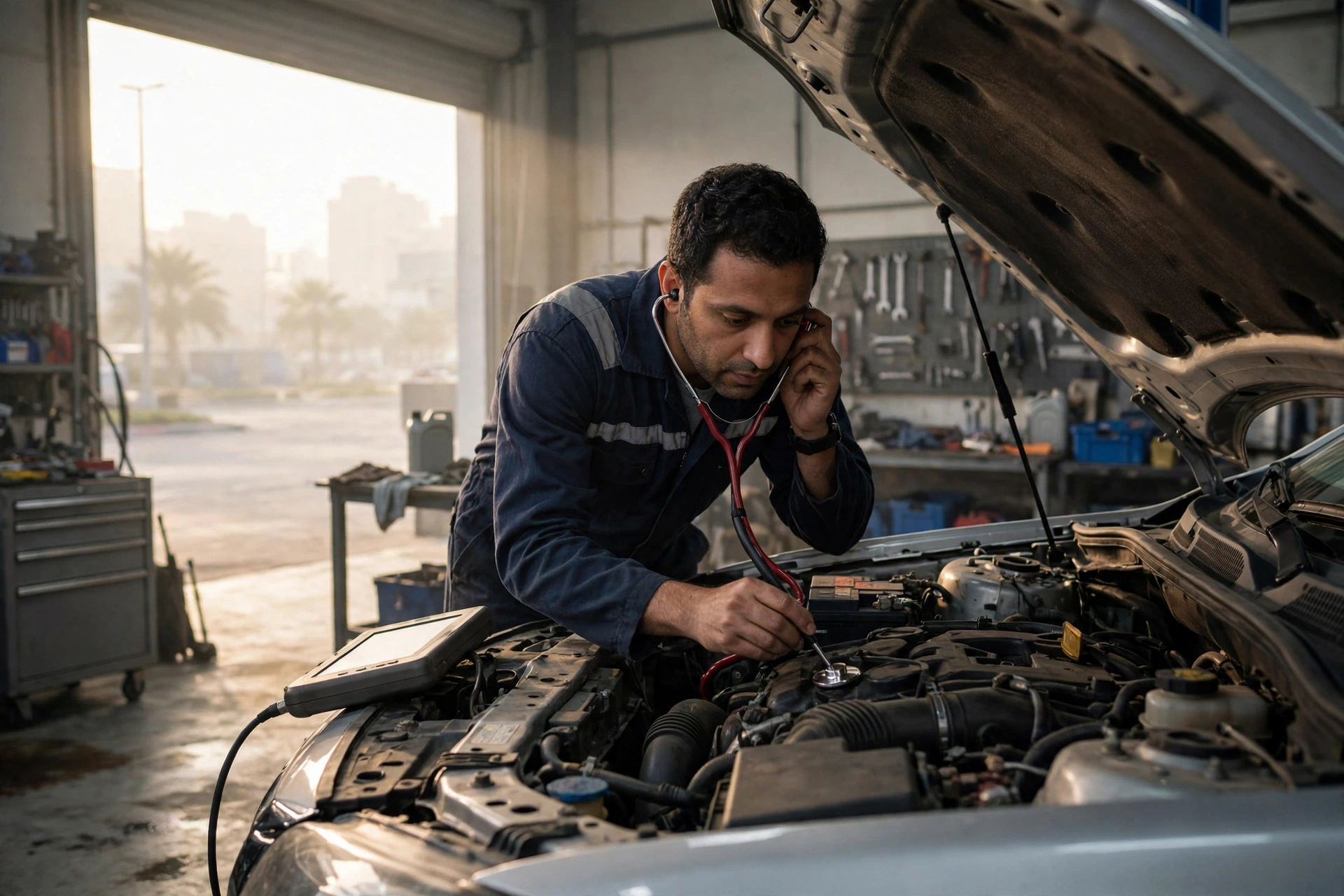
A chain is kinder than a belt: it usually warns you before it fails. The warning is a sound, and it is most obvious on a cold start. A rattling or chain-slap sound for a few seconds after a cold start is the classic sign of a chain tensioner or guide problem: the tensioner is hydraulically actuated by oil pressure, and when the engine has been sitting, the oil has drained down, and a worn tensioner cannot take up the slack immediately. The chain slaps against its guides for a few seconds until the oil pressure builds. If the rattle goes away after a few seconds, the chain is worn but still working. If the rattle continues after the engine is warm, the problem is worse, and it needs attention now.
The other signs are these: the check engine light, with timing-related codes — the most common are camshaft and crankshaft correlation codes, which mean the computer can see that the camshaft and crankshaft are no longer in step; rough idling, loss of power or misfires with no sign of ignition faults; poor acceleration and worse fuel economy; metal flakes in the oil or on the magnetic drain plug, which mean the chain or its guides are shedding metal; and an engine that cranks but will not start after a chain has jumped. Some European engines are known for chain tensioner trouble — workshops report it on certain BMW four-cylinder turbo engines and on early Audi and Volkswagen two-litre turbo engines, where a rattle on start-up can appear well before the chain fails — and if you drive one of those, a cold-start rattle is a sign to act on, not a quirk to live with.
The key point about a chain is that its life is driven by oil. A chain in an engine that has had regular oil changes with the specified oil can last the life of the car. A chain in an engine where the oil has been neglected, run low, or left in too long will wear early — and the wear shows up first in the tensioner and the guides, not in the chain itself. That is why the most important maintenance for a chain-driven engine is not a chain replacement. It is the oil change. And in the UAE, where the heat thins the oil and stop-start traffic works it hard, that matters more than it does in a cooler climate — which is the subject of the next section.
9. Why UAE Heat Changes the Maths for Both
Dubai heat is hard on both systems, but in different ways. For a timing belt, the problem is the rubber. Heat accelerates rubber degradation, and a belt that would last its full interval in a moderate climate can age faster in a car that sits in the sun and runs in 45-degree heat. Small cracks can appear on the belt’s outer surface, and the rubber hardens and loses its flexibility. Parking in the shade or a garage helps, but the belt is inside a hot engine bay, and the heat is inescapable. The practical advice is simple: in the UAE, do not stretch the belt interval. If the manual says the belt is due at a certain distance or age, treat that as a deadline, and if you bought a used car and do not know the service history, do not wait — have the belt inspected, and if there is any doubt, replace it. The cost of an inspection is negligible compared with the cost of a bent valve.
For a timing chain, the problem is the oil. Oil thins and oxidises faster in sustained heat and heavy stop-start driving, and a chain-driven engine that does long intervals between oil changes in Dubai traffic is under more strain than the schedule assumes. Some Dubai workshops recommend shorter oil change intervals for chain-driven cars in this climate — because the tensioner depends on oil pressure, and degraded oil cannot hold the chain taut. The chain itself is steel and does not care about the heat. The oil does, and the tensioner does, and the guides do. So the advice for a chain-driven car in the UAE is the opposite of the advice for a belt-driven car: do not worry about the chain, worry about the oil. Change it on time, use the grade the manufacturer specifies, and never let the level run low. A chain that is properly oiled will outlast the car. A chain that is not will rattle, and then it will jump.
There is one more UAE factor, and it is the dust. Sand and dirt affect the parts around the timing system — the pulleys, the tensioners and the seals — and a car that has spent its life in dusty conditions needs its seals and covers checked. A seal that has let dust in is a seal that will let oil out, and oil on a belt is the contamination that shortens its life. It is a small thing, and it is the kind of thing a proper service catches — which is why the timing system should be looked at at every major service, not just when the interval comes up.
10. What Gets Replaced With It: The Full Kit, Not Just the Part
Whether your car has a belt or a chain, the job is never just the belt or just the chain. It is the full kit, and replacing only the one part is a false saving that will cost you the job twice. For a belt-driven engine, the kit is the belt, the tensioner, the idler pulleys and, on most engines, the water pump — because the water pump is driven by the timing belt on many engines, and it wears at the same rate. The labour to reach the belt is the main cost of the job, and once the front of the engine is apart, the extra parts add little to the bill. A new belt on a failing tensioner will fail early. A new belt on a worn water pump will be taken off again when the pump fails. Do the whole kit, once, properly.
For a chain-driven engine, the kit is the chain, the tensioner, the guide rails and often the sprockets, along with the front cover seal and the related gaskets — so the new chain does not run on worn companions. Replacing only the chain leaves old guides and a tired tensioner to wear it out again, and the labour to reach the chain is the main cost, so the kit adds little to the bill. The same logic applies: do it once, do it completely. And after reassembly, the engine should be started and monitored, with the diagnostic scanner used to verify that the camshaft and crankshaft position sensor readings are in correct correlation — confirming the timing is set accurately before the car leaves the workshop. If a workshop does not check the correlation after a timing job, find one that does.
One more point about parts: use a quality kit, and do not use second-hand timing components. You cannot know how worn a used chain or tensioner is, and the labour is not recovered if it fails. The quote should list the parts, and you should be able to choose between the manufacturer’s parts and a quality aftermarket kit. A written quote before the work starts, with the parts listed, is the minimum to expect — and if a workshop will not give you one, do not let them open your engine.
The water pump deserves its own mention, because it is the part of the kit that owners question most — why replace a pump that is not broken? The answer is that the pump is driven by the timing belt on many engines, it wears at the same rate as the belt, and it sits behind the same covers. If the pump fails a year after the belt job, the whole front of the engine has to come apart again, and you pay the same labour a second time. A new pump with a new belt is cheap insurance, and it also protects the cooling system: a pump that is not moving coolant properly is a pump that lets the engine overheat, and our engine overheating guide explains what that leads to. After the job, the cooling system should be bled properly — air trapped in the system after a pump change can cause overheating on the first drive — and the coolant level should be checked again after the engine has run and cooled. A good workshop does all of this as part of the job. Ask whether they do, before you book.
11. Buying a Used Car: The Timing Question to Ask
If you are buying a used car in Dubai, the timing system is one of the most important questions to ask — and one of the easiest to forget. Ask the seller when the timing belt was last changed, and ask to see the receipt. If the car has a belt and the seller cannot show you a receipt, or does not know when it was changed, assume it has not been done, and factor the cost of a full kit into the price. If the car has a chain, listen to the engine on a cold start — and insist on seeing a cold start, because a warm engine hides the rattle. Ask the seller not to start the car before you arrive, and listen for the first few seconds. A rattle that lasts a few seconds and then stops is a chain that needs attention soon. A rattle that does not stop is a chain that needs attention now.
Check the service history for oil changes, too. A chain-driven car with a full history of regular oil changes is a car whose chain has been looked after. A chain-driven car with gaps in the history, or with oil changes done late, is a car whose chain has been neglected — and the neglect shows up in the tensioner and the guides before it shows up anywhere else. Our pre-purchase inspection guide covers the timing check alongside everything else, and it is worth doing before you pay: a proper inspection includes the cold start, the diagnostic scan for timing codes, and a look at the service history. And if the inspection finds a belt that is overdue, or a chain that rattles, use the report to negotiate — the cost of the timing job belongs in the price, not in your pocket after you have paid.
Ask for the documents, not just the seller’s word. A belt change should have a receipt: the workshop, the date, the mileage, and the parts fitted. A service history should have stamps or invoices showing the oil changes, with dates and mileages that line up with the odometer. Agency records from the dealer network are often preferred, because they tend to show original parts and dealer work, but a good independent specialist’s records are fine too, as long as the file is clear and complete. What you are looking for is consistency: the mileage in the records should line up with the odometer, the oil changes should be regular, and there should be no long gaps. A car with a thick, consistent file is a car that was looked after. A car with no file, or a file with a gap of two years, is a car you should be careful about — and if the seller cannot produce the file, the inspection becomes even more important, because it is the only evidence you have.
The same question applies to the car you already own. If you have owned your car for years and you have never thought about the timing system, now is the time to check. Look at the owner’s manual, find the belt interval or the chain inspection mileage, and compare it with your odometer and the car’s age. If the belt is due, book it. If the chain is at the inspection mileage, have it checked. And if you hear a rattle on a cold start, do not wait for the next service. Get it looked at now, because a chain that is rattling is a chain that is telling you something, and the cost of listening is far less than the cost of ignoring it.
12. When to Act, and What 95 Services Can Check
The timing system is one of the few parts of a car where the right time to act is before anything goes wrong. For a belt, that means the interval in your owner’s manual: when the distance or the age comes up, replace the belt, the tensioner, the pulleys and the water pump, and do not stretch it because the car feels fine. A belt that feels fine is a belt that is about to fail without warning, and the interval is the only warning you get. For a chain, that means the oil changes, the cold-start listen, and the inspection at the recommended mileage: if the chain rattles, if the check engine light shows a timing code, or if the engine misfires with no ignition fault, get it checked now, not at the next service.
If you are unsure which system your car has, or whether it is due, the check is quick. A workshop can tell you from the chassis number, check the belt’s condition if the cover can be opened, listen for a chain rattle on a cold start, and read the diagnostic codes for any timing faults. Our engine repair and diagnostics page explains what a proper diagnostic check includes, and our car repair and maintenance page explains what a proper service covers. And if your car needs a timing check, or a belt or chain job, call or WhatsApp 95 Services on +971 54 344 3513 — we come to you anywhere in the UAE, open 24 hours, and a mobile inspection before the job is a lot easier than a recovery after it.
Frequently Asked Questions
Which is better, a timing belt or a timing chain?
Neither is better in every case. A belt is quieter, lighter and cheaper to replace, and its replacement is a planned job on a known date — but it has a fixed interval and can fail suddenly. A chain is stronger and lasts far longer, often the life of the engine, and it usually warns you before it fails — but it depends on clean engine oil, and it costs more to replace because it is inside the engine. What matters is which one your car has, and looking after it the way it needs to be looked after.
How do I know if my car has a timing belt or a timing chain?
The most reliable answer is in your owner’s manual: if the maintenance schedule lists a belt replacement interval, your car has a belt. If there is no belt interval, it almost certainly has a chain. A dealer can also tell you from the chassis number, and a workshop can tell you from the make, model and engine size. The engine code is what decides, so check that rather than guessing from the badge on the car.
What happens if the timing belt snaps?
The engine stops at once. On most modern engines — which are interference engines — the pistons can hit the open valves, bending them, and the cylinder head then has to come off for repair. In the worst case the engine needs a rebuild or a replacement. On a non-interference engine, a broken belt strands you but should not damage the engine internally. That is why the belt interval matters so much: it is the job that stops a broken belt from becoming a destroyed engine.
How long does a timing chain last?
Many chains last 150,000 to 250,000 miles or more, and with proper maintenance — regular oil changes with the specified oil, and the level kept correct — a chain can last the life of the engine. But a chain in an engine where the oil has been neglected can need attention far earlier, because the tensioner and the guides wear when the oil is degraded or low. The chain’s life is driven by the oil, so the oil change is the most important maintenance for a chain-driven engine.
Does a timing chain need replacing?
Usually not on a schedule — most chains have no replacement interval. But the chain, tensioner and guides do wear, and when they do, they need replacing as a kit: chain, tensioner, guide rails and often the sprockets, plus the front cover seal and gaskets. The signs are a rattle on a cold start, a check engine light with timing-related codes, rough idling or misfires with no ignition fault, and metal flakes in the oil. If you hear the rattle, get it checked.
What does a rattle on a cold start mean?
On a chain-driven engine, a rattling sound for a few seconds after a cold start usually means the chain tensioner or the guides are worn: the tensioner is driven by oil pressure, and when the engine has been sitting, a worn tensioner cannot take up the slack immediately, so the chain slaps against its guides until the oil pressure builds. If the rattle goes away after a few seconds, the chain is worn but still working. If it continues after the engine is warm, the problem is worse and needs attention now.
The timing belt and the timing chain do the same job, and they ask different things of you. The belt asks you to respect a date in the manual. The chain asks you to respect the oil. In the UAE, where the heat ages rubber and thins oil, both of those asks matter more than they do anywhere else — and both are cheap to honour compared with the cost of ignoring them. Check which system your car has, check whether it is due, listen on a cold start, and change the oil on time. A few minutes of attention now is the difference between a car that keeps running and a car that stops on the highway with a repair bill that dwarfs the cost of the maintenance you skipped. And if your car needs a timing check, call or WhatsApp 95 Services on +971 54 344 3513 — we come to you, anywhere in the UAE, open 24 hours.
