
Dubai has one of the busiest used-car markets in the world. Cars change hands fast, the choice is enormous, and the prices can look very tempting — a three-year-old SUV for far less than a new one, a luxury saloon that has barely been driven, a family car with a full service history and one careful owner. And most of those cars are exactly what they claim to be. But some are not, and the ones that are not can cost you far more than the money you saved.
The problem is not that used cars in Dubai are bad. The problem is that the things that make a used car expensive to own are the things you cannot see in a ten-minute test drive. A gearbox that is about to fail feels fine until it does not. A car that was under water in a flood looks spotless after a good detail. A repainted quarter panel hides a chassis that was straightened after a crash. And the heat — the same heat that ages tyres, batteries and cooling systems faster than the mileage suggests — means a car can be tired in ways the odometer never shows.
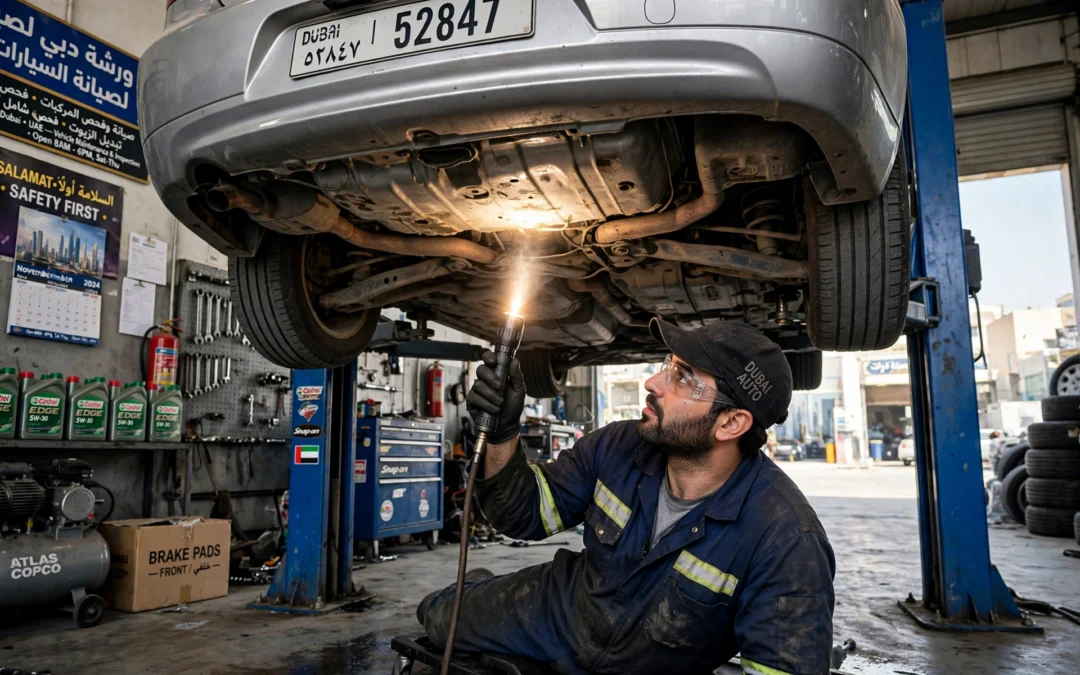
That is what a pre-purchase inspection is for. It is an independent check of a used car, done for you and only you, before you hand over any money. It puts the car on a lift, reads its computer, measures its paint, tests its gearbox and tells you, in plain language, what you are actually buying. This guide explains what a proper inspection includes, why the RTA test is not enough on its own, how to check a car’s history for free, and the flood, accident and odometer red flags that should make you walk away.
The one rule before everything else: never pay for a used car before an independent inspection — and if the seller refuses to let the car be inspected, that refusal is your answer. An honest seller has nothing to hide, and the inspection costs a fraction of a single major repair.
1. Why Buying a Used Car in Dubai Is Different
Three things make buying a used car in the UAE different from buying one almost anywhere else, and all three make an inspection more important, not less. The first is the heat. Summer temperatures above 45 degrees age a car faster than the mileage suggests: rubber hoses and seals harden, engine mounts wear, transmission fluid degrades, batteries often last only two to three years, and tyres that look fine can be past their best. A car with low mileage can still be tired if it spent its life in the heat, and a car with high mileage that was properly maintained can be a better buy than a low-mileage car that was neglected.
The second is imports. Many cars on the UAE used market were not originally sold here. American-spec and Japanese-spec cars are common, and they are often cheaper than the same model in GCC specification. That lower price can hide a history: some imported cars were repaired after a major accident abroad, some carry flood history from another country, and their overseas service records are often impossible to get. A car that looks like a bargain can be a car whose real story is in a country you have never been to. A speedometer that reads mainly in miles per hour is a hint the car came from the United States, and it is worth knowing before you buy.
The third is the speed of the market. Cars sell fast in Dubai, and sellers know it. The pressure to decide quickly — another buyer is coming this evening, the price is only good today, the car will be gone by the weekend — is real, and it is designed to make you skip the checks. Do not let it. An inspection takes one to two hours. A bad car takes months to fix and far more money than the inspection ever cost. The time to be careful is before you pay, because after you pay, the car is yours, and so are its problems.
2. The RTA Test Is Not Enough — and Here Is Why
Most buyers in Dubai have heard of the RTA vehicle test, and many believe that a car with a passing test is a good car. It is not. The RTA test answers exactly one question: is this car road-legal today. It checks the basics — brakes, lights, tyres, engine operation, body integrity and emissions — in about half an hour, and it gives a pass or fail. A passing certificate is valid for 30 days. That is useful, and you should always ask for it, but it is not an inspection of the car’s condition. It does not tell you whether the gearbox is about to fail, whether the car was rebuilt after a crash, or whether the odometer has been rolled back.
A proper pre-purchase inspection is a different job entirely. Where the RTA test checks 15 to 20 basic items, a thorough inspection covers 100 to 250 points and more, depending on who does it. It puts the car on a lift and looks at the underbody. It measures the paint thickness on every panel with a gauge. It reads the car’s computer for stored and pending fault codes. It tests the gearbox under light and full acceleration, checks the air conditioning properly, and gives you a detailed report with photographs — not a pass or fail, but a picture of what the car really is, and what it is likely to cost you in the next year.
There is also the RTA Technical Vehicle Status Report, which is a different thing from the test. It shows the insurance, ownership history, registration status and test records, and it can be ordered online. Two things to know about it: it needs the current owner’s consent, and the RTA itself states that the report does not contain accident data. It may also be missing registration records, service history, recall campaigns and mileage readings. So the report tells you what the car is on paper. It cannot tell you that the paint on the right rear quarter is far thicker than factory paint, that the timing chain rattles on a cold start, or that there is dried silt behind the boot lining. That is what a physical inspection is for — and a seller who will not give consent for the report is telling you something too. If they will not let you see the ownership history, ask yourself what is in it.
3. Paperwork First: The Mulkiya, the VIN and the Money Owed
Start with the paperwork, before you fall in love with the car. If anything here does not line up, stop — no inspection will fix a car that is not legally the seller’s to sell. Ask to see the original registration card, the Mulkiya, and the seller’s Emirates ID. The names should match. If the person selling the car is acting for someone else, they need a legal Power of Attorney. If they cannot show you that, walk away.
Next, the VIN — the 17-digit chassis number. Check it in three places on the car: the plate on the dashboard visible through the windscreen, the driver-side door frame, and the firewall in the engine bay. All three must match the Mulkiya exactly. If even one digit is different, treat it as a major warning sign. It can point to theft, to a cloned identity, or to repairs the seller is trying to hide. While you are there, check the engine number against the Mulkiya too. These are two-minute checks, and they are the checks that catch the worst cars.
Then the money the car owes. Before you pay, check for unpaid traffic fines, Salik, and any bank loan or mortgage on the car. A car with a bank loan cannot be transferred until the loan is cleared, and unpaid fines become your problem at transfer. Check the insurance status as well — whether the car was insured comprehensively or third-party only, and whether there is a claim history you can see. And remember the rule that protects you most: pay only when the RTA system shows the car is clear for transfer. Do not hand over cash on a promise that the paperwork will be sorted tomorrow.
Check the Mulkiya itself for its expiry date, too. A registration that is about to expire means you will be paying for the test and renewal almost immediately, and if the car fails its test, that cost and that delay are yours. Ask the seller when the car was last tested and whether it passed first time — a car that needed several attempts to pass is a car with problems that the test caught, even if it eventually passed. And if you are buying from a dealer rather than a private seller, the paperwork rules are the same, but the person you are dealing with is a business: ask whether the car is being sold with a warranty, what it covers, and get it in writing. A verbal promise from a dealer is worth nothing if it is not on paper. Whether the seller is private or a dealer, the principle is the same: the paperwork must be clean before the money moves, and if any document is missing, delayed or explained away, stop and ask why. A car with a clean file is a car you can buy with confidence. A car with a messy file is a car you should leave alone.
4. Accident History: What You Can Check for Free, and What You Cannot
An accident in a car’s past is not automatically a reason to reject it. What matters is how serious it was, which parts were damaged, and how they were repaired. Replacing a headlight is very different from repairing structural damage. The problem is that sellers do not always tell you, and fresh paint hides a lot. So check the history yourself, and do it before you pay.
In the UAE, you can check a vehicle’s accident history by chassis number on the Ministry of Interior portal, through Emirates Vehicle Gate, and through TAMM for Abu Dhabi cars. You enter the VIN and you get the date, place, time and report number of every registered accident. It costs nothing and needs no account. Do it for every car you are serious about. But know what it does not show: accidents that were never reported to the police, repairs done privately, and damage that happened abroad before the car was imported. The free check is a starting point, not a guarantee.
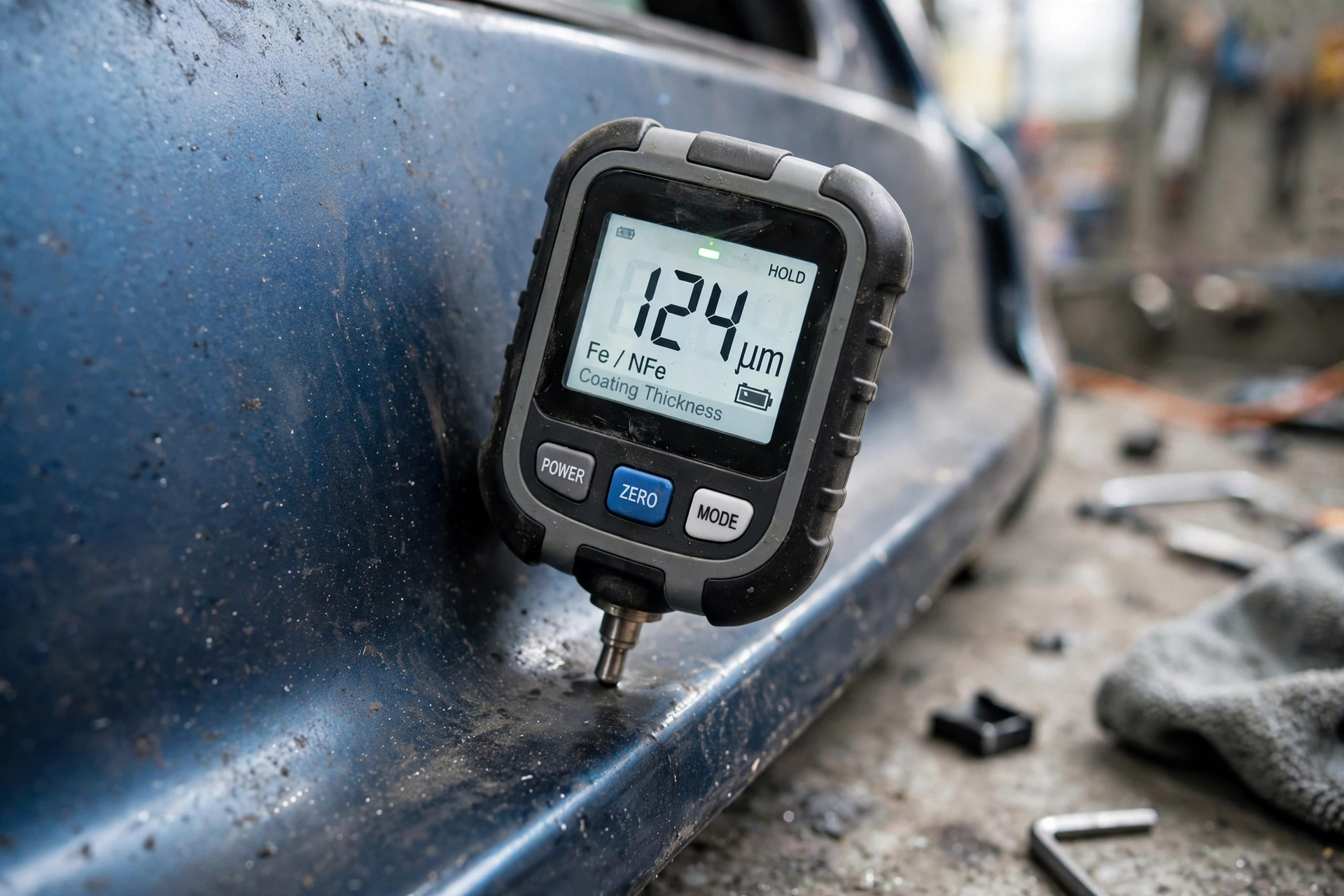
That is where the physical inspection earns its keep. A paint thickness gauge tells the story the paperwork cannot: factory paint reads in a narrow band, often around 100 to 140 microns, while filler and respray read far thicker and unevenly. The inspector measures every panel, and a panel that reads twice as thick as the others has been repaired. Panel gaps tell the same story in a different way: uneven gaps around the bonnet, doors and boot point to a car that has been pulled back into shape. Look along the side of the car at a low angle in daylight — ripples in the panels, overspray on rubber seals and lights, bolts that look as if they have been removed before, and welds that are not neat and even are all signs of repair work. And underneath, the inspector looks at the chassis rails, the door sills and the boot floor for welds or straightened metal. A car with structural repair is a car you should think very carefully about, whatever the price.
5. Body and Paint: Reading the Car’s Skin
You can learn a lot about a car from its skin if you know what to look for, and you should look in daylight. A car viewed at night, or under the bright lights of a showroom, hides things that daylight shows. Walk around the car slowly and look at the paint panel by panel. Does the colour match from one panel to the next? Does the texture look the same — the same orange-peel finish, the same gloss? A panel that looks slightly different in colour or texture has been repainted, and the question is why.
Check the panel gaps with your eyes and your fingers. The gap between the bonnet and the wings, the doors and the body, the boot and the rear quarters — on a car that has never been in an accident, those gaps are even and consistent. Uneven gaps, a door that sits slightly proud of the body, a bonnet that does not close flush, all point to a car that has been taken apart and put back together. Check the glass too: the date code on each window should be close to the car’s year of manufacture, and a window with a much newer date than the others has been replaced. Look at the headlights and tail lights for condensation inside — water inside a light is a sign of a seal that has failed, and it can also be a sign of flood damage.
Underneath, look for fresh undercoating. A thick, fresh coat of underseal on an older car can be innocent — it can be protection — but it can also be a cover for damage, rust or a repair. If the underbody has been freshly coated and the seller cannot explain why, ask the inspector to look harder. And check the tyres while you are there: uneven wear across the tread points to alignment or suspension problems, and our tyre age guide explains how to read the DOT code and work out whether the tyres are older than five years — in GCC conditions, tyres older than five years should be treated as expired, whatever the tread looks like.
6. Flood Damage: The Red Flags That Matter Most in Dubai
Flood damage is the hidden problem that matters most in the UAE, and it matters because of one event: the April 2024 floods. One Dubai inspection company estimates that around 50,000 cars were damaged in those floods, and some of them are still on the used market now, cleaned up and sold on. Water damage often shows up months later as electrical faults and corrosion, so a car that looks fine today can start failing in ways that are expensive and hard to trace.
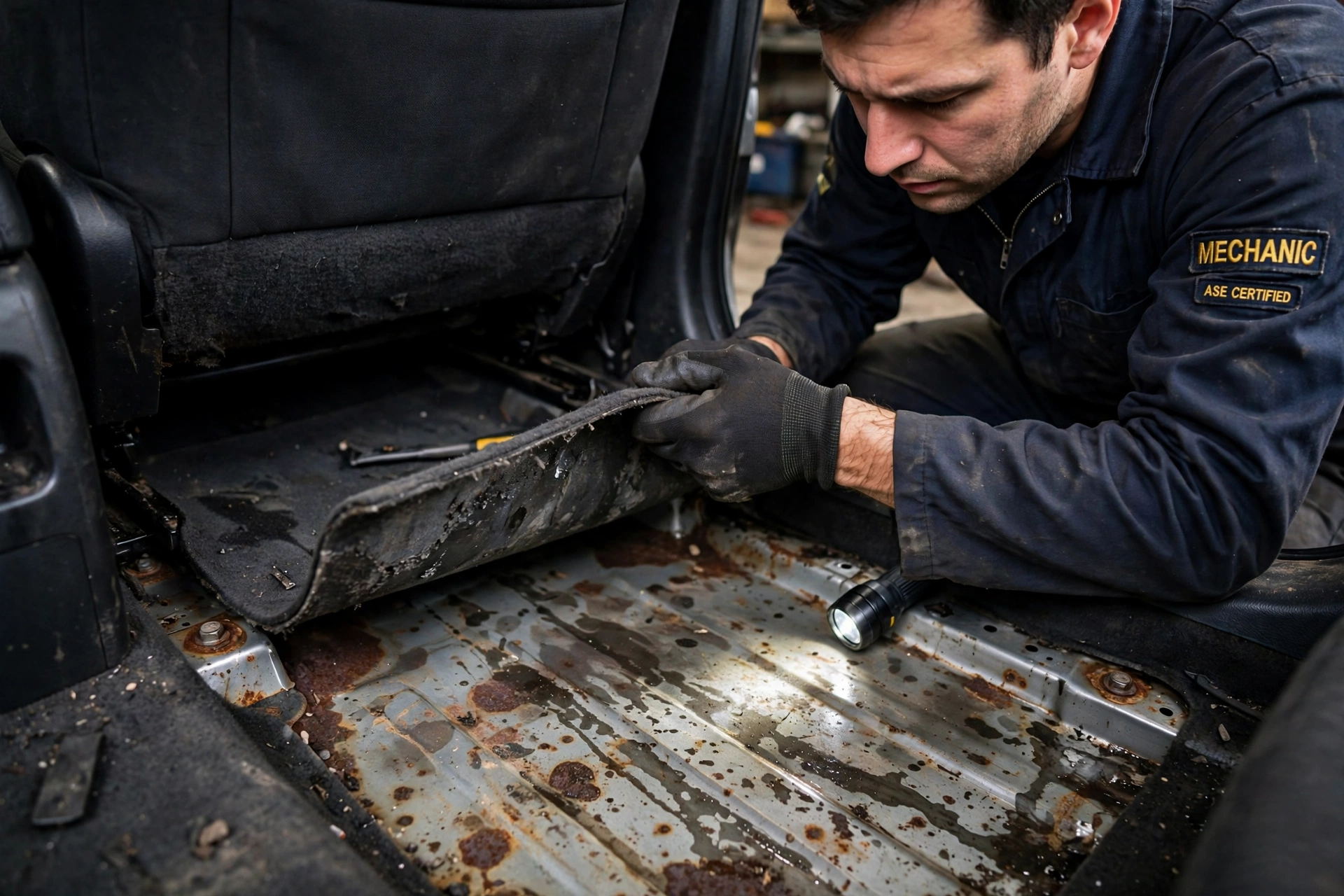
The signs are there if you know where to look, and they start with your nose. Smell the cabin. A damp or musty smell, or a smell of mould from the air conditioning, is a warning. Be wary of a car that smells strongly of air freshener — it may be covering something. Look at the carpets and floor mats: lift them and look underneath for water marks, silt or rust. Pull each seat belt fully out and look for tide marks near the bottom. Check the spare wheel well, the seat rails and the brackets under the dashboard for mud, sand or corrosion. Rust inside the cabin is not normal, and it is one of the clearest signs a car has been under water.
Then the electricals. Flood cars suffer random electrical faults — windows that work sometimes, sensors that throw warnings and then clear, screens that flicker, warning lights that come and go. Test every switch, every window, every mirror, every seat motor and every screen, and do it more than once. If something works intermittently, do not accept the seller’s explanation that it is a loose connection. And look for new carpets or new upholstery in an older car: if the interior looks newer than the car’s age suggests, ask why it was replaced. Any one of these signs is a reason to dig deeper. Several together is a reason to walk away. If you are unsure, tell the inspector your doubts before the inspection — flood damage is one of the hardest problems to spot on a short viewing, and the inspector needs to know to look for it.
7. Engine: The Cold Start Tells the Truth
Ask the seller not to start the car before you arrive. This matters more than almost anything else in the viewing, because a cold start shows problems that a warm engine hides. A car that has been running for twenty minutes before you get there has had time to warm up, and a warm engine masks rough idling, smoke, rattles and slow starting. If the car is already warm when you arrive, ask to come back another day and see it cold. A seller who will not let you see a cold start is telling you something.
On a cold start, listen before you look. The engine should turn over promptly and settle into a smooth, even idle. Rough idling, ticking, knocking or rattling on start-up are all warnings. A timing chain that rattles on a cold start and then goes quiet is a classic sign of a chain that is worn and will need replacing. Watch the exhaust as the engine starts: a puff of blue smoke means the engine is burning oil, white smoke that does not clear can mean coolant is getting into the combustion chamber, and black smoke points to a fuelling problem.
Then look at the fluids. Pull the dipstick and look at the oil: it should be amber or dark brown, not milky and not grey. Milky or foamy oil means water is getting into the engine, and that usually means a blown head gasket — an expensive repair and a reason to walk away. Check the coolant in the reservoir: it should be bright and clean, not brown or rusty, and the level should be correct. Look around the engine for leaks — around the head gasket, the sump and the timing cover — and look underneath for fresh oil on the ground. Our fluid leak guide explains how to tell what a leak is by its colour and location, and if you see a leak, ask the inspector to find where it is coming from before you negotiate. And check the battery: in UAE heat, batteries often last only two to three years, so a battery that is slow to turn the engine over is a car that needs a new battery soon. Our car won’t start guide covers the warning signs.
8. Gearbox and Drivetrain: The Most Expensive Surprise
The gearbox is the most expensive thing that can go wrong on a used car, and it is the thing a short test drive is least likely to reveal. A gearbox that is about to fail often feels fine for the first few minutes. The signs show up when the gearbox is warm, when you are in traffic, and when you ask it to do something hard — and that is why the test drive and the inspection both matter.
On the test drive, pay attention to the shifts. Under light acceleration, the changes should be smooth and almost unnoticeable. Under full acceleration, they should be firm and quick, not harsh and not delayed. Watch for the warning signs: a delay when you shift from Park to Drive or Reverse — the car hesitates before it engages — is an early gearbox warning. Slipping, where the engine revs rise but the car does not speed up, is a serious one. Jerking or harsh engagement between gears, or a gearbox that hunts between gears on the highway, are all reasons to get the car inspected before you pay, not after. And listen: a whining or grinding noise from the gearbox is never normal.
The inspection goes further. The inspector checks the transmission fluid — its colour and its smell. Healthy fluid is red or pink and clean; fluid that is dark brown or black, or that smells burnt, means the gearbox has been running hot and the fluid has not been changed. They check the CV joints and driveshafts for torn boots and play, and they read the gearbox computer for fault codes. Some gearboxes hide their problems well: the fault codes are stored even when the warning light is off, and only a scan finds them. If the inspection finds gearbox trouble, the decision is usually simple — walk away, or negotiate a price that covers a rebuild. Do not buy a car with a known gearbox problem and hope it will be fine. It will not be.
9. Electronics and the OBD Scan: What the Computer Knows
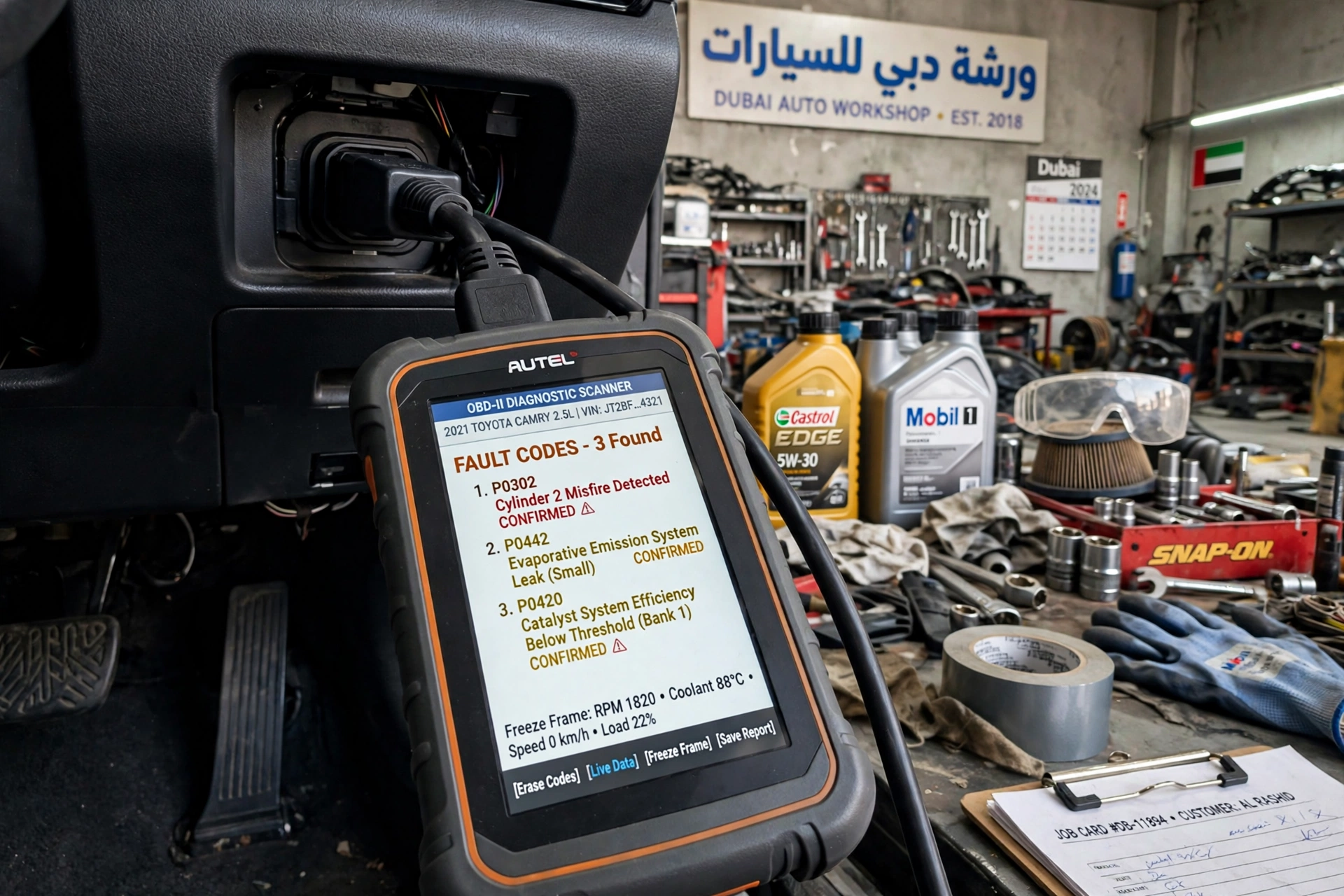
A modern car is a computer on wheels, and its computer remembers things the seller would rather forget. A full OBD diagnostic scan reads the stored and pending fault codes in the engine, gearbox, ABS, airbags and stability control systems, and it does it in minutes. It is one of the most valuable parts of an inspection, because it finds problems that no test drive will show: a fault code stored weeks ago, a sensor that is failing intermittently, an airbag system that has been tampered with, a gearbox that has recorded a slip.
But the scan does more than read codes. It also lets the inspector check the odometer against the car’s own records. Odometer tampering — rolling the mileage back — is a common problem with used cars, and it is hard to spot by looking at the dashboard. The clues are elsewhere: the mileage in the service history should line up with the odometer, and so should the wear on the car. A car that shows low mileage but has a worn steering wheel, worn pedals, worn driver’s seat and a tired interior has not done the mileage on the clock. In the UAE, normal driving is around 15,000 to 25,000 kilometres a year, so a five-year-old car showing very low mileage needs an explanation — and the service records, the inspection history and the tyre age should all support it. If they do not, the mileage is the thing that is wrong.
Test the electronics yourself as well, and test everything. Every window, every mirror, every seat motor, every light, the screens, the cameras, the sensors, the parking aids. On a modern car, a single failed sensor can cost a lot to replace, and a car with several small electrical faults is often a car with a bigger electrical problem underneath. And check the warning lights: when you turn the ignition on, all the warning lights should come on and then go out. A warning light that never comes on at all — especially the engine management light or the airbag light — may have been disabled to hide a fault. That is a serious red flag, and it is one the scan will confirm.
The scan also shows live data, which is where the real story often is. A good inspector does not just read the codes — they look at the live readings while the engine is running: the fuel trims, which show whether the engine is running too rich or too lean; the misfire counts, which show whether a cylinder is misfiring even when you cannot feel it; the oxygen sensor readings, which show whether the exhaust system is working properly. These numbers tell you how the engine is actually performing, not just whether it has stored a fault. And they cannot be hidden by clearing the codes before you arrive — clearing the codes wipes the memory, but it does not fix the underlying problem, and the live data will show it within minutes of the engine running. That is also why you should ask the seller not to disconnect the battery before you arrive: a disconnected battery clears the codes and resets the monitors, and a car that has just had its battery disconnected has nothing to tell the scanner until it has been driven for a while. If the seller has recently disconnected the battery, ask why — and if the answer does not make sense, treat it as a warning.
10. Air Conditioning and Cooling: The Test That Matters in Dubai
In Dubai, the air conditioning is not a luxury. It is the difference between a car you can drive and a car you cannot, and it is one of the things most buyers test least. A weak air conditioner in a Dubai summer is unbearable, and a failing one is expensive to fix. So test it properly: start the car, turn the air conditioning to its coldest setting, and let it run for ten minutes. It should be blowing genuinely cold air within a few minutes, not just cool air, and it should stay cold at idle, not only when you are driving. Weak cooling at idle is a common problem here, and it points to a compressor or a fan that is not working properly.
Smell the air as it comes out. A musty or mouldy smell from the air conditioning can mean water damage, or a cabin filter that has never been changed, or mould growing in the evaporator. Any of those is a reason to look further. Listen for the compressor: it should engage smoothly, without a loud clunk or a grinding noise, and the engine idle should not change dramatically when it kicks in. And check the cooling system at the same time, because the air conditioning and the engine cooling work together in this heat. Look at the coolant level and colour, check the radiator hoses, and watch the temperature gauge on the test drive. A car that runs hot in traffic, or whose temperature gauge climbs when the air conditioning is on, has a cooling problem — and our engine overheating guide explains what that usually means and how urgent it is.
While you are in the car, test the heating too. It sounds odd in Dubai, but the heater uses the same coolant circuit as the engine, and a heater that blows cold can mean the coolant is low or the thermostat is stuck. It is a small check, and it tells you something useful about the cooling system for free.
11. Tyres, Brakes and Suspension: What the Road Test Reveals
Tyres, brakes and suspension are the parts of the car that keep you safe, and they are also the parts that tell you most about how the car has been treated. Start with the tyres: read the DOT date code on the sidewall — our tyre age guide shows you how — and remember that in GCC conditions, tyres older than five years should be treated as expired, whatever the tread looks like. Check the tread depth, and look for uneven wear: wear on one edge of the tyre points to an alignment problem, wear in the middle points to over-inflation, and wear on both edges points to under-inflation. Uneven wear across the four tyres points to a suspension problem, and a car with four different brands of tyre is a car whose owner bought the cheapest tyre available each time.
On the test drive, test the brakes properly. Find a quiet, safe stretch of road and brake firmly from a moderate speed. The car should stop in a straight line, without pulling to one side, without vibration through the pedal or the steering wheel, and without any grinding or squealing. Pulling to one side can mean a sticking calliper, uneven pad wear, or an alignment problem — or it can mean accident damage. Vibration under braking usually means warped discs. And listen for the suspension: drive over a speed bump slowly and listen for clunks or knocks, and drive over a rough road and feel for a car that bounces more than it should. Leaking shock absorbers, worn bushes and tired springs are all common on Dubai cars, and they are all things the inspection will find on the lift.
Steering tells you just as much. On a straight road, the car should track straight with the wheel centred. If it pulls to one side, or the steering wheel sits off-centre when the car is going straight, something is wrong — and it may be as simple as an alignment, or as serious as a bent suspension component from an accident. And feel for play in the steering: a wheel that moves a little before the car responds is a car with worn steering components. None of these are reasons to reject a car on their own, but together they tell you how the car has been looked after, and whether the price reflects what you will need to spend.
Take the car to motorway speed as well, if you can do it safely. Some problems only show up at speed: a vibration through the steering wheel at 100 or 120 kilometres an hour often means a wheel is out of balance or a tyre is damaged, and a vibration through the seat often points to the rear wheels. A car that wanders at speed, needing constant small corrections to stay in its lane, has a steering or suspension problem. And listen for wind noise and road noise: excessive noise from one side can mean a door seal that has been disturbed, or a window that was replaced and never sealed properly. Finally, check the spare tyre and the jack. Open the boot, lift the floor, and look: is the spare there, is it inflated, is it the right size, and is the jack present and working? A missing spare is a small thing, but it tells you how the car was kept — and if the seller has removed the spare, ask what else has been removed.
12. GCC Spec or Imported — and the Final Decision
Before you decide, answer one question: is the car GCC specification, or was it imported? GCC-spec cars are built for the Gulf climate — the cooling system, the air conditioning and the filtration are all set up for the heat and the dust — and their full service records are usually easier to get, because they were serviced here by the dealer network. Imported cars, usually American or Japanese specification, often cost less, and that lower price can be a genuine bargain. But some imported cars were repaired after a major accident abroad, some carry flood history, and their overseas history may not show in UAE records at all. An imported car needs closer checks, not fewer, and the inspection should confirm the specification and the history before you pay.
Then make the decision, and make it with the inspection report in your hand. There are three possible answers. Buy it, if the inspection is clean or the faults are small and the price reflects them. Negotiate, if the inspection finds real problems that will cost money — use the report to get the price down by the cost of the repairs, and get the repairs done before you rely on the car. Or walk away, and walk away without regret, if the inspection finds structural damage, flood signs, a failing gearbox, or a seller who refused the inspection in the first place. Walking away from a bad car costs you nothing. Buying one costs you everything you saved and more.
A dealer warranty or a dealer’s own inspection report is useful, but remember who wrote it: the seller. An independent inspection is done for you and only you, and it is the only report that has your interests at heart. And if you need an inspection before you buy, 95 Services can come to the car, anywhere in the UAE — call or WhatsApp +971 54 344 3513, open 24 hours. We check the car where it stands, read the computer, and give you an honest answer before you pay. Our RTA inspection checklist covers the same ground from the registration side, and our car repair and maintenance page explains what a proper service includes once the car is yours.
Frequently Asked Questions
How long does a pre-purchase inspection take?
A thorough inspection usually takes one to two hours, depending on the car. That includes putting the car on a lift, a full diagnostic scan, a paint thickness check, a road test and a written report with photographs. It is a small amount of time compared with the years you will own the car, and it costs a fraction of a single major repair.
Does a passing RTA test mean the car is good?
No. The RTA test answers one question — is the car road-legal today — and it checks 15 to 20 basic items in about half an hour. It does not detect accident repairs, a failing gearbox, flood damage or odometer tampering. A car can pass the RTA test and still be hiding an expensive problem. That is why you need a pre-purchase inspection as well.
How can I check a car’s accident history for free in the UAE?
By chassis number on the Ministry of Interior portal, through Emirates Vehicle Gate, and through TAMM for Abu Dhabi cars. Enter the VIN and you get the date, place, time and report number of every registered accident. It costs nothing. But it does not show accidents that were never reported, repairs done privately, or damage that happened abroad before the car was imported — so it is a starting point, not a guarantee.
What is the difference between a GCC-spec car and an imported car?
A GCC-spec car was built for the Gulf climate, with a cooling system, air conditioning and filtration set up for the heat and dust, and its service records are usually easier to get because it was serviced here. An imported car, usually American or Japanese specification, is often cheaper, but it may carry accident or flood history from another country, and its overseas records are often impossible to get. An imported car needs closer checks, not fewer.
How can I tell if a car has flood damage?
Smell the cabin for damp or mould, and be wary of strong air freshener. Lift the carpets and look for water marks, silt or rust underneath. Pull each seat belt fully out and look for tide marks. Check the spare wheel well, the seat rails and the brackets under the dashboard for mud or corrosion. Look for condensation inside the headlights, and test every electrical item — flood cars often have faults that come and go. New carpets or new upholstery in an older car is another warning sign.
What should I do if the seller refuses an inspection?
Walk away. A seller who will not let the car be inspected is the biggest red flag there is, whatever the explanation. An honest seller has nothing to hide, and the inspection is done at your cost, on your behalf. If they will not agree to it, the car is not worth the risk — there are other cars, and the next one may be the right one.
Buying a used car in Dubai does not have to be a gamble. The checks exist, most of them are free, and the one that costs money — the inspection — is the cheapest insurance you will ever buy for a car. Do the paperwork first, check the history, look at the car in daylight, insist on a cold start, and never pay before an independent inspection. The right car is out there, and the few hours you spend checking it are the difference between a car you enjoy and a car you regret. Make sure the one you buy is the right one. And if you need a car inspected before you pay, call or WhatsApp 95 Services on +971 54 344 3513 — we come to you, anywhere in the UAE, open 24 hours.
