
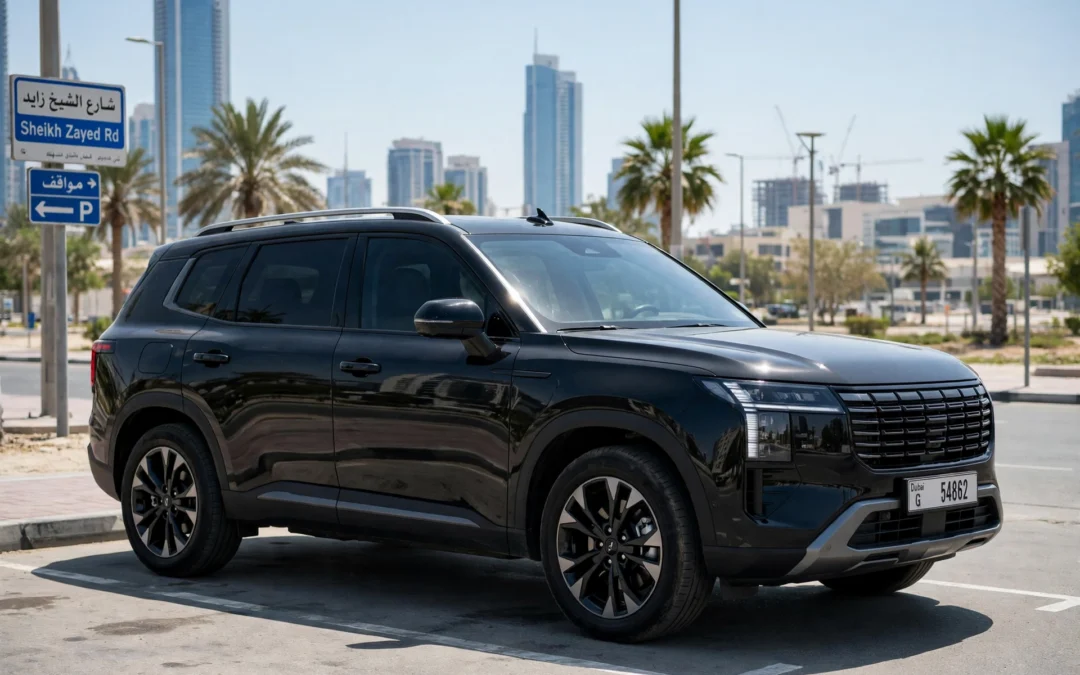
In Dubai, window tint is not a style choice. It is a necessity. The sun here is strong enough to turn a parked car into an oven, to fade the interior, and to make the air conditioning work twice as hard. Almost every car on the road has tinted windows, and most of them are perfectly legal. But every year, cars fail their RTA inspection over tint, and their owners pay a fine and then pay again to have the film removed and replaced. The difference between the two is not how dark the tint looks. It is whether the finished window passes a meter reading at the testing lane.
The rule itself is simple to state and easy to get wrong. For a private car in the UAE, the side and rear windows may be tinted up to 50 percent, and the front windscreen must stay clear apart from a narrow sun strip along the top edge. That is the figure set by Ministerial Resolution No. 178 of 2017, which raised the permitted level from the earlier 30 percent limit. Exceeding it carries a fine of 1,500 dirhams, and the film has to come off at your cost. Those are the facts most sources agree on — and they are the facts this guide is built on.
But there are places where the sources disagree, and this guide will not pretend they do not. Some guides state a different limit for the front side windows than for the rear. Some say the rear windows have no limit at all. Some quote a lower fine for specific cases. The disagreement comes from the way the rule is written and the way shops talk about film, and it is the reason so many drivers get caught out. This guide explains the rule, the disagreement, what the RTA actually measures, the medical exemption route, and how to choose a film that keeps you legal — so you do not pay for the same tint twice.
The rule in one line: for a private car, side and rear windows up to 50% tint, windscreen clear except a narrow sun strip. The number that matters is the meter reading on the finished window — glass plus film together — at RTA testing. Agree that number in writing before the film goes on.
1. The 50% Rule: Where It Comes From
Before July 2017, the permitted tint level in the UAE was 30 percent on side and rear windows. That changed with Ministerial Resolution No. 178 of 2017, which raised the limit to 50 percent in recognition of UAE summer conditions — the heat, the glare and the long hours of strong sun. The change was widely reported at the time, including in the Khaleej Times, and it is the rule that still applies today. Traffic enforcement now sits under Federal Decree-Law No. 14 of 2024 on Traffic Regulation, and the tint rule is enforced by the police in each emirate.
The published wording, as explained by Abu Dhabi Police in their notice of 2 July 2017, allows black tint up to 50 percent on side and rear glass. It excludes the front windscreen, heavy vehicles and vehicles with taxi plates. That wording matters, because it is the reason for the confusion that follows: the rule talks about tint on side and rear glass, and it does not spell out a separate figure for each window in the way a shop’s price list does. Different guides and different installers have filled in the gaps differently, and that is where the disagreements in this guide come from.
Two things are worth knowing about the rule before anything else. First, it is written for privately registered cars. Taxis, buses, many commercial vehicles and company-registered vehicles are treated differently, and in some cases are not permitted tint at all — so if your car is not a private car, do not assume the 50 percent figure applies to you. Second, each emirate enforces the rule through its own traffic authority — the RTA in Dubai, Abu Dhabi Police in Abu Dhabi, and the equivalent authorities in Sharjah and the northern emirates — and while the limit is the same, the enforcement is not identical everywhere. Sharjah, in particular, is known for stricter enforcement.
2. VLT Explained: What the Number Actually Means
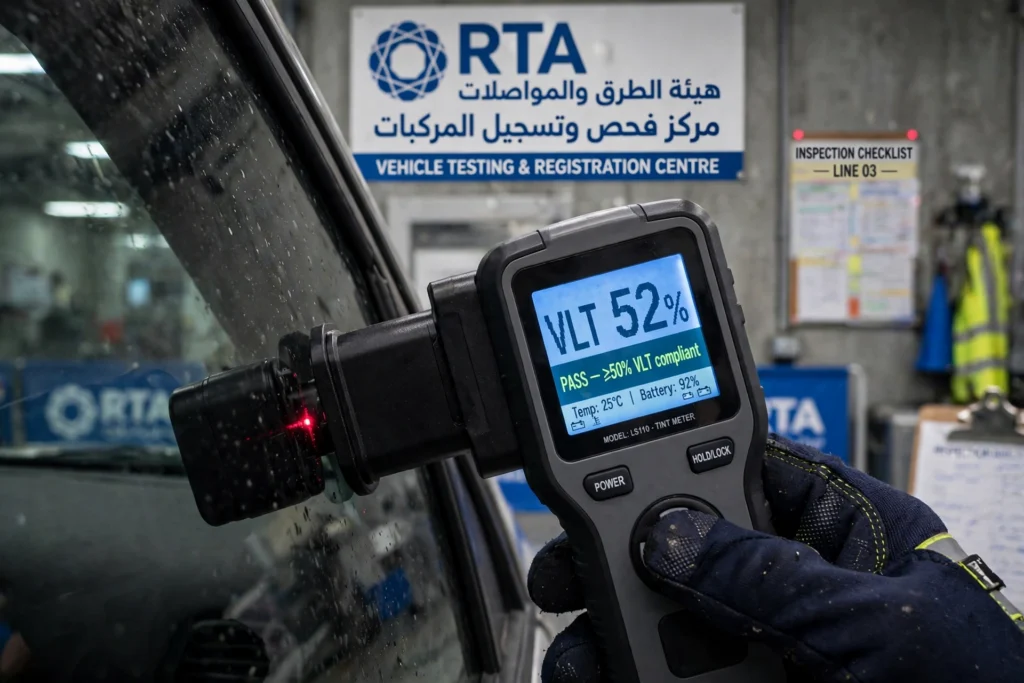 VLT stands for Visible Light Transmission. It is the share of visible light that passes through a window — glass and film together. A higher number means lighter glass: 70 percent VLT looks close to untinted, 50 percent VLT lets half the light through and looks like a mild sunglasses effect, and 20 percent VLT lets only a fifth of the light through and looks very dark. The number is measured with a light meter, and the meter reads the finished window, not the film on its own.
That last point is the one that catches people out. Factory glass absorbs light before any film goes near it — a lot of it on SUVs with privacy glass — so a film that measures 50 percent on the roll can put the finished window under the line once it is fitted. If your car already has factory privacy glass on the rear windows, adding a 50 percent film on top does not give you a 50 percent window. It gives you a darker one, and it may fail. This is why the advice in this guide is always the same: agree the number in VLT, and have the finished window metered before you pay. The meter reading on the car is the only number that counts.
There is also a language trap to watch for. Shops and guides use “tint percentage” in different ways — sometimes for darkness, sometimes for transmission, sometimes for a product shade name. A film sold as “50 percent” might mean it blocks 50 percent of the light, or it might mean it lets 50 percent through, and those are opposite things. Before you agree to anything, ask the installer which meaning they intend, and get the VLT of the finished window in writing. If they cannot give you that number, find another installer.
It is also worth understanding how the meter test itself works, because it explains why the finished window is the only number that counts. At the RTA testing lane, the inspector places a light meter on the window: a light source on one side and a sensor on the other, measuring how much visible light actually passes through the glass and the film together. The reading is a percentage, and it is the percentage the car is judged on. There is no argument with the meter, and there is no appeal to the film’s label. A film that says 50 percent on the box can read 42 percent on the car, and 42 percent is a fail. Factory privacy glass makes this worse: many SUVs and larger cars come from the factory with rear windows that are already dark, and adding any film at all on top can push the reading under the limit. Before you tint a car with factory privacy glass, have the installer meter the glass as it is, with no film on it, and work out how much room you actually have. In some cases the answer is none — the factory glass is already at the limit, and any film at all will fail. That is not the installer’s fault, and it is not a reason to fit the film anyway. It is a reason to choose a near-clear ceramic film for heat rejection, or to leave the glass alone.
3. Window by Window: What Is Allowed Where
Here is the rule window by window, as it is most commonly stated — and then the honest note about where the sources disagree. The front windscreen must stay clear, apart from a narrow sun strip along the top edge, the strip most manufacturers already fit, which sits above the driver’s normal line of sight. The front side windows — driver and front passenger — may be tinted up to 50 percent. The rear side windows and the rear windscreen may also be tinted up to 50 percent. That is the reading most guides give, and it is the reading this guide recommends you follow, because it is the conservative one: if you stay at or above 50 percent VLT on every window, you are within the limit on every reading of the rule.
Now the disagreement. Some guides state a different figure for the front side windows — 30 percent VLT, meaning the front windows may be darker than the rear — and some state that the rear side windows and rear windscreen have no minimum at all, meaning you can go as dark as you like behind the driver’s seat. These readings come from different interpretations of the same published rule and from different emirate practices, and they are not settled. A car that follows the 30 percent front-window reading may pass in one emirate and fail in another, and a car with very dark rear windows may pass its inspection and still be stopped at a checkpoint. The conservative reading — 50 percent everywhere — is the one that keeps you legal in every emirate, and it is the one this guide recommends. If a shop tells you a darker reading is definitely legal, ask them to put it in writing, and check it with the RTA first. The fine lands on you, not on the shop.
Two more windows to think about. The sunroof or moonroof can generally be tinted as long as it does not block the driver’s clear view, but it needs a separate film-and-glass compatibility assessment — not every film suits every roof glass. And mirrored or coloured films are a different matter again: the published rule is about black tint, and it is not blanket permission for coloured or mirrored films. If you are considering anything other than a standard dark film, confirm it with the authority before fitting.
4. Why Cars Fail Inspection Over Tint
In Dubai, tint is checked at RTA vehicle testing, and that matters: the test is a gate the car has to pass, so over-dark film is a problem with a date on it rather than a risk you can dodge. When you take your car for its annual test, or for a registration renewal, the inspection centre tests your front windows with a light meter. If they read below the minimum, the car fails inspection, and you cannot renew your registration until the tint is corrected or removed. That is the single most common way tint becomes expensive: not the fine, but the failed test, the removal, the re-test, and the new film.
An installer’s assurance that nobody checks carries no weight at the testing lane. The meter is objective, and it reads the finished window. Cars fail for the reasons this guide has already covered: a film that was 50 percent on the roll but darker once fitted over factory glass; a film that was fitted darker than the limit on the promise that it would not be checked; a windscreen film that should never have been fitted at all. And they fail because the owner did not know the rule — because the shop that fitted the film did not explain it, or explained it wrong.
There is also a second enforcement route: police checkpoints and routine stops. Traffic police in Dubai and Abu Dhabi use light meters at checkpoints, and a car that reads too dark can be stopped and fined on the spot. Our RTA inspection checklist covers the full test, and tint is one of the named reasons cars fail it — which is why the time to think about tint is before you fit it, not at the testing lane.
5. The Fine and the Removal: What It Actually Costs
The fine for exceeding the permitted tint limit is widely reported as 1,500 dirhams. UAE police have issued public warnings against increasing tint beyond the permitted level, reported by the Khaleej Times, and Abu Dhabi authorities have confirmed the same figure alongside the 50 percent ceiling, reported by Gulf News. Some sources quote a lower figure — 500 dirhams — for specific cases such as front-window tint in Dubai, and enforcement practice varies by emirate. Traffic penalties are revised periodically, so confirm the current amount with the issuing authority before assuming a figure. But the 1,500-dirham figure is the one most commonly reported, and it is the one to plan for.
The fine is not the expensive part. The removal is. The fine does not license the tint: the film has to come off, and stripping a full set of windows and cleaning off the adhesive is billable work. It is slow work, and it carries its own risk: an impatient blade on the rear windscreen can damage the defroster lines, and once those are damaged they do not come back. Then you buy film a second time — the legal film you should have bought in the first place. The whole bill lands on the owner, not on the shop that pushed the darker shade. That is why the cheapest tint is the legal tint, fitted once, and why a shop that offers you a darker film than the limit is offering you the fine.
There are further consequences in some cases. Repeated violations can lead to black points on your licence, and in severe or persistent cases the car can be impounded until the tint is removed, the fine is paid, and the car passes a re-inspection. The enforcement chain can escalate quickly, and it is not worth testing. If your car is stopped for tint, deal with it properly the first time: remove the film, keep the receipt, and fit legal film from a reputable installer.
6. Medical Exemptions: The Route, and What It Does Not Do
Darker tint can be approved in specific circumstances, including documented medical grounds — and this is the part of the rule where the sources agree most clearly. The UAE allows darker tint for drivers with medical conditions that require additional UV protection, such as lupus, certain skin cancers, or severe photosensitivity. But the exemption is not something you claim after the film is fitted. It is granted by the relevant authority in advance, it is tied to the vehicle, and it needs a medical report.
The route is this: you need a medical report or a letter from a licensed UAE hospital or clinic, setting out the condition and the need for additional UV protection, and you submit it to the relevant traffic authority — the RTA in Dubai, Abu Dhabi Police in Abu Dhabi, or the equivalent authority in your emirate. The authority decides, and if it approves, the exemption is issued for the vehicle. The documentation belongs in the vehicle, and in some emirates the exemption must be renewed periodically — one source states annually. An installer cannot grant an exemption, and no installer should fit film beyond the limit on the expectation that an exemption will follow. If a shop offers to fit darker film and sort the paperwork later, they are offering you the fine.
Two honest notes. First, the exact process, the qualifying conditions and the renewal period vary by emirate, and the sources do not agree on the details — so confirm the current process with the RTA or your traffic authority before you start. Second, a medical exemption does not mean unlimited tint: it means a darker tint than the standard limit, approved for that vehicle, for that condition. Do not assume it covers the windscreen, and do not assume it transfers to another car. It is tied to the vehicle it was issued for.
7. Other Exemptions: Government, VIP, Diplomatic and Commercial Vehicles
Medical exemptions are not the only ones. Government, security and diplomatic vehicles can be granted special permits for darker tint, for security and protocol reasons, and those permits are issued by the authorities, not by installers. The same applies to certain VIP vehicles. These are not loopholes a private driver can use: they are specific permissions, issued for specific vehicles, for specific reasons, and they do not transfer to a private car because it looks similar.
Commercial vehicles sit on the other side of the line. Taxis, buses and many commercial or company-registered vehicles are subject to tighter limits than private cars, and in some cases are not permitted tint at all. The reason is straightforward: a taxi or a bus carries passengers, and the authorities want those passengers and the driver to be visible. If your car is company-registered or used commercially, do not assume the 50 percent figure applies to you — check the rule for your vehicle category before you fit anything.
Abu Dhabi handles tinting on a permission basis in some respects, and vehicle categories are treated differently there. The practical point is the same in every emirate: the rule you need is the rule for your car, in your emirate, in your category. A guide written for private cars in Dubai does not answer the question for a company car in Abu Dhabi, and a shop that fits tint without asking what category your car is in has not done its job.
8. Emirate by Emirate: Dubai, Abu Dhabi, Sharjah and the North
The 50 percent limit is applied across the UAE, but enforcement and vehicle categories are handled by each emirate’s traffic authority, and the experience of getting caught is not the same everywhere. Dubai enforces through the RTA and Dubai Police, with tint checked at RTA vehicle testing and at police checkpoints, and the 1,500-dirham fine is the figure most commonly reported for Dubai. The RTA is the authority to confirm with before you fit film in Dubai, and the RTA inspection is the test your car has to pass.
Abu Dhabi follows the same 50 percent limit for side and rear windows, with the windscreen clear except for a narrow visor strip. Abu Dhabi Police are active in checking and fining, and some Abu Dhabi inspection centres are known for strict requirements — some guides report that they expect a slightly lighter tint, in the 30 to 40 percent range, to be safe. That is not a different law. It is a stricter reading at the testing lane, and it is another reason to aim for the conservative end of the limit rather than the darkest film you can get away with. Sunroof tinting is allowed in Abu Dhabi if visibility is maintained.
Sharjah follows the same limit, but it is known for stricter enforcement, and fines there start at 1,500 dirhams alongside black points in some cases. The northern emirates — Ajman, Fujairah, Ras Al Khaimah and Umm Al Quwain — apply the same 50 percent restriction, even though inspections may be less frequent there. Fewer inspections does not mean no rule: a car that is legal in one emirate and illegal in another is a car that can be fined when it crosses the border, and Dubai cars drive all over the country. The safe rule is the same everywhere: 50 percent, windscreen clear, meter reading confirmed.
One situation that catches people out is moving between emirates. A car registered in Dubai but driven mostly in Abu Dhabi, or a car that changes registration from one emirate to another, has to pass the test in the emirate where it is registered — and it can be stopped and fined in any emirate it drives through. If you move, or if you buy a car that was registered in another emirate, check the tint against the rule before you transfer the registration, not after. The transfer test will meter the windows just like the annual test does, and a car that passed in one emirate can fail in another if the testing lane reads it differently. And if you are buying a used car, check the tint as part of the purchase — a car with illegal tint is a car you will have to pay to fix, and that cost belongs in the negotiation. Our pre-purchase inspection guide covers the tint check alongside everything else, and it is worth doing before you pay rather than discovering the problem at your first RTA test.
9. Choosing a Film: Darkness Is Not the Same as Heat Rejection
The biggest misunderstanding in tinting is that darker means cooler. It does not. The heat that makes a car unbearable in Dubai arrives mostly as infrared radiation, not as visible light, and a film can block infrared without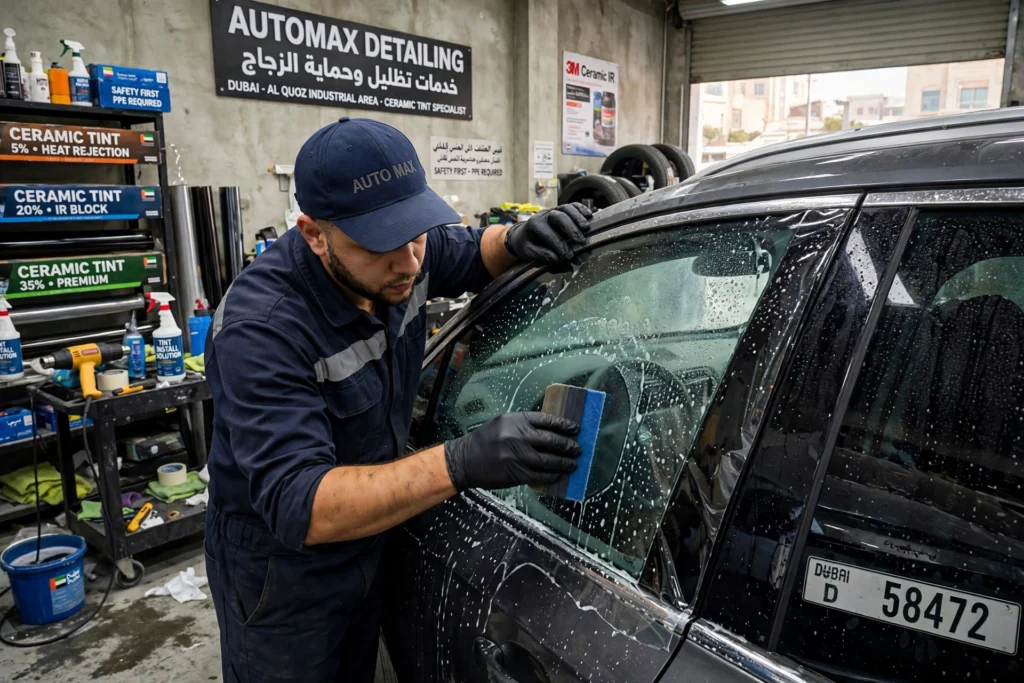 blocking visible light. That is why a clear or near-clear ceramic film can keep a car cooler than a dark dyed film, while staying well above the legal VLT limit. The performance figure to ask for is on the manufacturer’s spec sheet: the infrared rejection percentage and the total solar energy rejection, not the darkness of the film.
There are three main types of film, and they are very different. Dyed film is the cheapest: it darkens the glass by absorbing light, it fades over time, and it does little for heat. Metallic film reflects heat well, but it can interfere with mobile phone signals, GPS and radio reception, and it can look shiny. Ceramic film is the best performer for most drivers: it blocks a high share of infrared heat without darkening the glass much, it does not interfere with electronics, and it does not fade. It costs more, and it is worth it — because a ceramic film at 50 percent VLT can be cooler than a dyed film at 20 percent, and it is legal where the dyed film is not.
For the windscreen, the answer is a clear or near-clear heat film engineered for infrared rejection. These sit well above 50 VLT — some above 70 — while still cutting a substantial share of the heat load, because most of the heat arrives as infrared rather than visible light. But here is the honest note from the sources: the published rule excludes front-windscreen tinting, and a clear-looking film is still an added windscreen covering. A high VLT number, a ceramic label or a brand name does not override the published restriction. Some guides treat near-clear heat film on the windscreen as acceptable; others say to confirm the exact proposal with the authority before fitting. This guide says the same: confirm it with the RTA before you fit anything on the windscreen. The heat problem is real, and the legal answer is real too — but the windscreen is the one window where you should get the answer from the authority, not from the shop.
Film does not last forever, and how long it lasts depends on the type and the installation. A good ceramic film, fitted properly, should last the life of the car. A cheap dyed film will fade, turn purple, and start to bubble within a couple of years in Dubai heat — and a bubbled, peeling film is not just ugly, it is a visibility problem and a reason to fail an inspection. Bubbling usually means the film was fitted badly, or the adhesive has failed in the heat, and once it starts it does not stop. Peeling at the edges means the film was cut too short or the glass was not cleaned properly before fitting. Haze under the film means dust or moisture was trapped during installation. All of these are installation faults, and a reputable installer will fix them under warranty. Ask what the warranty covers before you pay, and how long it lasts: a lifetime warranty from the film manufacturer is worth far more than a one-year warranty from the shop, and a shop that will not warrant its work is a shop that does not expect it to last. And keep the warranty card and the receipt — if the film fails, you will need them, and if you sell the car, the next owner will want to know what is on the glass.
10. What to Ask the Installer Before You Pay
A good installer will answer these questions without hesitation. A bad one will not, and that is your answer. Before you agree to anything, ask for the VLT of the finished window, in writing — not the VLT of the film on the roll, but the reading the finished window will give on a meter. Ask them to meter the finished windows before you pay, and to show you the reading. Ask what film they are fitting, and ask to see the manufacturer’s spec sheet: the VLT, the infrared rejection and the total solar energy rejection. Treat any number quoted verbally, by anyone, as marketing until you have seen it in writing.
Ask about the warranty, and what it covers: fading, bubbling, peeling, and whether the warranty is from the film manufacturer or just from the shop. Ask how long the film will last, and what happens if it fails. Ask about removal: if the film has to come off for any reason, what will it cost, and will the defroster lines on the rear windscreen survive? And ask about the windscreen, specifically: what are they proposing, and have they confirmed it with the RTA? If the installer cannot answer these questions, or if they tell you not to worry about the legal limit, find another installer. The shop that fits your film is not the one that pays your fine.
One more check, and it is free: look at the installer’s own work. A good tint job has no bubbles, no dust under the film, no gaps at the edges, and no creases around the curves of the glass. A bad job has all of those, and it will only get worse in the heat. And if you are buying a used car, check the tint that is already on it — our pre-purchase inspection guide explains how, and an illegal tint on a car you are about to buy is a cost you should know about before you pay, not after.
Finally, ask the installer to put the meter reading in writing on the invoice, next to the film name and the VLT. That one line is your protection: if the car is ever stopped or fails a test, the invoice shows what was fitted and what it was supposed to read, and it shows that you asked for a legal job. A shop that will not write the number down is a shop that does not want to be held to it. And if you already have tint on your car and you are not sure whether it is legal, the cheapest test is a visit to an installer with a meter — most will meter your windows for free, and five minutes with a meter is better than a fine and a failed inspection.
11. Removing Tint: How to Do It Without Damaging Your Car
If your tint is illegal, or if it is old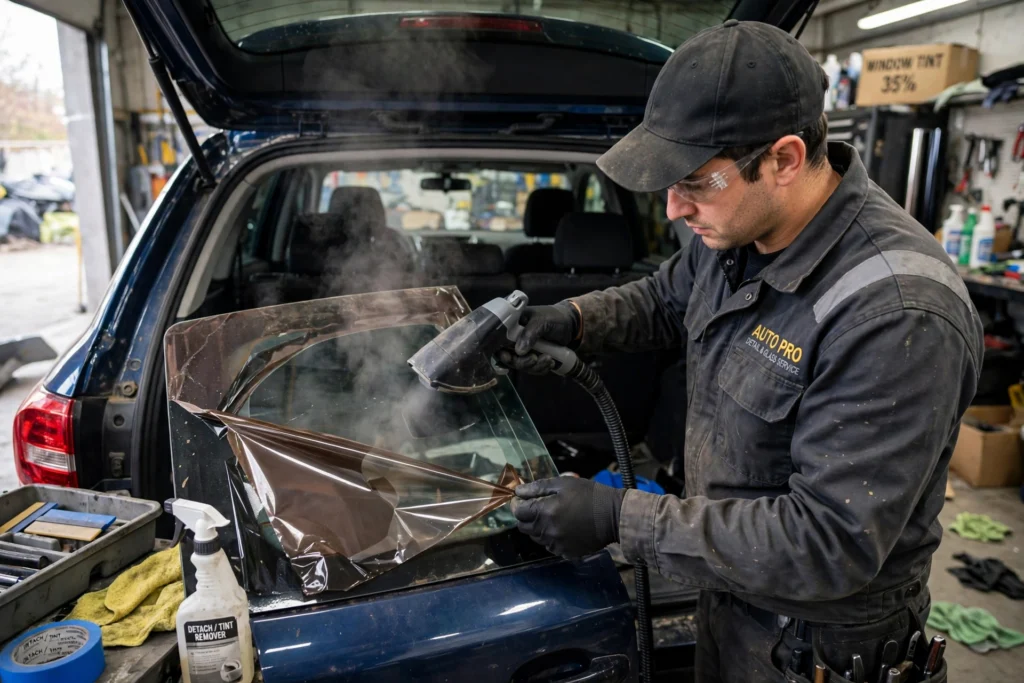 , bubbled, faded or peeling, it has to come off — and how it comes off matters. The film itself peels away with heat and patience: a steamer or a heat gun softens the adhesive, and the film lifts off in a sheet. The adhesive left behind is the hard part, and it needs a proper adhesive remover and a soft cloth, not a blade. A blade on the side windows is bad enough; a blade on the rear windscreen is worse, because the defroster lines are printed on the glass and a blade will cut them. Once a defroster line is cut, that part of the rear windscreen will not defrost again, and the only fix is a new windscreen.
Do it before your inspection, not at it. If your car is due for its RTA test and the tint is over the limit, remove it in advance, clean the glass properly, and then take the car for its test. Trying to argue the reading at the testing lane does not work, and being asked to remove the film at the inspection centre is the worst place to do it. And if you are removing old film to fit new legal film, let the installer do the removal: they have the tools, they know the defroster risk, and if they damage something, it is their responsibility. A removal done badly costs more than a removal done by someone who does it every day.
After removal, the glass needs a proper clean. Adhesive residue left on the glass will show up as haze in the sun, and it will stop new film from sticking properly. If you are fitting new film, have the installer clean the glass as part of the job. And keep the receipt for the removal and the new film: if you are ever stopped, the receipt and the meter reading are the proof that your car is legal.
12. Tint and Your Car: Heat, Air Conditioning, Night Driving and Visibility
Tint is not just about the law. It is about the car, and how the car works in Dubai. A good legal tint makes a real difference to the heat: it cuts the glare, it protects the interior from fading, and it takes load off the air conditioning. That matters, because the air conditioning is one of the hardest-working parts of a car in the UAE, and a car that is cooler inside is a car whose air conditioning lasts longer. Our car AC repair page explains what a proper AC service includes, and if your air conditioning is struggling even with legal tint, it may need attention rather than darker film.
But tint has a cost, and the cost is visibility. The darker the film, the harder it is to see at night, in the rain, and in fog — and Dubai has fog, sudden rain, and dark roads where the only light is your own headlights. A very dark tint makes it harder to see a pedestrian, a cyclist, or a car without lights, and it makes it harder for other drivers to see you. That is the reason the limit exists: it is not about the authorities disliking dark windows, it is about making sure drivers can see and be seen. Our driving in fog guide and our headlight restoration guide both cover the same problem from different angles — visibility in poor conditions — and tint that makes your night vision worse is tint that makes you less safe, whatever the meter says.
Tint also affects the value of your car when you sell it. A car with a good, legal, well-fitted ceramic tint is more attractive to a buyer: it is cooler, the interior is better protected, and the buyer does not have to spend money on tinting. A car with an illegal tint is the opposite: the buyer knows they will have to pay to remove it and fit legal film, and they will take that cost off the price — or they will simply buy a different car. A car with a bubbled, faded or peeling tint is worse still, because it signals that the car was not looked after, and a buyer who sees a bad tint job will wonder what else was done cheaply. If you are selling, it is worth removing a bad tint and fitting a legal one before you advertise, or at least being honest about it. And if you are buying, check the tint as part of your inspection: meter it if you can, look for bubbling and peeling, and ask the seller when it was fitted and by whom. A tint job with a receipt and a warranty is a selling point. A tint job with no paperwork is a question mark.
The right tint is the one that keeps you cool, keeps you legal, and keeps you able to see. Fifty percent on the side and rear windows, windscreen clear except the sun strip, ceramic film for heat rejection rather than darkness, and a meter reading confirmed before you pay. That is the whole guide in one paragraph. And if your car needs a check before its inspection — air conditioning, headlights, or anything else — call or WhatsApp 95 Services on +971 54 344 3513, open 24 hours, anywhere in the UAE. Our RTA inspection checklist covers the rest of the test, and our car repair and maintenance page explains what a proper service includes.
Frequently Asked Questions
What is the legal window tint limit in Dubai?
For a private car, the side and rear windows may be tinted up to 50 percent, under Ministerial Resolution No. 178 of 2017. The front windscreen must stay clear, apart from a narrow sun strip along the top edge. The number that matters is the meter reading on the finished window — glass plus film together — at RTA testing.
Can I tint my front windscreen?
No, not with a dark film. The front windscreen must stay clear apart from the factory sun strip. A clear or near-clear heat film engineered for infrared rejection is the usual answer to windscreen heat, but the published rule excludes windscreen tinting, so confirm the exact proposal with the RTA before fitting anything on the windscreen.
What is the fine for illegal window tint in the UAE?
The fine is widely reported as 1,500 dirhams, confirmed by Abu Dhabi authorities and reported by Gulf News, and the film has to be removed at the owner’s cost. Some sources quote a lower figure for specific cases, and penalties are revised periodically, so confirm the current amount with the issuing authority. Repeated violations can also bring black points and, in severe cases, impoundment.
Can I get a medical exemption for darker tint?
Yes, in specific circumstances. You need a medical report or letter from a licensed UAE hospital or clinic, setting out a condition that requires additional UV protection, such as lupus, certain skin cancers or severe photosensitivity, and you submit it to the relevant traffic authority — the RTA in Dubai, Abu Dhabi Police in Abu Dhabi — before the film is fitted. The exemption is granted in advance, tied to the vehicle, and must be renewed periodically. An installer cannot grant one.
Do the rear windows have a different limit from the front windows?
This is where the sources disagree. Most guides state 50 percent for all side and rear windows. Some state 30 percent VLT for the front side windows and 50 percent for the rear, and some state that the rear windows have no minimum at all. The conservative reading — 50 percent on every window — keeps you legal on every interpretation, and it is the one this guide recommends. Confirm with the RTA if you are unsure.
Will illegal tint make my car fail its RTA test?
Yes. Tint is checked at RTA vehicle testing with a light meter, and if your windows read below the minimum, the car fails inspection and you cannot renew your registration until the tint is corrected or removed. That is the most common way illegal tint becomes expensive — the failed test, the removal, the re-test and the new film.
Window tint in Dubai is simple when you know the rule, and expensive when you do not. Fifty percent on the side and rear windows, windscreen clear except the sun strip, a meter reading on the finished window, and a ceramic film that blocks heat without blocking light. That is the tint that keeps you cool, keeps you legal, and keeps you able to see at night. And if your car needs a check before its inspection, call or WhatsApp 95 Services on +971 54 344 3513 — we come to you, anywhere in the UAE, open 24 hours.
