

You are driving down Sheikh Zayed Road and your car starts doing something it has never done before. It jerks — a small, sharp stumble, like the engine missed a step. Then it does it again. The steering wheel trembles in your hands at the next red light, the engine sounds rough, uneven, almost like it is coughing, and then the check engine light comes on. Or worse, it starts flashing.
That stumble has a name: an engine misfire. It means one or more of your engine’s cylinders did not fire properly on a stroke when it should have. The engine is still running, but it is running on fewer cylinders than it was designed for, and it is telling you about it in the only language it has — shaking, jerking, hesitation, and a warning light.
A misfire is one of the most common engine problems in Dubai, and it is also one of the most misunderstood. Drivers ignore it because the car still moves. They guess at the cause and change parts that were never the problem. Or they panic and assume the engine is finished, when the real fault is a spark plug that costs very little to replace. This guide explains what a misfire is, what each symptom means, what to check first, and — most importantly — when to stop driving and when it is safe to drive to a workshop.
The one rule that matters most: a flashing check engine light means an active misfire that is sending unburned fuel into your exhaust, and that can destroy your catalytic converter. Ease off the accelerator, pull over somewhere safe, and switch the engine off. A steady light is different — drive gently to a safe place and get it checked soon. The rest of this guide explains how to tell the difference and what to do next.
1. What a Misfire Actually Is: One Cylinder Not Doing Its Job
To understand a misfire, you need about thirty seconds of engine knowledge, and it is worth having, because it makes every symptom in this guide make sense.
Your engine makes power by burning a precise mixture of fuel and air inside each cylinder, hundreds of times a minute. Each cylinder needs three things to do its job: a spark at the right moment, the right amount of fuel, and the air squeezed tight enough — compression — for the mixture to burn properly. If any one of those three is missing, late, or wrong, that cylinder does not produce its power stroke. It just goes along for the ride, pushed by the other cylinders, and the engine shakes because one of its workers has stopped working.
That is a misfire. It is not one fault — it is one symptom with several possible causes, and that is exactly why guessing is expensive. A worn spark plug, a failing ignition coil, a clogged fuel injector, a vacuum leak, or low compression can all produce the same shaking and the same warning light. The good news is that the pattern of the misfire — when it happens, how it feels, whether the light flashes or stays steady — narrows the list down a long way before anyone opens the bonnet.
Dubai makes misfires more likely, not less. Summer heat pushes engine bay temperatures far higher than the car was designed for in a mild climate, and heat is the enemy of ignition coils and rubber hoses. Stop-start traffic means the engine spends much of its life at low revs and high temperature, which is exactly when a weak spark shows up. And dust gets into everything eventually, including the air filter and the sensors that measure the air coming in. The parts that cause misfires wear faster here, and they deserve attention sooner.
2. The Symptoms, in Plain Language: Jerking, Rough Idle, Hesitation and More
Most drivers feel a misfire before they see any warning light. Here is what it feels like, and what each feeling usually means.
Jerking or stumbling when you accelerate. This is the classic one. You press the accelerator to pull away from a light or to overtake, and the car hesitates, then surges, then hesitates again — as if someone is tapping the brakes while you are trying to go. Under load, the engine needs its strongest spark, and a weak plug or a failing coil that copes fine at idle breaks down the moment you ask for power. If the jerk appears mostly when you accelerate, the ignition system — plugs and coils — is the first place to look.
A rough, shaky idle. At a red light, the car trembles. The steering wheel vibrates in your hands. The rev needle wavers instead of sitting still. The engine sounds uneven, like it is running on three legs instead of four. A rough idle is often at its worst when the engine is warm and the car is in gear, and it can smooth out a little when you put it in neutral or park. Rough idle alone does not prove a misfire — a vacuum leak or a dirty sensor can do the same — but rough idle plus a check engine light almost always means a misfire is being recorded.
Hesitation and loss of power. The car feels sluggish, as if it has lost a chunk of its strength. Hills feel steeper. Overtaking feels uncertain. The throttle responds a beat late, or the car surges forward in small jumps instead of one smooth pull. On some cars the computer notices the misfire and cuts power deliberately to protect the catalytic converter — a reduced-power or “limp” mode — which feels like the car has suddenly become much weaker than it was. That is the car protecting itself, not a new fault.
Hard starting, or stalling. A misfire that is bad enough can make the engine hard to start, especially in the morning, or make it stall at low speed — pulling into a parking space, for example, or creeping in traffic. If the engine cranks but takes much longer than usual to catch, or starts and then dies, ignition trouble is high on the list. That said, a car that will not start at all is more often a battery or starter problem than a misfire, and our car won’t start guide covers that side of things.
Worse fuel economy. A misfiring cylinder still gets fuel — it just does not burn it. That fuel goes out through the exhaust, unburned, which means you are paying for petrol your engine never used. If your fuel consumption has crept up and the car feels rough, a misfire is a likely reason.
A smell of fuel, or a popping sound from the exhaust. Unburned fuel in the exhaust can smell strongly of petrol around the car, and it can ignite in the hot exhaust instead of in the cylinder, which sounds like a pop or a bang from the back of the car. A fuel smell is always worth taking seriously — if it is strong, do not keep driving, and read our fluid leak guide, which covers fuel leaks and the do-not-drive rule for them.
3. Flashing vs Steady Check Engine Light: The Two Seconds That Matter Most
If you take one thing from this guide, take this: a flashing check engine light and a steady check engine light are not the same warning, and confusing them is the most expensive mistake a driver can make with a misfire.
A steady light — on, not blinking — means the engine computer has recorded a fault. The fault is real, and it needs attention, but it is not actively destroying anything at that moment. You can usually drive gently to a safe destination — home, work, or a workshop — and get it checked within the next few days. Do not ignore it for weeks, because a small ignition fault left alone becomes a bigger one. But a steady light on its own is not a roadside emergency.
A flashing light is different, and it is urgent. A flashing check engine light means an active misfire is happening right now, severe enough that unburned fuel is being dumped into the exhaust with every revolution. That raw fuel burns inside the catalytic converter, and the converter — the expensive part of your exhaust that cleans up the gases — overheats. Diagnostic specialists warn that driving at highway speed with a severe flashing light can destroy a catalytic converter in as little as 5 to 20 minutes. That turns a repair involving a spark plug or a coil into a repair involving the exhaust system.
So what do you do when the light starts flashing? Ease off the accelerator immediately — do not ask the engine for more power while it is misfiring. Put your hazard lights on, move out of traffic to a safe place, and switch the engine off. Do not restart the engine repeatedly to see if the light has gone away. Do not keep driving to see if it clears. If the engine is shaking badly, losing power, smoking, or smelling strongly of fuel, arrange a tow rather than a drive. A mobile mechanic can come to you, which is far cheaper than a new catalytic converter.
There is one exception worth knowing: if the light flashes briefly when you accelerate hard, then stops flashing and the car runs smoothly again, the misfire has dropped below the danger level for the moment. You can usually drive gently to a nearby workshop, at low speed and low revs, without hard acceleration. But do not take it on a long trip, do not drive it hard, and if the light starts flashing again, pull over. The fault is still there — it has only gone quiet.
One more thing about the light: it does not tell you which part has failed. The fault code stored in the computer — read with a diagnostic scanner — narrows it down: P0300 means a random or multiple-cylinder misfire, while codes from P0301 upwards point to a specific cylinder. Those codes are the starting point for diagnosis, not the diagnosis itself: the same code can be set by a plug, a coil, an injector, or low compression, and changing the wrong one wastes your money.
4. Spark Plugs: The Wear Item Most Misfires Start With
If a misfire has one most common cause, it is the spark plug. That is good news, because spark plugs are wear items — they are designed to be replaced — and because a worn plug is the cheapest misfire to fix.
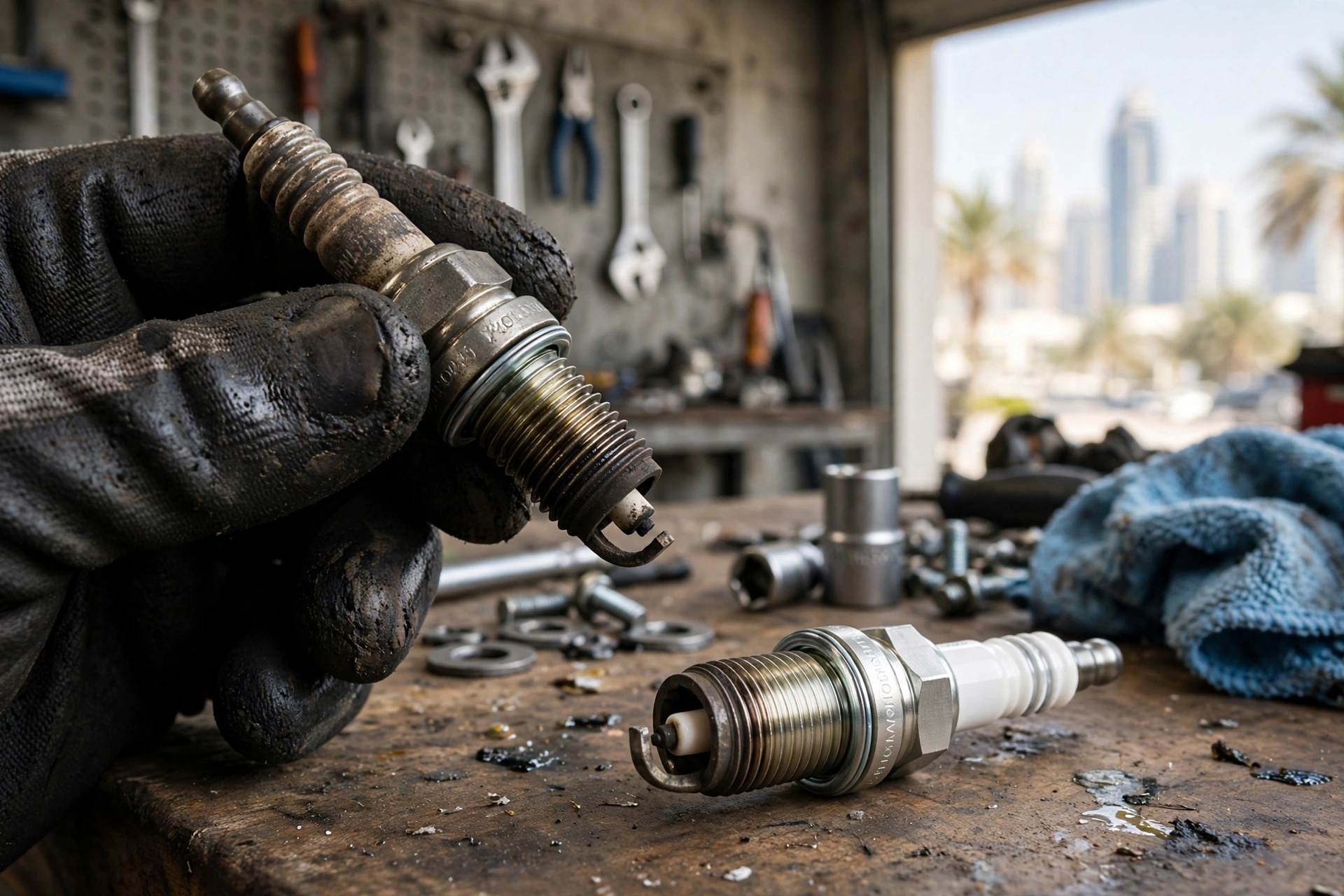
A spark plug does a violent job. It fires thousands of times a minute, in heat and pressure, and every spark erodes a tiny amount of metal from its electrodes. Over time the gap between the electrodes widens, and the spark gets weaker. Eventually the spark is too weak to ignite the mixture reliably, especially under load, and the cylinder starts to miss. How long a plug lasts depends on its type: standard copper plugs may last around 30,000 miles, while iridium or platinum-tipped plugs can last 100,000 miles or more. But mileage is not the whole story in Dubai. Heat ages plugs faster, and short trips leave deposits on them — carbon fouling — that a long highway run would have burned off.
A fouled plug is one that is coated in something it should not be: carbon from incomplete burning, oil leaking past worn seals, or deposits from fuel additives. A fouled plug can still spark sometimes, which is why a fouling misfire often comes and goes. A plug that is physically worn, with a gap far wider than it should be, tends to misfire more consistently, and mostly when you ask the engine for power.
Here is the useful part: a spark plug can be inspected. When a plug is removed, its condition tells a story — worn electrodes, a gap that has opened up, black sooty deposits, oily coating, or a cracked ceramic insulator. That is why a mechanic’s first step with a misfire is often to read the code, then look at the plugs. It is a quick check, and it answers the question directly. If your car is due for a service and the plugs are old, replacing them is often the first and cheapest step, and it rules out the most common cause in one move.
One caution: do not fit a different type of plug from the one your car was designed for. The wrong heat range — a plug that runs too hot or too cold for your engine — can cause misfires of its own. Your owner’s manual, or a mechanic who knows your car, will tell you the correct plug. And if only one plug is bad, it is usually worth replacing the full set: if one has reached the end of its life, the others are not far behind.
5. Ignition Coils: The Part That Fails When It Gets Hot
If the spark plug is the wear item, the ignition coil is the part that fails without warning — and in Dubai heat, it fails more often than most drivers expect.
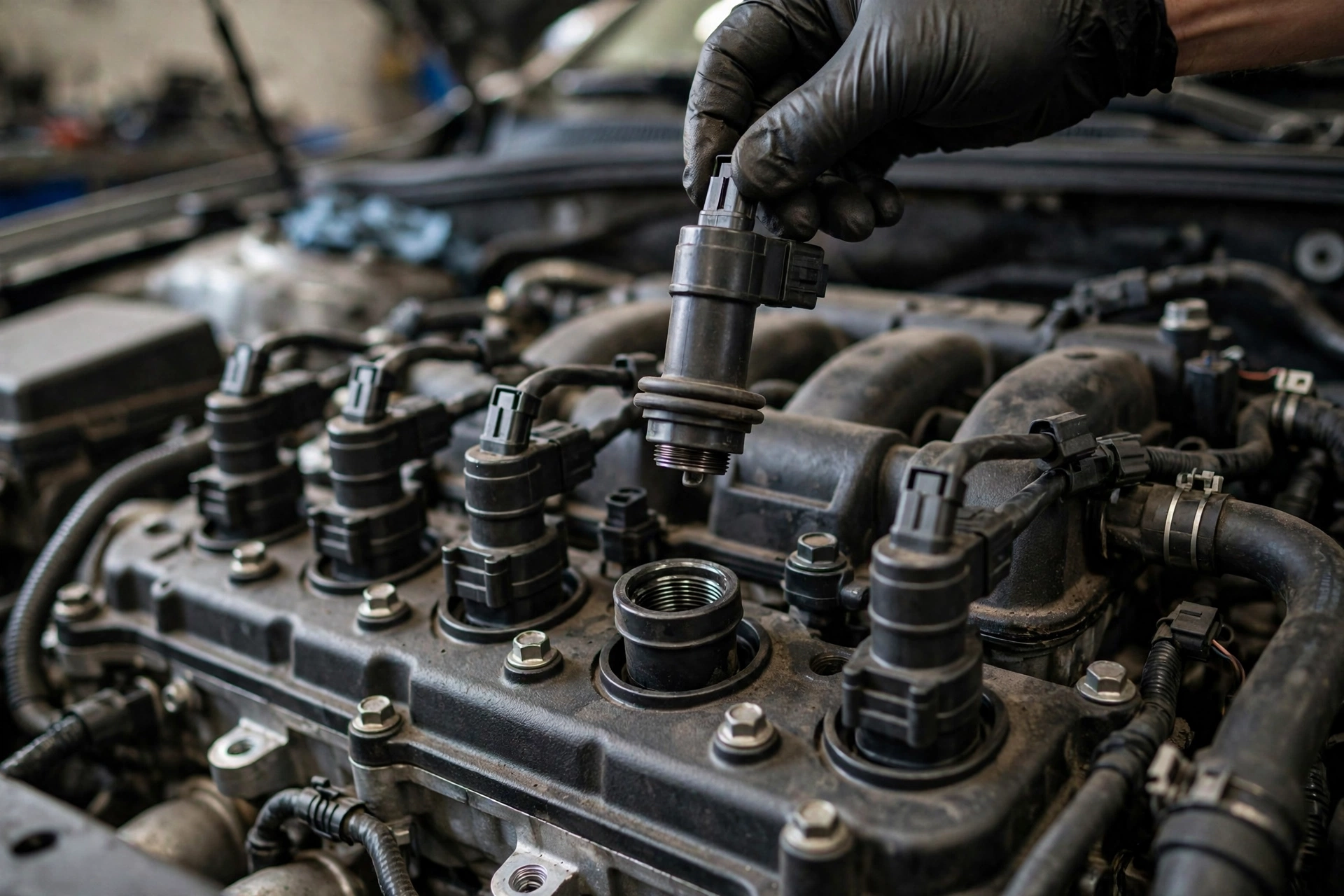
The coil is a small transformer. It takes the 12 volts from your car’s battery and steps it up to tens of thousands of volts — 20,000 to 50,000 volts, depending on the car — which is the voltage the spark plug needs to jump its gap and ignite the mixture. Most cars built since the late 1990s use one coil per cylinder, mounted directly on top of the spark plug. That design is called coil-on-plug, and it has no spark plug wires to fail — but it also means each coil sits right on top of the hottest part of the engine, soaking in heat and vibration for its entire life.
Heat and vibration are what kill coils. The plastic casing cracks, moisture gets in, or the windings inside break down. And here is the pattern that gives a coil away: a weak coil often fails only when the engine is hot, or only under load, and then seems perfectly fine again after the car has cooled down. A car that misfires after twenty minutes in traffic, then runs smoothly the next morning, is showing you a classic coil symptom. A plug, by contrast, usually misfires more consistently. That hot-only pattern is one of the most useful clues in misfire diagnosis, and it is worth telling your mechanic about — “it only happens when the engine is hot” is a sentence that saves a lot of guessing.
Coils also have a neat diagnostic trick, and it is one mechanics use every day. If the fault code points to one cylinder, the coil from that cylinder can be swapped with the coil from a neighbouring cylinder. If the misfire follows the coil to its new cylinder, the coil is the fault. If the misfire stays where it was, the coil is innocent and the search moves on — to the plug, the injector, or compression. The same swap test works for spark plugs. One swap can settle a question that a parts bill cannot.
When a coil fails completely, the cylinder stops firing altogether: heavy shaking, a flashing light, and a sharp loss of power. When it fails partially, the symptoms are subtler — a slight stumble on acceleration, a rough idle that comes and goes. Both are worth fixing promptly, because a partially failing coil is still sending unburned fuel into the exhaust, and it will not heal itself. And like plugs, coils tend to age together: if one has failed after years of heat, the others have lived the same life, so replacing them as a set is often the sensible choice.
6. Fuel: Injectors, Pressure and Bad Fuel
Not every misfire is an ignition problem. Sometimes the spark is perfect and the fuel is the problem — too little of it, too much of it, or the wrong quality.
A fuel injector is a precision nozzle. It sprays a fine mist of fuel into the cylinder at exactly the right moment, and the fineness of that mist matters: a good spray burns cleanly, a poor spray does not. Over time, injectors clog with varnish and sediment from the fuel, and the spray pattern degrades. A clogged injector starves its cylinder, the mixture goes lean — too much air, too little fuel — and the cylinder misfires. A leaking injector does the opposite: it dribbles fuel into the cylinder when it should be shut, the mixture goes rich, and the excess fuel smothers the spark. Both are misfires, and both feel similar from the driver’s seat, which is why a fuel fault is often found only after the plugs and coils have been ruled out.
Fuel pressure matters too. The fuel pump has to maintain a specific pressure so the injectors can spray properly, and if the pump is weak or the fuel filter is clogged, the pressure drops. Low fuel pressure usually causes a misfire across several cylinders at once, and it is often worst under acceleration. That is a useful distinction: a misfire on one cylinder points to that cylinder’s plug, coil or injector, while a misfire spread across several cylinders points to something the whole engine shares — fuel pressure, a vacuum leak, or a sensor.
Then there is the fuel itself. Contaminated fuel — petrol mixed with water, or fuel that has sat in a tank for months — can cause misfires, and it is more common than people think after a car has been parked for a long time. Water in fuel does not burn, and it can make the engine stumble badly. If a misfire started right after a fill-up, especially at a station you do not normally use, tell your mechanic: the timing is a clue. And if you have been using a lower grade of fuel than your car needs, that can cause knocking and rough running too.
7. Air and Compression: Vacuum Leaks, Sensors and the Serious Causes
The third family of misfire causes is the one drivers hear least about, and it includes both the simplest fix and the most serious one.
A vacuum leak is air getting into the engine where it should not. The engine computer measures the air coming in through a sensor, and works out how much fuel to add based on that measurement. If extra air sneaks in afterwards — through a cracked rubber hose, a loose fitting, or a failed intake gasket — the mixture goes lean, because the computer does not know about the extra air. The misfire is often worst at idle, when the leak is a large share of the small amount of air the engine is using. A vacuum leak can sometimes be heard as a faint hissing from the engine bay, and it is a common find on older cars in Dubai, because heat makes rubber hoses hard and brittle until they crack.
Sensors can cause misfires too. The mass airflow sensor measures the air coming in, and if it is dirty — dust is a real factor here — it can report the wrong number, and the fuel mixture goes wrong with it. An oxygen sensor that has gone lazy can do the same. These are not parts to replace on a guess: a diagnostic scan shows whether the sensor readings make sense, and cleaning a dirty sensor is sometimes all it takes.
Then there is compression — the engine’s ability to squeeze the air and fuel mixture tight enough for the spark to ignite it. If a cylinder cannot seal properly, the mixture escapes before it can burn, and no spark, however strong, will fix that. Low compression usually comes from worn piston rings, a valve that no longer seats properly, or a failed head gasket. A blown head gasket can also let coolant into the cylinder, which fouls the plug and causes a misfire that comes with a sweet smell and a dropping coolant level — and if you notice those together, read our engine overheating guide, because coolant loss and overheating are the same problem from a different angle.
Compression problems are the serious end of misfire diagnosis, and they are found with a compression test — a gauge screwed into the spark plug hole that measures how much pressure each cylinder can build. Low compression in one cylinder means a valve or ring problem in that cylinder. Low compression in two neighbouring cylinders often points to a head gasket failure between them. These are workshop jobs, and they are the reason a misfire should never be ignored for months: a small ignition fault is cheap, but a misfire that is actually low compression gets more expensive the longer the engine runs that way.
8. When It Happens Matters: Cold Starts, Hot Engines and Under Load
By now you may have noticed a theme: the pattern of the misfire is as informative as the misfire itself. If you can tell a mechanic when it happens, you have already done half the diagnosis. Here are the patterns that matter.
Only on a cold start, then it clears. A misfire that lasts a few seconds on the first start of the day and then disappears as the engine warms up often points to fuel — a leaking injector dribbling fuel into a cylinder overnight, or fuel pressure bleeding away while the car sits. If it clears within ten seconds or so and never comes back during the day, fuel is the first suspect. If it lasts longer, into the warm-up, the list widens to plugs and coils.
Only when the engine is fully hot. A misfire that appears after twenty or thirty minutes of driving, in traffic or on a long run, and vanishes when the car cools down, points strongly at an ignition coil. Coils fail under heat. This pattern is worth reporting exactly as you feel it, because it is one of the clearest clues there is.
Only under load — accelerating, climbing, or overtaking. A misfire that shows up when you press the accelerator hard, or when the car is working uphill, and disappears when you cruise gently, usually means a weak spark: a worn plug or a weak coil that can cope at idle but not when the cylinder pressure rises. It can also be low fuel pressure, which shows up when the engine demands the most fuel.
Only at idle, worse in gear. A rough idle that smooths out when you drive is the classic signature of a vacuum leak, because the leak matters most when the engine is using the least air. If the idle is rough and the car also stalls at low speed, get it checked soon — stalling in traffic is a safety issue, not just an annoyance.
All the time, from the moment you start. A misfire that never goes away — rough at idle, rough when driving, rough when hot and cold — is usually a hard failure: a dead coil, a badly worn plug, a failed injector, or a compression problem. It will not fix itself, and it will not get better. The longer you drive on it, the more unburned fuel goes into the exhaust, and the closer you get to catalytic converter damage. Book the check the same day.
9. What to Check First: The Five-Minute Order
You do not need tools to start diagnosing a misfire, and you do not need to guess. Here is the order that makes sense, from the simplest check to the workshop.
First, look at the light. Is it steady or flashing? That one observation decides whether you drive or stop, as section 3 explains. If it is flashing, stop. If it is steady, note it and carry on with the checks below.
Second, notice the pattern. When does it happen — cold start, hot engine, under load, at idle, or all the time? Write it down, or at least remember it clearly. That pattern is the single most useful thing you can tell a mechanic, and it is free.
Third, check the simple things. Is the fuel cap tight? A loose cap can set a warning light, though it rarely causes a misfire on its own. Is there a smell of fuel around the car? If there is, do not drive — treat it as a fuel leak and call for help. Is the engine oil level correct? Pull the dipstick, wipe it, push it back in and read it again. Low oil does not cause a misfire directly, but an engine that is losing oil has other problems, and a misfire plus low oil is a combination to take seriously. And if the car has been standing for a long time, ask yourself whether the fuel in the tank is old — fuel that has sat for months can cause rough running all by itself.
Fourth, listen and feel. Is the shaking worse with the AC on? Does the car stall at low speed? Does the exhaust pop? Does the temperature gauge sit where it normally does? A misfire plus a climbing temperature gauge is a different problem from a misfire on its own — it points toward coolant loss or overheating, and our engine overheating guide explains what to do in the first minutes, including what never to open while the engine is hot.
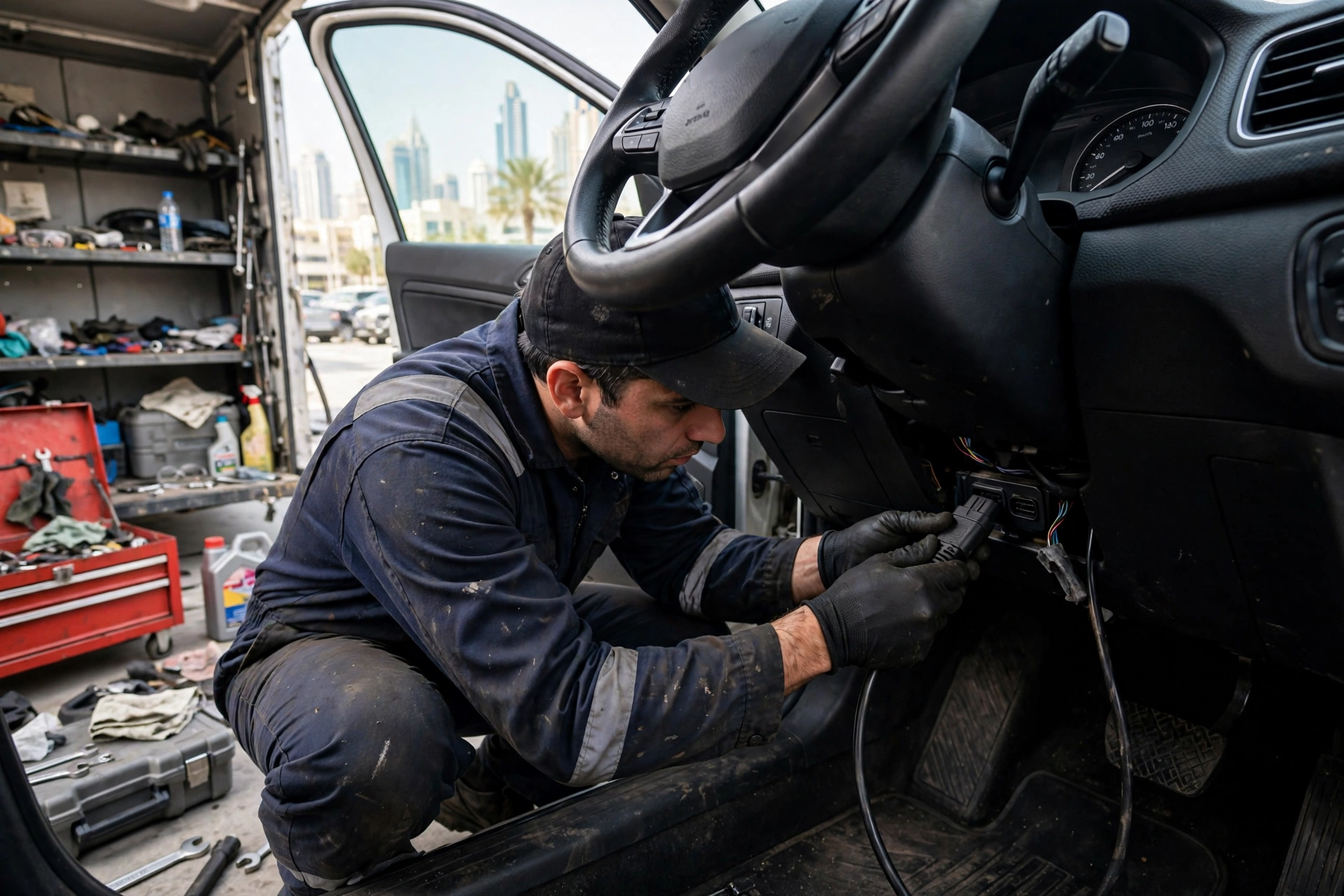
Fifth, get the code read. This is the step that separates diagnosis from guessing, and it is quick. A diagnostic scanner plugs into the port under the dashboard and reads the fault codes the engine computer has stored — which cylinder is misfiring, whether it is random or specific, and what else the computer has noticed. The code does not name the failed part, but it tells the mechanic where to start, and it turns a search of the whole engine into a search of one cylinder.
After that, the workshop tests. In order: inspect the spark plugs, swap coils between cylinders to see if the misfire moves, test fuel pressure and injector spray, check for vacuum leaks — sometimes with a smoke test, where harmless smoke is blown into the intake to show where it escapes — and if all of that is clear, run a compression test. That sequence finds the cause in the great majority of misfires, without replacing parts that were never broken.
What not to do: do not start by replacing all the coils or all the injectors, or pouring additives into the tank and hoping. Additives sometimes help a mildly clogged injector, but they do not fix a worn plug, a cracked coil, a vacuum leak, or low compression. And do not clear the fault code and pretend it never happened — clearing the code erases the evidence, and the misfire will come back.
10. Driving With a Misfire: When to Stop, When to Limp, When to Tow
This is the question every driver with a misfire actually needs answered, so here it is plainly.
Stop and switch off, then arrange a tow: the check engine light is flashing and the engine is shaking badly; the car has lost most of its power; there is a strong smell of fuel; the engine is smoking; the temperature gauge is climbing; or the car stalls repeatedly. In these cases driving further risks the catalytic converter, the engine, or your safety. Pull over somewhere safe, switch off, and call for help. A mobile team can come to you, and a tow is cheaper than the damage from driving on.
Drive gently to a nearby workshop: the light is steady, the car runs roughly but holds its speed, the temperature gauge is normal, and there is no fuel smell or smoke. Keep your speed low, avoid hard acceleration and the highway if you can, and go straight to the workshop. If the light starts flashing on the way, pull over and reassess.
Book a check within days: the misfire is occasional, the light is steady or comes and goes, the car drives almost normally most of the time. This is still a real fault, and it will not fix itself, but it is not a roadside emergency. Do not leave it for weeks, though — a misfire that is only occasional today can become a hard failure on the hottest day of the year, in the middle of Sheikh Zayed Road.
And if the car will not start at all, do not keep cranking it. Repeated cranking with a misfire or an ignition fault can flood the engine with fuel and flatten the battery, which turns one problem into two. If it will not start after a couple of tries, stop and get help — our car won’t start guide walks through the checks, and if you are unsure, a call will settle it. If you need a battery check as part of that, our car battery replacement page explains what the battery check includes.
11. Misfire and the RTA Test: Fix It Before You Book
If your registration renewal is coming up, a misfire is not just a driving problem — it is a test problem too.
The RTA technical inspection includes an emissions check. For petrol cars, the testing centre measures carbon monoxide, hydrocarbons and the air-fuel ratio from the exhaust; for diesels, it measures smoke. A misfiring engine burns fuel badly, and bad burning means bad emissions — high hydrocarbons from unburned fuel, and a mixture that is out of range. Dubai inspection guides list excessive exhaust emissions and a lit check engine light among the common reasons cars fail. A car that arrives at the test with a misfire and a glowing dashboard light is, in practical terms, a car that is likely to fail.
The practical point is the same as with any pre-test problem: find it early. Do your check a week or two before the test, not the night before. If the light is on, get the code read and the fault fixed, then drive the car for a few days before the test so the computer can confirm the repair — a code that has just been cleared can come back during the test if the fault is still there. And if the car has already failed on emissions, keep the fail report: it tells you and your mechanic exactly what was measured, and it saves paying for the same diagnosis twice.
Our RTA inspection checklist walks through the full pre-check — tyres, lights, brakes, fluids, warning lights and the rest — so you can find the small problems before the testing centre does. A misfire is one of the easier ones to fix in advance, and it was almost always warning you for weeks before the test date.
12. What It Costs to Ignore a Misfire
A misfire feels like a small problem when the car still moves, and that is exactly why it is expensive to ignore. Here is what happens, in order, when a misfire is left alone.
First, the fuel bill. A misfiring cylinder burns fuel without producing power, so you pay for petrol that does nothing. Over weeks and months, that adds up to far more than the cost of the part that was actually failing.
Second, the catalytic converter. Unburned fuel from a misfiring cylinder burns inside the converter, which is built to clean exhaust gas, not to burn fuel. Sustained misfiring overheats it, and a damaged converter is one of the most expensive single parts on a car to replace — and an emissions failure waiting to happen.
None of this is meant to frighten you. It is meant to put the repair in proportion. A spark plug or a coil is a small job. A catalytic converter, a worn engine, or a failed RTA test followed by a re-test is not. The cheapest time to fix a misfire is the week you first notice it, and the most expensive time is the month you finally cannot ignore it any more. If the light is on, or the car is jerking, get it checked. That is the whole message of this guide, really: listen to the car early, and the fix stays small.
Frequently Asked Questions
Can I drive with an engine misfire?
It depends on how bad it is. With a steady check engine light and a car that runs roughly but holds its speed, you can usually drive gently to a nearby workshop. With a flashing light, heavy shaking, a strong fuel smell, or a climbing temperature gauge, do not drive — pull over and arrange help. Never take a misfiring car on a long trip.
What is the most common cause of an engine misfire?
Worn spark plugs and failing ignition coils are the most common causes, and both are ignition faults. Fuel problems — a clogged injector or low fuel pressure — and air problems — a vacuum leak or a dirty sensor — come next. The least common, and the most serious, is low compression from worn rings, a damaged valve, or a failed head gasket. A diagnostic scan and a look at the plugs usually narrow it down quickly.
Why does my car misfire only when the engine is hot?
That pattern points strongly at an ignition coil. Coils fail under heat and vibration, and a weak coil can work fine when cold and break down once the engine bay is hot. Tell your mechanic exactly that — “it only happens when the engine is hot” — because it is one of the clearest clues in misfire diagnosis.
Will a misfire damage my car if I keep driving?
Yes, if you keep driving with it. Unburned fuel from a misfiring cylinder overheats the catalytic converter, and driving with a flashing check engine light can damage the converter in a short time. It also wastes fuel, increases wear inside the engine, and can turn a small ignition fault into a much larger repair. Fix it the week you notice it.
Can a misfire fail the RTA inspection?
Yes. The RTA technical inspection measures exhaust emissions, and a misfiring engine produces high emissions from unburned fuel. Inspection guides also list a lit check engine light among the common reasons cars fail. Fix the misfire and clear the light well before your test date, and drive the car for a few days afterwards so the computer can confirm the repair.
How much does it cost to fix a misfire in Dubai?
It depends entirely on the cause. A worn spark plug is a small job; a failed coil is a bigger one; a fuel injector or a compression problem is bigger still. That is why diagnosis comes first — a code read and a plug inspection cost far less than replacing parts on a guess. 95 Services keeps prices very low, and we will tell you what it needs before any work starts. Call or WhatsApp +971 54 344 3513 and describe the symptom — when it happens and whether the light is steady or flashing.
Why does my car jerk when I accelerate but run fine at idle?
Because the spark has to work hardest when you accelerate. A weak plug or a failing coil can manage at idle, when the cylinder pressure is low, and break down the moment you ask for power. Low fuel pressure behaves the same way — the engine needs the most fuel when you accelerate. If the jerk appears mostly on acceleration, the ignition system is the first place to look.
A misfire is your engine asking for attention in the plainest way it knows how — a jerk, a shake, a light on the dashboard. It is rarely a disaster, and it is usually a small part that has simply reached the end of its life in Dubai heat and traffic. The trick is to listen early: notice the pattern, check whether the light is steady or flashing, and get the code read before you start changing parts.
If your car is jerking, idling roughly, or showing a check engine light, you do not have to drive it anywhere to find out what is wrong. 95 Services covers the complete UAE with a mobile team, open 24 hours. Call or WhatsApp +971 54 344 3513 and tell us when it happens and whether the light is steady or flashing — we will come to you, usually within 15 to 20 minutes, read the fault codes, and tell you what it needs before any work starts. Our engine repair and diagnostics page and our car repair and maintenance page cover the checks in more detail.
