
You open the bonnet on a Friday morning, the engine cold, and you look at the coolant reservoir the way you have started doing every few days now. Last week it sat just under the MAX line. Today it is on the MIN line, or a little below it. You top it up, you drive to work, and when you check again in a few days it has dropped again. And yet there is nothing on the ground. No bright green puddle in your parking bay. No pink stain on the concrete. No wet patch, no drip, no smell you can pin down. The car drives fine, the temperature gauge sits where it always sits, and everything tells you it is probably nothing.
It is probably not nothing. A cooling system is sealed, and coolant does not just disappear. In a healthy car the level barely moves — a few spoonfuls over six months is about the most you should ever see. If you are topping up every week or two, the coolant is going somewhere, and the answer is almost never on the ground: a slow leak has four hiding places a puddle never reaches. It can evaporate the instant it touches a hot engine part, soak into the inside of your car, be burned inside the engine, or escape through the overflow as steam while you drive. None of those leaves a puddle. All of them leave clues.
This guide is about those clues. It is the companion to our fluid leak guide, which covers the leaks you can see on the ground, and to our engine overheating guide, which covers what to do when the temperature gauge climbs. This one is for the leak you cannot see: how to prove you are losing coolant, where it hides, the pressure test that finds it, the head gasket signs you should never ignore, and the point at which you stop driving and call for help.
The two rules that matter most: never open the radiator cap or the coolant reservoir cap while the engine is hot — the system is pressurised, and superheated coolant can spray out and cause severe burns. And if the coolant is dropping fast, or the temperature gauge climbs into the red, stop driving. A car that keeps losing coolant will overheat, and an overheated engine is a far more expensive problem than a leak.
1. First, Prove You Are Actually Losing Coolant
Before you spend a dirham on diagnosis, make sure the problem is real. Coolant levels are easy to misread, and a false alarm wastes everyone’s time. Do this properly once, and you will have a solid answer in a few days.
Check the level with the engine completely cold — first thing in the morning is best. The reservoir is the translucent plastic tank near the front of the engine bay, marked with MIN and MAX lines. The level moves between hot and cold because coolant expands as it heats up, so a hot reading and a cold reading are not comparable. Same time of day, same conditions, every time — and park on flat ground. A car on a slope will show a different level from the same car parked flat, and that difference is enough to fool you.
Then write it down: the date, the level, and how much you add when you top up. A phone note is fine. After a week or two the pattern will tell you what you are dealing with. A level that drops a few millimetres in a month is a slow weep — real, but not an emergency. A drop from MAX to MIN in a week needs finding soon. A top-up every couple of days needs finding now.
Two innocent explanations are worth ruling out first. One is trapped air: if the system was recently drained and refilled — after a service, a hose change, a radiator repair — air can get trapped inside, and as it works its way out over the next few days the reservoir level drops. That is normal for a short while after a refill. If the level settles after one or two top-ups and stays put, it was air. If it keeps dropping week after week, it is a leak.
The second is the cap. A radiator or reservoir cap that no longer holds pressure lets coolant boil away as steam, and that looks exactly like a hidden leak — level dropping, no puddle. The cap is cheap, it is often the cause, and it gets its own section below, because it is the first thing a mechanic will check and the last thing most drivers think of.
One more thing: do not top up with plain water and call it done. Coolant is roughly half water and half antifreeze, and the antifreeze is what raises the boiling point and stops corrosion inside the engine. Water dilutes the mix, and in Dubai heat that matters — a diluted system boils sooner and protects less. Water is fine in a genuine emergency, to get you to a workshop, but get the mix corrected afterwards. Use the coolant type your owner’s manual specifies: the colours — green, orange, pink, blue — are not interchangeable, and mixing types can cause deposits inside the system.
2. Why There Is No Puddle: The Four Ways Coolant Disappears
A coolant leak hides so well because coolant has four exits that never touch the ground, and each one points to a different kind of problem. Once you understand the four, the rest of this guide is just working out which one yours is.
The first is evaporation on hot metal. A small seep from a hose joint, a radiator seam or the water pump lands on an engine part running at close to a hundred degrees, and the coolant flashes off as steam before it can drip anywhere. The only evidence is a faint sweet smell when you switch the engine off, and a crusty residue where the leak is — dried coolant leaves a pale or coloured crust, green, pink or orange depending on the type. In Dubai this is especially common: everything under the bonnet runs hotter for longer.
The second is the cabin: the heater core behind the dashboard leaks coolant into the car, not under it, and section 5 covers its signs in full.
The third is inside the engine itself. If the head gasket — the seal between the top and bottom halves of the engine — fails in the wrong place, coolant can be drawn into a cylinder and burned, or it can mix with the engine oil. Burned coolant leaves through the exhaust as white smoke. Coolant in the oil turns the oil into a milky, frothy mess. Either way, nothing reaches the ground. This is the most serious of the four, and section 6 is devoted to it.
The fourth is the overflow. The system works under pressure — usually around 13 to 17 psi on most cars — and that pressure stops the coolant from boiling. If the cap cannot hold it, or the system is over-pressurised by a deeper fault, coolant is pushed out of the overflow pipe as steam while you drive. It vents onto the road behind you or evaporates under the bonnet, gone before you stop. The cap is the usual suspect here, and the cheapest fix in this guide.
3. The Radiator Cap: The Cheapest Suspect in the Whole Guide
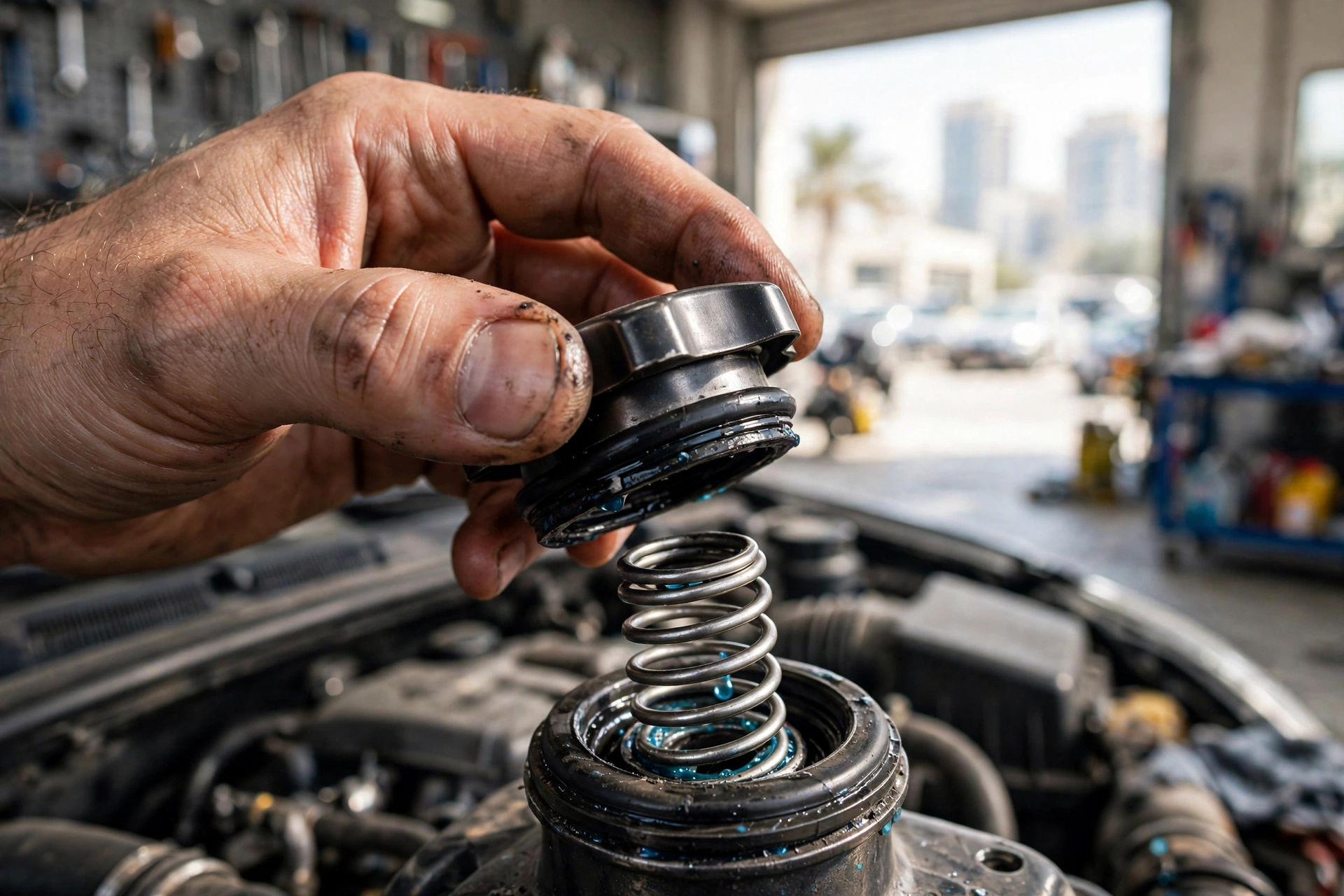
If there is one part in this guide to check before anything else, it is the radiator cap — or the reservoir cap, on cars where the pressurised cap sits on the plastic expansion tank rather than the radiator itself. It is a small, unglamorous part, it costs very little, and it is the single most common cause of coolant loss with no puddle. Most drivers never think about it, because it looks like a lid. It is not a lid. It is a pressure valve, and it does a job that matters more in Dubai than almost anywhere else.
Here is how it works. Water boils at 100 degrees at normal pressure, and an engine runs hotter than that, so the cooling system is sealed and pressurised — typically to somewhere between 13 and 17 psi — and under that pressure the coolant’s boiling point rises well above 100 degrees. That is what stops it from boiling inside your engine on a hot day in August traffic. The cap holds that pressure, and it also lets a little coolant out into the overflow tank when the pressure gets too high, then draws it back in as the engine cools.
When the cap’s rubber seal hardens or its spring weakens — and Dubai heat hardens rubber faster than most climates — it can no longer hold the pressure it is supposed to. The car still drives, the gauge still reads normal, but every time the engine gets properly hot, a little coolant boils off and escapes through the overflow as steam. No drip, no puddle, no stain — just a reservoir level that keeps going down, a faint sweet smell after you park, and a car that slowly, quietly loses its protection against overheating. A weak cap can also let air in as the system cools, and air creates hot spots.
Checking the cap is simple, but do it with a cold engine, always. Wait until the car has been standing for hours, or overnight. Unscrew the cap and look at the rubber seal underneath: if it is cracked, flattened, hard to the touch, or has bits of crust on it, it is past its best. The pressure rating is stamped on the top of the cap, usually something like 1.1 bar, which is roughly 16 psi. Whatever you replace it with must carry the same rating. A lower rating will vent too early; a higher rating will hold too much pressure and can stress hoses and the radiator. Same rating, every time.
4. Hidden External Leaks: Hoses, Radiator Seams and the Water Pump
If the cap checks out, the next place to look is the outside of the cooling system — the parts that carry coolant around the engine, where a leak can be real and still never reach the ground. These are the leaks that evaporate on hot metal, and they all leave the same kind of evidence: not a puddle, but a crust.
Start with the hoses: the upper and lower radiator hoses, the heater hoses to the dashboard, and a few smaller ones. They carry hot, pressurised coolant in one of the hottest places in the car. Over time, and faster in Dubai heat, the rubber hardens, the clamps loosen a fraction, and the hose ends start to weep — a few drops at a time, drying on the engine before they fall. What you look for is the crust: a pale, chalky or coloured deposit around a hose joint, a clamp, or where the hose meets a metal pipe. Run your finger along the underside of the hose ends — if it comes away with a sticky, sweet-smelling residue or a coloured crust, that joint is weeping. Squeeze the hoses gently when the engine is cold: a good hose feels firm and springy, while one that feels rock-hard, soft and swollen, or crackles when squeezed is on its way out. The thermostat housing weeps the same way, and it is often tucked out of sight — a torch and a mirror will get you a look.
Then the radiator itself. Most modern radiators have an aluminium core and plastic end tanks, crimped together along a seam — a known weak point after years of heat cycling, hot, cold, hot, cold, thousands of times. A hairline crack or a failed crimp lets out a fine mist of pressurised coolant, but only when the system is hot and under pressure. While you drive, that mist evaporates; when you park, the engine is cooling and the leak has already stopped. Look along the top and bottom edges, where the plastic meets the metal, for a faint coloured crust or a tide mark, and check the lower corners too, where a leak can collect behind the bumper instead of reaching the ground.
And then there is the water pump, which has a tell-tale of its own: a small hole in its housing called a weep hole, put there on purpose. It lets a few drops out when the pump’s internal seal starts to fail, as an early warning. A healthy pump leaves the weep hole dry; a failing one leaves a crusty streak running down from the hole, or a damp patch around the pump that dries to a coloured crust. The pump sits low on the engine, so it is not easy to see without getting under the car, but the streak is distinctive once you know what it is. If you see it, the pump is on its way out — and a pump that fails completely stops circulating coolant at all.
5. The Heater Core: The Leak Inside Your Dashboard
The heater core is a small radiator hidden deep behind your dashboard, on the passenger side. Hot coolant flows through it, and when you turn the heater on, air blows across it and comes out warm. In Dubai you barely use the heater — a few cool mornings in January, the defroster on a humid day — but the core is there all year, full of coolant and under pressure, whether you use it or not. When it develops a pinhole leak, the coolant has nowhere to go except into your car.
The first sign is usually the smell: a sweet, syrupy smell inside the cabin, strongest when the heater or the defroster is running, and stronger still when the car has been sitting with the windows closed. Coolant is mostly ethylene glycol, and glycol smells sweet when it heats up. If you notice that smell every time you get in the car, and it is stronger on the passenger side, pay attention — it is not an air freshener. The second sign is the windscreen: coolant vapour condenses on the inside of the glass and leaves a thin, greasy film that fogs up easily and smears when you wipe it. Ordinary fog wipes away clean; a coolant film feels slick, smears rather than clearing, and comes back quickly — especially when you run the defroster, because it is blowing more coolant vapour straight onto the glass.
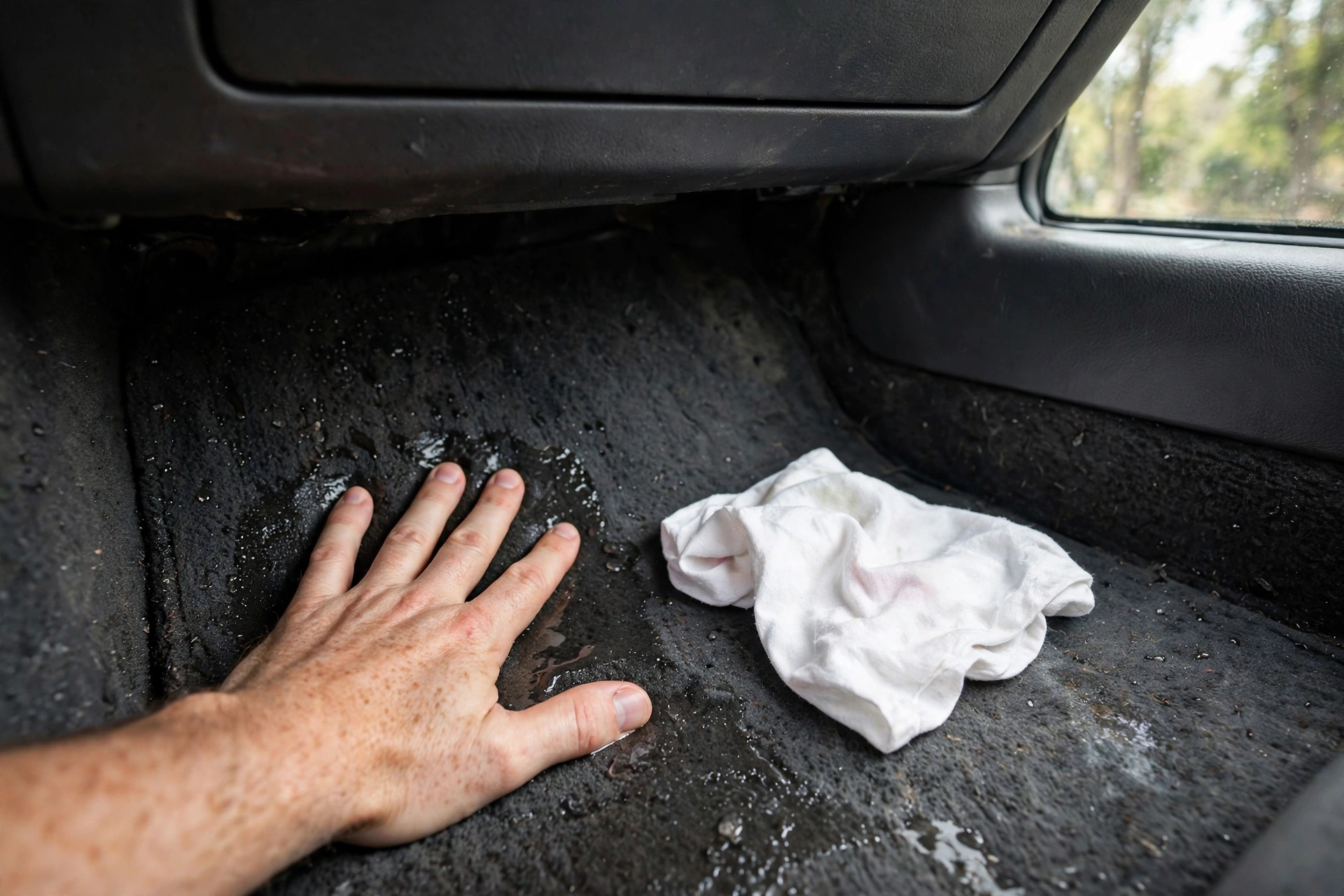
The third sign is the carpet. Gravity pulls leaking coolant down through the dashboard insulation and onto the floor, almost always on the passenger side. Press your hand into the carpet under the glove box: if it is damp, spongy or sticky, and it smells sweet, that is coolant, not water from a blocked AC drain. A white cloth pressed into the wet patch will pick up the colour — green, pink or orange. The fourth sign is weak heat: if the coolant level is low, or air has got into the system through the leak, the heater will blow lukewarm or cold even when the engine is warm. In Dubai you might not notice this for months, because you rarely ask the car for heat.
A leaking heater core is not a do-it-yourself repair — reaching it usually means taking a large part of the dashboard apart, which is a big job on most cars. It is also not a leak to live with: coolant vapour inside the cabin is not something you want to breathe, the fog on your windscreen is a genuine safety problem at night, and the leak will keep draining the system until the engine overheats. If the signs point to the heater core, get it confirmed and fixed — and if the fog is bad enough that you cannot see clearly, do not drive until it is sorted.
6. The Head Gasket: The One You Do Not Want to Miss
Everything so far has been a fixable nuisance: a cap, a hose, a radiator seam, a heater core. This section is about the one that is not. The head gasket is the seal between the cylinder head and the engine block, and it keeps three things apart that must never mix: the combustion chambers, the coolant passages, and the oil passages. When it fails, coolant stops being a cooling problem and starts being an engine problem. It gives you several warnings, and they are distinctive — but every one of them can be mistaken for something else on its own. The rule here is simple: one symptom is a clue, two are a pattern, and three mean stop guessing and get the car tested.
The most famous sign is white smoke from the exhaust. When a breach lets coolant into a cylinder, combustion turns it to steam, and it comes out of the tailpipe as thick, white smoke with a faintly sweet smell. The important word is persistent. Every car makes a little white vapour on a cold morning — thin condensation that clears within a minute or two. That is normal. Head gasket smoke is different: thicker, sweet-smelling, and still there after the engine is fully warm, ten or fifteen minutes into a drive. If white smoke is still coming out of the tailpipe when the engine is hot, that is coolant being burned, and it deserves attention the same day.
The second sign is in the oil. When the gasket fails between a coolant passage and an oil passage, coolant mixes with the engine oil, and the result looks like nothing else: a pale, milky, frothy substance, often described as chocolate milk or mayonnaise, on the dipstick or under the oil filler cap. Check both. A little creaminess under the cap alone can happen on a car that only does short trips — but a thick milky coating on the dipstick as well is a much stronger signal, and oil that looks milky and sits higher than the full mark is serious, because coolant in the crankcase raises the level. Milky oil means stop driving: it destroys the oil’s ability to lubricate, and an engine running on contaminated oil wears out from the inside, fast. If you find it, have the car collected.
The third sign is in the coolant reservoir. When the gasket fails between a combustion chamber and a coolant passage — the most common failure — combustion pressure pushes exhaust gas into the cooling system. The reservoir bubbles or foams while the engine is running, even when it is not overheating. The top radiator hose can go rock-hard within a minute or two of a cold start, because exhaust pressure is pumping in far earlier than normal heat would. And the level can behave strangely: dropping, then overflowing, then dropping again. Bubbling in the reservoir with the engine running is not normal. A healthy cooling system does not bubble.
None of these signs, on its own, proves a head gasket failure. White smoke can be condensation, a milky cap can be short trips, a rough cold start can be a spark plug. That is exactly why the gasket gets misdiagnosed so often — each symptom has an innocent explanation, and the car keeps driving well enough that it is easy to talk yourself out of worrying. The pattern is what matters. Coolant loss with no puddle, plus one of these signs, is a reason to test. Coolant loss plus two is a reason to stop driving until it is tested. The block test in section 8 takes minutes and gives a clear answer — far better than weeks of wondering while the damage gets worse.
7. The Pressure Test: The Test That Finds What Your Eyes Cannot
If this guide has one hero, it is the pressure test. It ends the guessing, because it makes a hidden leak happen while someone is watching. A mechanic with a pressure tester will find in fifteen minutes what a month of checking the reservoir cannot.
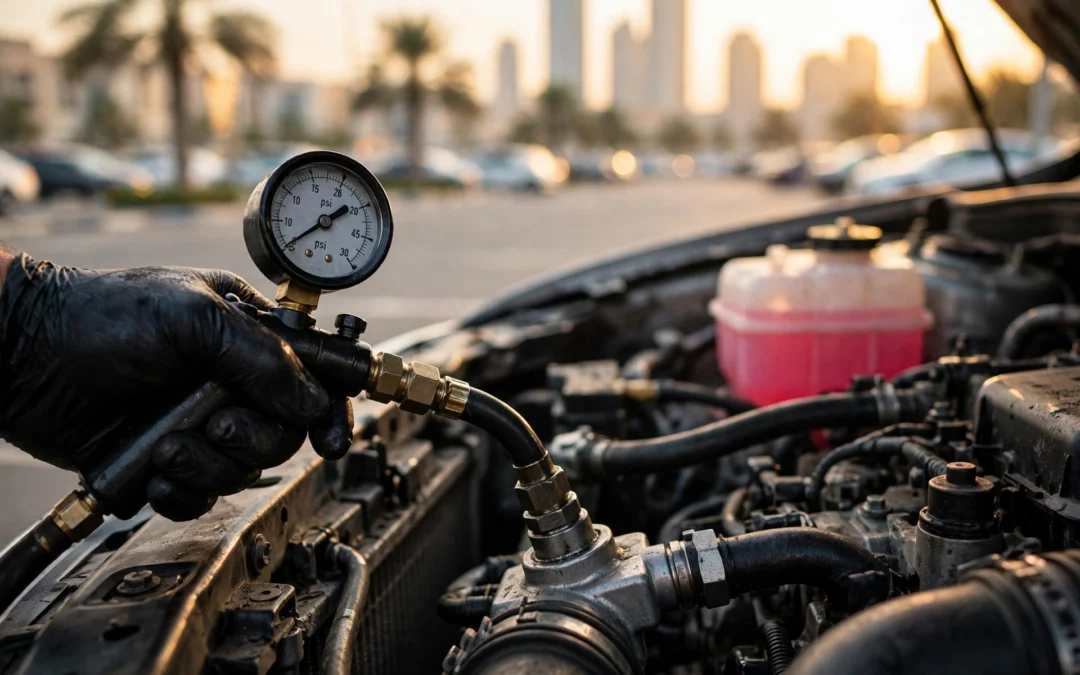
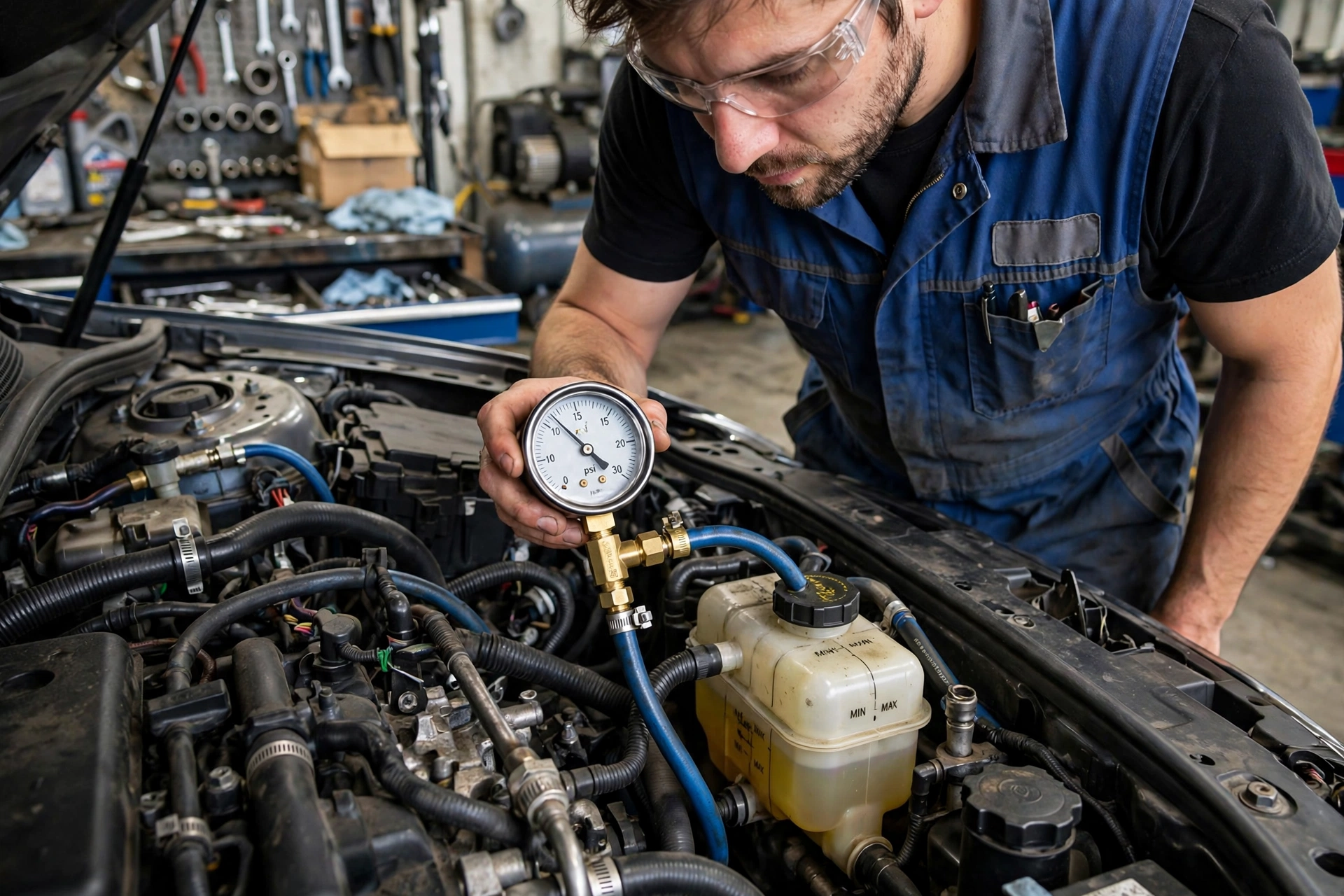
The tool is simple: a hand pump with a pressure gauge and adapters for different radiator necks and reservoir openings. The procedure starts with a cold engine — always cold, because opening a hot cooling system is dangerous, and heat expands parts and can give a false result. The cap comes off, the right adapter goes on the filler neck, and the mechanic pumps slowly until the gauge reaches the pressure stamped on your cap — usually around 13 to 17 psi on most cars. Never above the cap rating: over-pressurising can damage hoses, radiator tanks and gaskets. The system is then left pressurised for ten to fifteen minutes while the mechanic watches the gauge.
What happens next tells you what kind of leak it is. If the pressure holds steady, there is no significant leak at the test pressure — the leak, if there is one, only happens when the engine is hot, or it is internal, or it is in the cap. If the pressure drops and a drip appears — at a hose joint, a radiator seam, the water pump, the thermostat housing — the leak is found, and the job becomes a repair. If the pressure drops and nothing drips anywhere, the coolant is going somewhere internal: into a cylinder, into the oil, or into the cabin through the heater core. The cap gets its own test on the same equipment, and a cap that cannot hold its rating is replaced on the spot — because a test run with a bad cap tells you nothing about the rest of the system.
There are limits worth knowing. A cold test can miss a leak that only opens when the engine is fully hot — a hairline crack in a plastic radiator tank can seal itself when cold and open when hot. Some leaks only appear under load. And a pressure test will not find a heater core leak directly, because the core is inside the dashboard — although a pressure drop with no visible drip, plus a sweet smell in the cabin, points straight at it. When a cold test comes back clean but the coolant keeps dropping, the next steps are a hot test, a UV dye test, and the block test in section 8.
8. Two More Tests: UV Dye and the Block Test
When the pressure test comes back clean but the coolant keeps dropping, the diagnosis moves to two tests that answer the questions a pressure test cannot: where exactly is it escaping, and is it getting into the engine?
The first is the UV dye test, the best tool for a leak that is too small, too intermittent, or too well hidden to see. A small amount of fluorescent dye — made for cooling systems, and safe to use in them — is added to the coolant, and the car is driven normally for a day or two, so the dye circulates and escapes through the same leak the coolant is escaping through. Then the engine bay is inspected in the dark with a UV light. The dye glows bright yellow-green and marks the leak’s path like a highlighter: a glowing trail from a hose joint, a glowing stain at a radiator seam, a glowing weep at the water pump. A weep that dries before it drips still leaves dye behind, because dye does not evaporate — and dye on the passenger carpet or around the heater hoses at the firewall points straight at the heater core.
The second test is the block test, also called a combustion leak test, and it answers the head gasket question. A tester filled with a blue fluid is held over the radiator neck or the expansion tank while the engine runs. If exhaust gases are present in the coolant — which happens when the head gasket has failed between a combustion chamber and a coolant passage — the fluid changes colour from blue to yellow. Blue means no exhaust gas in the coolant. Yellow means there is, and that is a strong indication of a head gasket failure or a cracked cylinder head. The colour change either happens or it does not. These tests work best in order: pressure test first, UV dye second, block test third.
9. How Fast Is It Dropping? What the Rate Tells You
Not every coolant leak is an emergency, and knowing how fast yours is dropping decides whether you drive, drive carefully, or do not drive at all. The rate is also the most useful thing you can tell a mechanic on the phone, because it tells them how urgent the job is before they have even seen the car.
A slow loss is a few millimetres in the reservoir over a month, or a top-up every few months. The car drives normally and the gauge sits where it always sits. This is a book-a-check-soon leak: keep an eye on the level, keep the correct coolant in the car, and get it looked at within a week or two. Do not ignore it — slow leaks do not stay slow. A steady loss is a top-up every week or two, or a level that drops from MAX to MIN in a few days. This is a same-week check, with the level checked before every drive until it is fixed. At this rate, a long drive in August heat — Dubai to Abu Dhabi and back in the middle of the day — is a gamble. A rapid loss — a reservoir that empties in a day or two, or steam from under the bonnet — is a do-not-drive situation. Section 12 covers exactly what to do.
While you are topping up, keep a simple rule: check the level cold, top up to the MAX line, and write down how much you added and when. That log is the most useful thing you can hand a mechanic, because the rate is what separates a weep from a failure. And a word about stop-leak products, sold in every auto parts shop in Dubai: they circulate in the system and try to plug small holes, and they sometimes slow a tiny leak for a while. They are not a fix. They do not repair the cause, and they can clog the narrow passages in the radiator and the heater core. If a leak is big enough to notice, it is big enough to find properly.
10. Coolant Loss and the RTA Test: Fix It Before You Book
If your registration renewal is coming up, a coolant leak is not just a mechanical problem — it is a test problem. The RTA technical inspection checks the underside of the car for leaks, and oil, coolant and brake fluid leaks are all listed among the common reasons cars fail. The inspectors put the car over a pit or on a lift and look underneath, and a leak you cannot see from the driver’s seat is plain as day from below — especially a coolant leak, which leaves its coloured crust on hoses and housings even when it never reaches the ground. A slow leak that never leaves a puddle can still fail the test, because the inspection is not looking for a puddle. It is looking for the leak itself — wetness, residue, a weeping joint — and it is also checking fluid levels, so a car that is slowly losing coolant can fail on the level alone. A failing head gasket can fail on emissions too, because coolant burning in the cylinders changes what comes out of the exhaust.
The practical point is simple: do the checks in this guide a week or two before your test, not the night before. Check the level cold, look for crust and residue, check the cap, and if the level has been dropping, book a pressure test. If you find a leak, you have time to fix it and re-check. If you find it the night before, you are choosing between driving to the test with a known fault and fixing it first and re-booking. Our RTA inspection checklist walks through the full pre-check — tyres, lights, brakes, fluids and the rest — so you can find the small problems before the testing centre does.
11. Your Simple Plan: What to Do This Week
There is a lot in this guide, and it is easy to read it all and then do nothing, because the car still drives fine and the problem feels vague. So here is the whole thing reduced to a plan you can do this week, with nothing more than a torch, a phone note, and one booked check.
Day one, cold engine, flat ground: check the reservoir level against the MIN and MAX lines and write it down with the date. Look at the cap — is the rubber seal cracked or hard? Look at the hose ends and radiator seams for crust. Smell under the bonnet after a drive. Feel the passenger carpet for dampness. Look at the oil dipstick and the oil cap. Ten minutes, and you will already know whether you have one clue or several. Then check the level again over the next few days, under the same conditions. If it has not moved, check again in a week — you may have been looking at trapped air or a misreading. If it has dropped, note how much and how fast: that rate decides everything else. Watch the exhaust on a cold start too — thin vapour that clears in a minute is normal; thick white smoke that is still there when the engine is warm is not.
Then book the pressure test — the single most useful check in this guide, and the one that turns a vague worry into a known answer. Ask for the system test and the cap test together, and ask for the result in writing. If the test finds the leak, the job becomes a repair with a known scope. If it finds nothing, the next step is UV dye, then the block test if the signs point inside the engine. Either way, you will know what you are dealing with, and you will know it before the leak becomes an overheating problem.
12. When to Stop Driving
Most of this guide is about a problem you can live with for a while, as long as you are watching it. This section is about the point where that stops being true. If any of the following happen, do not drive the car. Pull over if you are already driving, switch the engine off, let it cool, and call for help.
The temperature gauge is in the red, or a temperature warning light has come on. The engine is already overheating, and every minute you keep driving makes the damage worse. Pull over somewhere safe, switch off, and wait. Do not open the cap. Do not pour water in. Wait until the engine is completely cold — and then have the car collected, not driven on.
There is steam coming from under the bonnet, or a strong smell of hot coolant that you can smell from inside the car. Steam means the system has lost pressure and the coolant is boiling. The car is telling you it has no cooling left. Stop.
The oil on the dipstick is milky, or the oil level has risen above the full mark. That is coolant in the oil, and driving on it destroys the engine’s bearings. Do not start the car again. Have it collected.
White smoke is pouring from the exhaust and it does not clear once the engine is warm, or the engine is misfiring badly on a cold start and the coolant level is dropping fast. That is coolant being burned in the cylinders. It will not get better on its own, and a cylinder full of coolant can lock the engine solid — a condition mechanics call hydrolock.
The reservoir is empty, or the coolant is dropping so fast that you need to top it up before every drive. A car with no coolant has no cooling, and the temperature gauge may not even warn you properly, because the sensor itself needs to be in coolant to read correctly. An empty reservoir is a do-not-drive situation, full stop.
If any of that happens in Dubai or anywhere in the UAE, you do not need to drive the car to a workshop. Call or WhatsApp 95 Services on +971 54 344 3513 — we come to you, usually within 15 to 20 minutes, and we will tell you honestly whether the car can be driven in or should be collected. A pressure test, a cap check, a dye test and a block test can all be done at your parking spot, and knowing the answer before the car moves is worth more than guessing and driving on.
Frequently Asked Questions
Is it normal for coolant to drop a little over time?
Only a very little. A healthy cooling system is sealed, so the level should barely move — a few spoonfuls over six months is about the most you should see. If you are topping up more than once every few months, or the level drops by more than a cup in three months, that is not evaporation. That is a leak, and it needs finding.
Can I drive with a slow coolant loss?
With a slow loss, a correct level, and no other symptoms, short drives are usually fine while you get it checked — but check the level cold before every drive, keep the right coolant in the car, and book the check within a week or two. If the loss is steady or fast, or the gauge moves at all, do not keep driving on it.
Why does my car smell sweet but there is no leak?
A sweet smell is almost always coolant, and the leak is there — you just cannot see it. A small seep evaporating on a hot engine part leaves the smell but no puddle. If the smell is strongest inside the car, especially with the heater or defroster on, the heater core behind the dashboard is the likely source. Check the passenger carpet and the reservoir level cold.
Can I top up coolant with water?
In a genuine emergency, to get to a workshop, yes — water is better than running low. But do not make a habit of it. Coolant is roughly half water and half antifreeze, and the antifreeze is what raises the boiling point and stops corrosion. Topping up with water dilutes the mix, which matters in Dubai heat. Get the mix corrected afterwards, and always use the coolant type your owner’s manual specifies.
Will a coolant leak fail the RTA inspection?
Yes, it can. The RTA technical inspection checks the underside of the car for leaks, and oil, coolant and brake fluid leaks are all listed among the common reasons cars fail. The inspection also checks fluid levels, so a car that is slowly losing coolant can fail on the level alone. Check for leaks a week or two before your test. Our RTA inspection checklist covers the full pre-check.
What if the pressure test shows nothing?
That happens, and it does not mean the coolant is not going anywhere. A cold pressure test can miss a leak that only opens when the engine is fully hot, and it will not find a heater core leak directly. The next steps are a UV dye test and a block test if the signs point inside the engine. If all three come back clean, the cap is the remaining suspect.
How do I know if it is the head gasket and not just a hose?
By the pattern, not by one symptom. A hose leak leaves a crust or a drip, and a pressure test will find it. A head gasket failure gives you a combination: coolant loss with no puddle, plus persistent white smoke after the engine is warm, or milky oil, or bubbling in the reservoir. No single symptom proves it on its own, but a block test gives a clear answer in minutes: the test fluid changes colour if exhaust gas is present in the coolant.
A car that loses coolant without leaving a puddle is not trying to confuse you. It is leaking in one of the four places a puddle never reaches — evaporating on hot metal, soaking into the cabin, burning inside the engine, or venting as steam through a weak cap — and each of those places leaves its own clues. The crust on a hose joint, the sweet smell after a drive, the fog on the inside of the windscreen, the damp passenger carpet, the white smoke that does not clear, the milky oil: none of these are mysteries once you know what they mean. Check the level properly, check the cap first, and get a pressure test booked. That is the whole job, and it starts with a torch, a phone note, and ten minutes on a cold engine.
If you have been topping up the coolant and you would like the leak found without driving the car anywhere, 95 Services covers the complete UAE with a mobile team. Call or WhatsApp +971 54 344 3513 and tell us how fast the level is dropping and what you have noticed — the smell, the smoke, the carpet, the gauge — and we will come to you, usually within 15 to 20 minutes, run the pressure test at your parking spot, and tell you what it needs before any work starts. Our car repair and maintenance page and our engine repair and diagnostics page cover the checks in more detail, and if the loss turns out to be an air conditioning issue, our car AC repair page explains what that check includes. We are open 24 hours, and our prices are very low — but the first thing is finding out where the coolant is going, and that starts with a test, not a guess.
