
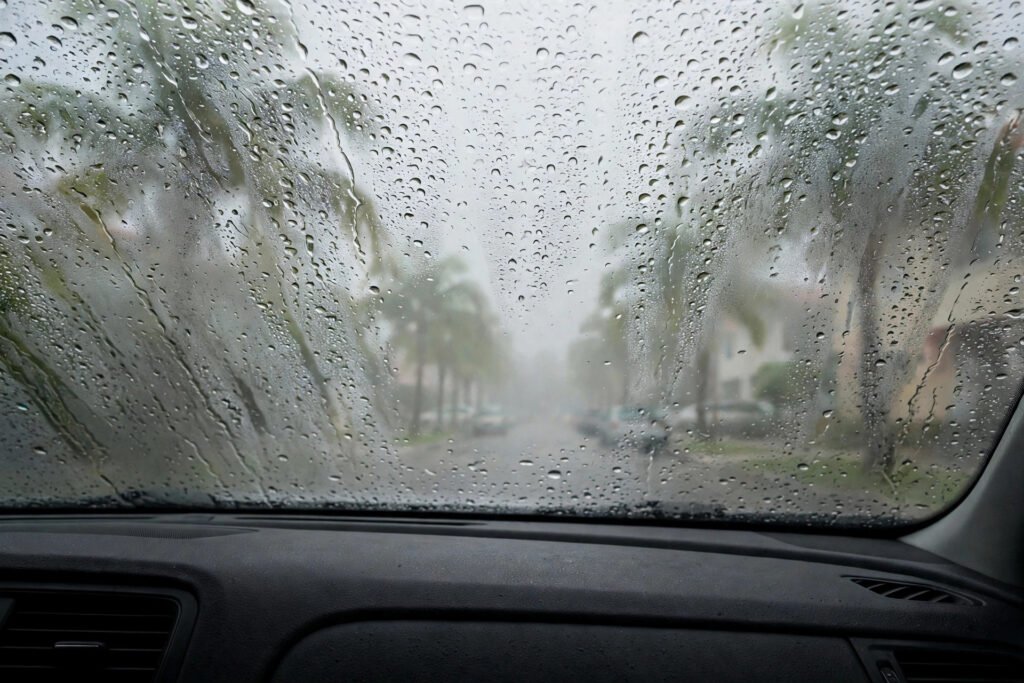
You get in the car on a humid Dubai morning, turn the key, and the first blast of air from the vents smells damp. Not fresh. Not clean. A bit like an old towel left in a closed bathroom. Then you look at the windscreen and it is misted over from the inside, even though you wiped the outside yesterday. You switch the fan up, you press the demister button, and nothing much happens for a long while. The air feels weak, the glass clears slowly, and the smell comes back every time the air conditioning has been off for a few hours.
If that sounds familiar, you are not imagining it, and your car is not just being difficult in the heat. In most cases like this, the problem sits in one small, overlooked part of the car: the air path. The cabin filter, the drain that lets condensation out, and the vents that push air onto the glass. When any of those three start to struggle, the cabin turns damp, the air turns stale, and the windscreen starts fogging at exactly the wrong moment — on Sheikh Zayed Road in slow traffic, on a school run at 7 in the morning, or pulling out of an underground car park in Marina or Downtown where the air is already thick with moisture.
This is a Dubai problem in a very specific way. We run the air conditioning almost all year. We drive through dust, sand, construction zones and long stretches of hot, dry air, and then we park in humid underground basements or by the sea in Jumeirah, JBR, Deira and Sharjah. That mix — dust outside, moisture inside, and an air conditioning system working hard for ten or eleven months a year — is hard on a cabin filter. It clogs faster here than it does in a cooler, cleaner climate. It stays damp longer. And once it stays damp, it starts to smell.
The good news is that most of this is simple to understand, simple to check, and often simple to fix. You do not need to be a mechanic to spot the early signs. You just need to know what a healthy cabin filter feels like, what weak airflow sounds like, where the water is supposed to go, and what to do when the demister is blowing but the glass is not clearing. That is what this guide does. It walks through the cabin filter first, because that is where most musty smells start, then the blocked drain and the wet carpet that so many drivers miss, then the fogging itself, and finally the practical checks you can do at home and the habits that keep the problem from coming back in Dubai conditions.
If you read one thing and take it away, let it be this: a musty smell that comes back every time you switch the air conditioning on, and a windscreen that fogs from the inside, are not two separate problems. They are usually two signs of the same blocked, damp air path. Fix the air path, and both often clear up together.
What the Cabin Filter Actually Does
Think of the cabin filter as the mask your car wears for the air you breathe. Every bit of outside air that comes through the vents passes through it first — or at least, it is supposed to. The filter sits in the air intake path, usually behind the glovebox or under the bonnet near the base of the windscreen, depending on the car. Its job is simple: catch dust, sand, pollen, leaves, soot and other fine particles before they reach you, and keep the inside of the heating and cooling box reasonably clean.
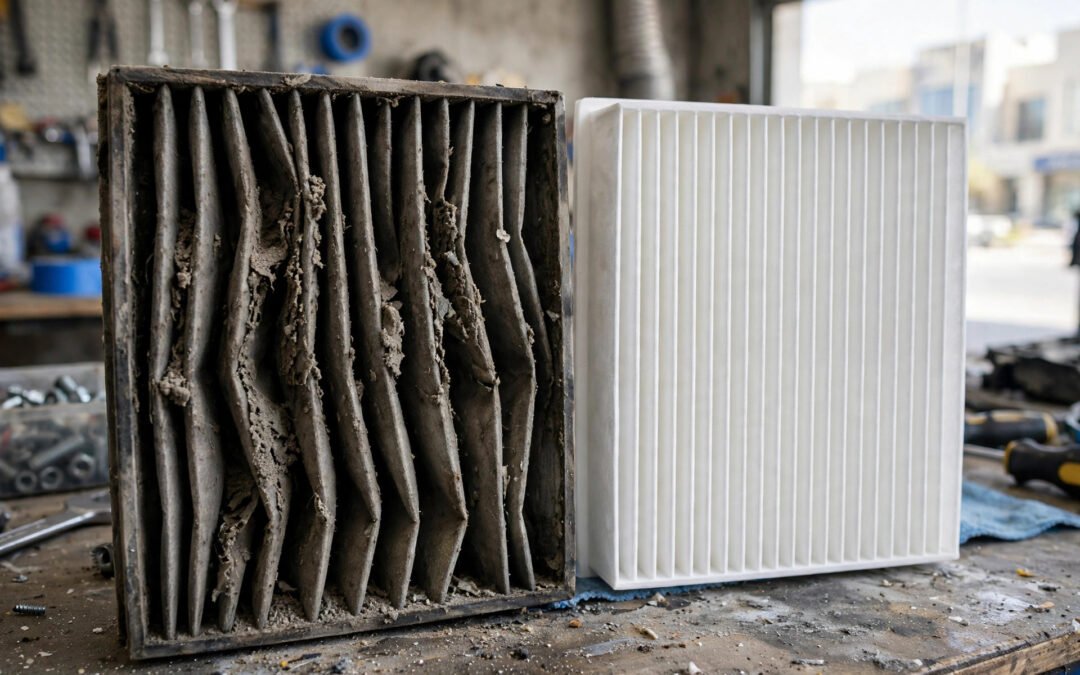
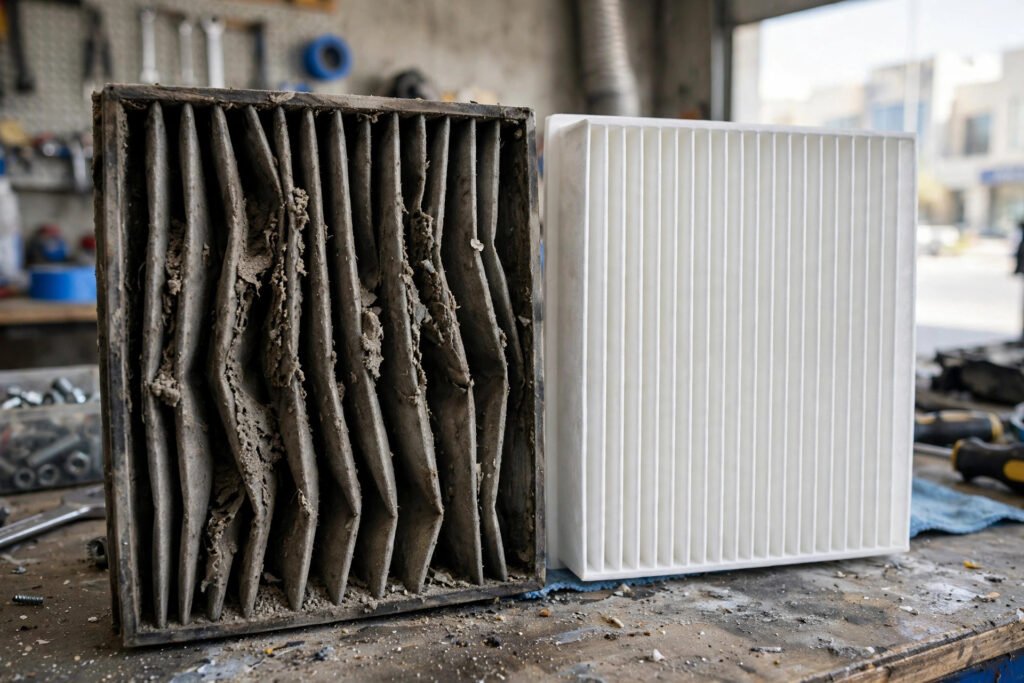
In Dubai, that job is bigger than it sounds. A car driving on a dusty day in Al Quoz, on a construction-heavy stretch in Dubai Hills or Business Bay, or behind a truck on the E311 can pull in a surprising amount of fine dust in one trip. Add the sand that blows in during a shamal, the exhaust haze in heavy traffic, and the general dust that settles on everything here within a day, and the filter has a lot to trap. A new filter is white or off-white, with clean, open pleats. Air passes through it easily. The fan does not have to work hard. The air that reaches your face feels fresh and moves at a good speed even on fan speed two or three.
As the filter fills up, the pleats slowly close with dust. At first you might not notice. The fan still blows, the air still feels cool, and the smell is still fine. Then, bit by bit, the airflow drops. You find yourself turning the fan to three when two used to be enough, then to four. The air feels less direct. The back seats get less air. The demister takes longer. This is the filter doing its job almost too well — it has caught so much that it is now blocking the very air it was meant to clean.
There are two common types of cabin filter you will come across in Dubai. The first is the standard particle filter, made of pleated paper or fibre. It catches dust and larger particles. The second is the activated carbon filter, which has a dark grey or black layer of carbon in it. That carbon layer is meant to cut down odours and some fumes from traffic. It costs a little more, and for many drivers in heavy city traffic it is worth it, because it takes the edge off exhaust smells and stale air. Neither type lasts forever. Both clog. And a carbon filter that is old and saturated can itself start to smell stale, because the carbon has absorbed all it can and the damp dust sitting in it has nowhere to go.
One thing that surprises a lot of drivers is how small this part is. Hold a new cabin filter in your hand and it is light, flat, about the size of a large book. It does not look like a part that could cause a smell through the whole car or fog up a windscreen. But because every cubic metre of cabin air passes through it, a dirty one affects everything: how strong the air feels, how clean it smells, how fast the glass clears, and even how hard the blower motor has to work. A blower pushing against a blocked filter strains, gets noisy, and can wear out sooner. So a cheap, light filter ends up protecting a much more expensive fan and keeping the whole cabin comfortable.
Another point worth knowing is that the filter also protects the cooling coil inside the dashboard, the part that makes the air cold. When the filter is clean, most dust stops there. When the filter is torn, missing, or so clogged that air finds a way around its edges, dust gets past it and settles on the coil and in the housing behind the dashboard. That dust holds moisture. Moisture plus dust plus warmth is exactly what mould and bacteria like. That is one of the main reasons a car can keep smelling musty even after the filter itself has been changed — the housing behind it is still damp and dirty, and it needs a proper clean as well. We will come back to that in the smell section, because it matters.
In short, the cabin filter is not a luxury extra. In Dubai it is a working part that takes a daily beating from dust and humidity. When it is fresh, you barely think about it. When it is clogged, you feel it every time you drive: weaker air, a stale smell, and a windscreen that does not clear the way it should.
Why Cabin Filters Clog Faster in Dubai
If you have driven in another country and then moved to Dubai, you may have noticed that service intervals feel shorter here, and that is not just the heat. The combination of conditions in the UAE is unusually hard on filters.
First, there is the dust. Dubai is a desert city. Even on a clear day, fine dust hangs in the air. On a windy day, or after a sandstorm, it is visibly in the air and on every parked car. That dust is exactly the size that a cabin filter is designed to catch, which means the filter fills faster here than it would in a place with clean, damp, green air. A driver doing daily runs on dusty roads, near construction sites, or on the open highway to Abu Dhabi or Sharjah will load a filter much faster than a driver doing short, slow trips in a quiet neighbourhood.
Second, there is the sheer amount of time the air conditioning runs. In many countries, the air conditioning is a summer thing. In Dubai, it is on for most of the year, often from the moment you start the car until you switch it off. That means air is being pulled through the filter for far more hours, day after day, than in a cooler climate. More hours means more dust trapped, and more moisture passing through the filter and the cooling coil behind it. Moisture is the second half of the musty-smell problem, and we run the system that creates it almost constantly.
Third, there is the humidity. Dubai humidity is not constant, but when it is high — especially in the summer months, near the coast, and in the early morning — the air coming into the car is already damp. The cooling coil wrings a lot of that moisture out of the air, which is why you see a puddle of water under a parked car after the air conditioning has been running. That is normal. But it also means the filter and the housing behind it spend a lot of time damp. A filter that is dusty and damp is very different from a filter that is dusty and dry. Damp dust sticks, clumps, and starts to smell. It also gives mould a place to grow.
Fourth, there is the way we park and drive. Many cars in Dubai spend the day in an underground car park or a shaded basement, where the air is cool and damp, and then go out into hot, humid air. That change in temperature makes condensation form on the glass and inside the air ducts. Cars parked near the sea, in Jumeirah, at the Marina, or on the Palm, get salt-laden, humid air as well. Cars that sit unused for a week or two — while the owner is travelling, for example — can come back with a cabin that smells noticeably stale, because the air inside has not moved, the filter has stayed damp, and any mould in the housing has had time to grow undisturbed.
Finally, there is the stop-start nature of city driving. Short trips, with the air conditioning switching on and off, do not give the system a good long run to dry itself out. A long highway drive with the air conditioning running steadily tends to dry the coil and the ducts better than ten short trips to the shops and back. If most of your driving is short hops in traffic, with the car parked in between, the inside of the air system stays damp for longer, and the smell builds up faster.
None of this means the filter is badly designed. It means the Dubai environment asks more of it, and the sensible response is to check it more often than the manual's standard interval might suggest. The manual was often written for average conditions in the car's home market, not for a desert city where the air conditioning runs eleven months a year and the dust never really stops. Many experienced mechanics in Dubai will tell you the same thing: look at the filter, do not just count the months. If it looks grey, clogged and dusty, it is done, whatever the calendar says.
The Symptoms of a Clogged Cabin Filter
A clogged cabin filter does not usually fail suddenly. It fades. The symptoms creep in one at a time, and because they are mild at first, it is easy to put them down to the weather, the traffic, or the car getting older. It helps to know the full list, so you can spot the pattern early.
1. Weaker Airflow From the Vents
This is the most reliable early sign. You turn the fan up, but the air coming out feels less forceful than it used to. On fan speed one or two, you can barely feel it on your face. On speed three or four, it is there, but it is not as strong as you remember. The air might still be cold, which can fool you into thinking everything is fine, but the volume is down. The blower is working harder to push the same amount of air through a narrowing gap.
Pay attention to the difference between the front vents and the rear vents, if your car has them. A clogged filter affects the whole system, but the rear often feels it first, because the air has further to travel. If passengers in the back are complaining that they cannot feel the air conditioning while the front feels okay, the filter is a good place to start.
Also listen. A blower pushing against a blocked filter often sounds different — a little louder, a little more strained, sometimes with a faint whistling sound. It is not a loud fault noise. It is more like the fan is working overtime. If you notice the fan noise going up while the airflow is going down, that is a classic filter symptom.
2. A Musty or Stale Smell When the Air Conditioning Starts
This is the symptom most drivers notice first, and the one that brings most people to a workshop. You switch the air conditioning on after the car has been parked, and for the first minute or two the air smells damp, stale, or musty — like a wet cloth, an old cupboard, or a room that has been closed up. Sometimes the smell fades as the system runs and dries out a bit. Sometimes it stays. Sometimes it gets worse when you switch to recirculation, because you are now recirculating the same damp cabin air through the same dirty filter again and again.
The smell is strongest at start-up because the moisture and the organisms in the damp filter and housing have had time to sit while the car was parked. Once the air starts moving and the coil gets cold and dry, the smell often eases. That on-off pattern — bad at start-up, better after a few minutes — is a very useful clue. It points to the air path rather than something elsewhere in the car, because a smell from elsewhere would usually be there all the time, not just when the fan first starts.
If the filter is very old, the smell can also linger even while you are driving, especially in humid weather or when the car has been parked in a damp basement. Passengers notice it before the driver does, because the driver gets used to it. If someone gets in your car and says it smells damp, believe them. Your nose has adapted; theirs has not.
3. Dust on the Dashboard and a Gritty Feeling in the Air
A filter that is torn, badly fitted, or so clogged that air is forcing its way around the edges stops doing its filtering job. Dust gets through. You might notice a fine layer of dust settling on the dashboard much faster than usual, even if you cleaned it yesterday. You might see tiny particles in the sunlight coming through the windscreen when the fan is on. You might feel a slight grit or dryness in your throat or eyes on a long drive, especially if you are sensitive to dust.
This is more common than people think. A filter that looks dirty but intact is still filtering. A filter that is damaged, or has been forced in the wrong way round, or is the wrong size for the housing, can let dust past. That is why a visual check matters: you are not just looking for dirt, you are looking for tears, gaps at the edges, and a filter that does not sit snugly in its slot.
4. The Windscreen Fogs Up and Takes Longer to Clear
This is the symptom that connects the filter to the fogging problem, and it is often the one that makes drivers realise something is actually wrong. The demister needs a good volume of dry air blowing onto the inside of the windscreen. A clogged filter cuts that volume down. The air that does get through is slower and, if the filter is damp, it can even be more humid than it should be. The result is that the glass fogs up more easily, and once it is fogged, it clears slowly.
You will notice this most on a humid morning, after rain, or when the car has been parked overnight in a damp place. You press the demister, you hear the fan, but the clear patch in the middle of the glass spreads outward very slowly, or the edges stay misted for the whole drive. In a healthy system, the demister should make a visible difference within a minute or two. If it is taking five or ten minutes, or if the glass fogs up again as soon as you turn the fan down, the airflow is not doing its job, and the filter is the first thing to check.
5. More Sneezing, Itchy Eyes, or a Stuffy Feeling in the Car
A cabin filter is also a health part, in a quiet way. It traps pollen, dust and other fine particles that irritate noses, eyes and throats. When it is clogged, it traps less well, and what it does trap stays damp and can become a source of irritation itself. Some drivers notice they sneeze more in the car, or their eyes itch on a long drive, or they feel stuffy and tired after an hour in traffic. Children and people with asthma or allergies often feel it first.
This is not a diagnosis, and if you have ongoing breathing problems you should talk to a doctor, not a mechanic. But from a car point of view, a fresh filter often makes a noticeable difference to how clean the air feels. Drivers who change a very dirty filter often say the same thing afterwards: the air feels lighter, and they did not realise how stale it had become until it was gone.
6. The Air Conditioning Feels Less Effective Overall
This one is easy to misread. The air coming out may still feel cold at the vent, but the cabin as a whole does not cool down as quickly, or does not stay as evenly cool. That is because cooling a cabin is not just about temperature — it is about moving enough cold air around the whole space. A clogged filter reduces the volume, so the front seats might feel okay while the back stays warm, or the car takes much longer to cool down after being parked in the sun.
In Dubai, where a car parked in the sun can be extremely hot inside, that difference matters. You expect the air conditioning to bring the temperature down quickly once you start driving. If it is taking much longer than it used to, and the fan is on high but the airflow feels weak, the filter is a likely cause, and it is a much simpler cause than most of the alternatives.
If you recognise two or three of these symptoms together — weaker airflow, a musty smell at start-up, and slow demisting — that combination is a strong sign. One symptom on its own could be many things. Three together, all pointing to the air path, usually means the filter, the drain, or the vents, and the filter is the place to start because it is the easiest to check.
Musty Smell: Where It Really Comes From
A musty smell in a car is almost always a moisture problem, not a dirt problem on its own. Dry dust does not smell musty. Damp dust does. So when you are trying to find the source of the smell, you are really looking for where water is sitting, where air is not moving, and where dust has collected in a damp place.
The cabin filter is the most common starting point. A filter that has trapped a lot of dust and then stayed damp becomes a damp, dusty mat. Every time air passes through it, it picks up that stale, damp smell and carries it into the cabin. Changing the filter often makes an immediate difference. Many drivers are surprised at how much better the car smells the day after a filter change, especially on the first start in the morning.
But the filter is not the only place moisture sits. Behind the filter is the cooling coil and the housing that holds it. When the air conditioning runs, the coil gets cold and moisture condenses on it, just like condensation on a cold drink. That water is supposed to drain away through the drain tube underneath the car. While the system is running, the coil and housing are wet by design. When you switch the car off, they stay wet for a while. In a hot, dry place they dry out fairly quickly. In a humid basement car park, or on a humid night, they stay damp longer. Dust that has got past a dirty filter settles on that wet coil, and over weeks and months a thin layer of mould and bacteria can grow there. That layer is a major source of the musty smell, and it does not go away just by changing the filter, because the filter sits in front of it, not on it.
This is why a proper clean matters when the smell is strong or has been there for a long time. A mechanic can clean the housing and the coil with a proper evaporator cleaner, which reaches the surfaces you cannot see from the glovebox. That is different from just spraying something into the vents, which often only masks the smell for a day or two. A real clean removes the damp layer that is causing it. If you have changed the filter and the smell is still there after a few days, the housing is the next place to look.
Leaves and debris in the air intake are another cause that is easy to miss. The intake sits at the base of the windscreen, under the bonnet edge, where leaves, small twigs and dust collect. In Dubai you do not get autumn leaves the way cooler countries do, but you do get dust, sand, and debris from trees and landscaping, especially if you park under trees in a villa community or near a park. That debris can sit in the intake, get wet when it rains or when you wash the car, and rot slowly. The smell from that is damp and earthy, and it comes through the vents because the intake is right there. A quick look and clean of the intake grille, and the drain channels around it, is a simple check that many drivers never do.
Recirculation makes all of this worse if it is used all the time. Recirculation is useful — it cools the car faster on a very hot day, and it keeps dusty or smoky outside air out in heavy traffic. But if you leave it on for every trip, you are recirculating the same cabin air, with its moisture from breathing, from damp clothes, from wet shoes, from a spilled drink, through the same filter and coil again and again. The cabin never gets a good flush of fresh, dry air. Over time, that makes the inside damper and the smell stronger. The habit that helps is simple: use recirculation to cool down quickly, then switch back to fresh air for most of the drive. That one habit lets the system breathe, and it helps the cabin dry out.
Wet items left in the car also feed the smell, and they are often overlooked because they seem unrelated to the air conditioning. A damp gym bag, a wet towel, a spill that was wiped but not dried, a floor mat that got wet in the rain and was never taken out to dry — all of these add moisture to the cabin, and that moisture ends up in the filter and the ducts. If you have a musty smell, check the cabin itself as well as the filter: lift the floor mats, feel the carpet underneath, check the boot, check under the seats. If anything is damp, dry it properly in the sun. A car that is dry inside smells very different from a car that is damp inside, even with the same filter.
Finally, do not underestimate how much the smell can be a combination. A slightly dirty filter on its own might not smell. A slightly damp housing on its own might not smell. A car parked in a humid basement with the recirculation left on and a wet floor mat in the back — that combination will smell. When you are fixing it, you often need to fix two or three small things together: a new filter, a clean of the housing, a clear drain, and a dry cabin. That is why a mechanic who looks at the whole air path, rather than just swapping the filter and sending you away, usually gets a better result.
Blocked AC Drain and Wet Carpets: The Hidden Water Problem
If the musty smell has a hidden partner, it is water where it should not be. Every car with air conditioning produces water. That is normal, and it is supposed to leave the car through a small drain tube. When that drain blocks, the water has nowhere to go, so it stays inside the car. That is when you get wet carpets, a damp smell that never goes away, and, in time, mould in places you cannot see.
Here is how it works. When warm, humid air passes over the cold cooling coil inside the dashboard, the moisture in the air condenses on the coil, just like water condenses on the outside of a cold bottle. That water drips down into a tray underneath the coil, and from there it runs out through a rubber drain tube that goes through the floor of the car. On a hot, humid day in Dubai, with the air conditioning running hard, that drain can produce a surprising amount of water. Park the car after a long drive and you will often see a puddle underneath, roughly under the front passenger area. That puddle is a good sign. It means the drain is open and the water is getting out.

When the drain blocks, the puddle stops appearing, and the water starts to back up. At first, the tray under the coil fills up. Then the water starts to spill over, usually onto the carpet on the passenger side, at the front. That is the classic sign: the front passenger footwell feels damp, or is visibly wet, and the carpet does not dry. The driver may not notice for a while, because they are not sitting on that side. A passenger might notice their feet feel damp, or a bag left on the floor comes back wet.
What blocks the drain? In Dubai, it is usually a mix of fine dust, sand, and the slimy build-up that forms in a damp tube over time. Dust gets into the housing, washes down with the condensation water, and settles in the drain. Over months, it forms a kind of mud that narrows the tube. Leaves and small debris from the intake can also wash down and block it. In some cars, the end of the drain tube is a flat rubber flap that can stick closed with dust and age. It is a small, simple part, but when it sticks, the water cannot get out.
The symptoms of a blocked drain are worth knowing, because they are different from a simple dirty filter, and they need a different fix.
The first sign is often the smell. A blocked drain means standing water inside the dashboard housing, and standing water goes stale quickly in a warm car. The musty smell gets stronger, and it does not fade after a few minutes of driving, because the source of the dampness is still there, right behind the dashboard. If you have changed the filter and the smell is still strong, and especially if it smells damp even when the air conditioning has been off, a blocked drain is a strong possibility.
The second sign is wet carpet, usually on the front passenger side, sometimes on the driver side as well depending on the car. Feel the carpet with your hand, not just with your eyes. Press down firmly. If it feels damp, cool, or spongy, or if your hand comes away wet, there is water there. Lift the floor mat and check underneath it — the mat can look dry on top while the carpet underneath is soaked. Check the carpet right up against the centre console and under the dashboard, where the water first spills. In a bad case, you might see water staining, or a tide mark where the water has dried and left a line.
The third sign is a sloshing or gurgling sound. When the tray under the coil is full of water and you go around a corner, brake, or accelerate, the water moves. Drivers sometimes describe it as a faint sloshing sound from behind the dashboard, like water in a bottle. It is not loud, and it is easy to miss if the radio is on, but if you turn everything off and listen while you turn, you might hear it. That sound means there is a significant amount of water trapped in there, and it needs to be drained.
The fourth sign is more water inside than you would expect after rain or a car wash, but only on one side, and without any obvious leak from a door or window. A blocked air conditioning drain is often mistaken for a leaking door seal or a windscreen leak, because the symptom — wet carpet — is the same. The difference is the timing. A door leak gets worse when it rains or when you wash the car. A blocked drain gets worse when you have been running the air conditioning a lot, even on a dry, sunny day. If the carpet is wet after a week of dry weather and heavy air conditioning use, the drain is a much more likely cause than the rain.
The fifth sign is misting that will not clear, even with the demister on. Standing water in the housing adds humidity to the air being blown into the cabin. Instead of dry air clearing the glass, you are blowing damp air onto it. That makes the fogging worse, not better. If the demister seems to be making the mist worse, or if the glass fogs up again almost immediately after it clears, check for dampness in the footwell.
What should you do if you suspect a blocked drain? The short answer is: do not just dry the carpet and hope it stays dry. The water will come back, because the drain is still blocked and the air conditioning is still producing water. The drain needs to be cleared, the housing needs to be checked, and the carpet needs to be dried properly. A mechanic can clear the drain from underneath the car, usually with compressed air or a thin, flexible tool, and can check that water flows freely afterwards. It is a quick job when the drain is accessible, but it is not a job to force. Pushing a stiff wire up the drain can damage the tube or push the blockage further in.
Drying the carpet properly matters as much as clearing the drain. A carpet that stays damp for days will start to smell, and the padding underneath can hold water long after the surface feels dry. If the carpet is very wet, the floor mat needs to come out, the carpet needs to be lifted if possible, and the car needs to be aired and dried in the sun with the doors open. In Dubai, a few hours in the sun with the doors open can help a lot, but a soaked carpet pad may need longer, or professional drying. Leaving it damp and just putting the mat back on top is how mould starts in the floor. Once mould is in the carpet padding, the smell can persist for months.
It is also worth checking that the drain is not just blocked, but that the tube has not come loose or cracked. In some cars, the drain tube can slip off its fitting, so the water drips straight into the footwell instead of going outside. That produces the same wet carpet, but clearing the tube will not fix it — the tube needs to be refitted. A mechanic checking the drain from underneath can usually see if the tube is in place and if water is coming out where it should.
One simple habit helps you spot a blocked drain early: when you park after a drive with the air conditioning on, glance underneath the car after a minute or two. Is there a small puddle forming under the front passenger area? In summer, there usually is. If there used to be a puddle and now there is not, even though you have been driving with the air conditioning on, that change is worth noting. It does not prove the drain is blocked — on a very dry day there may be less water — but a sudden change, especially combined with a damp smell or a wet carpet, is a useful early warning.
For more on water under a car and how to tell normal condensation from a real leak, see our guide to fluid leaks: https://95services.com/fluid-leak-under-car-dubai/
Why the Windscreen Fogs Up Inside
Fog on the inside of the windscreen is condensation, and condensation is simple physics, even if it feels mysterious at 7 in the morning when you are already late. Warm, moist air touches a cold surface, the air cools, and the moisture in it turns into tiny water droplets on the glass. That is all fog is. The question is always: why is the air inside the car moist, and why is the glass cold enough for it to condense?
In Dubai, the answer changes with the season and the time of day. On a winter morning, the glass is cold from the night, and the air inside the car is warm and moist from breathing, from damp clothes, from the humidity outside. You get in, you breathe, the heater or the air conditioning starts, and the glass fogs. In summer, the opposite can happen: the glass is cold from the air conditioning, and the humid outside air coming in when you open the door makes the inside fog. In an underground car park, the air is cool and damp, and the glass fogs as soon as you drive out into warm, humid air. After rain, the air is damp everywhere, and the glass fogs easily.
A healthy car deals with this quickly. The demister blows a good volume of dry air onto the inside of the windscreen. That dry air does two things: it warms the glass slightly, and it carries the moisture away. Within a minute or two, a clear patch appears and spreads. The system is designed to handle normal morning fog without drama.
When the system is not healthy, the fog wins. The reasons are almost always in the air path.
The first reason is low airflow. If the cabin filter is clogged, the demister is not getting enough air. It is like trying to dry a window with a hairdryer on its lowest setting. The air is there, but there is not enough of it to do the job quickly. The glass clears slowly, or only in the middle, or not at all at the edges. This is the most common link between a dirty filter and fogging, and it is why a filter change can suddenly make the demister feel like it is working again.
The second reason is humid air. If the air being blown onto the glass is itself damp — because the filter is damp, because there is standing water in the housing from a blocked drain, because the carpet is wet, or because the recirculation has been left on and the cabin air is getting more and more humid — then blowing it onto the glass does not clear the fog. It can even make it worse, because you are adding moisture to the glass instead of taking it away. This is the case where the demister seems to be fighting itself: you turn it on, the glass gets a little clearer, then it fogs up again as soon as you turn the fan down.
The third reason is a problem with the airflow direction. The demister relies on air being directed to the windscreen vents, the small slots at the base of the windscreen on top of the dashboard. If the flap that directs air to those vents is not moving fully, or if the vents are blocked by items on the dashboard — a sunshade left on the dash, papers, a phone holder, a dashboard cover that has slipped — then the air is not reaching the glass, even if the fan is strong. It is blowing to the face vents or the footwell instead. The fan sounds fine, the air feels fine on your face, but the glass stays fogged because the air is going to the wrong place.
The fourth reason is a dirty windscreen on the inside. This surprises a lot of drivers, but it matters. A thin film of dust, smoke, or the residue from cleaning products on the inside of the glass gives moisture something to cling to. A clean glass fogs less, and clears faster, than a dirty glass. If you have never cleaned the inside of your windscreen properly, try it. Use a clean microfibre cloth and a proper glass cleaner, and wipe in one direction, then the other, until the glass is truly clear. You will often find that the demister works noticeably better afterwards, simply because the moisture has less to hold onto.
The fifth reason is the temperature setting. The demister works best with a combination of warm air and the air conditioning running. That sounds contradictory — why would you run the air conditioning when you want warm air? — but the air conditioning dries the air as it cools it, and then the heater warms that dry air up. Warm, dry air clears glass much faster than warm, humid air, or cold, dry air on its own. Most modern cars do this automatically when you press the demister button: they turn the air conditioning on, even if you have the temperature set to warm. If your car's air conditioning is not engaging when you press demister, or if you have switched the air conditioning off manually, the air will be less dry, and the glass will clear more slowly.
Understanding fog as condensation also helps you understand why it often appears at the same times and places. It appears when there is a big difference between the inside and outside temperature and humidity. That is why it is common on winter mornings, after rain, when you drive out of an air-conditioned basement into humid outside air, and when you have several people in the car breathing out moist air in a small, closed space. Four people in a car on a humid morning will fog the glass much faster than one person alone. That is normal. What is not normal is when the fog does not clear within a few minutes of the demister running properly.
If your windscreen fogs up inside on a regular basis, and the demister is slow, do not just accept it as a Dubai thing. It is common here, but it is not unavoidable. It is a sign that the air path needs attention — filter, drain, vents, and the glass itself. Fix those, and the morning fog becomes a one-minute job again, not a ten-minute wait.
For more on driving safely when visibility is poor, see our guide: https://95services.com/driving-in-fog-dubai/
Demister Airflow Checks You Can Do Yourself
Before you book a workshop visit, there are a few simple checks you can do in your own driveway. They take ten minutes, they need no tools, and they will tell you a lot about whether the problem is the filter, the airflow direction, or something else. Do them in order, and note what you find.
Check 1: Fan Speed and Airflow at the Vents
Start the car, set the fan to speed one, then two, then three, then four. Hold your hand in front of the centre face vents at each speed. Does the airflow increase clearly at each step? Can you feel a good, strong flow on speed three and four? Or does it feel weak even on full speed, with a lot of fan noise but not much air?
Now do the same with the demister on. Press the demister button — the one with the windscreen symbol — and hold your hand just above the windscreen vents at the base of the windscreen. You should feel a clear flow of air coming up onto the glass. If the flow is weak, or you can barely feel it, the air is not reaching the glass in the volume it should. That points to a clogged filter or a direction flap problem.
Also check the footwell vents. Set the airflow to feet only, and feel the air at your feet. Then set it to face only, then to windscreen only. Does the air actually change direction when you change the setting? If the air stays on your face no matter what you select, or if the windscreen setting still blows mostly at your face, the direction flap may not be moving properly. That is a workshop job, but knowing it helps the mechanic find it faster.
Check 2: Fresh Air Versus Recirculation
With the fan on a medium speed, switch between fresh air and recirculation. You should feel a slight change in the sound and the airflow. Fresh air mode pulls in outside air. Recirculation mode recirculates cabin air, and often sounds a little different because the intake path changes.
Now try the demister with recirculation on, then with fresh air on. In most cars, the demister works better on fresh air, because fresh air is often drier than the recirculated cabin air, especially if the cabin is damp. If the glass clears noticeably faster on fresh air than on recirculation, that tells you the cabin air is humid, and you have been recirculating damp air. Make a habit of using fresh air for demisting, and for most of your driving once the car has cooled down.
If you notice that the recirculation button seems stuck, or the air always smells like outside traffic even on recirculation, or always smells stale even on fresh air, the intake flap may not be moving. Again, that is a workshop check, but it is useful information to pass on.
Check 3: The Windscreen Vents and Dashboard
Look at the top of the dashboard, where the windscreen vents are. Are they clear? Is there a sunshade, a cloth, papers, a dashboard mat, or any object sitting on top of them? Even a thin dashboard cover can block a surprising amount of airflow if it has slipped over the vents. Remove anything covering them and try the demister again. You might be surprised at the difference.
While you are there, look at the outside base of the windscreen, under the bonnet edge. That is where the air intake sits. Is it full of dust, leaves, or debris? Can you see a build-up? If you can safely clear loose debris with your hand or a soft brush, do so. Do not pour water down the intake, and do not poke anything deep into it. Just clear what you can see.
Check 4: The Inside of the Glass
Clean the inside of the windscreen properly. It is a simple job, but it makes a real difference. Use a clean microfibre cloth, a proper automotive glass cleaner, and wipe the whole inside surface. You may need to do it twice — the first wipe often just moves the film around. The second wipe, with a clean part of the cloth, should leave the glass truly clear. Do the same for the side windows, especially the front ones, because they fog as well.
After cleaning, try the demister on a morning when the glass would normally fog. Does it clear faster? If yes, keep the inside glass clean as a regular habit. It is one of the cheapest improvements you can make to visibility.
Check 5: The Carpet and the Smell Test
With the car parked and the air conditioning off, get in and sit for a minute. Does the car smell damp or musty even without the fan running? Now switch the fan on, without the air conditioning, just fresh air. Does the smell get stronger? Now switch the air conditioning on. Does the smell change again, or get stronger for the first minute?
Lift the floor mats, front and back, and press the carpet underneath with your palm. Is it dry? Is it cool and damp? Check the front passenger footwell carefully, right up against the centre console. If it is damp, note it. Check the boot as well, and under the seats, for any wet items or spills.
These five checks will not fix the car on their own, but they will give you — and any mechanic you talk to — a much clearer picture. Instead of saying "it smells and it fogs", you can say "the airflow is weak on full fan, the glass clears faster on fresh air than on recirculation, the passenger carpet is damp, and there is no puddle under the car after a drive". That is a diagnosis in a sentence, and it points straight to the filter and the drain.
For a closer look at demister, wiper and washer parts that affect visibility, see: https://95services.com/wiper-blades-washer-jets-demisters-dubai/
How to Check and Replace the Cabin Filter
Checking a cabin filter is one of the most satisfying jobs you can do on a car, because the difference between a dirty filter and a clean one is visible in seconds. You do not need to be a mechanic to look at it. You do need to know where it is in your car, and to be careful with the trim around it. If you are not comfortable removing trim, or if your car needs tools you do not have, a workshop can do it in a few minutes. But if you want to check it yourself, here is how most cars work, and what to look for.
Where Is It?
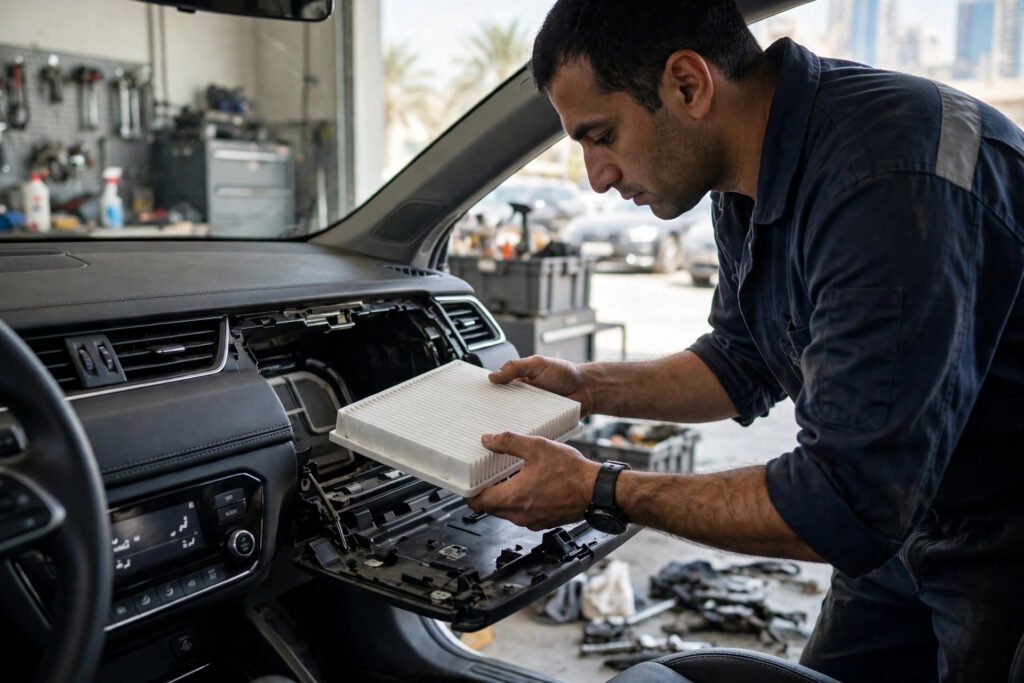
In most modern cars, the cabin filter sits behind the glovebox. You open the glovebox, empty it, squeeze the sides or release the damper arm, and let it drop down further than normal. Behind it, you will see a rectangular plastic cover. That cover unclips or unscrews, and behind it is the filter, which slides out like a drawer. In some cars, the filter is under the bonnet, at the base of the windscreen on the passenger side, under a plastic cover. In a few cars, it is under the dashboard on the driver side, or in the centre console. Your owner's manual will tell you exactly where it is for your model, and it is worth checking the manual before you start, because forcing the wrong panel can break a clip.
Before you start, switch the car off, and make sure the fan is off. Empty the glovebox, because it will drop down. Work gently. The plastic clips and the glovebox damper are not designed to be forced. If something does not move, stop and check the manual or a model-specific guide. A broken glovebox clip is an annoying repair for a job that should have been simple.
What to Look For
Slide the filter out slowly, keeping it level so the dust on it does not fall into the housing. Look at it in good light. A new filter is white or, for a carbon filter, dark grey but with clean, open pleats. A filter that needs changing is usually grey or brown, with the pleats full of dust. You may see sand in the pleats, small leaves, or a general dull, dirty colour that does not brush off. Hold it up to the light. Can you see light through the pleats? A clean filter lets some light through. A very dirty filter looks almost solid.
Check the edges and the frame. Is the filter torn? Is the frame bent? Is there a gap where air could get around it? Check the direction arrow on the side of the filter. That arrow shows which way the air flows, and it should point in the direction shown in the housing, usually downwards or towards the cabin. A filter fitted the wrong way round will not work as well, and it can be noisier.
Smell the filter. It sounds odd, but it is a useful test. A clean filter smells of nothing much. A dirty, damp filter smells musty, stale, or dusty. If the filter smells strongly musty, it is a major part of your smell problem, and changing it should help.
Look into the housing where the filter sits. Is there dust, leaves, or debris in there? Is it damp? Wipe out any loose dust with a clean, dry cloth. Do not use water inside the housing, and do not spray cleaning products directly into it unless you are using a product made for that purpose. If the housing is very dirty or smells strongly even after you have removed the filter, that is a sign it needs a proper clean, which is a workshop job.
Replacing It
If you are replacing the filter yourself, buy the correct filter for your exact car — make, model, year, and engine if there are different options. A filter that is the wrong size, even by a few millimetres, will not seal properly, and air will get around the edges. That defeats the purpose. A good parts shop in Dubai will check by your car details, or by the old filter itself. Take the old filter with you if you are buying in person, so you can compare the size and the shape.
Fit the new filter with the airflow arrow pointing the right way. Slide it in gently, making sure it sits flat and the edges seal. Replace the cover, making sure it clips or screws back properly, with no gaps. Put the glovebox back, making sure the damper arm is reconnected if your car has one. Close the glovebox and test the fan. You should notice the difference immediately: stronger airflow, less fan noise, and, after a short while, fresher air.
Do not try to wash and reuse a paper cabin filter. Some drivers try to blow it out with compressed air or wash it, hoping to get more life out of it. Blowing it out can remove some loose dust, but it does not restore the filter, and it can damage the fine fibres. Washing a paper filter ruins it. It is a consumable part, designed to be replaced, not cleaned and reused. The cost of a new filter is small compared to the cost of a blower motor working against a blocked filter, or the discomfort of driving with stale air for months.
How often should you change it? The manual will give a distance or time interval, but in Dubai, go by what you see, not just what the book says. If you drive a lot in dusty conditions, check it every few months and change it when it looks dirty, even if the interval has not come up yet. A good habit is to check it at every service, and to check it yourself in between if you notice any of the symptoms in this guide. A driver who checks the filter regularly will rarely be surprised by a musty smell, because they will have seen it coming.
When to Let a Workshop Do It
There are times when a DIY check is enough, and times when a workshop is the right call. Let a workshop do it if the filter is hard to reach in your car, if you have to remove a lot of trim, if the housing is very dirty or smells strongly after a filter change, if the carpet is wet, if you hear sloshing behind the dashboard, or if the demister still does not work after a new filter and a clean windscreen. Those signs point to the drain, the housing, or the airflow flaps, which need proper access and cleaning.
A good workshop will not just swap the filter. They will check the housing, check the drain from underneath, check that water flows freely, check the airflow direction, and clean the inside of the system if it needs it. That whole-air-path approach is what fixes a persistent smell, rather than just covering it for a week. When you talk to a mechanic, tell them what you found in your own checks — weak airflow, damp carpet, no puddle, smell at start-up. That information helps them find the cause faster, and it helps you know that they have looked at the right things.
For cabin-filter and air conditioning help in Dubai, see our car AC page: https://95services.com/car-ac-repair-dubai/
Prevention in Dubai Conditions: Keeping the Air Path Clean
Fixing a musty smell and fogging once is good. Keeping it from coming back is better, and in Dubai it is mostly about habits. None of these habits are difficult. They are small things, done regularly, that keep the filter drier, the drain clearer, and the cabin fresher.
Run Fresh Air Regularly
Use recirculation when you need it — to cool down quickly on a very hot day, or to keep out dust in a sandstorm or heavy traffic — but do not leave it on for every trip. Switch to fresh air for most of your driving, once the car has cooled down. Fresh air flushes the cabin, brings in drier air, and helps the system dry out. It also stops the cabin air getting stale from being recirculated again and again. If your car has an automatic mode, let it manage the mix. It is usually better at it than leaving recirculation on manually all day.
Let the System Dry Before You Switch Off
This is a small habit that makes a surprising difference. A few minutes before you reach your destination, switch the air conditioning cooling off, but leave the fan running on fresh air. That blows relatively dry air through the coil and the ducts, and helps dry the moisture that has built up while the cooling was on. It does not need to be long — two or three minutes is enough. It is especially useful if you are about to park in a damp basement or leave the car for a few days. A drier system when you park is a system that smells fresher when you come back.
You do not need to do this on every short trip. But if you have had a musty smell before, or if you park in a humid place, it is a habit worth building. Think of it as letting the car breathe out before you close it up.
Check the Filter on a Schedule That Fits Dubai
Do not wait for the smell to tell you the filter is done. Check it regularly. A practical schedule for Dubai is to look at the filter at every service, and to check it yourself between services if you drive in dusty conditions, if you do a lot of highway driving, or if you notice any of the symptoms in this guide. If you have just been through a sandstorm or a very dusty week, check it sooner. A visual check takes a few minutes once you know where the filter is, and it will save you months of driving with weak airflow.
Keep a note of when you last changed it. A simple note in your phone — date and mileage — is enough. That way you are not guessing. If the filter was changed six months ago and already looks grey and clogged, you know your driving conditions are hard on it, and you need to check it more often. If it still looks clean after a year, you know your conditions are gentler. Your car, your driving, and your parking will set the real interval, not just the book.
Keep the Intake and the Drains Clear
The air intake at the base of the windscreen, and the drain channels around it, collect dust and debris. A quick look every month or so, and a gentle clear of loose debris, stops that material washing down into the filter housing and the drain. Do not use a high-pressure hose directly into the intake. Just clear what you can see, and let a workshop handle anything deeper.
The same applies to the area under the car where the drain comes out. You do not need to crawl underneath, but when you are having the car serviced, ask the mechanic to check that the drain is flowing. It is a quick check, and it can catch a blockage before it becomes a wet carpet.
Keep the Cabin Dry
Dry the cabin, and the air path stays drier. Take wet items out of the car — damp towels, gym bags, wet floor mats after rain. If a spill happens, dry it properly, not just wipe the surface. If the floor mat gets wet, take it out and dry it in the sun. If you wash the car, leave the doors open for a little while afterwards to let the interior air out, especially if water has got onto the mats or the seats. A car that is dry inside is a car that smells fresh, and it puts less moisture into the filter and the ducts.
Check under the floor mats regularly, especially in the front passenger footwell. A mat can hide a damp carpet for weeks. Lifting it and feeling the carpet takes ten seconds, and it is the earliest warning of a blocked drain you will get.
Clean the Inside Glass and the Interior
A clean inside windscreen fogs less and clears faster. Make it part of your regular car clean, not an afterthought. Use a proper glass cleaner and a clean microfibre cloth, and do it in the shade so the cleaner does not dry too fast and leave streaks. Clean the side windows as well, and the rear window, because they fog too.
A regular interior clean also helps with the smell. Dust on the dashboard, on the vents, and on the seats gets pulled into the air system and adds to the load on the filter. Vacuuming the cabin, wiping the vents, and keeping the interior generally clean is not just about looks — it is about the air you breathe. A deep interior clean once in a while, especially after a dusty period or if the car has been sitting, can make a real difference.
For a full interior refresh, see our car detailing page: https://95services.com/car-detailing-dubai/
Park With Airflow in Mind
Where you park affects how damp the car gets. A car parked in a humid underground basement will stay damper than a car parked in a dry, ventilated place. You cannot always choose where you park, but if you have a choice, a ventilated spot is better for the cabin. If you are leaving the car for a week or more while travelling, try to leave it as dry as possible: run the fan to dry the system before you park, take wet items out, and, if it is safe to do so, leave a window very slightly open in a secure, covered place to let air move. Even a small amount of airflow helps stop the cabin going stale.
Do Not Mask the Smell
Air fresheners, sprays, and hanging fresheners have their place, but they do not fix a musty smell. They cover it. If the filter is clogged, the drain is blocked, and the housing is damp, a strong air freshener will just give you a musty smell with a perfumed smell on top of it, and the underlying problem will keep getting worse. Fix the air path first. Then, if you like a fresh scent in the car, use a mild freshener on a clean system. It will last longer, and it will smell better, because it is not fighting a damp filter.
Frequently Asked Questions
How do I know if my cabin filter is clogged?
The most common signs are weaker airflow from the vents, a musty smell when the air conditioning first starts, dust settling quickly on the dashboard, and a windscreen that fogs up inside and clears slowly. If you have two or three of those together, the filter is a very likely cause. The only way to be sure is to look at it. A dirty filter is visibly grey or brown, with clogged pleats, and it smells stale. A clean filter is white, with open pleats, and lets light through.
Why does my car smell musty only when I turn the air conditioning on?
Because the smell is in the air path, and it is strongest when the system first starts after being parked. While the car is parked, moisture sits in the damp filter and housing, and the stale smell builds up. When you switch the fan on, that stale air is pushed into the cabin. After a few minutes, the system dries a little and the smell often fades. If the smell stays, or if the carpet is also damp, the drain may be blocked as well.
Is water under my car after using the air conditioning normal?
In most cases, yes. That water is condensation from the cooling coil, draining out through the drain tube. On a hot, humid day in Dubai, you will often see a puddle under the front passenger area after parking. That is a good sign — it means the drain is open. If the puddle stops appearing, and the cabin starts to smell damp or the passenger carpet feels wet, the drain may be blocked and needs checking.
Why does my windscreen fog up inside on a winter morning in Dubai?
Because the glass is cold from the night, and the air inside the car is warm and moist from breathing and from the humidity outside. Moisture condenses on the cold glass. A healthy demister should clear it in a minute or two with a good flow of dry air. If it takes much longer, the filter may be clogged, the air may be damp from a blocked drain or wet carpet, or the vents may be blocked. Clean the inside glass, check the filter, and use fresh air, not recirculation, for demisting.
Can I drive with a clogged cabin filter?
You can, in the sense that the car will still move. But you will have weaker airflow, a stale smell, slower demisting, and a blower motor working harder than it should. In Dubai, where visibility and fresh air matter in traffic and on humid mornings, a clogged filter is not just uncomfortable — it can make the windscreen harder to clear when you need it most. It is a simple, low-cost part to change, and it is worth doing sooner rather than later.
How often should I change the cabin filter in Dubai?
Follow your owner's manual as a starting point, but check the filter visually as well. In Dubai, dust, sand, and long air conditioning use mean many cars need a change sooner than the standard interval. Check it at every service, and check it yourself if you notice weaker airflow, a musty smell, or slow demisting. Change it when it looks dirty, even if the interval has not come up yet.
Will changing the cabin filter fix the musty smell?
Often, yes, especially if the smell is mainly from the filter itself. Many drivers notice a big improvement the day after a change. If the smell is still there after a few days, the housing behind the filter, or a blocked drain, may also need cleaning. That is why a workshop check of the whole air path — filter, housing, and drain — is the right next step if a new filter alone does not fix it.
Should I use a carbon cabin filter?
A carbon filter can help cut down traffic odours and stale smells, and many Dubai drivers prefer it for city driving. It costs a little more than a standard filter, and it also clogs and needs changing on a similar schedule. If you drive a lot in heavy traffic, it is worth trying. If you drive mostly on open roads, a standard filter may be enough. Either type needs to be the correct size for your car, and fitted the right way round.
When to Get Help, and What 95 Services Can Do
You do not need to fix all of this alone. Some of it — cleaning the inside glass, checking the carpet, switching to fresh air — you can do today. Some of it — checking the filter, clearing the drain, cleaning the housing — is quick for a workshop, and much harder to do properly at home without the right access.
Get help promptly if the passenger carpet is wet, if you hear sloshing behind the dashboard, if the smell stays after a new filter, if the demister does not clear the glass in a reasonable time, or if the airflow stays weak even on full fan. Those are signs that the problem is beyond the filter, in the drain, the housing, or the airflow direction, and it will not fix itself. Leaving a blocked drain will only make the carpet wetter, the smell stronger, and the mould harder to remove.
At 95 Services, we check the whole air path, not just the filter. We look at the filter, the housing behind it, the drain underneath, the airflow to the windscreen, and the dampness in the cabin, so the cause is found, not just covered up. We work across Dubai and the complete UAE, and we come to you — at home, at work, or wherever your car is parked. Our response time is 15–20 minutes, and our prices are very low. Call or WhatsApp us on +971 54 344 3513, tell us about the musty smell, the wet carpet, or the fogging windscreen, and we will help you get the cabin air fresh, dry, and clear again.
A fresh cabin filter, a clear drain, and a demister that works properly are small things. But on a humid morning in Dubai, with the traffic building and the windscreen misted over, they are the difference between a stressful drive and a normal one. Check the filter, dry the cabin, keep the drain clear, and your car will smell better, breathe better, and clear its glass the way it was designed to.
