
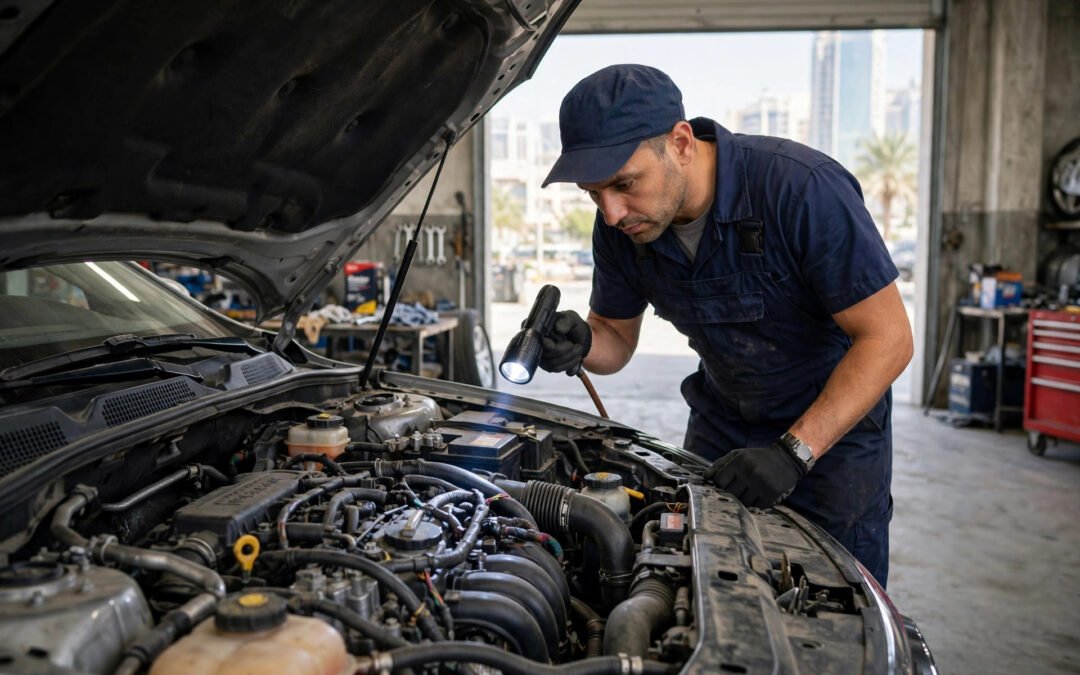

You are driving down Sheikh Zayed Road, the air conditioning is doing its best against the afternoon heat, and then it hits you. A smell. Not a faint one you can ignore, either — a proper smell, the kind that makes you turn the AC down and sniff the air like a bloodhound. Burning. Sweet. Petrol. Something like rotten eggs.
Your first thought is usually the same as everyone else's: is my car about to catch fire? Is it safe to keep driving? And honestly, that is the right instinct. A strange smell from a car is one of the earliest warnings you will ever get. Long before a dashboard light comes on, long before something actually breaks, your nose picks up the trouble. The trick is knowing which smell means "get to a workshop this week" and which one means "pull over right now, switch the engine off, and get out."
I have spent years under bonnets in Dubai, and I can tell you this much: most smells fall into just four families. Burning, sweet, fuel, and rotten egg. Learn those four, learn how to tell them apart, and you will never again sit in a car wondering whether to panic or carry on. That is what this guide does. We will go through each smell type one by one — what causes it, how it behaves, how urgent it is, and what a mechanic actually checks when you bring the car in. No jargon for the sake of it, no scare stories, just the practical stuff a driver in the UAE needs.
And one thing before we start. If you ever smell strong petrol inside the car, or a sharp electrical burning smell, or your temperature gauge is climbing into the red at the same time as a sweet smell, do not try to be brave about it. Pull over somewhere safe, switch off, and call for help. A car can be repaired. A fire cannot be undone. Everything else in this article — the checklists, the "drive carefully to the workshop" advice — sits underneath that one rule.
Your Nose Is a Diagnostic Tool — Use It Properly
Mechanics talk about listening to a car, and that matters, but smell is often faster than sound. A leak does not always drip onto the ground where you can see it. In Dubai, that is doubly true: a small oil drip can evaporate off a hot engine before it ever reaches the sand below, and a coolant leak can dry into a faint white crust on a hose while the puddle you were looking for never appears. But the smell? The smell stays. It drifts into the cabin through the vents, or it hits you the moment you step out of the car after parking.
So when a smell appears, slow down and pay attention to four things. First, when does it show up? Only when the engine is cold, only after a long drive, only when you brake, only when the AC is on, or all the time? Second, where is it strongest — inside the cabin, outside near the front, near a wheel, or at the exhaust? Third, does anything else happen at the same time — a warning light, a temperature gauge moving, smoke, a change in how the car drives? And fourth, does it get stronger or weaker when you change something, like turning the AC off or opening a window?
Those four answers narrow almost every smell down to one cause before anyone opens the bonnet. That is why a good mechanic will ask you those questions first. "When do you smell it?" is not small talk. It is the diagnosis starting.
A quick word on Dubai conditions, because they change everything about smells. Summer temperatures here push engines, brakes, batteries and rubber parts far harder than the same car would face in a mild climate. An engine bay that sits at 45 degrees in a car park will cook a small oil leak into a strong smell within minutes. Stop-start traffic on Al Khail Road or around Deira keeps brakes hot and clutches working overtime. Long desert drives to Abu Dhabi or up to Ras Al Khaimah hold the engine at high load for an hour or more, which is exactly when a weak hose, a tired catalytic converter or a slipping clutch shows itself. And sand and dust get everywhere — into vents, onto hot exhaust parts, into the engine bay — and can add their own hot, dusty smell on top of whatever else is going on. None of this means your car is badly built. It means the UAE is a hard place for a car to live, and smells are one of the ways the car tells you it is struggling.
One more practical note. If the smell only appears when the air conditioning is running, and it smells damp or stale rather than burning, sweet, or chemical, that is a different problem — a cabin filter and AC system issue, which belongs to our separate guide on cabin filters and demisters. This article sticks to the four smells that point to the engine, brakes, fuel system and exhaust. If you are unsure which one you have, the comparison table near the end of this article will help you sort it out in about a minute.
Smell Type 1: Burning Smells
Burning is the smell most drivers notice first, and it is also the broadest category. "Burning" can mean oil, rubber, clutch material, brake pads, or electrical wiring — and each of those smells a little different, appears at a different time, and carries a different level of urgency. The good news is that once you know the differences, you can usually tell them apart yourself.
A general rule first: any burning smell that is getting stronger, any burning smell with visible smoke, and any burning smell that comes with a warning light means stop. Pull over safely, switch the engine off, and get help. A faint burning smell that appears once after a long drive and then fades may be something minor, like a plastic bag stuck to the exhaust or a bit of spilled oil burning off after a service. But "faint and fading" is the only version of a burning smell you are allowed to watch for a day. Everything else gets checked.
Burning Oil: The Most Common Burning Smell
If there is one burning smell every Dubai driver will meet sooner or later, it is burning oil. It smells acrid and oily at the same time — a bit like a kitchen where oil has been left too long on a hot pan, but heavier, with a chemical edge. It usually creeps into the cabin through the vents when you are stopped at a traffic light, because the car is not moving and the smell from the engine bay has nowhere to go except up and in. While you are driving at speed, the airflow pushes it away, and you might not notice it at all. That on-off pattern — strong in traffic, gone on the motorway — is a classic sign of an oil smell.
What causes it? Engine oil is supposed to stay inside the engine. When a seal or a gasket gets old, or a valve cover gasket shrinks in the heat, a small amount of oil escapes and lands on something hot — the exhaust manifold, the engine block, the turbo if your car has one. The oil does not burst into flames. It smoulders and burns off slowly, and that is the smell you get. In Dubai the heat speeds up the ageing of rubber seals and gaskets, and a car that does a lot of short trips never quite gets the same pattern as a car that runs for hours. Both can leak, but the leaks show up differently.
How do you tell it is oil? Look for the supporting clues. Is the oil level dropping between services, even a little? Is there a dark stain under the car where you park — or, just as telling, is there no stain at all but the smell is still there? Remember, in summer a slow leak can burn off before it drips. Pop the bonnet when the engine is cold — never when it is hot — and look for dark, wet-looking patches around the top of the engine, especially around the valve cover, and for a thin film of oil on the underside of the bonnet. Check the oil cap too: a loose or cracked cap can let oil mist escape and smell strongly for a tiny fault. And think about timing. Did the smell start just after an oil change? A small spill during a service is common, and it usually burns off within a day or two of normal driving. If it is still there after a week, it is not a spill. It is a leak.
How urgent is burning oil? Medium to high. A slow leak will not stop your car today, but running low on oil will damage the engine, and oil dripping onto a very hot exhaust is a fire risk you do not want to carry around. If the oil level is still normal and the smell is mild, you can drive carefully to a workshop within a day or two — but check the oil level before every trip until then, and top up with the correct grade if it is low. If the oil level is dropping fast, if you see smoke from the engine bay, or if the oil pressure warning light comes on, stop. Switch off and call for help. Do not keep driving a car with no oil pressure. That is how engines die.
What a mechanic checks: the valve cover gasket, the oil filter housing and its seal, the sump gasket, the oil drain plug, the turbo oil feed lines on turbocharged cars, and the crankshaft seals. A good mechanic will also clean the area and ask you to come back after a short drive so the fresh leak shows up clearly against a clean engine — that is much more reliable than guessing from a dirty engine bay where old oil is everywhere. If you want to understand more about leaks in general, including the ones that leave a puddle and the ones that do not, our guide on a fluid leak under the car walks through the colours and positions that tell one fluid from another.
Burning Clutch: The Smell of a Slipping Clutch
A burning clutch has a smell all of its own. Drivers describe it as sharp, bitter, and a bit like burning paper or overheated brakes, but with a distinctive acrid edge that catches the back of your throat. Once you have smelled it, you do not forget it. It usually appears when you are using the clutch hard — pulling away on a steep car-park ramp, crawling in heavy traffic, reversing into a tight space, or holding the car on a hill with the clutch instead of the handbrake.
The clutch is a friction disc that connects the engine to the gearbox. When you press the clutch pedal, it slips on purpose so you can change gear smoothly. But when it slips when it should not — because it is worn out, because the driver is riding the pedal, or because the car is being held on a slope with partial clutch — the friction material overheats and burns. That is the smell. In Dubai, this happens a lot in stop-start traffic. A driver inching forward in a jam on Sheikh Zayed Road, foot hovering on the clutch pedal, is slipping the clutch dozens of times in a few minutes. Add the summer heat, and the smell arrives fast.
How do you tell it is the clutch? The smell comes with a feeling. The engine revs climb but the car does not speed up the way it should. The bite point of the clutch pedal feels higher than it used to, or the pedal feels vague. Pulling away feels sluggish. On a manual car, you might notice the revs flare between gears. On a car with a dual-clutch automatic gearbox, a burning smell after slow traffic can point to the same thing — the clutches inside the gearbox overheating. If the smell appears only when you are using the clutch heavily and fades once you are cruising, it is almost certainly the clutch.
How urgent is a burning clutch? Medium. A single episode of clutch smell after a bad hill start does not mean the clutch is finished — it means it got hot, and it will recover once it cools. But a clutch that smells every day, or a car that slips regularly, is a clutch on its way out. You can usually still drive it to a workshop, gently, avoiding heavy traffic if you can. Keep the revs low, do not hold the car on hills with the clutch, and do not tow anything. If the car barely moves when you release the clutch, or the smell is constant and strong, do not force it — call for help. Driving a badly slipping clutch to destruction can damage the flywheel as well, and that turns a clutch job into a much bigger bill.
What a mechanic checks: the clutch disc and pressure plate for wear, the release bearing, the flywheel surface for heat damage, and — on cars with a hydraulic clutch — the fluid level and the master and slave cylinders. They will also ask how you drive, and that is not a judgement. Riding the clutch is a habit, and a short conversation about keeping your foot off the pedal in traffic can add years to the next clutch.
A habit worth building now: in slow traffic, leave a gap, let the car roll in gear, and use the brake to stop rather than feathering the clutch. On hills, use the handbrake to hold the car while you pull away. Small changes, big difference to clutch life.
Burning Brakes: Hot, Sharp, and Usually Near a Wheel
Burning brakes smell sharp and chemical, a bit like a hot iron left on a shirt, and they usually announce themselves near one wheel rather than from the engine bay. You might smell it after coming down a long descent — the road down from Jebel Hafeet, for instance — or after a stretch of heavy braking in traffic, or after driving with the handbrake partly on. Yes, that happens more than people admit, and the smell is usually the first thing that gives it away.
Brakes work by friction. The pads squeeze the discs, the car slows down, and the energy turns into heat. That is normal. What is not normal is when the heat builds up beyond what the pads and discs can handle, and the pad material starts to overheat and give off that sharp smell. A stuck brake calliper — where the pad does not fully release after you take your foot off the brake — is the most common cause of a single wheel smelling hot. The pad drags constantly, the disc gets hotter and hotter, and the smell gets stronger the further you drive.
How do you tell it is the brakes? The clues are physical. One wheel feels much hotter than the others after a drive — be careful, and do not touch a brake disc with bare skin; hold your hand near the wheel and feel the heat radiating, or look for a wheel that is noticeably hotter than the rest. The car may pull to one side when you brake, or feel as though it is dragging even when your foot is off the pedal. The brake pedal may feel soft, or you may feel a vibration through the pedal. And the smell is strongest when you step out of the car near that wheel. If the smell is strong after a long downhill stretch but fades after a few minutes of gentle driving, that is usually just hot brakes cooling down, and it is not a fault — it is a warning to use engine braking more on descents.
How urgent are burning brakes? High. Brakes are the one system you never gamble with. Overheated brakes can fade, meaning they stop working properly when you need them most, and a stuck calliper can damage the disc, the pads, and the wheel bearing. If the smell is mild and fades after a few minutes of easy driving, drive gently to a workshop and have it checked the same day. If the smell is strong, if one wheel is very hot, if the car pulls to one side, or if the pedal feels soft or goes to the floor, pull over and call for help. Do not keep driving on fading brakes.
What a mechanic checks: the brake pads and discs for wear and heat damage, the callipers for sticking or seized pistons, the brake hoses, the handbrake mechanism, and the brake fluid — old fluid absorbs moisture and boils more easily, which makes fade worse. If you want the full picture on brake care, our car brake repair guide covers the warning signs and what a brake service actually includes. And if your brake warning light is on as well as the smell, treat that as a stop-and-check situation, not a drive-on one.
Burning Electrical: The Smell You Must Not Ignore
An electrical burning smell is different from all the others, and you need to know the difference. It smells like burning plastic, like a hair dryer that has sucked in a piece of paper, sharp and chemical and wrong in a way that makes you want to open the windows immediately. Sometimes you will see a thin wisp of smoke from under the dashboard or the bonnet at the same time. Sometimes a fuse has blown and something has stopped working — a window, a fan, a light.
Electrical burning means a wire is overheating, a connection is loose and arcing, or a component such as a blower motor or an alternator is failing and drawing too much current. It can happen in any car, but Dubai heat makes it more likely: wiring insulation gets brittle, connectors corrode in humidity and sand, and aftermarket accessories — extra lights, a badly fitted stereo, a dash camera wired to the wrong circuit — can overload a circuit that was never designed for the extra load.
How do you tell it is electrical? The smell is plastic, not oily. It often comes from inside the cabin, from the dashboard vents, rather than from the engine bay. Something electrical may have stopped working or started behaving oddly at the same time. And unlike an oil smell, it does not need the engine to be hot — it can appear the moment you switch something on.
How urgent is an electrical burning smell? Stop immediately. This is the one burning smell with no "drive carefully to the workshop" option. Electrical faults cause car fires, and a fire that starts in wiring can spread fast. Pull over somewhere safe, switch the engine off, and if you can do so safely, switch off the ignition completely. Do not open the bonnet if you see smoke or flames coming from it — stand well away and call for help. If you have a fire extinguisher in the car, only use it if the fire is small and you can do so from a safe distance with an escape route behind you. Your safety comes first; the car is replaceable.
What a mechanic checks: the wiring harness for melted insulation, the fuse box, the alternator, the blower motor, and any aftermarket wiring. They will also check for rodent damage, because in some areas rats and mice chew wiring, and a chewed wire is a short circuit waiting to happen. If a battery or alternator problem is part of the story, our guide on a car that will not start — battery, alternator or starter covers the electrical side in more detail.
Other Burning Smells: Rubber, Plastic, and the Odd Ones
Not every burning smell fits neatly into the four groups above. A few others are worth knowing so they do not confuse you.
A burning rubber smell can mean a drive belt is slipping or worn. The belt drives the alternator, the air conditioning compressor and sometimes the water pump, and when it slips it heats up and smells like hot rubber. You may also hear a squeal when you start the car or switch the AC on. A slipping belt is not an emergency in the same way as an electrical smell, but if the belt snaps, you can lose power steering, charging, and cooling in one go. Get it checked soon.
A sweet-burning or melting plastic smell after parking can be a plastic bag or some road debris stuck to the hot exhaust pipe. It smells terrible, and it is usually harmless — once the material burns off, the smell goes away. Look under the car when it is cool and check the exhaust for anything stuck to it.
A dusty, hot smell when you first switch the heater on after months of not using it is usually just dust burning off the heater element. In Dubai the heater barely gets used, so the first cold snap in January can bring a brief burning-dust smell that disappears after a few minutes. If it does not disappear, or if it comes with smoke, treat it as an electrical smell and stop.
And a new car, or a car with brand-new brake pads or a new clutch, will often smell hot for the first few hundred kilometres. That is the new friction material bedding in, and it fades. If it does not fade, have it checked.
Smell Type 2: Sweet Smell — Coolant
A sweet smell from a car is strange the first time you meet it, because sweet is not a word you expect to associate with a breakdown. But coolant — the fluid that keeps your engine from overheating — is made with ethylene glycol, which smells sweet, almost syrupy, like warm sugar. Some drivers describe it as maple syrup or candy. If you smell something sweet in or around your car, think coolant first.
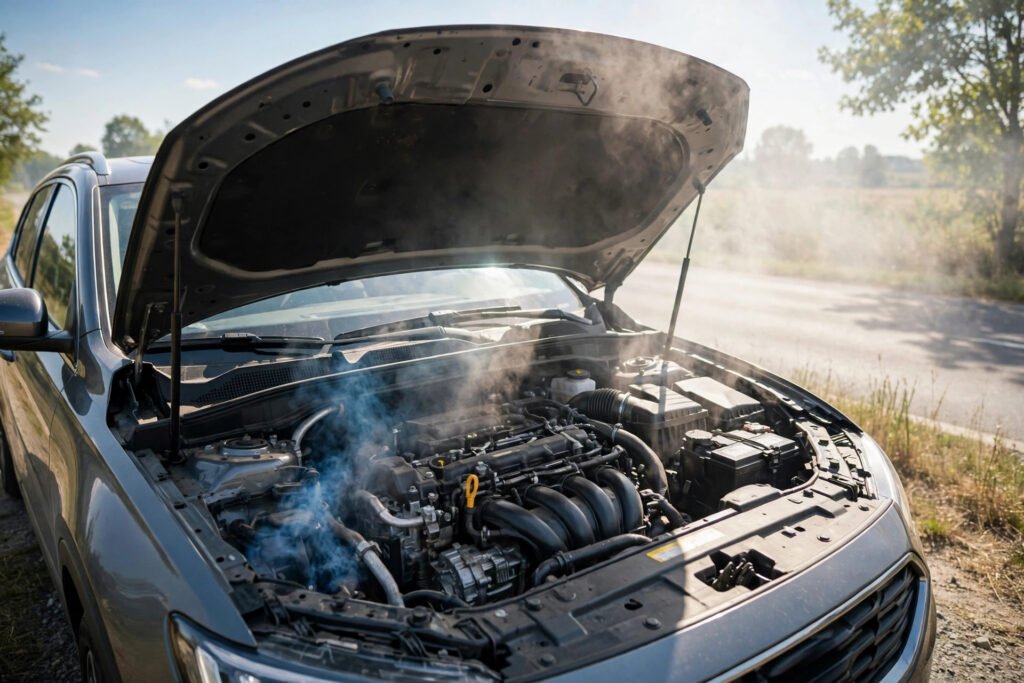
Coolant circulates through the engine, the radiator, and the heater. It picks up heat and carries it away. When it leaks, it can drip onto hot engine parts and steam, which is why the sweet smell often comes with a faint white vapour from under the bonnet, or a mist on the inside of the windscreen if the leak is in the heater core behind the dashboard. The smell is often strongest when the engine is hot and the cooling system is under pressure — after a long drive, or when you are stuck in traffic with the AC running and the temperature gauge sitting higher than usual.
What causes a coolant smell? A split hose, a loose hose clamp, a leaking radiator, a failing water pump, a cracked coolant reservoir, or a leaking heater core. Age and heat are the enemies here: rubber hoses harden and crack, plastic reservoirs go brittle, and the constant heating and cooling of Dubai driving speeds the whole process up. A car that has been topped up with plain water instead of proper coolant mix will also corrode its cooling system from the inside, which makes leaks more likely.
How do you tell it is coolant? The smell is sweet and unmistakable once you know it. Look for the other clues too. Is the temperature gauge reading higher than normal, or climbing in traffic? Is the coolant level in the reservoir dropping? Is there a white or greenish crust around hose joints — dried coolant leaves a chalky residue? Is there a puddle under the car that feels slippery and smells sweet, or no puddle at all? Remember, a leak can steam away before it drips, so the absence of a puddle proves nothing. Our guide on losing coolant with no puddle goes into this in detail, because it catches a lot of drivers out: they keep topping up, see no leak on the ground, and assume everything is fine while the engine slowly cooks itself.
How urgent is a sweet smell? High — and it becomes an emergency the moment the temperature gauge climbs. A small coolant leak will not stop your car in the next ten minutes, but a cooling system that is losing fluid will overheat, and an overheated engine can warp, crack, or seize. That is the most expensive kind of engine damage there is. If the smell is mild, the temperature gauge is normal, and the coolant level is only slightly low, you can drive carefully to a workshop the same day, watching the gauge the whole way. Top up the coolant with the correct type if you have it, but do not open the radiator cap when the engine is hot — the system is pressurised, and hot coolant can spray out and scald you badly. Wait until the engine is cool, then open it slowly.
If the temperature gauge is in the red, or you see steam pouring from the bonnet, or the heater suddenly blows cold air while the engine is hot, pull over immediately and switch off. Do not open the bonnet straight away if steam is coming out — let it cool first, then check the coolant level when it is safe. Do not drive on. Call for help. Our full guide on engine overheating covers exactly what to do in that situation, step by step.
What a mechanic checks: a pressure test of the whole cooling system, which finds leaks that are invisible to the eye; the hoses, clamps, radiator, water pump, thermostat, and the head gasket if the coolant is disappearing with no visible leak at all. A failing head gasket is the serious version of this problem, and it often shows up as white smoke from the exhaust alongside the sweet smell — which is why it is worth reading our guide on exhaust smoke colours if you are seeing white smoke as well as smelling something sweet.
One warning that matters in Dubai: never top up a cooling system with plain tap water as a permanent fix. It is fine as a roadside emergency measure to get you to a workshop, but tap water causes scale and corrosion inside the system, and it boils at a lower temperature than proper coolant. Use the correct coolant mix, and if you are unsure which type your car needs, ask — mixing incompatible coolants can cause sludge that blocks the system.
Smell Type 3: Fuel / Petrol Smell
A fuel smell is the smell most drivers are right to be afraid of. Petrol vapour is flammable, and a leak is a fire risk. The good news is that a fuel smell is also one of the easiest to identify — it smells like a petrol station, sharp and chemical, and it is usually strongest when you first start the car, when you fill the tank, or when the car has been parked in the sun.
A faint petrol smell for a few seconds after filling up is normal. You have just handled the pump, a drop may have spilled, and the vapour hangs around. It should clear within a minute of driving. A petrol smell that lingers, that appears every time you start the car, that is strong inside the cabin, or that you can smell when the car is just sitting parked is not normal. That is a leak, or a fault in the fuel system, and it needs attention.
What causes a fuel smell? The usual suspects are a leaking fuel line or hose, a cracked fuel injector seal, a damaged fuel tank, a faulty fuel cap that no longer seals, or a problem with the evaporative emissions system — the EVAP system — which is supposed to capture fuel vapour and feed it back into the engine instead of letting it escape. The EVAP system has a charcoal canister and a purge valve, and when the valve sticks open or the canister is saturated, the vapour escapes and you smell it. In Dubai, heat makes the problem worse: a full tank in a car parked in the sun builds up vapour pressure, and any weak seal will let it out. That is also why the smell is often strongest on a hot afternoon.
Diesel cars smell different — diesel has a heavier, oilier smell than petrol — but the same rule applies. A diesel leak is less of a fire risk than a petrol leak, but it is still a fault, it still wastes fuel, and diesel on the road is slippery and dangerous for other drivers, especially motorcyclists.
How do you tell it is fuel? The smell is unmistakable, but look for the supporting evidence. Is there a puddle or a damp patch under the car, especially towards the rear where the tank sits, or under the engine where the fuel lines run? Does the fuel gauge drop faster than usual? Is the car hard to start, or does it hesitate when you accelerate? Is the check engine light on? Does the smell get worse after filling the tank right to the top? A fuel cap that clicks properly when you close it is a small thing, but a cap that is loose, cracked, or missing its seal can cause a surprisingly strong smell, and it is the cheapest fix in this whole article — so check the cap first. Tighten it until it clicks. If the smell clears, you have found it.
How urgent is a fuel smell? Stop driving, and treat it as an emergency if the smell is strong. This is the other smell, alongside burning electrical, where there is no "drive carefully to the workshop" option when it is strong. Petrol vapour can ignite from a spark, from a hot exhaust, from a cigarette, from anything. If you smell strong petrol inside the cabin, pull over in a safe place away from other cars and buildings, switch the engine off, get out, and call for help. Do not switch the engine on again to "see if it is still there." Do not smoke anywhere near the car. Do not open the bonnet if you can smell fuel strongly and the engine is hot.
If the smell is faint, only outside the car, and there is no visible leak, you may drive a short distance to a workshop with the windows open — but only a short distance, only if the smell does not get stronger, and only if you are sure there is no dripping fuel underneath. If you are unsure, do not drive. A recovery truck is cheaper than a fire.
What a mechanic checks: the fuel lines and hoses from the tank to the engine, the injector seals, the fuel filter and its connections, the fuel tank and its filler neck, the fuel cap seal, and the EVAP system — the charcoal canister, the purge valve, and the vent hoses. They will also check for fault codes, because a failing EVAP purge valve often leaves a code even when the car still drives normally. A fuel smell that only appears after filling up often points to the filler neck or the EVAP vent; a smell that appears at idle often points to the injectors or the fuel rail.
One habit that helps: do not overfill the tank. When the pump clicks off, stop. Forcing extra fuel in floods the EVAP system, saturates the charcoal canister, and causes exactly the smell we are talking about. It also wastes fuel. The click means full. Leave it there.
Smell Type 4: Rotten Egg / Sulphur Smell
The rotten-egg smell is the strangest of the four, and the one drivers are least sure about. It smells like sulphur, like a hot spring, like a bad egg left in the sun. It usually comes from the exhaust, and you notice it most when you step out of the car, or when you are idling in traffic with the windows down, or when another car's exhaust drifts across yours. Some drivers only smell it when they accelerate hard after a long stretch of slow driving.
The smell comes from hydrogen sulphide, a gas that forms inside the catalytic converter. The catalytic converter is the part of the exhaust system that cleans up the gases coming out of the engine. Under normal conditions it converts hydrogen sulphide into odourless sulphur dioxide, and you smell nothing. When the converter is failing, or when the engine is running rich — burning too much fuel for the amount of air — the converter cannot keep up, and the hydrogen sulphide escapes. That is the rotten-egg smell.
What causes it? The most common cause is a catalytic converter that is worn out or damaged. Converters do not last forever, and in Dubai they work hard: high temperatures, stop-start driving, and short trips where the converter never fully warms up all shorten its life. A converter can also be damaged by a misfiring engine, because unburnt fuel entering the exhaust overheats the converter from the inside. Low-quality or contaminated fuel can contribute too, and so can an engine that is running rich because of a faulty oxygen sensor, a dirty air filter, or a leaking fuel injector. Sometimes the smell comes not from the converter at all but from the battery — an overcharging battery can give off hydrogen sulphide gas as well, and that smells the same. If the smell is strongest under the bonnet rather than at the exhaust, think battery.
How do you tell it is a rotten-egg smell? The smell is distinctive, but confirm the source. Is it strongest at the rear of the car, near the exhaust pipe? Does it appear when you accelerate hard, or after the car has been idling for a while? Is the check engine light on? Has your fuel consumption gone up? Is the car sluggish, or does it hesitate when you press the accelerator? A car with a failing converter often loses power gradually, so gradually that the driver gets used to it and does not notice until someone else drives the car and asks what is wrong with it.
How urgent is a rotten-egg smell? Medium, with one exception. A rotten-egg smell on its own, with the car driving normally, is not an emergency. You can drive to a workshop within a few days and have it checked. But do not leave it for months. A failing converter will only get worse, it can damage the engine if it becomes blocked, and it will fail an emissions test. The exception is the battery version: if the smell is coming from the battery, and the battery is hot, swollen, or leaking, or you can hear it hissing, stop and call for help. An overcharging battery can release flammable hydrogen gas, and a swollen battery case is a sign of serious internal damage. Do not jump-start a swollen or leaking battery. Do not lean over it. Get a professional to deal with it.
What a mechanic checks: the catalytic converter for damage or blockage, the oxygen sensors, the engine for misfires, the fuel system for a rich-running fault, and the battery and charging system if the smell points under the bonnet. They will also check the exhaust system for leaks, because a leaking exhaust can push the smell into the cabin instead of out behind the car. If the exhaust is part of the story, the smoke it produces can tell you more — our guide on exhaust smoke colours explains what white, blue and black smoke each mean, and it pairs naturally with this one.
A short note on short trips. If your car mostly does short runs — school run, grocery run, office five minutes away — the catalytic converter may never get hot enough to work properly, and you may get an occasional rotten-egg smell that clears after a longer drive. A good long drive on the motorway once in a while, at steady speed, helps the converter reach its working temperature and burn off deposits. It is not a fix for a genuinely failing converter, but it is a useful habit for a car that lives a life of short trips in city traffic.

How to Tell the Four Smells Apart: The Comparison Table
If you have read this far and you are still not sure which smell you have, use this table. Find the row that sounds most like your car. It will not replace a mechanic, but it will get you to the right conversation much faster.
| Smell | What it smells like | When you notice it | Where it is strongest | Urgency | First thing to check |
|---|---|---|---|---|---|
| Burning oil | Acrid, oily, like overheated cooking oil | In traffic, after the engine is warm | Engine bay, through the vents | Medium to high — check oil level now | Oil level, leaks around the valve cover |
| Burning clutch | Sharp, bitter, like burning paper | When pulling away, on hills, in slow traffic | Inside the cabin, near the pedals | Medium — drive gently to a workshop | Clutch feel, revs flaring without speed |
| Burning brakes | Sharp, chemical, like a hot iron | After heavy braking or a long descent | Near one wheel | High — brakes are never a gamble | One wheel hotter than the others |
| Burning electrical | Burning plastic, sharp and chemical | When you switch something on | Dashboard vents, inside the cabin | Stop immediately | What stopped working at the same time |
| Sweet (coolant) | Syrupy, like warm sugar or maple syrup | When the engine is hot, in traffic | Engine bay, sometimes inside the cabin | High — watch the temperature gauge | Coolant level, white crust on hoses |
| Fuel / petrol | Petrol station smell, sharp and chemical | On starting, after filling up, when parked in the sun | Inside the cabin, under the car, near the tank | Stop if strong — fire risk | Fuel cap, puddle under the car |
| Rotten egg / sulphur | Bad eggs, hot springs, sulphur | When accelerating, at idle, from the exhaust | Rear of the car, at the exhaust pipe | Medium — days, not weeks | Check engine light, battery if under the bonnet |
Keep that table in mind, but remember the golden rule that sits above it: if a smell is strong, getting stronger, or comes with smoke, a warning light, or a change in how the car drives, stop. The table helps you describe the problem. It does not overrule your judgement.
Quick Diagnostic Checklist: Five Minutes That Save You a Breakdown
You do not need tools for this. You need five minutes, a cool engine, and your eyes and nose.
First, park somewhere safe and flat, switch off, and walk slowly around the car. Sniff near the front, near each wheel, and at the exhaust. Where is the smell strongest? That alone tells you half the story.
Second, look under the car. Is there a puddle? What colour is it — dark brown or black for oil, green or pink for coolant, clear with a petrol smell for fuel? Is it under the engine, under the middle, or under the rear? A puddle under the rear of the car points to the fuel tank. A puddle under the engine points to oil or coolant. No puddle at all does not mean no leak — in Dubai heat, small leaks evaporate or burn off — but a puddle is useful evidence when it is there.
Third, when the engine is cold, open the bonnet and check the oil level on the dipstick and the coolant level in the reservoir. Both low at the same time is a serious sign. Oil low on its own with a burning smell points to an oil leak. Coolant low with a sweet smell points to a cooling system leak. Take a photo of the levels with your phone — it helps the mechanic, and it gives you a record if the level drops again.
Fourth, look at the dashboard. Is the check engine light on? Is the temperature gauge reading higher than the middle? Is the oil pressure light on? Any one of those changes the answer from "book a workshop visit" to "stop and call now."
Fifth, think about when it started. Did it begin after a service, after a long desert drive, after filling up at a new station, after a minor bump or scrape underneath the car? The timing is often the clue that solves the puzzle. A smell that started the day after a service is often a spill or a loose cap. A smell that started after a drive over rough ground can be a damaged fuel line or exhaust. Tell the mechanic the timing. It saves them time, and it saves you money.
Write the answers down before you call a workshop. "It smells sweet when the engine is hot, the coolant is low, and the temperature gauge goes up in traffic" is a far better phone call than "my car smells funny." The mechanic will know what to bring, what to check first, and how urgent it is.
What to Do at the Roadside in Dubai: The Safe Way to Handle a Smell
Knowing the smell is only half the job. The other half is knowing what to do in the moment, on a real road, in real heat, with traffic going past. Here is the practical version.
If the smell is fuel or electrical burning, or if there is smoke, pull over as soon as you safely can. Choose a hard shoulder, a service area, or a quiet side road — not the middle of a fast lane, and not under a bridge or in a tunnel if you can avoid it. Switch the engine off. Get everyone out of the car and well away from traffic, behind a barrier if there is one. In summer, take water with you if you have it, and get into the shade. Do not stand in front of or behind the car on a fast road. Call for roadside help and tell them the smell — "strong petrol smell" or "burning electrical smell" — so they send the right help and know it is urgent.
If the smell is sweet and the temperature gauge is climbing, the same advice applies, with one addition: do not open the bonnet immediately if steam is coming out. Let the car cool for at least twenty to thirty minutes. When you do open the bonnet, open it slowly and stand to the side. Never open the radiator cap on a hot engine. If you have coolant with you, wait until the engine is cool before topping up, and only then if you know the correct type. If you are unsure, wait for help. A tow is cheaper than a scald.
If the smell is mild — a faint burning oil smell, a whiff of clutch after a bad hill start, a brief rotten-egg smell that clears — you can usually keep driving, but drive gently and directly to a workshop. Turn the AC to fresh air rather than recirculation if the smell is coming through the vents, because recirculation traps it inside the cabin. Keep the windows open a crack if it helps. Watch the gauges. And if the smell gets stronger, or a warning light comes on, or the car starts behaving differently, pull over and reassess. A mild smell that turns strong is no longer a mild smell.
A few Dubai-specific points. In summer, a car that has been parked in the sun can smell hot and strange for the first few minutes after you start it — rubber, dust, and the AC system all warming up at once. That is usually normal and it clears quickly. What is not normal is a smell that stays, gets stronger, or appears only when you drive. Learn the difference between "hot car in the sun" and "something is wrong," and you will save yourself a lot of worry.
On long desert drives, plan a stop every hour or so on the hottest days, especially if your car is older or heavily loaded. A ten-minute break in the shade lets the brakes cool, lets the engine settle, and gives you a chance to walk around the car and check for smells, steam, or drips. It is a small habit that catches problems early, when they are still cheap.
And keep a basic kit in the boot: a litre of the correct coolant, a litre of the correct engine oil, a torch, a reflective vest, and water for yourself. None of these fix a leak, but they buy you options at the roadside, and they cost very little to carry.

What a Mechanic Actually Checks When You Bring in a Smelly Car
It helps to know what happens after you hand the keys over, so you know what to expect and what questions to ask. A good diagnostic visit for a smell usually goes like this.
First, the mechanic will ask you the questions we covered earlier: when does it happen, where is it strongest, what else happens at the same time, and when did it start? Answer as precisely as you can. Bring your notes. If you took a photo of a puddle or a low oil level, show it.
Second, they will inspect the car with the engine cold. They will look for leaks, check fluid levels, look at the condition of the hoses and belts, and check the battery. They will look under the car on a ramp, because some leaks are only visible from underneath. They may clean the engine bay so that a fresh leak shows up clearly after a short test drive.
Third, they will run the engine and reproduce the smell. This is where patience matters — some smells only appear when the engine is fully hot, or under load, or after a specific manoeuvre. A good mechanic will take the car for a proper test drive, not just around the block, and will check the temperature gauge, the warning lights, and the exhaust while they do it.
Fourth, they will use diagnostic tools where they help: a cooling system pressure test for a sweet smell, a scan for fault codes if the check engine light is on, a battery and charging test if the smell points to the battery, and an inspection of the catalytic converter if the rotten-egg smell persists.
Finally, they should explain the findings in plain language, tell you what is urgent and what can wait, and give you a clear idea of the work involved before they start. If you do not understand something, ask. A mechanic who cannot explain a repair in simple terms is a mechanic worth being cautious about. And if the smell turns out to be something simple — a loose fuel cap, a spilled drop of oil, a worn belt — say thank you and remember it, because the next time it happens you will know exactly what it is.
Preventing Smells: The Habits That Keep Your Car Sweet
Most smells are not random. They are the end of a chain that started weeks or months earlier with a worn seal, a missed service, or a driving habit. A few simple habits break that chain.
Service on time, and service properly. Oil changes, coolant changes, brake inspections and belt checks exist precisely to catch the things that later become smells. A service is not just an oil change — it is a chance for someone to look at the hoses, the seals, the brakes and the exhaust and spot trouble early. In Dubai heat, do not stretch service intervals. The heat ages everything faster.
Check your fluids yourself once a month. It takes five minutes. Oil on the dipstick, coolant in the reservoir, brake fluid in its reservoir, and a look under the car for anything new on the ground. You do not need to be a mechanic to notice that the coolant was at the full line last month and is at the low line today. That one observation can save an engine.
Drive kindly in traffic. Leave gaps, roll in gear, use the handbrake on hills instead of riding the clutch, and use engine braking on long descents instead of riding the brake pedal. These are not just good driving — they are the habits that keep clutches and brakes alive for years longer.
Do not ignore the small smells. A faint smell today is a repair bill tomorrow and a breakdown the day after. The drivers who spend the least on repairs are usually the ones who bring the car in when the smell is still faint, not when the car has stopped on the hard shoulder.
And one last habit: after any service, pop the bonnet when you get home and have a quick look. A spill, a loose cap, or a clamp that was not tightened properly is easy to spot in the first day, and easy for the workshop to fix if you call them straight away. Do not wait a week and wonder where the smell came from.
Frequently Asked Questions
My car smells like burning, but only when I turn the heater on. What is it?
That is usually dust burning off the heater element after months of not being used, which is common in Dubai where the heater barely runs. It should clear within a few minutes. If it does not clear, or if it comes with smoke, or if it smells like burning plastic rather than dust, switch the heater off and have it checked — treat it as a possible electrical issue.
Can I drive my car if it smells like burning oil?
If the smell is mild, the oil level is normal, and there is no smoke or warning light, you can drive carefully to a workshop within a day or two, checking the oil level before each trip. If the oil level is dropping fast, if there is smoke, or if the oil pressure light is on, stop and call for help.
Why does my car smell sweet after a long drive?
A sweet smell is almost always coolant. A hose, a clamp, or the radiator may be leaking slightly, and the leak only shows up when the system is hot and under pressure. Check the coolant level when the engine is cold, watch the temperature gauge, and get the cooling system pressure-tested. Do not keep topping up and ignoring it — the leak will get worse.
Is a petrol smell dangerous?
Yes. A strong petrol smell means fuel vapour is escaping somewhere, and petrol vapour can ignite. If the smell is strong inside the car, pull over safely, switch off, get out, and call for help. Do not keep driving, and do not smoke near the car. A faint smell after filling up that clears in a minute is normal. Anything more than that needs checking.
What does a rotten-egg smell mean?
It usually means the catalytic converter is not doing its job, often because it is worn out or because the engine is running rich. It can also come from an overcharging battery if the smell is strongest under the bonnet. It is not usually an emergency on its own, but have it checked within a few days — a failing converter gets worse, costs you fuel, and can damage the engine if it becomes blocked.
My car smells like burning after I drove down a steep hill. Is that normal?
A brief hot-brake smell after a long descent is common and usually harmless — the brakes were working hard and they need time to cool. Use engine braking more on descents, and give the car a few minutes of gentle driving afterwards. If the smell is strong, if it comes from one wheel only, or if the car pulls to one side, have the brakes checked the same day.
Why does the smell only appear when I am stuck in traffic?
Because the car is hot, the airflow is low, and smells from the engine bay drift into the cabin through the vents instead of being blown away. Oil leaks, coolant leaks, and clutch smells all behave this way — strong in traffic, faint on the motorway. That pattern is itself a useful clue for the mechanic.
Can a smell go away on its own?
Sometimes. A spill after a service burns off in a day or two. Dust on the heater clears in minutes. But a smell caused by a leak, a worn clutch, a sticking calliper, or a failing converter will not fix itself. If a smell is still there after a week, or if it keeps coming back, have it checked.
The Bottom Line
Your car talks to you in smells long before it talks to you in warning lights. Burning oil, a slipping clutch, hot brakes, a plastic electrical smell, sweet coolant, leaking fuel, rotten eggs from the exhaust — each one is a message, and each one has a different level of urgency. Learn the four families, learn the simple checks in this guide, and you will know what to do the next time a strange smell drifts into the cabin.
And when you need help, do not wait for the smell to become a breakdown. A quick check now is always cheaper than a recovery truck later.
Call 95 Services — Fast Mobile Car Help Across the UAE
If your car smells wrong and you are not sure whether it is safe to drive, call 95 Services. Our mobile mechanics come to you — at home, at work, or at the roadside — anywhere in the UAE, with a response time of 15–20 minutes. Call or WhatsApp us on +971 54 344 3513 and tell us what you smell, when it happens, and where it is strongest. We will tell you honestly whether it is safe to drive or whether you should wait for us, and we will diagnose the problem on the spot at low prices. A strange smell is your car asking for help. Answer it today, before it becomes something bigger.
