

Jerky Gear Shifts in Dubai? Hard Shifts, Delayed Changes and What They Point To
I have worked on cars all over Dubai for years now, and if there is one complaint I hear again and again, it is this one: the car was fine yesterday, and today every gear change feels like someone has kicked the car from behind. The driver is sitting at a signal on Sheikh Zayed Road, the light turns green, they press the accelerator gently, and instead of a smooth pull away, the car jerks forward. Or they are slowing down for a roundabout in Deira and the car clunks down through the gears like it is angry about it. Or they are on the highway to Abu Dhabi, they press the pedal a little harder to overtake, and nothing happens for a second, then the car suddenly jumps. That feeling stays with you. You start listening to every shift. You start dreading every traffic light.
I understand that feeling, because I have sat in the passenger seat with hundreds of drivers while they showed me exactly what their car was doing. Most of them say the same thing in different words: "It was smooth before, now it is not." They are right to notice. A smooth automatic gearbox is one of those things you never think about until it stops being smooth. When it works, you forget it is even there. When it starts jerking, every drive becomes a small worry. Is it going to get worse? Is it going to stop in the middle of the road? Is this going to be a big repair? Those are fair questions, and this article is my honest attempt to answer them in plain words, the way I would answer them if you called me and described what your car is doing.
Let me say this first, because it matters more than anything else in this article: a jerky gear shift is a symptom, not a diagnosis. It is your car telling you that something in the chain between the engine and the wheels is not working the way it should. That something could be small, like low fluid. It could be a sensor that is sending the wrong message. It could be wear inside the gearbox that has built up slowly over a long time. Or — and this surprises a lot of people — it could be the engine, not the gearbox at all. The job is to work out which one it is before you spend money fixing the wrong thing, and that is exactly what I am going to walk you through here.
Dubai makes this problem more common, and more confusing, than it needs to be. Our driving is not gentle on a gearbox. Think about a normal day here. You crawl through stop-start traffic in the morning, first gear, second gear, back to first, waiting, creeping forward a few metres, stopping again. Then you get onto a highway and run at a steady speed for half an hour in the heat. Then you are back in slow traffic around a mall car park, turning, reversing, stopping, starting again. Then the car sits in the sun all afternoon, the inside baking hot, and you start it up and ask it to work hard straight away with the air conditioning running flat out. That is a hard life for any gearbox, and it is the normal life of a car in Dubai. Add sand and dust in the air, and long periods where the car is barely moving but the engine is running, and you start to see why gearboxes here complain earlier than the handbook suggests they might.
I am not going to fill this article with technical words and then leave you to look them up. When I have to use a workshop word, I will explain it straight away in the same sentence, the way I would if we were standing next to your car with the bonnet open. I am going to describe what each problem feels like from the driver's seat, what it usually means, what you can safely check yourself, what you should not do, and when you need to stop driving and get help. I am also going to be honest about the cases where I cannot tell you the answer from a description alone, because nobody honest can. A gearbox has to be checked in person — fluid, fault codes, a road test — before anyone can tell you what is actually wrong with yours.
If you take one thing from this article, take this: do not ignore a new jerk, clunk, delay or slip. A gearbox that has just started jerking is often telling you early, while the fix is still small. The cars that come to me with the biggest problems are very often the ones where the driver felt the first jerk months ago and hoped it would go away on its own. Sometimes it does settle for a while, and that is the most dangerous part, because it makes you think the problem fixed itself. It did not. It just waited. So read this, learn what your car is trying to say, do the simple checks I describe, and if anything in the urgent list shows up, get the car looked at without delay. That one decision can be the difference between a straightforward job and a very unhappy one.
What a Jerky Shift Actually Feels Like
Before we talk about causes, let us get the feeling itself right, because the exact feeling is the best clue you can give a mechanic. Not all jerky shifts are the same, and the difference between them matters. When you call me, the most helpful thing you can say is not "my gearbox is broken" — it is what happens, when it happens, and which gears are involved. So let us go through the feelings one by one, slowly, and see which one matches your car.
The most common one is the hard shift, the jolt. You are driving normally, the car changes gear, and instead of a smooth handover you feel a thump through the whole car. It can feel like someone has tapped you from behind at low speed. Sometimes it is gentle, a small nudge you only notice because you are listening for it. Sometimes it is hard enough to make the passengers look at each other. It often happens at the same gear change every time — first to second, or second to third — and it often happens when you are accelerating gently rather than hard. That detail matters. A gearbox that shifts hard when you are gentle but smooths out when you press harder is telling a different story from one that bangs through every gear no matter what you do.
Then there is the delayed shift, and this one frightens people more than the jolt does. You press the accelerator and the engine revs climb, the sound gets louder, but the car does not speed up the way it should. It feels like the car is thinking about it. Then, a second or two later, the gear finally engages and the car surges forward. That pause is the delay, and the surge after it is what makes it feel jerky. I have had drivers tell me they thought the car was going to stall in the middle of a roundabout because of this. On a busy Dubai road, that pause matters. It matters at a junction, it matters when you are joining a highway, and it matters when you need the car to respond straight away.
Slipping is different again, and it is the one I take most seriously. Slipping means the gear is supposed to be engaged, but it is not holding properly. The engine revs rise, but the speed does not follow. It can feel like the car is in neutral for a moment even though the lever says drive. Sometimes it slips and then catches with a jerk. Sometimes it slips under load — going up a ramp in a parking building, or accelerating onto a highway — and feels fine when you are cruising gently. If your car is slipping, do not treat it like a small annoyance. Slipping means something inside is not gripping the way it should, and every time it slips, it is wearing itself a little more.
There is also the clunk, which is more of a sound than a feeling, though you usually feel it too. A clunk when you move the lever from park to drive or from drive to reverse. A clunk when the car changes down as you slow for a signal. A clunk that comes with a small shake through the steering wheel. A single clunk now and then is not always a disaster, especially in an older car, but a new clunk that was not there before, or a clunk that is getting louder, is worth attention. I always ask whether the clunk happens when the car is cold, when it is hot, or both, because that answer narrows things down a lot.
Hunting is the word mechanics use when the gearbox cannot decide which gear it wants. You are driving at a steady speed, maybe forty or fifty kilometres an hour through a residential area, and the car keeps shifting up and then down again, up and down, as if it cannot make up its mind. The revs rise and fall without you touching the pedal any differently. It feels restless, and it is tiring to drive. Hunting is common in slow Dubai traffic where your speed sits right on the border between two gears, and it is also common when a sensor is giving the gearbox confused information about how fast you are going or how hard you are pressing the pedal.
There is also the harsh downshift, which catches people out when they are slowing down. You lift off the accelerator, you press the brake gently for a signal, and instead of a smooth slowing down, the car jerks as it drops a gear, almost like a small engine brake kicking in too hard. Sometimes the whole car shudders. This one often shows up first when the car is cold in the morning and fades as it warms up, or the other way around — fine when cold, rough when hot. Again, cold versus hot is a clue, so remember which one it is for your car.
Some drivers describe a shudder or a vibration rather than a single jerk. It feels like driving over a rough patch of road, but the road is smooth. It often happens at a particular speed, or when the gearbox is in a particular gear, and it goes away when the gear changes. That shudder can come from the gearbox, but it can also come from the engine or from a worn mount, which is why I will talk about engine problems later in this article. Do not assume a vibration is automatically the gearbox.
And then there is the shift that simply does not happen. You are driving, the speed rises, the revs rise, and the car stays in the same gear far too long. Or it refuses to go into reverse when you need it, or it takes a long time to engage drive after you move the lever. A gearbox that will not shift, or will not engage, is different from one that shifts roughly, and it usually points to something the gearbox needs in order to work at all — fluid, pressure, or a signal it is not getting.
I want you to notice the pattern in your own car before you do anything else. Does it happen when the car is cold, in the first few minutes after you start it, and then settle down? Does it start fine and get worse as the car warms up in traffic? Does it happen only in one gear change, or in all of them? Does it happen when you accelerate gently, when you accelerate hard, or both? Does it happen when you slow down? Does any warning light come on? Does the car make a noise as well as a jerk? Write these answers down, even if it is just a note on your phone. When you describe the problem that clearly, a good mechanic can narrow it down much faster, and you are much less likely to pay for guesswork.
One more thing about feelings: trust yours. You drive your car every day. You know what normal feels like for your car, even if you have never thought about it in words. If something feels different, it probably is different. I have lost count of the drivers who told me "maybe I am imagining it" and then, on a road test, the car did exactly what they described. You are not imagining it. Your hands and your feet learn a car the way your ears learn a familiar voice. If the voice has changed, listen to it.
How an Automatic Gearbox Works, in Plain Words
You do not need to be a mechanic to understand the rest of this article, but a simple picture of how an automatic gearbox works will make every cause much easier to follow. So here is the simple version, the way I explain it to drivers standing next to their car.
Think of the engine as a person pedalling a bicycle, and the gearbox as the bicycle's gears. The engine can only work well in a certain range of speeds — too slow and it struggles, too fast and it is screaming. The gearbox lets the car use the engine's effort properly at every road speed. At low speed, it uses a low gear, which gives strong pulling power but does not go fast. At high speed, it uses a high gear, which lets the car cruise without the engine working too hard. Changing gear is simply moving from one of those ratios to another, and in an automatic car, the car does that moving for you.
Inside a conventional automatic gearbox, the work is done by a set of clutches and bands. You can think of a clutch as two plates that press together to grip, and release to let go. When the gearbox wants a particular gear, it presses the right plates together and releases the others. Bands do a similar job — they are like straps that tighten around a drum to hold it still. None of this happens by magic. It happens because of fluid, pushed under pressure, that squeezes those plates and straps at exactly the right moment. That fluid is called transmission fluid, and it is the lifeblood of the gearbox. It does three jobs at once: it carries the pressure that makes the shifts happen, it lubricates the moving parts so they do not grind each other away, and it carries heat away so the gearbox does not cook itself.
The timing of all of this is controlled by a small computer in the car, the gearbox control unit, and by a set of little valves called solenoids. A solenoid is just an electrically operated tap — it opens and closes to let fluid flow to the right place at the right moment. The computer watches how fast the car is going, how hard you are pressing the accelerator, how hot the fluid is, and how fast the engine is turning, and then it tells the solenoids when to open and close. When all of that works together, the change from one gear to another is smooth, because the old gear lets go at the same moment the new gear takes hold, like a relay runner passing a baton without dropping speed.
When a shift feels jerky, something in that handover has gone wrong. The old gear let go too early, or the new gear grabbed too late, or the pressure was too high and the new gear slammed in, or the pressure was too low and the new gear slipped before it caught. Every cause in this article comes back to one of those failures in the handover. Keep that picture in mind — two things that need to let go and grab at exactly the same moment, driven by fluid under pressure, timed by a computer and its little taps — and the rest will make sense.
A continuously variable transmission, a CVT, works differently, and I will explain it in its own section later, because the feelings it gives you when something is wrong are different too. For now, just know that most of the jerky-shift complaints I hear in Dubai are about conventional automatics, the kind with set gears you can count — first, second, third, fourth, and so on — and that is where most of this article lives.
The other thing to understand is that the gearbox does not work alone. It talks to the engine all the time. When the gearbox is about to change gear, it asks the engine to ease off for a fraction of a second so the change is smooth. If the engine does not ease off properly — because it is misfiring, or a sensor is wrong — the shift feels hard even though the gearbox itself is fine. That is why a good check looks at the engine as well as the gearbox, and why I will spend a whole section on engine problems that pretend to be gearbox problems. It is one of the most common reasons people get told they need a new gearbox when they do not.
Finally, remember that a gearbox is a sealed, hard-working piece of machinery that lives in heat and under load, and it wears slowly. It does not usually fail in one moment. It wears a little at a time, and the fluid gets older, and the plates get thinner, and the little taps get slower, until one day the smooth handover starts to fail. That is why a jerky shift that appears gradually is often wear, while a jerky shift that appears suddenly after something else happened — a service, a leak, a warning light, a hot day in traffic — often points to something specific that changed. Both stories matter, and a mechanic will ask you which one yours is.
Low or Burnt Transmission Fluid
If I had to pick one cause to check first on almost every jerky automatic I see, it would be the fluid. It is the most common cause, the cheapest to check, and the one that explains the widest range of symptoms. Low fluid, old fluid, or burnt fluid can cause hard shifts, delayed shifts, slipping, hunting, shuddering, and harsh downshifts — sometimes all of them in the same car. That is why I always start here, and why you should too.
Low fluid means there is not enough fluid in the gearbox to build the pressure the shifts need. Remember the picture from the last section: the shifts happen because fluid is pushed under pressure to squeeze the plates together. If there is not enough fluid, the pressure is weak, the plates do not squeeze firmly enough, and they slip before they grip. That slip is what you feel as a delay followed by a jerk, or as a flare in the revs before the gear catches. Low fluid often shows up first in a particular gear change, or when the car is going uphill, or when you accelerate hard, because those are the moments when the gearbox needs the most pressure.
Fluid gets low for one main reason: a leak. Gearboxes are sealed, so the fluid does not get used up the way engine oil slowly does. If the level is low, fluid is getting out somewhere. The leak can be obvious — a patch of red or brown fluid under the car where you park — or it can be slow and hidden, a weep from a seal that only shows as a damp patch underneath. I have seen cars where the owner never noticed a drop on the ground because the leak was small and the fluid was landing on a hot part and burning off, or being blown backwards under the car while driving. If your shifts have become jerky and the fluid is low, finding the leak matters as much as topping the fluid up, because topping up without fixing the leak just buys you a short time before the level falls again.
Old fluid is a different problem. Transmission fluid wears out. Heat breaks it down, and the tiny wear particles from normal use build up in it. Fresh fluid is usually a clear red or pink colour and feels slippery between your fingers. Old fluid turns brown, then dark brown, then almost black. It loses its ability to carry pressure cleanly and to protect the parts inside. Shifts become slower and rougher. The gearbox has to work harder to do the same job. In Dubai heat, with stop-start traffic keeping the gearbox hot for long periods, fluid ages faster than the handbook's gentle driving assumptions allow. That does not mean the handbook is wrong — it means Dubai driving is harder than the handbook's test driving, and the fluid knows it.
Burnt fluid is old fluid taken one step further. When a gearbox slips repeatedly, the plates that are supposed to grip rub against each other and generate a lot of heat. That heat burns the fluid. Burnt fluid smells acrid and sharp, a smell you notice immediately once you have smelled it once. It is usually very dark, and it may have tiny particles in it. Burnt fluid is both a symptom and a cause: it is a sign that slipping has already been happening inside, and it also makes the slipping worse, because burnt fluid cannot do its job properly. When I find burnt fluid, I do not just change the fluid and send the car away. I want to know what made it burn, because the heat came from somewhere.
This is where I have to be careful with advice, because topping up or changing transmission fluid is not like topping up windscreen washer fluid. The wrong fluid can cause real harm. Different gearboxes need different fluids, and the difference is not just a brand name — the fluids have different friction properties, which is a careful way of saying they grip differently. Put the wrong one in, and the plates may grip too hard or too softly, and the shifts will feel worse, not better. Some cars have a dipstick under the bonnet that lets you check the level and look at the colour. Many newer cars do not. They are sealed, and the level can only be checked properly from underneath, with the car level and the fluid at the right temperature. If your car has a dipstick, I will tell you how to check it in the checks section. If it does not, do not guess. That is a workshop check.
There is also a trap with fluid changes on a gearbox that has been neglected for a long time. If the fluid is very old and very dirty, and the gearbox has been slipping, the dirt in the fluid is sometimes the only thing helping worn plates grip at all. Change all of the fluid at once in that situation, and the gearbox can slip worse afterwards. That does not mean you should never change old fluid — it means a gearbox in that state needs a careful assessment first, not a quick flush. A good mechanic will look at the fluid, ask how long the problem has been there, and decide whether a change is safe, or whether the gearbox needs a deeper look first. Anyone who tells you a flush will fix a slipping gearbox without even checking the fluid is guessing, and guessing with a gearbox is expensive.
What should you take from this section? If your car has started shifting roughly, think about the fluid first. Has the car ever had its transmission fluid changed? Do you know when? Is there any fluid under the car where you park? Has the car been running hot in traffic? Has the problem come on gradually, the way old fluid would explain, or suddenly, the way a leak would explain? Those questions, plus a look at the fluid itself, answer more jerky-shift cases than any other single check. For a proper look at what a transmission repair in Dubai check involves, the fluid is always where it starts.
Worn Clutches, Bands and Solenoids, in Plain Words
When the fluid is fine and the car still shifts roughly, the next place I look is wear inside the gearbox itself. This is the part that worries drivers most, because it sounds expensive, and sometimes it is. But wear is also normal. A gearbox is a working machine. Its parts rub, press, release, press again, thousands of times on every drive through Dubai. Over a long life, they get thinner. The question is never whether there is wear — it is how much, where it is, and whether it has reached the point where the gearbox can no longer do a smooth handover.
Let me explain the clutches first, because they do most of the work. Inside a conventional automatic gearbox there are several sets of clutch plates. Each set is responsible for a gear or a group of gears. When the gearbox wants, say, third gear, it squeezes one set together and releases another. The plates are coated with a friction material, a bit like the material on a brake pad, that helps them grip firmly without slipping. Over time, that coating wears thin. The plates get smoother. They take a fraction longer to grip, and when they do grip, they can grab suddenly instead of smoothly. That is the hard shift you feel. Or they do not grip firmly enough under load, and they slip. That is the flare in the revs and the surge that follows.
Worn clutches often show up in one gear first, because one set of plates wears faster than the others. The set that handles the gear you use most in Dubai traffic — the low gears, first to second, second to third, the ones that work hardest in stop-start driving — tends to wear first. So if your car is smooth in the higher gears on the highway but jerky in the low gears around town, worn clutches for those low gears are high on my list. If the car is jerky in every gear, the wear may be more general, or the problem may be something that affects all the gears at once, like fluid pressure.
Bands are the other gripping part, and they work a little differently. A band is a strap that tightens around a drum inside the gearbox to stop that drum from turning. Think of it like a belt around a wheel that you pull tight to hold the wheel still. When the band is in good condition, it tightens smoothly and holds firmly. When it is worn, it can slip, or grab suddenly, or fail to hold the drum at all. A worn band often shows up as a harsh shift into a particular gear, or a delay when the car tries to change into that gear, or a clunk. Bands can sometimes be adjusted in older gearboxes, but in most modern ones they are not adjustable — when they are worn, the gearbox needs to be opened up.
Solenoids are the small electric taps I mentioned earlier, and they are a very common cause of jerky shifts in Dubai, partly because they are sensitive to dirty fluid and heat. A solenoid is a small valve that opens and closes to let fluid flow to the right clutch at the right moment. It is controlled by the gearbox computer. When a solenoid is working properly, it opens quickly and cleanly, the fluid flows, the pressure builds smoothly, and the shift is smooth. When a solenoid is sticking — because of dirt in the fluid, or because its internal parts have worn, or because the electrical signal to it is weak — it opens late, or opens slowly, or does not open fully. The fluid arrives late or at the wrong pressure, and the shift is delayed, or hard, or both.
A sticking solenoid often gives a very specific pattern. The car may shift fine when it is cold, and get worse as it warms up, because the fluid gets thinner when it is hot and the sticking valve behaves differently. Or the opposite: rough when cold, smooth when warm, because the cold fluid is thicker and the valve struggles to move in it. Or the problem may come and go, fine one day and rough the next, because the valve sticks sometimes and frees itself at other times. That on-and-off pattern is a strong hint towards a solenoid or a sensor, rather than a worn plate, because a worn plate does not fix itself on a good day.
There are usually several solenoids in a gearbox, each one handling a different job — one for shifting between gears, one for controlling the pressure, one for locking the torque converter, which I will explain in a moment. When one of them fails, the gearbox computer often notices, because it watches the result of each shift and compares it with what it expected. It may store a fault code, and it may turn on a warning light, or put the gearbox into a protective mode. That protective mode is often called limp mode, and it is worth knowing about. In limp mode, the gearbox stops shifting normally and stays in one gear, usually second or third, so you can drive slowly to safety but not normally. If your car has suddenly lost most of its gears and will only drive in one gear, it is probably in limp mode, and it needs a check, not a restart-and-hope.
The torque converter is another part that can cause jerky feelings, and it confuses a lot of drivers because it sits between the engine and the gearbox. You can think of it as a fluid coupling — it lets the engine keep running while the car is stopped, and it transfers the engine's effort to the gearbox through fluid, not through a solid connection. Inside it there is a clutch of its own, called the lock-up clutch, which locks the connection solid at cruising speed so the car is more efficient. When that lock-up clutch wears or starts to slip, you can feel a shudder at cruising speed, or a jerky feeling when it locks and unlocks, often around the speed where you would expect the car to settle into top gear. Drivers sometimes describe it as a vibration that comes and goes at one speed, or a feeling like driving over a rumble strip for a second or two. That is a classic lock-up shudder, and it is different from a hard gear change.
Wear does not happen overnight, but it does speed up when the fluid is neglected. Dirty fluid carries tiny particles that act like sandpaper inside the gearbox, wearing the plates and the valves faster. Hot fluid breaks down and protects less. Low fluid lets parts slip and overheat, which wears them faster still. That is why the fluid section came first in this article: looking after the fluid is the single best way to slow down the wear in the rest of the gearbox. A gearbox that has had regular fluid care will usually last far longer before its plates wear out than one that has been left alone.
How do I tell the difference between worn plates and a sticking solenoid without opening the gearbox? Mostly by the pattern, and by the fault codes, and by a road test. A solenoid problem often affects one shift, or comes and goes, or changes with temperature. A worn plate problem is usually consistent — the same shift, the same slip, every time, and it slowly gets worse over weeks and months. The fault codes help a lot, because the computer can often tell which solenoid is slow or which shift is taking too long. And the fluid helps too: if the fluid is full of dark particles and smells burnt, that points towards wear inside, because the particles are the worn material coming off the plates. If the fluid is clean and the level is right, a solenoid or an electrical problem is more likely.
I know this section sounds serious, and I do not want to frighten you. Many jerky gearboxes are fixed without opening the gearbox at all — with fluid, a solenoid, a sensor, or an engine repair. But I also do not want to pretend that wear does not happen. It does, in every car, eventually. The honest job is to find out how much wear there is and whether the gearbox can still do its job well after the simple things are fixed. Sometimes it can, and the car goes back to shifting smoothly for a long time. Sometimes it cannot, and then the honest conversation is about what comes next, and that conversation starts with a proper check, not with a guess on the phone. If you want to understand what that check looks like from our side, our car transmission repair in Dubai page describes the approach we take.
One last thing about wear: do not let anyone tell you your gearbox is worn out just because your car has covered a lot of distance. Distance alone does not decide it. I have seen gearboxes with very high distance that still shift smoothly because they were looked after, and gearboxes with much lower distance that were badly worn because they were driven hard in heat with neglected fluid, or because they had a leak that was ignored. The gearbox tells you its condition by how it behaves, what the fluid looks like, and what the codes say — not by a number on the dashboard.
Engine Problems That Feel Like Gearbox Problems
This is the section that saves people the most money, so please read it carefully. A surprising number of cars that come to me for a jerky gearbox do not have a gearbox problem at all. They have an engine problem that feels exactly like a gearbox problem from the driver's seat. If you fix the gearbox on one of those cars, you will spend a lot and the jerk will still be there, because you fixed the wrong thing. I have seen it happen, and it is a miserable outcome for the driver.
The most common engine culprit is a misfire. A misfire means one of the engine's cylinders is not firing properly. The engine is supposed to fire smoothly, cylinder after cylinder, in a steady rhythm. When one cylinder misses, the engine stumbles for a moment. It loses power for a fraction of a second, then catches up. From the driver's seat, that stumble feels like a jerk or a hesitation, and it often happens at the same moment the gearbox is changing gear, because that is when the engine is under load and a weak cylinder shows itself most. The driver feels the jerk and thinks "gearbox", but the gearbox was doing its job perfectly — it was the engine that stumbled during the change.
A misfire can be caused by something simple, like a worn spark plug, or a faulty ignition coil, which is the part that makes the spark, or a clogged fuel injector, which is the part that sprays fuel into the cylinder. It can also be caused by a vacuum leak, which is a small leak of air into the engine where it should not be, or by a dirty sensor. None of those are gearbox parts. All of them can make the car jerk when it shifts. The clue is often that the car also feels rough in other ways: it idles unevenly, it hesitates when you press the accelerator from a standstill, it feels down on power, or the engine warning light is on or flashing. If your car jerks and the idle is rough, think engine first.
Engine mounts are another classic pretender. An engine mount is a rubber and metal support that holds the engine in place and stops its vibrations from reaching the rest of the car. The rubber in a mount gets old, and in Dubai heat it gets old faster. When a mount wears out, the engine can move more than it should when it works hard — when you accelerate, when the gearbox changes gear, when you move from drive to reverse. That movement is felt as a thump or a clunk through the car, and it is very easy to mistake for a hard gear shift. I have had drivers convinced their gearbox was banging into gear, when the gearbox was shifting smoothly and the worn mount was letting the engine rock and thump against its limits.
How do you tell a mount from a gearbox? A mount thump often happens when you move the lever — from park to drive, from drive to reverse — and you feel a heavy clunk as the engine rocks. It can also happen when you press the accelerator suddenly from a stop. A gearbox jerk usually happens while the car is already moving, at the moment of a gear change. But the two can overlap, and the only sure way is to check the mounts, which a mechanic can do by looking at them and by watching the engine move while the car is held still. It is a quick check, and it is worth doing before any gearbox work.
The throttle body and the sensors that tell the gearbox how hard you are pressing the pedal can also cause jerky shifts. The gearbox computer needs to know how much power you are asking for. If the sensor that measures your pedal position is giving a jumpy or wrong reading, the computer may think you are pressing the pedal harder or softer than you really are, and it will choose the wrong moment or the wrong pressure for the shift. The result is a shift that feels too hard, or too early, or too late. A dirty throttle body — the part that controls how much air goes into the engine — can do the same thing, because it makes the engine's response uneven.
Then there is the engine's own power. If the engine is not making its proper power — because the air filter is clogged, or the fuel system is struggling, or a sensor is wrong — the gearbox has to work with an engine that is not behaving the way it expects. The shift timing is calculated on the assumption that the engine will respond in a certain way. When it does not, the shift feels wrong. This is especially true in Dubai, where dust can clog an air filter faster than you might expect, and where a car that spends its life in slow traffic can build up deposits that affect how the engine breathes and burns fuel.
The exhaust and the cooling system can play a part too, though less directly. An engine that is running hot — and I will talk about heat in its own section — does not make power smoothly, and the gearbox computer may change its behaviour to protect the car, which can feel like a rough shift. A blocked exhaust can make the engine struggle under load, which again shows up most when the gearbox is shifting. These are not the first things I check, but they are on the list when the obvious gearbox causes have been ruled out.
What should you do with this information? Do not let it confuse you — let it protect you. When you describe your jerky shift to a mechanic, mention everything else you have noticed, even if it seems unrelated. Is the idle rough? Does the car hesitate when you first press the pedal? Is there a warning light? Does it use more fuel than it used to? Does it feel down on power going up a ramp? All of those point towards the engine, and they can save you from a gearbox repair you do not need. A good check looks at the whole car — engine codes, gearbox codes, fluid, mounts, and a road test — because the car is one system, not two separate boxes. Our car engine repair in Dubai work overlaps with gearbox work more often than most drivers realise, and that overlap is exactly why the check has to be thorough.
I will say it plainly: if someone tells you that you need a new gearbox after only a short look, and they have not checked the engine, the fluid, and the fault codes, get a second opinion. A gearbox is a big job. It deserves a proper diagnosis, and a proper diagnosis always asks whether the engine could be the one causing the feeling. The drivers who save the most money are not the ones who find the cheapest gearbox repair — they are the ones who find the right repair in the first place.
CVT Versus Conventional Automatic, in Plain Words
Not every automatic car has gears in the way you might picture them. Many cars on Dubai roads now have a different type of automatic gearbox called a CVT, which stands for continuously variable transmission. If your car has one, the jerky feelings it gives you when something is wrong are different, and the causes are different too, so it is worth knowing which type you have and what to expect from it.
A conventional automatic, the kind I described earlier, has set gears. You can count them. First, second, third, fourth, and so on. When it changes gear, you can usually feel a small step as it moves from one to the next, even when it is working perfectly. A healthy conventional automatic has a gentle, definite step. When it goes wrong, that step becomes a jolt, a delay, or a slip, as I described in the earlier sections.
A CVT does not have set gears at all. Instead, it has two pulleys connected by a belt or a chain, and it changes the size of those pulleys to give the engine the right ratio for the speed, smoothly and continuously, without steps. In a healthy CVT, you do not feel gear changes at all, because there are no gear changes to feel. The engine note rises and falls smoothly, and the car speeds up without any jolt. Some CVTs are programmed to pretend they have steps, to make the car feel more familiar to drivers who expect them, but underneath, the mechanism is still a smooth, continuous change.
When a CVT goes wrong, it often feels different from a conventional automatic going wrong. Instead of a hard shift, you may feel a shudder or a vibration when you accelerate, especially from a slow speed. You may feel a hesitation when you press the pedal, as if the car is thinking before it responds. You may hear a whining or droning noise that gets louder as you speed up. You may feel the car surge and then settle, surge and then settle, as the pulleys struggle to hold the right ratio. Or the car may feel sluggish, as if the engine is revving but the car is not picking up speed the way it should. Drivers sometimes describe it as the car feeling like it is slipping, and in a way it is — the belt or chain is not gripping the pulleys properly.
The most common cause of a CVT feeling rough is its fluid, just as with a conventional automatic, but CVT fluid is different and even more specific. A CVT needs its own type of fluid, and using the wrong fluid can damage it quickly. CVT fluid also wears out, and when it does, the belt can slip on the pulleys, which causes the shudder and the hesitation. Heat is a particular enemy of a CVT, because the belt and pulleys depend on the fluid to grip properly, and hot, worn fluid grips less well. In Dubai traffic, where a CVT spends a lot of time at low speed with the engine working and the car barely moving, the fluid gets very hot, and that heat shortens its life.
A CVT also has its own set of wear issues. The belt or chain stretches and wears over time. The pulleys wear where the belt runs on them. The valves that control the pressure on the pulleys can stick, just like the solenoids in a conventional gearbox. When any of those wear, the CVT cannot hold the ratio it wants, and you feel it as a shudder, a surge, or a hesitation. A CVT that is shuddering badly is not something to keep driving in the hope it will settle. The belt is a hard-working part, and if it is slipping, it is wearing itself and the pulleys every time it slips.
How do you know which type your car has? The easiest way is to check the handbook, or to look at the gear lever and the dashboard. Many CVT cars still show P, R, N, D and sometimes L, just like a conventional automatic, so the lever does not always tell you. The handbook will say. A mechanic can tell you in a moment. If you are not sure, do not guess at the fluid type, and do not let anyone put conventional automatic fluid into a CVT. That is one of the fastest ways to damage one.
The other difference that matters for you as a driver is that a CVT should never feel like it is changing gears harshly, because it does not change gears. If your CVT car has started giving you a hard jolt, that jolt is not a normal CVT feeling at all, and it needs attention. It may be the CVT itself, or it may be the engine, or a mount, as in the last section. But it is not "just how a CVT feels". A healthy CVT feels smooth, almost boringly smooth, and anything that breaks that smoothness is worth checking.
I mention all of this because I meet drivers who have been told their CVT is jerky because "that is how CVTs are", and they have lived with a shudder for months that turned out to be worn fluid or a sticking valve. A CVT is different, but it is not supposed to be rough. If yours has become rough, treat it with the same seriousness as a conventional automatic that has become rough. The check is similar — fluid, codes, a road test — but the fluid and the parts are different, so make sure whoever checks it knows which type they are dealing with.
Dubai Heat and Stop-Start Traffic: Why Here Is Harder on a Gearbox
I have said it a few times already in this article, and I am going to say it properly now, because it is not a small detail. Dubai is a hard place for a gearbox. Not the hardest in the world, but much harder than the conditions most gearboxes were tested in when they were designed. If you understand why, you will understand why your car may need a little more care here than the handbook's basic schedule suggests, and why a problem that appears in July may have been building quietly since the winter.
Heat is the first part. In the summer, the air temperature alone is high enough to make any machine work harder to stay cool. A gearbox makes its own heat as it works — the plates rubbing, the fluid being pumped, the torque converter transferring power through fluid. It needs to shed that heat, and it does it partly through a cooler, and partly through the air flowing around it as you drive. When the air is already very hot, and the car is barely moving in traffic so there is little airflow, the gearbox cannot shed heat as well as it should. The fluid gets hotter, and it stays hot for longer. Hot fluid breaks down faster. It gets thinner, so it does not hold pressure as well. It protects the parts less well. And the seals inside the gearbox, which are rubber, get harder and less flexible when they spend their life in high heat, which can let fluid leak past them internally, so the pressure that should go to one clutch leaks away to somewhere else.
Stop-start traffic is the second part, and it is just as important as heat. A gearbox does its easiest work when the car is cruising at a steady speed on a highway. It settles into a gear, the lock-up clutch engages, and it stays there. It does its hardest work when the car is constantly changing speed, constantly shifting between first, second and third, constantly stopping and starting. That is Dubai morning and evening traffic, every day. Every shift is a moment when plates press together and release, when fluid is pumped, when heat is made. A car that does an hour of stop-start traffic makes far more shifts than a car that does an hour on a highway, and every one of those shifts is a little bit of wear, a little bit of heat, a little bit of work for the fluid.
Then there is the waiting. A car in Dubai traffic spends a lot of time with the engine running and the car barely moving — at signals, in queues, in car parks, waiting for a gap in a roundabout. During that time, the gearbox is still working. The torque converter is still transferring power through fluid while the car is held still by the brake, and that makes heat. It is not the same heat as hard driving, but it is heat, and it builds up when there is no airflow to carry it away. If you sit in traffic for a long time with the air conditioning running hard — and in summer, you will be — the engine is also working harder, which adds more heat under the bonnet, and the gearbox sits right next to all of that heat.
Sand and dust are the third part, and they are easy to forget because you cannot see them doing damage. Dubai air carries fine dust, and it gets everywhere, including into the places you would rather it did not. It can clog an air filter, which makes the engine work harder. It can get into the gearbox breather, the small vent that lets the gearbox breathe as it heats and cools. It can settle on the outside of the gearbox cooler and act like a blanket, stopping the cooler from doing its job properly. None of this causes a jerky shift on its own, but all of it makes the gearbox's life a little harder, day after day.
Long highway runs are the other side of Dubai driving, and they are not all easy either. A run to Abu Dhabi or to the Northern Emirates at a steady speed is good for a gearbox in many ways — it gets to settle, it gets airflow, it gets to cool down. But it also means the gearbox spends a long time at a steady high temperature, and if the fluid is already old, that long run can be the moment the problem shows itself. I have had drivers tell me their car was fine around town and then started jerking on a highway run, or fine on the highway and jerky when they got back into town traffic. Both stories make sense, because different kinds of driving stress different parts of the gearbox.
What does all of this mean for you? It means the fluid in a Dubai car is doing a harder job than the same fluid in a car that spends its life in mild weather with open roads. It means a small leak matters more here, because the gearbox is already running hot and cannot afford to lose pressure. It means a worn plate that might have lasted longer somewhere else may show itself earlier here. And it means the simple care I talk about later — checking the fluid, getting it changed when it needs it, not ignoring a new jerk, not sitting in drive with your foot on the brake for a very long time when you could be in neutral — matters more here than it would in a gentler climate.
It also means you should not be surprised if your gearbox needs attention a little earlier than the handbook suggests. The handbook is written for average conditions across many countries. Dubai is not average. It is hot, it is dusty, and its traffic is stop-start for hours every day. That is not a criticism of your car. It is just the truth about where you drive it. The cars that last best here are not the ones with the toughest gearboxes — they are the ones whose owners notice a change early and get it checked before a small problem becomes a hot, worn-out one. If your car has been running hot, or you have noticed the temperature gauge climbing in traffic, that is worth mentioning too, because engine overheating in Dubai and gearbox trouble often travel together in summer traffic, and the heat that affects one affects the other.
One practical habit that helps in summer traffic: when you are stopped for a long time — a long signal, a queue that is not moving — and it is safe to do so, you can move the lever to neutral and let the car rest, rather than sitting in drive with your foot hard on the brake. It is a small thing, and it does not fix a worn gearbox, but it takes a little heat out of the torque converter while you wait. Do not do it at every short signal, and do not do it while the car is moving. Just for those long waits, when you know you will be sitting for a while. It is a habit many Dubai drivers already have, and it is a sensible one.
The Checks a Driver Can Do
You do not need to be a mechanic to do the first checks on a jerky gearbox, and doing them will help you describe the problem clearly and avoid wasting time. What follows is what I tell drivers on the phone: simple, safe checks, in order, that do not require tools or getting underneath the car. If any check is not possible on your car, skip it — do not force anything.
The first check is the simplest: when does it happen? Drive the car as you normally would for a day or two, and notice the pattern. Is it worst in the first few minutes after a cold start, when the car has been sitting overnight? Does it settle down once the car is warm? Or is it fine when cold and worse when hot, after half an hour in traffic? Does it happen only in one gear change, like first to second, or in all of them? Does it happen when you accelerate gently, when you accelerate hard, or both? Does it happen when you slow down? Does it happen in reverse as well as in drive? Write the answers down. A pattern like "rough when cold, smooth when warm" points in a different direction from "smooth when cold, rough when hot", and a mechanic who knows the pattern can narrow the search quickly.
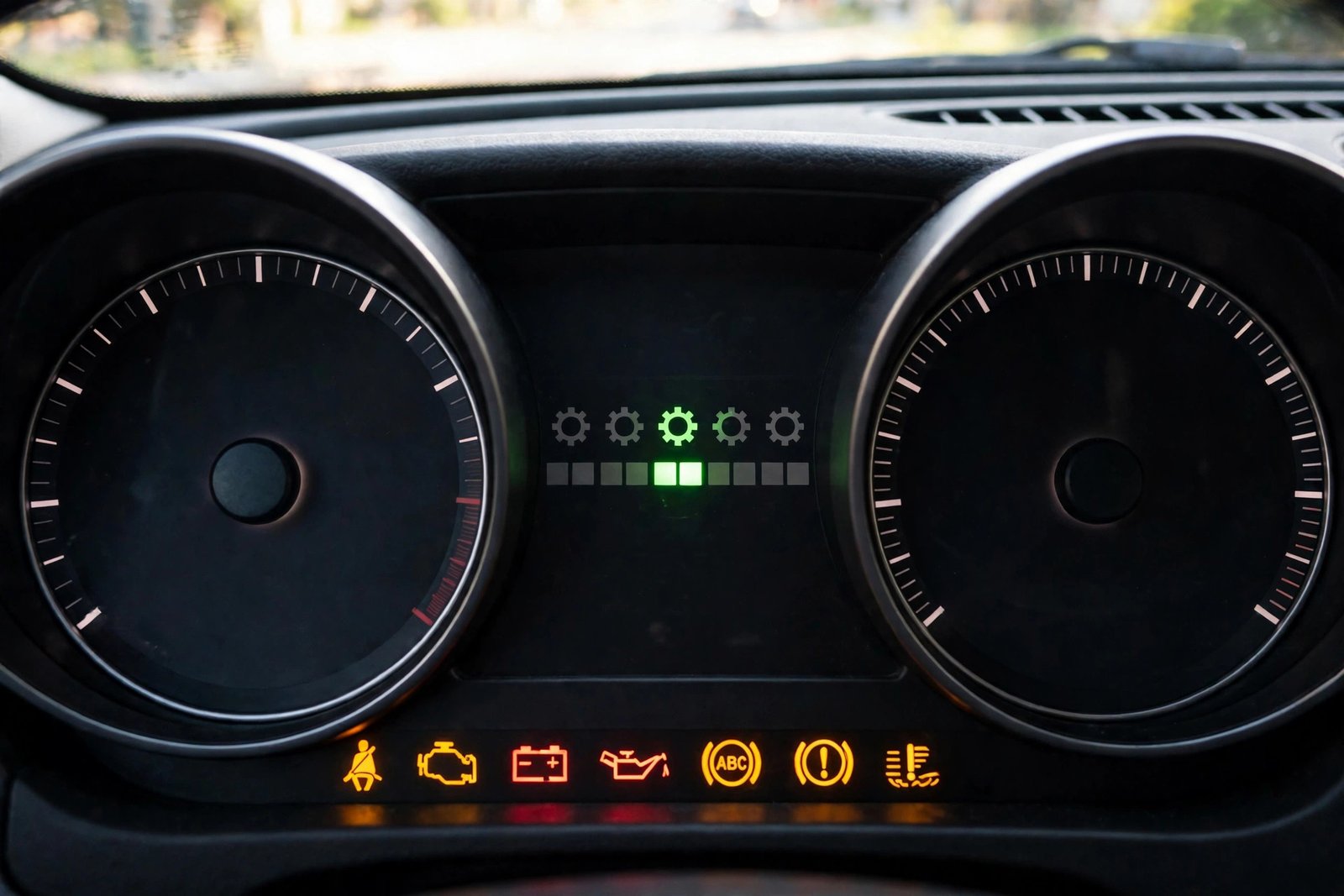
The second check is the warning lights. Look at the dashboard when you start the car, and look again when the problem happens. Is the engine warning light on? Is there a gearbox warning light, which is sometimes a gear symbol or a message about the transmission? Is any light flashing rather than staying on steadily? A flashing engine light is more urgent than a steady one, and it often means a misfire, which brings us back to the engine section. Take a photo of the dashboard if a light is on — a photo is worth more than a description, and it helps the mechanic see exactly what the car was showing. If a light has come on and the car has gone into limp mode, with only one gear available, do not keep driving it normally. Get it checked.
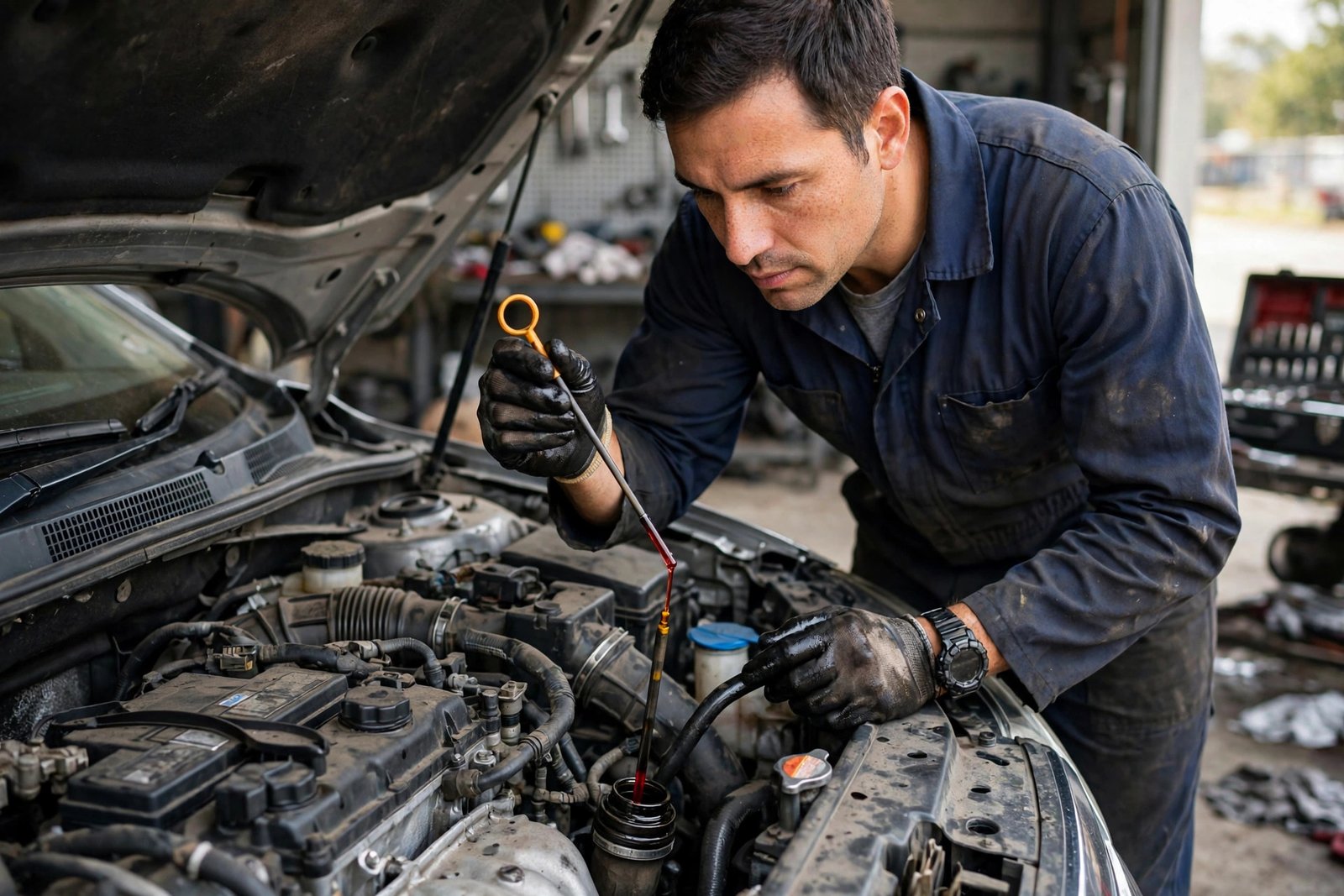
The third check is the fluid, but only if your car allows it. Some cars have a transmission dipstick under the bonnet, usually with a red or yellow handle, often towards the back of the engine bay. Others do not — they are sealed, and there is no dipstick to check. If your car has one, here is how to check it safely. Park on level ground. Start the engine and let it warm up, then, with your foot firmly on the brake, move the lever slowly through each position — park, reverse, neutral, drive — pausing for a few seconds in each, and then back to park. Keep your foot on the brake the whole time and keep the handbrake on. Then, with the engine still running, pull the dipstick out, wipe it clean with a lint-free cloth, push it fully back in, and pull it out again. Look at the level against the marks, and look at the colour and smell of the fluid on the stick. Fresh fluid is red or pink and clear. Old fluid is brown. Burnt fluid is dark brown or black and smells sharp and acrid. If the level is low, or the fluid is dark and smells burnt, that is important information. Do not top it up yourself with a bottle you bought without checking exactly which fluid your gearbox needs — the wrong fluid can cause harm, and I will come back to that in the next section. Just note what you found.
If your car has no dipstick, do not try to open anything else. The level can only be checked from underneath, with the car level and the fluid at the right temperature, and that is a workshop job. It is not a failure on your part — many modern cars are built that way. Just note that your car is sealed, and let the mechanic check it properly.
The fourth check is for leaks. Look at the ground where you park, especially in the morning before you move the car. Transmission fluid is usually red or pink when fresh, and brown when old. It feels slippery, and it does not evaporate quickly like water. A small patch under the middle of the car, or under the front, is worth noticing. Also look under the bonnet — not to touch anything hot, but to see if there is any dampness or staining around the gearbox area, or any fluid on the underside of the car that you can see from the side. If you find a patch, put a piece of cardboard under the car overnight and see how much appears and what colour it is. A photo of the patch helps too. A leak, even a small one, explains a low level, and a low level explains a jerk.
The fifth check is the sound. Listen when the car shifts. Is there a clunk? A whine? A grinding noise? A buzzing? Does the noise happen at the same time as the jerk, or is it there all the time? Does it change with speed? A whine that rises with speed can point to a pump or a bearing. A grinding noise is urgent — do not keep driving a car that is grinding. A clunk when you move the lever from park to drive can point to a mount, as I described earlier. You do not need to know what the noise means. You just need to notice it and describe it, because a mechanic who hears the same noise on a road test will know what to look for.
The sixth check is the feel of the lever itself. When you move the lever from park to drive, or from drive to reverse, does it engage straight away, or is there a delay before you feel the car take up the gear? A long delay — more than a second or two — before drive or reverse engages is a symptom in itself, and it often points to low fluid or low pressure. Does the lever feel loose, or does it not sit cleanly in each position? That can point to a linkage problem, which is the mechanical connection between the lever and the gearbox, rather than a problem inside the gearbox itself.
The seventh check is about the rest of the car. Is the engine idling smoothly, or is it rough and shaking? Does the car hesitate when you first press the accelerator? Does it feel down on power? Is the air conditioning making the idle worse? All of those point towards the engine, and they are worth mentioning alongside the gearbox feeling. A jerky shift with a rough idle is a different story from a jerky shift with a smooth idle, and the mechanic needs to know which one yours is.
The eighth check is the simplest of all: has anything changed recently? Did the problem start after a service? After a fluid change? After the car was in for other work? After a very hot day in traffic? After you drove through water? After a warning light came on? A sudden change after a specific event is a strong clue. A problem that started the day after a service may be related to that service — the wrong fluid, a loose connection, a sensor that was disturbed. That does not mean the service was bad. It means something changed at that moment, and the change is the place to look first.
Do all of these checks calmly, and do not try to fix anything you find by guessing. The point of the checks is information, not repair. You are gathering the story of your car so that when you call for help, you can tell it clearly: when it happens, which gears, cold or hot, what the fluid looks like, whether there is a leak, whether a light is on, and what else the car is doing. That story is worth more than any single test, because it tells the mechanic where to start, and it stops you paying for a search that starts in the wrong place. Regular car repair and maintenance services include these kinds of checks, and they are the reason a routine visit can sometimes catch a gearbox problem before it becomes a jerky one.
What NOT to Do When Your Gearbox Starts Jerking
When a car starts jerking, the temptation is to keep driving and hope it settles, or to try a quick fix you have heard about from a friend or from a video. I understand that temptation, because a gearbox repair sounds expensive and nobody wants to hear that news. But some of the things people do while they are hoping it will go away make the problem worse, and make the eventual repair bigger. This section is about the mistakes I see most often, and what to do instead.
Do not keep driving with slipping gears. I have said it before, and I will say it again, because it is the most important rule in this whole article. Slipping means the plates inside are not gripping properly. Every time they slip, they rub, they get hot, and they wear a little more. The fluid gets hotter, and it burns a little more. A gearbox that is slipping a little today can be slipping a lot in a week, and the wear that happens in that week cannot be undone by a fluid change later. If your car is slipping — revs rising without the speed following, gears that catch with a surge after a delay — reduce your driving, avoid hard acceleration and hills, and get the car checked promptly. Do not take it on a long highway run to see if it gets better. It will not get better. It will get hotter.
Do not guess at fluid types. Transmission fluid is not one thing. There are many different types, and they are not interchangeable. The difference is in how they make the plates grip — too much grip and the shifts are harsh, too little and they slip. Putting the wrong fluid in a gearbox, even with the best intentions, can make the shifts worse straight away, and in a CVT it can cause damage quickly. Do not top up with a bottle because the label says "automatic transmission fluid" and the price was good. Do not let anyone else top it up with a generic fluid either. The right fluid is the one the maker of your car specifies for your exact gearbox, and it is worth checking the handbook or asking a mechanic to confirm it before a single drop goes in.
Do not use additives as a fix. You will see bottles that promise to stop slipping, to smooth shifts, to seal leaks, to fix a gearbox without opening it. Some of them can make a shift feel smoother for a short time, usually by changing how the fluid grips, or by swelling a seal. But they do not fix worn plates, they do not fix a sticking solenoid, and they do not fix a leak properly. At best, they hide the problem for a while. At worst, they clog a small valve or change the fluid in a way that makes the real repair harder. If a gearbox needs an additive to work, it needs a proper check. I have never seen an additive fix a gearbox that was genuinely worn, and I have seen several make the diagnosis harder because the fluid was no longer in its normal state.
Do not keep resetting the warning light and driving on. If a gearbox warning light comes on, or the engine light comes on, and you disconnect the battery or use a code reader to clear it, the light may go off, but the problem that caused it is still there. The computer will notice it again, and the light will come back, usually sooner than before. Clearing a code also erases the information the mechanic needs — the code that says which shift was slow, or which solenoid was sticking. If a light is on, leave it on, note what it says, and get the car checked with the light still showing. That light is the car's way of telling you something, and switching it off without fixing the cause is like taking the battery out of a smoke alarm.
Do not tow the car the wrong way, and do not push-start an automatic. An automatic car should not be towed with its driven wheels on the ground for a long distance, because the gearbox is not being lubricated properly while it is being towed in that way, and it can be damaged. If the car needs to be moved and it cannot be driven, it should be carried on a flatbed, or towed in the way the handbook says is safe for that car. And do not try to push-start an automatic car the way you might push-start a manual. It does not work, and it can damage the gearbox. If the car will not start or will not move, call for help and have it carried.
Do not ignore a fluid leak. A small patch of fluid under the car is easy to dismiss, especially if the car still drives normally. But a leak does not fix itself, and it does not stay small. Seals get harder, leaks get bigger, and the level falls a little further every week. By the time the shifts become jerky, the level may already be low enough to cause damage. If you see fluid under the car, get it checked. Finding a leak early is a small job. Finding it after the gearbox has been running low for months is not.
Do not drive hard to "clear" the problem. Some drivers, when the car starts jerking, press the accelerator harder, thinking a harder shift will force the gearbox to behave. It does the opposite. Hard acceleration asks the gearbox for the most pressure and the most grip at the moment when it is already struggling to give it. It makes slipping worse, it makes heat worse, and it makes wear worse. Drive gently, avoid sudden acceleration, avoid towing anything, and avoid steep ramps and hills until the car has been checked. Gentle driving does not fix a gearbox, but it does stop you making it worse while you get to a check.
Do not let the car sit for weeks in the hope the problem will go away on its own. A gearbox that has been sitting does not heal. The fluid settles, seals can dry out, and the first drive after a long rest can be rough. If the car has a problem, sitting will not help it, and it may make the first drive back more stressful for the gearbox. Get it checked, and then, once you know what is wrong, you can make a proper plan.
And finally, do not let anyone open the gearbox, or flush it, or replace parts in it, without a proper check first — fluid, codes, and a road test. A gearbox is not a place for guessing. The check is not a formality. It is the step that stops you paying for the wrong repair. A mechanic who wants to open your gearbox before checking the fluid and the codes is not doing you a favour. Ask for the check first, and ask to see what it found. You are entitled to that, and a good mechanic will be glad to show you.
What a Proper Transmission Check Looks Like
When you bring a jerky car to a mechanic, what should actually happen? This is a fair question, and you deserve a clear answer before you agree to anything. A proper transmission check is not a guess, and it is not a single test. It is a sequence, and each step narrows down the possibilities. If someone skips straight to the big job without doing the sequence, ask them why. Here is the sequence I follow, and what each step tells us.
It starts with listening to you. I know that sounds soft for a technical job, but it is the most important step. You drive the car every day. You know when it started, what it feels like, which gears are involved, whether it is worse cold or hot, whether a light is on, whether there is a leak, whether the engine is rough as well. I write all of that down, because it tells me where to look first. A car that jerks only when cold is a different search from a car that jerks only when hot. A car that slips in one gear is a different search from a car that hunts in all of them. If a mechanic does not ask you these questions, they are starting blind, and blind work costs money.
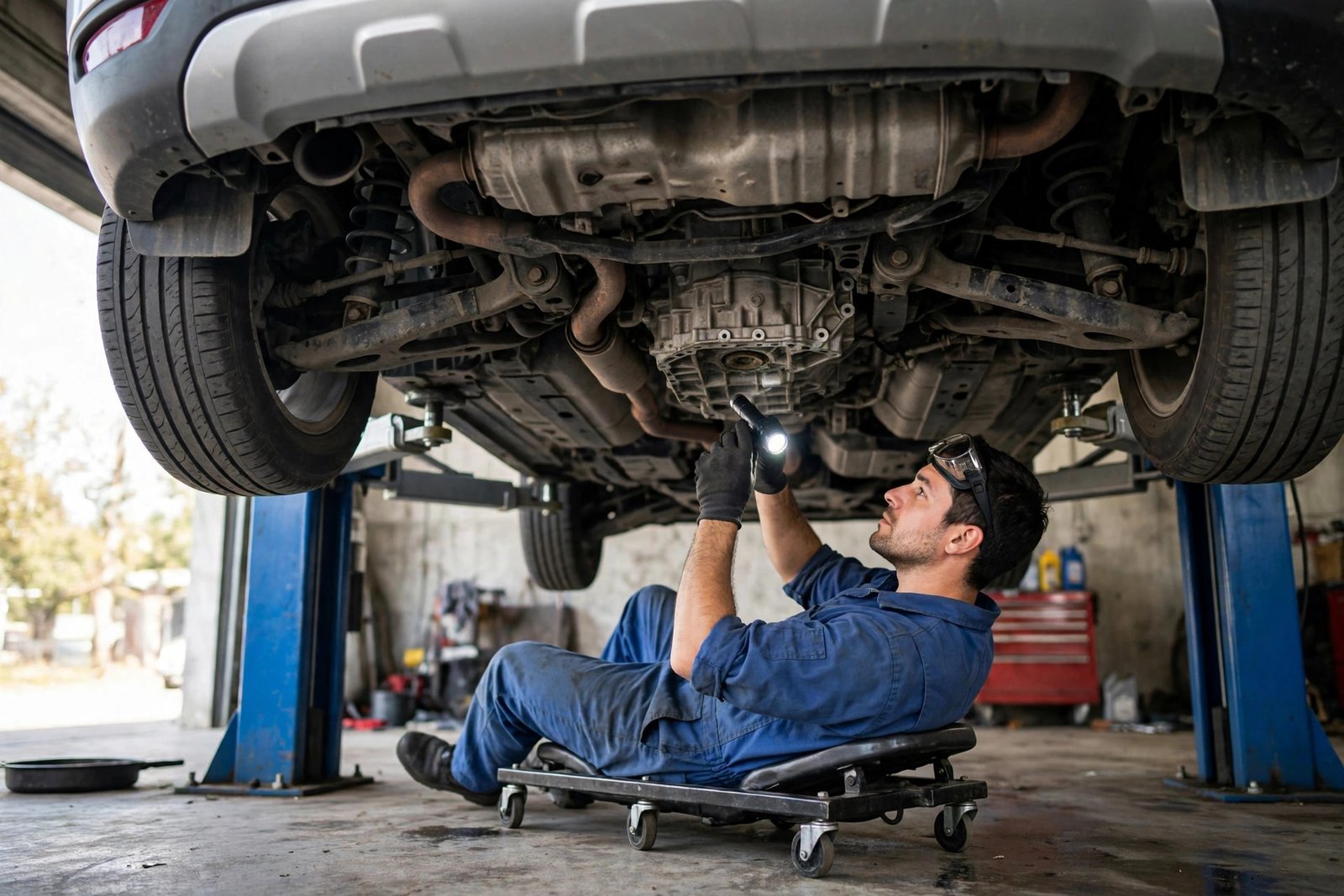
The second step is a look underneath and under the bonnet. I check the fluid level and condition, if the car allows it, and I look for leaks around the gearbox, the cooler lines, and the seals. I look at the colour of the fluid and smell it, because colour and smell tell a story that a level alone cannot. I look at the mounts, to see if the engine is moving more than it should. I look for anything loose, damaged, or recently disturbed — a connector that is not seated properly, a wire that has been rubbing, a pipe that is weeping. Many problems are visible if you look carefully, and this step takes minutes, not hours.
The third step is the fault codes. A modern car stores codes when something goes wrong — not just when a light comes on, but often before it. I plug in a diagnostic tool and read the codes from the engine and from the gearbox. The codes can say which shift took too long, which solenoid was slow, whether a sensor is giving a strange reading, whether the engine misfired and when. Codes are not a diagnosis on their own — a code says "this happened", not "this part is broken" — but they narrow the search enormously. A code that points to a particular solenoid, plus a road test that shows the same shift misbehaving, is a strong combination. A car with no codes at all is also information: it tells me the computer has not seen a clear electrical fault, and the problem may be wear, or fluid, or a mechanical issue the computer cannot see directly.
The fourth step is the road test, and it is the step I would never skip. I drive the car myself, in the conditions where you said the problem happens. Gentle acceleration, hard acceleration, slowing down, stop-start traffic, a steady cruise, a hill or a ramp if one is nearby. I feel each shift. I listen for noises. I watch the revs and the speed together, to see if they are moving the way they should. I note which gear changes are rough, and which are smooth. A road test often tells me in ten minutes what an hour of looking at parts would not. It also lets me feel whether the problem is the gearbox, the engine, or a mount, because each one feels different when you are in the car.
The fifth step, if the earlier steps point that way, is a pressure check or a more detailed fluid check. Some gearboxes let a mechanic measure the fluid pressure while the car is working, to see if the pump is making the pressure it should, or if pressure is leaking away internally. Some need the fluid drained and looked at properly, to see how much wear material is in it. These are workshop steps, and they are done when the simpler checks have not given a clear answer. They are not done first, because they take time and they are not needed for every car.
What happens after the check is a conversation, not a surprise. A good mechanic will tell you what was found, what it means in plain words, what the options are, and what would happen if you left it. They will show you the fluid if it is dark or burnt. They will show you the codes if there are any. They will tell you which parts are worn and which are still good. And they will tell you if the problem is actually the engine, not the gearbox, because that changes everything about the repair. You should not be asked to agree to a big job on the basis of "the gearbox is gone" without being shown why. Ask to see the evidence. Ask what the check found. Ask what else it could be. Those are reasonable questions, and a good workshop will welcome them.
A proper check also includes a look at the car's history, if you have it. When was the fluid last changed? Has the car had gearbox work before? Has it had engine work that could be related? Has it been in an accident that could have damaged a mount or a cooler line? History is not always available, especially if you bought the car used, but when it is available, it helps. A car that has never had its fluid changed is a different story from a car that had it changed a year ago and has been jerking since.
I want to be honest about one more thing: sometimes a proper check does not give a single, certain answer on the first visit. Gearboxes are complicated, and some problems only show themselves under particular conditions — when the car is very hot, or after a long drive, or in a particular gear. A good mechanic will tell you that, rather than guessing. They may ask you to leave the car so it can be tested when it is hot, or to come back when the problem is happening, or to drive it for a few days and note exactly when it happens. That is not a failure. It is the honest way to deal with a problem that does not show itself on every drive. What matters is that the search is systematic, that you are kept informed, and that no big work is started until the evidence is clear.
When It Is Urgent: Stop Driving and Get Help
Most jerky shifts are not emergencies in the first hour, but some are, and knowing the difference matters. This section is short on purpose, because if anything in it matches your car, you should not finish reading the article first. You should get help. I would rather you read this section, recognise your car in it, and call someone, than read the whole article and keep driving a car that is telling you to stop.
Stop driving and get help if the car is slipping badly. If the revs rise and the car does not speed up, if the gear catches with a heavy surge after a long delay, if the car feels like it is in neutral when it should be in drive — that is slipping, and it is urgent. Every slip wears the gearbox more. Do not try to drive through it, do not try to get home on a highway if you can avoid it, and do not keep accelerating hard to force the gear to catch. Pull over safely, and call for help.
Stop if there is a grinding noise. A grinding noise from the gearbox is not a small sound. It means metal is touching metal in a way it should not, and every second of grinding is damage. Turn the car off if you can do so safely, and do not try to drive it further to see if the noise goes away. It will not go away. It will get worse.
Stop if you can smell burning, or see smoke, or see fluid leaking heavily. A burning smell from the gearbox area, especially a sharp, acrid smell, means the fluid is overheating or burning, and the gearbox is in trouble. Smoke is worse. A heavy leak — fluid pouring or dripping steadily, not just a small damp patch — means the level is falling fast, and the gearbox may soon have too little fluid to work at all. Do not keep driving a car that is leaking heavily or smoking. Get it carried.
Stop if the car will not go into gear at all, or will not move when it is in gear. If you move the lever to drive and nothing happens, or the car moves a little and then stops, or reverse does not work at all, do not keep trying the lever again and again in the hope it will catch. Repeated attempts can make things worse. The car needs to be checked where it is, or carried to a workshop.
Stop if a warning light is flashing, or if the car has gone into limp mode and you are far from help. A steady light is a warning. A flashing light is more urgent, and it often means the engine is misfiring badly, which can damage other parts if you keep driving. Limp mode — where the car will only drive in one gear, slowly — is the car's way of protecting itself. It is designed to let you get to safety, not to let you drive normally. If you are in limp mode, drive slowly and gently to the nearest safe place, and then get help. Do not try to drive a long distance in limp mode, and do not try to reset it and carry on as if nothing happened.
Stop if the car jerks violently, or shudders so hard that it feels unsafe, or if the steering or the brakes feel affected. A gearbox problem should not affect the steering or the brakes, but a violent jerk at speed can unsettle the car, and if you do not feel in control, you are not safe. Trust that feeling. Pull over where it is safe, turn on your hazard lights, and call for help.
For everything else — a mild jerk that has just started, a hard shift in one gear, a delay that is new but the car still drives normally — the right move is prompt, not panicked. Do not ignore it, but do not panic either. Drive gently, avoid hard acceleration and long trips, and get the car checked as soon as you reasonably can, ideally in the next day or two. The sooner a new problem is checked, the smaller the repair is likely to be. The cars that come to me with the biggest problems are very often the ones where a small jerk was left for months, and by the time the car was brought in, the fluid was burnt, the plates were worn, and the repair was far bigger than it needed to be.
If you are on the road when the problem gets worse, use your hazard lights, move to a safe place, and call for help rather than trying to nurse the car home through heavy traffic. Dubai roads are busy, and a car that may stop or slip in the middle of a junction is a danger to you and to everyone around you. Calling for help is not overreacting. It is the right call, and it is what mobile help is for.
Mistakes to Avoid, and How to Look After Your Gearbox in Dubai
The last section before the questions is about the long term. A gearbox is not a part you can fit and forget, especially in Dubai. It needs a little care, and the care is simple. Most of the mistakes I see are not dramatic — they are small habits, repeated every day, that add up over years. Change the habits, and you give your gearbox a much better chance of lasting well.
The first mistake is neglecting the fluid. I have said it many times in this article, and I will say it once more, because it is the mistake that causes the most wear. Transmission fluid is not lifetime fluid in the way some people are told. It wears out, it gets dirty, it loses its ability to protect the gearbox. In Dubai, with heat and stop-start traffic, it wears out faster. Have it checked regularly, and have it changed when it needs it, with the right fluid for your exact gearbox. Do not wait until the shifts become jerky to think about the fluid. By then, the fluid has already been struggling for a while. Regular checks are part of looking after the car, not an extra.
The second mistake is ignoring a small change. A new jerk, a new delay, a new clunk, a new shudder — any of these is the car telling you something has changed. The temptation is to wait and see if it goes away. Sometimes it seems to, for a few days, and then it comes back worse. Do not wait. Get it checked while it is still small. A small problem is a small repair. A small problem left alone becomes a big one, and the difference is not just money — it is the difference between a car you can rely on and a car you cannot.
The third mistake is driving hard when the car is cold. When you start a car that has been sitting overnight, the fluid is cold and thick, and it does not flow as easily as it does when it is warm. The gearbox needs a few minutes of gentle driving to warm up. That does not mean you need to sit and idle for ten minutes — that is not good for the car either, and it wastes fuel. It means drive gently for the first few minutes, avoid hard acceleration, and let the car warm up as you drive. The same applies in reverse: after a long, hot drive in traffic, do not switch the car off immediately after a hard run if you can avoid it. Let it settle for a moment. Gentle starts and gentle finishes are kind to a gearbox.
The fourth mistake is resting your hand on the gear lever, or keeping your foot on the brake in drive for a very long time. Resting your hand on the lever can put pressure on the linkage, and over time that pressure can cause wear. It is a small habit, but it is easy to break — just rest your hand on your lap or on the steering wheel instead. Sitting in drive with your foot on the brake for a long time, as I mentioned earlier, keeps the torque converter working and making heat while the car is not moving. For a short signal, it does not matter. For a long wait, move to neutral if it is safe to do so. It is a small kindness to the gearbox, and it costs you nothing.
The fifth mistake is towing or carrying heavy loads without thinking about the gearbox. A gearbox that is already working hard in Dubai heat does not need extra weight to pull. If you need to tow something, check that your car is rated for it, and drive gently. Avoid towing when the car is already showing signs of a problem. And do not use the car to pull something it was not built to pull. That is a fast way to overheat a gearbox and wear its plates.
The sixth mistake is letting the engine's problems become gearbox problems. A misfire, a clogged filter, a worn mount — all of the engine issues I described earlier — do not just make the car feel rough. They make the gearbox work harder, because the gearbox is trying to shift smoothly with an engine that is not behaving smoothly. Looking after the engine is looking after the gearbox. Regular servicing, clean filters, good spark plugs, and prompt attention to a rough idle or a warning light all help the gearbox as well as the engine. The car is one system, and caring for one part helps the others.
The seventh mistake is choosing a repair based on price alone. I understand that money matters — it matters to everyone, and it matters to me when I am advising a driver. But a gearbox is not a place to choose the cheapest option without asking what it includes. A cheap fluid change with the wrong fluid is not a bargain. A cheap repair that does not include a proper check is not a bargain. A cheap part that wears out quickly is not a bargain. Ask what fluid will be used, ask what the check found, ask what is included, and ask what happens if the problem comes back. A fair repair is one where you understand what was done and why, and where the work is done properly the first time.
The eighth mistake is not keeping a record. When was the fluid last changed? When did the problem start? What was done last time the car was in a workshop? A simple note on your phone, or a folder with the car's service papers, makes a real difference. It helps the mechanic see the pattern, it helps you remember what was already tried, and it stops you paying for the same check twice. It also helps you notice if a problem is coming back, or if a repair did not last as long as it should have.
If you do these things — check the fluid, notice changes early, drive gently when cold, rest the car in long waits, look after the engine, choose repairs on quality as well as cost, and keep a record — you are doing more for your gearbox than most drivers do. None of it is difficult. None of it requires you to be a mechanic. It just requires you to pay attention to the car you drive every day, and to act early when it tells you something has changed. That is the whole message of this article, really. Listen to the car, check the simple things, do not guess at the big things, and get help promptly when the car needs it. A gearbox that is listened to is a gearbox that lasts.
Frequently Asked Questions
Why does my car jerk when it changes gear?
A jerk happens when the handover from one gear to the next is not smooth. In plain words, the old gear lets go and the new gear takes hold at slightly the wrong moment, or with too much or too little pressure. The most common reasons are low or old transmission fluid, a sticking solenoid, worn clutch plates, or an engine problem such as a misfire that makes the shift feel rough even though the gearbox itself is working. Dubai heat and stop-start traffic make fluid wear out faster, so a car that was smooth last year can become jerky as the fluid ages. The exact cause depends on when it happens, which gears are involved, and whether the car is cold or hot, which is why a proper check looks at the fluid, the fault codes, and a road test before anyone tells you what is wrong. Do not ignore a new jerk. Get it checked while it is still small, because a small cause is a small repair, and a small cause left alone can wear the gearbox further every time it jerks.
Is it safe to drive with jerky gear shifts?
It depends on how bad the jerking is. A mild, occasional hard shift with no slipping, no warning light, no burning smell and no leak is usually safe to drive gently for a short time while you arrange a check — drive softly, avoid hard acceleration, and get it looked at in the next day or two. It is not safe to keep driving normally if the car is slipping, if the revs rise without the speed following, if there is a grinding noise, a burning smell, a heavy leak, a flashing warning light, or if the car will not go into gear properly. Slipping wears the gearbox more every time it happens, and a car that may not respond when you need it is not safe in busy traffic. If you are unsure, drive gently to a safe place and call for help rather than risking a longer drive. Your safety, and the safety of the people around you on the road, comes first, and a check is always cheaper than the damage from driving a slipping gearbox for weeks.
What causes delayed gear changes in an automatic car?
A delayed change usually means the gearbox is not getting the pressure or the signal it needs at the right moment. Low fluid is the most common cause, because there is not enough fluid to build pressure quickly, so the gear takes a second or two to engage and then catches with a surge. A sticking solenoid can do the same thing, because the little valve that lets fluid flow to the right clutch opens late. Worn clutch plates can also cause a delay, because they take longer to grip. In some cars, a sensor that tells the gearbox how fast you are going or how hard you are pressing the pedal gives a wrong reading, and the computer waits before it shifts. Cold fluid is thicker and can make delays worse in the morning, while hot, thin, worn fluid can make delays worse after a long drive in traffic. Notice whether the delay happens in one gear or in all of them, and whether it is worse cold or hot, and tell the mechanic — those two details narrow the cause down a lot.
Can low transmission fluid cause hard shifts?
Yes, and it is one of the most common causes I see. Transmission fluid carries the pressure that makes each shift happen. When the level is low, the pressure is weak, the clutch plates do not squeeze firmly enough, and they slip before they grip, which you feel as a delay followed by a hard catch. Low fluid also means there is less fluid to carry heat away, so the gearbox runs hotter, and hot fluid protects the parts less well. Fluid gets low because of a leak — a seal, a pipe, or a cooler line — because a sealed gearbox does not use fluid up the way an engine slowly uses oil. If your shifts have become hard and the fluid is low, the leak matters as much as the level, because topping up without fixing the leak only buys a short time. Never top up with the wrong fluid, and if your car has no dipstick, let a workshop check the level properly from underneath rather than guessing.
Why does my car jerk more when it is hot?
Heat changes the fluid, and the fluid changes the shifts. When transmission fluid gets very hot, it gets thinner, so it does not hold pressure as well, and the clutch plates may slip before they grip. Hot fluid that is also old and worn protects the parts less, and seals that have spent their life in high heat can let pressure leak away inside the gearbox. In Dubai summer traffic, a gearbox can stay hot for hours, with little airflow to cool it, and that is when a problem that is barely noticeable in the morning shows itself clearly in the afternoon. A car that is smooth when cold and rough when hot often points to fluid that is worn, a solenoid that sticks when hot, or seals that leak more when they are warm. It can also point to the engine running hot, which affects how smoothly the engine delivers power during a shift. If your car is worse when hot, mention it clearly — it is a strong clue, and it also means you should avoid hard driving in the heat until the car has been checked.
What is the difference between a hard shift and a slipping gearbox?
A hard shift is a shift that happens, but happens roughly — a jolt or a clunk as the new gear engages too firmly or too suddenly. A slipping gearbox is one where the gear does not hold properly after it engages, or does not engage firmly at all. With slipping, the engine revs rise but the car does not speed up the way it should, as if the car is in neutral for a moment, and then the gear catches with a surge. A hard shift is unpleasant and needs attention, but a slipping gearbox is more urgent, because every slip wears the plates inside and makes the fluid hotter and more burnt. A car can have both — a hard shift that is followed by a slip, or a slip that ends in a hard catch — and both point to the gearbox not gripping the way it should. If you are not sure which one your car is doing, describe it the way it feels: "the revs go up but the car does not" is slipping, while "the car thumps when it changes gear" is a hard shift. That description alone helps a mechanic a great deal.
Do CVT cars jerk in the same way as normal automatics?
No, and that is worth knowing, because it stops you looking for the wrong feeling. A normal automatic has set gears, and when it goes wrong you feel a hard step, a delay, or a slip at a gear change. A CVT has no set gears — it changes ratio smoothly through two pulleys and a belt or a chain — so a healthy CVT should never give you a hard gear-change jolt at all, because there is no gear change to feel. When a CVT goes wrong, it usually gives you a shudder or a vibration when you accelerate, a hesitation before it responds, a whining noise, or a feeling that the engine is revving but the car is not picking up speed properly. The most common cause is worn CVT fluid, which lets the belt slip on the pulleys, and heat makes that worse. CVT fluid is different from normal automatic fluid, and using the wrong fluid can damage a CVT quickly, so never guess at the fluid type. If your CVT car has become rough or shuddery, treat it with the same seriousness as a normal automatic that has become jerky, and make sure whoever checks it knows your car has a CVT.
When should I get a jerky gearbox checked urgently?
Get it checked urgently — meaning stop driving and call for help — if the car is slipping badly, if there is a grinding noise, if you can smell burning or see smoke, if fluid is leaking heavily, if the car will not go into gear or will not move, if a warning light is flashing, or if the car has gone into limp mode and will only drive slowly in one gear. Get it checked promptly, in the next day or two, if the jerk is new, if it is getting worse, if it happens in more than one gear, if it is worse when hot, or if a warning light has come on and stayed on. Do not wait weeks to see if it settles, because a gearbox problem that seems to settle often comes back worse, and the wear that happens in the meantime cannot be undone. Drive gently until the check, avoid hard acceleration, hills and long trips, and keep a note of when it happens and which gears are involved. That note, plus the fluid and the fault codes, is what turns a worry into a clear answer.
Call 95 Services
If your car has started jerking, slipping, clunking or delaying when it changes gear, do not leave it and hope it goes away. Call 95 Services on +971 54 344 3513 and tell us what your car is doing — when it happens, which gears are involved, whether it is worse when the car is cold or hot, and whether any warning light has come on. We will listen to the whole story, because the whole story is what tells us where to start.
We are a mobile service, and we come to you anywhere in the complete UAE. Whether you are at home, at work, in a car park, or stuck at the side of the road, you do not need to drive a jerky car to a workshop and hope it makes it there. Call us, and we will come to you. Our response time is 15–20 minutes, and help can arrive within 20 minutes, so you are not left waiting and wondering while your car is misbehaving.
We will check the car properly — the fluid, the codes, the road test, the whole picture, including whether the problem is the gearbox or the engine pretending to be the gearbox — and we will explain what we found in plain words before any work is done. Our prices are very low, and we will always tell you what the work involves so you can make a clear decision.
So if your gear changes have stopped feeling smooth, pick up the phone and call 95 Services on +971 54 344 3513. One call, and help is on its way.
