A hydraulic fault rarely warns you: a tail lift stops halfway up, a steering rack groans, a hose bursts mid-shift. In Dubai’s heat, oil runs hotter, seals age faster, and small leaks become big failures fast. Hydraulic support is the answer: diagnosis, parts, workshop work, and — when a vehicle cannot move — the recovery that gets it to the workshop.
95 Services brings those pieces together: hydraulic repair alongside car repair, diagnostics, and roadside support, so drivers, fleet operators, and industrial customers deal with one point of contact. This guide explains what hydraulic support covers, how each part is repaired, how recovery works, and what each service typically costs — with the honest caveat that hydraulic work is almost always quoted after inspection.
What Hydraulic Support Covers
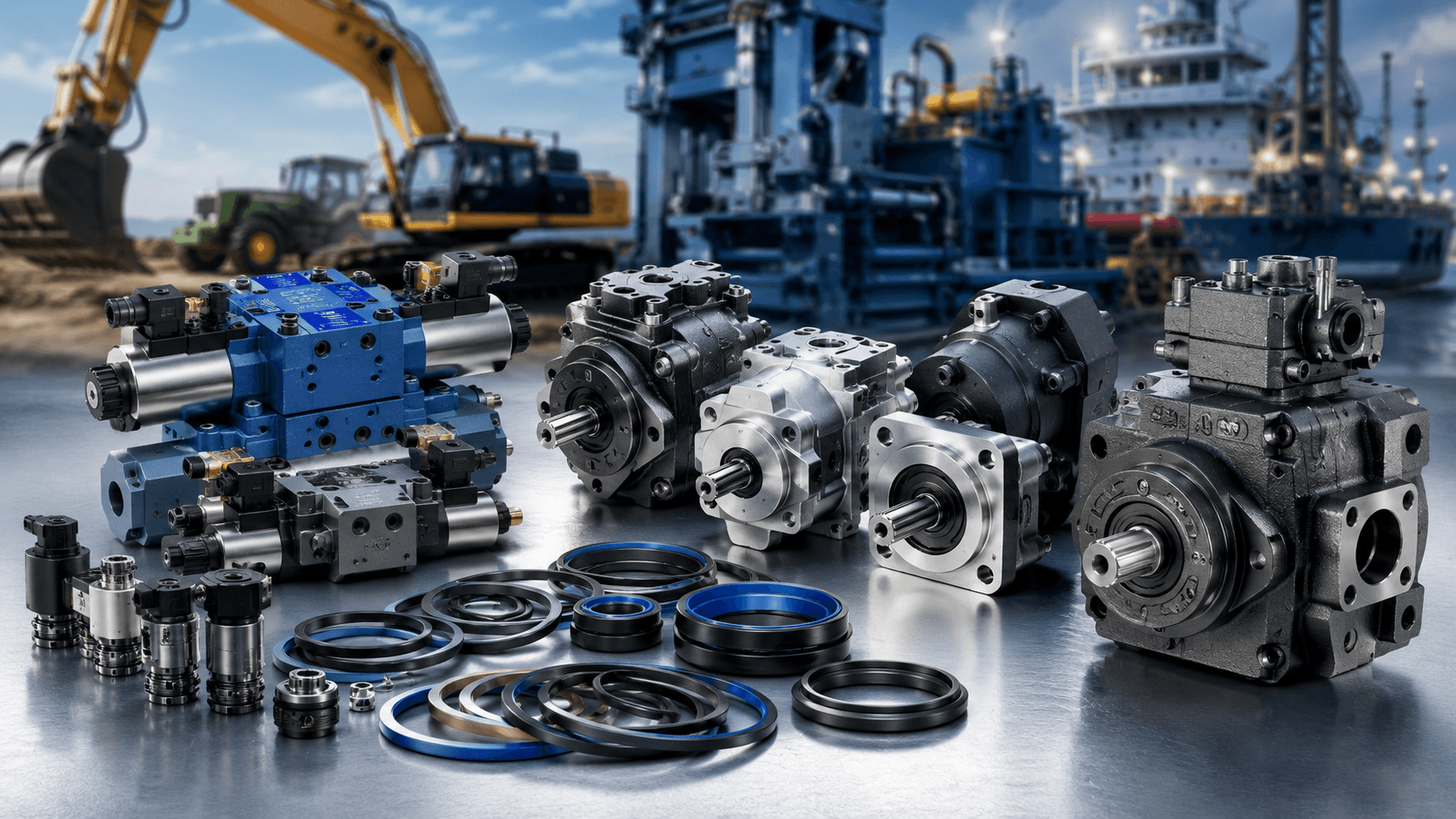
Hydraulics power far more than most people realise: power steering, brakes, clutch actuation, and convertible roofs in cars; excavators, forklifts, cranes, presses, tail lifts, and marine equipment in industry. When pressure drops or fluid escapes, the machine works badly or stops entirely.
Hydraulic support covers the full chain: fault diagnosis, cylinder repair and rebuilding, pump and motor work, hose and fitting replacement, valve and seal work, power unit attention, and pressure testing after repair. It also covers the practical side — advice on repair versus replacement, what the job involves, and how the vehicle or machine reaches the workshop when it cannot be driven. For the dedicated service page, see hydraulic repair and engineering services in Dubai.
Hydraulic Cylinder Repair and Rebuilding
The cylinder is the muscle of a hydraulic system, converting fluid pressure into the push and pull that lifts, tilts, and presses. When a cylinder leaks around the rod, drifts under load, or moves slowly in one direction, the usual causes are worn seals, a scored or bent rod, a damaged barrel, or contaminated oil.
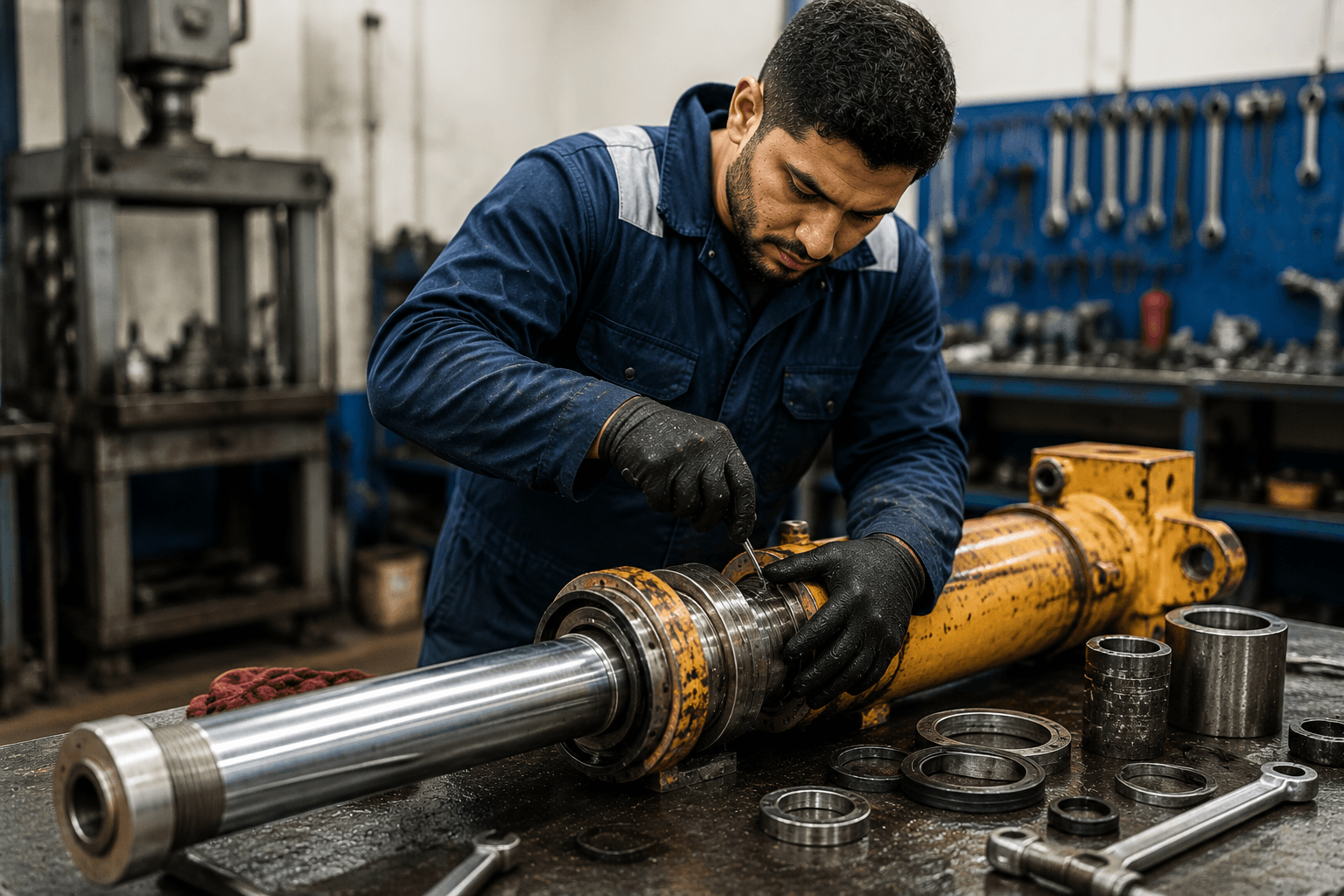
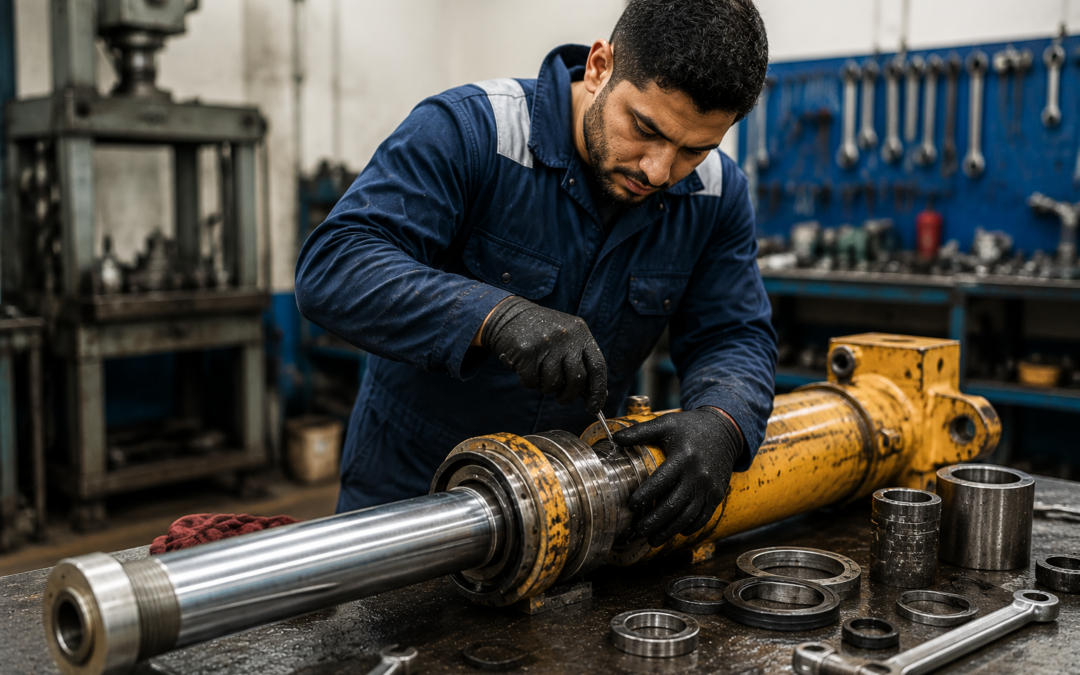
A proper repair follows a set order: inspect and confirm the fault, strip, clean, and measure the unit, replace seals as a complete set (a single fresh seal next to tired ones is a leak waiting to return), check the rod for scoring and straightness — light damage can be polished, deeper damage may need re-chroming or a new rod — hone the barrel bore if needed, then reassemble with clean oil and pressure-test before returning to service.
Repair is not always right. A badly scored barrel, a cracked end cap, or a rod bent beyond straightening usually means replacement is cheaper and safer. A good technician says so plainly and prices both options, rather than rebuilding a cylinder that will fail again within weeks. For a closer look at the rebuild process, read our guide on how to repair a hydraulic cylinder.
Hydraulic Pump and Motor Repair
The pump is the heart of the system, turning mechanical drive into fluid flow. When it wears out, the signs are hard to miss: slow operation, loss of power under load, whining or grinding, overheating oil, or metal particles in the fluid. Motors fail in similar ways — loss of torque, jerky rotation, or external leakage.
Pump work starts with diagnosis, not replacement. Low flow can come from a worn pump, but also from a clogged suction strainer, a slipping coupling, the wrong oil viscosity, or a relief valve stuck open. Replacing a pump without checking those causes is an expensive guess. Where the pump itself is at fault, options range from a seal and bearing kit to a full overhaul, or a replacement pump where the housing or internals are beyond recovery. After pump work, pressure and flow should be checked and the oil and filters reviewed — a fresh pump in dirty oil starts dying in its first hour.
Hydraulic Hose and Fitting Replacement
Hoses are the most common hydraulic failure, and the most underestimated. A burst hose does not just stop the machine: high-pressure fluid escaping through a pinhole can inject oil through skin, and a sudden pressure loss can drop a load without warning. If a hose leaks, bulges, cracks, or weeps at the fitting, stop the machine and relieve pressure before anyone works near it.
The replacement must match working pressure, diameter, fluid type, temperature range, and fitting style, and be routed without tight bends, rubbing, or tension at full extension. Fittings matter just as much — mismatched threads forced together cause slow leaks that keep returning. Note each hose’s size, length, and fitting type, and photograph the hose and end fittings before calling; it helps confirm the right replacement and a better quote.
Valves, Seals, and Power Units
Valves direct the flow: directional valves decide which way a cylinder moves, relief valves cap pressure, flow-control valves set speed, and solenoid valves switch flow on an electrical signal. When a valve sticks, leaks internally, or responds slowly, the machine may move in the wrong sequence, drift when it should hold, or refuse to move. Valve faults are diagnosed by testing — pressure readings at each port tell a clearer story than guesswork — and repair may mean cleaning, resealing, replacing a coil, or fitting a replacement valve.
Seals are replaced as a complete set during any overhaul — a full kit costs little against stripping labour, while mixing old and new seals, or the wrong seal material, is a common reason a repair leaks again quickly. The power unit — tank, pump, motor, valves, filtration — ties it together; its support covers oil and filter changes, tank cleaning, line checks, and pressure-setting verification, because contaminated oil damages everything downstream.
Hydraulic Troubleshooting and Diagnostics
Most faults show up as slow, weak, hot, or leaking. Slow with normal pressure points to flow; weak with low pressure to a relief valve or pump; overheating to a restriction; internal leaks — fluid slipping past a worn valve or piston seal — to heat and lost performance. A structured diagnosis saves money: symptoms and history first, then the cheap checks (oil level and condition, filters, coupling, suction restrictions, relief-valve settings), then pressure and flow tests against specification. Only then should a component be stripped. Be wary of any quote naming an expensive part before these checks.
Who Needs Hydraulic Support in Dubai
Construction is the most visible user: excavators, loaders, cranes, and concrete pumps all depend on hydraulics, and a failed hose on a live site costs far more in downtime than the repair. Marine and port equipment adds salt corrosion; manufacturing, warehousing, and workshops rely on presses, lifts, and handling machines. Car owners meet hydraulics in power steering, brakes, clutch hydraulics, and convertible roofs — a weeping steering rack, a roof that stops halfway, or a sinking clutch pedal are hydraulic problems first. Fleet operators need the same combination: hydraulic knowledge, vehicle knowledge, and a way to reach the workshop.
Mobile Hydraulic Work or Workshop Repair?
Some hydraulic work can be done where the machine stands: hose replacement, external leak inspection, oil and filter changes, valve coil replacement, and basic pressure checks are realistic on-site jobs, provided the machine is safely positioned, depressurised, and accessible. On-site work saves transport time and keeps a machine earning.
Other work belongs in a workshop: cylinder honing, pump overhauls, rod re-chroming, and system flushing need clean conditions and test equipment that does not travel well. For most significant faults, the honest process is two steps: diagnose on-site where possible, then do precision work in the workshop. Share machine type, symptoms, photographs, and location when you enquire — that decides the safer route.
Car Recovery: How a Vehicle Gets to the Workshop
When a car, van, or any vehicle cannot be driven safely, recovery is the bridge between the breakdown and the repair. Here is how it works, step by step.
Step 1: The call. Share four things by phone or WhatsApp: your exact location (a live pin is best), the vehicle make, model, and year, what happened and whether it moves at all, and where you want it taken. Photos of warnings, damage, or leaks help send the right truck first time.
Step 2: The right truck. A flatbed carries the whole vehicle with all four wheels off the ground — safest for all-wheel-drive and 4×4 vehicles, electric cars, lowered or luxury cars, and any vehicle that cannot roll. A wheel-lift lifts one end and suits many standard cars over short distances. Most EV makers require all four wheels off the ground, as towing with wheels turning can damage the drivetrain.
Step 3: Safe loading. The truck is positioned, the area made safe, and the vehicle loaded by winch or ramps, then secured with wheel or soft straps — never chains around wheels or suspension. Steering centred, parking brake set. Damaged corners get extra support so transport does not worsen damage.
Step 4: Transport. The vehicle travels to the workshop by the most suitable route. Customers do not ride in the truck — arrange your own way separately. On arrival it is unloaded, its condition noted, and keys handed over.
Step 5: Inspection and quote. In the workshop, the fault is inspected properly and a written scope and quote discussed before work begins — no repair should start on a roadside guess. If you hold comprehensive insurance, check your policy first: many UAE policies include roadside recovery up to a set distance.
While you wait. Move to the hard shoulder if the vehicle can still roll, switch on hazard lights, and get passengers out on the side away from traffic. Do not stand behind the vehicle on a live carriageway or open a hot coolant cap, and keep passengers out of direct sun.
Car Recovery and Hydraulic Support Rates in Dubai
Prices need the most care here: recovery varies by distance, vehicle, time of day, and truck; hydraulic work by component, damage, and parts. The figures below are indicative market ranges from Dubai guides and supplier listings checked in November 2026 — planning guides, not 95 Services fixed prices. Your exact price is confirmed before dispatch or repair.
Indicative car recovery rates
| Service | Indicative market range (AED) |
|---|---|
| Standard tow within the city, under 30 km | 150–300 |
| Flatbed tow, luxury or electric car, short distance | 250–350 |
| Battery jump-start or emergency fuel delivery | 100–150 |
| Flat tyre change at the roadside | 100–200 |
| Dubai to Sharjah recovery (around 35 km) | 300–450 |
| Dubai to Abu Dhabi recovery (around 140 km) | 500–700 |
| Accident recovery | 200–500 |
| Desert or sand recovery | 300–700 |
These combine figures from Dubai recovery guides published in 2026: one puts a standard city tow at AED 150–250 with flatbed work AED 50–100 higher; another lists city towing at AED 150–400 and accident recovery at AED 200–500. Some guides report higher figures — up to AED 500 in the city, AED 1,500 inter-emirate. After-hours calls (typically 10 pm to 6 am) commonly add 20–25%. Always agree the price before the truck leaves, in writing on WhatsApp or SMS.
Indicative hydraulic parts and repair costs
Hydraulic repair is rarely priced from a list: a seal kit is cheap, a scored barrel is not. UAE supplier listings put seals, fittings, and small hose assemblies at AED 50–200, jacks, pumps, and valves at AED 500–1,500, and cylinders and power packs at AED 2,000–5,000, with hose assemblies at AED 150–900 by size and pressure rating. These are parts prices, not fitted repair prices — labour, inspection, machining, oil, and testing sit on top.
One Dubai example: a local garage lists a single convertible-roof hydraulic cylinder repair — removal, refitting, fluid work, operating checks — at an indicative AED 1,575–3,150 including 5% VAT, with inspection at AED 260–470. A niche car job, not a general rate, but it shows the pattern: inspection first, a written quote, VAT treatment stated.
What moves the price
Four things decide the figure: distance and access (a live site, basement car park, or desert costs more to reach); component and damage (a seal kit versus a cylinder needing honing and a new rod); parts (original, equivalent, or reconditioned — the quote should say which); and time (nights, weekends, and holidays often carry a surcharge). A quote explaining all four beats a cheap verbal estimate explaining none.
Choosing Hydraulic and Recovery Support
Ask four questions before approving any job: what exactly is wrong and how was it diagnosed? What is included in the quote — and excluded? If stripping reveals more damage, is work paused for approval? Is the price confirmed in writing before dispatch or stripping? Check the recovery truck suits your vehicle, and that pressure testing follows hydraulic repair. Written quotes, clear scope, no work before approval: the baseline, not a luxury.
One Team for Hydraulics, Cars, and Recovery
Combining hydraulic support with car repair and recovery means fewer hand-offs and one diagnosis covering the whole vehicle. A van with a leaking tail-lift ram and a dashboard warning does not need two companies; a car needing recovery then diagnostics does not need its story told twice. That is the service 95 Services is built around — car repair, diagnostics, air-conditioning, battery and starting issues, gearbox concerns, selected roadside assistance, and hydraulic support — from a Dubai base in Abu Hail, Al Khabaisi. Mobile attendance depends on the work, area, and scheduling; ask when you call.
Frequently Asked Questions
What is hydraulic support?
Diagnosis, repair, and maintenance of hydraulic systems — cylinders, pumps, motors, hoses, valves, seals, power units — on vehicles, construction, marine, and industrial equipment, including inspection, pressure testing, and workshop transport.
Can a hydraulic cylinder be repaired, or must it be replaced?
Many can: new seals, a polished or re-chromed rod, and a honed barrel restore most leaking cylinders. Replacement suits a badly scored barrel, cracked end cap, or bent rod. Inspection should decide, with both options priced.
How much does car recovery cost in Dubai?
Indicative 2026 market ranges: standard city tow roughly AED 150–300, flatbed tow for a luxury or electric car AED 250–350 over a short distance, Dubai to Sharjah AED 300–450, Dubai to Abu Dhabi AED 500–700. Confirm the exact price in writing before dispatch.
Is a flatbed always needed for car recovery?
No, but it is required for all-wheel-drive and 4×4 vehicles, most electric cars, lowered and luxury cars, and any vehicle that cannot roll. Standard cars can often use a wheel-lift over short distances.
Can hydraulic repairs be done on-site in Dubai?
Some can: hose replacement, leak inspection, oil and filter changes, and basic pressure checks are realistic on-site jobs. Cylinder rebuilds, pump overhauls, and machining need workshop conditions and test equipment.
How do I get a quote for hydraulic repair or car recovery?
Call or WhatsApp +971 54 344 3513 with vehicle or machine details, your location, and the problem — photos and a short video help. Recovery prices are confirmed before dispatch; hydraulic quotes follow inspection, in writing, before work begins.
Get Hydraulic Support and Car Recovery in Dubai
Whether it is a cylinder that will not hold pressure, a hose that has let go on-site, or a car that needs to reach the workshop safely, the first step is a conversation. Call or WhatsApp 95 Services on +971 54 344 3513, or email info@95services.com, with your vehicle or equipment details, your location, and what has gone wrong. The team will discuss the right next step and confirm the price before any work begins. The office is at Ahmed Ali Al Owais Showroom Building, Office M05, Abu Hail, Al Khabaisi, Dubai, UAE — call before visiting so the correct arrangement can be confirmed.
