
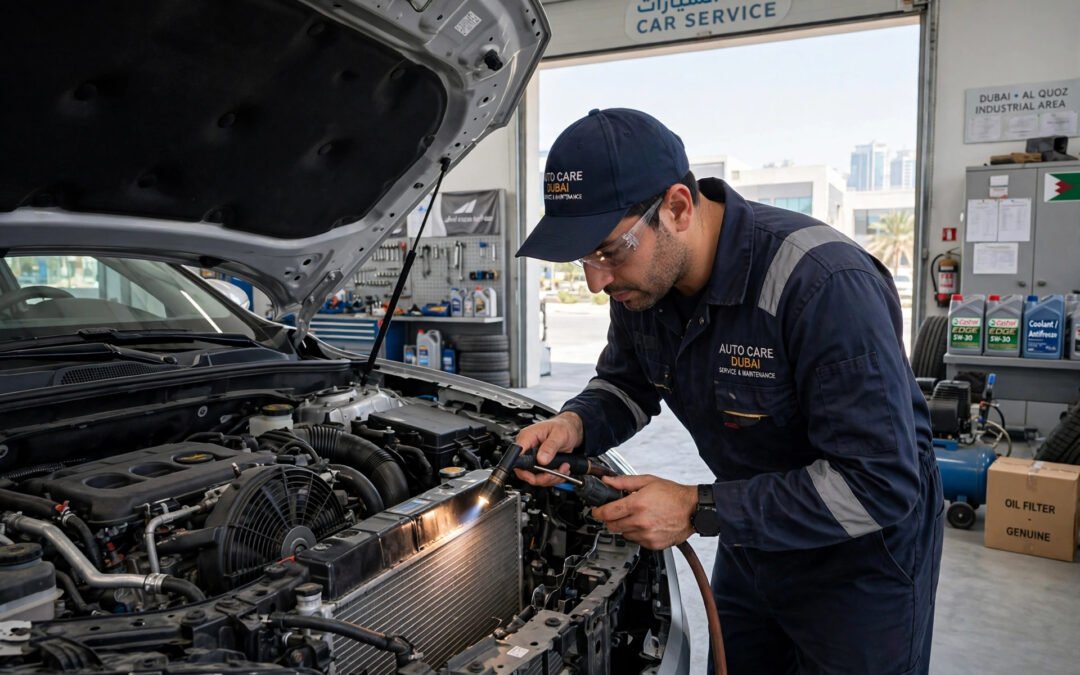
Radiator Leaking in Dubai? Puddles Under the Front, Cracked Tanks and When the Radiator Must Be Replaced
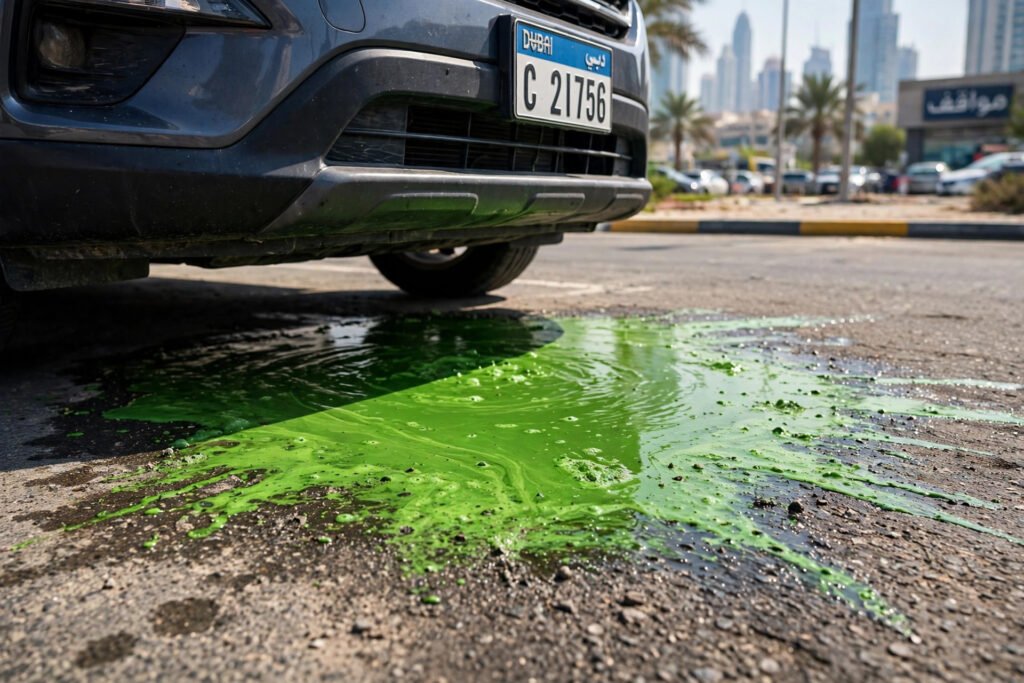
You walk back to your car after lunch in a Dubai mall car park, or you reverse out of your parking bay at home in the morning, and there it is — a puddle under the front of the car. Maybe it is small, just a damp patch. Maybe it is a proper pool of coloured liquid spreading across the tiles. Either way, your stomach drops a little, because you know that puddle was not there when you parked.
I have spent years working on cars in Dubai, and I can tell you that a puddle under the front of a car is one of the most common things people call me about in the summer. Sometimes it is nothing at all. Sometimes it is the first sign that the radiator is leaking, and if you ignore it, the car will overheat — usually at the worst possible moment, in the middle of traffic on a hot afternoon, with the air conditioning on full and nowhere to pull over.
This guide is about the visible kind of leak. The puddle you can see. The steam you can see. The temperature gauge climbing in front of your eyes. If your coolant level keeps dropping but the ground under your car is always dry, that is a different problem, and I have written a separate guide for it — our article on losing coolant with no puddle covers that case. This one is for the leak you can actually see, and for the question every driver asks once they see it: can this be repaired, or does the whole radiator have to be replaced?
I will keep this in plain words. You do not need to be a mechanic to understand what is happening under your bonnet, and you do not need to know part names to make the right decision. You need to know what to look at, what to smell, what the gauge is telling you, and when to stop driving and call for help. That is what this article does.
What the Radiator Actually Does, and Why Dubai Heat Is So Hard on It
Let me start with the basics, because once you understand the job, the symptoms make sense.
Your engine makes an enormous amount of heat when it runs. That heat has to go somewhere, or the metal parts inside the engine would get so hot they would warp and seize. The cooling system is what carries that heat away. Coolant — the coloured liquid in your cooling system — circulates through the engine, picks up the heat, and then flows through the radiator. The radiator is the wide, flat panel at the very front of the car, just behind the grille. Air passes through it as you drive, and the fan pulls air through it when you are standing still, and that airflow cools the liquid down before it goes back around the engine again.
So the radiator sits right at the front of the car, in the path of the hottest air, the dust, the sand, and every stone kicked up off the road. It is built to take that, but in Dubai it works harder than it would in a cooler country. On a summer afternoon when the outside temperature is in the high forties, and you are crawling through traffic in Deira or on Sheikh Zayed Road with the air conditioning running flat out, the radiator is doing a job that would be easy in mild weather and is very hard here. The coolant is hotter, the pressure inside the system is higher, and everything — the hoses, the seals, the plastic tanks on the ends of the radiator — is being pushed to its limit.
That is why radiator leaks show up more often in summer, and why a small weakness that was quiet all winter can suddenly start dripping in July. Heat does not create a leak out of nowhere, but it finds the weak spot and makes it worse. A seal that was just holding on gives up. A hairline crack in a plastic tank opens a little wider. A hose that has gone soft with age starts to weep at the clamp. If you understand that, you will also understand why I keep saying the same thing in every cooling article I write: in Dubai, the cooling system is not a part you can ignore until it breaks. It is the system that keeps your engine alive in the heat, and a leak in it is never a small thing for long.
Most radiators on modern cars are made the same way. The middle part — the core — is metal, usually aluminium, with many thin fins that let air pass through and carry heat away. The two ends of the radiator, the tanks on the left and right, or top and bottom depending on the car, are usually made of plastic on most modern cars. That matters, because as you will see in a moment, those plastic tanks are one of the most common places a leak starts. The tanks are joined to the metal core with a crimped seal, and the hoses connect to the tanks. So when I talk about a radiator leaking, I might mean a crack in the plastic tank, a failed seal where the tank meets the core, a damaged core, or a leak at a hose connection. The repair and the cost and the urgency are different for each one, which is why a proper look matters more than a guess.
The First Sign: A Puddle Under the Front of the Car
Let us start with the moment most people notice something is wrong. You see liquid under the front of the car.
The first thing to do is not to panic, and not to drive off and forget about it. Take thirty seconds and look at the puddle properly. Where exactly is it? Is it under the very front, below the grille and the bumper? Is it more towards the middle of the car, under the engine? Is it on the driver's side or the passenger side? Is it one puddle or several drips in a line? And most importantly, what colour is it?
The colour is your best clue, and it is the first thing I ask about when someone calls me. Coolant is coloured on purpose. It is usually green, pink, red, orange, or blue, depending on what type your car uses. It is a bright, almost artificial colour — the kind of colour that does not occur in plain water. It also has a slightly sweet smell, and it feels a little slippery or oily between your fingers, not like plain water. If the liquid under your car is bright green or pink, and it has that faint sweet smell, it is almost certainly coolant, and your cooling system has a leak somewhere.
But wait — before you decide it is coolant, check one very common innocent explanation. In Dubai, almost every car drips water from the air conditioning. The AC system pulls moisture out of the cabin air, and that water drains out under the car, usually somewhere under the middle of the car, near the passenger footwell area. On a humid day, or after a long drive with the AC on cold, that drip can be quite a lot of water, and it can leave a proper puddle. I have had plenty of calls from worried drivers who turned out to be looking at nothing more than AC condensation.
So how do you tell the two apart? Here is the simple test I give every driver, and it works in almost every case.
First, the colour. AC water is clear. It looks like plain water, because it is plain water. It has no colour at all. Coolant is coloured — green, pink, red, orange or blue. If the puddle is clear, it is almost certainly AC water. If it is coloured, it is almost certainly coolant. That one check alone settles most cases.
Second, the smell. AC water has no smell. Coolant has a faint sweet smell, a little like syrup. You do not need to put your face close to it — just a careful sniff from a short distance is enough. If it smells sweet, it is coolant.
Third, the feel. If you touch a drop with a fingertip, AC water feels like water. Coolant feels slightly slippery or oily. Wash your hands afterwards either way — coolant is not something you want to leave on your skin, and it is harmful if swallowed, so keep children and pets away from a coolant puddle.
Fourth, the position. AC water usually drips from somewhere under the middle of the car, roughly below the dashboard area. Coolant from a radiator leak is usually at the very front, below the grille and bumper, because that is where the radiator sits. A puddle at the very front of the car is much more likely to be coolant than AC water. A puddle under the middle is much more likely to be AC water. Of course, a puddle can spread and run along the ground, and the car might be parked on a slope, so position alone is not proof. But combined with colour and smell, it gives you a good picture.
Fifth, what happens over time. AC water stops dripping fairly quickly after you switch the engine off, because the AC is no longer running and the drain empties out. A coolant leak keeps dripping, or keeps coming back every time you park, because the cooling system stays pressurised for a while after you switch off, and the leak is still there the next morning. If the same coloured puddle appears in the same place every morning, that is not AC water. That is a leak.
One more check that helps: look at the coolant level in the reservoir bottle under the bonnet. The bottle is usually a translucent plastic tank with a cap, and it has minimum and maximum marks on the side. You can check the level when the engine is cold — and only when it is cold, because I will come back to the safety rules in a moment. If the level is below the minimum mark, and there is a coloured puddle under the front, the two things are almost certainly connected. The system is losing coolant, and the puddle is where it is going.
If the puddle is clear, the level is fine, and the car has been running the AC hard, you can relax. It is water from the air conditioning, and that is normal. Our guide on car AC repair in Dubai explains more about how the AC system behaves in the heat, including when a water drip is normal and when the AC itself needs attention. But if the puddle is coloured, sweet-smelling, at the front of the car, and the level is dropping, do not relax. Do not top it up and forget about it. Get the car looked at, because a radiator leak does not fix itself, and in Dubai heat it usually gets worse quickly.
Cracked Plastic End Tanks: The Leak I See Most Often
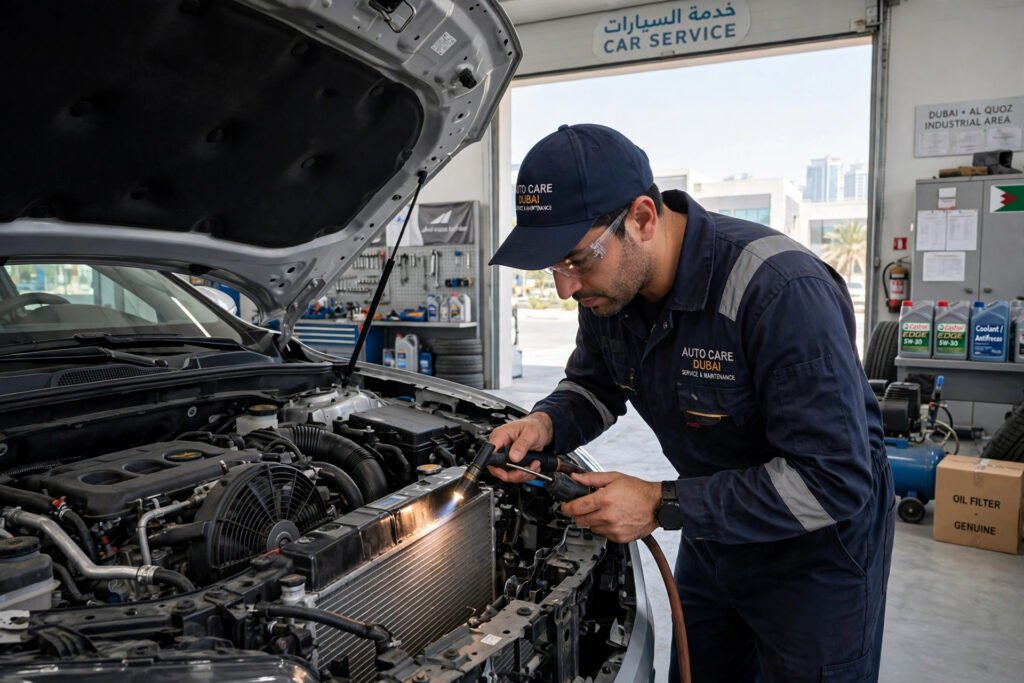
If I had to name the single most common radiator leak I see on cars in Dubai, it would be a cracked plastic end tank.
I explained earlier that most modern radiators have a metal core in the middle and plastic tanks on the ends. That plastic does a hard job. It sits at the front of the car, it holds hot coolant under pressure, and it goes through the same cycle every single day: hot when you drive, cooling down when you park, hot again the next morning. In Dubai summer, that cycle is more extreme than in a cooler climate. The plastic heats up more, cools down more, and does it more often. Over time — and I am talking about years of use, not weeks — the plastic becomes brittle. It loses the flexibility it had when it was new. And then one day, a small crack appears.
A cracked end tank usually starts as a hairline crack, so fine you might not even see it when the engine is cold. When the engine warms up and the system pressurises, the crack opens a little, and coolant starts to seep or spray out. That is why a cracked tank can be so confusing for an owner. You check the car in the morning, the ground is dry, and you think everything is fine. You drive to work, the engine gets hot, the crack opens, and coolant escapes — sometimes as a slow drip, sometimes as a fine spray that you can smell before you can see. Then you park, the engine cools down, the crack closes a little, and the leak seems to stop. The next morning the ground is dry again. It feels like the car is playing tricks on you.
It is not playing tricks. It is just physics. Heat and pressure open the crack, cooling closes it. That is also why a cracked tank is a leak that gets worse with time. The crack does not heal. Every heat cycle makes it a little longer, a little wider. A seep becomes a drip. A drip becomes a stream. And one day, usually on the hottest day of the year, the tank can split properly, and a large amount of coolant comes out all at once. I have seen cars where the driver only noticed a faint sweet smell for a week, and then the tank split in traffic and the temperature gauge shot into the red within minutes.
Where does a cracked tank leak? Usually along the top of the tank, or near the seam where the plastic tank meets the metal core, or around the hose connection where the tank is under the most stress. Sometimes you can see a white or coloured stain on the plastic — dried coolant leaves a crusty residue, a little like chalk, around the crack. That stain is a useful clue. If you open the bonnet when the engine is cold and you see a green or pink crust on the top of the radiator, or a wet patch that should not be there, take a photograph and show it to your mechanic. It tells them a lot.
Can a cracked plastic tank be repaired? This is the question every owner asks, and the honest answer is: sometimes, for a short time, but usually not in a way that lasts in Dubai heat. There are sealants and epoxies that can be applied to a crack, and in a mild climate a careful repair might hold for a while. But a radiator tank in Dubai lives under high pressure and high temperature every single day, and a repair on brittle plastic is a repair on a material that is already failing. The crack next to the repair often opens up, or the repair itself lets go when the system is at full pressure on a hot afternoon. I have seen cars come in where someone had sealed a tank, and the tank had then split right next to the seal. The driver thought the problem was fixed, and it was not.
That is why, in most cases, a cracked end tank means the radiator needs to be replaced. I know that is not what anyone wants to hear, and I am not saying it to sell a radiator. I am saying it because a tank that has cracked once has shown you that the plastic is at the end of its life. Replacing the radiator gives you a new core, new tanks, and new seals, and it takes the whole risk away in one job. It is the kind of repair where doing it properly once is cheaper and safer than doing it halfway twice. I will come back to the repair-versus-replacement decision in more detail later in this article, because it applies to more than just tanks, and it is worth understanding properly before you agree to any work.
The other thing a cracked tank teaches you is about age and mileage. A radiator is not a part that lasts forever, and in the UAE it has a harder life than in many other places. If your car is getting older, and the cooling system has never been properly checked, a pre-summer inspection is worth more than any single repair. A mechanic who knows what to look for can see the early signs — the staining, the brittle plastic, the weeping seal — and tell you before it becomes a breakdown. That is the whole point of a proper car repair and maintenance routine: finding things while they are still small.
Radiator Leak, Hose Leak or Water Pump Leak? How to Tell Them Apart
When a driver sees coolant under the car, the first question is usually "is it the radiator?" But the radiator is only one part of the cooling system, and coolant can escape from several places. A hose can leak. The water pump can leak. The thermostat housing can leak. The heater hoses at the back of the engine can leak. All of them leave a coloured puddle, and all of them make the coolant level drop. So how do you tell them apart?
The truth is that you, as the driver, do not need to diagnose the exact part. That is the mechanic's job, and it needs a proper look with the car on a ramp, or a pressure test, which I will explain shortly. But it does help to understand the general differences, because it stops you from agreeing to the wrong repair, and it helps you describe the problem clearly when you call for help. Here is the picture in plain terms.
A radiator leak usually shows up at the very front of the car. The puddle is below the grille, the bumper, or the front wheels. If you open the bonnet when the engine is cold and look at the radiator itself, you may see staining, wetness, or a crust of dried coolant on the tanks or along the seam where the tank meets the core. A radiator leak can also show up as a spray pattern — if the leak is a fine crack that only opens under pressure, the coolant can spray onto the fan, the inner wing, or the underside of the bonnet, leaving a fine coloured mist or a sticky residue over a wide area. If the inside of your bonnet has a strange coloured film on it, or the fan blades look stained, that can be a sign of a pressure leak from the radiator.
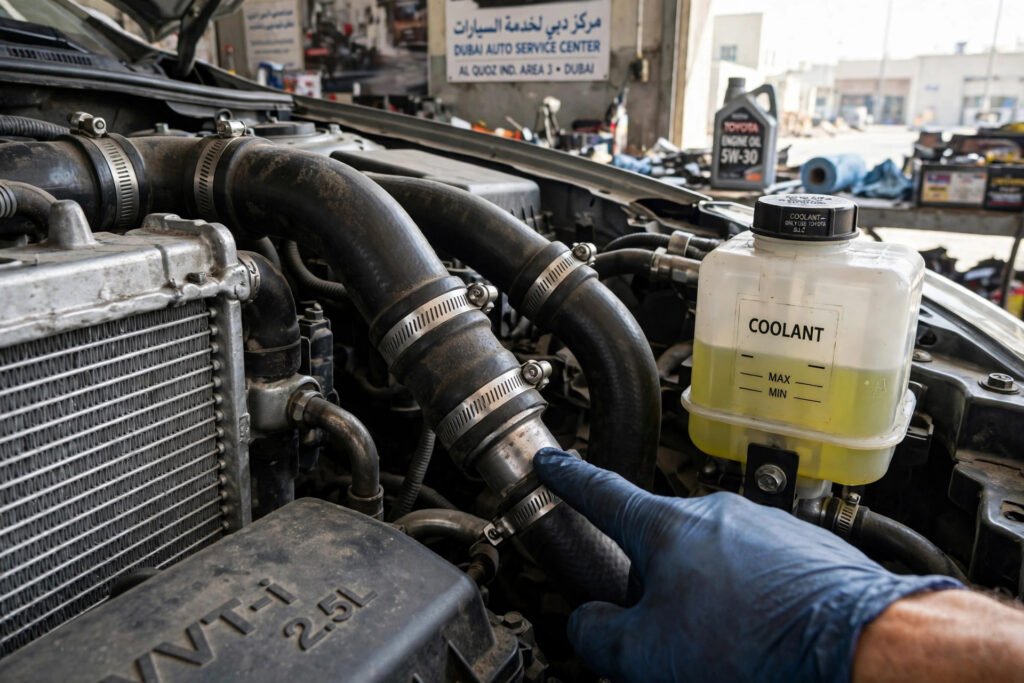
A hose leak is usually easier to spot, because hoses are big, soft, rubber tubes, and you can see them. The two main radiator hoses are thick — one at the top of the radiator, one at the bottom — and they run from the radiator to the engine. A hose leak often shows up at the ends, where the hose is clamped onto the radiator or the engine. The rubber goes soft with heat and age, or the clamp loosens, and coolant starts to weep out around the joint. You may see a wet ring around the end of the hose, or a drip that falls straight down from the hose onto the ground. A hose can also split along its length, especially on the underside where you cannot see it easily. When a hose splits, the leak is usually sudden and obvious — a lot of coolant comes out quickly, and the temperature gauge climbs fast. That is one reason I tell people to look at their hoses during a service. A hose that is swollen, soft and spongy when you squeeze it, or hard and cracked on the outside, is a hose that is telling you it is near the end of its life.
A water pump leak is different again, and it is harder for a driver to spot, because the water pump sits on the front of the engine, low down, usually behind the belts and pulleys. The water pump is the part that pushes the coolant around the system — it is the heart of the cooling system, in a way. It has a seal inside it, and when that seal wears out, coolant starts to leak from a small hole in the pump body that is there on purpose, called a weep hole. The leak drips down the front of the engine and lands on the ground somewhere under the middle of the car, often a little behind the front wheels. It can look a lot like a radiator leak from the ground, because the puddle is still roughly at the front of the car. The difference is usually in what you see when you look under the bonnet: a water pump leak often leaves a stain or a trail of dried coolant running down the front of the engine, and you may hear a noise from the pump — a grinding or whining sound from the front of the engine that changes with engine speed. A water pump that is leaking is a water pump that is wearing out, and it is not a part to leave, because if the pump fails completely, the coolant stops circulating, and the engine overheats very quickly.
There are other places coolant can leak from too — the thermostat housing, which is a small casing on the engine where the thermostat sits; the heater hoses, which carry hot coolant to the heater inside the cabin; and on some cars, the pipes that run along the engine. But the pattern is the same. The driver sees a coloured puddle and a dropping level, and the mechanic finds the exact source with a proper inspection. The way a mechanic finds it is usually a pressure test: with the engine cold, a hand pump is attached to the cooling system and the system is pressurised to its normal working pressure, and then the mechanic watches and listens for where the coolant comes out. A leak that is invisible when the car is just parked will often show itself clearly under pressure. It is a simple test, it does not take long, and it saves a lot of guessing. If a workshop tells you the radiator needs replacing but has not done a pressure test or a proper visual check, ask them to show you the leak. A good mechanic will be glad to show you — it is your car, and you should be able to see what is wrong with it.
One thing I want to be clear about: do not pour a leak-stopping additive into the cooling system and hope it fixes a radiator leak. There are products sold that claim to seal leaks from the inside, and they can sometimes slow a very small weep for a while. But they do not fix a cracked tank, they do not fix a split hose, and they do not fix a worn water pump seal. Worse, the sealing material can settle in the narrow passages of the radiator and the heater, and partly block them, which makes the cooling worse. I have seen cars where a leak additive turned a small, fixable leak into a radiator that had to be replaced because the core was partly blocked. If you have used one, tell your mechanic, so they know what is inside the system. And if you have not used one, do not start. Get the leak found and fixed properly.
Steam From Under the Bonnet and a Climbing Temperature Gauge
A puddle is a warning. Steam is an alarm. If you ever see steam coming from under your bonnet, or your temperature gauge starts climbing towards the red, you need to act — calmly, but quickly.
Let me describe what steam from a coolant leak looks like, because it can be frightening the first time you see it. You are driving along, maybe sitting in traffic on a hot day, and you notice a thin white cloud rising from the front of the car. It might be coming from the edges of the bonnet, or from the grille. It smells sweet, like hot syrup, and it gets thicker when you stop moving. That is steam from coolant escaping under pressure and hitting the hot engine or the hot air. It is not smoke from a fire — coolant steam is white, it smells sweet, and it does not have the harsh smell of burning oil or burning rubber. But it does mean the cooling system has lost pressure, coolant is escaping, and the engine is about to get very hot, very fast.
The temperature gauge is your other warning, and it is the one you should be watching every time you drive in summer. Most cars have a gauge on the dashboard with a needle, or a digital display, or a warning light. Learn where the needle normally sits on your car. On most cars, it sits in the middle when the engine is fully warm. That is normal. If the needle starts climbing above its normal position, that is the car telling you something is wrong. A small rise in heavy traffic on a very hot day, where the needle goes a little above the middle and then comes back down when you get moving again, can happen — but I would still get it checked, because a cooling system that struggles in traffic is a cooling system with a problem that summer will make worse. Our guide on engine overheating in Dubai explains the gauge and the warning signs in more detail, and it is worth reading if your car has ever run hot.
If the needle climbs close to the red zone, or into the red zone, or a red temperature warning light comes on, stop driving. I mean that plainly. Do not try to drive the last few minutes home. Do not try to reach the next exit. An engine that is overheating can be damaged in a very short time, and the damage is the expensive kind — a warped cylinder head, a blown head gasket, an engine that needs a major repair. A tow or a roadside call costs far less than an engine repair. Pull over somewhere safe, switch the engine off, turn the hazard lights on, and call for help.
Here is exactly what to do, step by step, if you see steam or the gauge climbs into the red.
First, turn the air conditioning off straight away, and turn the heater on full, with the fan on high. I know that sounds mad on a hot day in Dubai — the last thing you want is hot air blowing into the cabin. But the heater uses the engine's cooling system, and turning it on full pulls some heat out of the engine and into the cabin. It can buy you a little time and a little temperature drop while you look for a safe place to stop. Open the windows if you need to. It is uncomfortable for a few minutes, but it can help the engine.
Second, pull over somewhere safe as soon as you can. A petrol station forecourt, a wide hard shoulder, a car park — somewhere flat, away from moving traffic, where you can open the bonnet safely. Do not stop on a narrow hard shoulder on a fast road if you can avoid it. Do not stop in the middle of a roundabout. Safety comes first.
Third, switch the engine off, turn the hazard lights on, and get everyone out of the car and away from the front of it, especially children. Steam is hot, and a cooling system under pressure can spray hot coolant if something gives way.
Fourth, do NOT open the radiator cap, and do NOT open the coolant reservoir cap, while the engine is hot. This is the most important safety rule in this whole article, and I will say it again in its own section because it matters that much. The cooling system is under pressure when it is hot. If you open the cap, the pressure is released all at once, and boiling-hot coolant can spray out and cause very serious burns. People are badly injured every year by opening a hot radiator cap. Wait until the engine is completely cold — that can take an hour or more in summer — before anyone touches the cap. If you are not sure whether it is cold, it is not cold. Wait longer, or let a mechanic do it.
Fifth, do not pour cold water into a hot, empty cooling system. I know it is tempting — you have a bottle of water, the engine is hot, you want to cool it down. But pouring cold water into a very hot engine can crack metal parts, because the sudden change in temperature is too much for them. If the engine has overheated and the coolant is gone, the right move is to let it cool down on its own, and then let a mechanic fill it properly and find the leak.
Sixth, call for help. If you have roadside cover, call them. If not, call a workshop and explain what happened — steam, gauge in the red, puddle under the front. A good mobile mechanic can come to you, check the car where it is, and tell you whether it is safe to drive slowly to a workshop, or whether the car needs to be recovered. Do not let anyone talk you into driving an overheating car to the workshop "just a few minutes away." A few minutes is enough to cause real damage when the gauge is in the red.
And a warning about something I see every summer: after an overheating episode, some drivers top up the coolant, the gauge goes back to normal, and they decide the problem is solved. It is not solved. The coolant went somewhere, and unless you find out where, it will go again. An overheating episode is a symptom, not a one-off event. Get the car checked properly, even if it seems fine the next day. The leak that caused it is still there, and the next time it might happen further from home, at a worse time, with more damage.
What to Do the Moment You Find a Puddle
If you find a coloured puddle under the front of your car in the morning, before you have driven anywhere, here is the calm, practical routine I would follow.
Check the coolant level in the reservoir bottle, with the engine cold. The bottle is translucent, with minimum and maximum marks. If the level is below the minimum mark, do not drive the car until you have had advice. If the level is between the marks, the leak may be small, but it is still a leak, and it still needs to be found. Note how much has been lost. If the bottle is empty, do not drive at all. Call for help.
Look at the puddle again. What colour is it? How big is it? Is it under the very front, or further back? Take a photograph of the puddle and a photograph of the reservoir level. When you call a mechanic, those two photographs tell them more than a long description. They show the colour, the position, and how much coolant has been lost.
Look under the bonnet, with the engine cold, for any obvious signs — a wet hose, a stain on the radiator, a crust of dried coolant. Do not touch anything hot, and do not remove any caps. Just look. If you see something obvious, photograph that too.
Then call a workshop and describe what you have found. Say the colour, the position, the level in the bottle, and whether the car has been running hot or steaming. A good workshop will tell you honestly whether you can drive in carefully, topping up only if they tell you to, or whether you should wait for a mobile mechanic to come to you. In Dubai, where a mobile mechanic can reach you in 15 to 20 minutes, waiting for help is usually the sensible choice, and it is often quicker than driving to a workshop and queuing.
One more practical point. Coolant is harmful to pets and to children, and it is not good for the ground either. If you have a coolant puddle on your driveway or in your parking bay, try to soak it up with old rags or cat litter if you have any, and wash the area down with water once the leak has been dealt with. Do not let a dog drink from a puddle of coolant — it smells sweet, and animals are attracted to it, and it can make them very ill. Keep children away from it too. And wash your hands well after touching anything that has coolant on it.
When Can a Radiator Be Repaired, and When Must It Be Replaced?
This is the question at the heart of this article, and it is the one drivers worry about most, because they are afraid of being told they need a whole new radiator when a small repair would have done. So let me explain how a mechanic thinks about it, in plain terms, so you can follow the reasoning and make a good decision.
A repair is usually possible when the leak is small, in a place that can be reached and sealed properly, and in a part that is otherwise healthy. The most common repairable cases are these. A hose that is leaking at the clamp can often be fixed by replacing the clamp, or by cutting back the end of the hose and refitting it — but if the hose itself is old and soft, replacing the hose is the better job, and a hose is a routine part to replace. A small leak at a hose connection on the radiator, where the plastic neck is still sound, can sometimes be dealt with by a new clamp or a new hose. A leak in a metal pipe or a small fitting can sometimes be repaired or the fitting replaced. And on some older cars with metal tanks, a radiator specialist can sometimes repair a small leak in the tank or the core by soldering or by replacing a section. These are real repairs, and a good mechanic will do them when they are the right answer.
A repair is usually NOT the right answer when the radiator itself is failing. Here are the situations where replacement is the honest advice, and where I would give the same advice to a friend or a member of my own family.
First, a cracked plastic end tank. I covered this earlier, and it is the most common case. The plastic has become brittle with age and heat. Sealing one crack does not make the rest of the plastic young again. Another crack will open, usually soon, usually on a hot day. Replacing the radiator is the proper fix.
Second, a leaking seam between the tank and the core. The tank is crimped onto the core with a rubber seal. When that seal fails, or the crimp loosens, coolant weeps along the seam. This is a structural failure of the radiator, and it is very hard to repair in a way that holds under pressure in Dubai heat. The seal has done its life, and the radiator needs to be replaced.
Third, a damaged or corroded core. The core is the part with the thin fins. If it is blocked with scale and debris, if the fins are badly damaged, or if the tubes inside have corroded and are leaking in several places, the radiator cannot cool properly even if you seal one leak. A core with multiple leaks is a core that is finished. Replacing it is the only sensible option.
Fourth, a radiator that has been repaired before and is leaking again. If a radiator has already had a repair and the leak has come back — in the same place or in a new place — that is the radiator telling you it is at the end of its life. Repairing it again is throwing good money after bad, and it leaves you with the same risk of a breakdown.
Fifth, a radiator on an older car where the plastic tanks are clearly aged — discoloured, brittle, with staining in several places. Even if only one crack is leaking today, the rest of the tank is in the same condition. A mechanic who has seen the tank can usually tell you honestly whether it has life left in it or not.
There is also a point about the whole cooling system that matters here. A radiator does not work alone. When a radiator is replaced, a good mechanic will also check the hoses, the clamps, the thermostat, the water pump, and the fan. Sometimes a radiator has failed because another part of the system was not working properly — a fan that was not coming on, a thermostat that was stuck, a system that was running too hot for too long. If you replace the radiator but leave the real cause untouched, the new radiator will be under the same stress. That is why a proper radiator replacement is not just a swap. It is a check of the whole cooling system, and a conversation about what else needs attention. It is also why the minor vs major car service routine matters — a proper service is when these things are caught, before they become a leak on your driveway.
Now, about the choice of the replacement radiator. You will usually have a choice between a brand-new original part, a brand-new good-quality aftermarket part, and sometimes a used part. I will not pretend one choice is right for every car and every driver, because it depends on the age and value of the car, and on how long you plan to keep it. What I will say is this: a radiator is a safety part, in the sense that its failure can destroy an engine. It is not a part to buy on the lowest possible cost alone. A new radiator from a reputable maker, fitted properly, with new coolant and a proper check of the rest of the system, is a job that should give you years of trouble-free driving. A used radiator, or the cheapest part available, may save money today and cost you an engine tomorrow. Ask your mechanic to explain the options plainly — what the part is, where it comes from, and what is included in the job — and then decide. A good mechanic will not be offended by the question. They expect it.
And one more honest point. If your car is losing coolant but there is no puddle at all, do not assume the radiator is the problem, and do not agree to a radiator replacement on that evidence alone. A leak with no puddle is a different kind of problem — the coolant may be evaporating on a hot part before it reaches the ground, or it may be going somewhere inside the engine. That case needs a different investigation, and our companion article on losing coolant with no puddle explains it properly. A radiator replacement will not fix a leak that is not in the radiator, and a pressure test is the way to find out where the coolant is actually going.
What a Proper Radiator Check Looks Like at the Workshop
If you bring your car in with a puddle under the front, here is what should happen. I am describing this so you know what a thorough check looks like, and so you can tell whether the job is being done properly.
First, the mechanic should look. A proper visual inspection, with the engine cold, under the bonnet and underneath the car. They should look at the radiator tanks, the seam between the tank and the core, the hoses and their clamps, the water pump area, and the ground where the car was parked. They should look for staining, for wet patches, for crusts of dried coolant, and for any damage to the fins at the front of the radiator. On many cars, the front of the radiator can be seen through the grille, and a quick look can show whether the fins are blocked with dust, leaves, or insects, which is common in the UAE and makes the radiator less able to cool.
Second, the pressure test. This is the key test for a visible leak, and I mentioned it earlier. With the engine cold, a pump is fitted to the cooling system, the system is pressurised to its normal working pressure, and the mechanic watches for where coolant comes out. A small leak that only opens under pressure will show itself clearly. The mechanic can also leave the pressure on for a few minutes and watch whether it holds steady or drops. A system that holds pressure is a system without a leak. A system that loses pressure has a leak, and the test will usually show where it is.
Third, a check of the coolant itself. The mechanic should look at the colour and the condition of the coolant in the reservoir. Coolant that is rusty brown, or full of debris, or has a strange smell, is coolant that has not been changed when it should have been, and it can be a sign of corrosion inside the system. Coolant also has additives that stop corrosion, and those additives wear out over time. That is one reason coolant has a change interval in your car's service schedule, and one reason a proper service includes a coolant check. Using the wrong type of coolant for your car — mixing types, or topping up with plain water over and over again — can cause problems too. Your handbook will tell you what type your car needs, and a good workshop will use the right type.
Fourth, a check of the rest of the cooling system. The hoses should be squeezed and looked at for softness, swelling, or cracking. The fan should be checked — does it come on when the engine gets hot, and does it run at the right speed? The thermostat should be considered, especially if the gauge behaves strangely, or if the car takes a very long time to warm up, or overheats quickly. The water pump should be checked for noise and for leaking. The radiator cap should be checked too, because the cap is a part that holds the system pressure, and a cap that no longer seals properly can let coolant escape and let the system boil over at a lower temperature than it should. A cap is a small part, but it does an important job, and it is often overlooked.
Fifth, after any repair or replacement, the system should be filled with the correct coolant, bled of air, and tested. Bleeding matters, because air trapped in the cooling system can cause hot spots and make the gauge read strangely. A good mechanic will run the engine up to temperature, check that the fan comes on, check that the heater blows hot, check the level again once the engine has cooled, and look for any new leaks. That final check is the difference between a job that is finished and a job that just looks finished.
If you are asked to approve a radiator replacement, ask these questions. Where exactly is the leak? Can you show me? Is it the tank, the seam, the core, or a hose? Did you do a pressure test? What else did you check? These are fair questions, and a good mechanic will answer them plainly and show you the evidence. If someone cannot show you the leak, or cannot explain why a repair will not hold, think carefully before agreeing to the work.
Living With the Dubai Summer: Prevention That Actually Works
A radiator leak is usually the end of a long story, not the beginning of one. The radiator, the hoses, the coolant, and the rest of the cooling system have been wearing slowly for years, and the leak is the moment that wear becomes visible. That means there is a lot you can do to catch it early, and a lot you can do to make a new radiator last longer once it is fitted.
The single most useful habit is the simplest one: check the coolant level regularly, when the engine is cold. Once a month is enough for most drivers, and before a long drive — to Abu Dhabi, to the mountains, to the desert — is always worth it. Open the bonnet, find the translucent reservoir bottle, and check that the level is between the minimum and maximum marks. If it is dropping a little each time you check, something is leaking, even if you cannot see a puddle yet. A small, steady drop is a leak in its early stages, and finding it early is always cheaper than finding it after a breakdown. This is the same habit that helps with the no-puddle case too, which is why I keep pointing you to the losing coolant with no puddle guide — the two problems are cousins, and the checking habit is the same for both.
The second habit is a proper pre-summer check. In Dubai, the cooling system deserves a proper inspection before the hot months, not during them. April or May is the right time. A pre-summer check should include the coolant level and condition, the hoses, the fan, the radiator itself, and a pressure test if the level has been dropping or if the car has been running warmer than usual. It should also include a look at the front of the radiator to see whether the fins are blocked with dust and sand. In the UAE, the fins can clog with fine dust, and a radiator that cannot breathe cannot cool. A gentle clean of the fins — not a high-pressure jet, which can bend them — can make a real difference. If you drive a European car, where the engine bay is tightly packed and heat builds up more under the bonnet, the pre-summer check matters even more. Our guide to European car maintenance in the UAE explains why cooling deserves extra attention on those cars.
The third habit is about what you put in the system. Top up with the correct coolant for your car, not with plain water, and not with a different type of coolant mixed in. Plain water will cool the engine, but it does not protect against corrosion, and it boils at a lower temperature than coolant, which matters in Dubai heat. If you have been topping up with water for months because the level keeps dropping, you are not fixing the leak — you are watering down the protection in the system, and the corrosion that follows can damage the radiator from the inside. If you are in an emergency and you have to top up with water to get to a workshop, that is fine — but tell the mechanic, and get the system checked and filled with the right coolant as soon as you can. And never mix different colours or types of coolant unless your mechanic tells you it is the right type for your car. Coolants are not all the same, and mixing the wrong ones can cause deposits that block the radiator.
The fourth habit is to pay attention to the small signs. A faint sweet smell when you park the car. A small stain on the driveway that was not there last week. A temperature gauge that sits a little higher than it used to. A fan that runs for a long time after you switch the engine off. A heater that is not as warm as it used to be. None of these on their own proves a radiator leak, but together they are the car talking to you, and the car is usually right. Drivers who listen to the small signs get the cheap repair. Drivers who wait for the big sign — steam, a red gauge, a car that will not move — get the expensive one.
The fifth habit is about driving in extreme heat. If you are stuck in traffic on a very hot day and the gauge starts climbing, turn the air conditioning off and the heater on, as I described earlier, and try to keep the car moving if you can. Airflow through the radiator is what cools it, and a car that is moving, even slowly, gets more airflow than a car that is standing still. If you are parked and waiting for someone, with the engine running and the AC on full in the middle of the afternoon, you are asking the cooling system to do its hardest job with no airflow at all. Switch the engine off if you are going to be parked for a while. It saves fuel, it saves the cooling system, and it saves the engine.
And finally, keep the service history. A radiator replacement, a coolant change, a hose replacement — these are all jobs that a future mechanic needs to know about. If you sell the car, a clear history showing that the cooling system was looked after properly is worth real value to a buyer, because a buyer in the UAE knows what heat does to a cooling system. Keep the invoices, keep the dates, and keep the habit of a proper service on schedule. The minor vs major car service guide explains what a proper service should include, and a cooling check is part of it.
The Puddle, the Tank, the Gauge — Putting It All Together
Let me pull this together into the picture you actually need when you walk out to your car and see liquid on the ground.
If the puddle is clear, has no smell, and the coolant level is fine, it is almost certainly water from the air conditioning, and you can relax. If the puddle is coloured — green, pink, red, orange or blue — smells faintly sweet, sits under the very front of the car, and the coolant level is dropping, it is almost certainly a coolant leak, and the radiator is one of the most likely places it is coming from.
If the leak is from a cracked plastic end tank, or from the seam where the tank meets the core, or from a damaged core, the honest answer in most cases is a replacement radiator, not a repair. If the leak is from a hose or a clamp, a hose replacement is the usual fix, and it is a routine job. If the leak is from the water pump, the pump needs attention, and it should not be left. A pressure test is the way to tell these apart properly, and it is a quick, simple test that any good workshop can do.
If you see steam, or the temperature gauge climbs towards the red, stop driving, switch the engine off, turn the hazards on, and call for help. Do not open a hot radiator cap. Do not pour cold water into a hot engine. Do not try to drive the last few minutes home. An overheating engine can be damaged in a very short time, and a recovery call is far cheaper than an engine repair.
And if your coolant level keeps dropping but the ground under your car is always dry, read the companion guide on losing coolant with no puddle. That is a different problem, with different causes, and it needs a different investigation. Do not assume it is the radiator, and do not agree to a radiator replacement until someone has found where the coolant is actually going.
A radiator is a simple part doing a hard job in a hard climate. Look after it with a monthly level check, a proper pre-summer inspection, the right coolant, and attention to the small signs, and it will look after your engine. Ignore a puddle, ignore a smell, ignore a gauge that is climbing, and it will let you down — usually on the hottest day of the year, in the worst possible place. That is not bad luck. That is just what happens when a cooling system in Dubai is left to fail. The good news is that you do not have to wait for that day. The puddle is the warning. Listen to it.

Frequently Asked Questions
How do I know if the puddle under my car is coolant or just water from the air conditioning?
Check the colour, the smell, and the position. Air conditioning water is clear, has no smell, feels like plain water, and usually drips from under the middle of the car, below the dashboard area. Coolant is coloured — green, pink, red, orange or blue — has a faint sweet smell, feels slightly slippery, and from a radiator leak it usually sits under the very front of the car, below the grille and bumper. Also check the coolant level in the reservoir bottle when the engine is cold. If the level is dropping and the puddle is coloured, it is coolant. If the puddle is clear and the level is fine, it is almost certainly AC water, which is normal in Dubai.
My car leaves a puddle only on very hot days. Does that mean the leak is not serious?
Not necessarily. A small crack in a plastic radiator tank, or a weak seal, often only opens when the engine is hot and the system is under full pressure. On a cooler day the crack closes and the leak seems to stop. That does not mean the problem has gone away. It means the leak is in its early stages, and heat is what makes it show. In Dubai, where hot days are most days, a leak that only appears in the heat will only get worse. Get it checked while it is still a small leak, because a small leak is a cheaper and simpler job than a tank that splits in traffic.
Can I drive my car if the radiator is leaking a little?
It depends on how much is leaking and whether the engine is running hot, and the honest answer is that you should not decide that on your own. If the coolant level is only slightly low, the gauge sits in its normal place, and there is no steam, a careful drive to a nearby workshop may be possible — but only if a mechanic has told you it is safe, and only after topping up with the correct coolant if they tell you to. If the level is well below the minimum mark, the gauge is climbing, or there is steam, do not drive the car. Switch the engine off and call for help. Driving an overheating car, even for a few minutes, can cause damage that costs far more than a recovery call. If in doubt, call a workshop and describe the puddle and the level, and let them tell you.
Can a cracked radiator tank be repaired, or does it have to be replaced?
In most cases it has to be replaced. A cracked plastic tank means the plastic has become brittle with age and heat, and sealing one crack does not make the rest of the tank sound again. A repair may hold for a short time, but in Dubai heat and under full system pressure, another crack often opens next to the repair, or the repair itself lets go. A new radiator gives you a new core, new tanks and new seals, and it takes the risk away in one job. There are cases where a small leak at a hose connection or a clamp can be repaired, and a good mechanic will do that when it is the right answer — but a cracked tank is usually a replacement job, and a mechanic who tells you that is giving you honest advice.
How is a radiator leak different from a hose leak or a water pump leak?
The main difference is where the coolant is coming from. A radiator leak is usually at the very front of the car, and you may see staining or wetness on the radiator tanks or along the seam where the tank meets the core. A hose leak is usually at the ends of a thick rubber hose, where it is clamped on, and you may see a wet ring or a drip falling from the hose itself. A water pump leak comes from low down on the front of the engine, behind the belts, and often leaves a stain running down the front of the engine, sometimes with a grinding or whining noise from the pump. From the ground alone, they can look similar, because the puddle is in roughly the same place. A pressure test at a workshop — pressurising the cold system and watching where the coolant comes out — is the reliable way to tell them apart.
What should I do if steam comes from under the bonnet?
Turn the air conditioning off and the heater on full, pull over somewhere safe, switch the engine off, turn the hazard lights on, and get everyone away from the front of the car. Do not open the radiator cap or the coolant reservoir cap while the engine is hot — the system is under pressure, and boiling-hot coolant can spray out and cause serious burns. Wait until the engine is completely cold before anyone touches the cap, which can take an hour or more in summer. Do not pour cold water into a hot engine. Call for help and let a mechanic check the car where it is. And even if the car seems fine the next day after you top it up, get it checked properly — the leak that caused the steam is still there.
My coolant level keeps dropping but there is never a puddle. Is that the same problem?
No, that is a different problem, and it needs a different investigation. If the level keeps falling but the ground under your car is always dry, the coolant may be evaporating on a hot part of the engine before it reaches the ground, or it may be leaking somewhere you cannot see, or it may be going somewhere inside the engine. Do not assume it is the radiator, and do not agree to a radiator replacement on that evidence alone. Read our companion guide on losing coolant with no puddle, which covers that case properly, and ask for a pressure test so the real source can be found.
How can I stop my radiator from leaking in the first place?
You cannot stop a radiator from ageing, but you can catch problems early and make the cooling system last longer. Check the coolant level once a month when the engine is cold. Get a proper pre-summer check before the hot months — coolant level and condition, hoses, fan, radiator, and a pressure test if the level has been dropping. Use the correct coolant for your car, not plain water, and do not mix different types. Keep the front of the radiator clear of dust and debris so air can pass through it. And pay attention to the small signs — a sweet smell when you park, a stain on the driveway, a gauge that sits a little higher than it used to. Finding a leak early is always the cheapest repair.
Call 95 Services
A puddle under the front of your car is not something to ignore, and it is not something to guess about. It might be water from the air conditioning, and then you can relax. But if it is coolant — coloured, sweet-smelling, under the very front, with the level dropping — then your radiator, or a hose, or the water pump, is leaking, and in Dubai heat that leak will get worse. The longer you wait, the more likely you are to see steam, a red temperature gauge, and a car that will not move.
You do not need to work this out on your own, and you do not need to drive an overheating car to a workshop to find out what is wrong. That is what we do at 95 Services. We come to you, anywhere in the UAE, and we check the cooling system properly — a visual inspection, a pressure test to find the exact leak, and an honest answer about whether it can be repaired or whether the radiator must be replaced. If it is a hose, we will tell you. If it is the tank, we will show you. And we will check the rest of the cooling system too, so the new radiator is not put under the same stress that finished the old one.
Call 95 Services on +971 54 344 3513. Our response time is 15–20 minutes, we serve the complete UAE, and our prices are low. If you have found a puddle under the front of your car, if you can smell coolant, if you have seen steam, or if your temperature gauge is climbing, call us now — before a small leak becomes a big repair.
