
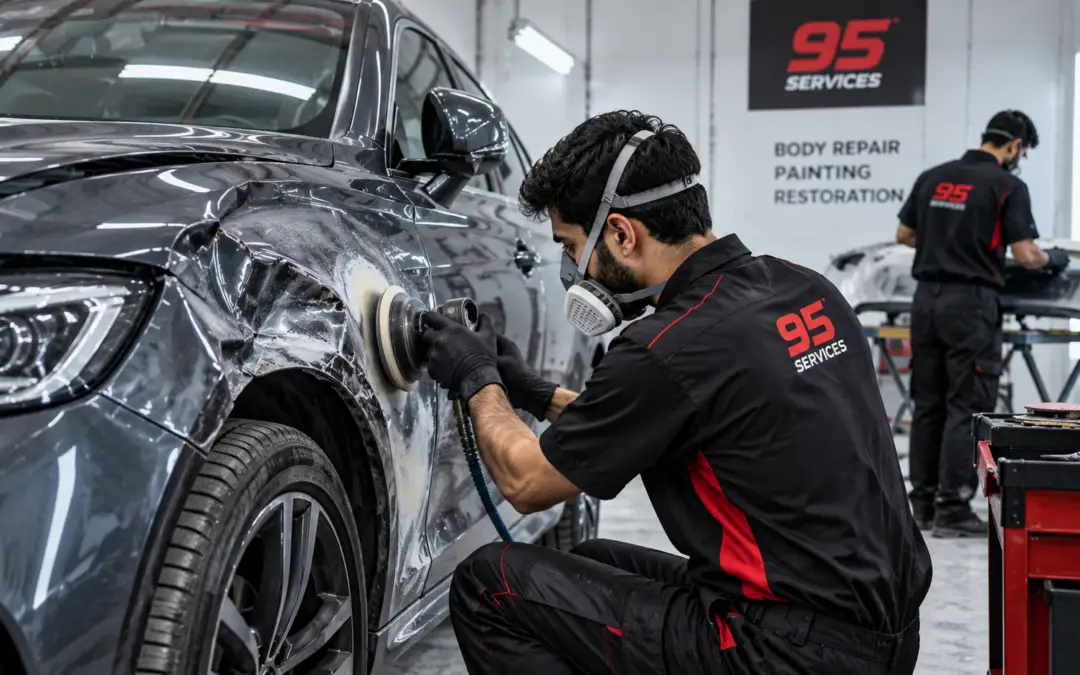
A car accident is disorienting even when nobody is hurt: the shock, the traffic, the paperwork, and then the question that follows every driver home — who fixes the car, and will it ever be right again? The answer depends on the assessment that comes first. Accident repair is not one job but a sequence: making the car safe, understanding the full extent of the damage (including the damage that is not visible), agreeing the scope and the cost, and then restoring the car — structure, panels, paint, and safety systems — to the condition it was in before the collision.
This article explains what to do immediately after an accident, how collision damage is assessed, what the repair process involves step by step, how paint and colour matching works, what the insurance process looks like, and how to check the finished repair — so the driver knows what should happen at every stage, and can tell good repair work from bad.
Immediately After an Accident: Safety, Reporting & Documentation
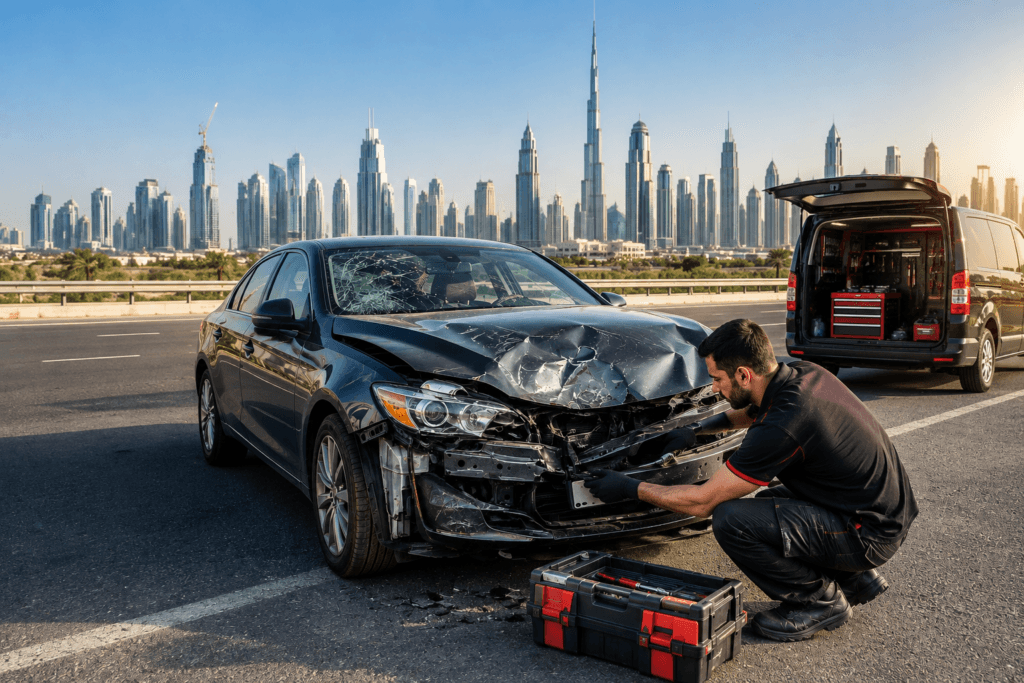
Safety comes first, before the car, before the paperwork. Check for injuries and call emergency services if anyone is hurt. Move to a safe place if it is safe to do so, switch on hazard lights, and keep passengers away from traffic. Do not attempt to drive a car with fluid leaks, a damaged wheel, a deployed airbag, or steering that does not respond — it needs recovery, not a careful drive home.
Then comes reporting and documentation, which protect the driver later. In Dubai, minor accidents are reported through the Dubai Police app or service channels, and more serious accidents require police attendance — follow the procedure that applies to the situation, and do not leave the scene without reporting. Photograph everything before anything is moved: all vehicles involved, the damage from several angles, number plates, the road position, and any relevant road markings or signs. Exchange details with the other driver: name, contact number, plate number, and insurance details. Note the time, location, and what happened while it is fresh. Notify the insurer promptly — most policies require prompt notification, and delays complicate claims. And keep every document: the police report, photos, repair estimates, and all correspondence. Good documentation is what turns a disputed claim into a straightforward one.
Collision Assessment: Finding the Damage You Cannot See
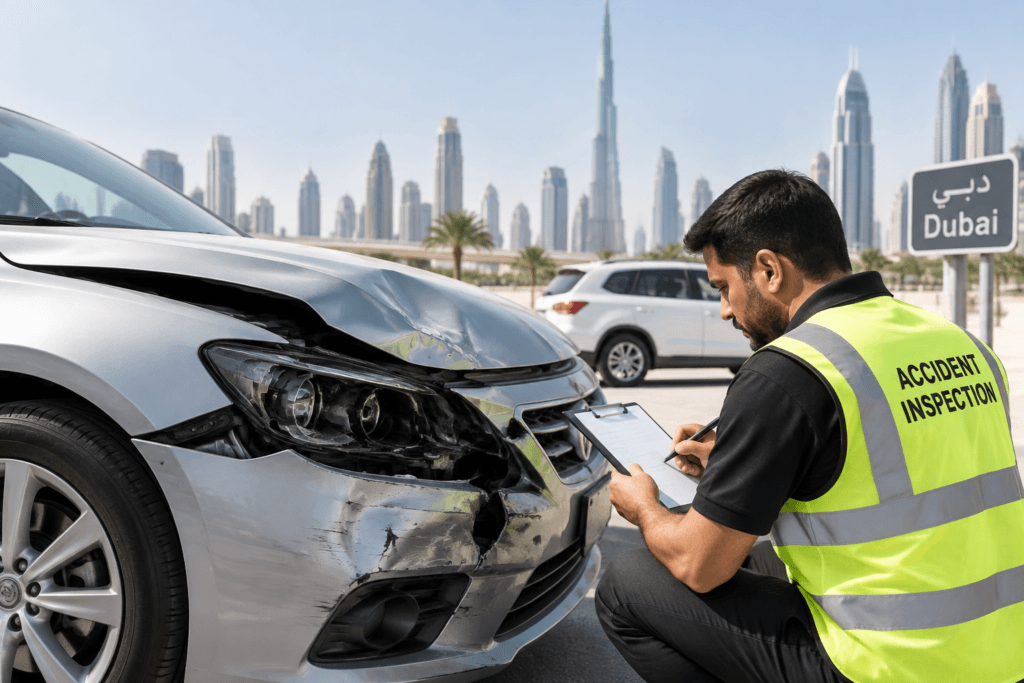
The visible damage is rarely the whole story. A bumper that looks scratched may hide a crushed absorber and a bent reinforcement bar. A door that closes may conceal a bent hinge pillar. A minor-looking front impact may have moved the radiator support, damaged the condenser, or stressed suspension mounting points. Proper assessment therefore goes beyond a walk-around: panels are inspected from inside and underneath, gaps and shut lines are measured against the undamaged side, the underbody and suspension mounting points are checked, and the car's structure is measured where the impact was significant.
Modern cars complicate this further: advanced driver-assistance systems (ADAS) — cameras, radar, and sensors mounted in bumpers, windscreens, and mirrors — can be knocked out of calibration by impacts that leave little visible damage. A windscreen replacement, a bumper removal, or a suspension repair can all require sensor recalibration before the safety systems work correctly again. The assessment must identify every affected system, not just the bent metal, because a repair that restores the appearance without restoring the safety systems has not restored the car.
The Repair Process, Step by Step
Collision repair follows a fixed sequence, and each step exists for a reason. First, strip-down: damaged panels, trim, and components are removed so the full extent of the damage is visible — estimates written before strip-down are always provisional, because hidden damage is only found once the car is opened up. Second, structural repair: bent structural elements are measured against manufacturer specifications and pulled back into position with straightening equipment, or cut out and replaced where the damage exceeds repair limits. Third, panel repair or replacement: panels that can be restored are repaired; panels beyond repair are replaced with the correct part. Fourth, preparation: surfaces are cleaned, filled where needed, sanded, and primed. Fifth, paint: colour-matched paint is applied in a controlled booth environment. Sixth, reassembly: trim, lights, sensors, and components are refitted, and ADAS calibration is performed where required. Seventh, quality control: gaps, shut lines, paint finish, lights, sensors, and a road test are all checked before the car is handed over.
The driver should be told at which stage the car is, and what was found at strip-down, before the repair proceeds beyond the agreed scope. Surprises found during strip-down are normal in accident repair — the honest response is to explain them, revise the estimate, and get approval, not to proceed silently and present the bill afterwards.
Bodywork: Panels, Straightening & When Replacement Is Right
Panel repair is a judgement call, and the judgement should favour the car's long-term condition, not the cheapest immediate option. A panel with minor denting and intact paint can often be restored with paintless dent repair — no filler, no repaint, original paint preserved. A panel with creased metal, stretched areas, or damaged edges needs conventional repair: metalwork to restore the shape, filler to perfect the surface, and repaint. A panel with torn metal, severe creasing, or damage to its mounting points should be replaced — repairing it would leave a weak, filler-heavy panel that fails again.
Structural parts follow stricter rules: manufacturer repair guidance specifies which parts may be straightened and which must be replaced, and those limits exist because the structure is what protects occupants in the next collision. A repairer who straightens a part the manufacturer says to replace is gambling with the car's crash performance. The driver is entitled to know which parts were repaired and which were replaced, and why — and that information should be in the final invoice, not hidden from it.
Paint & Colour Matching: Why It Matters and How It Works
Paint matching is where good repairs become invisible and bad repairs announce themselves. Modern car colours are complex: metallic and pearlescent finishes change appearance with viewing angle and light, and the same colour code can have several variants from the factory. Matching requires the correct colour code, a spectrophotometer reading of the actual car (because paint fades and varies), and a skilled painter who blends into adjacent panels so the repair disappears.
The environment matters too: paint applied outside a controlled booth collects dust and imperfections, and incorrect curing leaves a finish that fades or peels. A quality repair is painted in a booth, cured properly, and finished to match the surrounding panels in gloss and texture. The driver checking a finished repair should look at the car in daylight, from several angles, comparing the repaired panel with its neighbours — and should look at panel gaps, overspray on trim and glass, and the finish under direct light. A repair that looks right in the workshop's lighting and wrong in sunlight has not been matched properly.
Structural Repair & Safety Systems: Why Calibration Matters
The structure is what protects occupants, and its repair follows the manufacturer's guidance, not the repairer's preference. Modern car bodies use high-strength and ultra-high-strength steels in specific zones, designed to deform in controlled ways during a collision. Those zones cannot simply be heated and pulled back into shape — heat changes the steel's properties, and a straightened high-strength component may look right while having lost the strength it was designed to provide. Manufacturer guidance specifies which components may be repaired, which must be replaced, and which joining methods — welding, bonding, riveting — must be used. A repairer who ignores that guidance is rebuilding the car's appearance while weakening its protection.
Safety systems add a second layer. Airbag control units record crash data and may need replacement or reset after deployment; seatbelt pretensioners that fired must be replaced; and ADAS sensors — radar behind bumpers, cameras behind windscreens, ultrasonic sensors in bumpers — must be recalibrated after any work that disturbs their mounting or alignment. Calibration requires specific targets, level ground, and diagnostic equipment, and it must be verified with a system scan and, where required, a road test. A car handed back with uncalibrated safety systems may look perfect and protect nobody. The delivery check must include confirmation that every safety system is active and fault-free.
Parts: Original, Equivalent & What the Driver Should Know
Replacement parts come in grades, and the driver should know which grade is being fitted. Original parts come from the vehicle manufacturer and match exactly. Equivalent aftermarket parts are made to the same specification by other manufacturers and can be entirely suitable for many applications. Used parts, where appropriate, can be a legitimate economy option for older vehicles. What matters is not the label but the fit, the quality, and the honesty: the driver should be told what grade is proposed, why, and what the alternatives cost — and the choice should be theirs, on full information, within whatever the insurance policy allows.
Safety-critical parts — airbags, seatbelts, structural components, steering and suspension parts — deserve the strictest standard, and any repairer cutting corners there is cutting corners on the car's ability to protect its occupants. The estimate should list parts individually, with grades stated, so the driver can see exactly what is being fitted and challenge anything unclear.
Insurance: Claims, Estimates & Approval
The insurance process adds a layer of procedure to every accident repair, and understanding it removes most of the frustration. After notification, the insurer typically requires the police report, photos, and a repair estimate, and may send an assessor to inspect the car. The estimate must be approved before repair work begins — work started before approval risks not being covered. The policy's excess (the amount the driver pays) applies as stated in the policy, and the driver should know that figure before agreeing to anything.
Delays usually come from incomplete documentation, disputed liability, or estimates that do not match the assessor's view of the damage. The best defence is the documentation gathered at the scene, a detailed estimate that itemises parts and labour, and prompt responses to the insurer's questions. Where the other driver is at fault, the claim follows their insurer, and the process can take longer — patience and complete records are what keep it moving. Throughout, the repairer and the driver should be in direct contact about what the insurer has approved, so no work proceeds on assumptions.
What to Check When the Car Is Handed Back
Delivery day is the driver's last chance to catch problems before they become arguments. Check the repair in daylight: paint match from several angles, panel gaps even and consistent, doors, bonnet, and boot opening and closing smoothly. Check the lights, indicators, and wipers. Check that warning lights are off and that ADAS features — parking sensors, cameras, lane assist — work as before. Check the interior: trim refitted properly, no overspray, no leftover parts or tools. Take a short drive: steering straight, no new noises, no vibrations, brakes normal. And ask for the paperwork: the itemised invoice, the parts list, and any calibration records. A repairer confident in the work welcomes that inspection; one who rushes the handover should worry the driver.
What Accident Repair Costs — and How Quotes Work
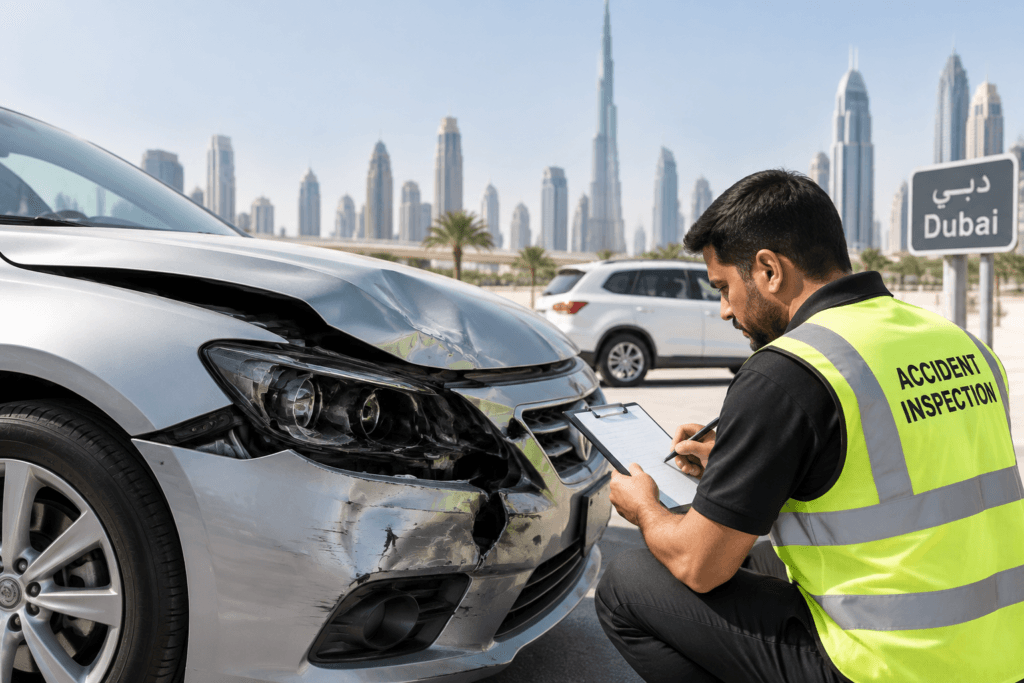
Service prices at 95 Services are kept very low as a matter of policy, and accident repair follows the same rule as every other job: assessment first, then the scope and price discussed and confirmed before repair work begins. No work starts on a guess, and no surprise appears on the bill afterwards. The estimate reflects what assessment found — structural work, panels, parts, paint, and calibration — itemised so the driver can see exactly what is included.
What affects the cost is straightforward: the extent of the damage, including hidden damage found at strip-down; the parts required and their grade; the paint work involved; and any ADAS calibration needed. Hidden damage found during strip-down is explained and approved before the repair proceeds beyond the agreed scope. If the repair is insurance-funded, the estimate is prepared for the insurer's approval, and the driver is kept informed at every stage.
How It Works: From Your Call to Your Car Restored
Every accident repair follows the same five steps. First, the call: phone or WhatsApp with the location, vehicle details, and what happened. Second, the response: help dispatched within the 15–20 minute standard, anywhere in the complete UAE — including car recovery where the car cannot be driven. Third, assessment: full inspection, including hidden damage and safety systems, with the findings explained. Fourth, the quote: itemised scope and price confirmed — and insurer approval obtained where applicable — before repair work begins. Fifth, repair and verification: the agreed work completed, quality-checked, and road-tested before handover. That sequence never changes, because speed without assessment is guessing, and a handover without checking is a promise unverified.
Frequently Asked Questions
What should I do first after a car accident?
Ensure safety, call emergency services if anyone is hurt, move to safety if possible, report the accident through the proper Dubai channels, photograph everything, exchange details, and notify your insurer promptly.
Can hidden damage be found before the repair starts?
Some of it, through careful inspection. The full extent is only known after strip-down, which is why estimates are provisional until then — and why hidden damage found during strip-down is explained and approved before the repair continues.
Will my car be the same after accident repair?
A properly repaired car — structure measured to specification, correct parts, matched paint, calibrated safety systems — is restored to its pre-accident condition. The quality of the assessment and the repair is what decides the outcome.
How long does accident repair take?
It depends on the damage, parts availability, and insurance approval. The repairer should give a realistic timeframe after assessment and keep the driver updated if it changes — not promise a date that cannot be kept.
How fast can help reach me?
The response time is 15–20 minutes. Call or WhatsApp +971 54 344 3513 with a live location, vehicle details, and what happened, and help is dispatched to reach the vehicle within 20 minutes, anywhere in the UAE.
Are 95 Services prices low?
Yes — service prices are kept very low as a matter of policy. Assessment comes first, and the scope and price are confirmed before work begins, with no work starting without the customer's approval.
Contact 95 Services: Accident & Collision Repair Across the UAE
Whether the car has been in a minor collision or a major one, the first step is one call. Contact 95 Services on +971 54 344 3513 by phone or WhatsApp, or email info@95services.com, with the vehicle details, the location, and what happened. Help is dispatched within the 15–20 minute response standard, prices stay very low, and the quote is confirmed before any work begins. The office is at Ahmed Ali Al Owais Showroom Building, Office M05, Abu Hail, Al Khabaisi, Dubai, UAE. Call before visiting so the correct service arrangement can be confirmed. For general repairs, see car repair and maintenance, or visit the contact page to send an enquiry.
