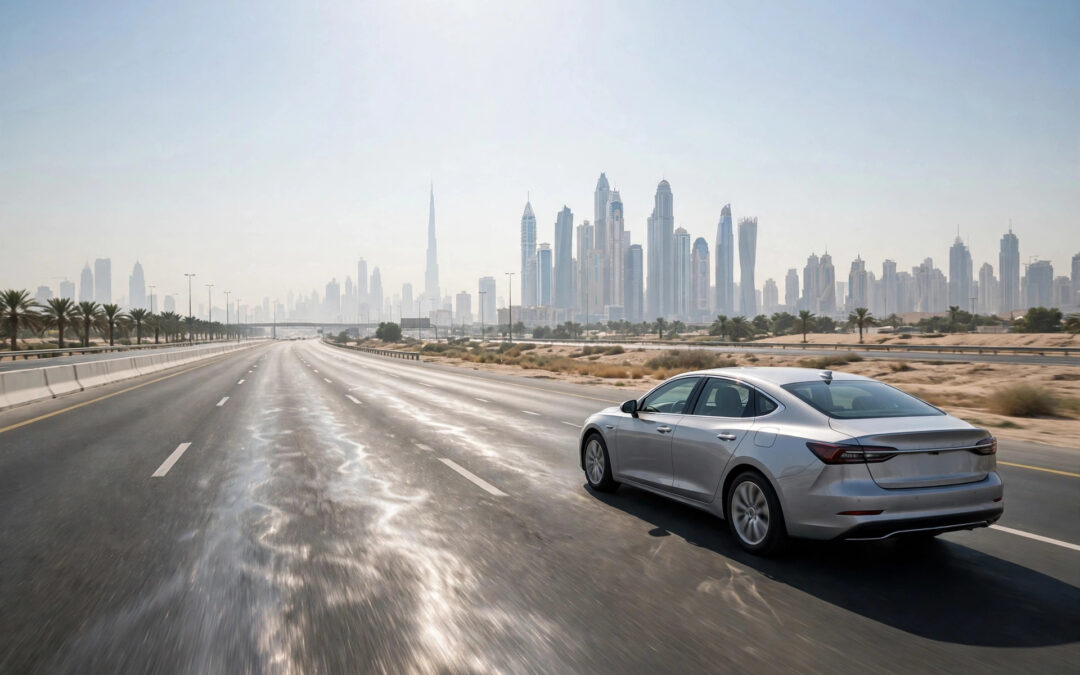
Every Dubai driver knows the moment. The car was fine in March and April, and then the first real week of summer arrives and something gives up: a battery that will not turn the engine over in a sun-baked car park, a tyre that fails at highway speed, or an air conditioner blowing warm air into a cabin that already feels like an oven. It feels sudden, but heat had been working on the car for weeks. A routine built for a mild climate does not hold up when the air passes 45°C, the asphalt runs far hotter still, and the air conditioning never rests.
Dubai's summer is a different operating environment. Engines idle on Sheikh Zayed Road with the cooling system at its limit. Fine desert dust reaches filters, radiators and vents. A single dust storm can scour paintwork and choke airflow in an afternoon. This guide covers the six areas that decide whether a car survives a Dubai summer without drama: the electrical system and alternator, tyre safety, cooling with air conditioning and fluids, exterior paint and detailing, the interior, and what to do if the car breaks down on a highway.
One idea runs through it all. Most manufacturers publish two service schedules: normal, and a shorter severe-service schedule for harsh conditions. Dubai driving — sustained heat, heavy traffic, long idling with the air conditioning running, fine dust and repeated short trips — matches the severe description in most owner's manuals. Follow that shorter schedule, and read this guide alongside your manual.
1. Protecting the Electrical System & Car Alternator in Extreme Heat
Heat attacks the electrical system first and most quietly. The battery starts the engine, and the alternator recharges the battery and powers everything electrical while the engine runs. When either half weakens, the other carries extra strain.
How heat strains the battery and alternator
Heat speeds up chemical wear inside a battery. Fluid is lost more quickly, internal parts corrode sooner, and the battery gradually loses its ability to hold a strong charge — while the car still starts normally most mornings. The electrical load is rarely light either: air conditioning at full effort, cooling fans cycling in traffic, lights, chargers and screens all draw power, and short trips end before a proper drive has replaced the energy starting took out.
The alternator feels the same pressure from the other side. It must recharge a harder-working battery while feeding a heavier load, in an engine bay that stays hot long after parking. Worn belts and loose connections reduce what reaches the battery, so a charging problem can look exactly like a battery problem. Never treat a flat battery as a simple swap without a charging check: a new battery on a failing alternator will go flat again.
Warning signs of alternator and charging failure
Act on the first repeat, not the third:
- Slow, laboured starting that keeps coming back, especially after standing in direct sun.
- A battery or charging warning light, steady or flickering at idle.
- Lights dimming at idle and brightening with revs, or flickering interior lights and sluggish windows.
- Repeated flat batteries, or needing a jump start more than once.
- Grinding or whining from the engine bay, or a burning smell after a long hot drive.
Two or more together deserve a prompt test, before a routine trip becomes a roadside wait in the heat.
When to seek professional car alternator repair near me
Searches for car alternator repair near me usually happen at the worst moment — the car already will not start. The better moment is earlier: at the first repeated slow start. A proper check tests the battery, alternator output, starter draw, belt and connections together, and gives a plain answer about which part is at fault. Start with car repair and maintenance services for diagnosis; if the battery itself is the confirmed fault, car battery replacement covers testing and fitting.
2. Tyre Safety & Blowout Prevention on Hot Asphalt
If the battery is the quietest summer failure, the tyre is the most dangerous. Tyres are the only part of the car touching a road surface that runs far hotter than the air above it. Prevention is a small routine done often enough to catch pressure, tread, age and alignment problems before heat turns them into failures.
Tyre pressure expansion in heat
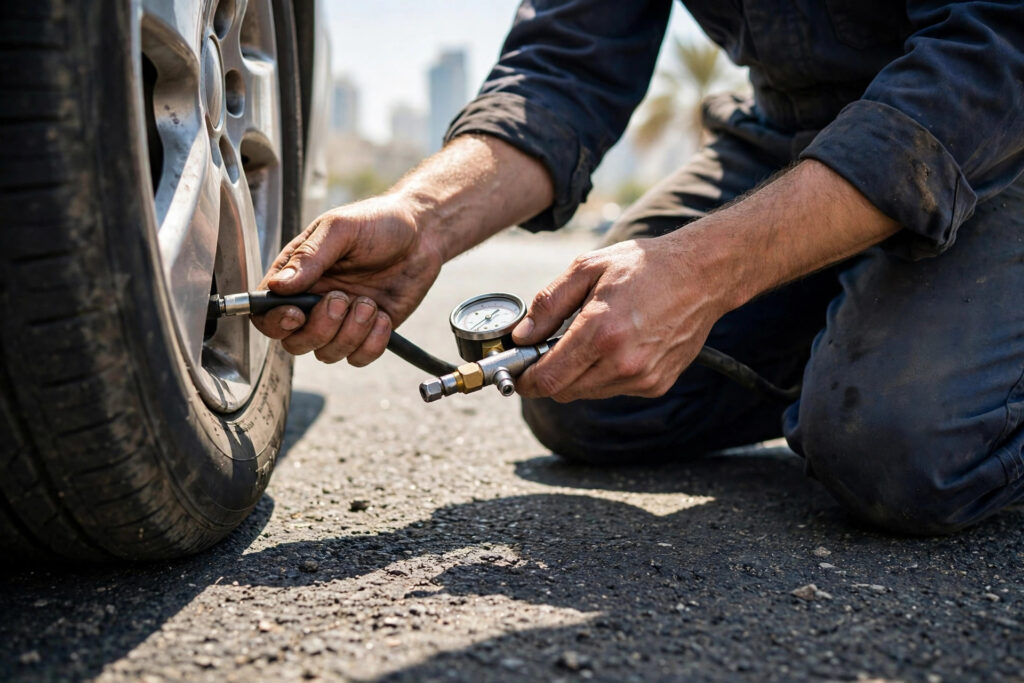
Air expands as it warms, so pressure rises through the day and falls overnight. Check pressures when tyres are cold — first thing in the morning, or after the car has stood for hours — with a proper gauge, against the pressures on the driver's door jamb, fuel flap or owner's manual. Never use the maximum printed on the sidewall; that is a limit for the tyre, not the right pressure for your car.
Under-inflation is the greater danger. A soft tyre flexes more as it rolls, generating internal heat on top of the heat from the road. Over-inflation shrinks the contact patch, reduces grip and wears the centre of the tread. Correct cold pressure, checked often, is the cheapest safety habit in this guide.
Tread wear, age and alignment
Tread is only half the tyre story in the UAE; age is the other half. Rubber hardens and cracks with sustained heat and sun, so a tyre can show usable tread while its structure has quietly deteriorated. Check the manufacture date in the DOT code on the sidewall, and treat cracking, bulges, flat spots, cuts or exposed cords as replacement signals whatever the tread looks like. Check the spare too.
If the car pulls to one side, the steering wheel sits off-centre on a straight road, or tyres wear more on one edge, the alignment needs checking. Rotation on the manufacturer's schedule spreads wear evenly but cannot fix an alignment fault. Have alignment checked after a hard pothole strike, and balancing checked if a new vibration appears at speed.
Routine checks and emergency tyre repair near me
Once a week in peak heat, and before any long journey: check all four cold pressures including the spare, inspect each sidewall for cracks, bulges and cuts, check tread across the full width, and note any new vibration, pull or noise. After a dust storm, look for embedded stones and grit in the tread.
When damage happens on the road, do not drive on the damaged tyre to the next exit. Pull over safely following Section 6. A regular tyre service Dubai visit covers pressure, tread, rotation, balancing and alignment together. For an emergency, tyre repair near me help through tyre repair services in Dubai covers mobile puncture repair, spare fitting and replacement at your location. The tyre puncture repair guide explains when a puncture can safely be repaired and when replacement is safer.
3. Engine Cooling System, AC Performance & Fluid Management
Cooling, air conditioning and fluids are three different jobs, but in a Dubai summer they fail together: a hot engine makes the cabin harder to cool, and heat-degraded fluids protect less well exactly when protection matters most.
Coolant flushes and radiator checks
The cooling system — radiator, coolant, water pump, thermostat, hoses and fans — runs near its limit in summer traffic. Coolant is not coloured water: it raises the boiling point, protects against corrosion, and must match the specification in the owner's manual. Check the level only when the engine is completely cold. Never open a radiator or pressurised coolant cap on a hot engine — the coolant can cause serious scalding.
If the gauge climbs into the red, switch off the air conditioning, pull over safely, and let the engine cool before anyone looks under the bonnet. Do not keep driving to the next exit: an overheated engine can warp a cylinder head in minutes. Act on a gauge creeping above normal, a sweet smell from the engine bay, puddles of green, pink or orange fluid, and hoses that look cracked, swollen or soft. A coolant flush follows the manufacturer's schedule, and is the right moment to inspect hoses, radiator fins and the water pump together.
Engine oil viscosity and fluid management
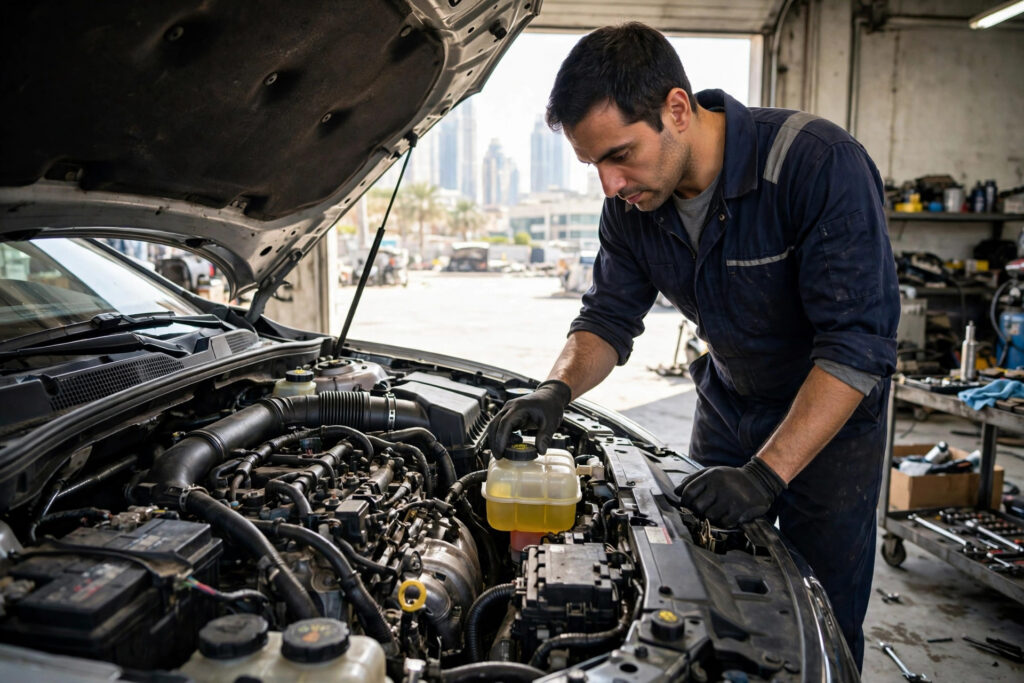
Engine oil lubricates, cools and cleans at once, and in extreme heat it degrades faster. The grade matters, but guessing a thicker grade is not the answer: modern engines are built around a specified viscosity. Use exactly the grade and specification in the manual, follow the severe-service interval where one is given, and check the level monthly on level ground with the engine cool. Very dark, gritty oil, or a level that keeps dropping, needs attention rather than another top-up.
Give the other fluids the same monthly glance. Brake fluid absorbs moisture over time, lowering its boiling point; a falling level never means evaporation — it signals pad wear or a leak. After heavy dust, have the engine air filter checked sooner than scheduled and the radiator and condenser fins inspected for clogging.
AC compressor maintenance
In Dubai, air conditioning is a safety system, not a comfort extra. Failure is usually a slow decline: cooling that weakens gradually, air that is cool but never cold, weak airflow, musty smells, or a compressor cycling noisily. Each is cheaper fixed early than after the compressor has been damaged by running dry.
Never let a system be simply regassed without a leak check. Refrigerant does not get used up in normal operation; if the level is low, it has escaped, and refilling a leaking system means paying twice. A proper pre-summer inspection covers refrigerant level and leak detection, condenser condition, compressor operation, blower performance and the cabin filter. The engine warning signs guide sets out the dashboard warnings never to ignore, and car AC repair in Dubai covers the full air conditioning system. Book the check in spring, not in the first week the cabin stops cooling.
4. Exterior Protection, Paint Care & Detailing in Dubai
Dubai attacks paintwork from every side: ultraviolet light breaks down clear coat, fine sand acts as an abrasive, bird droppings bake onto hot panels and etch the surface, and humidity holds dust against the paint. Once clear coat turns chalky or paint chips down to primer, protection becomes repair.
UV, sand and humidity damage to clear coats
The clear coat is a thin transparent layer over the colour, taking punishment so the colour does not have to. Ultraviolet radiation degrades it, leading first to dullness, then to oxidation — the chalky, faded finish on cars left outdoors unprotected. Sand builds into hazy swirl marks through thousands of tiny impacts, plus dry wiping and dirty cloths dragging grit across dusty panels. The worst habit is the quick dry wipe of a dusty car: wash it properly with water, or leave it until it can be washed. Remove bird droppings promptly with water; on a hot panel they can etch clear coat in hours.
Ceramic coating and car detailing and polishing Dubai
Professional car detailing Dubai care is a deep clean, restoration and protection inside and out — well beyond a wash. A full exterior detail typically means washing, decontaminating the paint to lift bonded grit, machine polishing to restore shine, then sealing the paint. Car detailing and polishing Dubai services matter because polishing removes light swirls, haze and oxidation from the top of the clear coat. But every polish also removes a very thin layer of that coat, so polishing is a periodic restoration, not a weekly habit.
Ceramic coating and paint protection film solve different problems. A ceramic coating is a thin layer bonded to the paint: it adds gloss, makes water bead and washing easier, and helps against ultraviolet light and stains. It is too thin to stop stone chips. Paint protection film is a durable transparent film over the panels: it takes chips and scratches instead of the paint, and many films self-heal light marks with warmth. For regular highway miles, film on the front is the stronger chip defence. See car detailing in Dubai, car PPF in Dubai, and the car detailing guide.
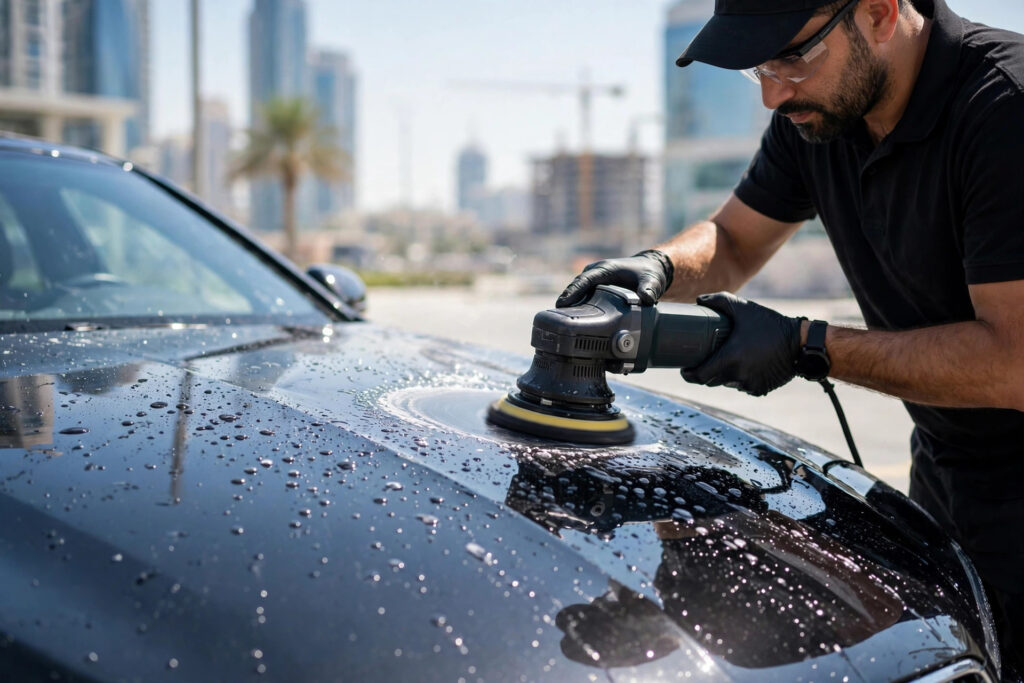
Car scratch repair Dubai: what polishing can and cannot fix
Light swirls and haze sit in the top of the clear coat and usually respond to polishing. Stone chips cut through clear coat and colour down to primer or metal and need touch-up or refinishing — polishing cannot replace missing paint. Car scratch repair Dubai work should start with an honest assessment: how deep is the damage, and whether correction, touch-up or refinishing fits that panel. Between visits, park in shade where possible, wash grit off rather than wiping it dry, and keep a protective layer in good condition.
5. Interior Preservation & Sun-Damage Prevention
A parked car in Dubai becomes an oven, and leather, dashboard plastics, fabrics and screens spend hours each day baking. Prevention is mostly about blocking heat and ultraviolet light, and keeping cabin air clean.
Leather, dashboard and trim
Leather dries out in sustained heat: without conditioning it stiffens, fades and cracks. Condition it on a regular cycle rather than waiting until it looks dry. A properly fitted windscreen sunshade is the simplest defence in this guide: it keeps direct sun off the dashboard and steering wheel. Parking in shade does the same for the whole cabin. Before driving off in a heat-soaked car, open the doors briefly to release trapped hot air, start the air conditioning in fresh-air mode, then switch to recirculation once the hottest air has cleared.
Cabin filters and UV window tinting laws in the UAE
The cabin filter sits between dusty outside air and the air you breathe, and in Dubai it loads quickly. A clogged filter shows up as weak airflow and musty smells. After a dust storm, or when airflow weakens, have the filter checked sooner than scheduled.
Window tint is one of the most effective heat defences, but darkness alone does not determine heat rejection. What matters is the film's solar heat-rejection performance: a lighter high-performance ceramic film can keep a cabin cooler than a darker low-grade film while staying within the law. On the law, the consistent UAE position is this: front side windows must allow at least 50% visible light transmission, and the front windscreen must remain untinted except for a narrow sun strip along the very top. Rear-window guidance varies, so confirm the current RTA position before fitting darker rear film. Medical exemptions exist with prior approval. Illegal tint risks fines, removal at the owner's cost and a failed inspection, so verify the current RTA guidance before booking.
6. Emergency Breakdown Protocol & Summer Maintenance Checklist
Even a well-maintained car can break down. Know the protocol before you need it, keep the kit in the car, and follow the seasonal table.
Step-by-step breakdown protocol for a Dubai highway
- Signal and move off the carriageway. At the first sign of trouble, switch on hazard lights and move steadily to the right-hand hard shoulder, an emergency bay or the nearest exit. Do not stop in a live lane if the car can still roll.
- Stop as far from traffic as possible. Pull as far right as the shoulder allows, apply the handbrake, turn the front wheels away from the road, and leave hazards running.
- Get people to safety. Exit on the side away from moving traffic and move behind the barrier where one exists. If the car is in a live lane with no safe exit, staying belted inside with hazards on while calling for help is often safer.
- Make the car visible — only where safe. A warning triangle is required by UAE law in breakdowns, but never walk back along a live high-speed carriageway to place one.
- Call for help with a clear location. Call 999 if anyone is in danger, injured, or the car blocks traffic. For non-emergencies, Dubai Police 901 and RTA roadside assistance on 800 9090 are the official lines. When calling 95 Services on +971 54 344 3513, give direction of travel, nearest exit, vehicle details and what happened.
- Do not attempt repairs on the highway. Do not open a hot bonnet in traffic or change a wheel beside fast lanes. If there is smoke, fire, fuel smell or leaking fuel, move people farther away and call 999.
- Stay hydrated and shaded. Keep water in the car, stay behind the barrier or in shade, and keep a phone charged. Heat exhaustion creeps up on people waiting in direct sun.
Keep an emergency kit in the car all summer: warning triangle, torch, first-aid kit, water, power bank and cable, reflective vest and a tyre gauge.
Monthly and seasonal maintenance schedule
| Check | How often | What to look for |
|---|---|---|
| Tyre pressure (cold) + spare | Weekly in peak heat | Correct door-placard pressure; no slow leaks |
| Tyre tread, sidewalls, age code | Monthly | Even wear; no cracks, bulges or cuts |
| Engine oil level + condition | Monthly | Level between marks; no grit or fuel smell |
| Coolant level (engine cold) | Monthly | Between marks; no leaks or sweet smell |
| Battery + charging test | Before summer + each service | Slow starts, dim lights, warning light |
| AC cooling + cabin filter | Before summer; filter after dust storms | Cold air, strong airflow, no musty smell |
| Brake fluid, pads, discs | Each service | Falling fluid, squeal, vibration |
| Belts + hoses | Before summer + each service | Cracks, fraying, swelling, squeal |
| Wipers, washers, all lights | Monthly | Streaking, empty washers, failed bulbs |
| Paint wash + protection check | Monthly wash; detail seasonally | Swirls, chips, etching, failing protection |
| Interior + sunshade + tint | Seasonally | Dry leather, cracked trim, legal tint |
| Emergency kit + documents | Monthly | Water, triangle, torch, charged power bank |
For the everyday habits behind this table, the car maintenance tips for Dubai drivers guide is a useful companion.
Frequently Asked Questions
How often should I check tyre pressure in Dubai summer?
Weekly in peak heat, always when tyres are cold. Use the door-placard pressures, check the spare too, and recheck before any long highway journey.
Why does my car battery keep dying in Dubai heat?
Heat accelerates wear and fluid loss, short trips never fully recharge the battery, and heavy air conditioning adds strain. Repeated flats can also mean the alternator or starter is at fault. Have battery, alternator and starter tested together.
My AC blows cool but not cold. Can I just regas it?
Only after a leak check. Refrigerant escapes through a leak; it is not used up normally. Inspect refrigerant level, leak detection, condenser, compressor and cabin filter first, then regas if the system is sound.
Is ceramic coating enough to protect paint from stone chips?
No. Ceramic coating helps gloss, ultraviolet protection and easier washing, but it is too thin to stop chips. For chip protection on highway-driven cars, paint protection film on the front panels is the stronger choice.
What window tint is legal in the UAE?
Front side windows must allow at least 50% visible light transmission, and the windscreen must stay untinted apart from a narrow sun strip at the top. Confirm the current RTA position for rear windows before fitting darker film.
What should I do first if my car breaks down on Sheikh Zayed Road?
Hazards on, move to the hard shoulder or nearest exit without stopping in a live lane, get everyone out on the side away from traffic and behind the barrier, and call for help — 999 if anyone is in danger or a lane is blocked. Do not attempt repairs beside fast traffic.
Conclusion: Proactive Care Beats a Roadside Wait
Dubai's heat and traffic are not going anywhere. What can change is how ready the car is for both. The drivers who sail through summer tested the battery before it failed, set cold tyre pressures weekly, had the air conditioning inspected in spring, washed grit off instead of wiping it dry, and knew what to do when something still went wrong. Start with the three checks that prevent the most common summer breakdowns: a battery and charging test, a cold tyre pressure and tread check, and a cooling and air conditioning inspection before the heat peaks. Small, timely care now beats a large, urgent bill in the hottest week of the year.
Contact 95 Services: Car Maintenance & Fast Help Across the UAE
Whether the car needs a pre-summer inspection, tyre help, air conditioning repair, detailing, or urgent roadside help, the first step is one call. Contact 95 Services on +971 54 344 3513 by phone or WhatsApp, or email info@95services.com. Help is dispatched within the 15–20 minute response standard, to arrive within 20 minutes, anywhere in the complete UAE, and the business is open 24 hours. Service prices stay very low. The office is at Ahmed Ali Al Owais Showroom Building, Office M05, Abu Hail, Al Khabaisi, Dubai, UAE. For general enquiries, visit the contact page to send a message.
