

The first proper rain after a long Dubai summer is when most drivers find out their wiper blades are finished. For months the sun has baked the rubber, the dust has settled on the glass, and the wipers have barely moved. Then the sky opens over Sheikh Zayed Road, the driver flicks the stalk, and instead of a clear windscreen there is a grey smear, a juddering blade, and a band of water right where they need to see. It is a small part, it costs very little, and it is the difference between seeing the road and guessing at it.
Wipers are the most ignored safety item on a car in the UAE, and the climate here is the hardest on them anywhere a normal family car is driven. In a temperate country a set of blades can last a year or two without much thought. In Dubai, Abu Dhabi or Sharjah, a car parked outside from June to September gets ultraviolet light and heat on the rubber every single day, and a blade that looked fine in spring can leave bands of water across the screen by October. The same heat that cracks dashboards and fades paint is quietly hardening the one part that has to flex perfectly against curved glass, hundreds of times a minute, in the rain.
This guide covers the whole visibility system, not just the blades: wiper blades, washer jets and demisters, because the three fail together and the fix for one often exposes the other. It explains why blades die so fast here, how to read what a streak or a squeak is telling you, how to choose the right blade for your car, how to fit it yourself in ten minutes, how to clear a blocked washer jet, and how to clear a windscreen that fogs up from the inside on a humid morning. It also covers the part most drivers only discover at the testing centre: wipers, washers and glass are a recorded defect at the RTA inspection, and a torn blade or an empty washer bottle can send you back for a retest.
The rule in one line: in the UAE, treat wiper blades as a 6 to 12 month part, never longer than 12 months, and check them before the rainy season, not after it starts. If they streak, smear, chatter or skip, they are finished — no cleaning trick brings hardened rubber back.
1. Why Dubai Kills Wiper Blades Faster Than Anywhere Else
A wiper blade is a strip of rubber pressed against hot glass. The rubber compound contains natural oils and synthetic polymers that keep it flexible, so the thin edge can follow the curve of the windscreen and sweep water away in one clean pass. Heat and ultraviolet light break that compound down. The oils dry out, the rubber oxidises, and what was once soft and pliable turns hard and brittle. A hardened blade cannot hold its shape against the glass, so it lifts at the ends, misses patches in the middle, and leaves the water exactly where you do not want it.
Three things in the UAE make this worse than in a cooler climate, and they work together. The first is the sun itself. A car parked outside in Dubai in July and August sits in temperatures well above 45 degrees, with the windscreen acting like a lens and the blades pressed flat against glass that is hot enough to burn a hand. Day after day, month after month, the rubber is baked. The second is dust. Fine desert dust settles on the glass and on the blade edge, and every wipe drags that grit across the rubber like sandpaper, wearing away the smooth edge and scratching the glass underneath. The third is disuse. For most of the year the wipers barely move, so the damage builds up silently. Then the first rain arrives and the blades are suddenly asked to work hard, on a dirty screen, after months of hardening. That is why the failure always seems sudden, even though it has been happening all summer.
How long should a set last here? Manufacturers generally recommend replacing blades at least every 12 months, and some say every 6 months. UAE garages and parts guides that deal with this climate every day put the realistic range at 6 to 12 months, with 6 to 9 months typical for a car parked outside and driven daily. There is no UAE study that pins it to an exact number of months, and any guide that gives you one is guessing. The honest rule is the one this guide uses throughout: 12 months is the longest any blade should stay on a car in the UAE, and condition decides sooner. A blade that streaks in September has not lasted nine months. It has failed, and the calendar does not matter.
One habit extends blade life more than any product. When you park in direct sun for a long time, lift the wiper arms away from the glass. It stops the rubber bonding to the hot windscreen and takes the worst of the heat off the edge. It looks odd, and in a car park full of lifted wipers it looks normal, because every driver who has paid for a new windscreen has learned it. Shade helps too, and so does keeping the glass clean, because a clean screen means less grit dragged across the edge. None of this makes a blade last forever. It buys you months, not years.
2. Reading the Signs: What Each Streak, Squeak and Skip Means
Wipers rarely fail without warning. They warn you in a language of streaks and noises, and each one points at a different cause. Learning to read it takes one rainy drive, and it stops you replacing the wrong part.
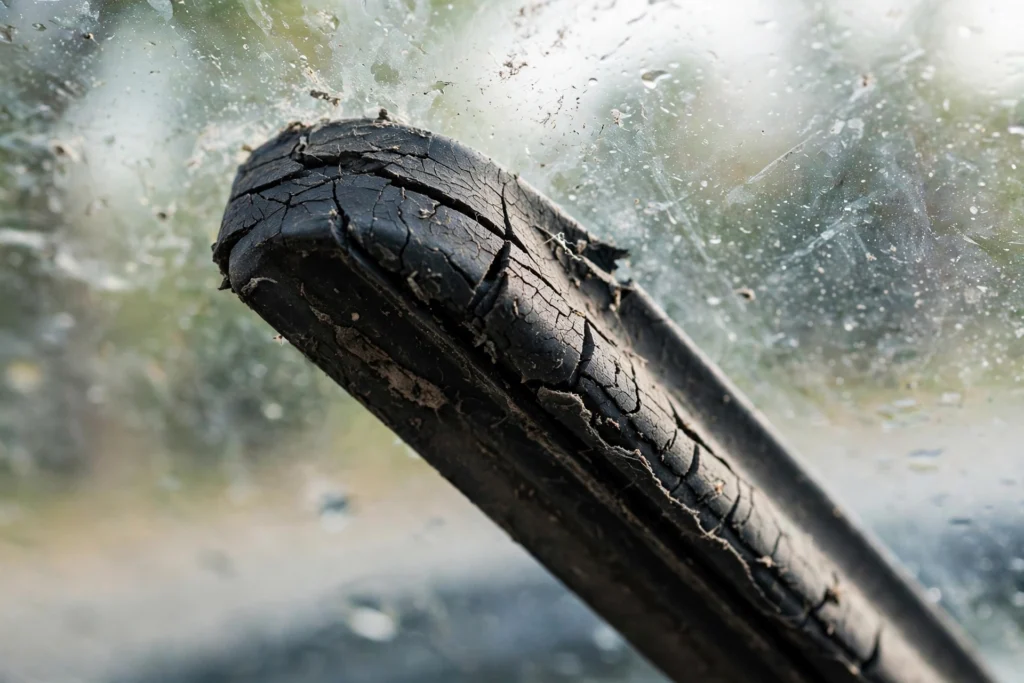
Streaks and thin vertical lines of water left behind after each pass are the classic sign of a hardened or cracked rubber edge. The blade is no longer making even contact, so water slips through the gaps. If the lines are in the same place on every sweep, look at that part of the edge. Run a finger gently along it. A good edge feels smooth and sharp, like a new eraser. A failed edge feels rough, feathered, or has small splits and chunks missing. Once the edge is split, no amount of cleaning will fix it. The blade is done.
Smearing is different from streaking. Instead of lines, the whole sweep leaves a hazy film, as if the glass has been wiped with an oily cloth. Smearing often means the blade is dirty, or the glass is dirty, or the washer fluid is wrong. Before you buy new blades, clean the rubber edge with a damp cloth and clean the windscreen properly inside and out, then test again with the washers. If the smear clears, the blades were dirty. If it stays, the rubber has gone hard and glazed, and it is time to replace them. Smearing can also come from a waxy residue left by some car shampoos and spray polishes, which is why the glass cleaning step in section 10 matters.
Chattering, juddering and squeaking mean the blade is skipping across the glass instead of gliding. Sometimes the cause is a dry screen: never run wipers on a dry, dusty windscreen, because dry rubber on dry glass chatters, wears fast, and scratches. Always spray the washers first. If it still chatters on a wet screen, the blade may be twisted in its frame, the arm spring may have weakened, or the rubber has hardened so much it cannot flex. A blade that chatters in the middle of the sweep but is quiet at the ends has usually lost its shape. A blade that squeaks loudly on every pass and leaves the screen clean is often just old and hard, and it will start streaking soon after.
Missed patches, usually a crescent of unwiped glass near the middle or at the tip of the blade, mean the blade is not pressing evenly. On a conventional framed blade, a seized joint in the frame stops one section pressing down. On a beam blade, the internal spring has weakened or the blade is the wrong length and cannot follow the curve. A missed patch that appears suddenly after a hot summer is usually hardening. A missed patch on a new blade usually means the wrong size or a fitting problem, which is why section 4 matters.
One more sign is easy to miss: the blade lifts off the glass at speed. At 100 km/h on the E311 in rain, a worn blade can be pushed up by the wind, leaving the top half of the screen unwiped. If your wipers are fine around town and useless on the motorway, that is the cause. Beam blades resist this better than old framed blades, because they press more evenly, which is one reason they are popular here.
3. The 60-Second Test: Check Your Wipers Before the Rain Does
You do not need a garage to know whether your blades are finished. Do this test now, in daylight, before the next rain. It takes a minute and it is the same check a good mechanic does first.
First, spray the washers and run the wipers for three or four sweeps. Watch the glass after each pass. A good blade leaves the screen almost clear, with at most a light mist that clears in a second. A failed blade leaves lines, patches or a smear that stays. Do it on both sides, and watch the passenger blade too, because drivers forget it and it is checked at inspection all the same.
Second, lift each arm and look at the rubber. Check the full length of the edge for cracks, splits, missing chunks and a feathered fringe. Bend the edge gently. Good rubber flexes and springs back. Hardened rubber feels stiff, almost like plastic, and stays bent. If the blade is more than a year old and feels stiff, replace it even if it still wipes acceptably. It will not survive the first proper downpour.
Third, check the washer spray. The jets should hit the middle of the screen in a fan or a pair of neat streams, not dribble down the bonnet and not shoot over the roof. If one side is weak or missing, the jet is blocked or the hose has come off, and section 6 covers the fix. Top up the washer bottle while you are there. An empty bottle is one of the most common inspection failures in Dubai, and it is the most embarrassing, because it takes thirty seconds to fix.
Fourth, check the rear wiper if your car has one. It is forgotten more than any other blade on the car, it hardens in the sun just the same, and on many cars it is the one that has to clear the rear screen in rain and dust. Run it, watch it, and replace it on the same schedule as the front pair.
Do this test at the start of the cooler months, before the fog and rain season, and again before any long drive to Oman or Saudi Arabia, where a failed wiper in mountain rain is a much bigger problem than the same failure in Dubai traffic. If the test shows any of the signs in section 2, do not wait for the rain to confirm it. The rain will confirm it at the worst possible moment.
4. Choosing the Right Blades: Beam, Hybrid, Silicone and the Size Trap
Walk into any parts shop in Dubai and you will see three kinds of blade on the shelf, and the difference between them matters more here than in a cooler country. The cheapest is the conventional framed blade: a metal frame with several joints that press the rubber against the glass. It works, and it is the blade most cars came with ten years ago. Its weakness in the UAE is the frame. The joints seize with dust and corrosion, the pressure becomes uneven, and the exposed frame gives the wind a place to grab at speed. It is still a fair choice for a car that lives in shaded parking and is driven gently, but it is not the best choice for most Dubai drivers.
The beam blade has no exposed frame. A single spring-steel strip inside the rubber presses it evenly along its whole length, so it follows the curve of the screen better, resists lifting at speed, and has no joints to seize. In dust and heat that is a real advantage, and it is why beam blades are now the common recommendation for UAE conditions. They cost more than a framed blade, and on some older cars the fitting is different, but for most modern cars they are the straightforward choice.
The hybrid blade sits between the two: a beam-style rubber with a low frame for extra pressure and a sleeker cover. It gives the even pressure of a beam blade with the firm mounting of a framed one, and it also handles UAE heat and dust well. If your car came with hybrids, replace like with like. If it came with framed blades, a beam or hybrid upgrade is usually a simple swap, provided the fitting matches.
Then there is the rubber itself. Standard natural rubber is the default and the cheapest, and it is the compound that hardens fastest in the sun. Silicone blades cost more and last longer in heat, because silicone resists ultraviolet damage and stays flexible at high temperatures far better than rubber. For a car parked outside every day in Dubai, silicone is worth considering, and it is increasingly the recommendation from UAE garages for exactly that reason. Whatever the material, no blade is permanent. Silicone lasts longer, not forever.
The size trap catches more drivers than any other mistake. The driver and passenger blades on most cars are different lengths, and the difference can be as little as an inch. A blade that is too long overhangs the edge of the screen and lifts, a blade that is too short leaves an unwiped strip. Do not guess from memory and do not trust a shop assistant to guess either. Measure the old blades before you go, or look up the sizes for your exact car, year and model, and check the fitting type at the same time. Most modern cars use a hook fitting, but some use a pin, a bayonet or a push-button fitting, and the wrong adapter means a blade that looks right and will not lock on. A blade that is not locked on can fly off at speed, which is a far worse problem than a streak. If you are unsure, bring the old blade with you and match it in the shop.
A note on price, because this guide follows the same rule as every other guide on this site: no price is quoted here as a 95 Services price, because 95 Services prices are set by the workshop, not by an article. As a general market indication only, UAE parts guides put a decent pair of blades in a modest range that most drivers find affordable, and the fitting itself is a small job. What matters is not the exact dirhams. What matters is that a blade is a cheap part protecting an expensive windscreen and an irreplaceable view of the road, and putting it off to save a small amount is a false economy.
5. Fitting New Blades Yourself: Ten Minutes, Two Mistakes to Avoid
Replacing wiper blades is one of the few car jobs that is genuinely easy, and doing it yourself means you can do it the moment the test in section 3 fails, instead of waiting for a garage visit. It takes about ten minutes for the pair, and you need no tools. The job is the same on almost every car, with the fitting type the only real difference.
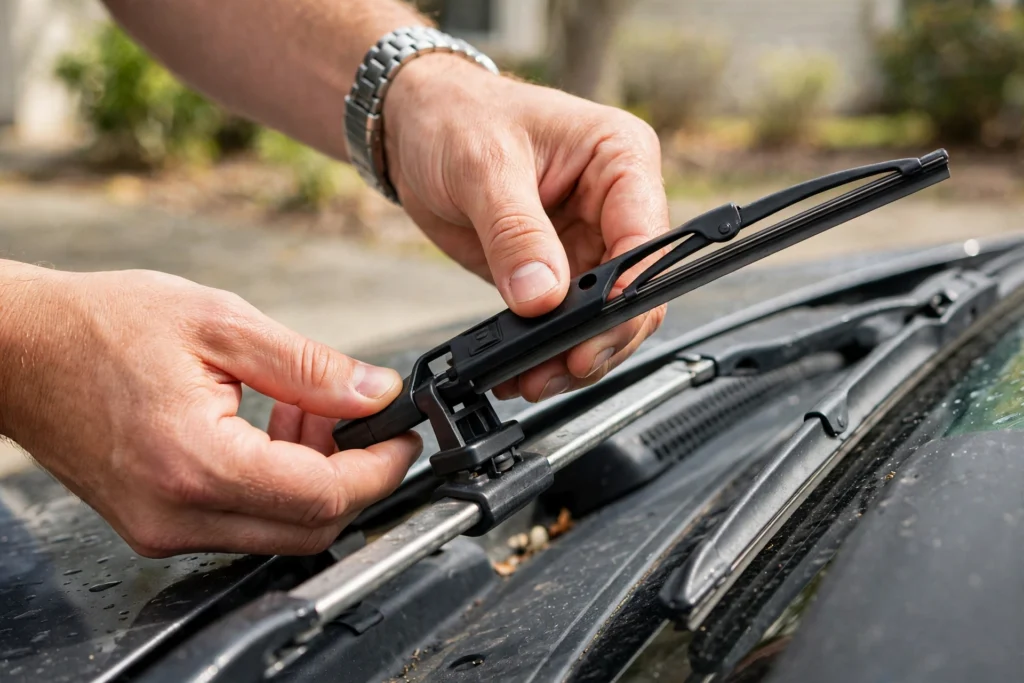
Start by lifting the wiper arm away from the windscreen until it stands up on its own. Put a folded towel on the glass under the arm before you do anything else. This is the first of the two mistakes to avoid. A bare wiper arm is a spring-loaded piece of metal, and if it slips from your hand and snaps back onto an unprotected windscreen, it can chip or crack the glass. The towel costs nothing and saves a windscreen. Every mechanic who has seen a cracked screen from a snapped arm will tell you the same thing.
With the arm up, look at how the old blade connects. On a hook fitting, you will see a small tab or button on the underside of the connector. Press it, slide the blade down and off the hook, and it comes free. On a pin fitting, the blade pulls sideways off the pin. On a push-button fitting, press the button and slide. Do not force it. If it will not move, you have the wrong tab. Look again, and if your car has a different fitting, check the instructions that come in the blade box, because the box usually shows all of them.
Fit the new blade by reversing the process. Slide it onto the fitting until you hear or feel a clear click. Then pull it gently to make sure it is locked. A blade that is not locked will work for a few sweeps and then come off, usually in the rain, which is the second mistake to avoid. Never skip the tug test. Then lower the arm carefully back onto the glass, remove the towel, and do the same on the other side.
Test the new blades with the washers before you drive. Three or four sweeps should leave the screen clear, with no lines and no chatter. If a new blade chatters, check that it is the right length and that the arm is sitting straight. A bent arm, often from a previous careless lift, can twist a new blade and make it skip. Straightening an arm is a small job, but it is one to leave to a mechanic, because bending it the wrong way makes it worse.
The rear wiper, where fitted, is usually a smaller blade with a simpler fitting, often a hook or a clip. The same rules apply: towel under the arm, click it home, tug to check. On some cars the rear blade is a dealer-only size, in which case a mobile mechanic can source it, and that is a fair reason to call one rather than guessing in a shop.
6. Washer Jets: Blocked, Misaimed and Weak, and How to Fix Each One
A perfect blade cannot clean a dry, dusty screen. That is the washer system's job, and it fails in three ways, each with a different fix. Knowing which one you have saves you replacing parts that are fine.
A blocked jet is the most common. Dust, limescale from tap water, and dried washer fluid narrow the tiny nozzle until the spray becomes a dribble or stops on one side. The fix is simple. Take a fine pin or needle and gently clear the nozzle hole, then run the washers to flush it out. Do not push hard and do not widen the hole, because a widened nozzle sprays everywhere except the screen. If the jet is a fan type, with a wide flat spray, it has no single hole to clear, and the fix is usually to flush the system and replace the jet, which is a cheap part.
A misaimed jet sprays well but hits the wrong place: the bonnet, the roof, or the very top edge of the screen. Many jets can be aimed with a pin in the nozzle, moved a fraction at a time until the spray lands in the middle of the wiper sweep. Move it a little, test, and move it again. A jet that will not hold its aim has a worn nozzle and needs replacing. Aim matters more than it looks. A jet that sprays over the roof wastes fluid and leaves the lower screen dry, which is exactly where the dust sits.
A weak spray on both sides, or a spray that starts strong and fades, usually means the system, not the jets. Check the washer bottle first and top it up. Then listen for the pump when you pull the stalk. If you can hear it humming but little comes out, the filter in the bottle may be clogged, or a hose may be kinked or split. If you cannot hear it at all, check the fuse, and if the fuse is fine, the pump itself may have failed. A split hose is easy to spot: washer fluid on the ground under the car, or a wet patch inside the engine bay, when the washers run. These are small repairs, and a mobile mechanic can do them at your home or office, which is the point of section 11.
What goes in the bottle matters. Use proper washer fluid, not plain tap water. Tap water in the UAE leaves limescale in the jets and the pump, it has no cleaning agent to cut the dusty film on the glass, and in the heat it grows a slime that blocks the filter. Proper fluid contains a detergent and, in the better ones, a water softener, and it is made to work with the rubber. Do not use household detergent or dish soap. It foams too much, it can damage the paint and the rubber, and it leaves a film that smears. Top the bottle up whenever you check the oil, so it is never the reason your screen stays dirty.
In winter, when the mornings are foggy and the air is humid, the washers earn their keep twice over. Dust that has settled overnight mixes with dew into a paste on the glass, and a dry wipe just drags it around. Spray first, then wipe, every time. That one habit protects both the blades and the glass.
7. Demisters: Clearing a Windscreen That Fogs Up From the Inside
There are two kinds of misted windscreen, and they have opposite causes and opposite fixes, which is why drivers get confused. The first is fog on the outside of the glass, on a humid morning or in foggy weather. The second is fog on the inside, which is the common one in the UAE in the cooler months, and the one this section is about.
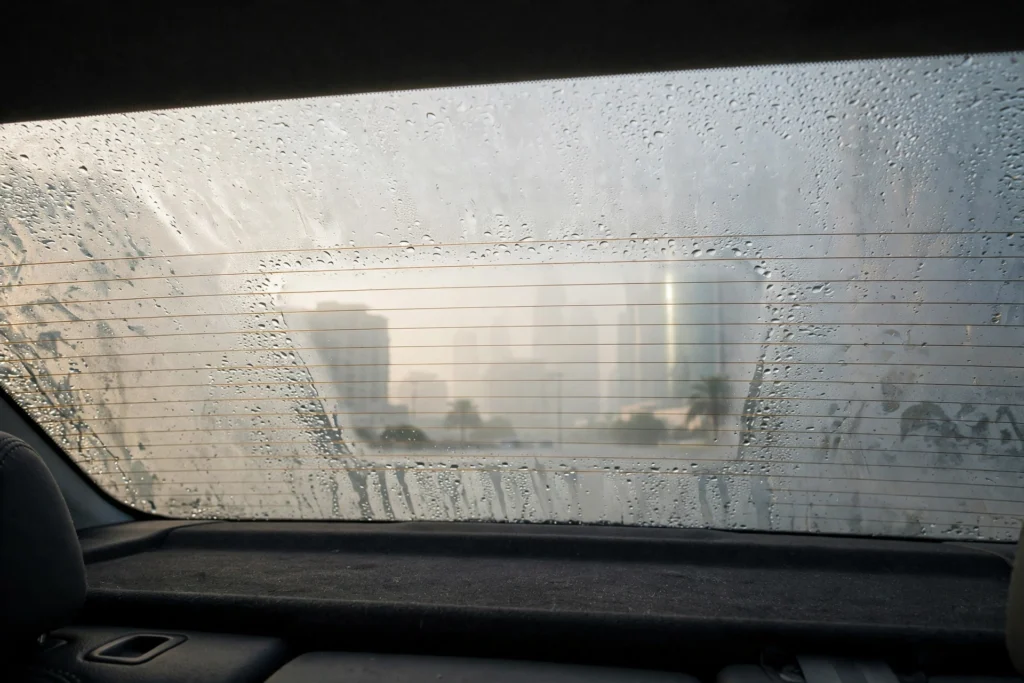
Inside fog happens when warm, humid air inside the car meets a cold windscreen. In Dubai the pattern is familiar: the air conditioning has been running hard, the glass is cold, and the morning air outside is warm and damp, or a car full of people has filled the cabin with moisture. Water condenses on the inside of the glass, and the driver reaches for a cloth and makes it worse, because wiping spreads the moisture into a smeary film that catches the headlights of oncoming cars.
The front demister is not a separate heater. It is the air conditioning, directed at the windscreen. Turn the demister on, set the air conditioning to cold, and point the airflow at the screen. The cold, dry air from the air conditioning pulls the moisture off the glass, usually in a minute or two. Turning the heater up and blowing hot air at the screen feels intuitive and is slower, because hot air holds more moisture. The fast fix is cold, dry air. If your car has an automatic demist button, use it. It does all of this for you.
The rear demister is different. It is the thin set of horizontal lines on the rear windscreen, which are electric heating elements. Press the rear demister button and the lines warm up and clear the glass from the bottom up. It works, but it is slow, and it only clears the rear screen. Never scrape at the lines, stick anything over them, or use an abrasive cleaner on them, because a broken line stays broken and that strip of glass never clears again. If one section of the rear screen never clears while the rest does, a line is damaged, and that is a repair, not a cleaning problem.
Inside fog that keeps coming back has a cause worth finding. The most common is a dirty cabin filter. The filter sits in the air path, and when it is clogged with dust, the airflow drops and the air that does get through is damp and stale. A clogged cabin filter also makes the air conditioning smell musty and work harder, and it is one of the cheapest parts on the car to replace. The short version is this: if your screen fogs up inside on most mornings, and the demister takes longer than it used to, have the cabin filter checked. Blocked drains are the other cause. The drains under the windscreen and around the sunroof carry rain away, and when they block with leaves and dust, water sits and seeps into the cabin, keeping the air damp. A damp carpet or a musty smell with the fog is the clue.
One more habit to drop: do not leave wet towels, umbrellas or damp floor mats in the car overnight. They put moisture into the cabin air, and the next morning it is on the inside of your windscreen.
8. Fog and Rain Driving: The Visibility Routine That Keeps You Safe
Clear glass is only half the job. The other half is what you do when the weather takes the visibility away, and in the UAE that means two things: fog on winter mornings, and sudden heavy rain. The routine is short, and it is worth learning before you need it.
Before you move, clear the screens. Front, rear, side windows and mirrors, all of them, and not just a small patch in front of the driver. A common sight on a foggy Dubai morning is a car moving with a single wiped square in the windscreen and the rest still white. That driver cannot see a car in the next lane, and the car in the next lane cannot see them. Clear it all, or do not move.
Use dipped headlights, not high beam, in fog and heavy rain. High beam reflects off the water droplets and throws the light back at you, making the fog look thicker. Dipped lights let you see and, just as importantly, let others see you. That is also why your headlights matter as a pair with your wipers. Cloudy or yellowed headlights cut the light that reaches the road, and fog is when you need every bit of it. Our cloudy headlights guide explains how to tell whether yours need attention.
Slow down, and increase the gap to the car in front. In fog, double the normal gap at least, because the car ahead can brake suddenly for something you cannot see yet. Do not follow the tail lights of the car in front as your guide to the road. That habit pulls you into their mistakes, and if they stop, you stop into them. Use the road markings and the edge of the road instead.
If the rain is so heavy that the wipers, even on their fastest setting, cannot keep the screen clear, pull over. Find a safe place off the road, put the hazard lights on, and wait. There is no speed at which an unclear windscreen is acceptable, and the rain in the UAE usually passes in minutes. The same applies to fog that closes in suddenly on the E311 or the road to Abu Dhabi. Stopping is not giving up. It is the correct decision, and it is the one the police advise.
Our full fog-driving guide covers lights, speed, gaps and the car checks to do before a foggy morning in detail. The wiper part of that preparation is this guide, and it is the part that has to be done before the foggy morning, not during it.
9. The RTA Inspection: Wipers, Washers and Glass Are a Fail Item
Many drivers think of the RTA inspection as a test of brakes, tyres and emissions, and it is, but visibility is on the list too, and it fails cars every year. The RTA's testing guide lists visibility as one of the checks on a light vehicle: the field of vision, the condition of the glass, the mirrors, the wipers and the washers. A torn blade, an empty or blocked washer system, or a crack in the driver's line of sight is recorded as a defect. It is not a warning. It is a fail.
The numbers put it in context. In the RTA's published breakdown of inspection failures, visibility, covering glass, mirrors and wipers, accounted for 7.7 per cent of failures. That is a smaller share than tyres or brakes, but it is a share made up almost entirely of cheap, preventable defects: a ten-minute blade change, a topped-up washer bottle, a cleared jet. Cars fail on wipers not because wipers are complicated, but because nobody looked at them before the test.
The test itself costs AED 170 for a light vehicle at the time of writing, and a retest after a failure costs AED 50, with the retest done at the same testing company within the window on your report. Those are RTA fees, published by the RTA, not workshop prices, and they are the reason the check in section 3 is worth doing the day before your test, not the day after it fails. A car that fails on wipers has to be fixed and brought back, and the second trip costs time even when the part costs almost nothing.
Do the check the day before your inspection. Run the washers and watch both blades, check the washer bottle is full, and look at the windscreen for chips and cracks, especially in the driver's line of sight. A small chip at the edge of the screen is often acceptable. A crack across the driver's view is not, and neither is a chip that has spread. If you are unsure, have it looked at before the test rather than after, because a windscreen decision made in a hurry at the testing centre is always the expensive one. Our RTA inspection checklist, covering tyres, lights, brakes, leaks and wipers, is the guide to read the week your renewal falls due.
10. Looking After the Windscreen Itself: Chips, Scratches and Clean Glass
Wipers and windscreens wear each other out, and the glass deserves the same attention as the blade. A windscreen that is already scratched makes new blades look bad, and a blade with a damaged edge scratches a good screen. They are one system, and they should be cared for together.
Start with cleaning. Clean the outside of the windscreen with proper glass cleaner and a clean microfibre cloth, not a paper towel and not the same cloth you used on the bodywork. The inside needs cleaning too, and it is the side most drivers forget. The inside of a windscreen collects a film of dust, plastic fumes from the dashboard, and residue from air fresheners, and that film is what makes the glass look hazy when the sun is low. Clean it with glass cleaner and a fresh microfibre cloth, in straight lines, and do it in the shade so the cleaner does not dry on the glass. A clean inside makes the demister work faster, because there is less film for the moisture to cling to.
Chips and cracks need a decision, and the decision is about where they are, not just how big they are. A small stone chip at the edge of the screen, away from the driver's view, can often be repaired, and a repair done early stops it spreading. A crack in the driver's line of sight is a different matter. It distorts what you see, it catches the light, and it is a defect at inspection. Do not wait for it to grow. Heat, vibration and a sudden cold wash on a hot screen all make cracks spread, and a crack that could have been repaired becomes a windscreen replacement. If your car has driver assistance cameras behind the windscreen, a replacement also needs calibration, which is a job to leave to a specialist. Ask about it before the glass is ordered, not after it is fitted.
Scratches from wipers are usually fine, circular arcs in the glass, and they come from exactly the habit this guide warns against: running dry, worn blades on a dusty screen. Once the glass is scratched, no blade will wipe it perfectly, because the water sits in the scratches. Light scratches can sometimes be polished out by a specialist. Deep ones cannot, and the screen has to be replaced. The cheapest way to avoid it is the one already given: spray first, replace blades on time, and never run the wipers on a dry screen.
11. When to Call a Mobile Mechanic Instead of Doing It Yourself
Most of this guide is a do-it-yourself job, and it should be, because the parts are cheap and the work is simple. There are times when calling a mobile mechanic is the better choice, and knowing them saves you a second trip to a parts shop.
Call one when the problem is not the blade. If the wiper arm is bent, the linkage under the scuttle panel is worn, the motor is slow or stops halfway, or the washer pump has failed, the fix is no longer a ten-minute swap. A mobile mechanic can diagnose it at your home or office, fit the right part, and test it properly. The same applies when the blade size is unusual, the fitting is a dealer-only type, or the rear blade on your car is one of the awkward ones that no shop seems to stock.
Call one when the windscreen is involved. A chip that needs assessing, a crack in the driver's view, or a wiper arm that has snapped back and marked the glass are all jobs where a wrong decision costs a windscreen. A mechanic who sees it in person can tell you whether it is a repair, a replacement, or nothing to worry about, and that answer is worth more than a guess from a photograph.
And call one when the car is due its inspection and you want the whole visibility check done at once. Blades, washers, glass, mirrors and lights, checked together the day before the test, is a small job that removes the most preventable reason to fail. That is the kind of visit 95 Services is built for. We come to you, anywhere in the UAE, and our response time is 15 to 20 minutes, with help able to arrive within 20 minutes. We are open 24 hours, and our prices are very low. Our car repair and maintenance page explains what a proper service includes. Call us on +971 54 344 3513 or message us on WhatsApp and we will come to you.
12. The Pre-Rain Checklist: Five Minutes Before the Weather Turns
Keep this short, and keep it by the car. It is the whole guide reduced to the checks that matter, and it is the list to run through at the start of the cooler months and before any long drive.
One, spray the washers and run the wipers. Both blades should leave the screen clear, with no lines, no smear and no chatter. Two, lift the arms and feel the rubber edges. Smooth and flexible is good. Rough, split or stiff means replace. Three, check the washer bottle is full, with proper washer fluid, and that both jets hit the middle of the screen. Four, test the rear wiper and the rear demister, and make sure the front demister clears the screen with cold air conditioning in a minute or two. Five, look at the windscreen in the driver's line of sight for chips and cracks, and clean the glass inside and out.
Five minutes, once, before the season. It is the cheapest insurance on the car, and it is the difference between a clear windscreen in the first rain and a grey smear on Sheikh Zayed Road.
Frequently asked questions
How often should I replace my wiper blades in Dubai?
At least every 12 months, and in practice every 6 to 12 months for a car parked outside and driven daily in the UAE. Manufacturers recommend 12 months at most, and some say 6 months. UAE garages put the typical life at 6 to 9 months, because summer sun and dust harden the rubber faster than in a cooler climate. Go by condition, not the calendar. If they streak, smear, chatter or skip, they are finished, whatever the date.
Can I just clean old wiper blades instead of replacing them?
You can clean them, and you should, but cleaning only helps when the problem is dirt. Wipe the rubber edge with a damp cloth and clean the windscreen, then test again. If the streaks or smear clear, the blades were dirty. If they stay, the rubber has hardened or the edge has split, and no cleaning will bring it back. Hardened rubber is a chemical change, not dirt, and the only fix is a new blade.
Why do my wipers work fine in light rain but fail in heavy rain?
Light rain asks very little of a blade, so a worn edge can still cope. Heavy rain asks for a full, even sweep at speed, and a hardened blade lifts, misses patches, or cannot clear the volume of water. The same blade can also lift off the glass at motorway speed if the frame is worn or the blade is the wrong type. If your wipers are fine around town and useless at 100 km/h in rain, they need replacing, and a beam blade is usually the better choice.
Why does my windscreen fog up on the inside in the morning?
Warm, humid air inside the car meets a cold windscreen and condenses on it. Use the front demister with the air conditioning on cold, which dries the air and clears the glass in a minute or two. If it keeps happening, check the cabin filter, because a clogged filter cuts the airflow and leaves the air damp, and check for blocked drains or damp carpets, which keep moisture in the cabin.
Will worn wipers really fail my RTA inspection?
Yes. Visibility, covering glass, mirrors, wipers and washers, is a checked item at the RTA inspection, and a torn blade, an empty or blocked washer system, or a crack in the driver's line of sight is recorded as a defect. Visibility accounted for 7.7 per cent of inspection failures in the RTA's published breakdown. Check the blades, the washer bottle and the glass the day before your test.
Are silicone wiper blades worth it in the UAE?
For a car parked outside every day, yes, they are worth considering. Silicone resists ultraviolet damage and stays flexible in heat far better than standard rubber, so it lasts longer in Dubai conditions. It still wears out, and it still needs replacing on condition, but it gives you more months before it does. Whatever the material, buy the right size and fitting for your exact car, and test the blade after fitting.
If your wipers are streaking, your washer jets are weak, or your windscreen will not clear, do not wait for the next rain to find out how bad it is. Call 95 Services on +971 54 344 3513 or message us on WhatsApp. We come to you anywhere in the UAE, our response time is 15 to 20 minutes, we are open 24 hours, and our prices are very low. A clear windscreen is a small job. Do it before the weather does it for you.
