
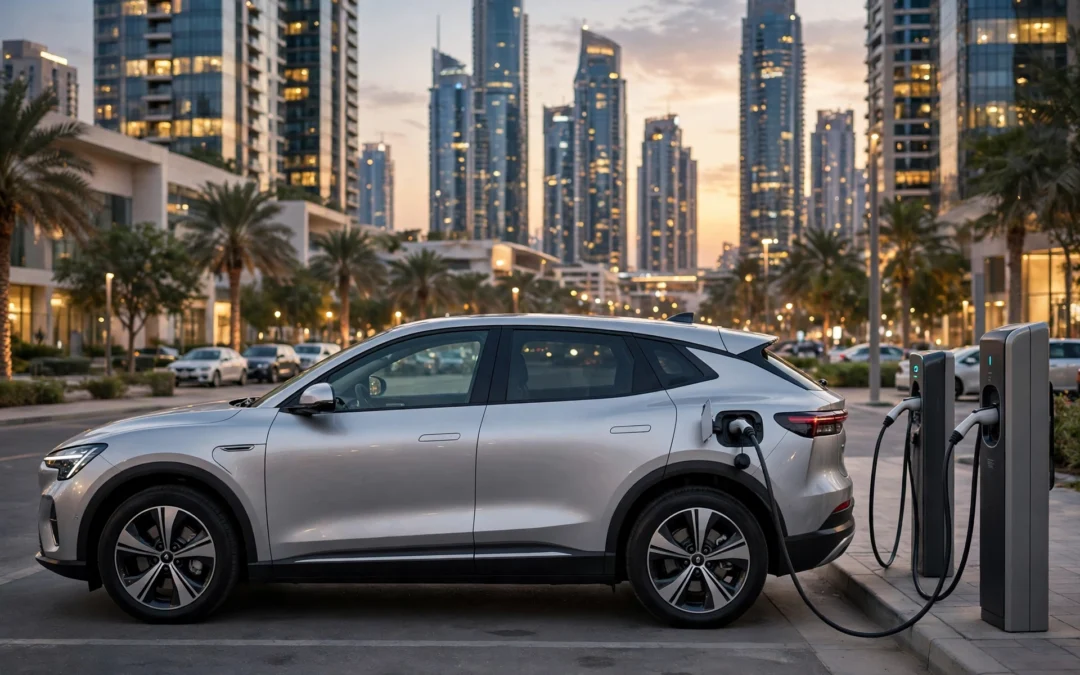
Walk through any car park in Dubai Marina or Business Bay now and count the Teslas, BYDs and Toyota hybrids. Five years ago they were a curiosity. Today they are everywhere — Model 3s doing the school run, Atto 3s parked outside the metro, Corolla Hybrids and Camry Hybrids queuing at the same petrol stations they barely need. And every one of those owners eventually asks the same question: what does this car actually need from a workshop?
The honest answer surprises most people. An electric car needs less maintenance than a petrol car — that part of the sales pitch is true. But “less” is not “none”. EVs still wear out tyres, still need brakes checked, still have a small battery that can leave you stranded, and still have a cabin filter choking on Dubai dust. Hybrids are a different story again: they still have an engine, so they still need oil — plus two jobs a petrol car never has. And in UAE heat, the one thing every EV owner should be watching is the battery, because 50°C summers are not what those cars were designed around.
This guide goes through it properly: what EVs still need, what they genuinely don’t, what Toyota hybrid owners need to know, how Dubai heat affects the battery, how charging works here, and — just as important — what a general mobile workshop can do for you and what genuinely belongs at the dealer. No scare stories, no invented prices, and wherever the answer depends on your exact model and year, we’ll say so and point you at your owner’s manual.
1. The short version: what an EV actually needs — and what it doesn’t
If you only read one section, read this one. A pure electric car — a Tesla Model 3 or Model Y, a BYD Atto 3 or Seal, a Hyundai Ioniq 5 — has no engine oil, no spark plugs, no fuel filter, no exhaust, no timing belt and no gearbox in the way you know it. That whole world of servicing simply disappears. Tesla says it plainly in its own maintenance guidance: its cars should generally be serviced on an as-needed basis, not on a fixed annual schedule. There is no yearly service stamp to chase.
What remains is a short list of wear items, and it is the same list on every EV: tyres, brakes, the 12V battery, the cabin air filter, wiper blades, suspension, and the cooling system that looks after the big battery. Everything else is checking, not replacing. That is why an EV service visit is usually quick — and why it costs less than the same visit on a petrol car. The trap is the opposite one: because nothing feels urgent, owners skip the checks entirely, and then a tyre wears through on Sheikh Zayed Road or the car refuses to wake up one morning with a full battery.
Here is the list of things an EV does not need, so you can stop worrying about them and stop paying anyone who tries to sell them to you:
- Oil changes. There is no engine oil. Any workshop offering you an EV oil change is selling you something that does not exist.
- Spark plugs, fuel filters and air filters for an engine. There is no combustion. The only filter is the cabin filter, which cleans the air you breathe.
- Exhaust work. There is no exhaust system at all.
- Timing belt or timing chain. There is no timing system. If you want to know what those parts do on a petrol car, and why their failure is so expensive, our guide to timing belt vs timing chain explains it — but on your EV, the question never arises.
- Emission tests. Nothing comes out of a tailpipe that isn’t there.
- Clutch or gearbox servicing in the conventional sense. Most EVs have a single-speed reduction gear with fluid that has no fixed replacement interval in the owner’s manual — the car tells you itself if it ever needs attention.
And here is what it does need, in the order that matters most in Dubai: tyres first, then the 12V battery, then brakes, then the cabin filter and air conditioning, then coolant and suspension. We will take each one in turn, because each one behaves differently on an EV than it does on the petrol car you came from.
One thing before we start: every interval in this guide comes from the manufacturers’ own published schedules, and those schedules differ by model and year. A 2023 Model 3 and a 2025 Model Y do not have identical lists. A BYD sold in Europe has a different schedule from a BYD sold in China. So treat the numbers here as the right starting point, then check your owner’s manual or the service screen in your car — Tesla owners can see exactly what is due under Controls, then Service, then Maintenance on the touchscreen. If a number here and your manual disagree, your manual wins.
2. Tyres: the one job EVs need more often, not less
This is the single biggest surprise for new EV owners, and the one that costs the most money if you ignore it. Electric cars eat tyres faster than petrol cars. Not a little faster — noticeably faster. Michelin puts the figure at roughly 20 per cent faster wear on average. UK fleet data found EVs carrying about 1.8 times as many tyre defects as petrol cars. The reasons are simple physics, and they are both built into every EV on Dubai roads.
First, weight. An EV is heavy. The battery pack sits under the floor and adds hundreds of kilos. Industry figures put the average EV at roughly 25 per cent heavier than a comparable petrol car. Every one of those kilos presses down through four small contact patches of rubber. Second, torque. An electric motor delivers its full pulling force the instant you touch the accelerator — there is no waiting for revs to build. That is what makes an EV feel so quick off the lights on Sheikh Zayed Road, and it is also what scrubs rubber off the driven tyres every single time you pull away briskly. Put the two together, add 50°C asphalt in July, and you have the fastest-wearing tyres most drivers have ever owned.
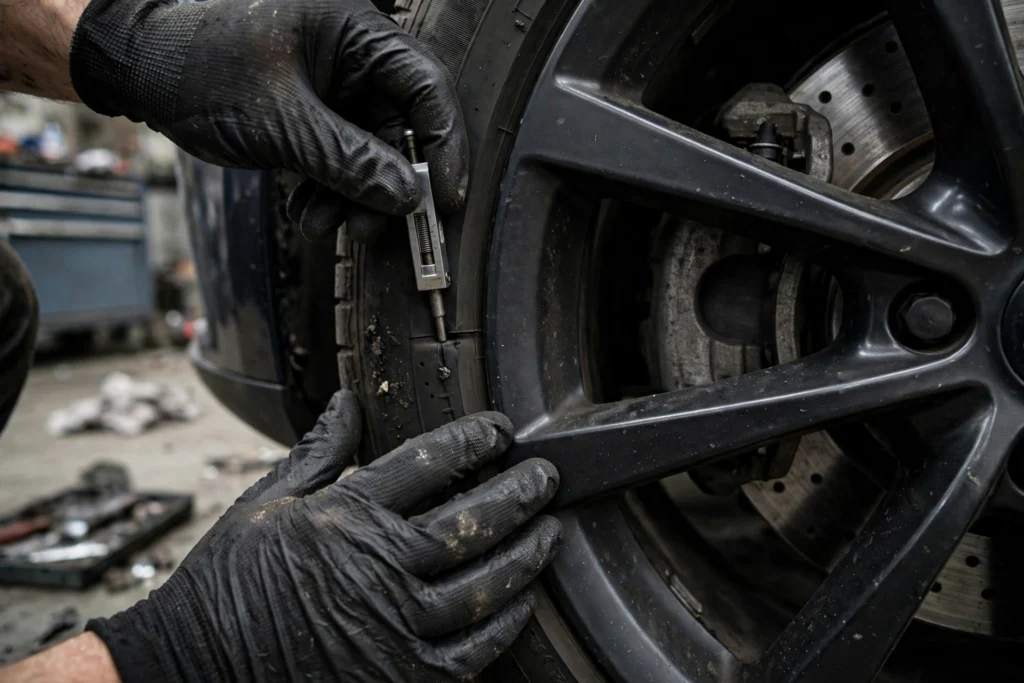
On a Tesla, the effect is strongest on the rear tyres, especially on dual-motor and Performance versions. Tesla’s own answer is the most frequent tyre rotation interval in the industry: rotate the tyres every 6,250 miles — about 10,000 km — or sooner if the tread depth differs by 2/32 of an inch (about 1.5 mm) between tyres. That is not a suggestion to file away; on an EV, skipping rotations is how you end up replacing two tyres at 20,000 km while the other two still look new. Our advice is the same for every EV, whatever the badge: rotate on the maker’s interval, check the tread every month, and check the pressures monthly too, when the tyres are cold — first thing in the morning, before driving. A tyre that has sat in the sun reads higher than it really is, and letting air out of a hot tyre leaves it underinflated.
Pressure matters more on an EV than on a petrol car, for two reasons. An underinflated tyre flexes more, heats up more, and wears its shoulders faster — and on a heavy car the effect is worse. And pressure affects range: soft tyres create more rolling resistance, so the car works harder and goes less far on a charge. The correct pressure is on the sticker inside the driver’s door jamb, not on the tyre sidewall, and not whatever the last person who touched the car guessed. Use that number.
When you do replace tyres, match or exceed the original load rating. EV tyres carry a heavier car, and a standard tyre with too low a load rating will wear out even faster and can overheat. Several tyre makers now sell EV-specific tyres with stronger sidewalls and foam inside to cut road noise — the quiet cabin of an EV makes tyre noise much more noticeable than in a petrol car, which is why the foam exists. You do not have to buy EV-branded tyres, but you do have to buy the right load rating and the right size, and the speed rating must match what the car came with.
Alignment deserves a mention here too. Get it checked once a year, and any time the car has hit a kerb or a hard pothole. On an EV, misalignment costs more tread than on a petrol car, because the tyre is already wearing faster — and the wear pattern to watch for is the inner edge going smooth while the rest of the tyre still looks fine. If you see that, or if the car pulls slightly to one side on a straight road, get the alignment checked before the next rotation, not after.
Finally, the spare tyre question. Many EVs have no spare at all — just a repair kit or nothing. Check what your car carries before you need it at midnight on Emirates Road. A mobile tyre service can reach you anywhere in the UAE, and our response time is 15–20 minutes, but it helps to know in advance whether your car has a spare, a sealant kit, or nothing but a phone number.
3. Brakes: they last longer, but they can seize from not being used
Here is the good news first: on an EV, brake pads last far longer than on a petrol car. Most of your slowing down is done by the electric motor, not the brake pads. When you lift off the accelerator, the motor turns into a generator, slows the car, and puts energy back into the battery — that is regenerative braking. The friction brakes, the pads and discs, only do the final part of the stop, or a hard stop when you really need it. Many EV owners go years without needing new pads. Tesla lists brake pad replacement as rare for exactly this reason.
But there is a catch, and in Dubai it matters more than most owners realise. Brakes that are hardly used do not stay in good condition by themselves. The discs are bare metal, and bare metal in humid air corrodes. Every time you wash the car, drive through a puddle, or park outside in a humid Dubai night, a thin layer of rust forms on the discs. On a petrol car, the next few stops scrub it off, because the brakes are used constantly. On an EV, the friction brakes may not get used for days at a time — and in the meantime, the rust builds up, the pads can stick to the discs, and the calliper slides can seize.
The first sign is usually a grinding or scraping noise when you do brake firmly, or a judder through the pedal. Sometimes the car feels like it is dragging slightly. Left alone, a seized calliper can wear a pad down to metal on one side while the other side looks new, and that is a real safety problem, not a cosmetic one. The fix is simple and cheap when it is caught early: the brakes need to be inspected, cleaned, and the calliper pins lubricated. Tesla’s schedule asks for brake cleaning and lubrication every 12 months or 12,500 miles — but only in places where roads are salted in winter, which Dubai is not. That does not mean Dubai cars are exempt. Our summers are humid, cars sit outside, and plenty of EVs here are parked for weeks while their owners travel. Any car that sits is a car whose brakes are quietly corroding.
So what should you actually do? Have the brakes inspected at every tyre rotation or at least once a year: pads, discs, calliper movement, and the brake fluid. A good habit, if your car allows it, is to deliberately use the friction brakes firmly once in a while — a few confident stops from moderate speed on a clear road, with nothing behind you, will clean the discs. Some EVs have a brake cleaning mode or let you reduce regeneration temporarily for exactly this purpose; check your manual. And never ignore a brake warning light, a soft pedal, or a pedal that travels further than it used to. Those are the symptoms that mean stop driving and call someone — the brakes are the one system where “it will probably be fine” is never the right answer.
Brake fluid is the other item people forget. It absorbs moisture from the air over time, and moisture lowers its boiling point, which is what makes the pedal feel spongy under hard use. Tesla asks for a brake fluid health check every four years, with replacement only if the check shows contamination. BYD’s European schedule replaces brake fluid every 24 months. Whichever your car follows, the principle is the same: fluid is checked on a calendar, not on mileage, because moisture gets in whether you drive or not. This is a quick test with a proper tester, and it is worth doing at the interval your manual states.
4. The small 12V battery: the part that strands EVs most often
If there is one section of this guide that saves you a bad morning, it is this one. Every EV and every hybrid has two batteries, not one. There is the big high-voltage battery that drives the car — the one everyone talks about — and then there is a small 12-volt battery, the same kind of battery a petrol car has, hiding somewhere you never look. The small battery runs the computers, the door locks, the screens, the lights, and the relays that connect the big battery when you start the car. There is no alternator on an EV. A small converter steps voltage down from the big battery to keep the 12V battery charged — but only while the car is awake and running.
Here is the part that catches people out: an EV with a completely full main battery can still be completely dead. If the small 12V battery cannot hold voltage, the car cannot close the relays that connect the big battery, and nothing happens. No unlock, no screen, no start — just silence, or a few confused warnings that appear and vanish. The main battery is sitting there, full of energy, and it cannot help, because the small battery is the key that wakes the car up.
This is not a rare edge case. In What Car?’s 2026 reliability survey of nearly 30,000 owners, the most common faults on electric models were not the motor and not the battery pack — they were 12-volt batteries and other small electrical niggles. Faults with the main battery pack made up only about 2 per cent of faults on new cars. Breakdown services say the same thing: tyres and the 12V battery are the two leading causes of EV call-outs, exactly as they are for petrol cars. And Dubai heat makes it worse. Heat is what kills 12V batteries. The motoring association AAA puts typical car battery life at three to five years, with the shortest life in the hottest regions — and Dubai is about as hot as it gets. Add a car that sits parked for weeks while its owner is travelling, with the alarm, the keyless entry and the telematics all sipping power the whole time, and you have the classic Dubai EV failure: car parked at the airport for three weeks, owner comes home, car dead.
The warning signs are worth knowing, because a 12V battery usually gives you a little notice — just not much. The car is slow to wake up, or the screens reboot when you start it. Several unrelated warnings appear at once and then clear themselves. The phone key stops working reliably. On a hybrid, you hear a click and the ready light never comes on. On a Tesla, the car may show a low-voltage battery warning on the screen or in the app. Some newer Teslas use a small lithium 12V battery instead of a lead-acid one, and those can fail suddenly, with almost no warning at all — one day fine, the next day nothing. That is not a defect; it is how that battery chemistry behaves, and it is why testing matters more than waiting for symptoms.
What should you do about it? Have the 12V battery tested at every service visit — a proper load test, not just a glance at the voltage. A voltage reading on a battery that has just been charged tells you almost nothing; a load test shows whether it can actually deliver power when asked. On a Toyota hybrid, the schedule includes a 12V test at the 15,000-mile visit, and the little battery often reaches the end of its life around 60,000 miles. On a BYD, early Atto 3 cars had well-reported 12V drain problems, and a 12V check belongs at every service. And if your car is going to sit unused for more than a couple of weeks, drive it first — a proper drive, not five minutes around the block — so the system has time to recharge the 12V battery. If the car is already dead, do not assume the big battery is the problem. Test the small one first. It is the fix that takes minutes, and it is the call we make most often on EVs.
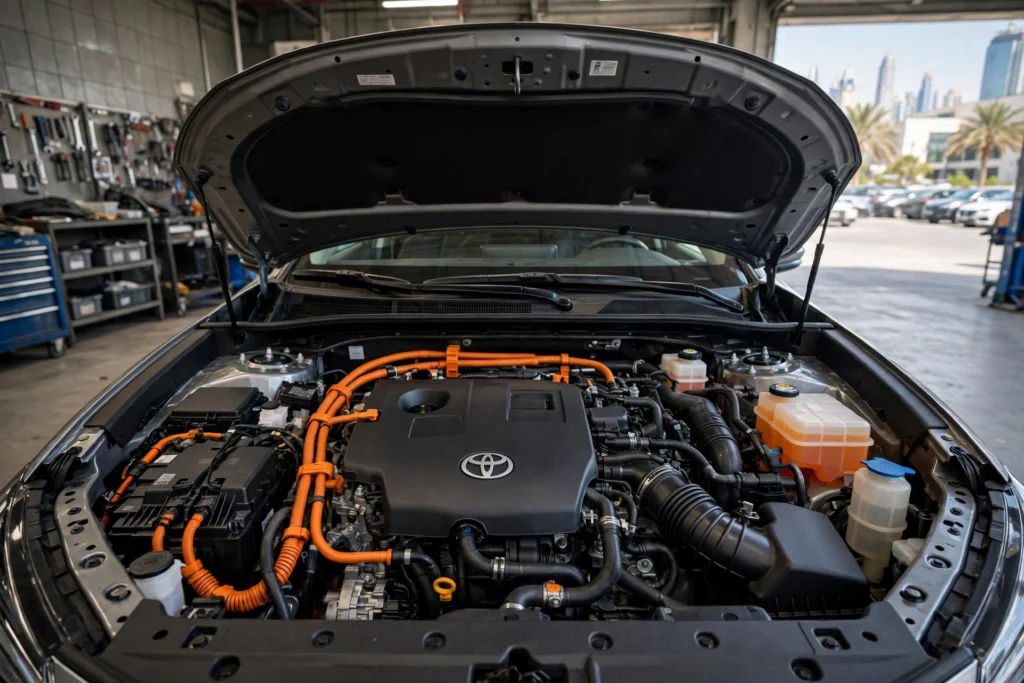
One safety note: the 12V battery on an EV or hybrid is an ordinary low-voltage part, and replacing it is ordinary work. The big battery is not. Never touch orange cables, never open the high-voltage battery case, and never let anyone who is not high-voltage qualified work on it. The orange colour is there for a reason — it means high voltage, and it means leave it alone.
5. Cabin filter and air conditioning: Dubai dust, Dubai heat
If there is one maintenance item that Dubai punishes more than anywhere else, it is the cabin filter. Your car pulls outside air through this filter before it reaches your face. In Dubai that air carries fine desert dust, sand, pollen and exhaust, all year round, and in a dusty week the filter loads up fast. A clogged cabin filter shows up as weak airflow from the vents, a musty smell when the air conditioning starts, windows that fog up inside, and an air conditioning system that has to work harder for less cooling. In a 48°C summer, weak airflow is not a comfort issue — it is the difference between a cabin that cools down and one that never quite gets there.
The intervals are straightforward. Tesla asks for a cabin air filter every two years on Model 3 and Model Y, and every three years on Model S and Model X. Cars with a HEPA filter system need those filters every three years as well. BYD’s European schedule replaces the cabin filter every 24 months. Toyota hybrids get a new cabin filter at the 15,000-mile visit. Those are the calendar numbers — but in Dubai, the honest answer is to check the filter when the symptoms appear, not only when the calendar says so. If the airflow has dropped, or the air smells stale when the AC starts, the filter is due whether the calendar agrees or not. It is a cheap part and a quick job, and it is the single most cost-effective thing you can do for your air conditioning.
We wrote a full guide to this, because the symptoms are easy to mistake for an air conditioning fault: cabin air filter symptoms in Dubai covers the musty smell, the weak airflow and the fogging, and what each one points to. If you have read that and the filter is not the problem, then the air conditioning itself needs looking at — and on an EV, the air conditioning matters more than it does on a petrol car.
That is because on many EVs, the air conditioning and the battery share the same cooling system. The heat pump or compressor that cools your cabin is also what keeps the battery at a safe temperature in a Dubai summer. Tesla’s air conditioning can draw 1 to 3 kW in normal use, and as much as 6 kW on the most demanding hot days — a big slice of the energy the car is using. When the AC is struggling because of a clogged filter, low refrigerant or a dirty condenser, the battery cooling suffers too. And a condenser clogged with fine sand and dust — which happens here, especially after a dusty week — cannot shed heat properly, so the whole system works harder and the range drops further.
A few habits make a real difference. Run the air conditioning regularly, even in the cooler months, so the seals stay lubricated and the system stays exercised. Use the car’s pre-conditioning — cooling the cabin while the car is still plugged in — so you are not asking the battery to cool a 70°C cabin from its own charge. Park in shade or covered parking whenever you can; a cabin that starts at 45°C instead of 70°C is far less work for the system. And if the air conditioning is blowing warm, making a new noise, or the airflow has dropped, get it checked promptly. On an EV, an air conditioning fault is never just about comfort.
6. Coolant and thermal management: the system that protects the battery
Ask most EV owners what coolant their car has and you will get a blank look. Petrol car owners know about coolant because the temperature gauge is right in front of them and the engine would boil without it. EV owners never see a temperature gauge, so they assume there is nothing to cool. There is — and in Dubai, it is one of the most important systems on the car.
A lithium-ion battery works best between roughly 20°C and 35°C. Above that, the chemistry inside starts to wear faster, and the damage is permanent and cumulative. Dubai in July is 45°C to 50°C in the shade, and a car parked in direct sun is far hotter than that. The only thing standing between that heat and the battery is the thermal management system: a liquid cooling loop that circulates coolant around the battery pack, a pump, hoses, a radiator at the front, and a control system that decides when to cool and how hard. On many cars the same loop also cools the power electronics and the motor. It runs while you drive, while you charge, and sometimes while the car is parked, quietly keeping the pack in its safe temperature band. You never hear it. You only notice it when it stops working.
What does this system need from you? Less than you might think, but more than nothing. The coolant itself is a long-life fluid — Tesla uses a premixed 50/50 ethylene glycol coolant and lists no fixed replacement interval in the owner’s manual. BYD’s European schedule replaces the power electronics coolant at 72 months or 90,000 km. Toyota hybrids have a separate inverter cooling loop using Toyota’s pink Super Long Life Coolant, with the first replacement at 150,000 miles. The point is that the interval is long, and it is different for every car, so the owner’s manual is the authority here, not a generic number.
What does need regular attention is the condition of the system, not just the fluid. Coolant levels drop slowly over time. Hoses crack under UV exposure and heat. The radiator fins at the front clog with fine sand and dust — a real Dubai problem, especially after the dusty weeks of spring and summer — and a clogged radiator cannot shed heat. A failing thermal management system cannot protect the battery, and the result is not a warning light on day one; it is a battery that quietly degrades faster than it should, year after year, until the range loss becomes obvious and irreversible.
So have the cooling system checked at every service: coolant level, hose condition, radiator cleanliness, and any sign of leaks. Look under the car yourself occasionally — a puddle of blue or orange liquid under an EV is coolant, and it means book a visit. On a Tesla, a “coolant low” alert means the same thing. Do not top up coolant yourself with water or the wrong type. Tesla’s coolant is a specific premixed formula and the manual warns that opening the reservoir can affect warranty coverage; BYD and Toyota each specify their own fluid. The wrong coolant in the wrong system can damage the pump and the seals. This is a check-and-top-up job for a workshop, using the fluid your car actually specifies.
7. Suspension, steering and alignment: carrying a heavy battery
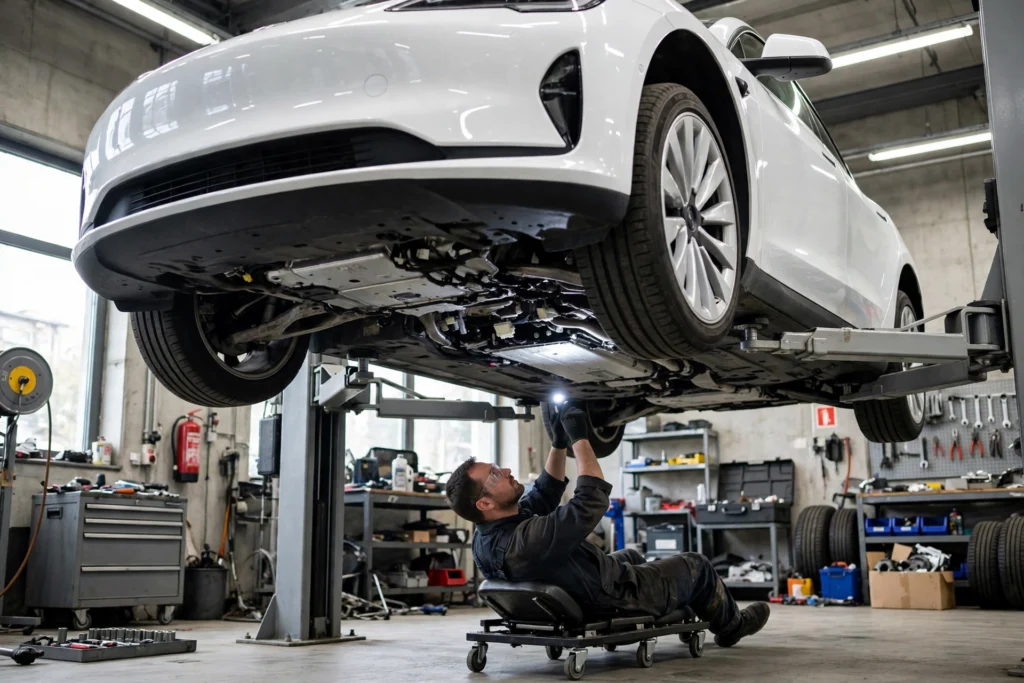
There is no engine in an EV, but there is still a suspension, still steering, and still a set of bushes, ball joints and shock absorbers doing exactly the same job they do on any car — except they are doing it under a heavier car. Remember the weight: an EV is roughly a quarter heavier than a comparable petrol car, and almost all of that extra weight sits low, in the battery pack. The suspension carries it all, every bump, every speed hump, every pothole.
The parts wear in the same ways they do on a petrol car, just a little sooner. Bushes harden and crack. Ball joints develop play. Shock absorbers lose their damping. The symptoms are the same too: a clunk over speed humps, a knocking noise on rough roads, steering that wanders slightly on a straight road, a vibration at motorway speed, or tyres wearing unevenly. On a Tesla Model 3, owners and workshops commonly report front suspension wear — control arms and ball joints — showing up from around 60,000 miles onwards. That is not a Tesla problem; it is a heavy-car problem, and it applies to any EV of similar weight.
What is different is that there is no engine noise to hide the small sounds. An EV cabin is quiet, so a worn bush or a tired shock absorber is audible much earlier than it would be in a petrol car. That is actually an advantage, if you listen. A new clunk, a new rattle, a new vibration — these are worth investigating early, when the fix is a bush, rather than late, when it is a bush plus a tyre plus an alignment.
Have the suspension and steering inspected at every service visit, and the alignment checked at least once a year and after any hard impact. The inspection is a visual and physical check: bushes, joints, dampers, springs, steering rack boots, and the condition of the underbody. The battery pack sits under the floor, protected by a metal plate, and that plate should be inspected too — a hard scrape on a speed hump or a rock can dent it, and a dented battery enclosure needs a proper assessment, not a shrug. If your car has been over a particularly nasty hump or a piece of debris, say so when you book the check. It takes five minutes on a lift to look, and it is the kind of thing you want to know about before it becomes a problem.
8. Software, recalls and updates: the service visit you never see
There is a kind of maintenance on an EV that has no equivalent on a petrol car, and it happens while you sleep. Software updates. A Tesla can gain range, change how its brakes behave, or fix a fault entirely through an overnight update. BYD pushes updates the same way. The car is, in a real sense, a computer with wheels, and keeping its software current is maintenance — not an optional extra.
Most updates arrive over the air, and most install without you doing anything more than accepting them. But there are a few things worth doing properly. Install updates when the car asks, rather than postponing them for weeks — updates often include safety fixes and battery management improvements, and delaying them means driving with a known issue the maker has already fixed. Make sure the car has a stable connection when updating — home Wi-Fi is better than a weak mobile signal in a basement car park. And after a major update, take a moment to check that everything behaves as expected: the charging, the climate, the driver assistance features. If something feels different after an update, note what changed and when, because that detail is exactly what a technician needs to hear.
Recalls are the other half of this. EVs have recalls like any car, and many of them are fixed by software. But some need a physical visit — a part replaced, a connector inspected, a seal changed. Check whether your car has any outstanding recalls at least once a year, through the maker’s app or website, or ask when the car is in for any other work. It costs nothing and it catches the things that never appear as a dashboard warning.
There is also a limit here that matters. Software is the maker’s territory. A general workshop cannot write Tesla software, cannot apply a BYD firmware update, and cannot clear a fault that lives in the maker’s own systems. What we can do is diagnose whether a problem is a software issue or a mechanical one, tell you honestly which it is, and send you to the dealer when the dealer is the only answer. A workshop that pretends it can reflash your car is a workshop to walk away from. The right question to ask any workshop is not “can you fix everything” but “will you tell me when you can’t” — and the answer should always be yes.
9. The big battery: health, degradation and UAE heat
Everything else in this guide is small money. The big battery is the one thing that makes EV owners nervous, and it deserves a straight answer. Yes, batteries degrade. No, it is not as fast or as catastrophic as the stories suggest — but in Dubai, the heat is real, and it does make a difference.
Here is what the data actually says. Fleet tracking data published by Geotab in 2026 puts average battery degradation at about 2.3 per cent of capacity per year. That is an average across climates, and it means a car that started with 400 km of range would have roughly 350 km after five years — noticeable, but not the disaster people imagine. Heat makes it worse. A Dubai garage’s own data suggests batteries here lose an extra 2 to 3 per cent of capacity per year compared with temperate climates, because high temperatures speed up the chemical reactions inside the cells. That is permanent and cumulative: every hot summer takes a little off, and you do not get it back.
The other side of that coin is the warranty. Most EV batteries in the UAE are covered for 8 years or 160,000 km, and the warranty typically guarantees a minimum retained capacity — usually around 70 per cent. With reasonable care, guides put the realistic life of a modern EV battery at 8 to 12 years, retaining 80 to 90 per cent of its capacity. The battery will not suddenly die at year eight. It will gradually hold a little less charge, and the car will gradually go a little less far. That is degradation, and it is normal. A sudden large drop, a battery that loses a quarter of its range in a year, or a car that shows wildly different range estimates from one day to the next — that is not normal degradation, and it needs a proper diagnostic.
Range in summer is a separate question from long-term degradation, and it confuses a lot of owners. In Dubai’s peak summer, your range will drop on the day — that is temporary, not damage. Comparative testing above 35°C found EVs losing 15 to 25 per cent of their rated range, and UAE summer afternoons push well past 35°C. The Tesla Model Y sits at the lower end of that range, thanks to its heat pump and active thermal management. Some fleet data shows Tesla vehicles achieving roughly 60 per cent of their advertised range in everyday real-world driving, all conditions included — a figure that already accounts for more than just heat. The two things eating your range on a hot day are the air conditioning, which can draw 1 to 3 kW normally and up to 6 kW on the most demanding days, and the battery’s own cooling system working hard to keep the cells in their safe band. Both are doing their job. The range comes back when the weather cools.
What can you actually do to look after the battery? More than you might think, and none of it is difficult:
- Park in shade or covered parking whenever you can. A car parked in direct sun in July is baking its battery. Basement or shaded parking is worth real money in battery life.
- Charge at night or in the early morning. The air is cooler, the battery is cooler, and the cooling system has less work to do.
- For most EVs, charge to 80 per cent for daily use. Most makers recommend this for cars with nickel-based batteries, because sitting at 100 per cent stresses the cells. BYD’s LFP Blade Battery is the exception — its chemistry needs a regular full charge on AC power so the battery management system can calibrate itself, and BYD’s own guidance calls for a battery self-calibration at least once every six months. Know which chemistry your car has before you follow generic advice.
- Avoid repeated fast charging of a hot battery. Fast charging generates heat, and if the pack is already hot from driving in July, the car’s system will slow the charge down to protect it — sometimes by half. That is a safety feature, not a fault. If you fast-charge every day in summer, you are asking the battery to run hot, constantly.
- Use pre-conditioning. Cooling the cabin while the car is still plugged in means the battery does not have to do that work from its own charge.
- Keep the cooling system healthy. That is section 6, and it matters more here than anywhere else in this guide. A battery with a failing cooling system in Dubai is a battery ageing fast.
Buying a used EV? Check the battery health first
If you are buying a used EV in Dubai, the battery health report is the single most important document in the deal — more important than the service history, and far more important than the paintwork. Ask for a state-of-health reading before you pay anything. On a Tesla, that means the battery health figures the car itself can show, or a report from the seller’s service records. On other cars, a diagnostic scan by a competent workshop can read the battery management system’s own data: capacity, cell balance, and any fault history. A car that has lost a lot of capacity is not necessarily a bad buy — it may be priced accordingly — but you need to know, because the battery is the most expensive part of the car and the one thing that decides what the car is worth.
Everything else on a used EV follows the same logic as any used car: tyres, brakes, suspension, accident history, and whether the car has outstanding finance or fines. We cover the full process in our guide to pre-purchase car inspection in Dubai, and the checks there — a proper inspection before you pay, including the accident history you can get free through the official government portals — apply to EVs just as much as to petrol cars. The only difference is that on an EV, the battery report sits at the top of the list.
10. Charging in Dubai: home wallbox, DEWA chargers and daily habits
Charging is the part of EV ownership that worries new buyers most, and it is the part that turns out to be the easiest once you have done it for a month. Dubai has the most developed charging network in the region, and it has been there longer than most people realise.
The backbone is DEWA’s Green Charger network, launched in 2014 as the first public EV charging network in the Middle East. By mid-2025, Dubai had more than 1,270 public charge points across the city, and independent operators licensed by DEWA — names like ChargeHub, Enova and Karwa — have been adding more. The network is no longer free, as it was in the early years: since Cabinet Resolution No. 81 of 2024, public charging across the UAE runs on a unified tariff, with AC charging at AED 0.70 per kWh plus VAT and DC fast charging at AED 1.20 per kWh plus VAT. Those are the official figures — check them again before you rely on them, because tariffs are reviewed, but they are the right ballpark for working out what a charge costs.
For most owners, though, the real charging happens at home. A wallbox charger — a dedicated 7 kW or 11 kW unit installed in your parking space — charges the car overnight, typically in four to six hours, and home electricity in Dubai runs at the residential tariff of roughly AED 0.30 to AED 0.44 per kWh depending on your consumption bracket. That makes home charging far cheaper than public charging, and it is the single best reason to get a wallbox if you can. Installation is a regulated electrical job, not a DIY project: it needs a certified contractor and approval from DEWA, and in an apartment building it needs the building management’s agreement as well. Guides report installation costs roughly in the range of AED 2,500 to AED 7,000 depending on the charger and the complexity of the install — get a proper quote for your own parking space, because the distance from your meter and the capacity of your building’s supply change the price. The charger itself should carry at least an IP65 rating to handle UAE heat, dust and sand.
If you live in an apartment without your own parking bay, the picture is improving but it is not perfect yet. Some newer buildings have shared chargers, and the public network covers malls, offices and petrol stations. But if you cannot charge at home, be honest with yourself about how the routine will work: you will be visiting public chargers several times a week, and that is a lifestyle change, not just a car change. Ask the building management what their EV charging policy is before you buy, not after.
A few daily habits make charging smoother. The standard connector for AC charging in the UAE is Type 2, which covers the vast majority of EVs sold here, including BYD, Hyundai and Kia; Tesla uses an adapter. For DC fast charging, CCS2 is the common standard. Keep your charging cable and any adapter in the car, not in the garage — you will need them away from home. If you use a DEWA charger, you will need a Green Charger account, which is registered through DEWA with your Emirates ID and a refundable deposit. And one practical tip for summer: avoid charging in direct sunlight in the middle of the day if you can. A battery that is already hot from sitting in the sun will charge more slowly, because the car protects itself by throttling the charge speed. Charge at night, and the car charges faster and the battery stays happier.
Finally, the RTA inspection. An EV or a hybrid still needs the same RTA roadworthiness test as any other car when its registration comes up for renewal — inspection is required once the car is more than three years old, the certificate is valid for 30 days, and the test itself costs AED 170. The test covers the same things it covers on any car: tyres, brakes, lights, suspension and steering. There is no separate EV test, and there is no emissions test to fail — which is one less thing to worry about at renewal time.
11. Toyota hybrids: the engine is still there — plus two hybrid-only jobs
Toyota hybrids are the most common electrified cars on UAE roads — Prius, Corolla Hybrid, Camry Hybrid, RAV4 Hybrid, Highlander Hybrid — and they confuse people in the opposite way to pure EVs. Owners either treat them like petrol cars and forget the hybrid system entirely, or treat them like EVs and forget the engine. The truth is in the middle: a Toyota hybrid is a petrol car with an electric helper, and it needs the maintenance of both.
The engine is still there, so the engine still needs servicing. Toyota’s rhythm for its hybrids is built on a 5,000-mile or six-month foundation — tyre rotation, multi-point inspection, fluid checks and an inspection of the hybrid battery cooling filter — with engine oil and filter every 10,000 miles or 12 months, using full-synthetic 0W-16 or 0W-20 oil depending on the model. Under severe conditions — frequent short trips, heavy stop-and-go traffic, dusty roads, which describes a lot of Dubai driving — the oil interval drops to 5,000 miles or six months. Spark plugs come up around 120,000 miles, the engine air filter at 30,000 miles, and the engine coolant at around 100,000 miles. None of this is exotic. It is the same schedule a petrol Toyota follows, and that is the point: the hybrid badge does not exempt the engine from oil.
What makes a hybrid different is two extra systems, and they are the two things a hybrid owner should know by name.
The first is the high-voltage battery cooling filter. Most Toyota hybrids cool their big battery with cabin air, drawn in through an intake vent near the rear seats and blown across the battery by a fan. A small filter keeps dust, pet hair and debris out of that fan. In Dubai, that filter loads up fast — dust is everywhere, and the intake is low, near the floor, exactly where dust settles. Toyota’s own technical service bulletin (T-SB-0062-20) says to inspect this filter every 5,000 miles and clean it every 20,000 miles, replacing it when it is damaged or heavily clogged. If the filter is blocked, the airflow drops, the battery runs hotter, and the car may reduce its electric assistance to protect the pack — which shows up as worse fuel economy and a hybrid system that seems to have gone quiet. It is a small part, in an unglamorous place, and it is the most commonly neglected item on a Toyota hybrid in this country. Check it, clean it, and keep it clean.
The second is the inverter cooling system. The inverter is the box of power electronics that converts the battery’s direct current into the alternating current the motors use, and it has its own dedicated cooling loop, separate from the engine radiator. It uses Toyota’s pink Super Long Life Coolant — the same pre-diluted 50/50 ethylene glycol formula as the engine loop, but in its own circuit. Toyota’s schedule calls for the first inverter coolant replacement at 150,000 miles or 180 months, then every 50,000 miles or 60 months after that, with level checks at every routine visit. Between replacements, what matters is the level and the condition: low coolant or contaminated coolant in the inverter loop can overheat the power control unit, and that is an expensive failure. So the inverter coolant level belongs on the checklist at every service, alongside the engine coolant.
Two more hybrid-specific notes. The transmission in a Toyota power-split hybrid is the eCVT — an electronically controlled continuously variable transmission that uses planetary gear sets rather than belts or pulleys. Toyota does not specify a fixed replacement interval for its fluid under normal driving; the guidance is inspection only. If a workshop tells you the eCVT fluid “must” be changed at a particular mileage, ask them to show you where Toyota says that — for your model and year, in the manual. And the 12V auxiliary battery: it gets tested at the 15,000-mile visit, and it commonly reaches the end of its life around 60,000 miles. On a hybrid, a tired 12V battery shows up as a click and no ready light — the same failure described in section 4, and the same quick fix.
One last thing about hybrids in Dubai: they are superbly suited to this city. Stop-start traffic is where a hybrid earns its money, because the electric motor does the low-speed work and the engine rests. But that also means the engine does a lot of short runs and cold starts in traffic, which is exactly the severe service pattern that shortens the oil interval. So if your Camry Hybrid spends its life in Dubai traffic, take the shorter oil interval seriously. The car will last longer for it.
12. Tesla and BYD in Dubai — and when to call a mobile mechanic instead of the dealer
That leaves the two brands Dubai asks about most, and the practical question every EV owner eventually faces: who do I actually call?
Tesla first. The schedule is the shortest in the industry, and it is worth writing down, because it is the whole list. Rotate the tyres every 6,250 miles (10,000 km), or sooner if tread depths differ by 2/32 of an inch. Replace the cabin air filter every two years on Model 3 and Model Y, every three years on Model S and Model X, and the HEPA filters every three years where fitted. Test the brake fluid every four years and replace it if the test shows contamination. Replace the wiper blades roughly once a year — our guide to wiper blades, washer jets and demisters in Dubai covers what the heat does to them. Clean and lubricate the brake callipers every year — but only where roads are salted in winter, which does not include Dubai. And that is it. No oil, no spark plugs, no timing belt, no coolant change on a fixed interval, no drive unit fluid on a fixed interval. The car tells you what is due on its own screen, under Controls, Service, then Maintenance, and it tells you itself if the drive unit fluid ever needs attention. If a workshop hands you a long Tesla service list with items that are not on the maker’s schedule, ask them which item comes from Tesla’s own guidance and which one they added. The honest answer is usually the short list above.
BYD is different, and it matters that you know which BYD schedule applies to your car, because the schedules genuinely differ by market. On the European schedule, a pure-electric BYD is serviced every 24 months or 30,000 km, with brake fluid and cabin filter replacement at the same 24-month visit, inspection of the high-voltage battery and cables, and the power electronics coolant replaced at 72 months or 90,000 km. In other markets, including China and Australia, the interval is shorter — every 12 months or 20,000 km. Plug-in hybrids like the Song Plus DM-i have their own schedule again: every 12 months or 15,000 km on the European schedule, with engine oil at every service, because the DM-i still has a petrol engine to look after. The first service on a DM-i is due at 3,500 km of hybrid-mode driving or six months, whichever comes first.
BYD’s battery is its Blade Battery — lithium iron phosphate, or LFP — which is more thermally stable than the nickel-based chemistry in many other EVs, and BYD quotes a six-year or 150,000 km vehicle warranty with an eight-year battery warranty. The LFP chemistry has one quirk owners should know: because its voltage barely changes across most of its charge range, the battery management system needs a regular full charge on AC power to calibrate itself. BYD’s own guidance calls for a battery self-calibration at least once every six months. So the generic advice to “never charge past 80 per cent” does not apply to your BYD the way it applies to a nickel-battery car — for an LFP car, a regular 100 per cent AC charge is part of the maintenance, not a mistake. And if your Atto 3 has ever been found dead in the morning with a full main battery, you are not alone: early Atto 3 cars had well-reported 12V battery drain issues, and the 12V check belongs at every service visit.
So when do you call us, and when do you go to the dealer? Here is the honest line.
Call a mobile mechanic — us — for: tyres and rotation, punctures, wheel alignment, brake inspection and cleaning, brake fluid testing, 12V battery testing and replacement, cabin filter replacement, wiper blades, air conditioning checks and re-gas, suspension and steering inspection, coolant level checks and top-ups with the correct fluid, underbody and battery enclosure inspection, a pre-purchase inspection on a used EV or hybrid, and any warning light or noise you want diagnosed before you decide what to do next. We come to you, anywhere in the UAE, and our response time is 15–20 minutes. We are open 24 hours. And our prices are very low.
Go to the dealer for: anything inside the high-voltage battery, the drive unit, the onboard charger or the inverter; any software update, firmware flash or recall work; any battery health warranty claim; and any fault that only the maker’s own diagnostic system can read. High-voltage work needs high-voltage qualification and the maker’s own tools, and no honest general workshop will pretend otherwise.
The grey area in the middle is diagnosis. If your EV has a warning you do not understand, or a noise you cannot place, or a range drop that feels sudden, the useful first step is often a proper inspection, not a guess. We can tell you whether the problem is a tyre, a 12V battery, a brake, a filter or a cooling issue — the things we can fix — or whether it is a high-voltage or software problem that belongs at the dealer. That diagnosis is worth having before you book anything, because it stops you paying dealer prices for a cabin filter and stops you waiting three weeks for a dealer appointment for a flat 12V battery.
Frequently asked questions
Do EVs need servicing at all in Dubai?
Yes — less than a petrol car, but not nothing. An EV still needs tyres rotated, brakes inspected, the 12V battery tested, the cabin filter replaced, the cooling system checked and the suspension looked at. Tesla’s own guidance is that its cars are serviced on an as-needed basis, with a short list of wear items rather than a fixed annual service. The items on that list are cheap to do and expensive to ignore.
How long does an EV battery last in UAE heat?
With reasonable care, guides put a modern EV battery’s life at 8 to 12 years, retaining 80 to 90 per cent of its capacity, and most are warranted for 8 years or 160,000 km. Fleet data puts average degradation at about 2.3 per cent of capacity per year, with heat adding roughly another 2 to 3 per cent a year in UAE conditions. Park in shade, charge at night, keep the cooling system healthy, and the battery will last far longer than the stories suggest.
Why did my EV die when the main battery was full?
Almost certainly the small 12V battery. It wakes the car up and connects the big battery, and when it fails, nothing happens — no unlock, no screen, no start — even with a full main battery. It is the most common EV fault in owner surveys, and Dubai heat shortens its life. Have it load-tested at every service, and test it first before assuming anything worse.
Do EV tyres really wear out faster?
Yes. EVs are roughly 25 per cent heavier than comparable petrol cars, and their instant torque scrubs rubber off the driven tyres. Michelin puts the extra wear at around 20 per cent faster on average, and fleet data found about 1.8 times as many tyre defects on EVs. Rotate on the maker’s interval — every 10,000 km on a Tesla — keep pressures at the door-jamb figure, and match the original load rating when you replace them.
Can a mobile mechanic service my Tesla or BYD?
For everything around the high-voltage system, yes: tyres, brakes, 12V battery, cabin filter, wipers, air conditioning, suspension, coolant checks and diagnostics. What a general workshop cannot do is open the high-voltage battery, repair the drive unit or onboard charger, or apply software updates — those belong at the dealer, and an honest workshop will tell you so.
Does a Toyota hybrid still need oil changes?
Yes. A Toyota hybrid still has a petrol engine, and it needs engine oil and filter every 10,000 miles or 12 months with full-synthetic 0W-16 or 0W-20 — or every 5,000 miles or six months in severe conditions like heavy Dubai stop-start traffic. On top of that, it has two hybrid-only jobs: the high-voltage battery cooling filter, inspected every 5,000 miles and cleaned every 20,000 miles, and the inverter coolant, first replaced at 150,000 miles.
Conclusion: less maintenance, not no maintenance
Electric cars really do need less maintenance than petrol cars. That is not marketing — it is arithmetic. Take away the engine, the gearbox, the exhaust and the fuel system, and you take away most of the service schedule with them. But the parts that remain are the parts that keep you safe and keep the car going: the tyres that grip the road, the brakes that stop the car, the small battery that wakes it up, the filter that cleans the air you breathe, and the cooling system that protects the most expensive part of the car in the hottest summers it will ever see.
None of those jobs is difficult. None of them is expensive when it is done on time. And every one of them is worse when it is left — a tyre worn through on the motorway, a brake calliper seized from months of disuse, a 12V battery that dies in an airport car park, a battery cooling system quietly failing while the pack ages faster than it should. The pattern is the same on every car we see: the cheap check you skip becomes the expensive repair you did not expect.
If your EV or hybrid is due a check, or if something does not feel right — a noise, a warning, a range drop, a car that is slow to wake — call or WhatsApp 95 Services on +971 54 344 3513. You can see everything we cover on our car repair and maintenance services page. We are open 24 hours, we come to you anywhere in the UAE, our response time is 15–20 minutes, and our prices are very low. Tell us the make, the model and the year, and we will tell you honestly what it needs, what it does not, and whether it is a job for us or a job for the dealer.
