
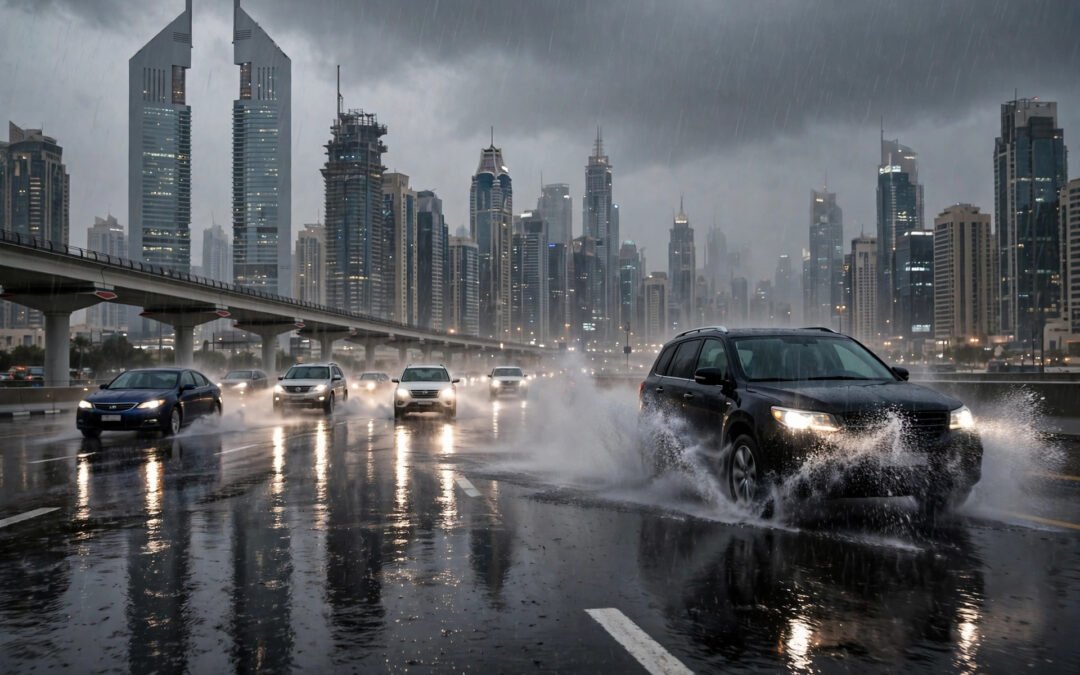
Driving in Rain in Dubai: First-Rain Roads, Aquaplaning and the Checks to Do Before a Wet Morning
Rain in Dubai is a strange thing. For months at a time the sky is clear, the roads are dry, and the only water your car ever sees is the wash at the petrol station. Then one morning the sky turns grey, the wind picks up, and the rain comes down — and suddenly everybody is driving like it is the first time they have ever seen water fall from the sky. In a way, it is. Not the first time, exactly, but the first time in a long while, and that gap is exactly what makes rain driving here so different from rain driving in a place where it rains every week.
I have spent years working on cars in Dubai, and I can tell you this plainly: most of the trouble I see on rainy days is not caused by the rain itself. It is caused by the months of dust before it, the worn wipers nobody noticed all summer, the tyres that were already tired, and the habit of driving at dry-road speed on a wet road. The rain only shows up what was already there. If you understand that, you can drive in the rain safely, calmly, and without the white-knuckle feeling that so many drivers describe to me the next morning in the workshop.
This guide is written for drivers, not for mechanics. I will not drown you in technical talk. I will tell you what actually happens on Dubai roads when it rains, what aquaplaning feels like and what to do when it happens, how to see properly when the rain is coming down hard, how much extra room you really need, what to do about flooded underpasses and standing water, and — most usefully of all — the short list of checks to do before a wet morning so that you are not discovering a problem at speed on Sheikh Zayed Road. Where the rules matter, I will point you to the official source, and where something depends on your car, I will tell you to check it rather than guess.
Why Rain Driving in Dubai Is Different
In a city where it rains often, drivers and roads both stay ready for it. The roads get washed regularly by the rain itself. Drivers keep their wipers fresh because they use them every week. Tyres get tested in the wet all the time. Nobody is surprised.
Dubai is the opposite. We can go for months with almost no rain at all. During those dry months, dust settles on every road in the city. It is fine, pale dust, and it gets into every crack and corner. At the same time, cars leave tiny traces of oil on the road surface — a drop here, a thin smear there, from thousands of cars passing every day. In dry weather none of that matters much. Your tyres grip the dry asphalt, the dust blows away or gets pressed into the surface, and you never notice it.
Then the first rain arrives. The water does not wash that dust and oil away straight away. First it mixes with them. The result is a thin, greasy film across the road, and that film is more slippery than a road that has simply been rained on for hours. I have driven on it myself many times, and I have had customers describe it to me in almost the same words every year: "The road looked wet, not dangerous, but the car felt light." That light feeling is the film. It is worst in the first hour or so of the first rain after a long dry spell, and it is worst on roads that carry a lot of slow traffic, at junctions, at roundabouts, and on the painted markings and metal covers that are already smooth when dry.
The second thing that makes Dubai different is the rain itself. When it rains here, it often rains hard and suddenly. A light drizzle that goes on for hours is rare. What we get, more often, is a heavy burst — the sky opens, the road fills with water in minutes, the spray from the car in front turns into a white wall, and then it stops almost as quickly as it started. That suddenness catches people out. One minute you are driving normally in the dry, the next you are in a downpour with standing water on the road and visibility cut in half, and you have had no time to slow down gradually or think about it. The drivers who cope best are the ones who slow down the moment the rain starts, before the road has a chance to surprise them.
The third difference is us — the drivers. Because rain is rare here, many of us have very little practice driving in it. We are excellent drivers in dry heat and bright sun, because that is what we do every day. In rain, the same driver can feel like a beginner again, and that is nothing to be ashamed of. It just means you need to slow down more than you think, leave more space than you think, and be honest with yourself about what you can and cannot see. There is no prize for keeping your normal speed in the rain. There is only a longer stopping distance and a smaller margin for error.
So when I talk about driving in rain in Dubai, I am not talking about rain in general. I am talking about this city: long dry spells, dusty roads, sudden heavy rain, deep standing water in low places, and drivers who may not have driven in rain for months. Keep that picture in your mind as you read the rest of this guide, and everything else will make sense.
The First Rain: Oil, Dust and the Slippery Film Nobody Can See
Let me start with the first rain, because it is the part most drivers get wrong, and it is the part that causes the most small accidents — the rear-end shunts, the slides at roundabouts, the cars that spin a little at a junction and scare their drivers badly.
Picture a road that has not seen rain for four or five months. Every day, thousands of tyres have rolled over it. A little dust has settled. A little oil has dripped. Brake dust, rubber dust, sand blown in from open ground, all of it has been pressed into the surface. In dry weather, your tyres push through that layer and grip the asphalt underneath. It is not perfect, but it is good enough, and you never notice it.
Now the first rain starts. The first drops of water land on that dry layer and mix with the dust and the oil. They do not wash it off. They turn it into a thin paste, a slippery film that sits on top of the road. For a while, your tyres are not gripping asphalt at all. They are gripping that film, and the film is sliding on the road underneath. That is why the first hour of the first rain is the most dangerous time to be driving. The road looks wet and normal, but the grip is far lower than it looks.
I have seen this happen in the workshop car park and on the roads around it. A customer comes in after the first rain of the season and says, "I was only going slowly, and the car just slid at the roundabout." They were not driving badly. They were driving on a road that had changed under them without looking any different. The same roundabout in the dry would have been fine at that speed. In the first rain, it was not.
Here is what that means for you in practice. When the first rain starts after a long dry spell, slow down more than you think you need to. Do not wait until the rain gets heavy. The slippery film is at its worst when the rain is light and has only just started — just enough water to mix with the dust and oil, not enough to wash it away. As the rain goes on and gets heavier, the film does wash off, and the grip does improve, but it improves slowly, and it is never as good as a dry road. So the rule is simple: the first rain is the worst rain. Treat it that way.
Be extra careful in the places where the film builds up most. Junctions and traffic lights are one, because cars stop and start there, and oil drips there, and the road surface gets polished by thousands of braking tyres. Roundabouts are another, because you are turning while you are braking or accelerating, and a slippery surface punishes turning more than it punishes going straight. Painted road markings, zebra crossings, and metal manhole covers are another — they are smooth when dry, and in the first rain they can be like ice. Try not to brake hard while you are on a painted line or a metal cover. Brake before it, in a straight line, and roll over it gently.
The other place to watch is the outside lane on a big road. After months of dry weather, the dust and oil collect where the traffic is slowest and heaviest, and water pools where the road is lowest. On Sheikh Zayed Road in the rain, the middle lanes often drain better than the slow lane, and the fast lane can have its own pools where the road dips. I am not telling you to change lanes in the rain to chase a drier patch — changing lanes in heavy rain is a risk in itself. I am telling you to expect that the grip will not be the same across the whole road, and to leave enough space that a small slide does not become a big problem.
One more thing about the first rain: it is also the rain that finds the weak points on your car. The wipers that have been sitting in the sun for months. The windscreen that has a thin film of dust and grime on it. The tyres that were already worn. The brakes that were already a little soft. In dry weather, those things hide. In the first rain, they show themselves all at once. That is why the checks at the end of this guide matter so much. They are not a luxury. They are the difference between a wet morning that goes fine and a wet morning that ends with a call to a workshop.
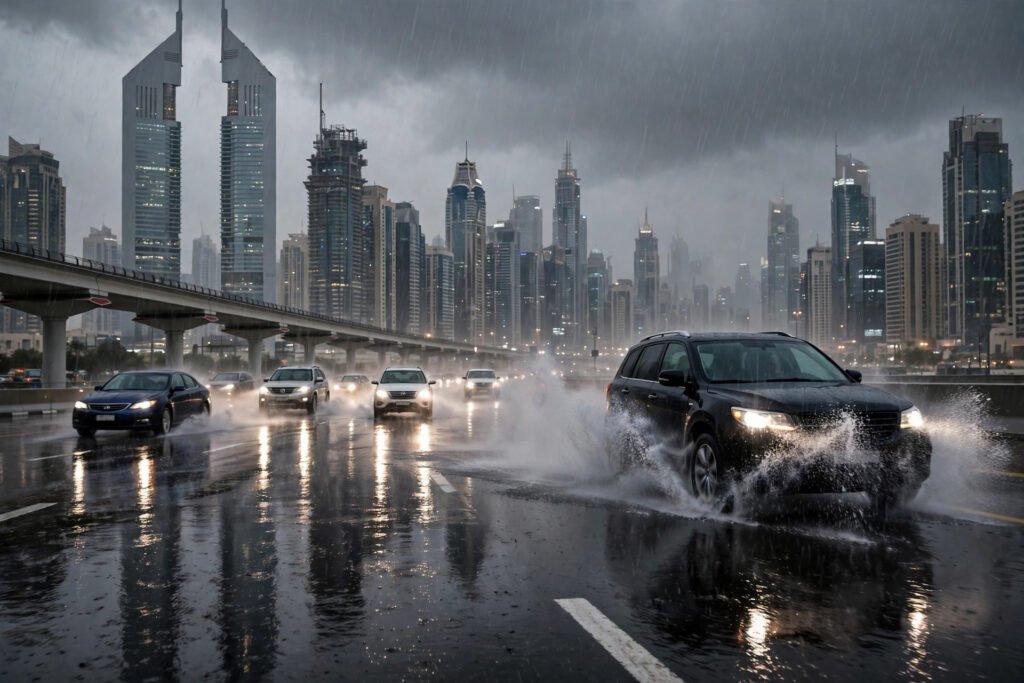
Aquaplaning: What It Feels Like, and What to Do When It Happens
Aquaplaning is the word that scares people most when they talk about rain driving, and it is also the word most people misunderstand. Let me explain it in plain words, because once you understand what is happening, you will know what to do — and, more importantly, what not to do.
Your tyres grip the road because they push the water out of the way. Every tyre has grooves in it, and those grooves are there to channel water away from the contact patch — the small area where the tyre actually touches the road. At low speed, on a road with a thin layer of water, the tyre can push the water aside fast enough, and it stays in contact with the asphalt. As you go faster, or as the water gets deeper, the tyre has to push more water out of the way in less time. At some point, it cannot keep up. The water builds up in front of the tyre, lifts the tyre off the road, and the tyre starts to ride on top of the water instead of on the asphalt. That is aquaplaning. The car is no longer being steered or braked by the tyres. It is floating, and it will keep going in the direction it was already going, no matter what you do with the steering wheel.
That sounds terrifying, and it can be, but let me tell you what it actually feels like, because knowing the feeling in advance helps you stay calm. The first sign is usually the steering. It goes light — very light, almost loose. You turn the wheel a little and nothing happens, or the car feels as if it is not responding the way it normally does. The engine note can change too, because the wheels are spinning more freely, and you may hear the spray change. Some drivers describe it as the car feeling as if it is floating or gliding. Others say it felt as if the road had disappeared. If you feel that, you are probably aquaplaning, even if only for a second or two.
The speed at which aquaplaning happens is not a single number. It depends on how deep the water is, how worn your tyres are, how wide your tyres are, and how much air is in them. Deeper water makes it happen at lower speed. Worn tyres make it happen at lower speed, because the grooves are shallower and cannot move as much water. Under-inflated tyres make it worse too. A new tyre with deep tread on a road with a thin film of water can cope at a speed that would be dangerous for a worn tyre in standing water. That is why I always say the same thing in the workshop: your tyres are your first defence against aquaplaning, and they are the part of the car you can actually control before the rain starts.
I will say more about tyre tread in the checks section, but here is the plain version. Look at your tyres. If the tread looks shallow, if the grooves look worn smooth, if you can see the wear markers sitting level with the surface of the tyre, then those tyres are already struggling in the wet, even before the rain gets heavy. A tyre with good tread clears water. A tyre with worn tread does not. There is no driving trick that makes up for a worn tyre in standing water. The only fix is a tyre with tread on it. If you are not sure about your tyres, read our guide on tyre repair services in Dubai and get them looked at before the next wet morning, not after it.
So what do you do if it happens? The answer is simple, but it goes against your instincts, so it is worth reading twice. First, do not brake hard. Do not stamp on the brake pedal. Hard braking while the tyres are not touching the road will not slow the car down, and when the tyres do touch the road again, the car can pull sharply to one side. Second, do not turn the steering wheel sharply. The car is not responding to steering right now, and a big steering input will only make things worse when the grip comes back. Third, ease off the accelerator gently. Take your foot off the pedal smoothly, do not lift it suddenly, and let the car slow down on its own. As the speed drops, the tyres will push the water aside again, they will touch the road, and the steering will come back. When it does, steer gently, in the direction you want to go, and brake gently if you need to.
I know that sounds like doing nothing, and in a way it is. But doing nothing, gently, is the right thing when the car is floating. The car will slow down on its own as the water drags on it. The danger is in the panic — the hard brake, the sharp turn, the sudden lift — that turns a short float into a spin. If you have ever felt the steering go light in the rain and wondered what just happened, that was probably a brief aquaplane, and the fact that you are reading this means you got through it. Next time, you will know what it is, and you will know to stay calm and let the speed fall.
The best way to deal with aquaplaning, though, is to avoid it in the first place. Slow down before you reach standing water, not when you are already in it. If you can see water lying across the road ahead, lift off the accelerator early and let the car slow down before it reaches the water. Do not drive through the deepest part if you can avoid it — the water is usually deeper at the edges of the road and in the dips, and shallower where other cars have already driven through. Follow the tracks of the car in front, where the water has already been pushed aside, but keep a long gap behind that car, because you need the space to stop. And if the rain is so heavy that you cannot see the road surface at all, slow down a lot, or pull over somewhere safe and wait for the worst of it to pass. There is no journey in Dubai that is worth driving blind through standing water.
One more point, and it matters in Dubai more than in most places. Our rain often comes in sudden bursts, and the water can be deep in one place and gone a hundred metres further on. That means you can be aquaplaning one moment and back on dry grip the next. That sudden change is another reason not to make big steering or braking inputs in the wet. When the grip comes back, it comes back suddenly, and a steering wheel that is turned hard will send the car sharply in that direction. Keep the wheel straight, keep your inputs small, and let the car settle. That is how experienced drivers get through it, and it is how you will too.
Wipers and Visibility: Seeing Properly When the Rain Comes Down
You cannot drive safely in the rain if you cannot see properly, and in Dubai the visibility problem is worse than most people expect. It is not just the rain on the windscreen. It is the spray from the car in front, the mist on the inside of the glass, the glare from headlights on wet roads at night, and the wipers that have been baked by the sun for months and have gone hard and cracked without anyone noticing.
Let me start with the wipers, because they are the most common problem I see after a rainy day, and the easiest to fix. A wiper blade is a strip of rubber. In Dubai heat, that rubber sits on a hot windscreen, in direct sun, for months at a time. It dries out. It hardens. It cracks. The edge that is supposed to sweep the water away cleanly becomes rough and uneven, and instead of clearing the glass it smears the water across it, leaves streaks, and makes a juddering noise as it moves. In the dry, you never notice, because you never use the wipers. In the first rain, you switch them on, and suddenly you cannot see through the smear.
I see this every rainy season. A customer comes in and says, "The wipers were fine last year." They were not fine. They were worn last year too, but last year the rain was light, or the customer did not drive far in it. This year the rain is heavier, or the drive is longer, and the worn blades cannot cope. Wiper blades are not a part that lasts forever in this climate. The sun ages them even when they are not being used. If your wipers are more than a year old, or if they streak, judder, squeak, or leave bands of water on the glass, they need changing. It is a small job, and it makes a huge difference to what you can see.
Here is a simple test you can do at home, before the rain starts. Spray some water on the windscreen — a bottle of water will do — and switch the wipers on. Watch what happens. A good blade clears the glass in one smooth sweep, with no streaks and no noise. A worn blade leaves lines of water, or a hazy film, or it chatters across the glass. If you see that, change the blades. Do not wait for the rain to test them for you. And when you change them, change both. The passenger-side blade matters just as much as the driver's side, because you need to see the whole road, not just the half in front of you.
The rear wiper matters too, if your car has one. Many drivers forget it completely. In rain, the rear window gets covered in spray and road grime, and if you cannot see behind you, you cannot change lanes safely and you cannot judge what is coming up behind you. Check it the same way, and change it if it streaks.
But wipers are only half the visibility story. The other half is the windscreen itself. After months of dry weather, a windscreen builds up a thin film of dust, traffic grime, and — in some cars — a waxy residue from cleaning products or from the air conditioning. In the dry, you do not notice it. In the rain, the water beads on it unevenly, the wipers smear it, and the glare from oncoming headlights scatters across it. If your windscreen looks hazy when the sun hits it at a low angle, or if the wipers seem to smear no matter how new the blades are, the glass itself may need a proper clean. Clean the outside with a proper glass cleaner, and clean the inside too — the inside of the windscreen collects a film from the dashboard plastics and from the air conditioning, and that film is what makes the glass mist up so quickly in the rain. If the windscreen is chipped or cracked, get it looked at as well, because a crack can spread in bad weather and a damaged windscreen is harder to see through when it is wet. You can read more in our guide on car windshield replacement in Dubai if you are not sure whether a chip is safe to leave.
Then there is the mist on the inside. This is the visibility problem that catches people by surprise, because it happens after you have already started driving. You get in the car, the rain is falling outside, the air inside is warm and damp, and the windscreen starts to fog up from the inside. The demister is the answer, and I will cover it properly in the checks section, but here is the short version for when you are already driving: switch the demister on, switch the air conditioning on with it, and direct the air to the windscreen. The air conditioning dries the air, and dry air clears mist far faster than warm air alone. Do not try to wipe the inside of the windscreen with your hand or a cloth while you are driving. It smears, it distracts you, and it does not last. Use the demister, and give it a minute to work.
Spray is the other visibility problem, and it is the one that worries drivers most on Sheikh Zayed Road in heavy rain. The car in front of you throws up a wall of spray, and for a few seconds you cannot see the road at all. The answer is distance. If you are close behind the car in front, you are driving in its spray. If you drop back, the spray thins out, and you can see again. That is another reason the following distance in the rain needs to be much longer than in the dry — not just for braking, but for seeing. I will come back to following distance in a moment, but remember this: in heavy rain, the gap is your visibility as well as your safety margin.
At night, rain driving gets harder again. Wet roads reflect headlights, the glare from oncoming cars scatters across a wet windscreen, and the road markings can be hard to see under standing water. Slow down more at night in the rain than you would in the day. Make sure your headlights are clean — a thin layer of dust on a headlight lens cuts the light badly, and in the rain you need every bit of light you have. And if your headlights seem dim, or one is not working, do not drive in the rain at night until it is fixed. You need to see, and other drivers need to see you.
Lights: Being Seen Is Half the Job
In rain, your lights are not just for you. They are for the other drivers. When visibility is poor, the car in front of you is a shape in the spray, and its lights are often the first thing you see. Your lights are the first thing the driver behind you sees. If your lights are off in heavy rain, you are much harder to see, and you are much more likely to be involved in an accident that was not your fault.
The rule I give every driver is simple: if the rain is heavy enough that you need the wipers on, switch your headlights on too. Not the parking lights. Not the daytime running lights alone. The dipped headlights. Dipped headlights make you visible from the front and from behind, because they switch the tail lights on as well. Daytime running lights, on many cars, only light the front, and the back of the car stays dark. In heavy spray, a car with no tail lights is almost invisible from behind, and that is a dangerous place to be.
Do not use your hazard lights while you are driving in the rain. I see this a lot in Dubai, and I understand why people do it — they want to warn other drivers that the rain is heavy and they are going slowly. But hazard lights are for a car that has stopped, or is in trouble. When you drive with them on, other drivers cannot tell whether you are turning, braking, or changing lanes, because your indicators are hidden by the flashing hazards. It also makes it harder for the driver behind you to judge your speed. If the rain is so heavy that you feel you need hazard lights to be safe, that is a sign you should pull over somewhere safe and wait, not a sign to keep driving with the hazards on. Pull over, switch the hazards on then, and wait for the worst of the rain to pass.
Fog lights are another thing people get wrong. Rear fog lights are very bright, and they are meant for thick fog, when visibility is extremely poor. In ordinary rain, a rear fog light can dazzle the driver behind you, and it can hide your brake lights. Only use the rear fog light when the visibility is truly bad — when you can barely see the car in front of you — and switch it off as soon as the visibility improves. Front fog lights are less of a problem, but they do not help much in rain, and they do not replace dipped headlights. Use the dipped headlights first, and only add the fog lights if the conditions genuinely call for them.
Check your lights before the wet season, not during it. Walk around the car and check every light: dipped headlights, main beam, tail lights, brake lights, indicators, and the number plate light. Get someone to press the brake pedal while you stand behind the car, or reverse up to a wall at night and watch the reflection. A brake light that is out is a serious problem in the rain, because the driver behind you is relying on it to know you are slowing down. An indicator that is out is a problem too, because lane changes in the rain need clear signals. These are small checks, and they take five minutes, but they matter.
One more thing about lights and rain: keep them clean. A headlight lens covered in dust and dried road grime gives out far less light than a clean one, and in the rain the difference is obvious. Wipe the headlights and tail lights when you wash the car, and wipe them again if you are setting off in the rain after the car has been parked for days. It takes a minute, and it is one of the easiest improvements you can make.
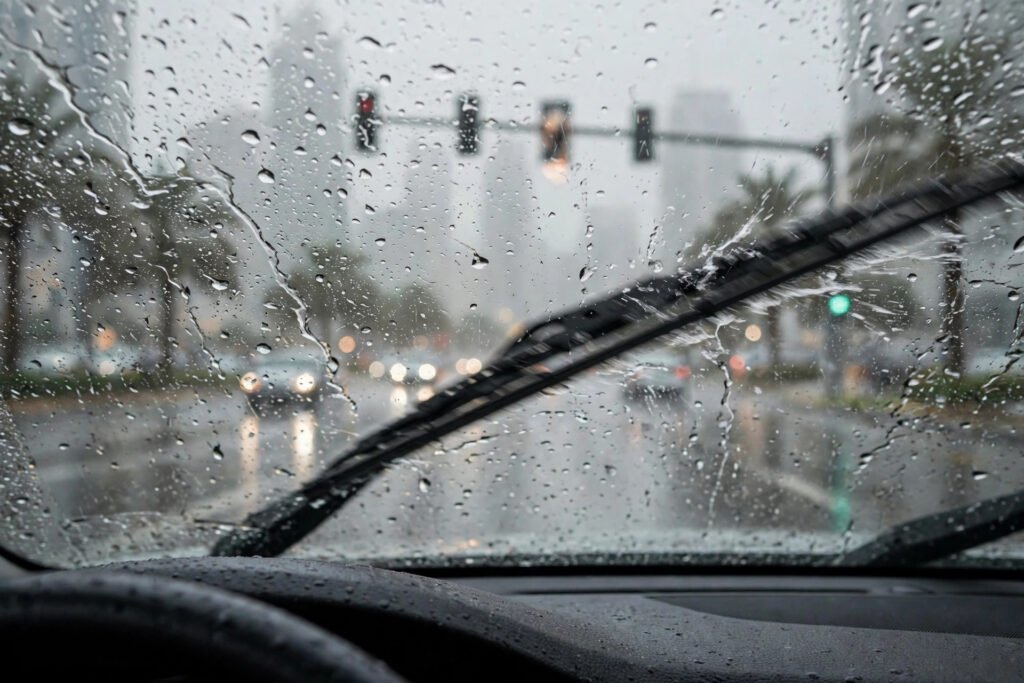
Following Distance and Braking Distances in the Wet
If there is one habit that would prevent more rain accidents in Dubai than any other, it is this: leave more space. More space than you think you need. Then a little more again. In the dry, a short gap feels normal, because your car stops quickly and the car in front stops quickly too. In the wet, everything changes, and the gap that felt safe in the dry is not safe any more.
Let me explain why, in plain words. When you brake, your tyres have to grip the road and slow the car down. On a dry road, the grip is good, and the car stops in a short distance. On a wet road, the grip is lower, because there is a thin layer of water between the tyre and the asphalt. The tyre has to push that water away before it can grip, and while it is doing that, the car is still moving forward. The result is that the car takes longer to stop — much longer. In heavy rain, or on a road with standing water, the stopping distance can be far longer than in the dry, and it can be longer still if your tyres are worn or your brakes are not in good condition.
I do not want to give you a false sense of precision by quoting a single number, because the real distance depends on your speed, your tyres, your brakes, the depth of the water, and the road surface. What I can tell you, from years of seeing the results, is that the difference is big, not small. A car that stops comfortably behind another car in the dry can run into the back of it in the wet at the same speed and the same gap. That is why the gap matters so much. It is not about being a cautious driver. It is about giving yourself the room that the wet road actually needs.
The practical rule is simple. In the dry, most drivers are taught to leave a gap of a few seconds behind the car in front. In the rain, double it. Then double it again if the rain is heavy, or if you cannot see the road surface, or if the car in front is throwing up a lot of spray. I know that sounds like a lot, and I know that on a busy road in Dubai, a big gap invites another car to pull into it. That is frustrating, but it is still better than being too close. If someone pulls into your gap, drop back again and make a new gap. Do not close up behind them to stop it happening again. The gap is not a space you own. It is a space you need, and you need to keep making it.
Speed is the other half of this. The faster you go, the longer it takes to stop, and the longer it takes grows quickly as speed rises. A small increase in speed makes a big difference to stopping distance in the wet. That is why slowing down in the rain is not just good advice, it is the single most effective thing you can do. If you drop your speed by a third in heavy rain, you have given yourself far more room to stop, and you have given your tyres a far better chance of clearing the water. You will still get where you are going. You will just get there a few minutes later, and you will get there safely.
Braking technique matters too. In the rain, brake gently and early. Start braking sooner than you would in the dry, and press the pedal smoothly, not sharply. If your car has anti-lock brakes — and most modern cars do — the system will stop the wheels from locking up if you brake hard, and you will feel the pedal pulsing under your foot. That pulsing is normal. Do not lift off the pedal when you feel it. Keep pressing, and steer gently. But the aim is not to need the anti-lock system at all. The aim is to brake early and gently, so that the car slows down smoothly and you never have to brake hard in the first place.
Be especially careful when you are braking on a wet road that is also turning, or when you are braking over a painted marking, a metal cover, or a patch of standing water. In those places, the grip can drop suddenly, and a hard brake can lock a wheel or make the car slide. Brake in a straight line, before the turn, before the marking, before the water, and then roll through gently. If you need to slow down in the middle of a turn in the rain, do it gently, with a light touch on the pedal, and do not make any sudden movements with the steering wheel.
Finally, remember that the car behind you is dealing with the same wet road. If you brake suddenly, the driver behind you needs even more room to stop than you do, because they have to react first and then brake. That is another reason to brake early and smoothly, and to give a clear signal. Tap the brakes gently well before you need to stop, so that your brake lights warn the driver behind you. Use your indicators early for turns and lane changes. In the rain, communication with other drivers matters more, not less, because everyone is working with less grip and less visibility.
Flooded Underpasses and Standing Water: The Water You Cannot Judge
Dubai has places where water collects when it rains. Underpasses are the most obvious. A road that dips down under another road, or under a bridge, can fill with water very quickly in a heavy downpour, because the water runs down into the dip and has nowhere to go. Some underpasses in Dubai are known for flooding, and drivers who use them every day know to be careful. But a visitor, or a driver who is new to an area, may not know, and may drive into water that is far deeper than it looks.
Standing water is dangerous for a simple reason: you cannot tell how deep it is by looking at it. Water on a road looks flat. A puddle that looks shallow can be deep enough to reach the bottom of your car, and a stretch of water that looks like a small puddle can hide a dip in the road that makes it much deeper in the middle. I have seen cars drive into water that looked like a few inches deep and find themselves stuck, with water coming into the cabin, the engine stalled, and no way forward or back. The driver did not do anything foolish. They just could not judge the depth, because nobody can judge the depth of standing water from the driver's seat.
So here is the rule, and it is the most important rule in this whole guide: never drive through standing water of unknown depth. If you cannot see the road surface through the water, do not drive into it. If you cannot see where the water ends, do not drive into it. If other cars are turning around, turn around with them. If the water is covering the kerb, or the white lines, or the bottom of the crash barrier, it is already too deep. Find another route, even if it takes longer. A longer route is always better than a flooded car.
If you do find yourself in water that is deeper than you expected — and it can happen quickly, because the water can rise while you are driving — do not panic, and do not try to power through it. If the car is still moving, keep a steady, slow speed, keep the engine revs up if you can, and do not change gear in the middle of the water if you can avoid it. If the engine stalls, do not keep trying to restart it. Trying to restart an engine that has taken in water can cause serious damage inside the engine, and it will not help you get out. Switch the engine off, get out of the car if it is safe to do so, move to higher ground, and call for help. Your safety matters more than the car. Water can rise quickly, and a car that is stuck in rising water is not a safe place to sit.
I want to be honest with you about the engine here. Water getting into an engine is one of the most expensive things that can happen to a car. An engine is built to compress air and fuel, not water. Water does not compress. If water gets into the cylinders, it can bend and break parts inside the engine, and the repair can be a major job. That is why I say, do not try to restart a stalled engine in deep water, and do not drive through water you cannot judge. The cost of a tow and a check is small compared to the cost of an engine that has taken in water.
Underpasses deserve special care. When you approach an underpass in heavy rain, slow down well before it, and look at the water. If you can see the road surface through the water, and the water is shallow, you can drive through slowly and carefully. If you cannot see the surface, or if the water is covering the lane markings, stop and turn around. Do not follow another car into a flooded underpass just because they went in first. Their car may be higher than yours, or they may be making a mistake. Make your own judgement, and if you are not sure, do not go in.
The same applies to any low-lying road, any car park entrance that dips down, and any road near a construction site where the drainage may not be finished. In heavy rain, water finds the lowest place, and it finds it fast. If you are driving in an area you do not know well, be extra careful, because you do not know where the low places are. Slow down, watch the road ahead, and be ready to turn around.
One more point about standing water and your car. Even if the water is shallow enough to drive through safely, it can still cause problems. It can splash up into the brakes and make them less effective for a short time afterwards. After you drive through standing water, press the brake pedal gently a few times while you are driving slowly, to dry the brakes out and check that they are working normally. It can also hide potholes and debris, so drive slowly and be ready for a bump. And if the water is dirty or salty, it can get into places under the car that will rust if they are not cleaned. After a wet day, especially if you have driven through deep water, it is worth getting the underside of the car washed and checked, and worth listening for any new noise or feeling for any change in how the car drives.
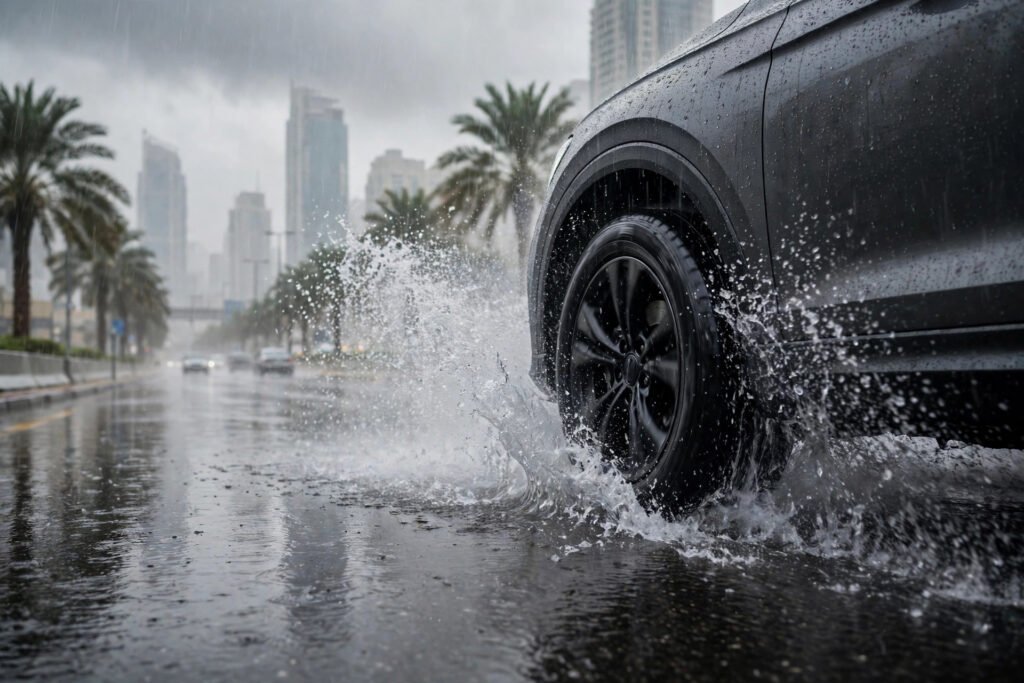
The Checks to Do Before a Wet Morning
Everything in this guide comes down to one thing: do not discover a problem in the rain. Discover it before the rain, when you have time to fix it, when you are parked, and when it does not matter if the job takes a few minutes. The checks below are the ones I do for customers before the rainy season, and they are the ones I would do on my own car. They take less than half an hour, and most of them need no tools at all.
Do them when the forecast says rain is coming, or at the start of the season when the first rain is due. Do not wait until the morning it rains. On a wet morning, every workshop is busy, every tyre shop has a queue, and the part you need may not be in stock. Do it the day before, when it is dry and calm, and you will drive through the rain knowing the car is ready.
Wipers: the check that takes two minutes
I have already talked about wipers, but they deserve a place in this checklist, because they are the most common failure on a wet morning. Lift each wiper arm away from the windscreen and look at the rubber edge. It should be smooth, flexible, and clean. If it feels hard, if it is cracked, if pieces are missing, or if the edge is rough and torn, change the blade. Then spray water on the windscreen and switch the wipers on. Watch for streaks, judder, squeaking, or bands of water left behind. If you see any of those, change the blade. Check the rear wiper the same way.
While you are there, check the washer jets. Press the washer button and see if the water sprays evenly across the windscreen. If a jet is blocked, or the spray is weak, or it only hits one side, the jet may be blocked with dust. A thin pin can clear it, but be gentle — do not force it. And check the washer fluid level under the bonnet. Top it up if it is low. In the rain, you will use the washers more than you think, because the spray from other cars throws dirt onto your windscreen, and the wipers alone will smear it.
Tyres: tread, pressure, and damage
Your tyres are the only part of the car that touches the road, and in the rain they are doing the hardest job on the car. Check them properly.
First, the tread. Look at the grooves across the tyre. They should be deep and clear. Every tyre has small wear markers in the grooves — little raised bars that sit at the bottom of the groove. When the tread wears down to the level of those markers, the tyre is worn out and needs replacing. If you are not sure, put a coin into the groove and look at how much of it disappears. If the groove is shallow, the tyre cannot clear water properly, and the risk of aquaplaning goes up sharply. Check all four tyres, not just the front ones, because the rear tyres matter just as much in the wet. A car with good front tyres and worn rear tyres can slide at the back in the rain, and that is a frightening feeling.
Second, the pressure. Check the tyre pressures when the tyres are cold — first thing in the morning is ideal. The correct pressure is listed on a sticker inside the driver's door, or in the handbook. Do not guess. Under-inflated tyres are worse in the wet, because the tread does not sit properly on the road and cannot clear water as well. Over-inflated tyres are worse too, because the contact patch — the area of tyre touching the road — gets smaller. Get the pressure right, and check it regularly, because it drops slowly over time and you will not notice it until the rain shows it up.
Third, look for damage. Walk around the car and look at each tyre. Look for cuts, cracks in the sidewall, bulges, or anything stuck in the tread. Look at the tread across the whole width of the tyre — if one side is worn more than the other, the wheels may need aligning, and that matters in the wet, because a car that pulls to one side in the dry will pull harder in the wet. If you find a nail or a screw in the tread, do not pull it out yourself. Get it checked properly, because pulling it out can cause a fast leak. Read our guide on tyre repair services in Dubai if you are not sure whether a tyre can be repaired or needs replacing.
And one more tyre point, because it matters in Dubai. Tyres age in the heat, even if they have plenty of tread left. A tyre that has been on a car for years, sitting in the sun, can have rubber that has gone hard and lost its grip, even though the tread looks fine. If your tyres are old — if you cannot remember when they were last changed — ask a tyre shop to check their age and condition. The age is stamped on the sidewall, and a good tyre shop will read it for you and tell you honestly whether the tyres are still safe.
Lights: every light, front and back
Walk around the car and check every light. Switch the headlights on and check both dipped beams and both main beams. Check the tail lights. Get someone to press the brake pedal while you watch from behind, or check the reflection in a shop window. Check the indicators on all four corners, and the hazard lights. Check the reverse lights. If any bulb is out, change it. A brake light that does not work is a serious problem in the rain, because the driver behind you is relying on it. An indicator that does not work is a problem too, because you need to signal clearly when visibility is poor.
While you are checking the lights, wipe the lenses. A headlight covered in dust gives out far less light than a clean one, and in the rain you need all the light you can get. The same goes for the tail lights — in heavy spray, a dirty tail light is much harder to see than a clean one.
Brakes: feel, sound, and the pedal
Your brakes are the safety system you will rely on most in the rain, so check them before you need them. When you drive the car, even on a dry day, pay attention to how the brakes feel. Does the pedal feel firm, or does it feel soft and spongy? Does the car pull to one side when you brake? Do you hear a squeal, a grinding noise, or a vibration through the pedal or the steering wheel? Any of those is a sign to get the brakes checked before the rain, not after it.
Check the brake fluid level under the bonnet as well. The reservoir is usually near the back of the engine bay, on the driver's side, and it has a minimum and a maximum mark. If the level is low, it can mean the brake pads are worn, or there is a leak, and it needs a proper check. Do not just top it up and forget about it. Find out why it is low.
If your car has been parked for a long time — and many cars in Dubai are left parked for weeks while their owners travel — the brakes can develop a thin layer of rust on the discs, and the pads can stick. The first few stops after a long park can feel rough or noisy, and the brakes may not work as well as they should until that rust has cleared. If you have left your car parked for weeks, read our guide on leaving your car parked for weeks in Dubai and take it gently for the first few drives, especially if the first of those drives is in the rain.
Demister, air conditioning, and the inside of the glass
The demister is the part of the car most drivers ignore until the morning they need it. Test it before the rain. Switch the demister on and see if the air comes out strongly at the base of the windscreen. Switch the air conditioning on with it, and check that the air gets cold. If the air conditioning is not cold, or if the demister blows weakly, get it checked. In the rain, you will need both, because the demister clears the mist and the air conditioning dries the air so the mist does not come straight back.
Clean the inside of the windscreen too. The inside of the glass builds up a film that you cannot see in the dry, but that makes the mist worse in the rain. Clean it with a proper glass cleaner and a clean cloth, and do the same for the side windows and the rear window. It takes ten minutes, and it makes a real difference to how quickly the glass clears.
Check the cabin filter as well, if you know where it is or if your last service is due. A blocked cabin filter reduces the airflow to the windscreen, and that means the demister works more slowly. If the airflow from the vents feels weak, or if the air smells musty, the filter may need changing. It is a routine service job, and it is worth doing before the rainy season.
The rest of the car: a quick walk around
Before a wet morning, do a quick walk around the car. Check that the doors and windows close properly and the seals are not damaged, because a damaged seal can let water in. Check that the boot closes properly. Check that the number plates are clean and readable. Check the windscreen for chips and cracks, because a chip can spread in bad weather and a cracked windscreen is harder to see through when it is wet. If you are not sure about a chip, read our guide on car windshield replacement in Dubai.
Check the battery too, especially if the car is older or if it has been parked for a while. Rain driving uses more electrical power — headlights, wipers, demister, air conditioning, all running at once — and a weak battery can struggle. If the car has been slow to start recently, or if the lights dim when you switch the wipers on, get the battery tested. A battery test takes a few minutes, and it is far better than a car that will not start on a wet morning.
Finally, keep the fuel tank reasonably full during the rainy season. It sounds like a small thing, but if you get stuck in traffic in heavy rain, or if you have to take a long detour around a flooded road, you will be glad of the fuel. And if you do break down in the rain, you will need the engine running to keep the lights on and the demister working while you wait for help. A full tank is cheap insurance.
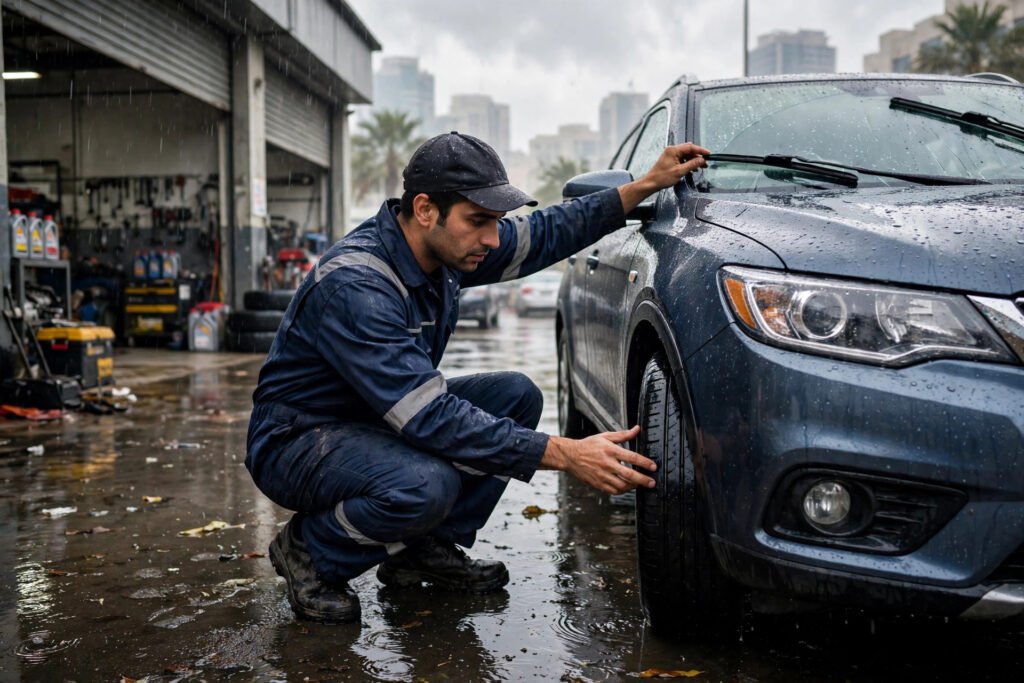
After the Rain: What to Check When the Roads Dry Out
Rain driving does not end when the rain stops. The car has been through a lot — standing water, spray, grit thrown up from the road, and brakes that have been working hard in the wet. A few simple checks after a rainy day will keep small problems from becoming big ones.
First, wash the car, and wash the underside. Rain in Dubai is not clean water. It picks up dust, sand, and road grime, and it throws that mixture all over the underside of the car, into the wheel arches, and onto the brakes and suspension. If it dries there, it can hold moisture against the metal and start rust. A proper wash, including the underside and the wheel arches, will clear it. Do not just wash the top and leave the bottom dirty. The bottom is where the damage happens.
Second, check the brakes. After driving through standing water, the brakes can feel soft for a short time, because the discs and pads are wet. That usually clears after a few gentle stops. But if the brakes still feel soft, or if they make a grinding noise, or if the car pulls to one side when you brake after a rainy day, get them checked. Water can get into places it should not, and grit can get trapped between the pad and the disc. A quick check is cheaper than a damaged disc.
Third, listen to the car. After a wet day, listen for any new noise — a squeal, a rattle, a hum that was not there before. Feel for any change in how the car drives — a vibration, a pull to one side, a steering wheel that feels different. Water and grit can find their way into bearings, belts, and suspension parts, and the first sign is often a small change in how the car feels. If something feels different after the rain, do not ignore it. Get it looked at while it is still a small job.
Fourth, check for water inside the car. After heavy rain, check the footwells, the boot, and under the mats. If water has got in — through a door seal, a sunroof drain, or a blocked drain under the windscreen — it can sit there unnoticed and cause damp, smells, and damage to the electrics. If you find water inside the car, dry it out properly and find out where it came in. A blocked drain is a common cause, and it is a simple fix if it is caught early.
Fifth, check the tyres again. After a rainy day, look at the tyres for any damage from debris hidden in standing water — a nail, a piece of metal, a sharp stone. Standing water hides things, and a tyre can pick up damage without the driver noticing. A slow leak that starts after a rainy day is often caused by something the tyre picked up in the water. If a tyre looks soft the morning after the rain, get it checked straight away.
And finally, if the car was left parked through the rain — if it sat outside for days while it rained on and off — give it a proper check before you drive it far. Cars that sit in the rain can develop flat spots on the tyres, a weak battery, and brakes that have stuck slightly. Start it, let it run for a minute, check the lights and the wipers, and take the first drive gently. That is the same advice I give in our guide on leaving your car parked for weeks in Dubai, and it applies just as much after a rainy week as it does after a holiday.
Driving in Rain at Night, on the Motorway, and in Heavy Traffic
Rain driving is not one situation. It is several, and each one has its own problems. Let me talk about the three that worry drivers most.
Rain at night is the hardest. The roads are wet, the headlights reflect off the water, the glare from oncoming cars is worse, and the road markings can disappear under standing water. Slow down more at night than you would in the day. Make sure your headlights are clean and working. Use dipped headlights, not main beam, because main beam reflects off the rain and the spray and makes it harder to see, not easier. Keep the windscreen clean inside and out, because glare is far worse on a dirty windscreen. And if you are tired as well as driving in the rain at night, pull over and rest. Tiredness and poor visibility are a bad combination.
Rain on the motorway is the second situation. On Sheikh Zayed Road in heavy rain, the spray from lorries and large cars can be so thick that you cannot see the car in front of you at all. The answer is distance and speed. Drop back, slow down, and do not try to overtake through spray. If you cannot see, you cannot overtake safely. Stay in your lane, keep a long gap, and let the faster drivers go past you. There is no shame in being the slowest car on the motorway in heavy rain. The slowest car is often the safest car. And if the rain is so heavy that you cannot see the lane markings, pull off at the next safe exit or service area and wait. Do not keep driving on a motorway you cannot see.
Rain in heavy traffic is the third. In slow traffic, the rain is less about speed and more about patience. The roads are wet, the cars are close together, and every stop and start is a chance for a small rear-end shunt. Leave a bigger gap than usual, even in slow traffic. Brake early and gently, so the driver behind you has time to react. Do not change lanes suddenly to get ahead — in the wet, a sudden lane change is a risk, and the few seconds you gain are not worth it. And keep the demister on, because in slow traffic with the rain falling, the windows will mist up quickly, and you need to see the cars around you.
In all three situations, the same principles apply: slow down, leave space, see properly, and be patient. Rain driving is not about skill. It is about judgement. The best rain drivers I know are not the fastest or the most confident. They are the ones who slow down early, leave a big gap, and are not embarrassed to pull over and wait when the rain gets too heavy.
Common Mistakes I See Every Rainy Season
I see the same mistakes every year, and I see the results of them in the workshop the next day. Let me list them plainly, so you can avoid them.
The first is driving at dry-road speed in the rain. The driver knows the road is wet, but they keep the same speed they always drive at, because they are in a hurry, or because they do not want to be overtaken, or because the rain does not look that bad. Then the car in front brakes, and they discover that their stopping distance is far longer than they thought. Slow down. It is the simplest thing, and it is the thing most people do not do enough.
The second is following too closely. In the dry, a short gap feels normal. In the wet, it is dangerous. The car in front can brake suddenly, or hit standing water and slow down, and you will not have time to react and stop. Leave a big gap. If someone pulls into it, make a new one.
The third is braking hard in standing water, or braking hard while turning. In the wet, hard braking can lock a wheel, or make the car slide, or make it pull to one side. Brake early, brake gently, and brake in a straight line. If you need to slow down for a turn, do it before the turn, not in the middle of it.
The fourth is driving through water you cannot judge. I have covered this already, but it is worth repeating, because it is the mistake that causes the most expensive damage. If you cannot see the road through the water, do not drive into it. Turn around. Find another route. The water is always deeper than it looks.
The fifth is using the phone in the rain. I know people do it, and I know it is tempting, but in the rain you need both hands on the wheel and all of your attention on the road. The spray, the standing water, the car in front braking suddenly — any of those can happen without warning, and you need to be ready. Put the phone away. If you need to make a call, pull over first.
The sixth is ignoring the wipers and the tyres until the rain starts. I have said this already too, but it is worth saying again, because it is the most preventable mistake of all. Check the wipers and the tyres before the rain. Change them if they are worn. It is a small job, and it is the difference between seeing the road and not seeing it.
The seventh is driving with the hazard lights on in the rain. I understand why people do it, but it hides your indicators and confuses other drivers. Use dipped headlights instead, and if the rain is so heavy that you feel you need hazards, pull over and wait.
The eighth is forgetting that other drivers are struggling too. In the rain, everyone is dealing with the same poor visibility and the same slippery roads. Be patient with the driver in front who is going slowly. Be patient with the driver who is hesitant at a roundabout. Give people space, give them time, and do not sound the horn because they are being careful. The careful driver is not the problem. The impatient driver is.
Rain and Fog Together, and When to Simply Not Drive
Sometimes rain comes with fog, or with low cloud, and the visibility drops to almost nothing. That combination is the most dangerous driving I see in Dubai, because you cannot see the road, you cannot see the cars around you, and the road is wet at the same time. If you are driving in rain and fog together, slow down a lot, switch your dipped headlights on, increase your following distance even more, and be ready to pull over. Do not use main beam, because it reflects off the fog and makes it harder to see. If the visibility gets so bad that you cannot see the road markings or the car in front, pull over somewhere safe, switch your hazard lights on, and wait. There is no journey that is worth driving blind.
You can read more about fog driving in our guide on driving in fog in Dubai, because fog has its own problems and its own techniques, and it is worth knowing them separately from rain. But the short version is this: if you cannot see, do not drive. Wait. The fog will lift, the rain will ease, and you will get there safely, even if you are late.
And that brings me to the last point, which is the simplest and the most important. Sometimes the right decision is not to drive at all. If the rain is very heavy, if the roads are flooding, if the forecast says the rain will get worse, and if your journey is not urgent, stay where you are. Wait an hour. Work from home. Let the rain pass. In Dubai, heavy rain rarely lasts all day. It comes in bursts, and it passes. An hour of waiting is a small price for a safe journey. I tell my customers this every year, and I will tell you the same: the bravest thing you can do in heavy rain is to decide not to drive in it.
If you do need to drive, and if you are not sure the car is ready — if the wipers are streaking, if the tyres look worn, if the brakes feel soft, if the demister is not working — get the car checked first. A proper check before the rain is always cheaper than a breakdown in the rain. For the current official road rules, check rta.ae. You can read about what a full check covers in our guide on car repair and maintenance services, and if you are buying a used car and want to know whether it is ready for the rainy season, our RTA inspection checklist in Dubai is a good place to start. The checks are not complicated, and they are not expensive. They are just the kind of thing that is easy to put off until the morning it rains, and by then it is too late.
I have spent years working on cars in Dubai, and I have seen what rain does to cars that are not ready for it, and to drivers who are not ready for it. I have also seen how well it goes when the car is ready and the driver is calm. The rain itself is not the enemy. The enemy is the surprise — the worn wiper, the bald tyre, the flooded underpass, the speed that was fine in the dry and is too fast in the wet. Take the surprise away, and the rain becomes just weather. Slow down, leave space, see properly, and check the car before the wet morning. That is the whole guide, really. Everything else is detail, and the detail is there to help you do those four things well.
Frequently Asked Questions
Why are Dubai roads so slippery in the first rain?
Because the roads have been dry for months, and dust and oil have built up on the surface. When the first rain starts, the water mixes with that dust and oil and forms a thin, greasy film on the road. Your tyres grip that film, not the asphalt underneath, and the grip is far lower than it looks. The film is worst in the first hour of the first rain, and it is worst at junctions, roundabouts, and on painted markings and metal covers. As the rain goes on and gets heavier, the film washes away and the grip improves, but it is never as good as a dry road. Slow down more than you think you need to in the first rain, and be extra careful when you are turning or braking.
What does aquaplaning feel like, and what should I do?
Aquaplaning happens when your tyres cannot push the water out of the way fast enough, and the tyre lifts off the road and rides on top of the water. The steering goes light and loose, the car feels as if it is floating or gliding, and turning the wheel does not seem to do anything. If it happens, do not brake hard and do not turn the steering wheel sharply. Ease off the accelerator gently, keep the wheel straight, and let the car slow down on its own. As the speed drops, the tyres will touch the road again and the steering will come back. Then steer gently and brake gently if you need to. The best way to avoid it is to slow down before you reach standing water, and to make sure your tyres have good tread.
How do I know if my wipers need changing?
Switch them on with water on the windscreen and watch what happens. A good blade clears the glass in one smooth sweep, with no streaks and no noise. A worn blade leaves lines of water, or a hazy film, or it judders and squeaks across the glass. Lift the blade and look at the rubber edge — if it feels hard, if it is cracked, or if pieces are missing, it needs changing. In Dubai heat, wiper rubber dries out and hardens even when it is not being used, so blades that are more than a year old are often worn even if they were rarely used. Change both blades, and check the rear wiper too.
Should I drive through a flooded underpass if other cars are doing it?
No, not just because other cars are doing it. You cannot tell how deep standing water is by looking at it, and a puddle that looks shallow can be deep enough to stall your engine and flood the cabin. The other driver's car may be higher than yours, or they may be making a mistake. If you cannot see the road surface through the water, do not drive into it. If the water is covering the lane markings or the kerb, it is already too deep. Turn around and find another route. If your engine stalls in deep water, do not keep trying to restart it — switch it off, get out if it is safe to do so, move to higher ground, and call for help.
How much extra following distance should I leave in the rain?
Leave much more than in the dry. In the dry, a gap of a few seconds behind the car in front is normal. In the rain, double it, and double it again if the rain is heavy, if you cannot see the road surface, or if the car in front is throwing up a lot of spray. The stopping distance in the wet is far longer than in the dry, because the tyres have to push water out of the way before they can grip, and worn tyres or a wet road can make it longer still. The gap is also your visibility — if you are close behind the car in front, you are driving in its spray. If someone pulls into your gap, drop back and make a new one. Do not close up to stop it happening.
Why does my windscreen mist up inside when it rains, and how do I clear it?
The windscreen mists up because the air inside the car is warm and damp, and the glass is cooler than the air. The moisture in the air condenses on the glass. To clear it, switch the demister on, switch the air conditioning on with it, and direct the air to the windscreen. The air conditioning dries the air, and dry air clears mist far faster than warm air alone. Do not wipe the inside of the windscreen with your hand while you are driving — it smears and it distracts you. Clean the inside of the glass properly before the rainy season, because a film of grime on the inside makes the mist worse, and check that the demister and the air conditioning are working before you need them.
What should I check on my car before the rainy season?
Check the wipers, the tyres, the lights, the brakes, and the demister. For wipers, look for streaks, judder, and cracked rubber. For tyres, check the tread depth, the pressure when the tyres are cold, and look for cuts, cracks, and bulges. For lights, check every light — headlights, tail lights, brake lights, and indicators — and wipe the lenses clean. For brakes, pay attention to how the pedal feels, and listen for squeals or grinding. For the demister, test it with the air conditioning on and make sure the air comes out strongly at the windscreen. Clean the inside and outside of the glass, top up the washer fluid, and check the battery if the car has been slow to start. These checks take less than half an hour, and they are the difference between a wet morning that goes fine and one that ends with a call to a workshop.
Is it safe to drive in the rain at night in Dubai?
It can be, but it is harder than driving in the rain in the day, so slow down more. Wet roads reflect headlights, the glare from oncoming cars is worse, and the road markings can disappear under standing water. Use dipped headlights, not main beam, because main beam reflects off the rain and the spray and makes it harder to see. Keep the windscreen clean inside and out, because glare is far worse on a dirty windscreen. Make sure your headlights are clean and working, and if you are tired as well as driving in the rain at night, pull over and rest. If the rain is so heavy that you cannot see the lane markings, pull off at the next safe exit and wait for it to ease.
Call 95 Services
Rain in Dubai catches a lot of drivers out, and it catches a lot of cars out too. The wipers that were fine all summer, the tyres that were already worn, the brakes that were already soft, the demister that has not been used in months — the first rain finds all of them at once. You do not need to work all of that out on your own, and you do not need to discover it on a wet morning on Sheikh Zayed Road.
That is what we do at 95 Services. We come to you, anywhere in the UAE, and we get your car ready for the rain — wipers, tyres, lights, brakes, demister, and a proper check of the things you cannot see from the driver's seat. If your wipers are streaking, if your tyres look worn, if your brakes feel soft, if the demister is not clearing the glass, or if you just want a proper check before the wet weather arrives, call us and we will help. And if you do get caught out in the rain — if the car will not start on a wet morning, if it stalls in standing water, if something feels different after a rainy day — call us and we will come to you.
Call 95 Services on +971 54 344 3513 or WhatsApp us. Our response time is 15–20 minutes, we serve the complete UAE, and our prices are low. If the forecast says rain is coming, call us now — before the wet morning, not after it.
