
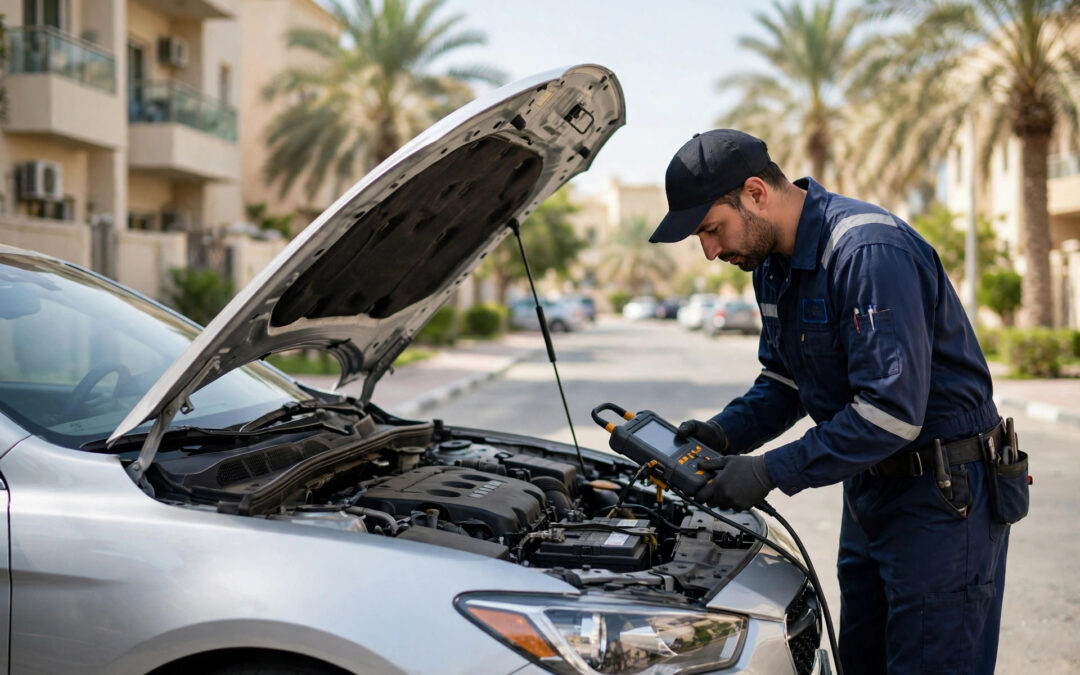
You turn the key or press the start button, and instead of the engine catching you get a click, a slow groan, or nothing at all. In Dubai, that moment usually arrives at the worst possible time: a school run, a work morning, or a car park in the middle of a hot afternoon. The instinct is to blame the battery and order a new one. Sometimes that is right. Often it is not — a new battery on a car with a failing alternator or dead starter is money spent on the wrong part.
Three parts do the starting and charging work, and they fail in different ways. The battery stores the power, the starter motor uses it to turn the engine, and the alternator refills the battery once the engine is running. Each one leaves its own clues: sounds, dashboard lights, and what happens after a jump start. This guide explains how to read those clues, how to tell a battery, alternator or starter fault apart before you replace anything, and how to jump-start safely when a jump is the right move.
The rule that saves the most money: test before you replace. A battery test, a charging-voltage check and a starter check together take minutes with the right tester, and they stop the most common mistake in no-start breakdowns — replacing a healthy battery while the real fault stays in the car.
1. How the Battery, Starter and Alternator Work Together
The three parts form a loop, and understanding the loop is what makes the symptoms readable. The battery is a store of electricity. When you try to start the car, the battery sends a heavy surge of current to the starter motor. The starter is a powerful electric motor bolted to the engine; it draws more current than anything else on the car — hundreds of amps for a few seconds — and uses it to spin the engine fast enough to fire. Once the engine is running, the alternator takes over. Driven by a belt from the engine, it generates electricity to run the lights, air conditioning and electronics, and it puts charge back into the battery, ready for the next start.
Because the parts depend on each other, one failing part can make another look guilty. A weak battery cannot spin a healthy starter, so the starter looks dead. A failing alternator leaves the battery empty, so the battery looks dead. A worn starter draws badly or refuses to engage, so the battery looks weak. That overlap is why the test order matters: battery first, then the charging system, then the starter.
Dubai heat sharpens all of this. Sustained high temperatures age batteries faster than cooler climates do — most car batteries in the UAE last about two to three years, and often fail suddenly rather than fading gradually. Heat also punishes starters, whose metal parts expand and bind, and it hardens drive belts that spin the alternator. A car that started fine all winter can refuse on the first hot morning of summer. The extreme heat maintenance guide explains how heat affects the whole car, including why the battery, alternator and starter should be tested together before any battery is replaced.
2. The 60-Second Triage: Listen and Look Before Anything Else
Before opening the bonnet or calling anyone, spend one minute on two observations: what the dashboard does, and what sound the car makes. Together they narrow the fault to one part in most cases.
First, watch the dashboard as you turn the key or press the button. Bright, steady lights mean the battery is delivering power to the car's systems, which points away from a flat battery and toward the starter or its wiring. Dim, flickering or dead lights mean the battery is flat or its connections are broken. Second, listen. Rapid clicking means the starter solenoid is tripping but the battery cannot supply enough current to turn the engine. One solid click with bright lights means power is reaching the starter but the starter itself is not turning. A slow, laboured crank that fades means a weak battery struggling under load. Grinding or whirring without the engine turning means the starter gear is not engaging properly.
| What you see or hear | Most likely cause | First step |
|---|---|---|
| Rapid clicking, dash dims or flickers | Weak or flat battery, or a loose terminal | Check terminals, then jump and test |
| One loud click, dash stays bright | Starter motor, solenoid or its cable | Stop trying, test the battery first |
| Silence, dashboard dark | Completely flat battery, loose terminal, main fuse or earth fault | Inspect terminals, jump or test |
| Slow, laboured crank | Ageing or weak battery, corroded cables | Test the battery under load |
| Grinding or whirring, engine does not turn | Starter gear not engaging the flywheel | Stop trying, call for diagnosis |
| Cranks normally, never fires | Fuel, ignition or immobiliser — not battery, alternator or starter | Stop after a couple of tries, garage job |
| Starts on a jump, dies within minutes | Charging system — alternator, belt or wiring | Do not keep jumping it, test charging |
3. The Battery: The Most Common Cause, and the Most Misdiagnosed
The battery is the most common reason a car will not start, and the part most often replaced unnecessarily. Both things are true at once. In Dubai, heat is the main reason: high temperatures speed up corrosion of the battery's internal plates and loss of electrolyte, so a battery here commonly lasts about two to three years, against three to five in cooler climates, and it often fails suddenly. A battery that started the car yesterday can be finished today, with no gradual warning.
Signs that point to the battery
The classic battery picture is a slow crank that gets slower with each attempt, rapid clicking with dimming dashboard lights, headlights that are noticeably dim, and electrical accessories that work weakly or not at all. Age is a clue on its own. If the battery is over two years old in UAE heat, it is inside the window where sudden failure becomes likely, and a test is worth doing before it strands the car. Corrosion on the terminals — a crusty white, green or blue build-up around the posts — is another sign: it adds resistance that starves the starter of current, and it can mimic a dying battery exactly.
Checking the battery: terminals, voltage and the load test
Start with what you can see. Look at the terminals without touching anything bare-handed: they should be tight, clean and free of heavy corrosion, and the battery should sit secure in its tray. A loose terminal does exactly what a flat battery does — rapid clicking, dim dash — and tightening it fixes the car in minutes.
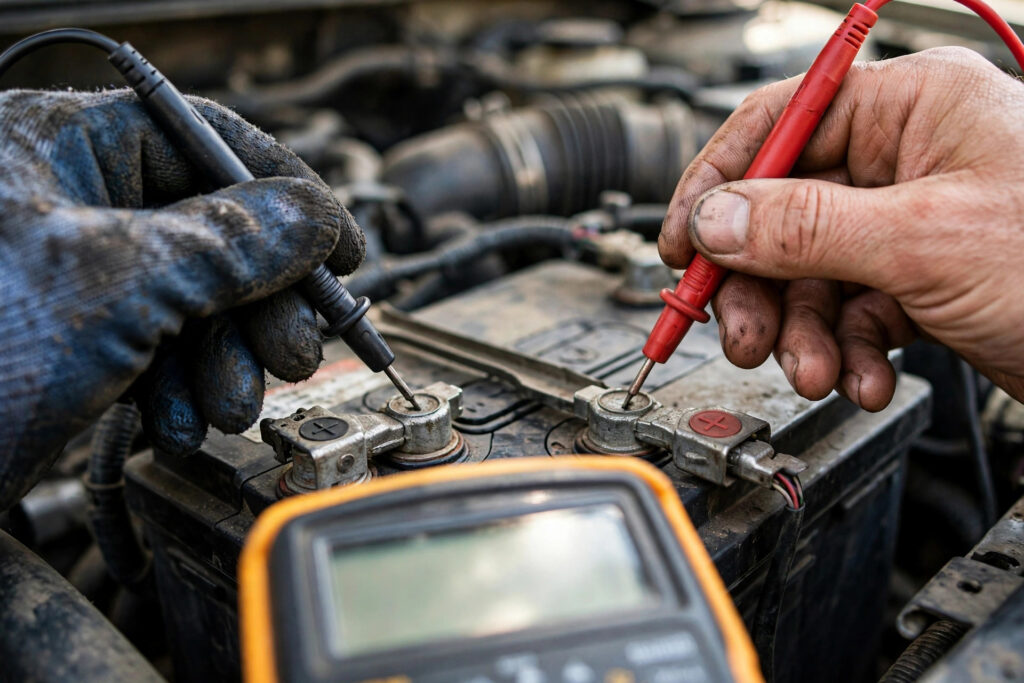
A basic digital multimeter tells you the battery's state of charge. Test with the engine off, ideally after the car has rested for a few hours. A healthy 12V battery reads about 12.6V at rest. Around 12.4V means roughly three-quarters charged, 12.2V about half, and below 12.0V means discharged or failing. Voltage alone does not prove health: a damaged battery can read normally and collapse under load. That is why a proper test puts the battery under load — a technician's battery tester measures how the battery performs under the strain of starting, which is the test that actually matters. If the battery fails under load while the charging voltage is normal, the battery is the fault. If it passes, look at the starter and the cables instead.
What a jump start tells you about the battery
A jump start is a diagnostic tool as well as a rescue. If the car starts on a jump, runs normally, and restarts on its own later, the battery was probably flat from a drain — a light left on, a short trip that never recharged it — rather than finished. If it starts on a jump and then will not restart the next time, the battery is likely no longer holding charge, or the charging system is not refilling it — the charging check in Section 4 separates those two. For the full picture on battery fitting, testing and replacement in Dubai, see the mobile car battery replacement guide and the car battery replacement service page, and for a car that is already flat where it stands, flat battery assistance.
4. The Alternator: The Battery Keeps Going Flat
The alternator's job is to refill the battery and run the car's electrics while the engine is on. When it stops charging properly, the car runs on the battery alone, draining it until the car stalls or will not restart.
Signs that point to the alternator
The clearest sign is the battery warning light — the picture of a battery on the dashboard — staying on or flickering while driving, especially with loads on: headlights, indicators, air conditioning. That light means a charging-system fault, not necessarily a bad battery, and it should never be ignored. Other signs: headlights that dim or flicker while driving, or brighten and dim with engine speed; a battery that keeps going flat even after jump starts; electrical accessories that weaken while driving; a whining, grinding or squealing noise from the engine bay, which can mean worn alternator bearings or a slipping drive belt; and a burning rubber or hot-wire smell from a slipping belt or an overheating alternator.
Checking the charging system: voltage, belt and load
With the engine running, a working charging system typically shows roughly 13.7 to 14.7 volts at the battery terminals. A reading at or below resting voltage with the engine running means the alternator is not charging at all. A reading far above the range means overcharging, which is just as much a fault. Some newer cars vary charging voltage deliberately, so the reading is judged against the car. The check should also be done under load, with lights and air conditioning on, because a weak alternator can look fine at idle and fail under demand.
Check the drive belt too. The alternator is spun by a belt from the engine, and a belt that is cracked, glazed, frayed or loose cannot spin it properly. A squeal on start-up or when the air conditioning engages often means the belt is slipping. Belt and tensioner faults are cheaper than alternator faults and produce the same flat-battery symptoms, so the belt is always worth a look before the alternator is condemned. Wiring and connections matter as well: a corroded main cable or a poor earth can stop charging just as surely as a dead alternator. The charging check is one job, done together. Charging-system diagnosis and repair are covered under car repair and maintenance services.
5. The Starter: One Click and Nothing Else
The starter motor is the heavy electric motor that physically spins the engine when you turn the key or press the button. When it fails, the failure usually appears at the exact moment of starting — and the dashboard is the giveaway.

Signs that point to the starter
The classic starter picture is a single loud click or clunk from the engine bay, then nothing, while the dashboard lights stay bright and steady. Bright lights mean the battery is delivering power, so the fault sits between the battery and the engine: the starter, its solenoid, or the cable feeding it. Other starter signs: a grinding noise as the starter gear fails to mesh cleanly with the flywheel; a whirring sound as the starter spins without engaging the engine at all; intermittent no-starts, where the car starts fine ten times and refuses on the eleventh; and a slow, laboured crank that does not catch even though the battery tests good. Repeated attempts with a grinding starter can damage the flywheel teeth, so grinding means stop trying, not try harder.
Checking the starter: battery first, then the simple tricks
The battery is always tested first, because a weak battery can produce the same single click. Only when the battery passes — good voltage, good load test, clean tight terminals — does the starter become the prime suspect. A technician then measures the voltage that actually reaches the starter while cranking: if full voltage arrives and the starter does not turn, the starter is at fault; if voltage collapses on the way, the cable or earth connection is the problem.
Two simple checks can help before calling. On an automatic, try starting with the selector in Neutral instead of Park, with your foot firmly on the brake. If it starts in Neutral, the inhibitor switch that prevents starting in gear may be at fault — a small part, not a starter. The other old trick is a sharp tap on the starter body with a tool handle while someone tries the key: if the car then starts, the starter's internal contacts are worn and sticking, and the starter needs attention soon. Treat a tap-start as a diagnostic clue and a way to get home, never as a fix — the fault will return, usually at a worse moment. If the battery is good, the lights are bright, and the car clicks or grinds, it is a workshop diagnosis, not a battery purchase.
6. The Step-by-Step Diagnosis, In Order
Put the sections above together and the diagnosis runs in a fixed order. Work through it from the top, and stop at the step that answers the question — do not skip ahead to buying a part.
- Watch and listen. Turn the key or press the button once. Note the dashboard lights (bright, dim, dead) and the sound (rapid clicking, one click, slow crank, grinding, normal crank with no fire, silence). The table in Section 2 gives the first suspect.
- Check the simple things. On an automatic, confirm the selector is fully in Park (or try Neutral). On a manual, press the clutch fully. Check that nothing obvious is draining power — lights, hazards, accessories left on — and that the key fob battery is not dead on a push-button car.
- Inspect the terminals. Look at the battery terminals for looseness, corrosion and damage. A loose or corroded terminal mimics a flat battery. Do not touch a cracked, leaking or swollen battery — that is a replacement, not a check.
- Test the battery. Resting voltage with a multimeter, then a load test. A battery that fails under load while charging voltage is normal is the fault. A battery that passes moves the suspicion to the starter and cables.
- Try a jump — once, properly. If the battery is flat, jump-start following Section 7. How the car behaves after the jump is diagnostic: runs and restarts later (drained battery), runs then dies (charging fault), no change (starter or connections).
- Check the charging system. With the engine running, check charging voltage at idle and under load, and inspect the drive belt. Charging voltage at or below resting voltage, or far above the normal range, means a charging fault.
- Check the starter circuit. If the battery is good and the car clicks, grinds or does nothing with bright lights, the starter, solenoid, cable or earth is the suspect. Voltage at the starter while cranking separates a starter fault from a cable fault.
- Know when to stop. Grinding, smoke, a strong electrical smell, a cracked battery, or a car that cranks normally but never fires are all stop points. Call for diagnosis instead.
Never disconnect the battery with the engine running to "test" the alternator. That old trick can spike the voltage and damage the car's electronics, including the engine computer. The charging voltage is checked with a meter while everything stays connected.
7. Jump-Starting Safely: The Order That Matters
A jump start is safe when the order is right and dangerous when it is not. Reversed polarity — positive to negative — can damage both cars' electronics in a second, so slow down and check each clamp before connecting the next. Use proper jump leads or a jump pack, and a donor car with the same 12V system. For hybrids and electric cars, check the owner's manual first: they carry a 12V auxiliary battery as well as the high-voltage drive battery, and the jump points and procedure differ by model.
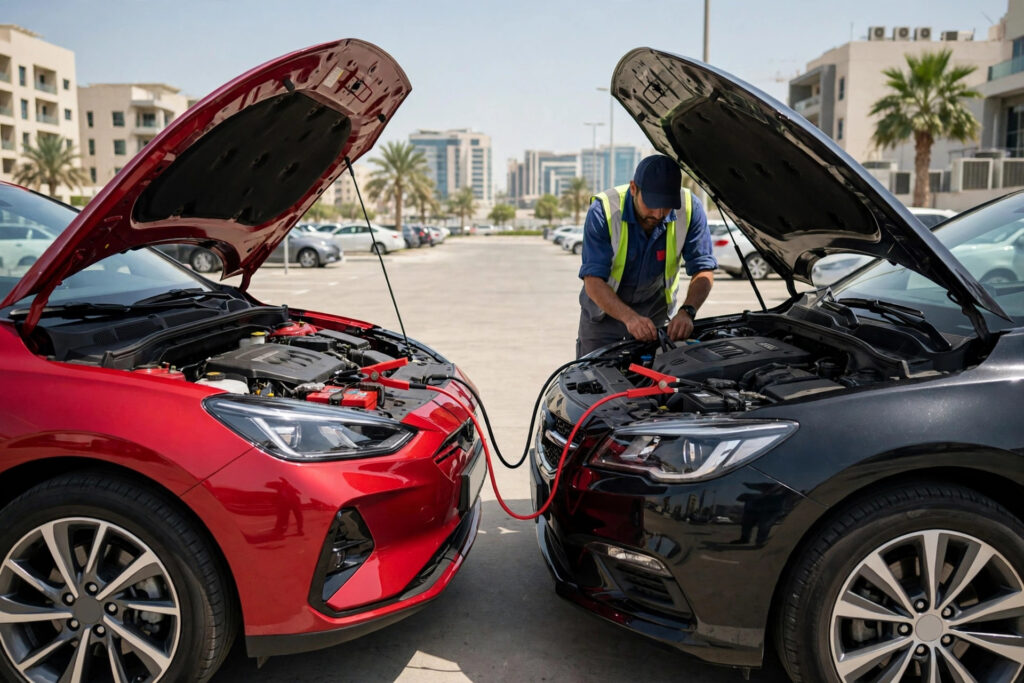
- Prepare both cars. Switch off everything electrical in both cars — lights, air conditioning, radio. Keep the cars close enough for the leads to reach, without the cars touching.
- Red to the flat battery. Connect the red (positive) clamp to the positive (+) terminal of the flat battery.
- Red to the donor battery. Connect the other red clamp to the positive (+) terminal of the donor battery.
- Black to the donor battery. Connect the black (negative) clamp to the negative (−) terminal of the donor battery.
- Black to an earth point. Connect the last black clamp to a solid, unpainted metal part of the flat car's engine — an engine bracket or bolt head — away from the battery. Never to the flat battery's negative terminal: the last connection can spark, and batteries can give off flammable gas.
- Start the donor car and let it idle for a few minutes. Then try the flat car. If it starts, leave both cars running.
- Remove in reverse order: black from the earth point, black from the donor, red from the donor, red from the flat car. Keep the clamps from touching each other or any metal while removing them.
After a successful jump, the car needs a proper run — around 30 to 45 minutes of driving, not idling in a car park — for the alternator to put meaningful charge back. Get the battery and charging system tested the same day: a battery that needed a jump once will usually need one again, and a charging fault will empty a fresh battery just as surely as an old one. And do not keep jumping a car that dies again within minutes — that pattern means the charging system is not working, and repeated jumps only drain the donor car too.
8. When It Is None of the Three: Cranks Fine, Never Fires
An engine that cranks at normal speed but never fires is not a battery, alternator or starter problem. The starting system has done its job — the engine is spinning — but something else is missing: fuel, spark, or permission to run. Common causes include an empty fuel tank, a faulty fuel pump, a blown fuel-pump fuse or relay, a failed crankshaft sensor, worn spark plugs or coils, or the immobiliser not recognising the key. A flashing key or padlock symbol on the dashboard points to the immobiliser; try the spare key before anything else.
Stop after a couple of tries. Extended cranking floods the engine, drains the battery and can overheat the starter — turning one fault into two. This is a garage diagnosis: fault codes, fuel pressure and sensor signals tell the story, and guessing at parts is the expensive route. The engine warning signs guide explains the dashboard warnings and symptoms that belong to this territory, and car repair and maintenance services covers the diagnosis itself.
9. Preventing the Next No-Start
Most no-starts are predictable, and the prevention is mostly testing, not spending. Have the battery and charging system tested once a year, ideally before summer, and every six months once the battery is past two years old — in UAE heat, batteries commonly last about two to three years and often fail without a long warning. Keep the terminals clean and tight, and check the drive belt at each service. Give the car proper runs: repeated ten-minute trips in traffic never let the alternator fully recharge the battery after starting, especially with the air conditioning running. Switch off lights, air conditioning and accessories before switching the engine off, so the next start is not loaded. Park in shade where possible — a battery under the bonnet of a car baking in open sun sits hotter than the air around it, and heat is what ages it.
The same checks belong in the run-up to the annual inspection. The RTA inspection checklist covers the battery and warning-light checks as part of the pre-test routine, and the car maintenance tips for Dubai drivers guide covers the everyday habits that keep the whole car in test-ready condition.
Frequently Asked Questions
How do I know if it is the battery or the starter?
Watch the dashboard and listen. Rapid clicking with dim or flickering lights points to the battery. One loud click with bright, steady lights points to the starter. A battery that passes a load test while the car still clicks confirms the starter or its wiring.
How do I know if it is the battery or the alternator?
A jump start separates them. If the car starts on a jump, runs, and restarts later, the battery was drained. If it starts on a jump and dies again within minutes, or the battery keeps going flat day after day, the charging system is not refilling it — check charging voltage with the engine running, which should read roughly 13.7 to 14.7 volts.
Can a car with a bad alternator be jump-started?
It will usually start, but it will not stay running for long: with no charging, the car runs on the battery alone until the battery is empty, then stalls. Do not keep jumping it. Get the charging system checked instead, including the drive belt and connections.
What voltage should a car battery read?
About 12.6V at rest means fully charged; around 12.4V is roughly three-quarters charged; 12.2V is about half; below 12.0V means discharged or failing. With the engine running, a working charging system typically shows roughly 13.7 to 14.7V.
How long does a car battery last in Dubai?
Commonly about two to three years, against three to five in cooler climates, because heat speeds up corrosion and electrolyte loss inside the battery. Failure is often sudden. Test once a year, before summer, and every six months once the battery is over two years old.
My car cranks but will not start. Is it the battery?
Almost certainly not. Normal-speed cranking means the battery and starter are doing their job. The fault is in fuel, ignition or the immobiliser — fuel pump, relay, crankshaft sensor, spark plugs or key recognition. Stop after a couple of tries and get a garage diagnosis.
Conclusion: Diagnose First, Replace Once
A car that will not start is telling you which part failed — if you listen before you spend. Rapid clicking and dim lights say battery. One click with bright lights says starter. A car that dies after a jump says alternator. A car that cranks and never fires says fuel or spark. The test order never changes: battery first, charging system second, starter third, and never a part bought on a guess. Diagnose first, replace once, and the next no-start is the one that never happens.
Contact 95 Services: Battery, Alternator & Starter Help Across the UAE
Whether the car needs a battery test, a jump start, charging-system diagnosis, starter work, or urgent roadside help, the first step is one call. Contact 95 Services on +971 54 344 3513 by phone or WhatsApp, or email info@95services.com. Help is dispatched within the 15–20 minute response standard, to arrive within 20 minutes, anywhere in the complete UAE, and the business is open 24 hours. Service prices stay very low. The office is at Ahmed Ali Al Owais Showroom Building, Office M05, Abu Hail, Al Khabaisi, Dubai, UAE. For general enquiries, visit the contact page to send a message.
