

Most drivers never think about power steering fluid until the day the steering wheel suddenly feels like it belongs to a different car. One morning it turns with one finger, the next it fights you at every roundabout. Or a strange whine starts up when you park, and you are left wondering whether it is serious or just one of those noises cars make in the heat.
Here is the honest answer: a power steering fluid leak is one of those problems that starts small and quiet, and then gets expensive if you ignore it. The fluid itself is cheap. The pump it protects is not. The steering rack it protects costs even more. And in Dubai, where summer heat cooks rubber hoses and seals for months at a time, these leaks are more common than most drivers realise.
This guide walks you through the whole thing in plain language. What the fluid actually does, the signs that tell you it is running low, where it usually leaks from, how urgent the problem really is, and what a repair looks like when a mechanic gets involved. By the end you will know whether you can drive to help carefully, or whether you should stop the car where it is and call for help instead.
What Power Steering Fluid Actually Does
Power steering fluid is the working fluid inside a hydraulic power steering system. When you turn the steering wheel, a pump — driven by the engine — pushes this fluid under pressure into the steering rack. That pressure does most of the heavy work of turning the wheels, so your hands only have to guide them.
Without it, you would be wrestling with the full weight of the car every time you turned. Anyone who has ever driven an old car with no power steering, or tried to turn the wheel of a modern car with the engine off, knows exactly how heavy that feels. The fluid is what stands between you and that workout.
It does more than push, though. The fluid also lubricates the pump and the moving parts inside the steering rack, and it carries heat away from them. A system that runs low on fluid is not just harder to steer — it is running dry inside, with metal parts rubbing and heating up in ways they were never meant to. That is why a small leak can turn into a dead pump surprisingly quickly.
Most power steering fluid is a thin hydraulic oil, usually red, pink or amber when it is fresh. Some car makers specify their own fluid, and some use automatic transmission fluid in the steering system instead. The colour matters less than the level, but as we will see later, the colour of a puddle under your car can tell you a lot about where it came from.
One thing worth clearing up early: not every car has this fluid. A growing number of modern cars use electric power steering instead, which has no fluid at all. If your car is one of those, a leak is not your problem — but a steering fault still can be. We will come back to that difference later, because it changes everything about how the fault is diagnosed and fixed.
The First Signs: Your Car Will Tell You Before the Leak Gets Bad
Power steering leaks rarely announce themselves with a dramatic failure on day one. They creep in. The level drops a little, the pump starts to struggle a little, and the steering feels a little different. Drivers in Dubai often notice it first in a car park, because that is where you turn the wheel the most at low speed — and low speed is exactly when power steering works hardest.
If you catch it at this stage, the fix is usually straightforward. If you wait until the steering goes heavy in moving traffic, you are dealing with a bigger job and a much less pleasant drive. So it pays to know the signs.
A Whining or Whirring Noise When You Turn
This is the classic early warning, and the one mechanics hear about most. You turn the wheel — especially at low speed, or when you hold it at full lock while parking — and a high-pitched whine or whirr rises from under the bonnet. It often gets louder the further you turn, and it may fade again when you straighten up.
What you are hearing is the power steering pump struggling. When the fluid level drops, air gets drawn into the pump along with what little fluid is left. The pump churns that mixture, and the result is the whine. It is the same kind of sound a thirsty pump makes in any hydraulic system, and it means the pump is working without the lubrication and cushioning it was designed to have.
A whine does not always mean a leak. A worn pump can whine too, and so can a loose drive belt. But a whine that appears alongside a dropping fluid level, or a whine that gets worse over a few days, points strongly at a leak. Do not just turn the radio up. A pump that whines for weeks will eventually fail, and a failed pump can send metal debris through the whole steering system.
It is also worth knowing that a little noise at full lock is normal on many cars. When you hold the wheel hard against its stop, the system is at maximum pressure, and a brief groan is expected. The warning sign is a whine that appears during normal turning, or one that is getting louder week by week.
Steering That Feels Stiff, Heavy or Slow to Respond
This is the sign nobody misses, because you feel it in your hands. The steering that used to turn with two fingers now needs a proper pull. Parking takes real effort. Tight turns feel sluggish, as if the car is thinking about it before it responds.
Low fluid means low hydraulic pressure, and low pressure means less assistance. The effect is worst at low speed, because that is when you need the most help from the system — turning stationary or slow-moving wheels takes far more effort than steering at motorway speed. That is why many drivers first notice the problem in a shopping mall car park and not on Sheikh Zayed Road.
Pay attention to whether the heaviness is constant or comes and goes. Steering that is heavy all the time, in both directions, usually points to a system-wide problem such as low fluid or a failing pump. Steering that is heavy in one direction only, or stiff at one particular point in the turn, more often points to a mechanical fault in the rack itself. Either way, it is not something to live with. Heavy steering makes emergency manoeuvres slower and more tiring, and in a sudden situation — a car pulling out in front of you, a pedestrian stepping off a kerb — that delay matters.
Groaning, Squealing or Grinding When You Turn the Wheel
Different noises mean different stages of the same problem. A whine is early. A deep groan is the pump working harder as the level falls further. A grinding or crunching sound is late, and it is the one that should worry you most.
Grinding usually means metal is meeting metal somewhere it should not. The pump may be running dry, or the rack may be starved of lubrication. A squeal, meanwhile, can be the drive belt slipping on a pump that has become hard to turn because it is seizing up. None of these sounds fix themselves. They all get worse, and the repair bill grows with them.
If you hear grinding, treat it as urgent. Turn the radio off for a minute and listen properly the next time you drive. Note when it happens — at full lock, on cold starts, only when turning left — and tell the mechanic exactly that. Small details like that save diagnostic time, and diagnostic time is money.
Jerky, Inconsistent or "Notchy" Steering
Sometimes the steering does not go heavy all at once. Instead it goes uneven. You turn the wheel and it moves freely for a moment, then catches, then frees up again. Or the assistance seems to cut in and out, so the effort you need keeps changing mid-turn. Drivers often describe it as the steering "fighting back" or "sticking" at certain points.
This jerky feeling usually comes from air in the system. As the fluid level falls, the pump starts pulling in air, and air compresses where fluid does not. The result is assistance that arrives in surges rather than smoothly. Contaminated fluid can do the same thing — old, dirty fluid full of tiny particles does not flow the way clean fluid does, and the steering feels rough and inconsistent as a result.
Jerky steering is easy to dismiss because it comes and goes. On a straight road at speed you may not feel it at all. It shows up most when you are turning slowly, which is also when you need predictable steering the most. If the wheel ever feels like it is catching or jumping as you turn, get the fluid level checked before you write it off as a quirk of the car.
A Puddle Under the Car — And What Its Colour Tells You
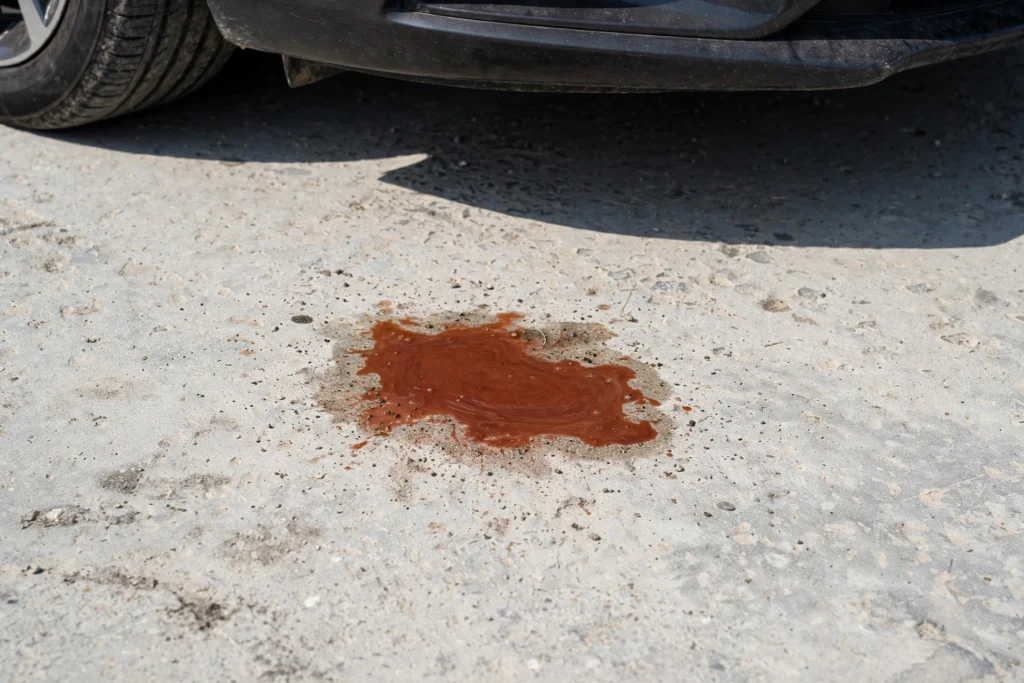
A puddle is the most visible sign of a leak, and the most useful one for working out what is leaking. Power steering fluid is usually red, pink or light brown when fresh, and it darkens to a darker brown or almost black as it ages. It feels oily and slick between your fingers, and it has a faint sweet or slightly burnt smell — quite different from engine oil, which smells heavier and more acrid.
Where the puddle sits matters. Power steering leaks usually show up toward the front of the car, roughly under the engine or just behind the front wheels, because that is where the pump, hoses and rack live. A puddle in the middle of the car is more likely transmission fluid or something else entirely, and a puddle at the back is usually not steering-related at all.
Here is a quick way to narrow it down before you call anyone:
- Red or pink, thin and oily, near the front: very likely power steering fluid or transmission fluid. Both are red, and telling them apart from a puddle alone is genuinely hard — a mechanic will check the levels of both.
- Dark brown or black, thick, under the engine: more likely engine oil. It smells stronger and feels thicker than steering fluid.
- Clear or slightly green, watery: usually condensation from the air conditioning, which is normal in Dubai heat. If it feels like water and has no smell, it is probably just the AC drain.
- Green, orange or pink, sweet-smelling and watery: coolant. That is a different problem and also one to take seriously.
If you find a puddle, do not just wipe it away and forget it. Put a piece of cardboard under the car overnight and check it in the morning. The size, colour and position of the stain will tell a mechanic a great deal, and a photo of it on your phone is genuinely useful when you call for help. If you want a fuller guide to working out what any leak under your car might be, our article on fluid leaks under your car in Dubai walks through each fluid one by one.
The Fluid Level Keeps Dropping
This is the sign that confirms a leak rather than just suggesting one. Power steering fluid is not consumed the way engine oil or fuel is. In a healthy, sealed system, the level should stay more or less the same between services. If you top it up and it is low again a week later, the fluid is going somewhere — and the only somewhere it can go is out.
That is why topping up the reservoir without finding the leak is a short-term fix at best. It will quiet the whine and lighten the steering for a few days, and that can be useful if you need to drive carefully to a workshop. But it does not fix anything. The leak is still there, the level will fall again, and every kilometre you drive on a leaking system is a kilometre the pump runs with less protection than it needs.
A slow leak might take weeks to show up as a low level. A fast one can empty the reservoir in a day. Either way, the rule is simple: fluid that needs topping up more than once has a leak behind it, and the leak needs finding.
Burning Smell or Smoke From Under the Bonnet
Leaking fluid does not always reach the ground. Sometimes it drips onto a hot engine part or the exhaust, and then you smell it before you see it. Power steering fluid on a hot surface gives off a sharp, acrid burning smell, and in bad cases you will see thin wisps of smoke rising from under the bonnet when you stop.
Do not ignore this. Fluid dripping onto the exhaust is a fire risk, and smoke of any kind under the bonnet deserves a proper look. If you see smoke, pull over somewhere safe, switch the engine off and do not open the bonnet straight away if the smoke is thick — let things cool for a few minutes first. Then check the fluid level once it is safe, and call for help rather than driving on if the reservoir is empty or the smoke was heavy.
How to Check Your Power Steering Fluid Yourself
Checking the fluid takes about two minutes and needs no tools, and it is the single most useful thing you can do before calling a mechanic. You will know within a minute whether the level is low, and that one fact shapes everything that follows.
First, park on level ground with the engine off and the car cool — checking on a hot engine is not dangerous for the steering system, but it is easier to read the level and less unpleasant to work around when things have cooled down. Pop the bonnet and look for the power steering reservoir. It is usually a small plastic bottle, often translucent white, with a cap marked with a steering wheel symbol or the words "power steering". On many cars it sits near the front of the engine bay, close to the pump and its drive belt.
Some reservoirs have a dipstick built into the cap. Unscrew it, wipe it clean, screw it back in and pull it out again — the same routine as checking engine oil. Others have minimum and maximum lines moulded into the side of the bottle, and you read the level through the plastic. Either way, check whether the fluid sits between the marks, and look at its colour while you are there. Fresh fluid is red, pink or amber and fairly clear. Dark brown or black fluid full of grit has been in there too long, and it is not protecting the system the way it should.
A word of caution: if your car has electric power steering, you will not find a reservoir at all, and that is normal. There is nothing to check, because there is no fluid. If you are not sure which system your car has, your owner's manual will say — or a mechanic can tell you in seconds. Do not open anything you are unsure about, and never top up with the wrong fluid. Using the wrong type can damage seals and cause exactly the leak you are trying to avoid. If the bottle says to use a specific fluid, use that one and nothing else.
If the level is low, top it up to the maximum mark with the correct fluid and then watch it. Drive normally for a day or two and check again. If it has dropped, you have a leak, and it is time to find it. If it has stayed put, it may have been a one-off low reading — but keep an eye on it for the next week anyway.
Where Power Steering Fluid Leaks From
A leak has to come from somewhere, and in practice it comes from one of a handful of places. Knowing them helps you understand what the mechanic is looking at, why some leaks are cheap and some are not, and why a proper inspection matters more than guessing from the puddle alone.
High-Pressure and Return Hoses
Hoses are the most common leak point, especially on older cars and in hot climates. The power steering system has two main hoses: a high-pressure hose that carries fluid from the pump to the rack, and a lower-pressure return hose that brings it back. The high-pressure hose lives a hard life — it carries fluid at high pressure, it sits close to engine heat, and it flexes every time the engine moves on its mounts.
Over time the rubber hardens, cracks and starts to weep fluid, usually at the ends where the hose meets a metal fitting. In Dubai the process is faster. Months of extreme under-bonnet heat age rubber far quicker than the mild climates most cars were designed for, and a hose that might last a decade in Europe can start cracking years earlier here. A weeping hose is often the cheapest steering leak to fix, because it is a single part and a straightforward job — but a hose that bursts while you are driving will empty the system in seconds, so a weep is still worth fixing promptly.
Pump Seals and the Pump Itself
The power steering pump is a small, hard-working component, usually bolted to the side of the engine and driven by a belt. Inside it are seals that keep the fluid in and the pressure up. When those seals wear out, fluid seeps out around the pump body or from behind the pulley, and it often drips straight down onto the drive belt or the ground below.
Pump leaks tend to start as a light oily film rather than an obvious drip. You might notice the area around the pump looking wet or glossy, or a thin coating of grime where leaking fluid has collected dust. By the time there is a puddle, the seal has usually been failing for a while.
A leaking pump is a bigger job than a leaking hose, because the pump often has to come off the car and either be resealed or replaced. And a pump that has been running low on fluid for a long time is often damaged inside as well — worn bearings, scored internal surfaces — which means a new seal alone will not bring it back. This is one more reason to act early: catching a hose leak in time can save the pump.
Steering Rack Seals
The steering rack sits low across the front of the car, behind the engine and between the front wheels. It is the part that actually turns the wheels, and it is full of seals — at each end where the tie rods come out, and around the pinion where the steering column connects.
Rack seals fail with age and heat, and they are harder to spot because the rack is tucked away underneath. The first signs are often wet-looking rubber boots at the ends of the rack, or fluid collecting on the rack housing itself. Sometimes the leak is slow enough that the fluid just coats the underside of the car in a thin film, and the only clue is a falling reservoir level and a faint smell.
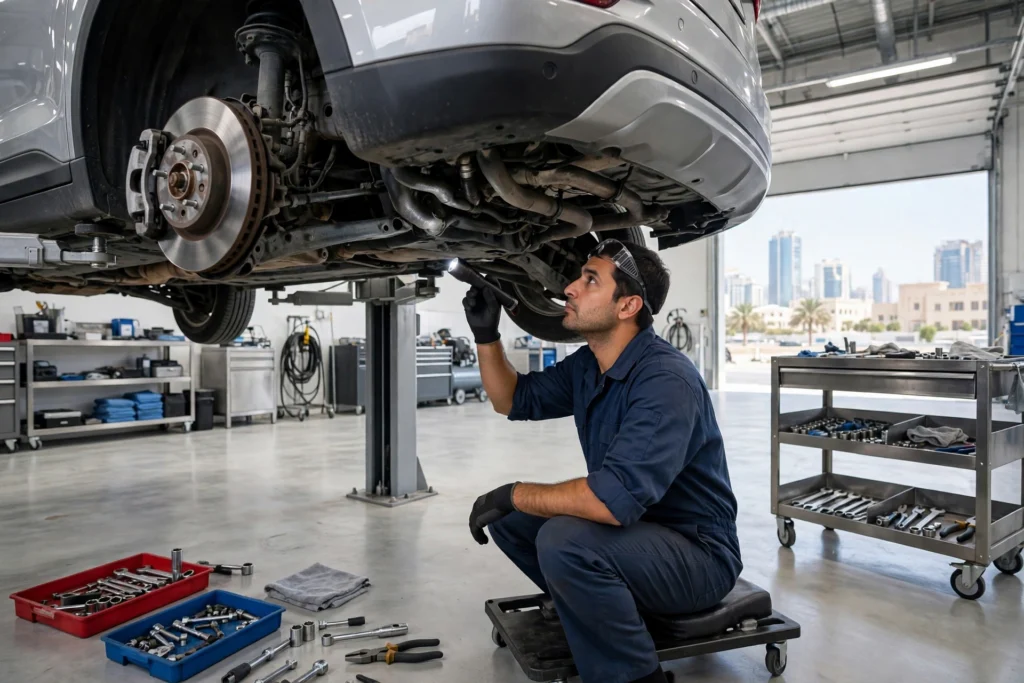
Rack leaks are the ones drivers dread hearing about, because replacing a rack is one of the bigger steering jobs. But not every rack leak means a new rack. Sometimes the leak is at a line connection on the rack rather than in the seals themselves, and that is a far simpler fix. A proper inspection — ideally with the car on a lift, so the whole rack can be seen — is what separates a small repair from a big one. This is also the stage where a mechanic can check the tie rods and boots at the same time, since worn steering and suspension problems in Dubai often show up together on cars that have spent years on hot, dusty roads.
Reservoir, Cap and Cooler Lines
Not every leak comes from a high-pressure part. The reservoir itself can crack, especially the plastic ones that spend years baking under a hot bonnet. The cap can lose its seal, or the small return hose clipped to the reservoir can work loose and weep fluid down the side of the bottle. These are small leaks, but they still drop the level over time, and they still let air into the system.
Some cars also have a small power steering cooler — a loop of pipe at the front of the car, in the airflow — with its own lines and connections. Those lines corrode or get damaged by road debris, and they leak just like any other hose. A cooler leak is easy to miss because it sits low and forward, and the fluid often blows back along the underside of the car while driving, so the puddle does not sit neatly under the leak.
The point of listing all of these is not to turn you into a mechanic. It is to show why a proper inspection matters. A puddle tells you fluid is escaping. It does not tell you from where, and the repair is completely different depending on the answer. A hose, a pump seal and a rack seal are three different jobs with three different costs — and guessing wrong wastes money.
Why Dubai Heat Makes Steering Leaks More Likely
Dubai is hard on rubber and seals. Under-bonnet temperatures in summer are far higher than in the temperate climates most cars are designed for, and heat is the enemy of every rubber hose, O-ring and seal in the steering system. Rubber hardens and loses its flexibility faster, seals shrink and lose their grip, and plastic reservoirs become brittle and crack.
Dust plays a part too. Fine sand gets into the engine bay and settles on hoses and seals, and over time it works its way into joints and connections. Add in the stop-start driving of city traffic — constant low-speed turning in car parks and at junctions, which is exactly when the steering system works hardest — and you have a recipe for earlier wear than the manufacturer's service schedule assumes.
None of this means steering leaks are inevitable. It means the fluid level deserves a look more often than the manual suggests, especially on cars over five years old or past 100,000 km. A two-minute check every month or two is cheap insurance, and it is the kind of thing that gets done naturally as part of a regular service — which is one more reason not to skip services. If your car is due for a check, a full car repair and maintenance service is the right time to have the steering system looked over along with everything else.
How Urgent Is a Power Steering Fluid Leak?
This is the question every driver with a whining pump really wants answered, and the honest answer is: it depends on how bad it is. A slow weep and a system that has run dry are two very different situations, and they call for two very different responses.
When You Can Drive Carefully to Help
If the steering still works, the reservoir still has fluid in it, and the only symptoms are a mild whine and a small puddle, you can usually drive the car — carefully — to a workshop or to a safe place where a mobile mechanic can reach you. Top the fluid up to the maximum mark first, using the correct fluid for your car, and then drive gently: avoid full-lock turns where you can, keep your speed down, and go straight to help rather than running errands on the way.
Watch and listen as you drive. If the whine gets louder, the steering gets heavier, or a warning light comes on, pull over. Do not push through it. A short, careful drive to help is sensible; a long drive across the city while the problem gets worse is not.
This is also the situation where a mobile repair service makes the most sense. If the car is parked at home or at work and the leak is slow, a technician can come to you, find the leak and often fix it on the spot — a hose, a clamp, a top-up and a bleed — without you having to drive a car with compromised steering through traffic at all. Our mobile team covers the complete UAE, usually reaching you within 20 minutes, and we are open 24 hours, so a steering problem at midnight is handled the same way as one at midday. Call or WhatsApp +971 54 344 3513 and describe the symptoms — the noise, the puddle, the fluid level — and we will tell you honestly whether it is safe to wait for us or whether the car should not be driven at all.
When to Stop Driving Immediately
Some situations are not a "drive carefully" situation. They are a "stop the car" situation. Pull over somewhere safe and switch the engine off if any of these apply:
- The steering has gone almost completely heavy. If you can barely turn the wheel, you have lost most or all of the assistance. You cannot steer properly in an emergency, and you should not be in moving traffic.
- The reservoir is empty. An empty reservoir means the pump is running dry. Every minute the engine runs, the pump is damaging itself, and the steering will only get worse.
- You hear grinding, or the pump sounds like it is seizing. Grinding means metal on metal. Continuing to drive will destroy the pump and can send debris into the rack.
- There is smoke, or a strong burning smell. Fluid dripping onto hot exhaust parts can catch fire. Do not keep driving and hope it goes away.
- The fluid is pouring out, not dripping. A burst hose empties the system in seconds. There is nothing left to drive on.
- The steering wheel pulls hard to one side or locks up. A steering fault that changes how the car steers on its own is dangerous at any speed.
In any of these cases, do not try to nurse the car home. Park safely, switch off, and call for recovery. A car with no power steering assistance can still be steered with a lot of effort at low speed, but at traffic speed — and especially in an emergency — it is a risk to you and to everyone around you. If you need the car moved, our car recovery service in Dubai can collect it and bring it to the workshop, and that is always the safer choice when the steering has failed.
What Happens If You Ignore a Leak for Weeks
It is tempting to keep topping up the fluid and putting the repair off, especially when the car still drives more or less normally. But a leak does not stay a leak. It follows a predictable path, and the end of that path is always more expensive than the start.
First the pump starts to wear, because it is running with less fluid and more air than it was built for. Then the pump starts shedding tiny metal particles into the fluid, and that contaminated fluid circulates into the rack, scoring its internal surfaces and damaging its seals. Then the rack starts leaking too, and now you have two failed components instead of one. At that point the repair is a pump and a rack, plus a full flush to get the debris out — a job several times the cost of the hose or seal that started it all.
There is also the safety side. Steering that is heavy or jerky today can fail properly tomorrow, and it will not wait for a convenient moment. It will fail in a car park, on a roundabout, or on a fast road — wherever you happen to be. A leak that costs little to fix now is not worth that risk.
What a Power Steering Leak Repair Actually Involves
Knowing what happens during a repair takes the mystery — and the worry — out of it. A good steering repair follows a sequence, and skipping steps is how leaks come back a month later.
Step 1: Inspection and Finding the Leak
The first step is finding exactly where the fluid is escaping. That sounds obvious, but a steering system is a maze of hoses, connections and seals tucked into a crowded engine bay, and the fluid often travels before it drips — a leak at the pump can show up as a puddle under the rack, because the fluid ran along a hose before it fell.
A proper inspection usually means getting the car on a lift so the whole underside can be seen, cleaning the oily areas, and then running the engine and turning the wheel while watching for fresh fluid. Sometimes a UV dye is added to the fluid, which glows under a special light and makes even a slow weep easy to spot. The level and condition of the fluid are checked at the same time, because dark, gritty fluid tells its own story about the health of the pump and rack.
This is also when the mechanic checks the parts around the steering system. Worn suspension bushes, damaged boots and loose tie rods often show up during the same inspection, and on a car that has been running with a leak for a while, it is worth checking the drive belt too — a belt soaked in steering fluid can slip or perish. If the inspection turns up suspension repair work as well, it is usually better to hear about it now, while the car is already on the lift, than to discover it later.
Step 2: Replacing the Failed Part
Once the leak is found, the failed part is replaced. What that means depends entirely on where the leak is:
- A hose: the old hose comes off, a new one goes on with new clamps or fittings, and the connections are tightened to the right torque. Straightforward, and usually the cheapest outcome.
- A pump seal or a worn pump: the pump is removed, resealed or replaced, and the drive belt is checked and replaced if it has been soaked in fluid.
- A rack seal: in some cases the rack can be resealed; in others it needs a replacement rack. This is the biggest job of the three, and it includes a wheel alignment afterwards, because anything that disturbs the steering geometry needs to be set right again.
- A reservoir or cap: a simple swap, and one of the quickest fixes there is.
One thing a good mechanic will not do is replace parts by guesswork. If the leak is at a hose, there is no reason to replace the pump. If the rack is the problem, a new hose will not fix it. The inspection exists so that you pay for the part that actually failed — nothing more.
Step 3: Flushing the Old Fluid and Bleeding the Air Out
This is the step that gets skipped by rushed jobs, and it matters more than people think. Once the failed part is replaced, the old fluid — which may be dirty, burnt or full of tiny metal particles from a struggling pump — needs to be flushed out and replaced with fresh fluid of the correct type for your car. Putting clean fluid into a dirty system just contaminates the clean fluid.
Then the system has to be bled. Air trapped in the lines makes the steering feel spongy and jerky, and it makes the pump whine even though the leak is fixed. Bleeding means turning the wheel from lock to lock with the engine running while the reservoir is kept topped up, until the fluid runs clear and bubble-free and the steering feels smooth all the way through. It is a simple process, but it takes patience, and a car that leaves the workshop still whining has almost always been rushed through this step.
Step 4: A Proper Road Test
Finally, the car is driven — slowly at first, in a car park, turning lock to lock, then out on the road. The mechanic is listening for the whine, feeling for heaviness or jerkiness, and checking for fresh leaks underneath when the car comes back. Only when the steering feels right and the underside is dry is the job finished.
If a repair ever comes back with the same symptoms a week later, the most likely causes are a leak that was missed — there can be more than one — or air still trapped in the system. Either way, it is worth going back to the same workshop promptly rather than living with it. A reputable repairer would rather re-check their own work than have you driving a car that still does not steer properly.
Hydraulic vs Electric Power Steering: Why the Difference Matters
Here is where a lot of confusion comes from. Your car has one of two steering systems, and they fail in completely different ways. Knowing which one you have saves you from chasing a fluid leak that does not exist — or missing a fault because you were looking for a puddle that will never appear.
Hydraulic Power Steering
This is the older system, and the one this whole article is about. It uses a pump, fluid, hoses and a rack. It leaks, it whines, it goes heavy when the fluid runs low, and it is fixed with spanners, seals and fresh fluid. Most cars older than about ten years have it, and many newer cars still do — especially larger cars and SUVs.
The symptoms are physical and gradual: noise, heaviness, puddles, a dropping fluid level. If you can see fluid and hear a whine, you are almost certainly dealing with a hydraulic system and a hydraulic problem.
Electric Power Steering (EPS)
Electric power steering has no pump, no hoses and no fluid. Instead, an electric motor — usually mounted on the steering column or on the rack — provides the assistance, controlled by sensors and a small computer. It is lighter, it uses no engine power when you are driving straight, and it is now fitted to most new cars.
EPS faults look different. There is no puddle and no whine, because there is nothing to leak and no pump to struggle. Instead you usually get a warning light on the dashboard — a steering wheel symbol, often in amber or red — and the steering goes heavy suddenly, or the assistance cuts in and out without warning. Sometimes the steering feels strangely light, or it pulls to one side. Sometimes the fault only appears when the car is hot, or only on startup, and then clears itself.
The causes are different too: a failing electric motor, a faulty torque sensor, a wiring problem, or a software issue. Diagnosing it means plugging in a diagnostic scanner and reading fault codes, not looking for drips. And the fix is electrical — a sensor, a motor, a wiring repair — rather than a seal or a hose.
So before you start looking for a leak, check which system you have. Your owner's manual will say, and a quick look under the bonnet will usually settle it: a reservoir and a pump mean hydraulic; no reservoir at all usually means electric. If your car has EPS and the steering feels wrong, do not top up anything — there is nothing to top up. Get the fault codes read instead.

How to Keep Your Steering System Healthy
A steering leak is not always preventable — seals age and hoses wear — but a few simple habits make a real difference, especially in Dubai conditions.
- Check the fluid level every month or two. Two minutes, no tools, and it catches a slow leak weeks before the pump starts whining.
- Do not hold the wheel at full lock. When you are parking and the wheel will not turn any further, ease off slightly instead of forcing it. Holding full lock puts the system at maximum pressure, which is when hoses and seals are under the most strain.
- Have the fluid changed when your mechanic recommends it. Fluid degrades with heat and age. Fresh fluid protects the pump and rack; old, dirty fluid does the opposite. Your service schedule will give an interval — in Dubai heat, the earlier end of that interval is the sensible choice.
- Fix small leaks promptly. A weeping hose is a cheap repair today and a dead pump tomorrow. The cost of a leak only ever goes in one direction.
- Keep up with servicing generally. A steering inspection takes minutes when the car is already on a lift for a service, and it is the easiest time to spot a damp hose or a cracked reservoir before it becomes a problem. That is also the time to have the engine repair and other wear items checked while everything is accessible.
Frequently Asked Questions
Can I drive with a power steering fluid leak?
It depends on how bad it is. A slow leak with fluid still in the reservoir and steering that still works can usually be driven carefully, at low speed, straight to a workshop — after topping the fluid up. But if the steering is very heavy, the reservoir is empty, you hear grinding, or there is smoke or a strong burning smell, stop driving and call for recovery. Driving with no assistance is unsafe, and running the pump dry will destroy it.
How do I know if the puddle under my car is power steering fluid?
Power steering fluid is usually red, pink or light brown, thin and oily, and it appears near the front of the car, under the engine or just behind the front wheels. It feels slick between your fingers and smells faintly sweet or slightly burnt. But red fluid can also be transmission fluid, so the surest check is the reservoir level: if it is low and falling, the leak is in the steering system.
Can I just keep topping up the fluid instead of fixing the leak?
You can, for a short while, and it will quiet the noise and lighten the steering. But it is not a fix. The leak is still there, the level will keep falling, and every kilometre driven on a leaking system wears the pump and the rack a little more. Topping up is a way to get the car safely to a repair — not a substitute for one.
How long does a power steering leak repair take?
A hose or reservoir replacement is often done within a couple of hours. A pump replacement takes longer, and a steering rack replacement is a bigger job that can take the better part of a day, plus a wheel alignment afterwards. A proper inspection first will give you a realistic time — any honest answer depends on where the leak actually is.
My car has electric power steering. Can it leak fluid?
No. Electric power steering has no fluid at all, so it cannot leak. If your steering feels heavy or a steering warning light comes on, the cause is electrical — a motor, sensor or wiring fault — and it needs a diagnostic scan rather than a fluid check.
Why does my steering whine only when I park?
Parking is when the system works hardest, because you are turning the wheels at very low speed and often to full lock. A pump that is starting to struggle — because the fluid is low or the fluid is old — will show it first in exactly those conditions. If the whine is new, check the fluid level before your next drive.
When Your Steering Feels Wrong, Do Not Wait It Out
A power steering fluid leak is one of the most straightforward problems a car can develop — and one of the most expensive to ignore. The signs are clear if you know what to look for: the whine, the heavy wheel, the jerky turn, the red puddle on the ground. None of them get better on their own. All of them get worse, and the repair bill grows with them.
The good news is that catching it early usually means a simple repair: a hose, a seal, a flush and a bleed, and your steering feels like itself again. And you do not have to drive a car with compromised steering through Dubai traffic to get it fixed. Our mobile mechanics come to you — at home, at work, or wherever the car is parked — across the complete UAE, usually within 20 minutes, and we are open 24 hours. Our prices are very low, and we will tell you honestly what the leak is and what it will take to fix it before we start.
If your steering has started whining, feeling heavy, or leaving marks on the ground, call or WhatsApp +971 54 344 3513 now. Describe what you are hearing and seeing, check the fluid level if you can, and we will take it from there — before a small leak becomes a big repair.
