

There is a particular kind of silence that falls over a car on the way to the testing centre in Dubai. You have washed it, you have topped up the washer bottle, you have even wiped the dashboard. You pull into the lane, an inspector waves you forward, and for the next half hour your car is no longer yours — it belongs to the rollers, the brake tester, the pit, and the man with the torch. Then comes the moment everyone dreads: the inspector walks back, shakes his head, and hands you a sheet with red marks on it. Failed.
It happens far more often than most drivers expect, and usually for reasons that could have been fixed the day before with a ten-minute check at home. The RTA test — the Vehicle Technical Inspection — is not a mystery exam. It is a safety check: can this car stop properly, can the driver see clearly, does it leak, does it pollute, and is anything about to fall off? Most cars that fail do so on small, ordinary faults. A dead number-plate bulb. A tyre that is older than you think. A wiper blade that has gone hard in the summer heat. A brake pad worn down to the metal.
This guide walks through the most common reasons cars fail the RTA test in Dubai, one by one, with what the inspector actually checks, why that fault matters, and how to sort it before you book. It also covers the practical side — when you need the test, how booking works now, what it costs according to the RTA, and what to do if your car fails. Read it before your next test, run the checklist at the end, and you will walk into the lane knowing exactly what is coming.
What the RTA Test Is, and When You Need One
The RTA calls it the Vehicle Technical Inspection. It is the roadworthiness test every vehicle in Dubai has to pass before it can be registered or its registration renewed. A light vehicle inspection takes around 32 minutes, and the certificate you get when you pass is valid for 30 days — so time your test sensibly and do not leave the renewal to the last week.
You need the test in three main situations. The first is the annual renewal: once your car is more than three years old, it has to be tested before the registration (mulkiya) can be renewed each year. New cars get a break here — a first-owner car is exempt from testing for 3 years from the year of manufacture or the year of registration, whichever comes first. The second is an ownership transfer, when a used car changes hands and the new owner registers it. The third is export, when a car is being taken out of the country with its plates.
The test itself is done at authorised testing centres across Dubai — the names most drivers know are Tasjeel, Shamil, Wasel, Al Mumayaz and Al Mutakamela. The lane checks are broadly the same wherever you go, because they all follow the RTA's Vehicle Technical Inspection Brochure, which sets out the detailed criteria. What follows in this article is what the lane checks in practice, based on the RTA testing guide and test-centre guidance — not a word-for-word quote from the RTA website, but the real faults inspectors look for, in the order they tend to find them.
Booking, Fees, and the Rules You Should Know Before You Go
Since 2 June 2025, booking an appointment is mandatory for registration, renewal and export with plates. You book through the RTA website or the RTA Dubai app, pick your centre and your time, and turn up for it. One detail worth remembering: arrive no more than 15 minutes before or after your appointment time. Turn up an hour early and you will simply be waiting; turn up late and you may lose the slot.
There is one useful exception to the booking rule. If your car fails and you need a re-inspection, you do not need a new appointment — you can go back for the re-test without booking again. That matters, because it takes the pressure off: a fail is not the end of the story, it is a list of jobs to do, and the re-test is designed to be straightforward.
On cost, the RTA lists the light-vehicle test at AED 170 in total (AED 150 plus a AED 20 Knowledge and Innovation fee). The re-inspection fee for a light vehicle is AED 50, and the Knowledge and Innovation fee is AED 20. Fees can change, so confirm them on rta.ae before you book rather than relying on what a friend paid last year. And if you genuinely disagree with a result, you can appeal to the Technical Inspection Committee — its decision comes after 5 working days and is final until you fix the faults and submit a new request.
One more option is worth knowing about if your car cannot easily get to a centre, or if your day simply will not allow it: the Mobile Technical Inspection service, where a test vehicle comes to you. It is offered through Tasjeel, Wasel and Al Mutakamela. It is a handy fallback, but it is still the same test with the same standards — a mobile lane will not pass a car a fixed lane would fail.
1. Tyres: The Number One Fail Reason in Dubai
If there is one section of this guide to read properly, it is this one. Tyres are the single most common reason cars fail the RTA test in Dubai, and the frustrating part is that most of the failures are entirely avoidable. The heat here is brutal on rubber. A tyre that looks fine from three steps away can be five years old, hard as plastic, and covered in fine cracks you only notice when you crouch down and look properly.
The inspector checks four things on your tyres: tread depth, age, condition, and size. Let us take them one at a time.
Tread depth: the 1.6 mm legal minimum
The legal minimum tread depth is 1.6 mm. Below that, the tyre cannot clear water from the road properly, braking distances grow, and in the rare Dubai downpour the car can aquaplane. The inspector measures the tread across the tyre, and a tyre worn below the limit — or worn unevenly down to the limit on one edge — fails. Uneven wear is a clue in itself: if the inside edge is bald while the outside looks fine, something is wrong with the alignment or the suspension, and the inspector will notice.
Check it yourself before the test with the coin test or a tread-depth gauge, which costs next to nothing at any auto shop. Look at the wear indicators too — the little raised bars inside the tread grooves. When the tread is level with those bars, the tyre is done. Do not try to argue that the tyre "still has a few thousand kilometres in it." The lane measures; it does not negotiate.
Tyre age: the five-year rule, and the three-year confusion
This is where a lot of drivers get caught out, so let us clear it up properly. The RTA rule is that tyres must not be older than 5 years from the date of manufacture. The inspector reads the DOT code on the sidewall — a four-digit number where the first two digits are the week and the last two are the year. A code reading 2319 means the tyre was made in week 23 of 2019. If that tyre is on your car today, it is well past its limit, however good the tread looks.
The confusion comes from the number three. Some sources say tyres last three years, and drivers hear "three years" and assume that is the tyre rule. It is not. The three-year figure is the new-car test exemption — a brand-new, first-owner car does not need a test for its first three years. It has nothing to do with how old a tyre can be. The tyre limit is five years from manufacture, full stop. If you want to read more about how to find and decode the date on your own tyres, our guide to tyre age and the DOT code walks through it step by step.
Rubber hardens and cracks with heat and time, and Dubai gives it both in abundance. An old tyre loses grip, especially in the wet, and the sidewall becomes the weak point.
Cuts, bulges, cracks and wrong sizes
The inspector runs a hand and an eye over every tyre. A cut deep enough to show the cords underneath, a bulge in the sidewall where the internal structure has given way, or a web of fine cracks across the tread and sidewall will each fail the car. A bulge is the most serious of the three: it means the tyre can blow out at speed, and no inspector will let that through.
Finally, the tyres have to be the right size for the car — the size the manufacturer specified. Fitting a different size, or mixing very different tyres across an axle, is a fail. If you have replaced one tyre after a puncture, make sure the replacement matches the others in size and is not dramatically newer or older than its partner on the same axle.
The fix is simple and it is cheap compared with a failed test and a second trip: check the DOT dates on all four tyres (and the spare, if it is fitted), measure the tread, look for cracks and bulges, and replace anything that is over five years old or below the tread limit before you book. If a tyre needs replacing and you would rather not drive to a shop on it, a mobile tyre service can come to you — see our tyre repair services in Dubai for what a call-out covers.

2. Brakes: The Test That Measures, Not Guesses
Your brakes are the one system on the car where the inspector does not rely on a visual check. The car is driven onto a roller brake tester, which spins the wheels and measures the actual braking force on each wheel, and the balance between the left and the right. This is a measurement, not an opinion — and that is why brakes are the second most common fail.
The two numbers that matter are force and balance. Force is whether each wheel brakes hard enough. Balance is whether the left and right wheels on the same axle brake evenly. A car that pulls to one side under braking, or where one wheel is doing most of the work, fails the balance check even if the car "feels fine" in normal driving. Most drivers never brake hard enough in daily traffic to notice a 20 or 30 percent imbalance; the rollers notice it instantly.
Worn brake pads are the usual cause. Pads wear down gradually, and because the change is slow, drivers adapt to it without realising the pedal is travelling further and the car is taking longer to stop. If you hear squealing or grinding when you brake, that is the wear indicator — or worse, metal on metal — and the car will almost certainly fail. Our guide to brake pads squeaking in Dubai explains what each noise means and when it is urgent.
Worn or scored brake discs cause the same problem from the other side: even good pads cannot grip a disc that is grooved, warped or below its minimum thickness. The inspector can see and feel disc condition, and a badly scored disc will show up in the roller readings as well.
Then there is the handbrake, which gets its own test. A weak handbrake that cannot hold the car on a slope fails, and so does one that only works on one wheel. Try it yourself before the test: on a gentle slope, apply the handbrake and see whether the car holds with the lever pulled up a reasonable amount. If the lever comes up to the top of its travel and the car still creeps, the cable needs adjusting or the rear brakes need attention.
Before your test, listen for noises, feel for a soft or spongy pedal, check the brake fluid level in the reservoir, and look at the pads if you can see them through the wheel. If anything feels off, get the brakes checked before you book — it is far cheaper than a fail, a re-test fee, and a second morning lost.
3. Lights: One Dead Bulb Fails the Whole Car
This is the fail that annoys drivers the most, because it feels so small. One dead bulb — a single number-plate light, one indicator, a reverse light you never look at — and the car fails. But the logic is straightforward: every exterior lamp on the car is part of how other drivers see you and understand what you are about to do. A brake light that does not work is a rear-end collision waiting to happen. An indicator that does not flash is a lane-change accident waiting to happen.
The inspector tests every exterior lamp: headlights on dipped and main beam, front and rear indicators, brake lights, reverse lights, fog lights where fitted, and the little bulb that lights the rear number plate. That last one catches more people than any other, because nobody ever checks it. Stand behind the car at night and look — if the plate is dark, the bulb is gone.
Headlight aim is the other half of this check, and it fails plenty of cars on its own. The beam has to point at the right height and angle: too high and you blind oncoming drivers; too low and you cannot see far enough ahead. Aim drifts over time, especially after a front-end knock, a suspension change, or a bulb replacement done in a hurry. It also drifts when a car is loaded differently — but the lane tests the car as it arrives, so if the aim is wrong, it fails. A garage can check and adjust headlight aim in minutes with a beam setter, and it is worth doing before the test rather than after a fail.
Also check the lenses themselves. Headlights that have gone cloudy or yellowed with age scatter the beam and reduce its brightness, and badly faded lenses can fail the light-output check. And if you have fitted aftermarket LED or HID bulbs into housings that were not designed for them, be aware that the beam pattern they produce is often wrong — the inspector tests what the light does on the road, not what the box promised.
The pre-test check here takes five minutes and costs nothing: get someone to stand outside while you work through every light — dipped, main, indicators left and right, brake lights, reverse, hazards, and the number-plate bulb. Replace any dead bulb before you book. Bulbs are cheap. Re-tests are not free.

4. Windscreen and Visibility: What the Driver Can See
The inspector sits in the driver's seat and looks out. That is the test, in a sense — can the driver see the road clearly, in all directions, in all weather? Anything that gets in the way of that is a fail.
A crack or a chip in the windscreen is judged by where it is, not just how big it is. A small stone chip at the far edge of the passenger side may pass. A crack in the driver's direct line of sight will not, even if it looks small to you. The reasoning is simple: a crack refracts light, catches the sun at exactly the wrong angle, and turns into a blind spot at the worst possible moment. A star crack that has started to spread is a fail even if it began as a tiny chip last month. Get chips repaired quickly — a proper resin repair is fast and cheap while the chip is fresh, and once it spreads across the glass, the only fix is a new windscreen.
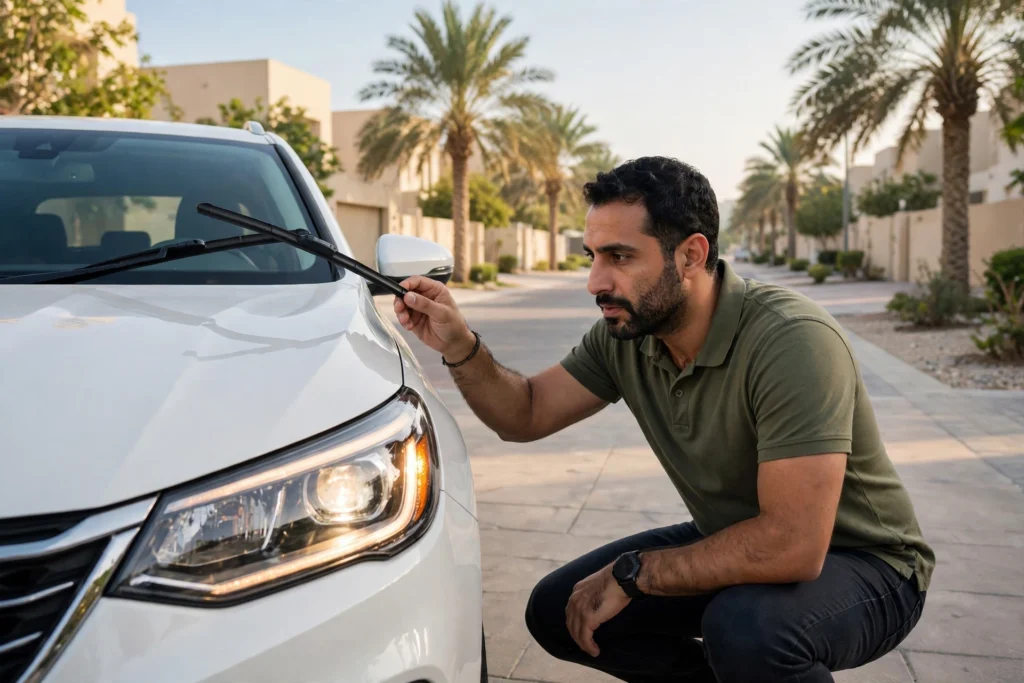
Wiper blades are the next item, and in Dubai they fail more often than drivers expect. The sun bakes the rubber until it goes hard and brittle, and then the first rain of the season reveals the damage: the blade skips, judders and leaves unwiped streaks across the glass. The inspector runs the wipers and the washers, and torn, split or hardened blades fail. So do empty washer bottles and blocked washer jets. Fill the washer bottle, check that both jets spray onto the glass properly, and replace the blades if they are more than a year old or if they leave any streak at all. It is one of the cheapest fixes on this entire list.
Mirrors matter too. A cracked or missing mirror, or one that will not stay adjusted, fails — the driver needs all three mirrors to see what is around the car.
5. Window Tint: The 50% Limit and the Windscreen Rule
Window tint is one of the most misunderstood rules in Dubai, and it catches a surprising number of cars at the test lane. The rule comes from Ministerial Resolution 178 of 2017, and it is simple: tint on the side and rear windows must not exceed 50%. The front windscreen must have no tint at all.
The inspector measures the tint with a meter, so "it looks light to me" is not a defence. A film that was sold to you as 50% may actually measure darker once it is on the glass, especially if the glass itself already has a factory tint. And a film that was legal when it was fitted can darken or bubble over time. If your tint is old, peeling, bubbling or has gone purple at the edges, have it measured before the test — many tint shops will check it for free — and be ready to remove it if it reads over the limit.
There is one genuine exception: a medical exemption exists, with a permit, for people whose condition requires darker tint. That is a formal permit, not a note from a clinic or a verbal explanation at the lane. If you have a medical reason for darker tint, get the permit sorted well before the test, and carry it with you.
The penalty side is worth knowing even though it is not the test itself: the fine for illegal tint is widely reported as AED 1,500 with removal of the tint, but penalties change, so confirm the current figures on official sources before you rely on them. What matters for the test is simpler — if the meter says over 50% on the sides or rear, or any tint on the windscreen, the car fails. If you want the full detail on what is allowed and where, read our guide to car window tint rules in Dubai.
6. Fluid Leaks: What the Pit Sees
Part of the test happens from underneath the car, with the inspector in a pit looking up at the underside. This is the part drivers never see, and it is where slow leaks that you have been ignoring for months finally get noticed.
The inspector looks for any fluid dripping or actively leaking: engine oil, coolant, brake fluid, power-steering fluid, transmission fluid. A light misting or an old stain that is dry may be noted but not failed; a fresh drip, a wet patch, or fluid actively running down a component is a fail. The distinction matters, and it is also the reason you should look under your car before the test rather than hoping for the best.
Engine oil leaks are the most common. They usually come from a worn valve-cover gasket, a tired oil-pan gasket, or a loose oil filter or drain plug after a service. A few drops on your parking spot are easy to ignore — until the inspector sees the underside wet with oil. Coolant leaks are next: a weeping hose, a cracked radiator, a failing water pump. The inspector will spot the coloured residue coolant leaves behind, and a coolant leak is also a car that is at risk of overheating on the Sheikh Zayed Road in August, so it is worth fixing on its own merits.
Brake fluid leaks are treated more seriously still, because they affect control of the car. A brake fluid leak is a fail without discussion, and rightly so.
The home check is easy: park on clean cardboard or a light-coloured surface overnight and look at what is underneath in the morning. Note the colour and the position — black or brown under the engine means oil, green or pink under the front means coolant, red under the middle means transmission fluid. Then open the bonnet and check the levels: engine oil on the dipstick, coolant in the reservoir, brake fluid in its reservoir, power-steering fluid if your car has it. Any level that keeps dropping is a leak, not evaporation. Get it found and fixed before you book, because a leak that the pit sees is a leak that will still be there at the re-test if you only wipe it off.
7. Emissions: The Exhaust Test
The emissions check is the part of the test that worries owners of older cars the most, and it is also the part that most often reveals a problem the driver already knew about but had been putting off. A probe goes into the exhaust, the engine is run up, and the gases coming out are measured against the limits. Visible smoke from the exhaust is a fail in itself — blue smoke, black smoke or thick white smoke all tell the inspector something is wrong before the probe even gives a reading.
Blue smoke means the engine is burning oil — worn piston rings, tired valve seals, a turbo on its way out. Black smoke means too much fuel is being burned, often a faulty injector, a blocked air filter, or a sensor feeding the engine the wrong information. Thick white smoke that does not clear once the engine is warm usually means coolant is getting into the combustion chamber. None of these are small problems, and none of them will fix themselves by the re-test.
Even without visible smoke, a car can fail the gas limits. The usual culprits are a tired catalytic converter, a misfire the driver has learned to live with, a faulty oxygen sensor, or an engine management light that has been on for months. A misfiring engine does not burn its fuel properly, and the unburned fuel goes straight out of the exhaust — the probe catches it immediately. If your car has a rough idle, hesitates when you accelerate, or uses noticeably more fuel than it used to, get it diagnosed before the test rather than after a fail. Our guide to car engine repair in Dubai covers the most common causes of misfires and poor running, and what a proper diagnosis looks like.
A few practical points before the test: make sure the car is properly warm when you arrive — a cold engine runs rich and produces worse readings, so drive it for a good twenty minutes before the lane rather than starting it cold in the car park. And if the check-engine light is on, do not just hope the probe will not notice — it will, and the warning light is its own separate fail. Fix the cause, clear the light properly, and drive the car for a day or two before the test so the system has completed its checks.
8. Steering and Suspension: Play, Wear and Wandering
The inspector checks the steering and suspension by moving the wheels, rocking the car, and looking at the components from underneath. What he is feeling for is play — looseness where there should be none — and what he is looking for is wear that has gone past the point where it is safe.
Steering play is the big one. With the car on the ground, the inspector turns the steering wheel and watches the road wheels: if the wheel moves noticeably before the tyres start to turn, something in the steering system is worn. That could be a tie-rod end, a ball joint, or wear inside the steering rack itself. The driver usually notices this one as a vague, wandering feeling at speed, or a steering wheel that is no longer centred when the car is going straight. It creeps up slowly, so people adapt to it — but the lane measures it, and a car that wanders is a car that cannot be placed precisely on the road.
Worn suspension joints and bushings fail the same way. Rubber bushings harden and crack in the heat, ball joints develop play, and control-arm bushings wear until the wheel can move in directions it should not. The symptoms are knocks and clunks over bumps, a car that feels unsettled over uneven roads, and tyres that wear unevenly. The inspector checks each joint for movement, and any joint with play beyond the limit fails.
Shock absorbers get tested too. A shock absorber that has lost its damping lets the wheel bounce instead of staying in contact with the road, and the inspector can see and feel it. Leaking shocks, where oil is visible on the body of the damper, are a fail.
Before the test, drive the car with the radio off and listen. Knocks over speed bumps, a steering wheel that shakes at speed, a car that pulls to one side, or a ride that has become bouncy are all worth investigating before you book. Suspension work is not cheap, but it is the difference between a car that is safe and a car that is not, and the test exists precisely to catch it.
9. Chassis, Body Damage and Unapproved Modifications
The inspector walks around the car and looks at its structure — the chassis, the body panels, the bumpers, and anything that has been added or changed. This is not a beauty contest; a few parking dents will not fail a car. What fails is damage that affects safety, or changes that were never approved.
Accident damage is the first thing checked. A bent chassis rail, a cracked subframe, a crumpled crash structure that was never properly repaired — these are structural failures, and they fail the test. Rust is checked the same way: surface rust on an old exhaust bracket is one thing, but rust that has eaten through a structural member, a floor pan or a suspension mounting point is another. Dubai's climate is kind to bodywork compared with wetter countries, but cars that have spent time near the coast or have had poor accident repairs can still hide serious corrosion underneath.
Loose parts fail too. A bumper that is hanging off its clips, a loose undertray flapping underneath, an exhaust that is held up with wire, a number plate that is barely attached — the inspector will note all of it. The logic is the same as everywhere else in this test: if it can fall off on the road, it is a danger to everyone behind you.
Then there are modifications, and this is where a lot of otherwise well-kept cars come unstuck. Dubai has a thriving car-modification culture, and much of it is perfectly legal — but changes to the exhaust system, the lighting, and the suspension need approval, and an unapproved modification fails the test. A loud aftermarket exhaust with no approval, headlights that have been changed to a different type, a suspension that has been lowered or lifted without approval, oversized wheels that foul the bodywork — all of these can fail. The test does not care how good the modification looks or how much it cost. It cares whether it is approved and whether it is safe.
If your car has modifications, sort the paperwork before you book. If you are buying a used car that has been modified, this is exactly the kind of thing a car pre-purchase inspection in Dubai is designed to catch — it will tell you which modifications are approved and which will cost you a failed test on day one.
10. Dashboard Warning Lights and Fault Codes
This is the simplest fail on the list to understand and one of the easiest to avoid — and yet it catches car after car, because so many drivers have learned to live with a light on the dashboard.
The inspector checks the dashboard with the ignition on. If the ABS light stays on, the airbag light stays on, or the check-engine light stays on, the car fails. These are not advisory lights. The ABS light means the anti-lock braking system is not working — the car will still brake, but it will not brake the way it was designed to in an emergency stop. The airbag light means the airbag system has a fault and may not deploy in a crash, or may deploy when it should not. The check-engine light means the engine management system has found a fault, and as we covered in the emissions section, that fault will almost always show up in the exhaust readings too.
What makes this fail particularly frustrating is that many drivers have been driving with the light on for months, and the car "feels fine." Modern cars are good at compensating for faults, and they will keep running with a dead sensor or a misfiring cylinder far longer than they should. But the test does not ask how the car feels. It asks whether the systems that are supposed to protect you are working, and a lit warning light is the car's own way of saying no.
Do not try to clear the light and hope for the best. Disconnecting the battery or clearing the codes with a scanner will turn the light off for a while, but the fault is still there, and the car's computer will log it again as soon as it runs its self-checks — often before you even reach the lane. Worse, a recently cleared system shows up as "not ready" on the inspector's scanner, which is itself a problem. Fix the cause, not the light.
Each light has its own common causes. A check-engine light that flashes is more urgent than one that stays steady — our guide to the check engine light flashing versus steady explains the difference and what to do in each case. An ABS light is often a wheel-speed sensor, which is a small and relatively cheap fix. None of these are jobs to guess at — get the fault codes read properly, fix what the code points to, and drive the car for a day or two before the test so the system can confirm the repair.
11. What to Do When Your Car Fails
First, do not panic, and do not argue with the inspector. A fail is not a judgement on you or your car — it is a list. Take the inspection report, read it carefully, and make sure you understand every item on it before you leave the centre. If anything on the report is unclear, ask the inspector to explain it while you are still there. That conversation is worth more than an hour of guessing later.
Second, fix the listed faults — all of them. It is tempting to fix the obvious one and hope the others were borderline, but the re-test checks the failed items again, and anything still wrong will fail again. Get the work done properly, with the right parts. A tyre that is over five years old will still be over five years old at the re-test. A brake pad that is worn to the metal will still be worn to the metal. There is no shortcut through a re-test.
Third, remember the practical advantage the RTA gives you: you do not need a new appointment for the re-inspection. Go back when the work is done. The re-inspection fee for a light vehicle is AED 50, plus the AED 20 Knowledge and Innovation fee — confirm the current figures on rta.ae before you go. And remember that your certificate, once you pass, is valid for 30 days, so do not leave the re-test until the last possible day and then find yourself out of time for the renewal itself.
If you disagree with the result itself — not the faults, but the inspector's judgement — you can appeal to the Technical Inspection Committee. Its decision comes after 5 working days and is final until you fix the faults and submit a new request. An appeal is for a genuine dispute about the result, not a way to buy time while the faults are still there.
Your Pre-Test Checklist: Run This at Home the Day Before
Most of the fails in this guide can be caught in half an hour at home, the day before your appointment. Work through this list in order, and tick each item off honestly. If you cannot tick it, fix it before you book — not after a fail.
- Tyres: Check the DOT date on all four tyres — none older than 5 years from manufacture. Measure tread depth — at least 1.6 mm everywhere, with no bald edges. Look for cuts, bulges and cracks on the sidewalls. Check the size matches the manufacturer's specification.
- Brakes: Listen for squealing or grinding. Feel the pedal — firm, not soft or spongy. Check the brake fluid level. Test the handbrake on a gentle slope.
- Lights: With a helper, test dipped and main beam, indicators left and right, brake lights, reverse lights, hazards, fog lights, and the rear number-plate bulb. Check headlight aim and clean any cloudy lenses.
- Windscreen and wipers: Look for cracks or chips in the driver's line of sight. Run the wipers — no streaks, skipping or torn rubber. Fill the washer bottle and check both jets spray properly. Check all three mirrors.
- Tint: Side and rear windows at 50% or lighter, no tint on the front windscreen. If your tint is old or bubbling, have it measured before the test.
- Underneath: Park on clean cardboard overnight and look for drips in the morning. Check oil, coolant, brake fluid and power-steering fluid levels.
- Dashboard: Start the car and confirm no ABS, airbag or check-engine light stays on. If one does, get the fault codes read and fixed — do not just clear them.
- Body and structure: Walk around the car. Bumpers secure, number plates firmly attached, nothing loose underneath, no unapproved modifications you have forgotten about.
- Paperwork and booking: Appointment booked through the RTA website or the RTA Dubai app. Arrive no more than 15 minutes before or after your time. Car properly warm when you arrive — drive it for twenty minutes first.
- Battery: A weak battery can cause slow starts and dashboard lights that confuse the test. If the car has been slow to start, get the battery checked — a mobile car battery replacement in Dubai can sort it at your home or office before test day.
When to Book a Pre-Test Inspection with a Mobile Mechanic
The home checklist catches the obvious faults, but some of the most common fails — brake balance on the rollers, steering play, suspension wear, emissions readings — cannot be checked in a driveway. That is what a pre-test inspection is for, and it is worth booking if any of these apply to you.
Book one if your car is more than five years old, if you have owned it for less than a year and do not know its history, if any warning light is on, if the car has ever been in an accident, or if you have already failed once and want to be sure the re-test passes first time. A pre-test inspection is also the sensible choice if you are short on time — a mobile mechanic comes to your home or office, goes through the same checks the lane will run, and tells you exactly what needs fixing before you book. It costs far less than a failed test, a re-test fee, and a second morning at the centre.
A good pre-test inspection covers the brakes, the suspension and steering for play, the lights and aim, the tyres including age and tread, the fluids and leaks from underneath, and a diagnostic scan for fault codes. Ask for a written list of what needs doing, with the urgent items separated from the advisory ones, so you can decide what to fix first. And if the inspection finds something serious — a worn steering joint, a failing catalytic converter, a brake imbalance — be glad it was found in your driveway and not in the test lane.
Frequently Asked Questions
How long does the RTA vehicle test take?
A light vehicle inspection takes around 32 minutes. Allow more time than that for the whole visit — arriving, waiting for your slot, and the paperwork afterwards — and remember to arrive no more than 15 minutes before or after your appointment time.
Do I need an appointment for the RTA test?
Yes, since 2 June 2025 an appointment is mandatory for registration, renewal and export with plates. Book through the RTA website or the RTA Dubai app. The one exception is a re-inspection after a fail — for that, no new appointment is needed.
How long is the inspection certificate valid?
The certificate is valid for 30 days. Plan your renewal around that window so you are not left doing a re-test at the last minute.
What is the most common reason cars fail the RTA test?
Tyres — tread below the 1.6 mm legal minimum, tyres older than 5 years from the date of manufacture, and cuts, bulges or cracks. Brakes and lights are next. All three are easy to check at home before you book, which is why they are so frustrating to fail on.
Can I appeal if I think the test result is wrong?
Yes. You can appeal to the Technical Inspection Committee, and its decision comes after 5 working days. The decision is final until you fix the faults and submit a new request, so an appeal is for a genuine dispute about the result — not a substitute for fixing the faults.
My car is new — do I need the test?
Not for the first three years. A new first-owner car is exempt from testing for 3 years from the year of manufacture or the year of registration, whichever comes first. After that, the car needs a test before each annual renewal. And remember: the three-year exemption is about the test, not the tyres — the tyre age limit is five years from manufacture.
The Test Is Not the Enemy
It is easy to treat the RTA test as something to get through, a bureaucratic hurdle between you and your renewed mulkiya. But every item on the inspector's list is there because it has caused an accident somewhere — a tyre that blew out, a brake that pulled to one side, a windscreen crack that caught the sun at the wrong moment, an airbag that did not deploy. The test is not trying to fail your car. It is trying to make sure the car you drive every day is safe to be on the road with everyone else's family.
Most fails are small, cheap and fixable — a bulb, a wiper blade, a tyre that is older than you realised. The drivers who fail are usually not the ones with neglected cars. They are the ones who never checked. Spend half an hour on the checklist in this guide, fix what it finds, and walk into the lane knowing your car is ready. And if you would rather have a professional run through it for you, that is exactly what a pre-test inspection is for.
If your car needs attention before the test — tyres, brakes, lights, an engine fault, a warning light that will not go away — 95 Services can help. Our mobile mechanics come to you anywhere in the UAE, open 24 hours, with help that can arrive within 20 minutes and a response time of 15–20 minutes. Prices are very low, and the work is done at your home or office, so you do not lose a morning driving to a garage. Call or WhatsApp us on +971 54 344 3513 and tell us your test date — we will make sure your car is ready for the lane before you book. For everything from routine servicing to pre-test checks, see our car repair and maintenance services and book the visit that gets your car passed first time.
