
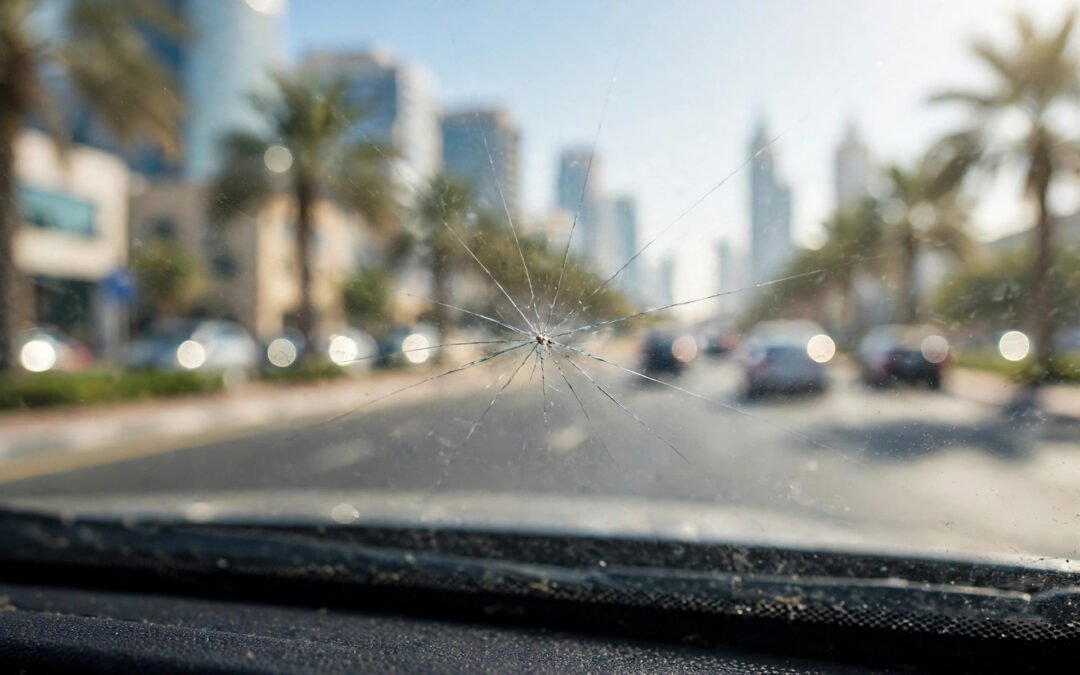
You are driving home on Sheikh Zayed Road, traffic is moving well, and then — tick. A tiny stone flicks up from the truck in front of you and hits your windscreen. You flinch. You look. There it is: a small white star, no bigger than your thumbnail, sitting low on the passenger side. Or maybe it is right in front of you, dead centre, and every time the sun catches it, it throws a little flash into your eyes.
Most drivers in Dubai know that exact moment. It happens on Emirates Road, on the Dubai–Abu Dhabi highway, on the way to Jebel Ali, on a Friday drive out toward Hatta. A lorry tyre picks up a pebble. A car in front of you kicks up gravel from a roadworks patch. The wind does the rest. It is not your fault, it is not bad driving, and it is not rare. In a city where so many cars spend so much time at highway speed, in heat, in dust and sand, windscreen chips are simply part of owning a car here.
And yet that tiny mark raises a run of questions that most people only think about once it has already happened. Can it be repaired, or does the whole windscreen have to come out? Will it spread? Is it safe to keep driving? What will the RTA inspection say when renewal comes around? Will my insurance help, or will claiming make things worse? And if the screen does have to be replaced, what about that little camera sitting behind the mirror — the one that watches the lane markings and helps the car brake?
This guide answers all of that, in plain language, the way a mechanic who has seen a thousand windscreens in Dubai would explain it to you over the bonnet of your car. No scare tactics. No invented prices. Just what matters, what you can safely leave for a few days, what you should not leave at all, and how to make the repair-or-replace call with confidence.
One honest note before we start: some of the exact numbers you will see quoted online — a particular size in millimetres, a particular fine, a particular retest fee — are not published in one clear official RTA document that we could verify at the time of writing. Different workshops and guides quote different thresholds, and they disagree with each other. Where that is the case, this article says so plainly, tells you the general rule that is consistent across sources, and tells you to confirm the detail at the testing centre or with your insurer before you rely on it. That is better than a confident-sounding number that turns out to be wrong on the day of your test.
Your windscreen is not just a window
It helps to know what you are actually looking at when you look through your windscreen, because it explains almost everything else in this guide — why a small chip can be repaired, why a long crack cannot, why heat makes things worse, and why the glass matters in a crash.
A modern car windscreen is laminated glass. That means two layers of glass with a thin, clear plastic layer — usually PVB, polyvinyl butyral — sandwiched between them and bonded under heat and pressure. The side windows and the rear window on most cars are different: they are tempered glass, made to shatter into small blunt pieces. Your windscreen is deliberately different. When it is hit hard, it cracks, but the plastic layer holds the pieces together. That is why a windscreen hit by a stone does not shower you with glass. It stays in one piece, cracked, but in place.
That laminated construction does three jobs you probably never think about until something goes wrong.
First, it is part of the structure of the car. On a modern car, the windscreen contributes to the stiffness of the body shell. It helps the roof resist crushing in a rollover. It provides a backstop that the passenger airbag pushes against when it inflates — the bag fires up and out, and the windscreen helps it stay in the right shape and position in front of the passenger. A windscreen that is badly cracked, poorly bonded, or fitted with the wrong adhesive does not do that job as well. This is not a theoretical point. It is the main reason a proper replacement matters more than a cheap one.
Second, it is your main view of the road. That sounds obvious, but it is worth saying plainly: everything you do as a driver — judging the gap to the car ahead, seeing a pedestrian step off the pavement in Deira, spotting a cyclist in your mirror's blind spot, reading a brake light two cars ahead in the rain — runs through that one piece of glass. A chip in the wrong place does not just look untidy. In low sun, at night, in fog, or in the glare bouncing off a wet road after a rare Dubai downpour, a chip or crack scatters light. It creates a starburst, a flare, a blind spot that moves as you move your head. You can be a careful driver and still miss something because the glass got in the way.
Third, on a growing number of cars, the windscreen is now a mounting point for technology. Behind the rear-view mirror, tucked against the glass, sits a camera on many newer cars. Sometimes there is a rain sensor, a light sensor, sometimes a bracket for a head-up display. The glass in that area has to be optically clear and the camera has to sit at exactly the right angle. Move the glass by a millimetre, or fit a screen with a slightly different tint or curvature in that zone, and the camera's view of the road changes. We will come back to this in the ADAS section, because it is the part of a replacement that most drivers have never heard of — and the part that matters most on a modern car.
So when we talk about "repair or replace", we are not talking about cosmetics. We are talking about a structural part, a safety part, and increasingly an electronic part. That is why the decision deserves a proper look, not a shrug and a "it is only a small chip".
How a chip happens, and what happens inside the glass
A stone chip is a small impact with a lot of energy concentrated in a tiny point. The stone is small — a pebble, a piece of gravel, a fragment thrown up by a tyre at 100 or 120 km/h — but it is travelling fast relative to your car, and it hits a hard, brittle surface. The outer layer of glass takes the hit. A tiny cone-shaped piece of the outer layer breaks away. That is the little crater you can see and feel with your fingertip. Around it, the glass is stressed. Tiny fractures run out from the impact point, sometimes visibly, sometimes so fine you cannot see them until the light catches them.
At the moment of impact, the damage is usually small. What happens next depends on what the glass goes through. And in Dubai, the glass goes through a lot.
Your car sits in the sun. The outside of the glass heats up. The inside, if you have the air conditioning running — and in a Dubai summer, you do — is much cooler. Glass expands when it is hot and contracts when it is cold. When one side is hot and the other is cold, the two sides pull against each other. That is thermal stress. A healthy windscreen handles it easily. A windscreen with a chip in it has a weak point, and thermal stress concentrates at weak points. That is why a chip that looked harmless on Monday can be a crack running halfway across the screen by Thursday, after three days of baking in an open car park in Al Quoz and then cooling down in an underground garage in Marina.
Vibration does the same thing in a slower way. Every bump, every expansion joint on the highway, every speed hump in a residential area, every time you close a door with a bit of force — all of it sends a tiny shock through the body of the car and into the glass. Again, a healthy screen shrugs it off. A chipped screen has a crack tip, and a crack tip is where stress concentrates. Each little shock can nudge the crack a fraction of a millimetre further. You do not notice it day by day. Then one morning you get in, and the crack that was two centimetres long is now ten.
Water and dust get into the picture too. Once the outer layer is broken, the chip is an open wound in the glass. Fine desert dust works its way in. If it rains, or if you wash the car, water gets in. Dust and moisture inside a chip make a resin repair harder, because the repair works by filling the empty space with clear resin — and if that space is already full of grit and moisture, the resin cannot bond cleanly. This is one of the practical reasons for the advice you will read later in this guide: cover a fresh chip with clear tape as soon as you can. It is a small, slightly odd-looking step, and it genuinely helps.
None of this means you should panic the moment you hear the tick. Most chips do not turn into a full replacement in an hour. But it does mean the chip is not a "leave it for six months and forget about it" problem either. Time, heat and driving are all working against you, slowly, in Dubai more than in most places. The sooner you get it looked at, the more options you have — and usually, the simpler and cheaper the fix.
Why Dubai is particularly hard on windscreens
It is worth pausing on this, because drivers who have moved to Dubai from cooler countries are often surprised by how quickly glass damage spreads here. It is not bad luck. It is the environment.
The summer heat is the biggest factor. A car parked in direct sun in July or August in Dubai can have a dashboard and windscreen far hotter than the air temperature. The glass itself absorbs heat. Then you get in, start the car, and blast the air conditioning. Cold air hits the inside face of a very hot windscreen. That sharp temperature difference across the thickness of the glass is exactly the kind of stress that makes a crack grow. The same thing happens in reverse when you drive out of a hot car park into a chilled underground garage, or when you wash a sun-baked car with cold water. None of these things are avoidable — you have to park, you have to use the AC — but it helps to understand why a chip behaves differently here than it would in a mild climate.
Then there is the sand and dust. Dubai is a desert city. Fine sand is in the air, on the roads, on construction sites, on the shoulders of highways. At speed, that sand is abrasive. It does not usually chip a windscreen by itself, but it pits the glass over time — tiny, almost invisible marks that make the surface less smooth — and it is carried by the wind and by the tyres of the vehicles around you. Add in loose gravel near roadworks, and the small stones that sit on the hard shoulder and get flicked up by a truck tyre, and you have a steady supply of the exact small, fast projectiles that chip glass.
The roads themselves play a part. Dubai's highways are fast, well-built roads. That is a good thing, and it is also the reason a stone hit here carries so much energy. At 60 km/h in a residential street, a pebble bouncing off a tyre might not even mark the glass. At 120 km/h on Emirates Road, the same pebble arrives with far more force. The long, high-speed commutes that are normal here — Dubai to Abu Dhabi, Sharjah to Jebel Ali, the daily run down Sheikh Zayed Road — mean more exposure, at higher speed, to whatever is on the road surface.
And there is one more Dubai-specific habit worth mentioning: the car wash. Dubai drivers wash their cars often, because dust settles fast. A high-pressure jet aimed straight at a chipped area can force water and grit into the chip. That does not mean you should stop washing your car. It means that if you have a fresh chip, tell the wash attendant, or wash around it gently, and get the chip looked at before the next wash if you can. Small care, real difference.
None of this is a reason to dread driving in Dubai. It is a reason to treat a chip as a small job to do this week, not a small job to do someday. In this climate, "someday" is often the day the crack has run too far to repair.
What kind of damage do you have? The types of chips and cracks
When a technician looks at your windscreen, the first thing they do is work out what type of damage it is. The name matters, because different shapes behave differently, and different shapes repair differently. You do not need to memorise the trade names, but it helps to recognise what you are looking at, so that when someone tells you "that is a star break, it should repair" or "that is an edge crack, it will need replacing", you know what they mean and why.
Bullseye
A bullseye is the classic stone chip. It looks like a small round target: a dark impact point in the middle, with a neat circular ring around it, like a tiny dartboard in the glass. It is usually caused by a roundish stone hitting square-on. A small, clean bullseye, away from the driver's direct view and away from the edge of the glass, is one of the most repairable kinds of damage there is. Resin flows into the round cone nicely, fills it, and the repair is usually strong and hard to spot afterwards. A large bullseye, or one with cracks running out from the ring, is a different story — the bigger it is, the less likely a repair will hold and look right.
Star break
A star break is what it sounds like: a central impact point with short, thin cracks — legs — radiating out from it, like a star. You will see this a lot in Dubai, because the stones that hit at highway speed tend to produce this shape. A star with short legs can often be repaired. The resin is injected at the centre and drawn out along each leg. A star with long legs, or legs that keep growing, is harder. Each leg is a crack tip, and each crack tip is a place where stress concentrates. If the legs are already long, or if there are many of them, a technician will usually advise replacement, or at least warn you honestly that a repair may not stop the crack from running later.
Half-moon, or partial bullseye
A half-moon looks like a bullseye that only formed halfway — a semicircular chip, usually because the stone hit at an angle rather than straight on. It behaves much like a bullseye. Small and clean, it usually repairs well. Large, or with cracks coming off the ends of the arc, it is less certain.
Combination break
A combination break is a mix — a bullseye with star legs, for example, or a chip with several different fracture patterns in one place. These are common when a larger stone hits, or when a chip has been left and has started to develop. Combination breaks are judged case by case. A small one can sometimes be repaired, but the more complex the pattern, the more a technician will lean toward replacement, because resin cannot reliably fill every branch of a complicated fracture, and a repair that leaves air trapped in one branch may not hold.
Surface pit
A surface pit is not really a chip at all. It is a tiny dent in the outer surface of the glass, with no cracks running from it. You can feel it with your fingernail — a little rough spot — but it has not broken through in a way that threatens the structure. Pits are usually caused by sand and small debris over time. A single pit is cosmetic. A windscreen covered in pits, after years of desert driving, can become hazy in low sun, because the pitted surface scatters light. Pits alone do not usually need a repair, and they cannot really be filled in the same way a chip can. If the haze is bad enough to affect your view, that is a replacement conversation, not a repair one — but that is a slow, long-term process, not an emergency.
Short crack, or single-line crack
A short crack is a single line in the glass, with no obvious impact crater at one end, or with a small chip at one end where it started. It might be a couple of centimetres long, running in a fairly straight line. Short cracks are the borderline case. A short crack away from the edge and away from the driver's view is sometimes repairable, depending on its length and whether it is stable. A short crack that is already growing, or one that runs toward the edge, usually is not. The technician will look at where it ends — a crack that ends in the middle of the glass is easier to deal with than one that ends at the edge, because the edge is where the glass is held in the frame and where stress is highest.
Long crack
A long crack is a single line that runs a significant distance across the windscreen — from one side toward the other, or from the bottom up toward the middle, or in a curve that keeps going. There is no single official length that divides "short" from "long" — different guides and workshops quote different limits, and no single official limit is published, so a technician's judgement on the day decides. What matters in practice is that resin injection cannot reliably hold a long crack together over time. The crack will flex as the car moves and as the temperature changes, the resin will not flex in the same way, and the crack will usually find a way to keep growing. A long crack means replacement, in almost every case.
Edge crack
An edge crack is any crack that starts at, or reaches, the edge of the windscreen — the black border area where the glass meets the frame. Edge cracks are taken seriously for a simple structural reason: the edge of the glass carries more stress than the middle, because that is where the glass is bonded to the car and where the body flexes. A crack at the edge has a ready-made path to keep running, and it undermines the bond between the glass and the frame. Even a short edge crack is usually a replacement. If you see a crack starting from the very edge, do not wait to see if it grows. It almost certainly will.
Stress crack
A stress crack is a crack with no impact point at all. You get in the car one morning and there is a line in the glass, and you cannot remember any stone hitting it. Stress cracks happen when the glass is under strain — from a body flex, from a manufacturing weakness, from extreme temperature change, or from a previous poor fitting that put the glass under tension. They often start at the edge and run inward. A stress crack is a replacement job, and it is also worth asking the workshop to check the fitting and the frame, because if the new glass goes into the same stressed frame, the same thing can happen again.
Damage in the camera zone
This deserves its own mention, because it changes the decision even when the damage looks small. On cars with a forward-facing camera behind the windscreen — for lane-keeping, automatic emergency braking, adaptive cruise control — any damage in the area the camera looks through is treated much more strictly than damage elsewhere. Even a small chip there can distort the camera's view. A repair in that zone can leave a faint mark that the camera reads as an obstruction. For that reason, many technicians will recommend replacement for any damage in the camera's field of view, even if the same damage elsewhere on the screen would be repairable. The camera's view matters as much as yours.
How to look at your own damage
You can do a useful first check yourself, in daylight, before you call anyone. Park the car, clean the windscreen if you can — or at least the area around the damage — and look at it from inside and outside. Run your fingertip lightly over it: can you feel a crater, a rough edge, a line? Look at it from an angle, with the sun behind you: how far do the cracks run? Is the damage in front of the steering wheel, or off to the side? Does it touch the black edge? Is it in front of the mirror, where the camera sits? Take a clear photo, close up and from a little further back, with something for scale — a coin next to it is the usual trick. That photo, sent to a workshop on WhatsApp, will usually get you a straight answer: "that should repair" or "that will need replacing, come in and we will confirm". It will not be a final diagnosis — a technician needs to see it in person to be sure — but it will save you a wasted trip and give you a realistic expectation before you arrive.
And one thing not to do at this stage: do not press on the chip, do not try to pick at it, and do not pour anything into it. Supermarket "DIY repair kits" exist, and we will talk about them later, but poking at the damage with a fingernail or a key can turn a repairable chip into an unrepairable crack. Look, photograph, cover, and call.
Repair or replace? The decision, step by step
This is the question the whole article is really about, so let us work through it properly. The short answer is: small, clean, stable damage away from the driver's view and away from the edge can usually be repaired; large, long, edge, or driver's-view damage usually needs replacement. The longer answer is that five things decide it — size, location, depth, number, and age — and they all have to be considered together. A chip that passes on size but fails on location still needs replacing. A crack that passes on location but fails on size still needs replacing. Think of it as five gates, and the damage has to get through all five to be a repair.
Gate 1: Size
Size is the first gate, and the most quoted, and also the one where the numbers disagree the most between sources. As a general rule of thumb used by many workshops in Dubai and elsewhere, a chip smaller than a one-dirham coin can often be repaired, and a crack shorter than a few inches sometimes can be. But different workshops quote different coin sizes and different crack lengths, and no single official RTA figure could be verified for this article. So treat any specific size you read online as a guide, not a rule. What matters is the principle: the smaller the damage, the more likely resin can fill it completely and bond it strongly. The larger it is, the more likely the repair will leave air pockets, visible distortion, or weak points that let the crack run later. A technician measures the damage, looks at how the fractures branch, and makes a judgement. If they say "it is too big to repair well", they are usually right — a repair that does not hold is worse than no repair, because it can give you false confidence.
Gate 2: Location — the driver's view
Location is often the deciding gate, even for small damage. The area directly in front of the driver — roughly the area swept by the wipers on the driver's side, and especially the area straight ahead of the steering wheel — is treated as a no-go zone for repair by most careful workshops. The reason is optical. A resin repair, even a good one, almost always leaves a faint mark. You might barely notice it on the passenger side. Directly in your line of sight, that faint mark catches the sun, catches headlights at night, and sits exactly where you need a clear view of the road. It can also distort what you see through it, very slightly, which is enough to matter when you are judging distance at speed. For that reason, damage in the driver's primary view usually means replacement, even if it is small. Damage on the passenger side, or low down near the dashboard, or high up near the top edge where you rarely look, is much more likely to be repairable.
Gate 3: Location — the edge
As we saw above, any damage that touches the edge of the windscreen, or is very close to it, is usually a replacement. The edge is where the glass is bonded to the frame and where stress concentrates. Resin cannot restore the strength of the edge bond. A repair at the edge may look fine for a week and then let go when the car flexes over a speed hump or the glass heats up. Technicians are rightly cautious here. If your crack reaches the black border, expect to hear "replacement".
Gate 4: Depth and layers
A windscreen has two layers of glass. A chip that only breaks the outer layer is a repair candidate. A chip that goes through both layers, or that has damaged the plastic layer in between, is not. You cannot always tell this by looking. A technician will look at the damage from an angle, sometimes with a light behind it, and check whether the inner surface of the glass is damaged too. If you can feel a rough spot on the inside of the windscreen, directly behind the chip, that is a sign the damage goes all the way through. That is a replacement. Delamination — a cloudy or bubbly area where the layers have started to separate — is also a replacement, because resin cannot re-bond separated layers.
Gate 5: Number and age
One chip is a repair. Three or four chips, scattered across the screen, are a different picture. Each chip is a weak point, and a windscreen with several weak points is a windscreen that is likely to develop a crack from one of them sooner or later. Most technicians will repair one or two small chips, but if there are several, or if there is a chip plus a crack, they will usually advise replacement — not to sell you a screen, but because patching three places on a piece of safety glass leaves you with a screen that is still compromised in three places.
Age matters too. A fresh chip, clean and dry, repairs well. A chip that has been there for weeks or months, full of dust, washed many times, with cracks that have already started to creep, repairs badly. The resin cannot get into a dirty, wet fracture properly. This is why the "do it this week" advice matters. It is not a sales tactic. A chip repaired on day two and a chip repaired on day sixty are two different jobs, and the second one often cannot be done at all.
Put those five gates together and you get a simple way to think about it before you call a workshop. Small, clean, single, outer-layer-only, away from the driver's view and away from the edge, and fresh: likely repair. Anything else — large, in your view, at the edge, through both layers, multiple, or old and dirty: likely replacement. If you are in between, that is exactly what a technician's inspection is for. A good workshop will show you the damage, explain which gate it fails, and let you see for yourself. If a workshop cannot explain why it is a replacement, ask them to show you. You are entitled to understand the decision about your own car.
How heat and driving make a crack spread — and how to slow it down
We have already touched on this, but it deserves its own section, because it is the part of the story that catches most Dubai drivers by surprise. A chip does not stay the same size. Left alone, it gets worse. Understanding why helps you understand why "I will deal with it after the weekend" so often turns into "I need a whole new windscreen".
Think of the crack as a tiny fault line in the glass. At the tip of the crack, the glass is under more stress than anywhere else. That is basic physics: stress concentrates at a sharp point. Every change in temperature, every vibration, every flex of the car body adds a little more stress at that tip, and every little addition can extend the crack by a tiny amount. You cannot see each tiny extension. You see the result, days later, when the crack is suddenly much longer than you remember.
Dubai's daily temperature swing is the main driver. A car parked in the sun heats up through the morning. The windscreen, dark dashboard, and interior all absorb heat. The glass expands. Then you get in and turn the air conditioning to full. Cold air floods the cabin and hits the inside face of the hot glass. The inside contracts while the outside is still expanded. That difference pulls at the crack tip. Then you park in a shaded or underground car park, and the glass cools more evenly, and the stress eases — but the crack has already moved a fraction. Then the next day, the same cycle repeats. Over a week of hot days, those fractions add up.
Slamming doors makes it worse, in a small but real way. When you shut a car door, you push a pulse of air pressure into the cabin. The cabin is a sealed box, more or less, and the pressure has to go somewhere. It pushes on the windscreen. On a healthy screen, nothing happens. On a chipped screen, that pressure pulse is another little nudge at the crack tip. You do not need to close your doors like you are handling eggs, but while you have a chip, it is worth closing them gently — push, don't slam — and asking passengers to do the same. The same goes for the boot.
Bumpy roads and speed humps do the same thing through vibration. Dubai's roads are generally smooth, but every car still meets expansion joints, roadworks, uneven patches, and the occasional pothole. Each one sends a jolt through the suspension, into the body, and into the glass. Again, a healthy screen handles it. A chipped screen feels it at the crack tip.
Using the windscreen demister or heater on full blast on a cold morning — rare in Dubai, but it happens in winter, especially early in the morning in the desert areas — is another sharp temperature change. So is blasting the AC directly onto a sun-baked windscreen at maximum. If you have a chip, it is kinder to the glass to let the cabin cool down gradually: start the AC, but do not aim the vents straight at the windscreen on full cold for the first few minutes. Let the glass come down in temperature more evenly. It is a small habit, and it costs you nothing.
None of this is meant to make you afraid to drive your car. You can drive with a small chip, carefully, for a short time, while you arrange a repair — provided the chip is not in your direct line of sight and is not already a long crack. But you should drive knowing that the clock is running, and that in Dubai's heat, the clock runs faster than it would in a cooler place. The drivers who end up needing a replacement are very often the drivers who meant to get the chip fixed, and then had a busy week, and then had a hot week, and then looked up one morning and found the crack had run.
What to do in the first hour after a chip
This is the practical part. You have just heard the tick. You are on the road, or you have just parked. What do you actually do?
First, stay calm and keep your eyes on the road. A chip is not an emergency stop. Unless the damage is so bad you cannot see — a large crack suddenly spreading across your view, glass starting to sag or bulge, which is rare — you do not need to pull over in a dangerous place. Drive to somewhere safe, a petrol station, a car park, your home or office, and then look at the damage properly.
Second, look at it and photograph it. As described earlier, look from inside and outside, in daylight if you can. Take a close-up photo and a wider photo showing where the damage sits on the screen. Note when it happened and where you were driving. That helps the workshop, and it helps if you later talk to your insurer — you will be able to say clearly what happened, rather than trying to remember a week later.
Third, cover it. This is the single most useful thing you can do in the first hour, and it takes thirty seconds. Put a piece of clear tape — ordinary clear sticky tape, or clear packing tape — over the chip, on the outside of the windscreen. Press it down gently, so it covers the impact point and any short cracks. The tape does two jobs: it keeps dust, sand and water out of the chip, which keeps the damage clean for a resin repair; and it keeps the chip a little more stable. It will look slightly odd. It is worth it. Do not use opaque tape, do not use a sticker that leaves glue everywhere, and do not try to fill the chip with anything — no glue, no nail polish, no toothpaste, none of the home remedies you will find online. Those things contaminate the fracture and make a proper repair harder or impossible.
Fourth, be gentle with the car until it is fixed. Close doors softly. Avoid slamming the boot. Do not use a high-pressure washer directly on the chip. Do not pour cold water on a hot windscreen. If you can, park in the shade rather than in direct sun, and if you have a sunshade, use it. None of these steps will fix the chip. All of them will slow it down and keep it repairable for longer.
Fifth, call a workshop and book it in. Not "when I get around to it" — this week. Send them the photo on WhatsApp and ask two questions: can this be repaired, and when can you look at it? A good workshop will give you a straight answer from the photo and a time to come in. If the damage is in your direct view, or it is already a long crack, or it touches the edge, ask if it is safe to drive in, and listen to the answer. If they say "do not drive it, we will come to you", take that seriously. Mobile windscreen work is common in Dubai, and for a replacement, a mobile technician coming to your home or office is often the practical option.
Sixth, do not use the wipers over the damaged area if you can avoid it. A wiper blade dragging across a chip can catch the edge of the broken glass and extend a crack, and it can also push grit into the fracture. If it rains, you will need the wipers — safety comes first — but if the weather is dry, leave them off until the repair is done.
And seventh, if the chip is directly in front of you and it is distracting you — flashing in the sun, pulling your eye, making you squint — treat that as a safety issue, not a cosmetic one. A distraction in your direct view is a reason to get the car seen sooner, and if it is genuinely blocking your view, to not drive it until it is fixed. Your eyes should be on the road, not on the chip.
What a resin repair actually involves
A lot of drivers picture a windscreen repair as someone dabbing a bit of glue on the chip and hoping for the best. The real process is more careful than that, and it is worth knowing what a proper repair looks like, so you can tell a proper job from a rushed one.
It starts with cleaning and inspection. The technician looks at the damage, checks its size and depth, checks whether the inner layer is damaged, and decides whether a repair is genuinely possible. A good technician will tell you honestly if it is not, rather than taking the job and doing a repair that will fail. If the chip is dirty, they will clean it carefully — not by scrubbing, but by removing loose dust and moisture from the fracture.
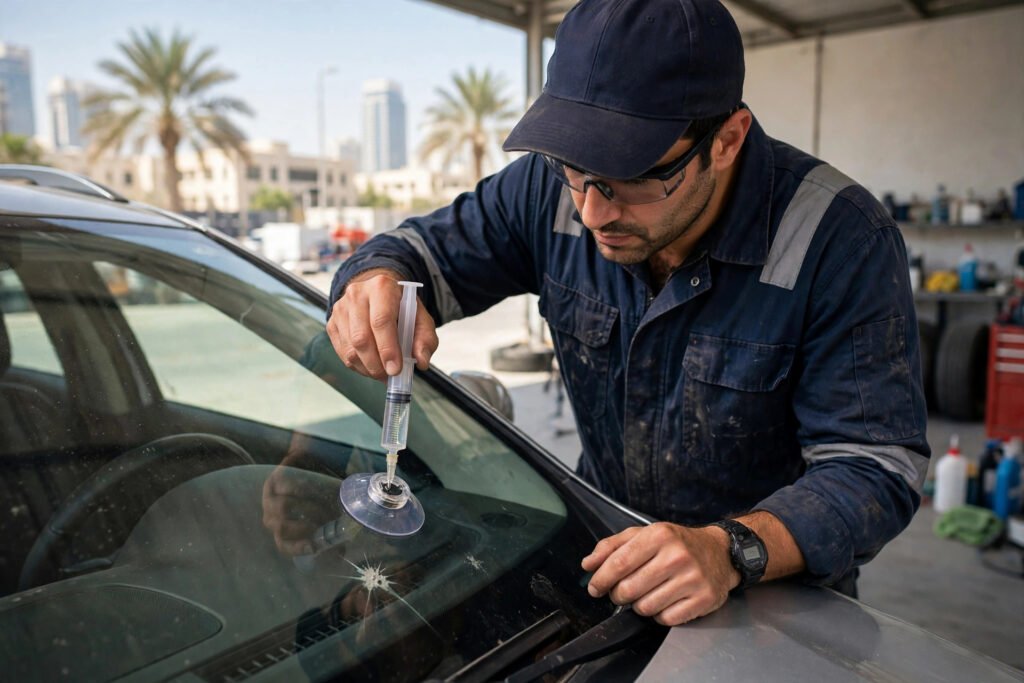
Then they set up the repair bridge. This is a small device, usually with suction cups, that sits on the windscreen over the chip and holds an injector precisely over the impact point. The injector creates a vacuum, pulling air and moisture out of the fracture. This is an important step. If air stays trapped in the fracture, the resin cannot fill it properly, and the repair will have bubbles and weak spots. You will sometimes see a technician cycling the vacuum — pulling air out, letting a little resin in, pulling again — to make sure the fracture is properly emptied before it is filled.
Then the resin goes in. It is a clear, liquid resin, designed to have a similar refractive index to glass — that is, it bends light in a similar way — so that once it is cured, it is hard to see. The injector pushes the resin into the chip and out along any short cracks, under controlled pressure. The technician watches it flow, and tops it up as needed, until the fracture is filled.
Then it is cured. Ultraviolet light — usually a small UV lamp held over the repair — hardens the resin. This takes a few minutes. The resin goes from liquid to solid, bonding the broken glass together and filling the empty space.
Then the excess is removed and the surface is polished. The technician scrapes off any resin that has overflowed onto the surface of the glass and polishes the spot smooth, so that the wiper blade passes over it cleanly and the surface feels flat to the touch.
A good repair is quick — often well under an hour — and you can usually drive the car straight away. It does not make the glass look brand new. There will usually be a faint mark where the chip was, visible if you look for it, especially at certain angles. What a good repair does is restore strength to the damaged area, stop the crack from spreading, and make the damage far less visible than it was. If someone promises you a repair that will be completely invisible, be a little sceptical. A faint mark is normal. A repair that stops the crack and looks tidy is a good repair.
What a repair cannot do is also important. It cannot fix a long crack. It cannot fix damage at the edge. It cannot fix damage that goes through both layers. It cannot remove a large area of damage in your direct view without leaving distortion. If a workshop offers to "repair" a long crack across your windscreen, ask them to explain how the repair will hold, and consider getting a second opinion. A repair that fails a month later costs you the repair and the replacement.
DIY repair kits: a word of caution
You will find DIY windscreen repair kits in car accessory shops and online. They are inexpensive, and they promise a lot. For a very small, very clean, very fresh chip, in a car you do not depend on heavily, a DIY kit can sometimes make the damage less visible. But there are reasons a professional repair is usually the better choice in Dubai.
The first is the vacuum step. Professional equipment pulls air out of the fracture properly. A DIY kit, with a small hand injector, often does not. The result is a repair with air trapped inside, which looks cloudy and does not bond well.
The second is the resin itself. Professional resins are matched to glass, cure properly under UV, and are chosen for the type of damage. A generic kit resin may not cure fully in Dubai's heat, or may yellow over time in the sun.
The third is judgement. A professional can tell you whether the chip is repairable at all. A DIY kit cannot. If you try to repair a chip that should have been replaced, you have spent time and money, you have contaminated the fracture with resin that a technician now cannot remove cleanly, and you have possibly turned a borderline replacement into a definite one — or worse, given yourself false confidence that a damaged screen is now safe.
That is not to say you should never touch a DIY kit. It is to say: for a car you drive every day, on highways, with your family in it, and with an RTA inspection to pass, a professional look is worth it. At the very least, send a photo to a workshop first and ask whether it is a repair. If they say yes and you still want to try it yourself, you are at least making an informed choice.
RTA inspection: what a chipped windscreen means for your test
For most Dubai drivers, the moment a windscreen chip becomes a real problem is not the day it happens. It is the day the registration renewal comes around, and the car has to go through the RTA vehicle test. So let us talk about that directly, and honestly about what we could and could not verify.
What the test is, and when you need it
In Dubai, cars over a certain age need a technical inspection before their registration can be renewed, and an inspection is also needed when ownership is transferred. The test is carried out at RTA-approved testing centres — Tasjeel, Shamil, Wasel, Al Mumayaz and others, at locations across the city, from Al Barsha and Al Quoz to Al Qusais and Jebel Ali. Since mid-2025, the centres work by appointment, booked through the RTA Dubai app or the RTA website, and you pay at the centre. The inspection itself is a safety and roadworthiness check: brakes, lights, tyres, suspension, emissions, steering, body condition, and — relevant here — glass, mirrors, wipers and visibility.
A testing certificate is generally valid for a short period, so the timing matters. You do not want to pass the test and then let the certificate expire while you sort out the renewal. And you do not want to book the test with a known fault on the car, fail it, and then have to fix the fault and come back for a retest. That is wasted time, a wasted appointment, and a second fee. It is far better to fix the windscreen first and then book the test.
For a full walkthrough of the test itself — what is checked, what to bring, and how to prepare — our RTA inspection checklist guide is a useful companion to this article: https://95services.com/rta-inspection-checklist-dubai/
What the inspection says about glass
Here is what is consistent across the sources we checked, including garage guides that follow the RTA testing process closely: the windscreen is checked for cracks and chips, and visibility is the test. Specifically, damage in the driver's primary field of view — roughly the area swept by the wipers, and in particular the area directly in front of the driver — is treated as a visibility fault and can cause a failure. Small chips outside that area, for example in a corner of the passenger side, may pass at the inspector's discretion. Wipers and washers are checked too: worn blades that streak or skip, and a washer that does not work, can also be flagged.
That general rule is consistent. The exact detail is not. Different guides quote different size thresholds for what counts as a fail — a coin of one size or another, a crack of one length or another, a distance from the edge — and those thresholds disagree with each other. We could not find a single official RTA publication, on rta.ae or in a published RTA inspection checklist, that states a precise millimetre or coin-size limit for windscreen chips at the time of writing. So this article does not state one as fact. That is deliberate. If you go to a test centre expecting a particular size to pass because a website said so, and the inspector judges it differently, you will fail the test and you will have wasted the trip.
The safest way to read the position is this: if the damage is in your line of sight, the car may fail inspection. If it is outside your line of sight but it is a crack, or a large chip, or it is near the edge, the car may also fail, and the decision may come down to the inspector on the day. If the damage is small, outside the driver's view, and cleanly repaired, you are in a much stronger position — but even then, a repair that has left a cloudy mark or distortion in the driver's view can be questioned. The only way to be sure is to fix the glass before the test, and to ask the testing centre directly if you have a borderline case and want a definitive answer before you book.
That sounds cautious. It is meant to be. An RTA test is a pass-or-fail judgement by an inspector looking at your actual car on the day, not a formula you can apply from your sofa. A workshop can advise you, and a good pre-inspection check will flag the glass before you book, but the final call is the inspector's.
If you fail on glass, what happens next
If a car fails the test, you receive a report listing the failure points. You then have a period — generally described in guides as 30 days — to fix the faults and return for a retest, which looks at the failed items again. The retest fee is lower than the full test fee. But the exact retest fee is another figure where sources disagree, quoting different amounts, so we do not state one here. Confirm the current fee on the RTA service page or at the centre when you book.
The practical lesson is simple: do not book the test as a way of finding out whether your windscreen will pass. Book it after the windscreen is fixed. A pre-inspection check at a workshop a week or two before your renewal date will catch the glass, the wipers, the lights, the tyres — all the small things that cause fails — and give you time to fix them without rushing. It is a much calmer way to go through renewal than failing on the day and then scrambling to get a new windscreen fitted while your registration is running out.
The wiper connection
One detail that catches people out: the windscreen and the wipers are checked together. A chipped windscreen and worn wiper blades are a bad combination. The blade drags across the chip, the chip catches the blade, the blade wears faster, and the combination leaves streaks that make visibility worse. If you are getting the windscreen repaired or replaced, have the wiper blades checked at the same time. They are a small part, and they make a real difference to what you can see in rain or in the spray thrown up by other cars. Our guide to wipers, washer jets and demisters in Dubai covers this in detail: https://95services.com/wiper-blades-washer-jets-demisters-dubai/
And if you are driving in fog, or in the low winter sun, or at night, a damaged windscreen makes all of those conditions harder. A chip that is a minor annoyance on a clear afternoon becomes a real problem when the light is poor. Our driving-in-fog guide is relevant here, because fog and glare are the conditions where a damaged screen shows up most: https://95services.com/driving-in-fog-dubai/
Tint and the windscreen
A quick note on tint, because it comes up at the same inspection. The windscreen itself should not carry a dark tint film beyond what is permitted, and any tint on the front windows is measured at the test. If you have had tint applied to the windscreen — sometimes sold as a heat-rejection film — and it is too dark, or it is bubbling or peeling around a chip, that can be flagged separately from the chip itself. If you are replacing the windscreen, ask the workshop about the tint on the old glass and whether the new glass needs any film re-applied, and make sure it is within the permitted limit. Do not assume a film that was fine on the old screen will automatically be fine on the new one.
A note on fines for driving with a damaged windscreen
You may read online that driving with a damaged windscreen that affects visibility can lead to a fine. Some secondary sources quote a specific amount. We could not verify a specific current fine amount on an official source at the time of writing, so we do not state one in this article. What is fair to say, in general terms, is that UAE traffic law treats a windscreen that obstructs the driver's view as a safety issue, and a police officer or an inspector who judges your view to be obstructed can take action. The practical point is the same as for the RTA test: if the damage is in your view, do not drive with it longer than you have to. Fix it, and the question goes away.
Insurance: what to know before you call
Insurance is the part of this topic where drivers have the most questions and the least clear information, because every policy is different. This section gives you general guidance only. It does not describe any particular insurer's policy, and it does not promise what your insurer will or will not cover. For that, you need to read your own policy document or call your insurer and ask. What follows will help you ask the right questions.
Windscreen cover is often separate from accident cover
Many comprehensive motor policies in the UAE include some form of windscreen or glass cover, sometimes as part of the main policy, sometimes as an add-on. The details vary widely. Some policies cover chip repairs with no excess, or with a small excess, because the insurer would rather pay for a small repair now than a full replacement later. Some cover a full replacement, with an excess you pay. Some have a limit on how many glass claims you can make in a year. Some only cover glass if the damage was caused by a specific event. Some require you to use an approved workshop or an approved glass supplier. You cannot assume any of this from a general article. You have to check your policy.
The first step, before you book a repair, is to find your policy document — the one you received when you bought or renewed your insurance — and look for the section on glass, windscreen, or "own damage". If you cannot find it, call your insurer and ask, in plain terms: "I have a stone chip in my windscreen. Is glass covered? Is a chip repair covered? What is the excess for a repair, and what is the excess for a replacement? Do I need to use an approved workshop? Do I need approval before the work is done, or can I claim afterwards? Will a glass claim affect my no-claims discount or my premium at renewal?"
Those are the questions that matter, and the answers will be different for different policies. Write the answers down, with the name of the person you spoke to and the date, if you can. If the insurer says you need pre-approval, get it before the work starts. If they say you can use any workshop, keep the invoice and the photos. If they say you must use an approved workshop, find out which ones are approved before you book anywhere else.
Repair is usually the insurer's preferred option too
In general terms, insurers prefer a repair to a replacement when a repair is possible, for the same reason you should: it is simpler, it keeps the original factory-fitted glass and its factory seal in place, and it costs less. That is why some policies waive the excess for a chip repair entirely. It is in the insurer's interest to fix a small chip early, before it becomes a large claim. If your insurer offers a free or low-excess chip repair, take it seriously. It is one of the few cases in insurance where the insurer's interest and yours point in exactly the same direction.
That said, do not let an insurer's preference override safety. If a technician tells you the damage needs a replacement, and the insurer's process pushes for a repair, ask for the decision to be reviewed, and get the technician's assessment in writing if you can. A repair that should have been a replacement is not a saving for anyone.
What to document
Whether you claim or not, document the damage. Photograph it when it happens. Note the date, the time, and where you were driving. Keep the workshop's assessment — repair or replace, and why — and keep the invoice. If you do claim, the insurer will usually want the photos, the invoice, and sometimes the old glass or a report from the workshop. If you do not claim, the same records are useful if the repair fails later, or if you need to show a future buyer that the windscreen was replaced properly and why. Good records cost you nothing and save you a lot of explaining later.
Will claiming affect your premium?
This is the question almost every driver asks, and it is the one with the least general answer. Some insurers treat a glass claim differently from an accident claim, and do not let it affect your no-claims discount. Others count it as a claim like any other. Some do not. It depends on your policy, your insurer, and your claims history. Do not rely on what a friend told you about their insurer, and do not rely on a general article — including this one — to tell you what will happen to your premium. Ask your insurer, before you claim, and ask specifically about the no-claims discount and the renewal premium. If the excess is close to the cost of the repair, it may be simpler to pay for the repair yourself and not claim at all. That is a judgement for you, once you know the numbers for your policy. We do not state any specific excess or premium effect in this article, because we cannot verify a general figure that applies to all policies.
If you do not have glass cover
If your policy does not include glass cover, or you have third-party-only cover, you will be paying for the repair or replacement yourself. That is still worth doing promptly. A repair is, in general terms, a much smaller cost than a replacement, and a replacement is a much smaller cost than the consequences of driving with a windscreen you cannot see through properly, or failing an RTA test and having to do the whole thing again. Think of it as maintenance, like tyres or brakes — a cost of keeping the car safe and legal, not an optional extra.
Buying a used car? Check the glass
If you are buying a used car in Dubai, the windscreen is part of the check, just as it is at the RTA test. Look for chips, cracks, and previous repairs. A previous repair is not necessarily a problem — a good repair is a sign the car was looked after — but a poor repair, a cloudy mark in the driver's view, or a crack that has been left, is a reason to ask questions and to factor a replacement into the price. Our pre-purchase inspection guide covers the wider check, and glass is one of the items on it: https://95services.com/pre-purchase-car-inspection-dubai/
ADAS calibration after replacement: the step you must not skip
If your car is more than a few years old, you may have a forward-facing camera behind your windscreen and not even know it. It sits behind the rear-view mirror, looking out through a small clear area of the glass. It is part of a system with a name you may have seen in your car's manual: ADAS, Advanced Driver Assistance Systems. It is the system behind lane-keeping assist, which warns you or steers you gently if you drift out of your lane; automatic emergency braking, which can brake the car if it thinks you are about to hit something; adaptive cruise control, which keeps a set distance from the car in front; traffic sign recognition; and sometimes a forward collision warning.
Those systems depend on the camera seeing the road clearly and from exactly the right position. The camera is mounted to a bracket on the windscreen, or to a bracket that is itself bonded to the windscreen. When the windscreen is replaced, the camera is removed, the old glass comes out, the new glass goes in, and the camera is refitted. Even if the new glass is identical to the old one, the camera's position changes by a tiny amount — a fraction of a millimetre, a fraction of a degree. That tiny change is enough to shift what the camera sees. A lane marking that the camera thought was two metres away might now read as a slightly different distance. The system might still work, but it might work less accurately. Or it might throw a warning light and switch itself off. Or, worse, it might work and be wrong — braking late, or steering at the wrong moment — without telling you.
That is why calibration is needed after a windscreen replacement on a car with a forward-facing camera. Calibration is the process of telling the camera, precisely, where it is and what it is looking at, so that its readings are accurate again. It is not a luxury. It is not an upsell. On a car that has the system, it is part of a proper replacement.
Static and dynamic calibration
There are two main kinds of calibration, and your car may need one or both, depending on the make and model.
Static calibration is done in the workshop, with the car stationary. The car is parked on a level surface, at a set distance from a calibration target — a board with a precise pattern on it, placed at a precise height and distance. The technician connects a diagnostic tool to the car, tells the car to look at the target, and the system adjusts itself until it reads the target correctly. The workshop needs to be level, the lighting needs to be right, and the target needs to be positioned exactly. It is a careful, methodical job, and it takes time.
Dynamic calibration is done on the road. The technician connects the diagnostic tool, drives the car at a set speed on a suitable road — usually a straight road with clear lane markings, at a steady speed — and the system calibrates itself as it drives, reading the lane markings and the road ahead. This also takes time, and it needs the right road conditions. It cannot be done properly in heavy traffic, on a road with faded markings, or in bad weather.
Some cars need only one type. Some need both. Some need a specific procedure that only a dealer or a specialist with the right diagnostic tool can do. Your workshop should know which type your car needs, and should be able to tell you before the replacement starts. If a workshop offers to replace your windscreen and does not mention calibration, and your car has a camera behind the mirror, ask them directly: "Does my car need ADAS calibration after this, and will you do it?" If they say it does not need it, ask them to explain why. If they say they will do it, ask whether it is static, dynamic, or both, and whether it is included in the job or done by someone else.
What happens if calibration is skipped
If calibration is skipped, a few things can happen. The most obvious is a warning light on the dashboard — a lane-keeping or collision warning light that stays on, or a message telling you the system is unavailable. That is actually the better outcome, because at least the car is telling you something is wrong.
The worse outcome is that the system appears to work but is misaligned. It may not warn you when it should. It may warn you when it should not. It may brake or steer at the wrong time. You may not notice until you need it — and the moment you need automatic emergency braking is not the moment to discover it is looking in slightly the wrong direction.
There is also an inspection and insurance angle. If your car has ADAS and the system is showing a fault after a replacement, that fault may be picked up at a service or an inspection. And if you are in an accident and the car's safety systems were not working because calibration was skipped after a glass replacement, that is a difficult conversation to have with an insurer. Again, we are not stating a specific insurance rule here — policies differ — but the general point is clear: a safety system that is not working properly is a risk, and a proper replacement includes making sure it works again.
What to ask before a replacement
Before you agree to a replacement on a car with a camera behind the windscreen, ask these questions, and make sure you understand the answers:
- Does my car have a forward-facing camera or any sensor mounted on the windscreen? If you are not sure, the workshop can check from your registration number or your VIN.
- Does it need calibration after a replacement? Which type — static, dynamic, or both?
- Will you do the calibration here, or will the car need to go elsewhere?
- How long will the whole job take, including calibration?
- Will you give me a printout or a report showing the calibration was done and passed?
- If a warning light comes on after the job, will you check it without charging me again?
A workshop that does this work properly will answer those questions without hesitation. They will have the diagnostic tool, the targets, and the space to do static calibration. They will know which cars need a dealer procedure. And they will be honest if your car needs to go to a specialist. A workshop that waves the questions away, or tells you calibration is not needed on a car that clearly has a camera, is a workshop to be careful with.
Repair and ADAS
A resin repair does not usually need calibration, because the glass is not removed and the camera is not disturbed. That is another reason a repair is preferable when it is possible. But there is an exception: if the repair is in the camera's field of view, the faint mark left by the repair can interfere with what the camera sees. That is why, as we said earlier, damage in the camera zone is often treated as a replacement, even if it is small. The camera's view has to be clear, and a repair mark in that view is not clear enough. If your chip is in the camera zone, expect the workshop to recommend replacement, and to include calibration in the job.
Other sensors and features on the glass
The camera is not the only thing that can be mounted on or near the windscreen. Many cars have a rain sensor, which turns the wipers on automatically when it rains. It sits against the glass and reads the water on the surface. A replacement needs the sensor refitted correctly, with the right gel pad or coupling, or the automatic wipers will not work properly. Some cars have a light sensor, which turns the headlights on automatically. Some have a heated windscreen, with fine wires in the glass. Some have a head-up display, which projects information onto the glass — that needs a specific type of glass, with a special coating in the projection area, or the display will look doubled or blurry. Some have an antenna in the glass.
All of this is to say: a windscreen is not a generic piece of glass. It is specific to your car, its model, its year, and its options. When you get a quote for a replacement, make sure the workshop has identified your car correctly, including whether it has a camera, a rain sensor, a heated screen, or a head-up display. The right glass matters, and the wrong glass — even if it fits — can leave you with systems that do not work.

What a proper replacement looks like, step by step
If your windscreen does need replacing, it helps to know what a proper job looks like. Not because you will be doing it yourself — you will not — but because you will know what to expect, how long it will take, and what to check when you collect the car.
It starts with identification. The workshop confirms your car's make, model, year, and options, and orders or selects the correct glass. That includes the tint, the camera bracket, the rain sensor area, the heating elements if any, and the head-up display area if any. Using the wrong glass is the single most avoidable mistake in a replacement, and it is avoided by checking the car properly at the start.
Then the car is prepared. The wipers are removed. The trim around the windscreen — the plastic and rubber pieces on the inside and outside — is carefully removed. The rear-view mirror and any camera or sensor is removed and put somewhere safe. The dashboard and the seats are covered, because cutting out a windscreen is a dusty job and you do not want glass fragments or old adhesive on your interior.
Then the old glass comes out. A technician cuts through the old adhesive — the polyurethane bond that holds the glass to the frame — using a cutting wire or a powered cutting tool. This is done carefully, so the paint on the frame is not damaged. Damaged paint on the frame can rust, and rust under a new windscreen bond is a problem that will come back later. Once the old glass is out, the frame is cleaned. Old adhesive is trimmed back to a thin, even layer. Any rust or damage to the frame is treated. The frame is primed, so the new adhesive will bond properly.
Then the new glass is prepared. A fresh bead of polyurethane adhesive is applied to the frame, or to the glass, in a continuous, even line, with no gaps. The new windscreen is lifted into place — usually by two technicians, using suction cups — and set down precisely, so it sits evenly in the frame. The trim, the mirror, the camera and the sensors are refitted.
Then the curing starts. Polyurethane adhesive does not set instantly. It needs time to cure and reach its full strength. The time depends on the adhesive, the temperature, and the humidity. In Dubai's heat, curing is usually faster than in a cold climate, but it still takes time — often a few hours before the car is safe to drive, and longer before the bond is at full strength. The workshop will tell you a safe drive-away time. That is the earliest time you can drive the car, not the time the adhesive is fully cured. Respect it. Do not drive the car before that time, even if it looks fine. The bond is what holds the windscreen in place in a crash, and it is also what holds the roof up and gives the airbag its backstop. Driving before the bond has set properly is not worth the risk.
After the drive-away time, there are usually a few aftercare instructions: do not wash the car with high pressure for a day or two, do not slam the doors for a day, leave any tape that the technician has put around the edges in place until they tell you to remove it, and keep an eye out for wind noise or water leaks. A small amount of wind noise or a leak in the first few days is a sign to go back to the workshop and have it checked — it may be a small gap in the adhesive, and it is far easier to fix early than to live with.
Then, on a car with ADAS, calibration is done — either before you collect the car, or as part of the same appointment. You should not collect a car with a camera system that has not been calibrated. Ask for the calibration report, and check that any warning lights are off before you drive away.
The whole job — replacement plus curing plus calibration — usually takes a few hours, and sometimes the car is kept for a full day if calibration needs a road test or the adhesive needs longer. A mobile replacement, done at your home or office, follows the same steps, but the technician needs a shaded, reasonably clean place to work, and the curing time still applies. Ask the workshop how long you will be without the car, and plan around it. Do not book a replacement for the morning of your RTA test. Book it a few days before, so you have time to check the car, do a short drive, and make sure everything is right.
How to check the job when you collect the car
When you collect the car, take a few minutes to check it properly, before you drive away. Look at the windscreen from outside: is it sitting evenly in the frame, with an even gap all around? Is the trim fitted neatly, with no gaps or loose pieces? Look from inside: is the mirror straight, is the camera housing fitted properly, is the trim around the top of the screen secure? Look for adhesive that has squeezed out onto the paint or the dashboard — a small amount is normal, but it should have been cleaned up. Check that the wipers work, the washers work, and the rain sensor works if you have one. Check that there are no warning lights on the dashboard. Take a short drive, at low speed first, and listen for wind noise or whistling around the edges. If you hear it, go back. A good workshop will want to know and will fix it. Do not accept "it will settle" as an answer to a leak or a loud whistle.
And keep the invoice and any calibration report. They are part of the car's history now, and they are useful if you sell the car, if you claim on insurance, or if anything goes wrong later.
What does it cost? A qualitative guide — no invented prices
This is the part of the article where many guides give you a table of prices. We are not going to do that, deliberately. Prices for windscreen repair and replacement in Dubai vary widely, and they vary for real reasons: the make and model of your car, whether the glass is original or equivalent, whether the car has a camera that needs calibration, whether the work is done in a workshop or mobile at your home, and whether your insurer is involved. A price quoted for a small hatchback with no camera will be very different from a price for a large SUV with a heated windscreen, a head-up display, and a camera that needs both static and dynamic calibration. Quoting a single number, or a narrow range, for all of those cars would be misleading. So instead, here is what affects the cost, in plain terms, so you can judge a quote when you get one.
A chip repair is, in general terms, the least expensive option by a wide margin. It is a short job, it uses a small amount of resin, and it does not involve removing glass or recalibrating anything. That is one more reason to do it early, before the chip becomes a crack and the repair becomes a replacement.
A replacement is, in general terms, a much larger job. The glass itself is the biggest part of the cost, and it varies a lot by car. Glass for a common car, made in large numbers, with no special features, is generally more available and less expensive. Glass for a rare car, a new model, a luxury car, or a car with a heated screen, a head-up display, or a camera bracket, is generally more expensive, and it may take longer to source. Original glass — the same glass the car was built with, from the car maker's supplier — is generally more expensive than equivalent glass from another reputable glass maker. Equivalent glass can be perfectly good, provided it is made to the right specification for your car, with the right tint, the right camera area, and the right fittings. But "equivalent" is not the same as "any glass that fits". Make sure the workshop can tell you what glass they are fitting, and why it is right for your car.
Calibration is an additional part of the cost on a car that needs it, because it takes time, diagnostic equipment, and in some cases a specialist. It is not an optional extra on a car that has the system, and a quote that leaves it out may not be a cheaper quote — it may be an incomplete quote. Ask whether calibration is included, and if it is not, ask what it will cost and who will do it.
Mobile work — a technician coming to your home or office — can be convenient, and it may cost a little more than taking the car to a workshop, or it may be included. It depends on the workshop. What matters is not whether the job is mobile or in the workshop, but whether the technician has the right conditions to do it properly: shade, a clean working area, and enough time for the adhesive to cure.
Insurance can change the cost to you, as we discussed above, but it does not change the underlying cost of the job. If your insurer is paying, they will usually have an agreed process and possibly an approved supplier. If you are paying yourself, get a written quote before the work starts, with the glass type, the calibration, and any other parts listed separately, so you can see what you are paying for. If a quote is far lower than others you have received, ask why. A very low quote can mean equivalent glass when you were expecting original, or calibration left out, or a rushed job. A very high quote can mean original glass, dealer calibration, and a warranty — or it can just mean a high price. The only way to tell is to ask what is included.
Do not choose a windscreen replacement on price alone. This is a safety part. The glass, the adhesive, the fitting, and the calibration all matter. A cheap job that leaves you with a poorly bonded screen, a leaking seal, or a camera that does not work is not a saving. A fair price for a proper job, with the right glass and a calibration report, is worth it. That is not a sales line. It is the same logic you would apply to brakes or tyres. You do not buy the cheapest brakes you can find and hope for the best. Glass deserves the same thinking.
Choosing a workshop: what to look for, and what to ask
Dubai has many workshops that do glass work, from main dealers to independent specialists to mobile operators. You do not need to go to the dealer for every car, but you do need a workshop that takes glass seriously. Here is what to look for.
First, do they ask about your car properly? A good workshop will ask for the make, model, year, and whether the car has a camera, a rain sensor, a heated screen, or a head-up display — before they quote. If they quote a price without asking any of that, they are guessing, and the guess may be wrong.
Second, do they inspect the damage before they commit to repair or replace? A photo on WhatsApp is a good start, but a proper decision needs a look in person. A workshop that says "bring it in, we will look and tell you honestly" is a good sign. A workshop that says "it will definitely be a repair, come in" without seeing it is not.
Third, do they explain the decision? If they say replacement, they should be able to show you why — the crack reaches the edge, the damage is in your view, the chip is too large, the inner layer is damaged. If they say repair, they should be able to tell you what the repair will look like afterwards — a faint mark is normal — and whether the crack is likely to hold.
Fourth, do they do calibration, or do they have a clear arrangement for it? On a car with ADAS, this is not a detail. It is part of the job. Ask, as we said above, and listen to the answer.
Fifth, do they give you a written quote, with the glass type and the calibration listed? And do they give you an invoice and a calibration report afterwards? Paperwork matters, for insurance, for resale, and for your own records.
Sixth, what is the aftercare? If the screen leaks, if there is wind noise, if a warning light comes on, will they look at it again? A workshop that stands behind its work will say yes, plainly, without you having to argue.
And a practical Dubai point: ask about timing. If you need the car for work, for school runs, for a trip to Abu Dhabi, you need to know how long you will be without it. A repair is usually under an hour. A replacement plus calibration can be half a day or more. Plan it, rather than discovering it on the day.
If you are in any doubt, get a second opinion. There is nothing wrong with sending the same photo to two workshops and comparing what they say. If they agree, you can be confident. If they disagree, ask each of them to explain, and the explanation that makes sense — that points to the size, the location, the edge, the layers — is usually the right one.

Special cases worth knowing about
A chip in a leased or financed car
If your car is leased, or you are paying it off through finance, the windscreen is not just your problem. The leasing or finance company may have requirements about how glass damage is repaired, what glass is used, and whether the work has to be done by an approved workshop. Check your agreement before you book a replacement, especially if you are thinking of using equivalent glass rather than original. Returning a leased car with a non-standard windscreen, or with a camera system that has not been calibrated, can cause problems at handover. A quick call to the leasing company is worth it.
A chip on a car you are about to sell
If you are selling your car, fix the windscreen before you list it. A buyer will see a chip, a dealer will see a chip, and an RTA inspection for the ownership transfer will see a chip. A small repair before the sale is a much easier conversation than a buyer using a cracked windscreen to negotiate the price down, or a failed transfer inspection. It also shows the car was looked after. Keep the invoice to show the buyer.
A chip after a previous repair or replacement
If your windscreen has already been repaired once, and you get a second chip, the same five gates apply — but the technician will also look at the previous repair. A new chip near an old repair, or a crack running from an old repair, is more likely to need a replacement, because the glass in that area is already weakened. If your windscreen was replaced before, and you get a chip in the new glass, tell the workshop when it was replaced and where. It helps them understand the history of the glass.
Multiple chips from one drive
Sometimes you do not get one chip, you get several — a truck throws up a spray of gravel, and you end up with three or four small marks across the screen. Each one may be small, but together they are a replacement conversation, as we said earlier. Do not try to repair all of them and hope the screen will be as strong as it was. A screen with several repairs is a screen with several weak points. Ask the technician to look at all of them together and give you an honest view.
Chips on the rear window or side windows
This guide is about the windscreen, but it is worth a brief note on the other glass. Side and rear windows are usually tempered glass, not laminated. They do not chip in the same way — they tend to shatter into small pieces when they are hit hard, rather than cracking. A chip in a side window is less common, and it is usually a replacement, because tempered glass cannot be resin-repaired in the same way. If a side window is chipped, get it looked at, but expect a replacement. The same applies to a sunroof, which is often laminated or tempered depending on the car — again, a specialist look is needed.
Driving in the rain, fog, or at night with a chip
A chip that is easy to ignore on a bright afternoon becomes a problem when the light changes. At night, headlights from oncoming cars hit the chip and scatter. In fog, the scattered light makes the fog look worse. In rain, the wiper drags across the chip and the water beads differently around it. If you have to drive in those conditions with a chip, slow down, increase your following distance, and use your lights properly. And get the chip fixed sooner rather than later, because the conditions where it matters most are the conditions where you can least afford a distraction.
Our guide to driving in fog in Dubai is useful background here, because it covers the visibility habits that matter when your view is already compromised: https://95services.com/driving-in-fog-dubai/
And if the chip has made you think about the general condition of your car's glass and paint — the haze, the pits, the water marks — a professional detail can help you see the difference between glass that is damaged and glass that is just dirty. That is a cosmetic question, not a safety one, but a clean car is easier to inspect properly. Our car detailing guide is here: https://95services.com/car-detailing-dubai/
Myths and mistakes
A few myths come up again and again when drivers talk about windscreens. It is worth clearing them up, because they lead people to make the wrong call.
"Myth: a small chip will stay small if I ignore it." No. It might stay small for a while, especially in cooler weather, but in Dubai's heat and with daily driving, it is likely to grow. Ignoring it does not make it go away. It makes a repair less likely.
"Myth: a repair makes the glass as good as new." No. A good repair restores strength and stops the crack, and it makes the damage much less visible. It does not make the glass look brand new. A faint mark is normal. Anyone who promises invisible is overselling.
"Myth: I can just put clear nail polish or superglue on it." No. Those products are not designed for laminated glass. They can trap air and moisture, they can yellow in the sun, and they can make a proper resin repair impossible afterwards. Clear tape, as a temporary cover, is fine. Glue is not.
"Myth: the windscreen is just a window, it does not matter for safety." No. It is a structural part, it supports the roof and the airbag, and it is your main view of the road. That is why a proper fitting matters.
"Myth: any glass that fits will do." No. The glass has to be the right specification for your car — the right tint, the right camera area, the right sensor fittings, the right heating elements if any. The wrong glass can fit and still be wrong.
"Myth: calibration is a dealer trick to charge more." No. On a car with a forward-facing camera, calibration is a real, technical step. The camera has to be aligned after the glass is changed. Skipping it is not saving money. It is leaving a safety system uncalibrated.
"Myth: I can wait until the RTA test to find out if it will pass." You can, but it is a bad way to find out. If it fails, you have wasted the appointment, you have to fix the glass anyway, and you have to come back for a retest. Fix it first, test second.
"Myth: my insurer will definitely cover it, or definitely will not." Neither is certain until you check your policy. Policies differ. Ask, before you assume.
The common thread in all of these myths is the same: they make the problem sound smaller or simpler than it is. A chip is a small problem, but it is a real one, and it deserves a proper look. The good news is that a proper look is quick, a repair is quick, and a replacement, done properly, leaves you with a car that is safe, legal, and ready for the road.
A simple checklist: what to do this week
If you have a chip right now, here is the whole guide in one short list.
- Look at the damage in daylight, from inside and outside. Photograph it.
- Cover it with clear tape, on the outside, to keep dust and water out.
- Be gentle: close doors softly, avoid high-pressure water on the chip, park in shade if you can.
- Send the photo to a workshop on WhatsApp and ask: repair or replace, and when can you see it?
- If it is in your direct view, or it is a long crack, or it touches the edge, ask if it is safe to drive in, and listen to the answer.
- If you are claiming on insurance, call your insurer before the work starts and ask about cover, excess, approved workshops, and the no-claims discount.
- If it is a repair, expect a faint mark afterwards, and expect to drive away the same day.
- If it is a replacement, ask about the glass type, the drive-away time, and ADAS calibration — and get the calibration report.
- When you collect the car, check the fitting, the trim, the wipers, the sensors, and the dashboard for warning lights. Take a short drive and listen for wind noise.
- Book your RTA test after the glass is fixed, not before. Have the wipers checked at the same time.
Frequently asked questions
Can I drive with a chipped windscreen in Dubai?
In many cases, yes, for a short time, if the chip is small, outside your direct line of sight, and not a long crack. Drive carefully, get it looked at this week, and do not ignore it. If the damage is in your direct view, if it is a long crack, if it touches the edge, or if it is distracting you or blocking your view, do not drive it until it has been checked. Safety comes first, and a chip in your view is a safety issue, not a cosmetic one. If you are in any doubt, send a photo to a workshop and ask whether it is safe to drive in.
How long does a windscreen chip repair take?
A straightforward resin repair usually takes well under an hour, once the car is in the workshop and the technician has inspected the damage. You can usually drive away straight after. A replacement takes longer — a few hours for the fitting and curing, plus calibration time on a car with a camera system. Ask the workshop for a time when you book, so you can plan your day.
Will a repaired chip be invisible?
Usually not completely. A good repair makes the damage much less visible and stops it from spreading, but a faint mark often remains, visible if you look for it at certain angles. That is normal. If a repair is offered as "completely invisible", be cautious. What matters is that the repair is strong, the crack has stopped, and the mark is not in your direct view.
Can a crack be repaired, or does it always need a replacement?
A short crack, away from the edge and away from the driver's view, is sometimes repairable, depending on its length and whether it is stable. A long crack, a crack that reaches the edge, a crack in the driver's view, or a crack that is still growing, usually needs a replacement. There is no single official length that divides repairable from not repairable that we could verify — different workshops quote different limits — so the decision is made by a technician looking at your actual crack.
Will my car fail the RTA inspection with a chipped windscreen?
It may fail. The inspection checks the windscreen for cracks and chips that affect the driver's view. Damage in the driver's primary field of view is treated as a visibility fault and can cause a failure. Small chips outside that area may pass at the inspector's discretion. We could not verify a precise official size threshold on rta.ae, so do not rely on a particular coin size or millimetre figure you read online. The safest approach is to fix the glass before you book the test, and to confirm any borderline case at the testing centre. Our RTA inspection checklist guide will help you prepare: https://95services.com/rta-inspection-checklist-dubai/
Does windscreen replacement need ADAS calibration?
If your car has a forward-facing camera behind the windscreen — for lane-keeping, automatic emergency braking, or adaptive cruise control — then yes, in general terms, calibration is needed after a replacement, because the camera's position changes when the glass is changed. Some cars need static calibration in the workshop, some need dynamic calibration on the road, and some need both. A repair, where the glass is not removed, does not usually need calibration, unless the repair is in the camera's field of view. Ask your workshop which type your car needs and whether it is included.
Will my insurance cover a windscreen chip or replacement?
It depends on your policy. Many comprehensive policies include some glass cover, and some waive the excess for a chip repair, but the details — what is covered, the excess, whether you need an approved workshop, whether a claim affects your no-claims discount — vary by insurer and by policy. Check your policy document or call your insurer before the work starts, and ask those questions directly. Do not assume a general article can tell you what your policy covers.
How can I stop a chip from spreading?
Cover it with clear tape as soon as you can, to keep dust and water out. Park in the shade if you can. Close doors gently. Avoid high-pressure water on the chip. Avoid blasting cold air conditioning directly onto a sun-baked windscreen. And get it repaired promptly — a fresh, clean chip repairs well, and a chip left for weeks in Dubai's heat is much harder to repair. The single most effective thing you can do is to book the repair this week, not next month.
Is it safe to get a windscreen replaced at my home or office?
Mobile replacement is common in Dubai, and it can be done well, provided the technician has a shaded, reasonably clean place to work, the right glass, and enough time for the adhesive to cure. The curing time still applies, and calibration still needs to be done properly — static calibration needs a level surface and the right equipment, which a mobile technician may or may not be able to do on site. Ask the workshop how they handle curing and calibration for a mobile job, and what the drive-away time will be.
What should I do if a crack appears with no stone chip — a stress crack?
A crack with no impact point is often a stress crack, and it usually needs a replacement. It is also worth asking the workshop to check the frame and the fitting, because if the glass was under strain, a new screen fitted into the same frame could develop the same problem. Do not try to repair a stress crack with resin. Get it looked at, and expect a replacement.
My wipers streak across the chip. Is that a problem?
Yes, in two ways. The blade can catch the edge of the chip and make the crack worse, and the streaking makes your view worse in rain. Have the wiper blades checked when you get the glass looked at. Worn blades are a common RTA fail on their own, and they are a small, inexpensive part to replace. Our wipers guide covers this: https://95services.com/wiper-blades-washer-jets-demisters-dubai/
I am buying a used car. Should I worry about a repaired windscreen?
A good repair is not a reason to walk away — it is a sign the car was looked after. A poor repair, a cloudy mark in the driver's view, a crack that has been left, or a replacement with the wrong glass or an uncalibrated camera, is a reason to ask questions. Check the glass as part of your pre-purchase inspection, and factor any needed glass work into the price. Our pre-purchase guide is here: https://95services.com/pre-purchase-car-inspection-dubai/
The bottom line
A chipped windscreen in Dubai is a small, common, fixable problem — if you deal with it early. The stone that hits your glass on Sheikh Zayed Road does not have to become a new windscreen. A small, clean chip, looked at this week, is usually a quick resin repair. The same chip, left through a hot summer, through daily driving, through car washes and slammed doors, can become a long crack, a failed RTA test, and a full replacement with calibration.
You do not need to know the trade names for every type of break. You need to know five things: size, location, depth, number, and age. Small, away from your view, away from the edge, outer layer only, single, and fresh — that is a repair. Anything else — large, in your view, at the edge, through both layers, multiple, or old — is likely a replacement. And when it is a replacement on a modern car, the camera behind the mirror matters as much as the glass itself. Calibration is part of the job, not an optional extra.
Get it looked at this week. Send a photo. Ask the questions in this guide. And drive with a clear view of the road — because in Dubai, with its fast highways, its bright sun, its sudden fog and its busy traffic, a clear view is not a luxury. It is the thing everything else depends on.
Need help with a chipped or cracked windscreen? Call 95 Services
If you have a chip or a crack and you are not sure whether it can be repaired or needs replacing, talk to us first. Send us a photo of the damage on WhatsApp, tell us your car model, and we will give you a straight, honest answer — repair or replace, and what happens next.
95 Services is a mobile car service across the complete UAE. We come to you — at your home, your office, or wherever your car is — and we aim to reach you within 15–20 minutes. Our prices are low, and we will tell you plainly what the job involves before we start, including whether your car needs ADAS calibration after a replacement.
Call or WhatsApp us today on +971 54 344 3513. A small chip is a quick job when you catch it early. Let us look at it before Dubai's heat turns it into a big one.
Drive safe, and keep your view clear.
