

There is a particular kind of excitement that only a road trip gives you. You load the car the night before, you leave Dubai before sunrise, and by lunchtime you are somewhere that looks nothing like home. Oman does that to people. So does Saudi Arabia. Both are proper drives, both are worth doing, and both have ruined more than a few weekends for one simple reason: the paperwork was not sorted before the car moved.
This guide is not about the pretty parts. You already know the mountains past Hatta are beautiful and the highway to Riyadh is long and straight. This guide is about the boring parts that decide whether you actually get there: the documents in the glovebox, the insurance that does or does not cover you once you cross the line, the border queue, and the state of your car before you ask it to do 450 or 1,000 kilometres in Gulf heat. Get those right and the trip is easy. Get one of them wrong and you are turning around at a border post with the family still in the car.
One thing to say up front, because it matters for everything that follows: border rules change. Fees change, visa lists change, and new rules appear with very little warning. Where this guide gives you a figure, it is the figure that was being reported when the guide was written, and where a rule could not be pinned to an official source, the guide says so and tells you who to check with. Before you travel, check the official portals — the UAE government portal u.ae, the RTA, the Royal Oman Police eVisa site, and Saudi Arabia’s official visa portal ksavisa.sa. A guide is a starting point. The border officer’s screen is the final word.
1. Two very different trips: Oman is a weekend, Saudi is a journey
People talk about “driving to Oman or Saudi” as if they are the same kind of trip. They are not, and treating them the same way is the first mistake.
Oman is a weekend. From Dubai to Muscat is roughly 450 kilometres, and the usual route runs out on the Hatta road (E44) to the Hatta–Al Wajajah crossing, about six kilometres past Hatta Wadi Hub. Leave at six in the morning and you can be in Muscat for a late lunch. The crossings are close, the visa for most UAE residents is stamped at the border, and the whole thing feels like a long day out rather than an expedition. That is exactly why it catches people out — because it feels easy, they assume the paperwork is easy too, and then a missing document turns a weekend into a U-turn.
Saudi Arabia is a journey. Dubai to Riyadh is roughly 980 to 990 kilometres, and the only practical land crossing is Al Ghuwaifat on the UAE side and Al Batha on the Saudi side, reached on the E11 through Abu Dhabi. Dubai to the border alone is around 460 kilometres, three and a half to five hours depending on stops. Then there is the Saudi side, and then there is Riyadh, still hundreds of kilometres away. This is a two-day drive for most people, or one very long day if you are stubborn and take turns at the wheel. It needs a visa arranged in advance, different insurance, and a car you genuinely trust, because the second half of the drive has long empty stretches where the next petrol station is not around the next corner.
The season matters for both. The comfortable window is roughly October to April. In those months the driving is pleasant, the mountains are clear, and a breakdown is an inconvenience. In July and August the same breakdown is a different problem: the heat is brutal, the air conditioning is working at full load for hours, and the cooling system has no margin left for a weakness you did not know about. If you must travel in summer, the car preparation in section 9 is not optional. It is the trip.
One more thing before the detail starts. If you are planning a trip that enters Saudi Arabia on the way to somewhere else — Salalah via Saudi, for example, or onwards to Bahrain or Qatar — every leg needs its own documents and its own insurance. A Saudi transit visa is not the same as a Saudi tourist visa, and a car accepted at one border is not automatically accepted at the next. Confirm each leg separately, in writing, before you leave.
2. The one rule that decides everything: your UAE insurance stops at the border
Ask most drivers in Dubai what their car insurance covers and they will say “everything”. Ask them what it covers in Oman and there is usually a pause. Here is the answer, and it is the most important sentence in this whole guide: a standard UAE motor policy covers your car inside the UAE. Once you cross the border, it does not cover you unless you have arranged an extension in writing.
This is not a grey area or a matter of opinion. The UAE’s Unified Motor Vehicle Insurance Policy — the standard wording every insurer in the country must use, now held in the Central Bank of the UAE’s rulebook — excludes loss or damage that happens outside the geographical territory set out in the policy, unless a rider extends the cover to that territory. A rider is an add-on to your policy, agreed with your insurer for an extra premium. Without it, your own car is uninsured the moment you are on the other side of the border.
That leaves you with two separate things to arrange, and they are not the same thing. People mix them up constantly, and the mix-up is expensive, so let us be very clear about it.
The first is cover for your own car. That is a rider on your UAE comprehensive policy — often sold as “GCC cover” or an “Oman extension” — and it is what pays to repair your car if you damage it abroad. The second is third-party cover: the insurance that pays for injury and damage you cause to other people and their property. In Oman that is the Orange Card. In Saudi Arabia it is a Saudi policy bought through the official Manafith system. These are different products, bought from different places, and you need to understand both, because carrying only one of them leaves a hole.
Think of it this way. If you carry only the Orange Card and you roll your car in a wadi outside Nizwa, nobody pays for your car. The Orange Card is third-party cover only; it never repairs your own vehicle. If you carry only a GCC extension on your UAE policy and you hit another car in Al Khobar, you have no valid Saudi third-party policy, and you are driving in breach of Saudi law. Neither gap is theoretical. Both happen to real drivers every year, and both are discovered at the worst possible moment — after the accident, when it is too late to buy anything.
So the rule for every cross-border trip is simple: before you leave, call your insurer and ask two questions in plain language. First, does my policy cover damage to my own car in the country I am driving to, and if not, what rider do I need and what does it cost? Second, what third-party cover do I need for that country, and will you issue it or do I buy it at the border? Get the answers in writing — an email or a message from the insurer, not a verbal “yes, you are fine” from a call centre. Print it. Put it in the glovebox with the rest of the documents. If your insurer cannot answer clearly, that is itself an answer, and you should sort it out before the trip rather than at a border kiosk.
One practical note: many UAE comprehensive policies already include an Oman extension, sometimes at no extra cost. It is genuinely worth a phone call before you assume you need to buy anything. But “many” is not “yours”. Check your own policy schedule, not your neighbour’s.
3. Oman by road: the documents checklist
Oman is the friendlier of the two crossings, but “friendlier” does not mean “no paperwork”. Border officers on both sides can ask for any of these documents, and the one you left at home is always the one they ask for. Pack originals, not photographs on your phone, and keep a second set of copies — one paper set in the car, one digital set on your phone — in case an original goes missing on the trip.
For every person in the car, you need a passport valid for at least six months, with blank pages for stamps. That six-month rule is strict, and it applies to everyone, including children. Check every passport in the house a week before you travel, not the night before, because a passport with five months left on it is a trip cancelled at the border. Every UAE resident in the car should also carry their Emirates ID. It is the document that proves your residency status, and your residency status is what decides your visa treatment at the Omani border.
For the driver, add a valid UAE driving licence. And this is where you should also sort out an International Driving Permit, because the UAE government portal u.ae is clear about it: UAE citizens and residents who intend to drive in a foreign country are required to apply for an International Driving Permit while they are still in the UAE. It is a United Nations convention document, a translation of your licence rather than a replacement for it, and it is valid for one year. You apply through the Automobile and Touring Club of the UAE, the RTA, Emirates Post, a Dnata office, or the Ministry of Interior app. You need your Emirates ID, a copy of your passport and valid residency, a copy of your valid UAE licence, and passport-size photos. Emirates Post’s published fees are AED 178.50 through a branch and AED 199.50 online including delivery, and the RTA’s online route is widely reported at AED 197 — but confirm the current fee on the channel you use, because these change. Do not leave this to the last day. Apply at least a week ahead, carry the permit with your UAE licence, and never hand over the permit on its own: it is only valid together with your original licence.
For the car, you need the vehicle registration card — the Mulkiya — and proof of ownership. That means the registration must be valid, not expired, and the car must be in the name of someone in the vehicle or covered by a proper authorisation. If your Mulkiya is close to expiry, renew it before the trip rather than during it; our guide to car registration renewal in Dubai (Mulkiya) walks through the fines, insurance and inspection steps in the right order. A car with an expired registration is not going anywhere, and a border post is the worst place to discover that.
Then there is the visa. GCC citizens do not need a visa for Oman at all. For UAE residents of other nationalities, the usual route is a visa on arrival at the border: the widely reported figure is 5 Omani rials, roughly AED 48, for a 14-day stay. Eligibility depends on your nationality and on the profession shown on your Emirates ID, which must be on the Royal Oman Police’s approved list. If your profession is not on the list, or you want a longer stay, apply for an eVisa in advance through the Royal Oman Police eVisa portal, evisa.rop.gov.om — the unsponsored GCC-resident eVisa is also widely reported at OMR 5, for a 28-day stay. Do not assume you qualify. Check your own nationality and profession against the portal before you travel, and apply at least five working days ahead if you are going the eVisa route. Visa rules are the kind of thing that changes quietly, and “my friend got in last year” is not a document.
Finally, take your accommodation details — the name and address of your hotel or wherever you are staying — and enough cash in small amounts for the border. Cards work in many places, but border posts are not the place to discover that yours does not. Omani rials for fuel and small expenses on the other side are worth having before you cross, because the first petrol station after the border is not always the first building you see.
4. The Orange Card, explained properly
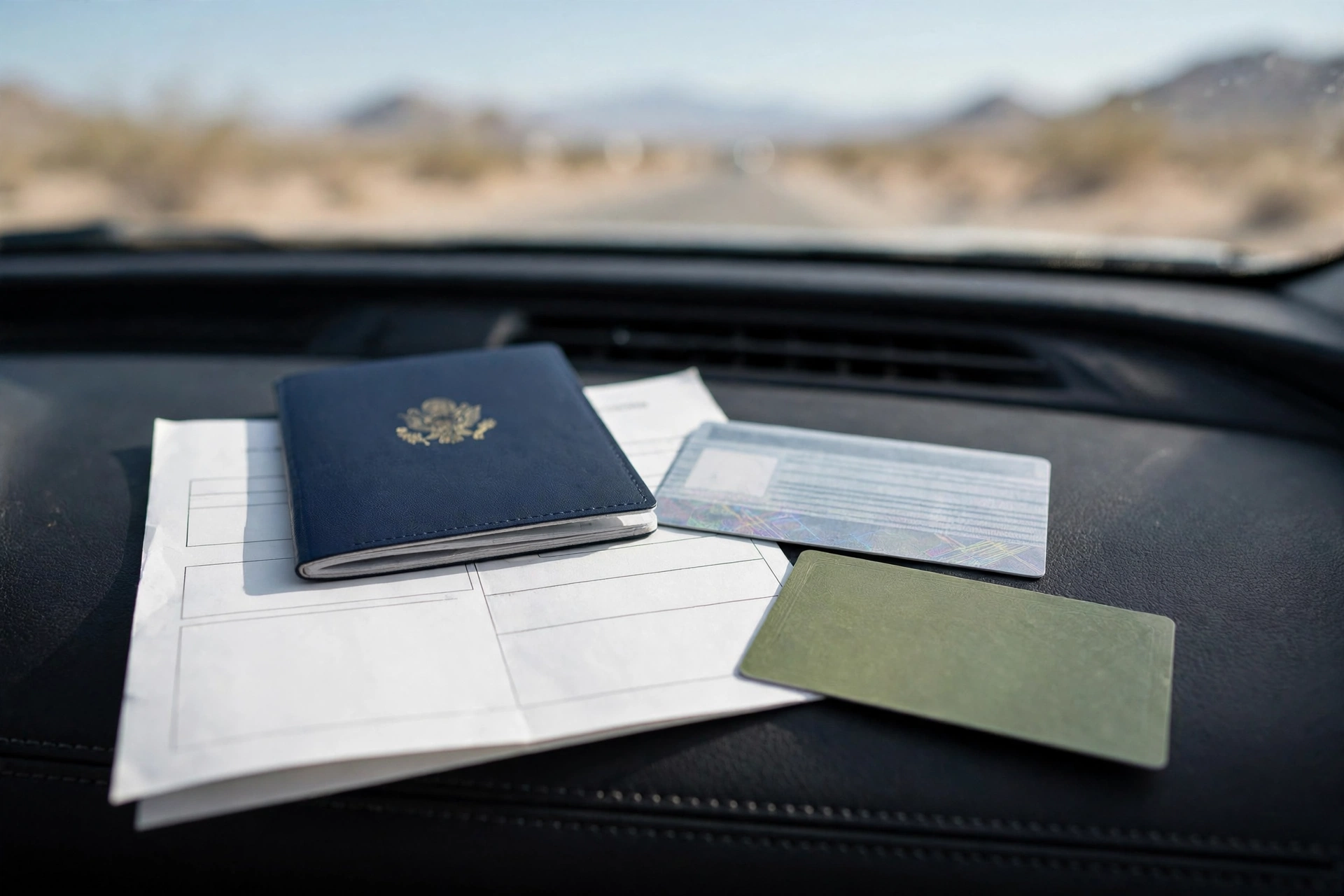
The Orange Card is the single most misunderstood document in Gulf road travel, so it deserves its own section. Its proper name is the Arab Orange Insurance Card. It comes from a 1975 Arab Insurance Card convention, it is used across Arab League countries, and in the UAE the unified bureau role is performed by Abu Dhabi National Insurance Company. What it actually is, in plain language, is a certificate proving that your car carries valid third-party liability cover in the country you are driving into. It is not comprehensive insurance. It is not a magic pass. It is a third-party certificate, and that limitation is the whole point.
Here is what it does. If you have an accident in Oman and you damage someone else’s car or injure someone, the Orange Card is what makes sure the other party is compensated under Omani law. It is the bridge between your UAE policy and Omani law. Here is what it does not do: it does not pay one dirham towards repairing your own car. If you are at fault and your car is wrecked, the Orange Card does not help you. That is what the GCC extension rider on your own UAE policy is for, from section 2. If you remember one thing from this guide, remember that these two are different and you may need both.
How do you get one? Start with your own insurer, well before the trip. Many UAE comprehensive policies already include an Orange Card for Oman, sometimes free, and some insurers now issue it digitally — GIG Gulf, for example, lets policyholders download it through their portal. Ask your insurer directly: does my policy include an Orange Card for Oman, and can you issue it to me before I travel? If the answer is yes, print it and carry it. A digital copy on your phone is useful, but a printed copy in the glovebox is what a border officer wants to see.
If your policy does not include Oman, you can buy third-party cover at the border. Self-service kiosks at the crossings sell it, and the widely reported figure is around AED 105 to AED 106 for a five-day minimum. That is third-party cover only, and five days is the minimum you can buy. Treat that figure as a guide, not a price list — confirm it at the border, and remember that buying at the border means queuing twice: once for the insurance and once for the crossing. It also means that if the kiosk is out of order, or the queue is an hour long, your trip is already delayed before it has started. Buying in advance is better in every way.
One more Orange Card fact that surprises people: the card is about the car, not the driver. It is tied to the vehicle and the policy. If you change cars, you need a new card. If you borrow a car, the card has to match that car. Do not assume a card issued for one vehicle covers another.
And a warning about something we hear in the workshop more than we should: never drive into Oman hoping nobody will ask. Some crossings are quiet and some officers wave cars through quickly, and that is exactly how people end up driving uninsured in a foreign country. It works until the day it does not, and the day it does not is the day of an accident, when the absence of third-party cover turns a bad day into a legal and financial disaster. Sort the card before you leave. It is the cheapest part of the trip.
5. Saudi Arabia by road: get the eVisa first
Saudi Arabia does not do visa on arrival at the land border in the way Oman does, and this is the single biggest difference between the two trips. For Saudi, the visa comes first, before the car moves, before the hotel is booked, before anything else. If you arrive at Al Batha without a valid Saudi visa, you are turning around. There is no queue you can join to fix it there.
For UAE residents, the route is the Saudi tourist eVisa, applied for online through the official portal, ksavisa.sa. The widely reported terms are generous: a multiple-entry visa valid for one year, allowing stays of up to 90 days per visit. A single-entry visa typically allows a 30-day stay. The fee most guides quote is around SAR 535, roughly AED 525, for the multiple-entry visa, including the mandatory medical insurance; the single-entry figure quoted is around SAR 300. Treat those as reported figures, not official ones — check the live fee on ksavisa.sa when you apply, because the total includes the insurance element and it moves. Approval is usually fast, often within hours, but do not leave it to the day before travel. Apply at least a week ahead, and print the visa as well as saving it on your phone.
The eligibility conditions are straightforward but strict. Your passport must be valid for at least six months beyond your date of entry. Your UAE residence permit must usually be valid for at least three months beyond your entry date. GCC nationals do not need a visa at all and can travel on their ID or passport. Everyone else needs the eVisa in hand. If your residency is close to expiry, or your passport is, sort those first — a visa application will not fix an expiring passport.
Two Saudi-specific warnings that belong here. First, Makkah is a separate matter from the rest of the Kingdom. Entry to Makkah requires the right permit, and during the Hajj restricted period — from 1 Dhu al-Qi’dah to 14 Dhu al-Hijjah — visit visas, including tourist eVisas, do not allow entry to Makkah at all. If Makkah is part of your plan, check the Nusuk platform and the current Hajj permit rules before you travel, and do not rely on a tourist eVisa to get you in. Second, if your route passes through Saudi Arabia to reach somewhere else, such as Qatar or Bahrain, you need to confirm the transit rules for each leg separately. A visa that covers Saudi Arabia does not automatically cover the next border.
One more thing that saves time at the crossing itself: the UAE side at Al Ghuwaifat runs a Smart Land Border system that lets many motorists stay in their vehicles during immigration processing, provided the documents are correctly registered under the driver’s name. That only works if your documents are in order and match the driver. A mismatch — a car in someone else’s name, a visa under a different spelling, a missing document — pushes you out of the fast lane and into the manual queue, which is where trips lose hours. The system rewards preparation. Give it something clean to work with.
6. Manafith: Saudi Arabia does not use the Orange Card
This is the mistake that catches even experienced Oman drivers. They have done Hatta a dozen times, they know the Orange Card, and they assume Saudi Arabia works the same way. It does not. Saudi Arabia runs its own compulsory third-party motor insurance system, and it is called Manafith. The Orange Card is not used in Saudi Arabia, and an Orange Card will not satisfy a Saudi checkpoint.
Manafith is the Saudi system for third-party liability cover for foreign vehicles entering the Kingdom. It is compulsory, and it is what the Saudi side will ask for. The official route is the Manafith platform, manafeth.najm.sa, where you can buy the cover online before you travel. That is the route we recommend: buy it before you leave Dubai, print the confirmation, and carry it with the rest of the documents. Buying at the border is possible, but it is the same story as Oman — an extra queue, an extra delay, and a trip that starts with standing around instead of driving.
The same two-cover logic from section 2 applies here, and it applies even more sharply, because the distances are longer and the stakes are higher. Manafith is third-party cover. It pays for damage you cause to others. It does not repair your car. For your own car, you need the GCC extension rider on your UAE comprehensive policy, agreed with your insurer before you leave, covering Saudi Arabia specifically. Ask your insurer, in writing, whether your rider lists Saudi Arabia. A rider that covers Oman does not necessarily cover Saudi Arabia, and a rider that covers “the GCC” may have country exclusions in the fine print. Read the schedule. The schedule is the policy, not the sales brochure.
There is also a vehicle entry permit to think about. Saudi guidance for residents entering by land refers to a vehicle entry permit from the competent authority in their country or an authorised agent. We could not verify the exact current process for a UAE-registered private car from an official Saudi source at the time of writing, so we are not going to invent one here. Before you travel, check with the Saudi visa portal, the Visit Saudi help centre, or your insurer whether a separate vehicle entry permit applies to your trip. If your car is rented or financed, this matters even more — see the next section — because permission for the car and permission for the driver are two different things, and the border can ask for both.
Finally, keep your UAE insurance valid for the drive back. It sounds obvious, but policies expire, and a policy that expired while you were in Riyadh is a problem on the return leg too. Check the expiry date before you leave, and if it falls during the trip, renew it first. The same applies to your Mulkiya: a registration that expires mid-trip is a problem at both borders.
7. Driving a car you do not own: rentals, borrowed cars and bank loans
Most border problems we hear about do not involve the driver’s own car. They involve a car that belongs to someone else — a rental, a borrowed car, a company car, or a car that is still under a bank loan. If the car is not registered in your name, stop and read this section twice, because this is where trips actually fail.
Start with the simplest rule: if the car is not yours, you need written permission, and that permission needs to be in the right form. For Oman, the widely reported requirement is a No Objection Certificate from the registered owner, notarised and translated into Arabic, stating that the owner gives you permission to use the vehicle. It should include the car’s chassis number, the registration details, and your Emirates ID number. A casual note in English, or a WhatsApp message from the owner, is not this document. Get it done properly, in advance, by a notary. It costs far less than a wasted trip.
Rental cars are the highest-risk case of all. Many UAE rental agreements simply do not allow the car to leave the UAE, and some rental companies will tell you plainly that their cars stay in the Emirates. Others allow Oman but not Saudi Arabia, or allow cross-border travel only with written permission and an extra fee. Never assume. Read your rental agreement, then call the rental company and ask, in writing, whether this specific car may be driven into the country you are visiting. If the answer is no, no document you carry will fix it — the car itself is not permitted to cross, and the border system may know that before you do. If the answer is yes, get the permission letter from the rental company and carry it with the rental agreement. Some companies also require you to take their own cross-border insurance, which is a separate matter from your own cover.
Bank-financed cars need attention too. If your car is under a mortgage or bank loan, the bank is a party to the trip whether you think about it or not. You will typically need a no-objection letter from the finance company, and for Dubai-registered cars there is a further step that many residents have never heard of: the RTA’s Certificate to Use the Vehicle Outside the UAE for Tourism Purposes. This applies to residents driving a Dubai-registered vehicle out of the country for tourism. UAE citizens travelling to GCC countries are exempt, but residents are not. The widely reported fee is AED 120 for a light vehicle — AED 100 plus AED 20 in knowledge and innovation fees — and the certificate is valid for six months. Before you can apply, you need a no-objection certificate from the Automobile and Touring Club of the UAE, which is the body that handles the Carnet de Passage process; one traveller’s account puts the club’s processing fee at AED 420. You then apply through the RTA app or website, under your vehicles, using the vehicle owner’s account, and any outstanding traffic fines on the vehicle must be settled first.
We should be honest about this certificate: enforcement at the border appears to vary, and at least one experienced traveller reports never having been asked for it when driving a fully owned car. That does not make it optional. The RTA’s position is that residents should hold it, and a document you hold and are never asked for costs you an afternoon of admin. A document you do not hold and are asked for costs you the trip. Get it, and get it early, because the club NOC step takes time and cannot be done the night before.
There is also a change coming that every cross-border driver should know about. Cabinet Decision 174 of 2026 sets out new federal traffic rules taking effect from 1 January 2027. The official reporting so far has focused on vehicle registration — including a planned five-vehicle limit per resident, which the Ministry of Interior postponed in November 2026 pending review — and some guides have also reported new requirements for taking a vehicle out of the UAE, including a customs carnet. That cross-border detail is not confirmed in the official announcements we could verify, so treat it as unconfirmed for now. If you are travelling in early 2027, check with your licensing authority — RTA for Dubai plates, the relevant authority for other emirates — before you travel, because this article was written before the new rules took effect and the detail at the border may still be settling. For other emirates, by the way, the RTA certificate does not apply at all: vehicles registered outside Dubai need to ask their own licensing authority, or the Ministry of Foreign Affairs, about the equivalent document.
Finally, a practical point about names. Every document for the trip should show the same name, spelled the same way, for the same person. Passport, Emirates ID, licence, visa, insurance, NOC — if one of them spells your name differently, or uses a different version of it, fix it before you travel. Border systems match names exactly, and a mismatch that looks trivial to you looks like a different person to a computer.
8. What actually happens at the border
Knowing the documents is one thing. Knowing the order of events is another, and it is what stops the border from feeling chaotic. Here is how a typical crossing works, for both Oman and Saudi Arabia, and what to expect at each step.
For Oman, the main crossings from the UAE are Hatta–Al Wajajah on the E44 towards Muscat, Mezyad south of Al Ain towards Buraimi and inner Oman, Khatmat Malaha on the Fujairah coast road, the Dibba crossing, and Al Darah in Ras Al Khaimah for Khasab and Musandam. A newer crossing, Wam, began operating at Dibba Al Fujairah in February 2025. Choose your crossing by your destination, not by habit: Hatta is the natural choice for Muscat and Sohar, Mezyad for Buraimi, and Al Darah for the Musandam peninsula. Check that your chosen crossing is open to tourists before you set off, because not every post handles every kind of traffic, and a crossing that handles goods is not necessarily the one for your family car.
At the UAE exit post, you present your passport and Emirates ID, and you pay the UAE exit fee. The figure every major guide quotes is AED 35 per traveller — Gulf News, Khaleej Times and The National all give the same number — though at least one guide describes it as per vehicle, so treat the per-traveller figure as the one to budget for and confirm it at the post. GCC citizens are typically exempt from this fee. Then the car is checked: Mulkiya, and any NOC or tourism certificate that applies to your situation.
On the Oman side, you present your passport and your visa position — visa on arrival, eVisa, or GCC-citizen exemption — and the vehicle’s documents and insurance. This is where the Orange Card, or the border-bought third-party cover, is shown. Officers may inspect the car, and they may ask about what you are carrying. Answer plainly and keep the documents in one folder, in the order you expect to need them, so you are not digging through bags at the window.
For Saudi Arabia, the sequence is similar but the posts are bigger and the queues can be longer. The crossing is Al Ghuwaifat on the UAE side and Al Batha on the Saudi side, on the E11. The border operates around the clock. On the Saudi side, expect passport control, visa verification, and a vehicle document inspection. Have your eVisa printed, your Manafith cover printed, your Mulkiya, your licence and your IDP ready, and any NOC or finance letter that applies. If you are carrying medication, commercial goods, or anything that might attract a customs question, declare it. A border post is not the place for surprises in either direction.
A few practical border tips that apply to both crossings. Travel early. The posts are quietest in the early morning, and they get busy around weekends, public holidays and the start of school breaks. Thursday evenings and Friday mornings are the worst times to cross into Oman. Take cash in small notes, in both currencies, because card machines at border posts are not something to rely on. Keep fuel in mind: since late October 2026, petrol stations within 50 kilometres of Oman’s border crossings have been reported to sell a maximum of 30 litres per fill-up, so fill up properly before you get near the border rather than planning to fill up at the last station. And keep your phone charged, with the insurer’s number, your hotel’s number, and the relevant emergency numbers saved before you leave Dubai — Oman’s police emergency number is widely published as 9999, and Saudi Arabia’s unified emergency number as 911, with 993 for traffic. Save them now, not when you need them.
Most crossings, done properly, take under an hour. The ones that take four hours are almost always the ones where a document was missing, a name did not match, or an insurance question had no answer. The border is not trying to ruin your trip. It is checking the things this guide has just told you to prepare. Do the preparation and the border becomes a formality.
9. Long-drive car prep: the checks that matter before 450 or 1,000 km
Here is the part of the guide that belongs to us, because this is what we see every week in the workshop: cars that are fine for the school run and the mall, and not fine for a thousand kilometres of highway in the heat. A car that does short trips in Dubai can hide a surprising number of weaknesses. A long drive finds all of them, usually at the worst possible moment, usually a long way from help. A proper check before you leave is not over-cautious. It is the cheapest insurance on the whole trip, and it costs far less than a recovery truck in another country.
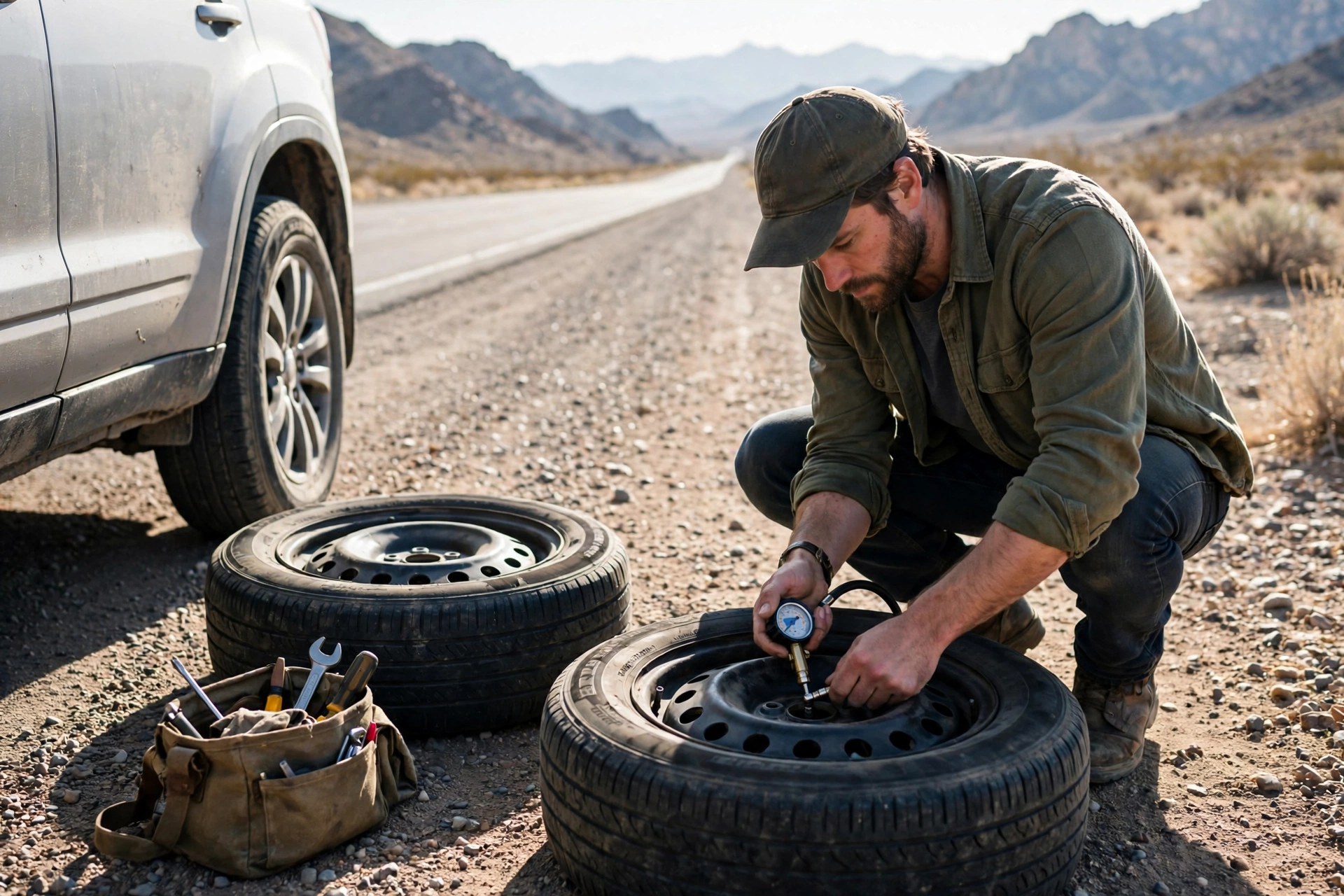
Start with the tyres, because they are the single most common cause of trouble on a long drive, and the easiest to check. Look at all four, plus the spare. Check the tread depth and the sidewalls for cracks, bulges and cuts — Gulf heat ages rubber, and a tyre that looks fine at a glance can be perished on the sidewall. Check the pressures when the tyres are cold, against the figure on the driver’s door jamb or in the owner’s manual, not against a number you remember from somewhere. Set them for a loaded car if you are travelling with passengers and luggage, because the correct pressure changes with load. And check the spare properly: is it actually there, is it inflated, and do you have the jack and the wheel brace to fit it? A spare with no air in it is not a spare. It is luggage. If any tyre is more than five years old, or the tread is close to the limit, replace it before the trip, not after it fails. Our guide to pre-purchase car inspection in Dubai covers the same tyre and underbody checks we do before a car changes hands — they are the same checks that matter before a car crosses a border.
Next, the cooling system. This is the one that ends trips in summer. The engine will run at full load for hours, the air conditioning will be running at full load for hours, and the outside temperature will be doing neither of you any favours. Check the coolant level in the reservoir when the engine is cold, and look for leaks around hoses, the radiator and the water pump. If the coolant is brown or rusty, or the level keeps dropping, get it looked at before you leave. A car that runs a little hot in Dubai traffic will run properly hot on a long climb in Oman, and an overheated engine in the mountains is a recovery job, not a roadside fix.
Then the fluids, all of them: engine oil, brake fluid, power steering fluid, windscreen washer fluid, and coolant again. Top up what is low, and if the engine oil is due, change it before the trip rather than during it. While you are under the bonnet, look at the drive belt for cracks and fraying, and listen for the cold-start rattle that can mean a timing chain tensioner is tired. A belt or chain failure on a long drive is not a minor inconvenience — on most modern engines it is a ruined engine. If you are not sure whether your car has a belt or a chain, or when it was last changed, our guide to timing belt vs timing chain in the UAE explains the difference, the intervals, and the warning signs to listen for.
Brakes and battery come next. The brakes need to stop a loaded car, repeatedly, on long descents — mountain roads in Oman have descents that will find weak brakes very quickly. If the pedal feels soft, if there is a squeal or a grind, or if the car pulls to one side under braking, get it checked. The battery needs to start a hot engine, run the air conditioning at idle in a border queue, and keep doing it all day. Heat kills batteries in the Gulf, and a battery that is three or four years old owes you nothing. If it is slow to crank, replace it before the trip. A dead battery at a border post is a miserable way to spend an afternoon.
Finally, the small things that become big things on a long drive: lights, wipers, air conditioning, and the spare key. Check every light, including the brake lights and indicators, because you will be driving in the dark at some point on a long trip. Check the wipers and the washer jets — a dirty windscreen at sunset on a desert highway is genuinely dangerous. Make sure the air conditioning blows properly cold at idle, not just at speed, because border queues happen at idle. And take the spare key. Losing your only key in Muscat or Riyadh is a problem that no roadside kit can solve.
If all of that sounds like a lot, it is a morning’s work for a proper workshop, and it is exactly the kind of check we do at 95 Services before a customer takes a car on a long drive. We are mobile, we are open 24 hours, and we come to you anywhere in the UAE — so the check can happen in your driveway the evening before you leave, not in a queue at a workshop. Call or WhatsApp us on +971 54 344 3513 and tell us you are driving to Oman or Saudi Arabia. We know what to look for. Our car repair and maintenance services cover the full pre-trip check, and our prices are very low — the check costs far less than a single night in a hotel you did not plan to stay in.
10. Desert and highway driving: heat, sand and long empty stretches
The driving itself is straightforward for most of both routes. The roads are good, the signage is clear, and the highways are well maintained. What is different from driving in Dubai is the emptiness: long stretches with nothing in them, fewer petrol stations than you expect, and conditions that change faster than they do in the city. A few habits make the difference.
Fuel first. Never let the tank drop below half on a cross-border drive. Fill up in Dubai before you leave, fill up at every sensible opportunity, and never pass a petrol station in a remote stretch thinking the next one will be closer. In Oman, remember the reported 30-litre limit near the border crossings, and plan your fuel stops around it. In Saudi Arabia, the distances between stations on the highway are long, and the desert sections have fewer of them than the map suggests. Half a tank is your new empty.
Speed limits deserve respect, and not only because of fines. Saudi highways are posted at 120 to 140 km/h in places, and Omani highways have their own limits, but the safe speed is the one that matches the road, the load and the light. A fully loaded car with a roof box does not handle like an empty one. Slow down for crosswinds on exposed desert sections, and slow down more when you see sand drifting across the road — it is slippery, it hides the lane markings, and it can build up into a drift faster than you expect. If you are heading into the desert proper rather than staying on the highway, read our guide to preparing a 4×4 for the desert season in the UAE first. The tyre pressures, the recovery gear and the driving technique for sand are a different subject from highway driving, and they matter the moment you leave the tarmac.
Watch for animals. Camels cross desert roads, and they do it without warning, at dusk and at dawn, when the light is worst. A camel is not a small hazard. It is a very large one, and hitting one at highway speed is a serious accident. Slow down in areas with camel warning signs, and be especially careful in the hour after sunrise and the hour before sunset. The same goes for goats and sheep near villages, and for trucks that pull out slowly on two-lane roads.
Take breaks properly. On a 1,000-kilometre drive, tiredness is a bigger risk than any mechanical problem. Stop every two hours, even if you feel fine. Swap drivers if you can. Drink water — the air conditioning dries you out, and you will not notice how dehydrated you are until your concentration is already gone. And keep your phone charged and your location shared with someone at home. On the emptier stretches, phone signal comes and goes, so download offline maps before you leave and do not rely on live navigation alone.
Finally, drive in daylight where you can. The desert at night is beautiful and also unforgiving: unlit roads, animals, and long distances between help. If you must drive at night, make sure your lights and wipers are in perfect order, keep your speed down, and never drive tired. A hotel stop is always cheaper than an accident.
11. If the car breaks down across the border
Even a well-prepared car can break down, and when it happens in another country the rules are different from the ones at home. The most important thing to know is that your UAE roadside assistance does not automatically follow you across the border. Our 15 to 20 minute response time, and our service across the complete UAE, apply inside the Emirates. Once you are in Oman or Saudi Arabia, you are relying on your insurer’s cross-border arrangements, the local police, and whatever cover you arranged before you left. That is why the phone calls in section 2 matter so much: the time to discover what your insurer does abroad is before the trip, not on the hard shoulder.
If the car fails, the first job is the same everywhere: get everyone safe. Pull as far off the road as you can, switch on the hazard lights, put out the warning triangle, and get passengers — especially children — away from the traffic, behind a barrier if there is one. In the heat, shade and water matter immediately. Do not stand on the traffic side of the car, and do not try to fix anything that involves getting under the vehicle on a soft shoulder.
Then call, in this order: the local police or traffic number if anyone is hurt or the car is blocking the road; your insurer’s cross-border assistance number, which you saved before you left; and your hotel or your contact in the country, who may know a local workshop. Have your policy number, your location, and your passport and vehicle details ready before you call, because every one of those calls will ask for them. If you have an accident rather than a breakdown, the rules are stricter: do not move the vehicles until the police have seen them, do not admit fault at the roadside, take photographs of everything, and get the police report number. Your Orange Card or Manafith cover is what the other party’s claim will run through, and the police report is the document that makes the claim work.
Recovery across a border is slow and expensive, and it is the part of the trip nobody budgets for. A recovery truck that has to bring your car back into the UAE involves two countries’ paperwork, and it does not happen in an afternoon. If the car cannot be fixed locally, you may be looking at days, not hours, and a hotel bill you did not plan for. That is not a reason to avoid the trip. It is a reason to do the preparation in section 9 properly, to carry the emergency kit in the next section, and to make sure your insurance includes repatriation or cross-border recovery before you leave. Ask your insurer that exact question: if my car cannot be repaired where it breaks down, what happens, and who pays? If the answer is silence, you do not have the cover you think you have.
One last point, and it is a practical one. Keep every receipt, every police report, every workshop invoice, and every message from your insurer. Claims across borders run on paperwork, and the claim you can prove is the claim that gets paid. Photograph every document as well as keeping the original, and send copies to your own email the same day so that a lost folder does not become a lost claim.
12. What to pack: the emergency kit that fits in the boot

A proper emergency kit is not a big production. It is one bag in the boot, and it turns a bad hour into a manageable one. Here is what should be in it, and why.
The car itself first: a properly inflated spare tyre, a jack that works, a wheel brace, and a torch with fresh batteries. A tyre pressure gauge and a small portable compressor are worth their weight on a long drive, because a slow puncture found early is a ten-minute fix and a slow puncture found late is a shredded tyre. Jump leads, because a flat battery in a border queue is common enough to plan for. A litre of engine oil and a litre of coolant, in sealed bottles, because topping up is easy and running dry is not. A roll of duct tape and a few cable ties, because temporary fixes hold longer than you think.
Then the people: drinking water, more than you think you need — at least a few litres per person, because the heat does not negotiate. A first-aid kit with plasters, bandages, antiseptic and any regular medication anyone in the car takes. Sunscreen and hats, because a breakdown in the sun without them is miserable within minutes. Snacks that do not melt. A phone charger that works from the car’s socket, and a power bank as well. And the warning triangle, which is not optional equipment in most countries and is the single cheapest safety device you own.
Then the paperwork, in one waterproof folder: passports, Emirates IDs, licences, IDPs, Mulkiya, insurance papers, Orange Card or Manafith confirmation, NOC or tourism certificate, visa printouts, hotel booking, and the insurer’s cross-border number written on paper as well as saved in your phone. A phone with a dead battery should not mean a trip with no documents.
Pack the kit the night before, not the morning you leave. Check the spare’s pressure, check the torch batteries, and put the folder where you can reach it without emptying the boot at the border window. The kit you can reach is the kit that works.
Frequently asked questions
Do I need an Orange Card to drive from Dubai to Oman?
Yes. You need motor insurance that is valid in Oman, and for most UAE drivers that means an Orange Card, which is third-party cover for Oman. Many UAE comprehensive policies already include one — ask your insurer before the trip. If yours does not, third-party cover is widely reported to be available at border kiosks for around AED 105 to AED 106 for a five-day minimum, but confirm the current figure at the border. Remember that the Orange Card does not repair your own car; for that you need a GCC extension rider on your UAE policy.
Can I drive a rental car from Dubai to Oman or Saudi Arabia?
Only with the rental company’s written permission, and many rental agreements do not allow the car to leave the UAE at all. Some companies allow Oman but not Saudi Arabia. Read your agreement, ask the company in writing, and carry their permission letter with the rental agreement. Never assume a rental car can cross a border.
Do UAE residents need a visa for Oman?
GCC citizens do not need a visa. UAE residents of other nationalities can usually get a visa on arrival at the border — widely reported at 5 Omani rials, roughly AED 48, for a 14-day stay — provided their nationality and the profession on their Emirates ID are eligible. For longer stays, or if you are unsure about eligibility, apply for an eVisa in advance through the Royal Oman Police eVisa portal, evisa.rop.gov.om. Check your own eligibility before you travel.
What insurance do I need to drive to Saudi Arabia?
Saudi Arabia does not use the Orange Card. You need Saudi third-party cover through the official Manafith system, ideally bought online through manafeth.najm.sa before you travel, plus a GCC extension rider on your UAE comprehensive policy to cover damage to your own car. Your UAE policy on its own does not cover you in Saudi Arabia. You also need a Saudi eVisa, applied for in advance through ksavisa.sa.
Do I need an International Driving Permit for Oman or Saudi Arabia?
The UAE government portal u.ae says UAE citizens and residents who intend to drive in a foreign country are required to apply for an International Driving Permit while still in the UAE. It is valid for one year, it is a translation of your licence rather than a replacement, and you apply through the Automobile and Touring Club of the UAE, the RTA, Emirates Post or the Ministry of Interior app. Carry it together with your UAE licence.
What should I check on my car before a Dubai to Oman or Saudi road trip?
Tyres including the spare and its pressure, the cooling system and coolant level, all fluids, the drive belt and the timing belt or chain, brakes, battery, lights, wipers and air conditioning. A car that is fine for short trips in Dubai can hide weaknesses that a 450 or 1,000-kilometre drive in the heat will find. Get a proper pre-trip check the day before you leave — it costs far less than a recovery in another country.
The trip is worth it — do the boring parts first
Oman and Saudi Arabia are two of the best road trips you can do from Dubai. The mountains past Hatta, the coast road to Khasab, the long empty highway to Riyadh — none of that needs selling. What needs saying, one more time, is that the trip is decided before you leave, in the glovebox and under the bonnet. Documents, insurance, a car you trust. Get those three right and the border is a formality, the drive is a pleasure, and the only thing you will remember is the road.
So do the boring parts first. Check the passports. Call the insurer and ask the two questions from section 2. Get the NOC or the tourism certificate if your car needs one. Apply for the eVisa early if you are going to Saudi Arabia. And get the car checked by someone who knows what a long drive does to a car.
That last part is what we do. At 95 Services, we come to you anywhere in the UAE, we are open 24 hours, and our response time is 15 to 20 minutes. Tell us you are driving to Oman or Saudi Arabia and we will do the full pre-trip check — tyres, cooling, fluids, belts, brakes, battery, lights — in your driveway, the evening before you leave. Our prices are very low, and the check costs far less than a single night in a hotel you did not plan to stay in. Call or WhatsApp us on +971 54 344 3513, or message us on WhatsApp at +971 54 344 3513, and we will get your car ready for the road. Then go and enjoy the drive. That is the whole point.
