
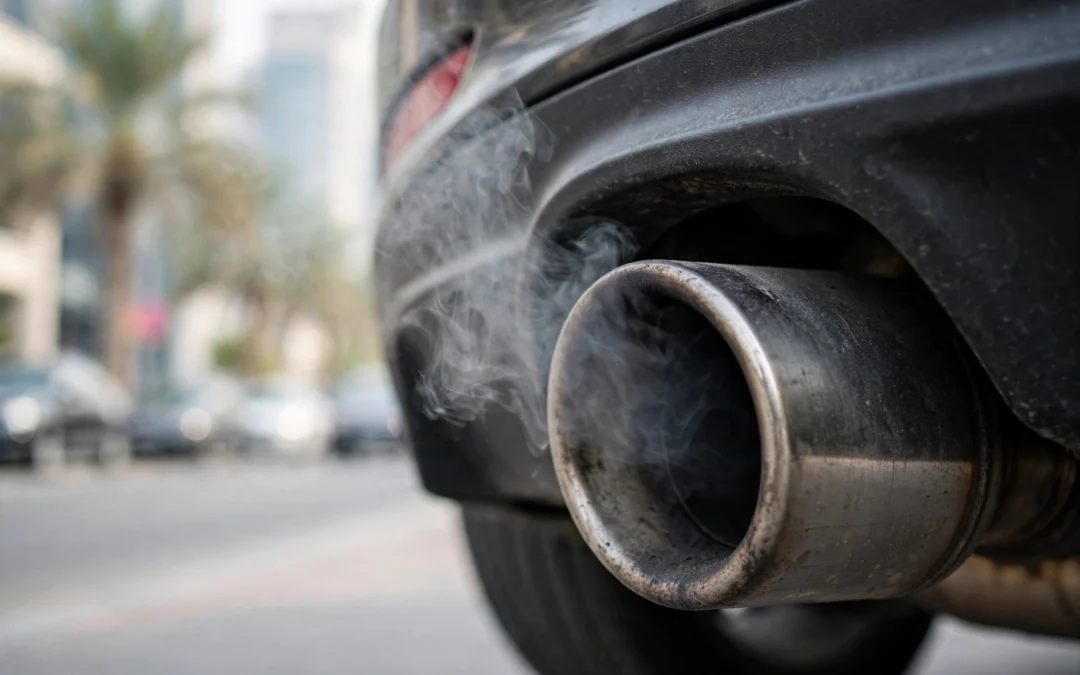
Your exhaust is the most honest part of your car. It cannot hide what is happening inside the engine: if coolant is getting into the cylinders, if oil is being burned, if the fuel mixture is wrong, the tailpipe shows it — in colour. A healthy engine’s exhaust is colourless, essentially invisible. When it turns white, blue or black, the colour is a clue, and each colour points in a different direction. Learning to read it is one of the most useful things a driver can do, because the colour tells you how urgent the problem is, what kind of repair you are looking at, and whether you should keep driving or stop.
The three colours have three different meanings, and confusing them is the most common mistake. White smoke usually means water — either harmless condensation, or coolant leaking into the combustion chamber, which is one of the most serious faults a car can have. Blue smoke means oil is being burned, and the question is where it is getting in. Black smoke means too much fuel and not enough air — the engine is running rich, and the fault is usually in the fuel system or the sensors, not in the engine itself. And grey smoke sits between blue and black, and needs testing to tell which one it is.
This guide explains all four colours, what causes each one, how to tell the harmless smoke from the serious smoke, what to check before you call a workshop, how a proper diagnosis works, and when to stop driving immediately. It is written for drivers in Dubai and across the UAE — where the heat, the dust and the stop-start traffic all change how these faults show up — and where a smoking exhaust can also mean a failed RTA test. If your car has started smoking, the colour is your first clue. This guide is the rest of the story.
The one rule to remember: thin white vapour that disappears as the engine warms up is normal. Thick white smoke that stays, especially with a sweet smell or a rising temperature gauge, is not — stop the car and get it checked.
1. What a Healthy Exhaust Looks Like
A petrol engine in good running condition should not produce any visible smoke in its exhaust. The exhaust gases are colourless, and on a warm day you should see nothing at all coming out of the tailpipe. That is the baseline, and anything you can see after the engine has warmed up is a sign that something is entering the combustion chamber that should not be there — coolant, oil, or too much fuel.
There is one exception, and it matters, because it is the exception that stops people from panicking over nothing. On a cold start, especially on a cool morning, a thin white vapour from the tailpipe is normal. It is water vapour: combustion produces water, and the moisture condenses in the cold exhaust system, then burns off as the pipes warm up. It is thin, it has no smell, and it disappears within a few minutes as the engine reaches normal temperature. A few puffs of blue smoke on the first start after the car has sat for several days can also be normal, and should quickly disappear. But if the smoke is still there after the engine is warm, or if it is thick, or if it has a smell, it is not condensation. It is a fault, and the colour tells you which one.
The other thing to know is that the colour is a clue, not a diagnosis. The same colour can have more than one cause, and two different faults can produce the same colour. A workshop does not diagnose from the colour alone — it uses scan data, pressure tests and compression tests to find the cause, and the colour tells it where to start looking. What the colour does for you, as the driver, is tell you how urgent it is, and what to check first. That is what the next four sections do: white, blue, black and grey, one at a time.
Your nose is the second diagnostic tool, and it is worth using. Exhaust smoke has a smell, and each kind of smoke smells different: coolant smoke smells sweet, oil smoke smells like burnt oil, and unburned fuel smells like raw petrol. The smell is often easier to identify than the colour, because colours shift in sunlight and smoke looks different against different backgrounds, while the smell does not change. If you can smell the smoke from the driver’s seat, or if the cars behind you are pulling back from it, the smell is telling you something. Sweet means coolant and the car should stop. Burnt oil means oil, and the oil level needs checking. Raw fuel means the mixture is rich, and the fuel system needs looking at. Colour and smell together are a far better clue than either one alone — and when you call a workshop, the smell is one of the first things they will ask about.
2. White Smoke: Condensation, or Coolant Where It Should Not Be
White smoke is the colour that causes the most confusion, because it has two completely different meanings, and the difference between them is the difference between nothing and a ruined engine. Thin white vapour on a cold start, which disappears as the engine warms, is condensation — water vapour from combustion, condensing in a cold exhaust. It is normal, it has no smell, and it goes away in a few minutes. Thick white smoke that stays after the engine is warm is a different thing entirely: it usually means coolant is leaking into the combustion chamber and being burned, and it is one of the most serious faults a car can have.
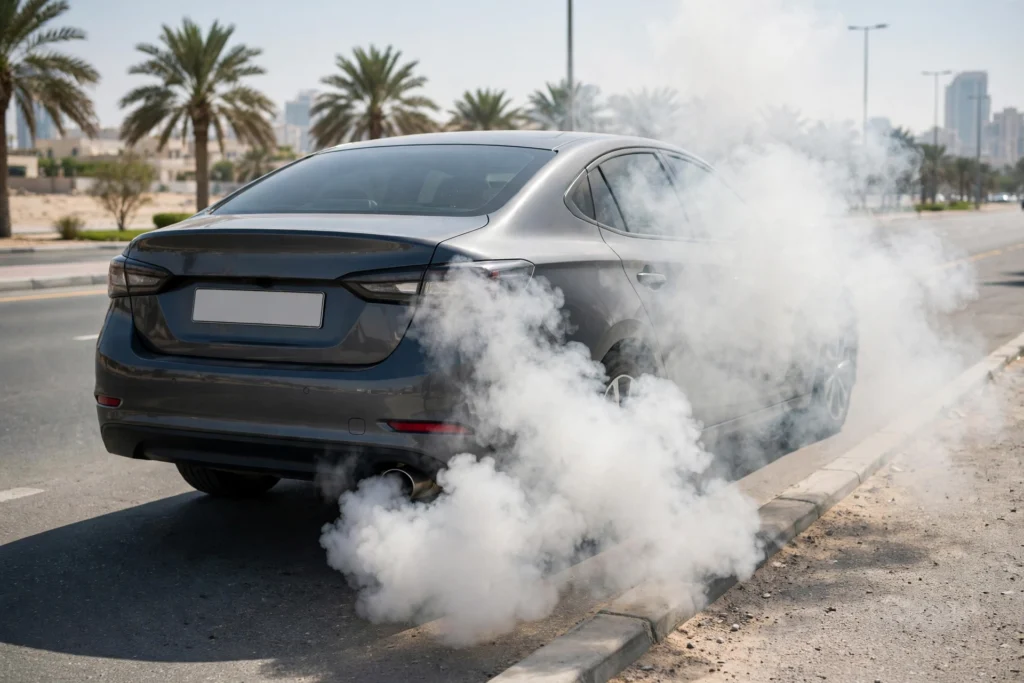 Coolant gets into the combustion chamber when the seal between the cylinder head and the engine block fails — a blown head gasket — or when there is a crack in the cylinder head or the engine block, or a failed intake manifold seal. The head gasket is the seal that keeps coolant, oil and combustion gases separate, and when it fails, coolant leaks into the cylinders, burns off, and comes out of the tailpipe as thick white smoke. The smoke has a distinct sweet smell, which is the most reliable way to tell it apart from condensation: condensation has no smell, coolant smoke smells sweet. There will be other signs, too. The coolant level in the reservoir will be dropping, with no visible leak underneath the car — because the coolant is not leaking out, it is being burned inside. The engine will tend to overheat, because the cooling system is losing coolant and losing its ability to cool the engine. And if coolant is mixing with the oil, the oil on the dipstick will look milky or frothy. Our losing coolant guide covers the coolant-loss side of this in detail, and our engine overheating guide covers what happens when the cooling system cannot keep up.
If you see thick white smoke, stop driving as soon as it is safe to do so. Continuing to drive with a coolant leak can lead to the engine overheating, and in some cases to coolant mixing with the engine oil — which damages the bearings and can destroy the engine. Shut the engine off, check the coolant level (only when the engine is cold — never open the coolant cap on a hot engine), and look at the oil on the dipstick. If the oil is milky, or the coolant is low, or the temperature gauge is climbing, do not drive on. Call for recovery. And if the head gasket has failed, our cylinder head repair guide explains what that repair involves, because a blown head gasket usually means the cylinder head comes off. There is one more cause of white smoke worth knowing: on some cars, automatic transmission fluid can be sucked into the engine through a vacuum hose from the transmission, and it burns as white smoke that smells like burnt oil rather than sweet. It is less common, but a workshop will check for it if the head gasket tests come back clear.
3. Blue Smoke: Your Engine Is Burning Oil
Blue smoke — or blue-grey smoke — means engine oil is being burned in the combustion chamber. All engines consume a small amount of oil, but when the smoke is visible and blue, the engine is burning more than it should, and something is letting oil in. The most common causes are worn piston rings, worn or damaged valve-stem seals, worn cylinder walls, a leaking turbocharger seal on a turbocharged car, or a PCV valve that is stuck closed and letting crankcase pressure push oil past the seals. Overfilling the oil can also cause blue smoke, and it is the first thing to check, because it is the easiest to fix: if the oil level is above the maximum mark on the dipstick, the excess oil gets pushed into the combustion chamber.
 When the smoke appears tells you where the oil is coming from, and this is the most useful diagnostic detail a driver can give a workshop. Blue smoke on start-up, which clears after a few seconds, points at the valve-stem seals: oil has seeped past the seals while the engine was sitting, and it burns off on the first start. Blue smoke under acceleration points deeper — at the piston rings, or at the turbocharger on a turbo car. Blue smoke on deceleration, when you lift off the throttle going downhill, also points at the valve seals and guides. And blue smoke all the time, under every condition, usually means the rings or the cylinder walls are worn, and the engine is burning oil continuously. Note these details before you call a workshop: when the smoke appears, how much there is, and whether the oil level is dropping. They shorten the diagnosis considerably.
Blue smoke has a smell, too — a foul, burnt-oil smell that the cars behind you will notice before you do. If you are following a car that is burning oil, you will know it: the smell gets into your cabin, and you will be reaching for the air conditioning recirculation button. The smoke is not just a smell, though. Burning oil leaves deposits on the spark plugs and in the combustion chamber, it can foul the catalytic converter, and it means the engine is losing oil — so check the oil level regularly, and top it up with the correct grade if it is low. Our engine misfire guide covers the misfires that oil-fouled plugs can cause, and if your car is misfiring as well as smoking, the two are probably connected. Blue smoke is not usually a stop-the-car emergency in the way thick white smoke is, but it is not something to ignore either: an engine that is burning oil is an engine that is wearing, and the longer it goes, the worse it gets.
4. Black Smoke: Too Much Fuel, Not Enough Air
Black smoke means the engine is burning too much fuel — the air-to-fuel mixture is too rich, with too much fuel and not enough air. Unlike white and blue smoke, which point at the engine itself, black smoke usually means the engine is mechanically fine and the fault is in the fuel system or the sensors. The most common causes are a leaking or clogged fuel injector, a faulty fuel pressure regulator letting too much fuel into the system, a faulty MAF sensor or oxygen sensor sending the wrong information to the engine computer, a clogged air filter starving the engine of air, or an ignition fault that means the fuel is not being burned properly. On a car with a carburettor — rare now, but still seen on older cars — a stuck choke or a faulty float can do the same thing.
The signs are easy to spot. The smoke is black and sooty, and it is usually worst under acceleration, when the engine is being asked for more fuel. The inside of the tailpipe will be coated with heavy black carbon deposits — a quick look at the tailpipe tells you a lot, because a healthy tailpipe is clean, and a rich-running engine leaves it black. The car will use more fuel than it should, the engine may feel sluggish or hesitate, and the check engine light may come on. A brief puff of black smoke during hard acceleration can be normal, because the mixture goes momentarily rich — but under normal driving and at idle, the exhaust should be transparent. If black smoke is visible all the time, the engine has a rich fuel condition, and it needs diagnosing.
Black smoke is the least urgent of the three colours, but it is not harmless. The unburned fuel washes oil off the cylinder walls, which accelerates wear, and the soot builds up in the exhaust and the engine. It also means the car is failing its emissions — and in Dubai, that matters, because the RTA vehicle test includes an emissions check, and a car that is visibly smoking is a car that can fail. The fix is usually in the fuel system or the sensors, not in the engine, and a diagnostic scan will usually point at it quickly: the live data shows whether the fuel pressure is too high, whether an injector is leaking, or whether a sensor is reading wrong. Drive gently, schedule a diagnosis soon, and do not keep driving for weeks with black smoke — the fuel is going somewhere it should not, and the engine is paying for it.
5. Grey Smoke: The Ambiguous One
Grey smoke is the colour that does not fit neatly into the other three, and it is the one where the colour alone is least helpful. Grey smoke can be oil or incomplete combustion — it overlaps with both blue and black — and it needs testing to tell which one it is. Sometimes grey smoke is really blue smoke that looks grey in bright sunlight, or black smoke that looks grey when it is thin. Sometimes it is something else entirely: a failing turbocharger can produce grey smoke, and so can a problem with the PCV system, which is the system that vents pressure from the crankcase. If the PCV valve is stuck closed, crankcase pressure builds up and pushes oil past the seals, and the result can be grey smoke that looks like neither blue nor black.
The way to deal with grey smoke is to stop guessing from the colour and start checking the other signs. Check the oil level: if it is dropping, the smoke is probably oil. Check the tailpipe: if it is coated with black soot, the engine is running rich. Check the smell: burnt oil smells different from unburned fuel, and a workshop can tell the difference at once. And check when the smoke appears: on start-up, under acceleration, or all the time. All of these details help, but grey smoke is the colour where a proper diagnosis matters most — because the colour cannot tell you the answer, and the answer decides whether the repair is a sensor, a seal, or something bigger. A scan, a compression test and a look at the live data will tell you what the colour cannot.
6. Diesel Cars: Different Rules
If you drive a diesel, the smoke rules are different, and what is normal for a diesel would be a fault on a petrol car. Black smoke is normal for older diesel engines when they are first started or when they are accelerating hard — the engine is getting too much fuel for the air available, and the soot comes out of the tailpipe. But on a late-model diesel, there should be no black smoke under normal driving, and if the engine continues to produce black smoke, it is getting too much fuel: the cause may be incorrect injector timing, an injection control problem, a damaged air filter, the wrong grade of fuel, or a faulty fuel injection pump. The rule is the same as for petrol: a puff on hard acceleration is normal, persistent smoke is not.
White smoke on a diesel is also different. It can be unburned fuel passing through the engine, or it can be coolant — and if you see continuous white smoke while driving, the problem is likely incorrect injector timing or a loss of compression in one or more cylinders. Blue smoke on a diesel means the same thing as on a petrol car: engine oil is being burned, usually because of worn piston rings, valves or cylinders, or because the engine has been overfilled with oil. The diesel’s own complications — the injectors, the injection pump, the turbocharger — add their own causes, and a diesel that is smoking needs a diesel specialist’s diagnosis, not a guess from the colour. The colour still tells you where to start, but the diesel’s fuel system is a world of its own, and the scan data matters more than the smoke.
7. When to Stop Driving Immediately
Most exhaust smoke is a problem to schedule, not an emergency — but some of it is an emergency, and knowing the difference is the most important part of this guide. Stop driving and call for recovery if the smoke comes with any of these: the temperature gauge is climbing, or the engine is overheating; the oil pressure warning light has come on; there is fluid on the ground under the car; or the smoke is thick and white, with a sweet smell, and the coolant level is dropping. These are the signs that the engine is being damaged while it runs, and every minute you keep driving makes the repair bigger.
Thick white smoke is the one to take most seriously. If coolant is leaking into the combustion chamber, the engine is losing coolant and losing its ability to cool itself, and continuing to drive can lead to the engine overheating, to coolant mixing with the engine oil, and to damage to the bearings, the valves and the pistons. Shut the engine off, and do not restart it to see if the smoke goes away — it will not, and the restart can do more damage. The same applies if the oil pressure light is on: low oil pressure means the engine is not being lubricated, and driving with it on can destroy the engine in minutes. Pull over safely, turn the engine off, and call for recovery. Our car repair and maintenance page explains what a proper service covers, and our engine diagnostics page explains what a diagnostic check includes — but the first step, when the smoke is thick and white or the warning lights are on, is to stop the car.
Blue and black smoke are usually safe to drive with, gently, to a workshop — but gently is the operative word. Drive at low speed, avoid hard acceleration, and do not take the car on a long journey. Blue smoke means the engine is losing oil, so check the oil level before you drive, and top it up if it is low. Black smoke means the engine is running rich, so the fuel is washing oil off the cylinder walls, and the longer you drive, the more wear it causes. And if the smoke is so thick that the cars behind you cannot see, pull over: you are a hazard to other drivers, and a car that is smoking that heavily needs recovery, not a drive to the workshop.
8. What to Check Before You Call a Workshop
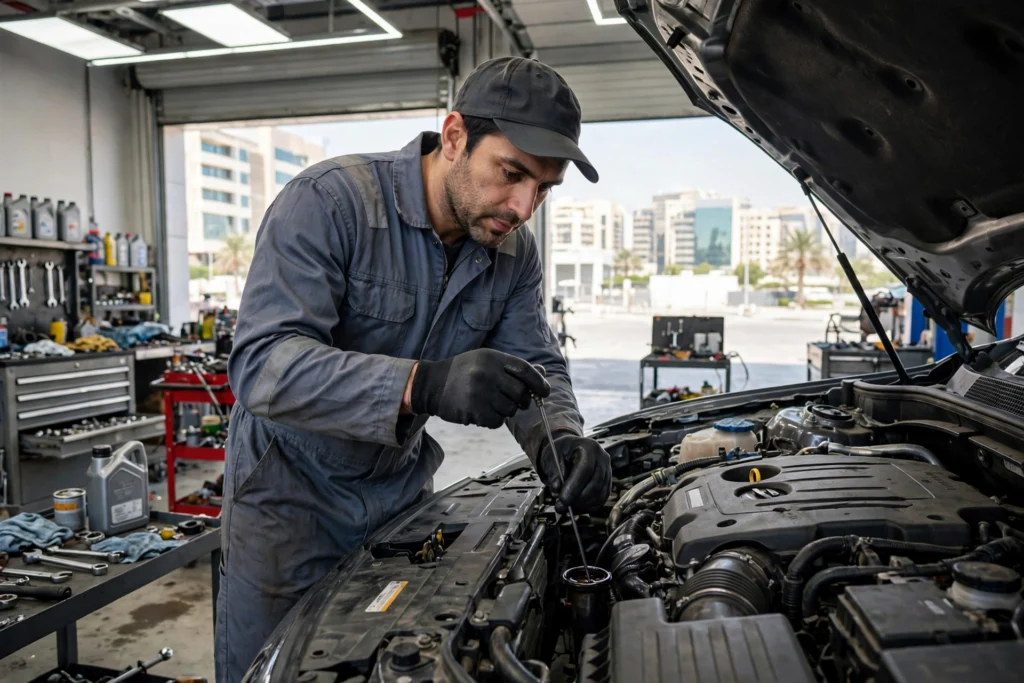
Before you call, spend five minutes checking the things a workshop will ask you about. They shorten the diagnosis considerably, and they can tell you whether you are looking at a small repair or a big one. First, check the coolant level — but only when the engine is cold, because opening the coolant cap on a hot engine is dangerous. If the coolant is low, and there is no leak under the car, the coolant is going somewhere inside the engine, and that points at the head gasket. Second, check the oil on the dipstick. If it looks milky or frothy, coolant is mixing with the oil, which is a sign of a head gasket failure. If the oil level is dropping, the engine is burning oil. If the oil is over the maximum mark, the engine may have been overfilled, and that alone can cause blue smoke.
Third, note when the smoke appears. Does it happen only on a cold start, or all the time? Only under acceleration, or at idle? Does it clear as the engine warms up, or does it get worse? Fourth, note the smell: sweet means coolant, burnt oil means oil, and raw fuel means unburned fuel. Fifth, look at the tailpipe: a clean tailpipe is normal, a tailpipe coated with black soot means the engine is running rich. And sixth, check whether the temperature gauge is normal, whether the check engine light is on, and whether the car is using more fuel than usual. Write these things down, or take a short video of the smoke — the colour, the thickness, and when it appears. A workshop that can see the smoke and hear the answers will diagnose it far faster than one that is guessing from a phone call, and a video is worth more than a description. Our fluid leak guide explains how to tell what a leak is by its colour and location, which helps if there is fluid on the ground as well as smoke from the tailpipe.
9. How a Workshop Diagnoses Exhaust Smoke
The colour is the clue, not the diagnosis. A proper diagnosis uses tests, and the tests are what separate a guess from a repair. The first step is usually a diagnostic scan: the scanner reads the fault codes and the live data, and it can show whether the fuel pressure is too high, whether an injector is leaking, whether a sensor is reading wrong, or whether the camshaft and crankshaft are out of step. For black smoke, the scan is often enough to point at the cause. For white and blue smoke, the tests go further.
 For white smoke, the key tests are a cooling-system pressure test and a combustion-gas test. The pressure test pressurises the cooling system and shows whether it holds pressure — if it does not, there is a leak somewhere. The combustion-gas test checks whether exhaust gases are present in the coolant, which means combustion gases are leaking into the cooling system through a failed head gasket. For blue smoke, the key tests are a compression test and a leak-down test: the compression test measures the pressure in each cylinder, and a low reading in one cylinder points at the rings or the valves; the leak-down test pressurises each cylinder and shows where the air is escaping — past the rings, past the valves, or into the cooling system. A borescope — a small camera put into the cylinder through the spark plug hole — can also show the condition of the cylinder walls and the piston. And for all colours, the oil and the coolant are checked: milky oil means coolant in the oil, low coolant with no external leak means coolant in the cylinders, and metal flakes in the oil mean the engine is shedding metal from the inside.
The point of all of this is that the repair depends on the cause, not the colour. White smoke from a failed head gasket is a cylinder head job. Blue smoke from worn valve seals is a different job from blue smoke from worn piston rings. Black smoke from a leaking injector is a different job from black smoke from a faulty sensor. The tests tell the workshop which one it is, and the quote follows from the tests — not from the colour. If a workshop quotes you a repair from the colour alone, without any tests, find one that tests first.
When you take the car in, ask the workshop what tests it will run before it quotes. A good answer names the tests: a scan with live data, a cooling-system pressure test or a combustion-gas test for white smoke, a compression test or a leak-down test for blue smoke, and a fuel pressure check for black smoke. Ask what the tests showed, and ask to see the numbers — the compression readings for each cylinder, the fuel pressure, the fault codes. A workshop that shows you its evidence is a workshop you can trust, and a workshop that will not show you its evidence is one to be careful about. Ask, too, whether the diagnosis fee is separate from the repair, and whether it is waived if you go ahead with the repair. And ask what else the tests found: a car that is smoking often has a second problem behind the first, and it is better to know about it before the repair starts than after it is finished.
10. The Fixes, and Why the Colour Decides the Bill
The repair follows the cause, and the causes are very different in size. Black smoke is usually the smallest repair: a leaking injector, a faulty fuel pressure regulator, a faulty MAF or oxygen sensor, or a clogged air filter. These are parts that can be replaced without opening the engine, and the job is a matter of hours. Blue smoke is a bigger job, and its size depends on where the oil is coming from: valve-stem seals can be replaced with the cylinder head in place on some engines, but worn piston rings mean the engine comes apart, and worn cylinder walls mean the engine needs machining. White smoke is usually the biggest job of all: a blown head gasket means the cylinder head comes off, and a cracked head or block means the engine needs a replacement head or a replacement engine. The colour, in other words, is a rough guide to the bill — black is usually the cheapest, blue is in the middle, and white is usually the most expensive — but the tests decide, and the quote should follow the tests.
There is one more thing the colour decides, and it is whether the car is worth repairing. A head gasket job on a car that is otherwise in good condition is worth doing. A ring job on a car with worn cylinder walls, high mileage and other problems may not be — and a workshop should tell you that honestly, rather than quoting a repair that costs more than the car is worth. Ask for the quote in writing, with the parts and the labour listed, and ask what else was found: a compression test that shows one low cylinder is a different story from a test that shows all cylinders low. And if the engine needs to come apart, ask whether the timing belt or chain should be done at the same time — because the labour to reach it is already being paid for, and it is the kind of job that is cheap to do while the engine is open and expensive to do later.
Prevention, as always, is cheaper than repair, and the three colours have three different preventions. Black smoke is prevented by regular servicing: a clean air filter, injectors that are looked after, and sensors that are replaced when they fail rather than ignored when the check engine light comes on. Blue smoke is prevented by the oil: regular changes with the correct grade, the level kept between the marks, and never overfilled. White smoke is prevented by the cooling system: coolant changed on schedule, hoses and the radiator cap checked, and the temperature gauge watched — because a head gasket usually fails after the engine has overheated, and the overheating is the warning that comes before the smoke. None of this is complicated, and all of it is cheaper than the repair it prevents. A car that is serviced on time, with the oil and the coolant looked after, is a car whose exhaust stays invisible — which is exactly how it should be.
11. Buying a Used Car: The Exhaust Check
If you are buying a used car in Dubai, the exhaust is one of the most important things to check, and one of the easiest. Insist on seeing a cold start: ask the seller not to start the car before you arrive, and watch the tailpipe for the first minute. Thin white vapour that disappears as the engine warms is normal. Thick white smoke that stays is a head gasket problem, and you should walk away — or at least, you should not pay the asking price for a car that needs a cylinder head job. Blue smoke on start-up that clears points at the valve seals. Blue smoke under acceleration points at the rings or the turbo. Black smoke under acceleration points at the fuel system. And a tailpipe coated with black soot tells you the engine has been running rich, whatever the seller says about its condition.
Ask the seller to rev the engine while you watch the tailpipe, and watch the smoke under acceleration as well as at idle. Check the oil on the dipstick: milky oil means coolant in the oil, and low oil means the engine is burning it. Check the coolant level: low coolant with no visible leak means the coolant is going inside the engine. And check the service history for oil changes, because a chain-driven engine with a full history of regular oil changes is a car that was looked after, and an engine with gaps in the history is a car whose internal wear is a question mark. Our pre-purchase inspection guide covers the exhaust check alongside everything else, and it is worth doing before you pay: a proper inspection includes the cold start, the diagnostic scan, and a look at the service history. And if the inspection finds smoke, use the report to negotiate — or to walk away. A smoking exhaust on a car you are about to buy is not a small problem. It is a repair that belongs in the price, or a reason not to buy the car at all.
12. Smoking Exhaust, the RTA Test, and What 95 Services Can Check
There is one more reason to take exhaust smoke seriously in the UAE, and it has nothing to do with the engine: the RTA vehicle test. The test includes an emissions check, and a car that is visibly smoking is a car that can fail it. A car that fails the test cannot be renewed, and it cannot be driven legally until it passes — which means a smoking exhaust is not just a repair, it is a deadline. Our RTA inspection checklist guide explains what the test covers, and the exhaust is part of it: if your car is due for its test, and it is smoking, get the smoke diagnosed before the test, not after it fails. A failed test means a second test, a second fee, and a car off the road in between.
If your car has started smoking, the check is quick. A workshop can look at the smoke, read the diagnostic codes, check the coolant and the oil, and run the pressure and compression tests that tell you what the cause is. Our engine repair and diagnostics page explains what a proper diagnostic check includes, and our car repair and maintenance page explains what a proper service covers. And if your car needs a diagnostic check, or a repair, call or WhatsApp 95 Services on +971 54 344 3513 — we come to you anywhere in the UAE, open 24 hours, and a mobile diagnostic before the problem gets worse is a lot easier than a recovery after it does.
Frequently Asked Questions
Is white smoke on start-up normal?
Thin white vapour on a cold start, which disappears within a few minutes as the engine warms up, is normal — it is water vapour from combustion, condensing in a cold exhaust. Thick white smoke that stays after the engine is warm, especially with a sweet smell or a dropping coolant level, is not normal: it usually means coolant is leaking into the combustion chamber, most often through a blown head gasket, and you should stop driving and get it checked.
What does blue smoke from the exhaust mean?
Blue or blue-grey smoke means the engine is burning oil. The most common causes are worn piston rings, worn valve-stem seals or guides, a leaking turbocharger seal on a turbo car, or a PCV valve that is stuck closed. When the smoke appears helps tell you where the oil is coming from: blue on start-up that clears points at the valve seals, blue under acceleration points at the rings or the turbo. Check the oil level, top it up if it is low, and get it diagnosed soon.
Can I drive with black smoke coming from the exhaust?
Usually, yes — gently, and to a workshop, not on a long journey. Black smoke means the engine is running rich, with too much fuel and not enough air, and the fault is usually in the fuel system or the sensors rather than the engine itself. Drive at low speed, avoid hard acceleration, and schedule a diagnosis soon. The unburned fuel washes oil off the cylinder walls and the soot builds up, so do not drive with it for weeks — and remember that a smoking car can fail the RTA emissions check.
Why does my car smoke only when I accelerate?
Smoke that appears under acceleration and clears at idle usually points at the parts that work hardest when the engine is under load. Blue smoke under acceleration points at the piston rings or the turbocharger. Black smoke under acceleration points at the fuel system — a leaking injector, too much fuel pressure, or a sensor reading wrong. A brief puff of black smoke on hard acceleration can be normal, but persistent smoke under acceleration is a fault, and it needs diagnosing.
Does exhaust smoke mean my engine is finished?
Not necessarily. Black smoke is usually a fuel system or sensor fault, and the engine itself is fine. Blue smoke from valve seals is a repair, not a death sentence. But thick white smoke from a blown head gasket, or blue smoke from worn rings and cylinder walls, can be a major repair — and on a high-mileage car with other problems, it can be a repair that costs more than the car is worth. The colour is the clue, the tests are the answer, and a proper diagnosis will tell you whether the car is worth repairing before you spend anything.
How much does it cost to fix exhaust smoke?
It depends entirely on the cause, and the colour is only a rough guide: black smoke is usually the cheapest to fix, because the fault is usually a sensor, an injector or a filter; blue smoke is in the middle, because it depends on whether the oil is coming past the seals or the rings; and white smoke is usually the most expensive, because a blown head gasket means the cylinder head comes off. No workshop can give you a real price from the colour alone — the quote should follow the diagnostic tests, and it should be in writing, with the parts and the labour listed, before any work starts.
Your exhaust is the most honest part of your car, and it is worth listening to. A healthy exhaust is invisible. Thin white vapour on a cold start is normal. Anything else — thick white smoke, blue smoke, black smoke, or grey smoke that will not go away — is a message from the engine, and the message is that something is getting into the combustion chamber that should not be there. Read the colour, check the coolant and the oil, note when the smoke appears, and get it diagnosed. And if your car needs a diagnostic check, call or WhatsApp 95 Services on +971 54 344 3513 — we come to you, anywhere in the UAE, open 24 hours.
